7.6 C
New York
Home Blog Page 912

New EU-funded project aims at reducing fuel consumption

0

The technology group Wärtsilä, together with a consortium of six other industry and academic partners, has been awarded EU funding for a major project aimed at reducing fuel consumption and lowering emission levels for shipping.

The SeaTech project consortium has been formed to develop two symbiotic ship engine and propulsion innovations that when combined, could lead to a 30 percent reduction in fuel consumption. At the same time, the project envisions 99 percent reductions in emissions of sulphur oxides (SOx) and nitrogen oxides (NOx), a 46 percent reduction in CO2 emissions, and a 94 percent reduction in particulate matter emissions.

Project Owner Jonas Åkerman, Director of Research & Technology Development, Wärtsilä Marine, says:

“Efficiency and environmental sustainability are the defining characteristics of the new era for shipping, and this project provides significant support for this trend. By working in close collaboration with highly competent partners, we intend to play an important role in facilitating a cleaner and more profitable future for the marine sector.”

The proposed engine power generation innovation is built around achieving ultra-high energy conversion efficiency. It involves precise controlling of the engine to achieve radical reductions in exhaust emission levels. The renewable energy based propulsion innovation is a biomimetic dynamic wing mounted at the bow of the ship to augment propulsion in moderate and heavy sea conditions. By capturing wave energy, extra thrust is produced and ship motions are dampened.

The ultimate objective of the project is to upscale both innovations and to demonstrate them in relevant operational environments. Finally, the expected complimentary and synergistic effects of deploying both innovations on short-sea vessels will be modelled using data from the demonstrations with the help of a customised advanced data analytics framework.

Retrofitting and subsequent maintenance of the innovations will be simplified, and the return on investment (RoI) for owners is expected to be approximately 400 percent. This high return results from the savings in fuel and operational costs.

Commercialisation of the developments is anticipated to take place in the European and Asian short-sea markets by 2025, followed thereafter by expansion into the deep-sea market. Assuming just 10 percent of European short-seas vessels were to be retrofitted with SeaTech, 32.5 million tons of CO2 would be eliminated annually, the equivalent of emissions from 200,000 passenger cars. Related benefits would be notable savings in health care costs, and the indirect creation of jobs in the shipbuilding industry.

The SeaTech project partners are Wärtsilä, Huygens Engineer BV from the Netherlands, the Estonian company Liewenthal Electronics, Utkilen AS from Norway, the National Technical University of Athens, UiT The Arctic University of Norway, and the UK’s University of Southampton. Wärtsilä is the coordinator of the 3-year project, which will run until 2023.
HMM to replace human labourers in a risky environment with underwater robots

0

HMM announced that it plans to replace human labourers in a risky environment with underwater robots when it comes to hull cleaning work on its vessels.

As part of the plan to use the automated robots to clean underwater parts of hull surfaces, HMM has signed a cooperation agreement with TAS GLOBAL CO., LTD., a domestic manufacturer specialising in underwater robots.

Fouling on the hull such as barnacles, seaweed, moss, etc. is widely known to decrease the speed of vessels and increase fuel consumption by creating additional friction.
Therefore, shipping companies have made an effort to improve fuel efficiency and reduce greenhouse gases through periodic underwater hull cleaning performed by divers sent down under a vessel in many instances.

The diver-free alternative adopted by HMM is expected to not only prevent industrial accident but also contribute to protect ocean life. Several countries are currently prohibiting in-water cleaning of vessels in their waters due to the high risk of aquatic invasive species(AIS) being easily transferred across the oceans as well as toxic hull paints which jeopardise the marine ecosystem.

However, underwater robots are designed to capture hull fouling and transfer it to shore refining facilities through a filtration system connected to their main body. This robotic technology enables to prevent environmental hazards caused by the transfer of aquatic invasive species. 

It is also expected to lower costs by as much as 40% with substantially reduced working hours and to perform a more precise cleaning process without damage to hull coatings.

Train 2 of Cameron LNG liquefaction project begins commercial operations

0

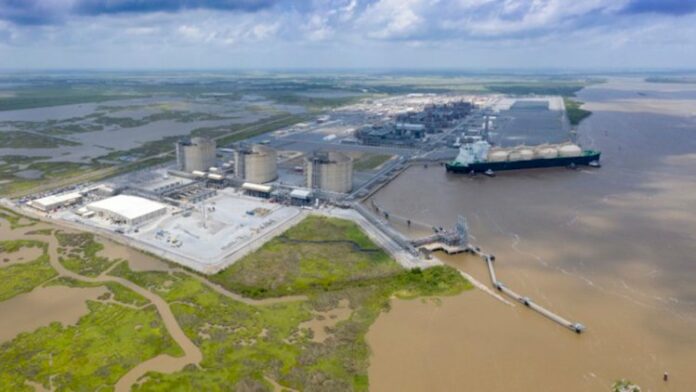
Sempra LNG, a subsidiary of Sempra Energy, has announced that Cameron LNG's second train of the liquefaction-export infrastructure project in Hackberry, La., has begun commercial operations under Cameron LNG's tolling agreements.

Lisa Glatch, chief operating officer of Sempra LNG and board chair for Cameron LNG, said:

"We are excited that our first liquefaction project is nearing completion and we couldn't be more pleased that Cameron LNG is already contributing to position the U.S. as one of the top LNG-producing countries in the world. We are looking forward to achieving commercial operations of the third and final train of Phase 1 while maintaining the same remarkable safety record the project has achieved thus far."

Train 3 remains on track to start initial liquefied natural gas (LNG) production in the second quarter of 2020 and to commence commercial operations in the third quarter of 2020. The facility's first liquefaction train started commercial operations in August 2019.

Phase 1 of the Cameron LNG export project includes the first three liquefaction trains that will enable the export of approximately 12 million tonnes per annum (Mtpa) of LNG, or approximately 1.7 billion cubic feet per day.

Mark Coscio, McDermott's Senior Vice President for North, Central and South America, said:

"Congratulations to the project team whose focus on execution excellence continues to move the Cameron LNG project forward with this significant accomplishment. Together, we will focus on efficient project delivery and the highest of quality as we work to complete the final of the three trains for the project."

Cameron LNG is jointly owned by affiliates of Sempra LNG, Total, Mitsui & Co., Ltd. and Japan LNG Investment, LLC., a company jointly owned by Mitsubishi Corporation and Nippon Yusen Kabushiki Kaisha (NYK), following its substantial completion.

Alfa Laval PureBallast 3 certified for installation on Chinese-flagged vessels

0

Alfa Laval PureBallast 3 has become one of the first non-Chinese ballast water treatment solutions to be type approved by the China Classification Society. With the Chinese type approval in hand, PureBallast 3 systems can now be installed on vessels that carry the Chinese flag.

The type approval certificate for PureBallast 3 was issued by the China Classification Society on 17 January 2020. For Chinese customers, it provides access to one of the global market’s most respected and successful ballast water treatment solutions.

Peter Sahlén, Head of Alfa Laval PureBallast, says:

“Alfa Laval has long had a strong position in the Chinese newbuilding market and has grown considerably in the retrofit market during the last 12 months. Now that PureBallast 3 has Chinese type approval, we can support all shipowners who build or sail under the Chinese flag. There are many who see the benefits of a strong international partner in ballast water treatment – one with proven UV technology that can handle large ballast water flows, but also one with global service and support.”

For Alfa Laval, obtaining Chinese type approval is an important step that reflects the company’s lasting commitment to the Chinese market.

Sahlén says:

“Alfa Laval has had dedicated ballast water treatment resources in China since the signing of the IMO Ballast Water Management Convention. In fact, the majority of our dedicated service engineers are stationed in China, where they are well positioned to support Chinese and foreign customers with the commissioning and service of PureBallast systems. From shipbuilding to the delivery of goods worldwide, China is key to the marine industry. We look forward to deepening our cooperation with Chinese customers and will be proud to see PureBallast 3 systems sail under the Chinese flag.”
 

SeaRobotics deploys ASV to Bahamas for post Dorian survey

0

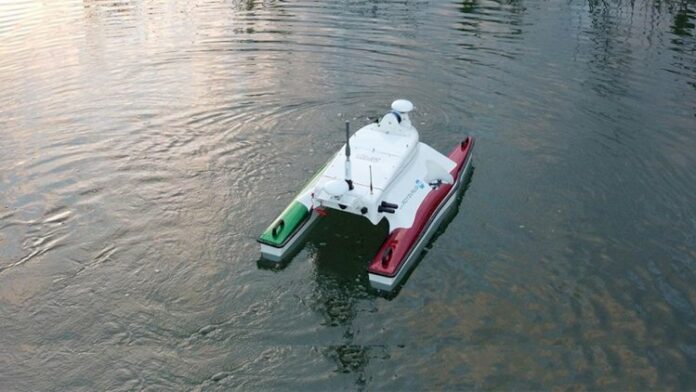
SeaRobotics has announced the successful deployment of their SR-Surveyor M1.8 ASV in cooperation with Morgan & Eklund (M&E), a Florida based land and hydrographic survey firm, to safely survey a twenty-mile stretch of waterways in the hard-hit islands of the Bahamas.

Don Darling, President of SeaRobotics, said:

“We designed the SR-Surveyor M1.8 to excel at working in hurricane and storm-damaged areas, without putting manned vessels in harm's way. The SR-Surveyor M1.8 is portable, which is key in difficult to reach areas due to downed trees, submerged vessels and debris limiting access to launch areas. High-quality data is also critical to recovery efforts — they need an accurate picture of the underwater environment to do their jobs safely and effectively.”

Providing accurate data and detailed images of the condition of the waterways are crucial to the success of the recovery effort and M&E, a hydrographic survey firm with experience in post-hurricane damage assessment chose the SR-Surveyor M1.8 because of its shallow draft and multiple sensors onboard.

Rob Collaro, Director of Hydrographic and Land Surveys, M&E, said:

“This ASV can navigate hard-to-reach areas and collect multiple types of data that help present an accurate image of the underwater environment.”

The SR-Surveyor M1.8 has closely coupled multiple sensors on board and has the ability to collect side-scan sonar, multibeam sonar, and lidar data simultaneously. The optimized sensor suite (EdgeTech 2205, Velodyne PUCK, SonTek M9, and AML MicroSV) provided accurate data and detailed images of the condition of the waterways, which are crucial to the success of the ongoing recovery effort.

Darling added:

“The Surveyor M1.8 performed well and allowed M&E to safely and successfully image the waterways. We’re happy that we’ve been able to contribute to the recovery efforts in the Bahamas.”

Scientists look for local levers to benefit coral health

0

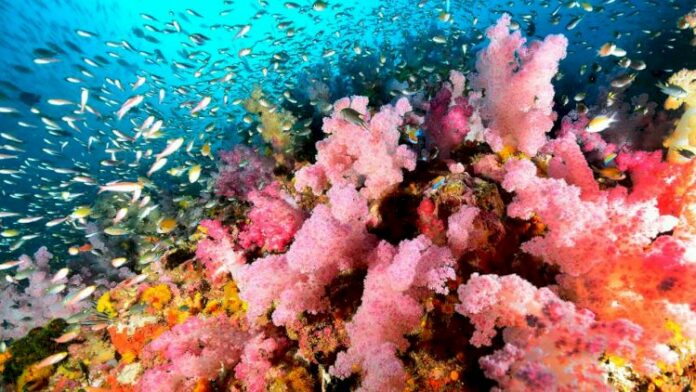
Reducing nutrient pollution can help prevent coral reefs from bleaching during moderate heatwaves, according to a National Science Foundation-funded study by researchers at UC Santa Barbara. The results, which appear in Proceedings of the National Academy of Sciences, offer new strategies for managing these highly threatened and important ecosystems.

Reef-building corals host beneficial algae in their tissues. In exchange for protection and nitrogen, the algae provide the coral with food. All is well until the water gets too warm.

At higher temperatures, the algae's photosynthesis goes into overdrive, and the chemical balance between the coral and the algae breaks down. At a certain point, the coral and its tenant part ways in a process known as bleaching. Coral can survive for a time without algae, so recovery is possible if conditions return to normal quickly. But in the absence of its partner, the coral will starve and eventually die. The worse the bleaching is, the more likely that is to happen.

Experiments in the lab, as well as in a few small field studies, suggested that nitrogen pollution, such as from fertilizer and sewage runoff, could exacerbate bleaching. Excess nitrogen in the water can short-circuit the beneficial partnership between corals and algae.

However, it was not known whether nutrient effects on bleaching occurred in many corals over large areas. So marine biologists decided to investigate the effects of nitrogen on coral bleaching — on the scale of an entire island — as part of the NSF Moorea Coral Reef Long-Term Ecological Research site in French Polynesia.

The scientists looked at the two most common types of branching coral in Moorea. They found that nutrient-exposed corals were more sensitive to temperature.

Daniel Thornhill, a program director in NSF's Division of Ocean Sciences, says:

"This research demonstrates that managing local stressors like nutrient pollution makes corals more resistant to temperature stress. The knowledge will be helpful for resource managers and will buy time to address the global threat reefs face due to warming, acidifying oceans." 
 

Five companies form consortium to develop the Net Zero Teesside project

0

OGCI Climate Investments – the $1B+ investment fund of The Oil and Gas Climate Initiative – has announced the formation of a consortium of OGCI members – BP, Eni, Equinor, Shell and Total, with BP as operator – to accelerate the development of the Net Zero Teesside project, previously known as the Clean Gas Project.

The partners bring global experience of carbon capture, utilisation and storage technology and are committed to working closely with the UK government and local stakeholders, including the Tees Valley Mayor and Combined Authority, to develop the Net Zero Teesside project to deliver the UK’s first zero carbon cluster. With the right government support the project has an ambitious yet achievable potential start-up date of the mid-2020s.

The project will decarbonise local industry by building a transportation and storage system to gather industrial CO2, compress it and store it safely in a reservoir under the North Sea. The transportation and storage infrastructure will encourage new investment in the region from industries that wish to store or use CO2. In addition, a combined cycle gas turbine (CCGT) facility with carbon capture technology will provide low carbon power as a complement to renewable energy sources and underpin the investment in the infrastructure.

Pratima Rangarajan, CEO of OGCI Climate Investments, said:

“Net Zero Teesside is a demonstration of OGCI’s commitment to accelerating CCUS on a global scale. It’s the anchor project, first ideated at the UK Energy Technologies Institute (ETI), developed into an industrial carbon cluster within OGCI Climate Investments and  now, the first hub within OGCI’s CCUS Kickstarter initiative.  This transfer of ownership to the OGCI consortium is proof of how OGCI’s initiative is successfully supporting emerging hubs.”

Andy Lane, Managing Director of Net Zero Teesside, commented:

“Its advantageous location, advanced planning stage, the expertise of our world class project partners and government support for decarbonisation in the UK mean Net Zero Teesside is uniquely positioned to become the UK’s first decarbonised cluster. The formation of such a powerful partnership led by BP demonstrates the industry’s commitment to the UK government’s net zero targets. We’re hugely excited to see Teesside back at the forefront of UK industry and want the project to progress further.”

Ben Houchen, Tees Valley Mayor, said:

“Net Zero Teesside represents the next step in our ambitions for Teesside, Darlington and Hartlepool to become a pioneer in clean energy, driving almost half a billion pounds into the regional economy and boosting the wider UK by £3.2billion. This world-leading industrial-scale decarbonisation project will safeguard and create 5,500 good quality, well paid jobs for local people. It will act as a beacon for new technologies and further investment as other companies are attracted to our area, while helping the UK achieve its clean energy potential.”

Net Zero Teesside has signed memorandums of understanding (MoUs) with 3 existing industrial partners demonstrating the strong local commitment to decarbonising existing local industry. The MOUs support the continued engagement between the parties in evaluating the technical and commercial case for capture of CO2 from the industrial plant for safe storage.

Attendees at the event including MPs, policy makers, business leaders and local stakeholders will hear from speakers about the significant role Net Zero Teesside will play in helping the UK reach its net zero 2050 greenhouse gas emissions target whilst delivering an annual gross benefit of up to £450 million for the Teesside region and the support of up to 5,500 direct jobs.

SPIL transforms shipping supply chains through innovation

0

Revolutionizing logistics services via digitization has been a top priority for PT Salam Pacific Indonesia Lines (SPIL) in recent years as the company works to connect islands across Indonesia through their 36 strategically located offices.

Traditionally, SPIL customers could only book a shipment or get track-and-trace updates on their cargo through a direct call to the company’s customer support line, which was open only during a typical 8-hour workday.

Suriadi Taslim of SPIL’s Strategic Development and Implementation says:

“Before we started the digital transformation, it was very hard for our customers to see their containers [in transit], and now our customers can see the status of their containers directly from on board the vessel, on arrivals, and on being discharged in/from the port.”

The move to digitally transform was inspired by technological advancement and directly from client feedback, which prompted the SPIL board of directors to consider expanding their customer-facing services into the digital space — and this attentiveness can also be seen in the program’s rollout.

Today the company is realizing digitization benefits and continues to look for advancement that could be translated into efficient well defined work standards which in turn is beneficial for the customers.

From 2017 to 2018, new bookings made through the new mySPIL® app and web portal constituted only 40% of the company’s total new business. But after the roadshow in 2019 — which stopped at major cities across Indonesia including Surabaya and Jakarta — that figure leapt up to 80%.

As a further inducement to customers, SPIL implemented a rewards points program as part of the mySPIL® app. Booking through the program nets the customer points that can be redeemed for monetary values in another commercial app. All the seamlessly exchanged data between apps are done through Application Programming Interface (API), which again proves SPIL’s belief in technology.

Part of the SPIL digital growth plan today is focused on connecting their regional supply chain business directly to the global market. To help achieve this goal the firm has joined and subsequently onboarded to TradeLens. It’s part of a plan poised to enhance customer experience and allow for more efficient operations which can be translated into significant cost savings downstream.

For SPIL, this new partnership with TradeLens will be measured in two key ways. First, by the number of global ports and terminals who are actively providing data and visibility to their operations team. Second, by the number of SPIL export and import customers who also join and subsequently utilize TradeLens to streamline their own businesses. The combination of these two dynamics will accelerate the capabilities of SPIL to offer highly sophisticated supply chain services.

Taslim says:

“It’s the reason we wanted to join TradeLens. We want to be tied-in to a world supply chain ecosystem to enable end-to-end visibility and enhance our services.”

Since going live on TradeLens, SPIL has started working to onboard their largest port and terminal partners and are also working with traders and freight forwarders to join the TradeLens platform.

SPIL continues to modernize its enterprise mindfully, by valuing the input of its domestic customer base across Indonesia, while also working internationally to connect them more seamlessly with its partners in the global supply chain. Adopting new digital platforms is clearly one essential part of that strategy, but no less important has been the attentive approach by SPIL to the needs of its customers: the kind of vital, face-to-face interaction that is easily overlooked alongside major technological shifts. As SPIL has seen since they began their digital transformation, these initiatives work better when pursued with others. 

First of six multi-role tugs delivered to the Polish Navy

0

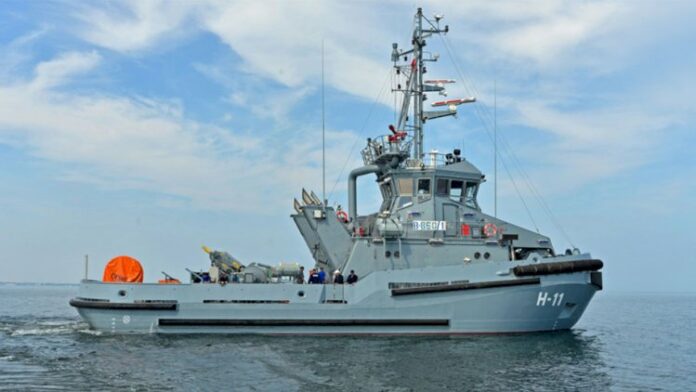
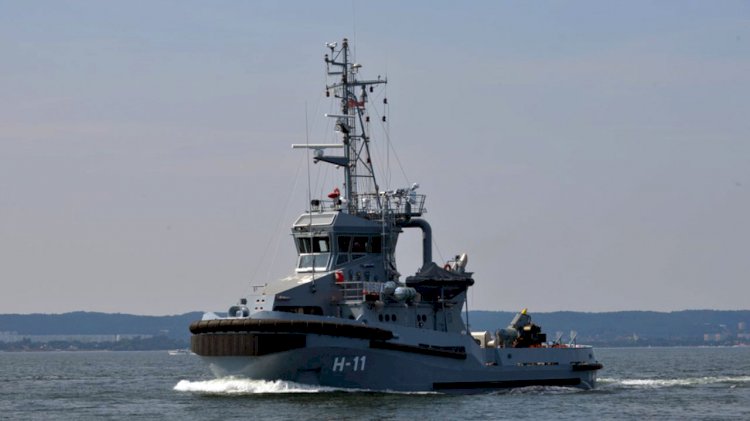
"Bolko", the first of a total of six multi-role tugs built by Remontowa Shipyard in Poland has recently been delivered to the Polish Navy.

Further five tugs – "Gniewko", "Mieszko", "Semko", "Leszko" and "Przemko" – are scheduled for delivery in the near future. Each of the ASD tugs is equipped with two SCHOTTEL Rudderpropellers type SRP 360 FP. They will be used for military and logistic operations support at sea and in ports.

The propulsion system of the Navy tugs consists of two ice-classed SCHOTTEL Rudderpropellers type SRP 360 with 2.0 m fixed pitch propellers. Each thruster is driven by an MTU 12V 4000 engine delivering a power of 1,193 kW. As a result, the tugs will achieve a bollard pull of up to 35 tonnes and a free-running speed of 12 knots.

The Polish tugs will be used for military and logistical operations support at sea and in ports as well as for technical evacuations, personnel transfers, search and rescue operations and oil spill recovery. Thanks to FSIC IA ice class reinforcement, these vessels can also be deployed in the Baltic Sea at any time of the year.

Operation in regions where ice is present places special demands on propulsion systems. Over the years, SCHOTTEL has built up a vast amount of experience in this field. Today, the German manufacturer of propulsion systems offers a series of ice-class-strengthened azimuth thrusters up to Finnish-Swedish ice class IA Super.


Austal introduces its new 83 metre trimaran ferry

0

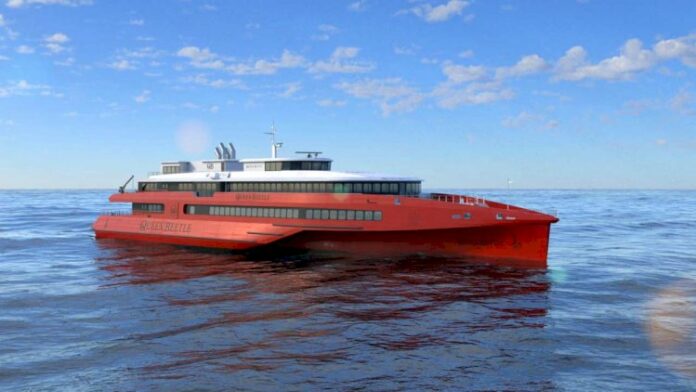
Austal has celebrated the company’s latest development in high-speed trimaran technology with the revealing of an 83 metre trimaran ferry, under construction for JR Kyushu Jet Ferry of Japan, at the company’s Henderson South shipyard in Western Australia.

Austal Hull 396, to be known as Queen Beetle, was designed and constructed by Austal Australia and is due for launch in mid-March 2020. The vessel will be handed over to JR Kyushu Jet Ferry in June 2020 and will commence services between Busan, South Korea and Fukuoka, Japan in July 2020.

Speaking at the reveal ceremony, which was attended by more than 100 guests, including Governor of Western Australia The Hon Kim Beazley AC and West Australian Premier The Hon Mark McGowan MLA, Austal Chief Executive David Singleton said the company was proud to be introducing the new trimaran to Japan while offering outstanding value to a new customer, JR Kyushu Jet Ferry.

He said:

“We’re very proud to be introducing this new Austal trimaran to one of the most technologically advanced and mature markets in the world. In fact, Queen Beetle will be the first high-speed trimaran ferry to be delivered to and operate in Japan.

This stunning new ship will truly transform the fast-ferry journey between Japan and South Korea, offering significantly improved seakeeping and an exceptional on-board experience for passengers and crew.

With a capacity to carry 502 passengers in greater comfort, with previously unavailable amenities such as a shop and café, this new trimaran represents outstanding value to our customer, JR Kyushu Jet Ferry.”

Since 2005, Austal has delivered 14 high-speed aluminium trimarans worldwide, including 11 for the United States Navy. Austal has a further 11 trimarans under construction or scheduled for construction at the company’s shipyards around the world – and remains the only shipbuilder designing, constructing and sustaining large high speed trimaran ferries, globally.

More than 200 West Australians were employed in the design and construction of the vessel, spending a combined 450,000 hours to get the vessel to the current point in its construction program.

WA Premier Mark McGowan said it was particularly pleasing that a range of local suppliers and subcontractors had also contributed to the construction of the vessel, in addition to those directly employed by Austal.

Mr McGowan said:

“The extent of the local content in this vessel is proof of both a vibrant shipbuilding industry in Western Australia as well a testament to the quality of the work and products that Western Australian companies can contribute to the maritime sector, whether in civil or defence areas.”

JR Kyushu Railway Company President Mr Toshihiko Aoyagi said:

“JR Kyushu Jet Ferry is very excited about the imminent launch, completion and delivery of the Queen Beetle trimaran and we look forward to commencing services in Japan, in July. The reveal ceremony has assured us the Queen Beetle will be the most impressive ship in our fleet.”

The distinctively red-painted Queen Beetle will be able to transport 502 passengers (and 20 crew) across 2 passenger decks, at speeds up to 37 knots on the 115 nautical mile route.

Featuring a customised interior designed by Eiji Mitooka of Don Design Associates, the Queen Beetle includes two classes of seating plus compartments for groups and families, a children’s play area and nursing room, a café and bar, duty-free shop, lockers for luggage and all-access spaces for wheelchairs and prams. An outdoor viewing deck will further enhance the on-board experience for passengers.