-9.1 C
New York
Home Blog Page 533

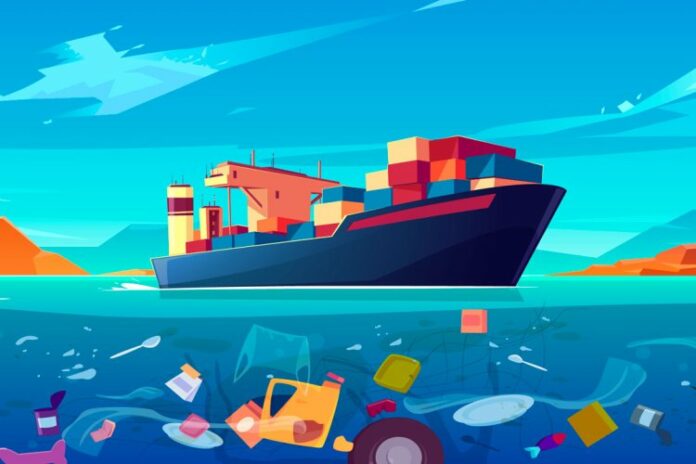
K LINE and TUMSAT start joint research on marine plastic waste

0

“K” LINE has announced the signing of a joint research agreement with Tokyo University of Marine Science and Technology (TUMSAT) to start joint research on marine plastics. 

The TUMSAT has been leading research in this field, surveying the amount of marine plastic waste, including microplastics (plastic particles 5 mm or less) floating in the world’s oceans. 

This joint research will use “K” LINE’s vessels, which navigate many seas around the world, to collect samples of plastic particles, and is expected to promote the study of marine plastic waste.

The joint research will evaluate how much plastic waste can be collected from seawater under common process without installing any special equipment on intake and filtration of seawater by ships on voyages in order to avoid possible further marine pollution. 

First, the “K” LINE vessel will take samples from the seawater intake line with a strainer while the ship is running, and then the TUMSAT will collect plastic particles from the samples and analyze the material, size, and other elements.

The project will lead to further research, such as the collection of microplastics in the open sea using ocean-going vessels and the establishment of a monitoring system for the density of microplastics in specific areas.

CAPITAL to secure ABS decarbonization notations for newbuild tankers

0

In an industry first, Capital Ship Management (CAPITAL) is to secure ABS notations recognizing investment in decarbonization technologies for its newbuild orders for medium range tankers.

ABS developed the notations with Capital’s input during their extensive program of new construction projects. The HVSC-Ready notation is for vessels equipped for High Voltage Shore Connection systems to be installed in the future, and the Wind-Assist Ready notation is for vessels equipped for wind-assist equipment to be installed on board.

The notations, which can be applied to any vessel type, were developed to support industry decarbonization efforts and recognize sustainability investments.

Vassilios Kroustallis, ABS Senior Vice President, Global Business Development, said:

“It is great to be able to reward Capital’s forward-thinking approach with these notations and we are proud to be able to support them on their decarbonization journey.”

Nikolas Vaporis, Chief Technical Officer, CAPITAL, said:

“At CAPITAL, innovation and technological progress are key drivers when we look to order new vessels. We would like to thank ABS for recognizing our efforts to challenge established design concepts and hope that in doing so others will join the path towards decarbonization sooner. The HVSC Ready and Wind-Assist Ready notations will distinguish these state-of-the-art vessels from their peers and hopefully spur even greater innovation going forwards.”

The HVSC-Ready notation was introduced with the update to the ABS Guide for High Voltage Shore Connection, published in July.

Houlder designs and installs telecoms deck for Global Marine

0

The Normand Clipper, is currently on charter to Global Marine. Mobilised for inter array power cable installation, Global Marine identified the potential to multipurpose the vessel for fibre optic (FO) telecoms cable installation.

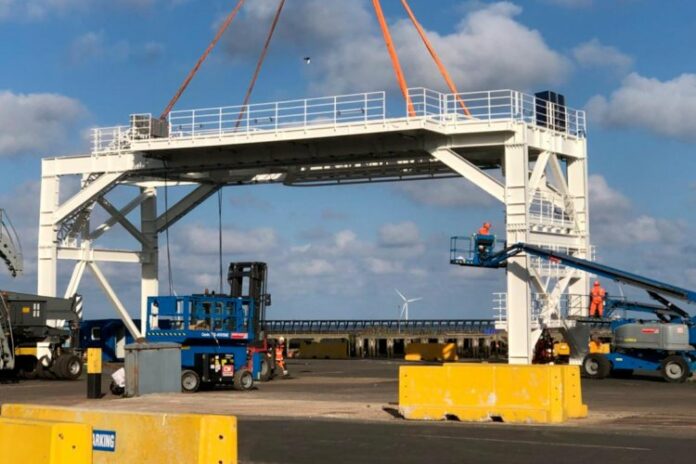
They approached Houlder to provide the expertise to design, engineer and help install an additional working platform above the power cable carousel. The deck supports equipment for subsea FO cable installation work and makes use of the carousel below as a static cable tank. The deck utilises bolted deck connections which helps permit a rapid transition between power and FO modes.

The company used its knowledge to design the new deck for fabrication.  Features of the deck, typical with FO cable work include a bight slot, bight recess / access and equipment seatings. Houlder also designed access ways between the vessel and new deck as well as an additional cable way to route the cable to the vessel’s main deck. Working with Global Marine, Houlder developed the vessel’s full mobilisation deck arrangement to ensure operational continuity between the new and main deck cable handling equipment.

A significant design challenge that Houlder faced was the large unsupported span of the new deck. The engineering team undertook a detailed structural evaluation including lift analysis and weight optimisation studies to ensure the most efficient design was produced. Integration of the new deck into the existing vessel and carousel structures was managed using 3D design packages. The connection of the new deck to the vessel was designed to avoid the need for vessel strengthening and permit rapid installation. Houlder worked with the classification society DNV to ensure full involvement at key stages of the design process.

Houlder acted as Global Marine’s representative whilst the deck was fabricated in NE England by Tolley Fabrications. During the installation phase, Houlder were present to help supervise.

Bryce Harding, Engineering Manager, Houlder, commented:

“For this project, our collaborative approach, working closely with Global Marine, ensured an efficient solution was produced whilst successfully navigating each challenge as it arose. As one example, early design reviews established a requirement to fabricate the deck remotely from the mobilisation port. This highlighted a need to modularise the deck to ensure it was suitable for road transportation, followed by pre-assembly at the quayside. An added benefit is the ability to stack the sections, reducing the space required for storage, when demobilised. Recognising each of our client’s requirements and undertaking regular design reviews with them, ensures Houlder offer the best solutions possible. Applying a ‘front end’’ approach to our design was paramount to success. It is fantastic to see the vessel now in action and working as intended.”

Martyn Drye, Engineering Director, Global Marine, commented:

“Having identified a possible way to easily and rapidly mobilise the Normand Clipper for FO cable work, we needed a pragmatic, comprehensive and rapid approach to the engineering design.  Houlder met these challenges as marine engineering experts and delivered as required. The result is a vessel that is successfully installing FO cable but can be rapidly switched back to power cable mode if required.  Ultimately this improves vessel utilisation and enables us to offer the best support to our clients.”

Low carbon wind farm CTV developed by RAL

0

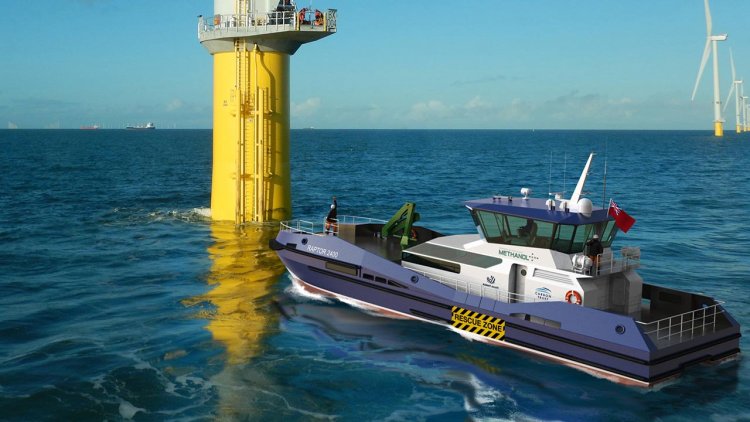
As a marine fuel, methanol provides emissions benefits that are similar to natural gas when it comes to reducing CO2, NOx, SOx, and particulates, but without the need for cryogenic or pressurized fuel tanks.

This reduces capital cost, saves space and allows more fuel to be carried. With the advent of green methanol – produced from sustainable low carbon sources including renewable electricity with carbon capture – well-to-wake carbon emissions can be reduced to net zero by switching to green methanol as it becomes more widely available in the years to come; a seamless transition requiring no changes to the vessel.

Erik Johnston, P.Eng., Project Manager for Robert Allan Ltd., said:

“The possibility of using green methanol marks a shift from the current linear fuel cycle to a circular fuel cycle, where harmful combustion waste products are converted back into useful fuels. This will have great benefits for generations to come.”

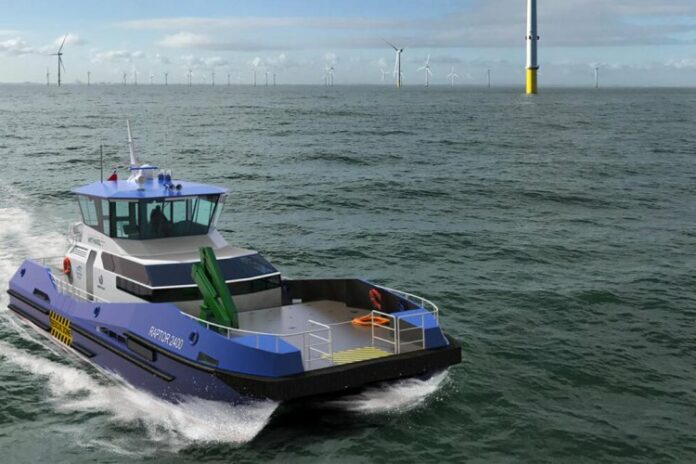
The particulars of the RAptor 2400 are:

  • Length Overall: 23.8 m
  • Moulded Beam: 8.0 m
  • Moulded Draft: 1.1 m
  • Methanol Capacity: 12 m3
  • Installed Power: 1800 kW
  • Speed: >25 knots

Cabins for the master and two crew are in the demi-hull accommodations. A spacious and comfortable technician seating area with large forward and side windows on the main deck accommodates up to 12 wind farm service personnel.

Four Scania DI16 main engines, each rated at 450 kW at 2100 rpm, provide propulsion. Converted to run on methanol by ScandiNAOS, these engines meet IMO Tier III emissions limits without any additional aftertreatment. Two engines in each demi-hull are connected to a dual-input gearbox driving a Servogear controllable pitch propeller system that caters to both maximizing sprint speed and bollard push performance. Extensive in-house CFD analysis was used to achieve a speed in excess of 25 knots at full load displacement.

The CTV has been designed for compliance with Interim Guidelines for Safety of Ships Using Methyl/Ethyl Alcohol as Fuel and Lloyd’s Register Rules for the Classification of Methanol Fuelled Ships.

ABS issues its AIP for GEV’s pilot compressed hydrogen ship

0

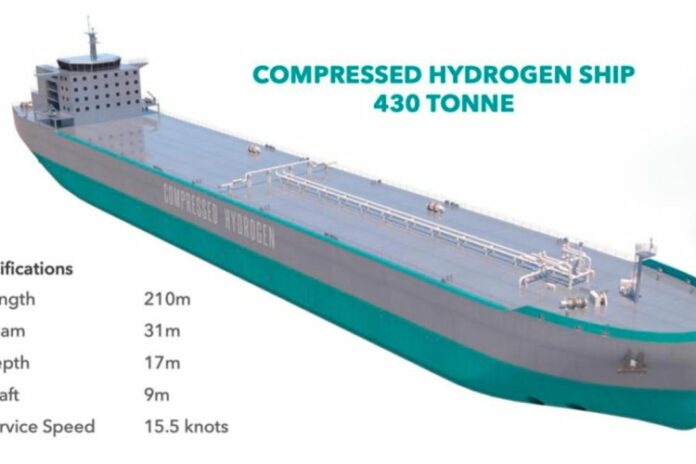
Global Energy Ventures Ltd has announced that ABS has issued its AIP for the Company’s pilot-scale compressed hydrogen ship, based on a cargo capacity of 430 tonnes of hydrogen. 

Martin Carolan, GEV Managing Director & CEO, commented:

“GEV is pleased to report that we have received AIP from ABS for our pilot scale 430-tonne hydrogen ship, which follows AIP received earlier this year for our innovative compressed hydrogen ship with a 2,000-tonne capacity. ABS is a leading classification society for gas carriers and GEV is looking forward to working with them to ensure that our compressed hydrogen ships continue to meet the highest safety standards.

Marine storage and transport solutions are required for hydrogen to contribute to global decarbonization ambitions. Efficient, safe and cost competitive marine transport solutions for high purity hydrogen are required before 2030 to enable the development of greenfield hydrogen supply chains at scale. GEV views the compressed hydrogen ship as a competitive carrier and the ideal scale to advance the commercialisation of several hydrogen greenfield export projects proposed or under development.”

Learnmarine introduces new VR/AR Simulator for crane operators

0

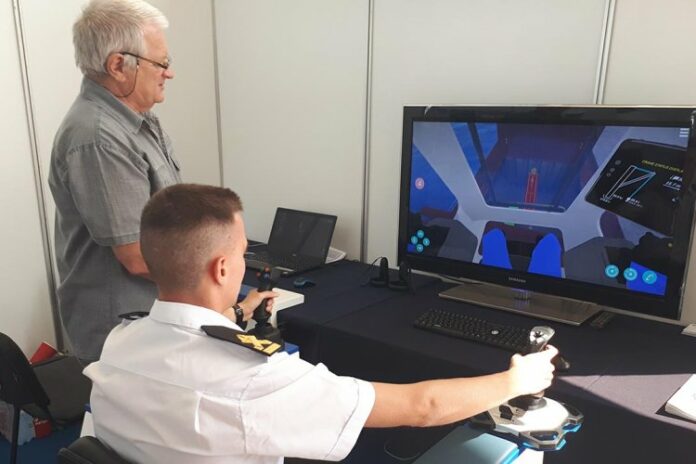
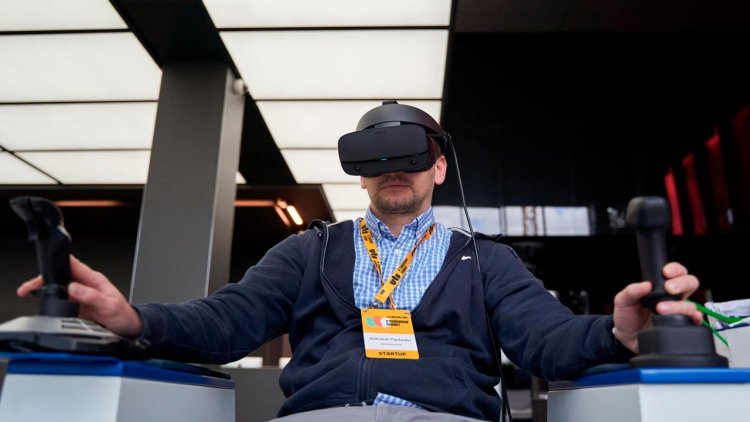
Learnmarine, the Ukrainian training and competency assessment provider for the maritime industry, has presented its new AR/VR marine crane and ASD tug simulators.

Learnmarine`s simulators allow to practice complex, multiplayer operations. Training can be carried out both in virtual reality and conventionally, using multiple screens for visualization.

Aleksandr Pipchenko, the head of an educational platform Learnmarine, explains:

“Our AR/VR simulator allows practicing crane operation skills in a risk-free immersive environment with various cargoes: containers, pipes, boxes, and other types of loads that can be carried on the deck or in the hold of the vessel. Four crane operators and banksmen can participate in the simulator exercise at the same time.

Our clients are very satisfied with visualization quality, especially when we immerse them in the virtual world. In addition, we use physical controllers (joysticks), which are similar to those used on ships. As a result, there is a complete feeling that you are on the ship, in real conditions, and you are working with real loads.”

Learnmarine works with clients who require personnel training in operation of large machines such as cranes, mooring and towing winches, and similar, as well as training and assessment on practical ship handling skills. Also, the development team is looking into expansion of the models library with coastal cranes, container and port loaders and other large equipment.

Aleksandr Pipchenko says:

“Gradually, we are more and more focused on the port infrastructure. The level of automation in the maritime industry is steadily increasing. This will lead to the fact that many maritime specialties will go ashore. Therefore, we see our further development within the framework of the port infrastructure.”

Seaspan announces delivery of first of five 12,200 TEU newbuild containerships

0

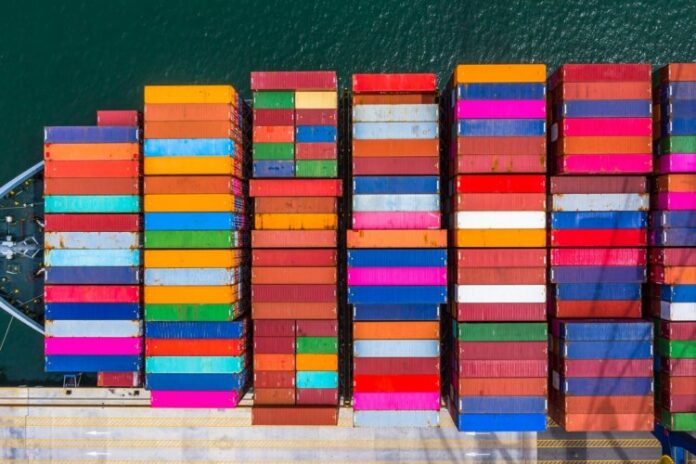
This vessel is the first of five newbuild containerships in this class.

Bing Chen, Chairman, President and CEO of Seaspan, commented:

“This delivery marks a major milestone in Seaspan’s continuing quality growth and unmatched ability to best serve our customers. About two months ahead of the scheduled delivery during a global pandemic is testament to how Seaspan creates value for our customers in a current vessel shortage market. I’m proud of our team’s supreme execution working with the logistical restrictions and our shipyard’s prioritizing of their limited resources to facilitate early delivery of this best-in-class vessel. This further demonstrates the capabilities of our fully integrated platform and resilient business model within the global logistics market.”

Since November 2020, Seaspan has announced investments for 70 newbuild containerships, representing the addition of 839,000 TEU, which will add over $11 billion of gross contracted cash flows and bring the fully delivered fleet to 1,959,200 TEU. The chart below summarizes newbuild vessels which Seaspan has announced but has not yet received delivery of:

Vessel Class Newbuilds Total TEU:

  • 7,000 TEU 10 70,000
  • 7,000 TEU LNG 15 105,000
  • 12,000 TEU 6 72,000
  • 12,200 TEU 4 48,800
  • 15,000 TEU 16 240,000
  • 15,000 TEU LNG 10 150,000
  • 15,500 TEU 6 93,000
  • 24,000 TEU 2 48,000
  • Total 69 826,800

KN becomes operator of the two commissioned LNG terminal

0

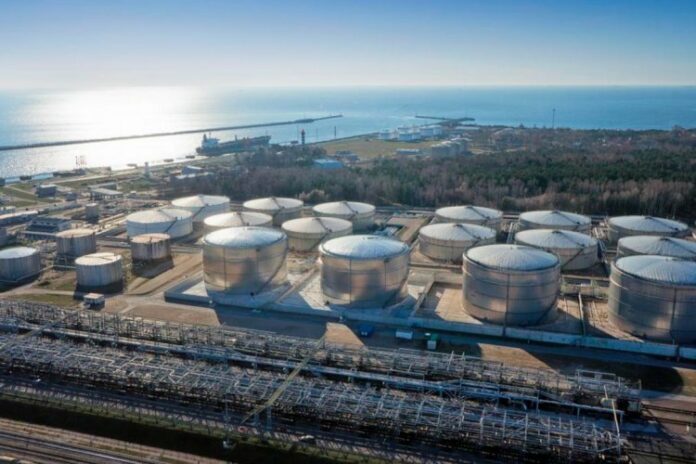
The opening ceremony of the GNA LNG terminal and the GNA I thermal power plant celebrates the significant milestone of the project for GNA, as well as for KN Açu Serviços de Terminal de GNL Ltda. (KN Açu), which is responsible for ensuring flawless operations of the fully-functioning LNG import terminal in the Port of Açu, Brazil.

Natural gas-fired thermoelectric plant UTE GNA I (hereinafter – GNA I) is a USD 1 billion LNG-to-power project located at the Port of Açu, in the northern region of Rio de Janeiro. With 1,338 MW of installed capacity, enough to supply energy for 6 million households, GNA I will contribute to the energy security of the national system. In addition, the project includes a FSRU BW Magna, a 28 MMm3/day operational LNG floating storage regasification unit.

KN has been appointed as the operator of the LNG terminal in this project in 2020 with an initial 13-year operational period term of the agreement, including a possibility of its extension upon mutual agreement. Since then, KN established local organisation KN Açu and provided extensive in-house training for the local O&M team, the company role also comprised the development of O&M strategy and ISO compliant management system, other relevant operational and commercial processes such as terminal commercial rules, emergency response plan, hydrocarbon accounting system and other systems required for the operational phase of the terminal.

KN and KN Açu teams have jointly assisted GNA in launching commercial operations by providing extensive on-site and remote support during different project development phases including mechanical completion, pre-commissioning and commissioning stages including functional and performance testing of the terminal. Furthermore, assistance was provided in LNG terminal’s readiness audits before major project start-up milestones such as hydrocarbon introduction to the terminal, FSRU arrival, gas send-out operations and similar.

Darius Šilenskis, CEO of KN, says:

“It is a great pleasure for KN to witness one of the most significant achievements in the recent Brazilian energy sector development and a historic moment for our long-term partner GNA. We are honoured to have the possibility to contribute to this important milestone of a very complex project with our global in-depth expertise and know-how in LNG terminal operational capabilities. Also, I would like to express my gratitude for the tireless professionalism and determination of KN and KN Açu teams, who are committed to ensuring long-term functions of safe and reliable LNG terminal operations trusted to us“

Bernardo Perseke, CEO of GNA, says:

“We have reached a significant milestone in the implementation of GNA I project and today is a good day to celebrate the joint efforts of everyone involved. We are grateful for the expertise and competence brought by KN into the project, and we are confident that KN will further maintain high safety and goal-oriented performance.”

Austal delivers high-speed trimaran ferry to Fred. Olsen Express

0

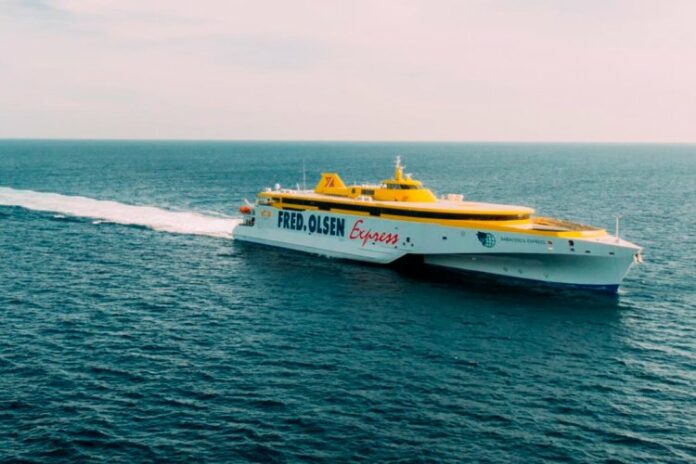
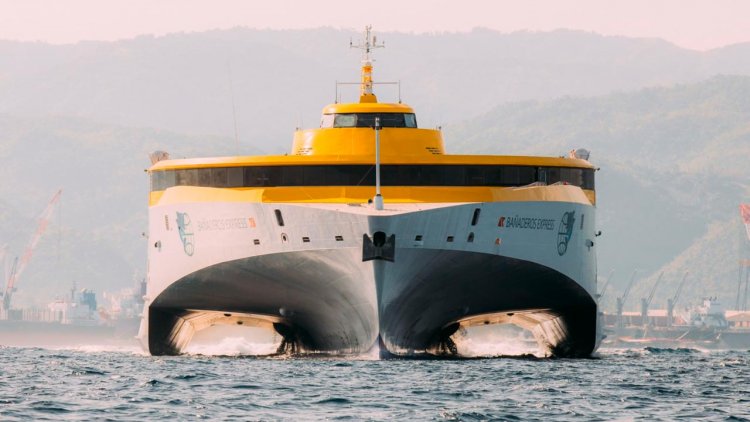
The delivery signals the completion of the A$190 million contract for two trimarans, announced in December 2018. The first vessel, Bajamar Express (Austal Hull 394) was constructed by Austal Australia and delivered in July 2020.

Captain Juan Antonio Rojas and the crew of Bañaderos Express formally accepted the vessel from Austal Philippines President and General Manager Wayne Murray at a COVID-safe ceremony held at the company’s Balamban, Cebu shipyard.

Austal Limited Chief Executive Officer Paddy Gregg said the delivery of Bañaderos Express to Fred. Olsen Express highlights the trimaran platform’s continued popularity with operators and Austal Philippines’ proven capability to deliver large, high quality vessels.

Mr Gregg said:

“Fred. Olsen Express was the world’s first ferry operator to see the unique value of the Austal trimaran hull to deliver a superior customer experience, operating the 127 metre Benchijigua Express since 2005. Now, with Bajamar Express and Bañaderos Express they have two more trimarans that further enhance their offering to customers and enable the world’s first dedicated trimaran service in the Canary Islands.”
Austal Philippines President and General Manager Wayne Murray thanked his team again for their commitment to safety and productivity in the delivery of Bañaderos Express during the challenging COVID-19 environment, and highlighted the vessel’s significance as the 20th vessel constructed by the shipyard.

Mr Murray said:

“Bañaderos Express is a real milestone for Austal Philippines as it is the 20th vessel constructed here at the Balamban shipyard since we opened in 2012. In just ten years our team have constructed 18 catamarans and two trimarans, including the two largest high-speed ferries ever built in the Philippines, for operators located around the world.”

“This delivery of Bañaderos Express is even more significant, given the challenging COVID-19 environment in which we have operated over the past two years. Austal Philippines has successfully maintained productivity, while keeping our team safe during the pandemic.”

Following the delivery, Fred. Olsen, S.A. Chief Executive Officer Andrés Marín thanked the Austal Philippines team for their outstanding efforts in the construction of Bañaderos Express, which continues Fred. Olsen Express’ commitment to offering passengers superior comfort and stability in the Canary Islands.

Mr Marin said:

“With the addition of Bañaderos Express, Fred. Olsen Express has a unique fleet that now includes three trimarans, offering the very best high-speed ferry experience for our customers.”

“Following the successful introduction of her sister ship, Bajamar Express, which was acknowledged by the Royal Institute of Naval Architects in the UK as one of 2020’s Significant Ships, we’re delighted to be adding this equally impressive, environmentally-friendly new ship to our schedule and look forward to welcoming passengers onboard very soon.”

Capable of transporting 1,100 passengers and 276 cars at a cruising speed of over 37 knots, the new ferries for Fred. Olsen Express feature class-leading interior amenities and facilities, including multiple bars, kiosks, a retail shop and children’s play area.

Following the vessel’s maiden voyage from the Philippines to the Canary Islands, Bañaderos Express will join Bajamar Express to offer a dedicated trimaran service on the route between Santa Cruz, Tenerife, and Agaete, Gran Canaria, from the fourth quarter of CY2021.

Nexans to provide services to Parkwind’s offshore wind farms

0

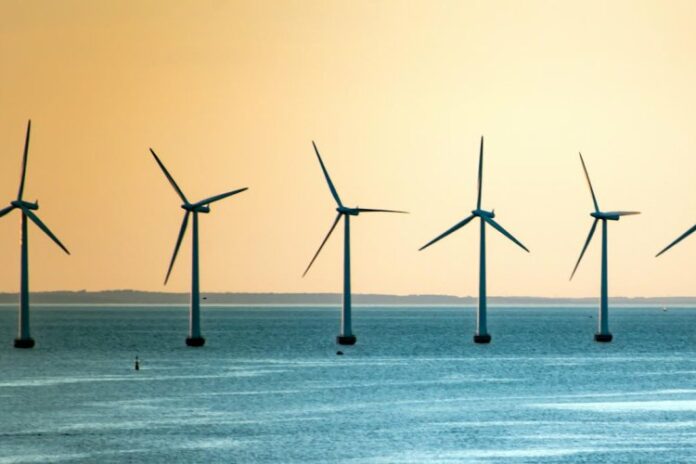
Nexans has won a contract with Parkwind to provide turnkey business continuity services to four of its offshore wind farms in Belgium. The Northwind, Belwind, Nobelwind and Northwester 2 farms are among the biggest in Belgium, with a combined installed capacity of 771 MW. Together, these four wind farms can power over 800,000 homes.

The five-year partnership will see Nexans providing a range of services such as pre-engineering of potential repair scenarii, periodic spare inspections and emergency response time of repair vessel in case of contingency situation on both inter-array and export cables.

Eric Antoons, Parkwind’s co-CEO, said:

“Built on many years of joint experience with our Belgian wind farms and underpinned by our continuous drive to bring innovation to both wind farm design and maintenance, this agreement with Nexans sets a new maintenance standard in the industry. With this level of contingency, we are able to manage the risk of cable failure in an unprecedented way and maintain the availability of our offshore wind farms at its highest.”

Ragnhild Katteland, Nexans Executive Vice President, Subsea & Land Systems Business Group, said:

“Nexans has extensive worldwide experience in repairs related to offshore wind assets. Through this five-year agreement, we are excited to provide Parkwind with turnkey business continuity solutions which will guarantee the preparedness and the remedy of potential damages to their assets. Nexans was also able to leverage its strong expertise to cover both inter-array and export cables including Nexans and third-party cable. Thereby Parkwind gets exclusive access to a one-stop shop solution as well as upcoming Nexans innovation upgrades. It’s all part of our ongoing commitment to enable electrification and connect the world’s renewable energy sources”.