2.1 C
New York
Home Blog Page 1028

Global solar PV installations to reach record high in 2019

0

Global solar PV installations will reach a new high of 114.5 GW in 2019, up 17.5% on 2018, according to new research from Wood Mackenzie.

As noted in the Wood Mackenzie 'Global solar PV market outlook update: Q2 2019', the market is now back on a strong growth trajectory after a slowdown in 2018. Annual installations are expected to rise to around 125 GW per year by the early 2020s.

Commenting on the report, Tom Heggarty, Wood Mackenzie Senior Research Analyst, said:

"Global growth will continue despite a gradual slow-down in China, the world's largest PV market. The Chinese market peaked at 53 GW in 2017, driven by generous feed-in tariffs. A move towards more competitive procurement of solar PV will lead to more sustainable annual additions of 30-40 GW."

Global PV market continues to diversify rapidly

Countries installing between 1-5GW annually will be the market's growth engine. In 2018, there were seven such markets. By 2022, there will be 19 – with new names including Saudi Arabia, France and Taiwan.

"In India, auction activity is starting to recover after a slow-down caused by land and transmission constraints. In the U.S., announcements of new state utility IRPs, in Florida for example, are good news for the solar PV market. The European market will grow strongly as policy markets look to deliver on 2020 and 2030 renewable energy targets. In Latin America, Brazil looks to be the most exciting market of the moment, with both auctioned PPAs with distributors and free market contracts with large consumers on offer. In the Middle East, all eyes are on the upcoming 1.5 GW auction in Saudi Arabia, which is set to be extremely competitive," added Mr. Heggarty.

China's first solar PV auction produced staggering results

China recently announced the results of its first solar PV auction. "A staggering 22.8 GW of projects awarded contracts in China's inaugural auction. This is by far the world's largest completed auction, with the next largest being the award of 3.9 GW of solar PV in Spain during July 2017. Awarded projects are intended to be connected by the end of 2019, facing tariff cuts for any delays.

Brazil overtakes Mexico for world's lowest-priced solar PV contract
"In June's A-4 auction, Enerlife/Lightsource BP was awarded a contract for the 2020 MW Milagres project for just $16.95/MWh – $2/MWh lower than the $18.93/MWh awarded in 2017 to Neon's Pachamama PV project in Mexico.

"Auctions will remain the driver of growth in many global PV markets. We expect to see 90 GW of solar PV projects awarded contracts through auctions in 2019, up from 81 GW in 2018."
SQLearn: New digital innovation for maritime

0

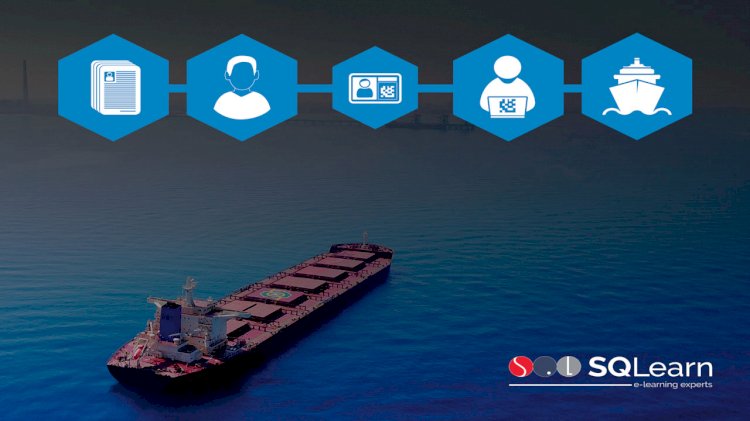
A new initiative, aiming to solve the time-consuming management of the large volume of training certificates in the field of shipping, is designed by SQLearn, in collaboration with the American classification society ABS and the i4M Lab research laboratory of the University of the Aegean.

Thenamaris Shipping Inc. actively supports this research project offering an ecosystem through which the project can be developed and become a reference commercial product for the shipping industry.

Digital transformation has also invaded shipping. Modern vessels are increasingly automated and reliant on ICT to perform, monitor remotely and control the performance of their operations. In this context, the digitization of the means and processes implementing international trade, as well as the accompanying documents, is being attempted on a large scale. However, shipping companies not only distribute the commercial documents accompanying the goods and the persons but also manage the vessel’s d and crew’s documents, many of which are frequently and repeatedly inspected at Port-State-Controls.

The digitization of these documents is widening, although in many cases digital shipping documents are not really digitally signed documents that can be read and processed by machines, but simply copies of the prototypes. As digitization progresses in the shipping industry, shipping companies are seeking for digital innovation to take advantage of the operational efficiency it generates. The OCEAN project is included in this perspective.

OCEAN (Online Certificates Authentication Network) aims to reform and optimize the current procedure for managing the large volume of certificates required to be presented by a seafarer. An integrated system for the management and verification of certificates through Blockchain technology will be developed within the project. The aim is to create a safe and reliable automated handling and management environment, with particular emphasis on STCW training certificates.

The aim is to fully develop a process of digital management, verification of the origin, validity and lifetime of crew’s documents, training logs, etc., with the “trust” advantages offered by Blockchain technologies. In particular, OCEAN will save cost, time, paper, and offer real-time data access. The system will also help in the future to facilitate chartering as it can be used by charterers as a reference point for assessing shipping companies in order to find those who qualify for their cargo shipments.

The above-mentioned project has been submitted as a proposal under the 2nd Round of the Single Action “Research – Create – Innovate” and in any case, its implementation is a priority for the involved parties in the coming months.

Seaspan opts for SCHOTTEL again

0

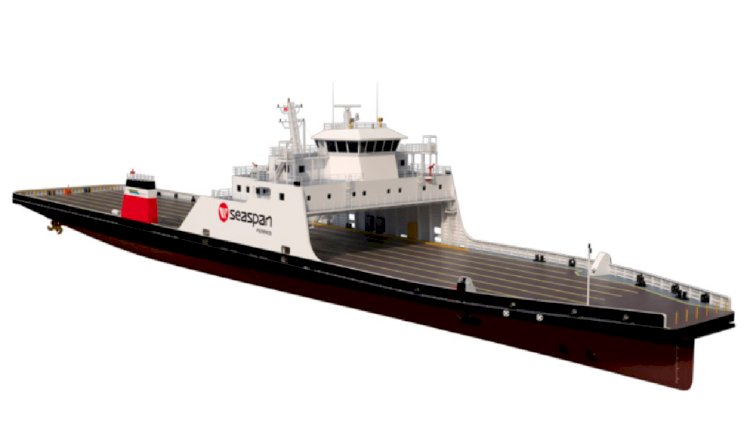
SCHOTTEL has been chosen as propulsion supplier for two new build Ro-Ro ferries under construction at Damen Shipyards Mangalia, Romania.

Each of the vessels ordered by Canadian Seaspan Ferries Corporation will be propelled by two SCHOTTEL Combi Drives and two SCHOTTEL Transverse Thrusters. The new ferries will join the company’s first two hybrid vessels, “Seaspan Swift” and “Seaspan Reliant”, which were commissioned just over two years ago. Seaspan Ferries currently operates a fleet of seven ferries out of four terminals in British Columbia, Canada.

“Thanks to the positive experiences we’ve had with SCHOTTEL thrusters in our first two LNG ferries, we once again opted for the German manufacturer. Their efficient and sustainable propulsion solutions have helped us further expand our service offering and reduce emissions at the same time,” states Harly Penner, Director of Fleet Engineering & Vessel Development at Seaspan Ferries.

Each of the Vard Marine designed vessels is powered by two natural gas fueled engines with 209 m³ storage onboard plus 2 MWh batteries for driving the SCHOTTEL propulsion package. The package itself consists of two Combi Drives type SCD 560 STP with an input power of 2,600 kW and a propeller diameter of 2.6 m which will allow a design speed of 16 knots. Beyond this, two type STT 1 FP bow thrusters (each of 550 kW) ensure precise and high manoeuvrability. These can be mounted and dismounted while the vessel is afloat.

With the SCHOTTEL exclusive Combi Drive, the electric motor is integrated vertically into the rudderpropeller, resulting in a highly efficient and quiet electric variant of the well-proven SRP and STP propulsion units. By sharing the load between two propellers, the twin propeller concept increases propulsion efficiency and reduces fuel consumption over single propeller systems.

With a capacity of 1,034 lane metres each, both new ferries will be servicing the commercial route from Vancouver Island to the lower mainland. The 149 m long and 26 m wide ferries will carry a range of cargo, but will primarily haul semi-trailers as well as automobiles transporting everything from daily essentials to electronics, lumber, pulp and paper. Both Ro-Ro ferries are also capable of carrying hazardous cargos, construction/logging equipment and special project cargo.

Damen Shipyards will start construction of the vessels at its Mangalia Shipyard in Romania later this year. The new vessels are scheduled to go into operation in 2021.

Karoon signs binding Baúna sale and purchase agreement

0

Karoon Energy Ltd announced that its wholly owned subsidiary, Karoon Petróleo e Gás Ltda, has executed a binding sale and purchase agreement to acquire a 100% operating interest in the Baúna field (Concession BM-S-40) located in the Santos Basin, offshore Brazil for a headline consideration of US$665 million.

The Baúna field consists of two producing oil reservoirs, Baúna and Piracaba, which are both tied back to the leased floating production, storage and off-loading facility (FPSO) Cidade de Itajai, and the existing undeveloped Patola discovery. The asset is currently producing light sweet crude at a rate of approximately 20 Mbopd.

The acquisition is also expected to deliver material operational and logistical synergies for the potential development of Karoon’s existing southern Santos Basin assets, Neon and Goiá.

Karoon’s Managing Director, Mr. Robert Hosking said:

“The company has been working very hard over the past three years to acquire a high quality production asset with robust economic returns. Through the acquisition of the Baúna asset Karoon has delivered on its highest strategic priority. Baúna will provide Karoon shareholders with material oil production (currently approximately 20 Mbopd before development workovers) and a platform for future growth. The transaction will be transformational for Karoon shareholders, providing significant exposure to reserves, resources and high margin oil production. The acquisition of Baúna opens a new phase for Karoon as a significant ASX listed oil producer. It is expected to generate significant operational and logistical synergies with Karoon’s other 100% owned southern Santos Basin exploration and development assets.“


Vladimir Rusanov LNG carrier starts NSR 2019 season with record passage

0

PAO NOVATEK announced today that the Arc7 ice-class LNG tanker “Vladimir Rusanov” completed the Northern Sea Route (“NSR”) passage via the Eastern direction, and delivered a cargo of LNG produced by the Company’s Yamal LNG project from the port of Sabetta to the port of Tianjin, located in China.

The Vladimir Rusanov transited the ice-covered part of the route in only 6days, setting a new record for independent passage via the NSR without ice-breaking support with cargo on board. The net voyage time from Sabetta to the destination port was completed in a record 16 days, which is less than half the time required to transport a cargo of LNG along the traditional westbound route via the Suez Canal and Strait of Malacca.

"For the second year in a row, our Arc7 ice-class LNG tankers were once again the first ships to open the summer navigation period via the Northern Sea Route,” noted First Deputy Chairman of the Management Board Lev Feodosyev. “This voyage set a number of records for the passage time of the ice part of the NSR, and for the total voyage time to China from the Russian Arctic region. These achievements were made possible due to the accumulated ice navigation experience and the outstanding ice performance characteristics of LNG tanker fleet designed specifically for our Yamal LNG project. We will continue to optimize our logistical model to ensure competitive LNG supplies to key global consuming markets”.

GNS and FrontM launch Voyager VOICE

0

GNS and FrontM launch new service to provide more cost-effective shore to ship voice calling. Voyager VOICE offers high quality, reliable calls, flat-rate price transparency and up to 40% savings on shore to ship calls.

GNS, the maritime technology company, and FrontM, the Edge AI software platform provider, have announced a new technology partnership to provide shipping companies with big savings on shore to ship voice calls.

The new Voyager VOICE service uses Voice Over Internet Protocol (VoIP) technology to deliver savings of up to 40% on current call costs to bridge satellite phone numbers.

“Over the last few years, GNS has been steadily driving down our customers’ costs by challenging traditional business models with services like our Voyager NAVIGATION as a SERVICE (VNaaS) offer and Voyager MONEY,” says Paul Stanley, GNS CEO. “We are delighted to be working with FrontM to now be able to extend those savings to include shore to ship communications. Our new Voyager VOICE service opens up significant opportunities to manage shore to ship communications more cost-efficiently.”

Voyager VOICE has been developed specifically for shipping companies to enable shore-based personnel to more easily and cost-effectively connect and collaborate with vessel-based teams. Voyager VOICE pricing is very simple and completely transparent. Shore to ship calls using Voyager VOICE cost a flat-rate of just $3.60 per minute representing a saving of at least $2.40 per minute on most mainstream voice-calling tariffs.

Office-based users can call vessels from their desk using the Voyager VOICE web site. There is also a free smartphone application which is perfect for low-cost vessel calling on the move. Thanks to GNS’s extensive data intelligence capabilities, Voyager VOICE also incorporates a comprehensive vessel ‘telephone directory’ to enable users to quickly and easily find the right number to call.

To get started with Voyager VOICE, users simply create an account online and start dialling. There are no annual service fees to pay over and above the Voyager VOICE $3.60 per minute flat-rate. Multiple user logins can be created for each company account and call volumes, duration and costs can be monitored by user, team and department to help companies to drive down communication costs further.

ICTSI Manila continues equipment roll-out

0

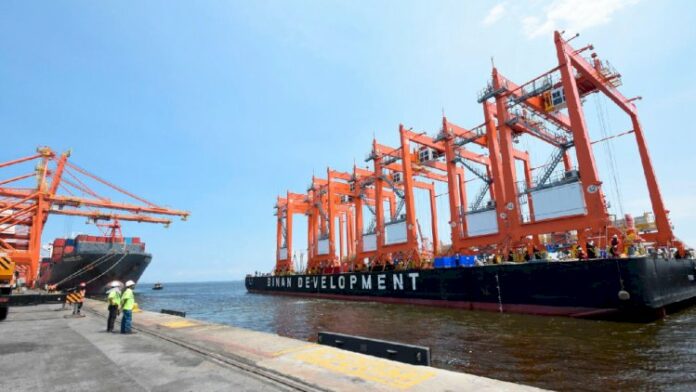
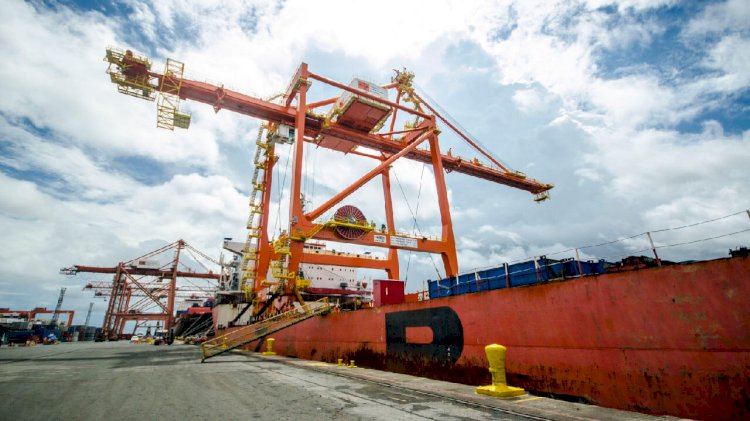
International Container Terminal Services, Inc. (ICTSI) recently took delivery of another new quay crane (QC) and eight new hybrid rubber tired gantries (RTGs) for its flagship Manila International Container Terminal (MICT), establishing the terminal as having the largest fleet of modern container-handling equipment in the Philippines today with 18 QCs and 58 RTGs.

Manufactured by Shanghai Zhenhua Heavy Industry Co. Ltd. (ZPMC), the QC is part of the five from ICTSI’s 2018 USD80-million capacity improvement program package. With a reach of up to 16 rows across twin, the new QC can service the largest feeder vessels calling the Philippines. It will be deployed at Berth 3.

Complementing quayside improvements, the eight RTGs are also part of the 2018 16-unit order from Mitsui Engineering & Shipbuilding Co. Ltd. Faster and more-fuel efficient than standard diesel RTGs, these RTGs are the most eco-efficient landside port equipment in the country today. They are also part of ICTSI’s Group-wide commitment towards ensuring carbon-neutral operations part of which includes expanding the use of next generation energy-efficient cargo handling equipment and vehicle fleets.

To further lessen its footprint at its flagship while addressing productivity demands, ICTSI recently made a fresh order of 16 new hybrid RTGs again from Mitsui. This forms part of ICTSI’s USD380million group-wide capital expenditure.  Scheduled for delivery in early 2020, terminal emissions and fuel consumption per move are expected to be reduced by up to 40 and 60 percent, respectively, while increasing the MICT’s RTG fleet to 74.

“The new quay cranes and rubber tired gantries, along with other improvements, will push a notch higher our terminal’s already efficient turnaround times – quayside and landside. This should redound to economic benefits for the Philippine supply chain.  At the same time, we are proud that of the push that we are undertaking to attain carbon neutrality at our flagship,” said Christian R. Gonzalez, ICTSI Global Corporate Head.

Gonzalez adds:  

“On top of what has already been done, a number of initiatives are currently in place or are being put in place across the ICTSI Group to improve productivity and reduce port emissions.  These include gate automation and gate system upgrades to reduce queuing times, fleet changes to introduce faster and more fuel-efficient equipment, and utilizing machine learning and analytics to improve and automate yard strategy to reduce truck stay times. Taken altogether, these are expected to have an even greater material impact on indirect emissions from ICTSI port operations, seen to reduce cycle times of more than 20 minutes per truck visit.”

With the largest port equipment in the country, existing or planned, the MICT remains to be the only Philippine terminal capable of servicing the largest boxships plying Asian routes. 

To further ramp up capacity in support of growing Philippine trade, ICTSI has begun construction of Berths 7 and 8, and back-up areas for the future Berths 9 and 10. ICTSI has several other projects in the pipeline supporting MICT’s ever-increasing role as the country’s leading international gateway, including inter-terminal transfers at NorthPort for greater inter-island connectivity, and increased barge berthing services between the MICT and Cavite Gateway Terminal in Tanza.

About Manila International Container Terminal

In 1988, International Container Terminal Services, Inc. (ICTSI) won the 25 + 25 years concession to operate the Manila International Container Terminal (MICT) in an international tender. Since ICTSI’s takeover, MICT has increased its annual capacity five-fold, expanded its container handling fleet to make it the largest and most modern container terminal in the Philippines, and switched from a manual control system to an integrated real-time IT terminal control system. MICT is ICTSI’s flagship operation.
 
About International Container Terminal Services, Inc.

Headquartered and established in 1988 in Manila, Philippines, International Container Terminal Services, Inc. (ICTSI) is in the business of port operations, management and development. ICTSI’s portfolio of terminals and projects spans developed and emerging market economies in the Asia Pacific, the Americas, Europe, Middle East and Africa. ICTSI has received global acclaim for its public-private partnerships with governments divesting of their port assets to the private sector.

VIDEO: BAE Systems announces evolution in unmanned boat technology

0

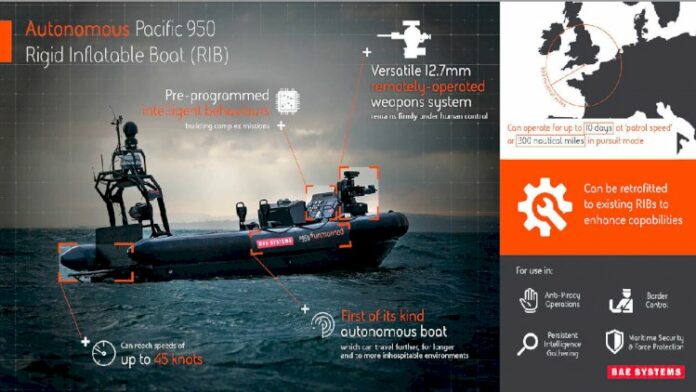
BAE Systems has successfully completed a series of trials on a ‘first of its kind’ autonomous boat that will allow navies to go beyond the limits of human endurance with unmanned vessels that can travel further, for longer and to more inhospitable environments.

The autonomous Pacific 950 Rigid Inflatable Boat (RIB) demonstrator has been used to develop and prove innovative technologies which have the potential to make naval missions faster, easier and safer, taking the relationship between human and machine to new territories.

Developed alongside industry experts from L3Harris and MSI Defence Systems, the P950 is equipped with automated navigational decision-making technologies, freeing up operators to focus on mission critical information from afar. To enhance the capability of existing warships, the technology has been designed to be retrofitted to existing RIBs, such as BAE Systems’ Pacific 24, which is currently in service with the Royal Navy across its surface fleet.

The vessel can operate for up to 10 days at ‘patrol speed’ or 300 nautical miles in pursuit mode, reaching speeds of up to 45 knots, whilst either being remote controlled or on a semi-autonomous mission. Trials conducted by BAE Systems have shown how the technology provides a unique ability to undertake complex, multi-phase missions and support advanced dynamic tasking, whilst providing enhanced situational awareness to support faster and more effective decision-making by naval operators.

It has potential applications across a range of missions, including anti-piracy operations, border control, persistent intelligence gathering, maritime security and force protection. The use of autonomous vessels in high-risk areas would allow operations to be conducted without endangering sailors or Marines.

Mike Woods, Chief Technologist for BAE Systems’ Maritime Services business, said:

“This technology represents a huge step forward in the interaction between human and machine, combining sophisticated autonomous technology with human capabilities to overcome many of the challenges faced in difficult conditions at sea. The boat keeps sailors out of harm’s way whilst allowing them to respond to the increasingly varied, often unpredictable scenarios they face every day, and aids faster decision making in complex and ambiguous situations.”
 

Precision delivery

The boat has pre-programmed intelligent behaviours to position itself appropriately in relation to a potential threat. Its weapons system, developed by MSI Defence Systems with BAE Systems, remains firmly under a human operator’s control, ensuring that whilst the vessel can operate and navigate autonomously, there will always be a highly-trained operator in the loop, making the final decision on engagement and targeting.

Proving the technology

First introduced on an experimental basis in 2015 and trialled as part of the Royal Navy’s Unmanned Warrior exercise in 2016, the work now completed, in collaboration with the UK Ministry of Defence, has evolved the technology on the P950 demonstrator to an advanced state of readiness.  Further work will be conducted by BAE Systems in coming months to prove the technology can be integrated with existing naval ship combat management systems. The RIB will also undertake further trials, including participation in NATO Exercise REPMUS, to be held in Portugal later this year.

Mr Woods added:

“For the past four years we have been working in collaboration to develop this ‘first of its kind’ technology. We are proud to have matured autonomous maritime technology significantly, positioning the UK as a forward thinker in this unique space and providing a crucial advantage where it counts.

Unique Group launches next gen HBOT Facility

0

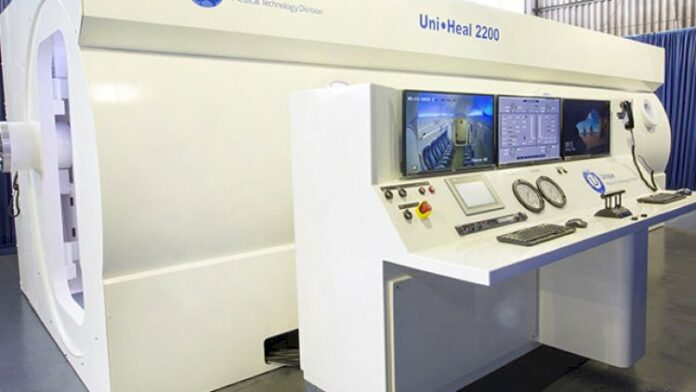
Unique Group proudly launches its in-house designed and manufactured multiplace hyperbaric oxygen treatment (HBOT) chamber to the healthcare market, thus offering a new proposition in hyperbaric treatment.

Originating within the diving industry – where they have been traditionally used to treat decompression sickness – HBOT chambers are worldwide used for the treatment of serious infections and wounds that will not heal as result of diabetes and radiation injury and other indications as outlined by the Undersea and Hyperbaric Medical Society (UHMS).

Based in the Netherlands, Unique Group’s Medical Technology division specialises in the production of innovative hyperbaric equipment, from concept through system design to in-house fabrication. Unique Group also supports clients with the integration of the equipment in the hospital and providing training for the staff.

The manufacture of the Uni-Heal 2200 Hyperbaric Oxygen Treatment Facility has drawn upon over 25 years of Unique Group’s cross-sector experience in the manufacturing of decompression chambers, medical treatment equipment and life support equipment used worldwide in the energy, civil and defence industries.

Highly customisable, the Uni-Heal 2200 is multi-accredited, including ASME VIII Div 1 PVHO-1 (USA Safety Standard for Pressure Vessels for Human Occupancy), ISO 13485, European 97-23 EC and 93-42 EEC and DNV-GL. 

Sahil Gandhi, COO Unique Group, comments:

“Years of engineering expertise and close collaboration with hyperbaric specialists has gone into the design and manufacture of the Uni-Heal 2200, which can be equipped and customised to any specification – ranging from capacity and working pressure to patient lighting and seating, thus providing a bespoke turnkey solution to our clients.

The Uni-Heal 2200 represents an entirely new proposition in hyperbaric treatment facilities, a big congratulations to the team for its launch. We aim to work with our clients to ensure a smooth integration and ensure a positive patient and provider experience.”

Speedcast wins contract for tully-managed communications with Color Line

0

Multi-year contract is speedcast’s first win at new customer Color Line, Norway’s largest cruiseferry line

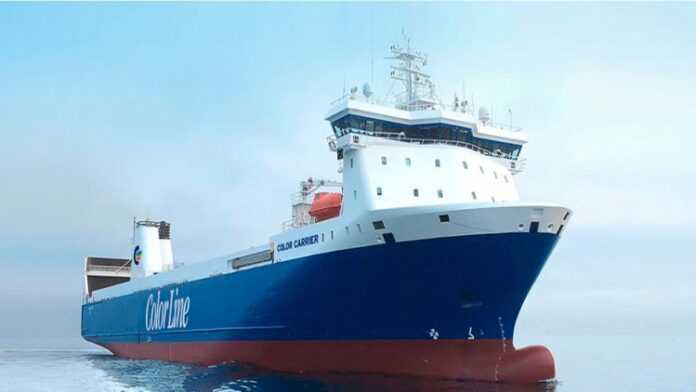
Speedcast International Limited, the world’s most trusted provider of remote communication and IT solutions, announced that the company has been awarded a new multi-year, fully-managed communications contract with Color Line, onboard the Color Carrier vessel. 

Color Line is Norway’s largest cruiseferry company, and Color Carrier is the latest addition to the Cargo service fleet operating between Oslo, Norway and Kiel, Germany. The new communications service provided by Speedcast uses 4G/LTE services in conjunction with VSAT and Iridium Certus™ links for enhanced reliability through multi-access technology coverage. Dual tracking LTE and multiple omni-directional antennas are used to increase range. All links are managed by Speedcast’s network operations team to ensure seamless connectivity.

“With the combination of tracking LTE antennas and omni-directional LTE antennas supported by an SD WAN solution, we are able to demonstrate nearly 100% coverage from LTE/4G connectivity on the sailing route for the Color Carrier,” says Brent Horwitz, Speedcast’s SVP of Cruise and Ferry. “Combined with reliable backup from VSAT and Iridium Certus L-band, Speedcast is able to provide robust and seamless connectivity covering the needs of Color Line’s corporate operations, as well as onboard crew and passengers at sea. The solution implements the latest technology innovations to achieve fast, low-latency communications.” 

“The Speedcast solution enables us to use the best available link at any given location in our sailing route to cover our operational needs,” says Anders Angell-Olsen, Chief Technology Officer at Color Line. “This is an important feature of our onboard communications system, since we depend on connectivity for ship tracking, safety and security and guest experience on all of our routes. The introduction of 4G/LTE as the main link is efficient and reliable, which is a good match for requirements onboard Color Carrier.”