-2.6 C
New York
Home Blog Page 954

Sea Machines and HamiltonJet collaborate to merge capabilities of autonomous control system

0

Boston-based Sea Machines Robotics announced today that it has successfully commissioned an SM300 autonomous control system aboard a HamiltonJet-powered workboat in New Zealand. HamiltonJet is now trialing this marine technology and has offered to provide on-demand customer demonstrations in the Southern Hemisphere.

The combination of Sea Machines and HamiltonJet systems for commercial vessels gives owners greater operational capability by enabling autonomous control of commercial vessels executing nearshore or coastal missions. The integration of water-jets delivers increased maneuverability, precise station-keeping and even emergency stops. The internal nature of a water jet drive also increases confidence when running autonomously and allows shallower-water operation. As well as offering full autonomy, the Sea Machines system can also act as an on-board skipper aid for precise waypoint following or as a remote-helm control system for on- or off-board use.

HamiltonJet commercial customers primarily operate in the marine security, survey, search and rescue, firefighting, ferry, aquaculture and pilot boat sectors.

Ahead of the install, the companies’ respective development teams worked from opposite sides of the Earth to ensure the Sea Machines system could digitally communicate with the proven HamiltonJetlink interface for autonomous systems. The installation and integration of the SM300 was completed in Christchurch without direct oversight by Sea Machines, a success made possible by the system’s intentional plug-and-perform interfaces.

Sea Machines designed the SM300 to integrate with the digital and analog marine systems, sensors and instruments commonly found on workboats and commercial vessels. Once installed, the intelligent SM300 adds the following operational capabilities:

  • Remote autonomous command,
  • Wireless remote-helm control,
  • Remote payload control,
  • Remote vessel monitoring,
  • Autonomous waypoint routing,
  • Autonomous collaborative following,
  • Obstacle detection and collision avoidance, and more.

Sea Machines’ Michael G. Johnson, CEO, said:

“Sea Machines is pleased to team with HamiltonJet, the unquestioned leader in water-jet propulsion systems for workboats and utility craft. In addition to providing valuable feedback for system advancements, HamiltonJet has an established global network and install base, potentially helping Sea Machines access new workboat, utility and high-end yacht markets around the world. As an early adopter of Sea Machines technologies, HamiltonJet again reaffirms its reputation as an innovator and advanced solutions provider for commercial marine operators.”

HamiltonJet’s Ben Reed, CEO, said:

“At HamiltonJet, we worked on our first remote-control application in 1993 and have since integrated with multiple autonomy providers in the military space. Sea Machines seem to have a well-packaged offering for the commercial market and I admire the strategy Sea Machines is taking, which is to turn autonomy into a product you can actually buy and get working with minimum fuss and modification. This is particularly true with HamiltonJet water-jets, where our simplified JETlink interface makes integration and control easy. We are impressed with the demonstration and happy to show anyone the vessel located in Christchurch New Zealand.”

Sea Machines’ SM Series of products, which includes the SM200 and SM300, provides marine operators a new era of task-driven, computer-guided vessel control, bringing advanced autonomy within reach for small- and large-scale operations. Sea Machines is also a leading developer of advanced perception and navigation assistance technology for a range of vessel types, including container ships. The company is currently testing its perception and situational awareness technology aboard one of A.P. Moller-Maersk’s newest ice-class container ships and has several other installations scheduled.

New great accomplishment for the Freeport LNG project

0

McDermott International, Inc. with its partners, Chiyoda International Corporation and Zachry Group, today announced that Train 2 of the Freeport LNG project on Quintana Island in Freeport, Texas, has begun producing liquefied natural gas (LNG). This significant project achievement is a precursor to first cargo.

Mark Coscio, McDermott's Senior Vice President for North, Central and South America, said:

"First liquid for Train 2 is another great accomplishment for the Freeport LNG project. As we progress to first cargo for Train 2, we applaud the diligence and commitment of the project team for driving Freeport LNG toward a safe completion."

Zachry Group, as the joint venture lead, partnered with McDermott for the Pre-FEED in 2011, followed by FEED works to support the early development stage of the project as a one-stop shop solution provider for Trains 1 and 2. Later Chiyoda joined the joint venture partnership for work related to Train 3. The project scope includes three pre-treatment trains, a liquefaction facility with three trains, a second loading berth and a 165,000 m3 full containment LNG storage tank.

Freeport LNG Trains 2 and 3 remain on schedule with Train 3 initial production of LNG scheduled for Q1 of 2020.

Innovative LNG-powered cruise ship was delivered to Costa Cruises

0

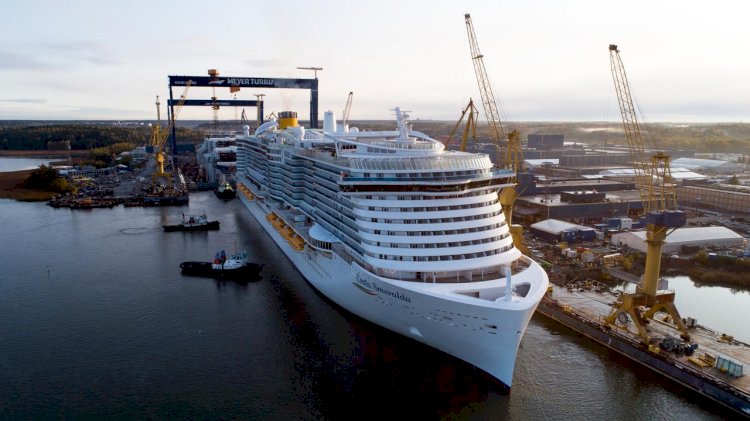
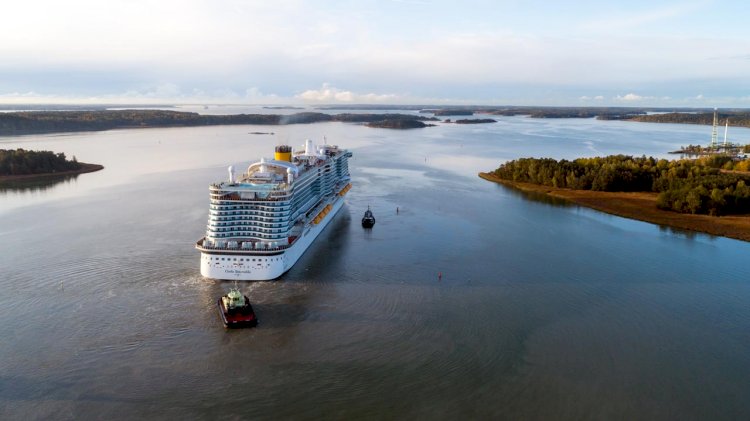
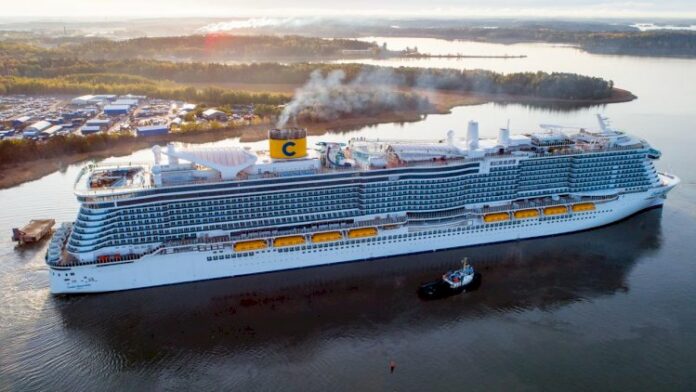
Costa Smeralda was delivered to Costa Cruises from Meyer Turku shipyard and will sail towards Barcelona today. The ship is one of the most innovative, and some would claim, the most beautiful ships ever built at Turku shipyard.

Neil Palomba, President of Costa Cruises, said:

“Costa Smeralda will be a further boost to the use of LNG in cruise ships, a technology we were the first to believe in, setting a new course in the cruise sector. Our Costa Group has invested in the construction of five new LNG ships as part of our leadership in sustainable tourism. It is an innovation in the cruise and overall shipping industries, destined to mark a step change as it guarantees a significant reduction in our environmental impact without compromising the safety aspects that are an essential priority for us. Costa Smeralda is a significant product innovation as well, with Italian hospitality remaining a fundamental and distinctive element of our brand, able to enchant and excite not only new cruise passengers but also more experienced ones".

Costa Smeralda is leading the LNG revolution in cruise ships, being part of the first LNG-powered cruise ship class in the world. The usage of LNG as fuel will cut down all small-particles and sulfur oxide emissions and significantly reduce nitrogen oxide and CO2 emissions of the ship.

Costa Smeralda is a breakthrough project featuring creative Italian design and innovative spaces for the guests to enjoy.

CEO of Meyer Turku, Jan Meyer, states:

“We have used all our knowledge, skills and imagination to design and build this ship. I would especially like to mention the Colosseo, a three-deck open area in the middle of the ship with state-of-the-art audio-visual technology inside which required a specific design and building capabilities. We are looking forward to the passengers enjoying some exceptional shows and performances there. We trust that the passengers will very much appreciate the design, quality and features of the ship during their coming holidays. The exceptional upper deck areas and the Spanish stairs in the aft of the ship will be a treat in warm Mediterranean weathers.”

Costa Smeralda is truly a traveling “smart city”. Apart from the major innovation of liquefied natural gas, the ship incorporates a series of cutting-edge technological innovations designed to further reduce environmental impact. The daily water requirement is achieved directly from the sea thanks to the ship’s desalination systems.  Energy consumption is reduced to a minimum by using LED lights, recovering the heat generated by the engines, the particular shape of the hull designed to significantly reduce drag in the water, and new- generation elevators that recover energy by re-introducing it into the electricity system.

Jan De Nul starts rolling out its ACT GREEN programme in Nieuwpoort

0

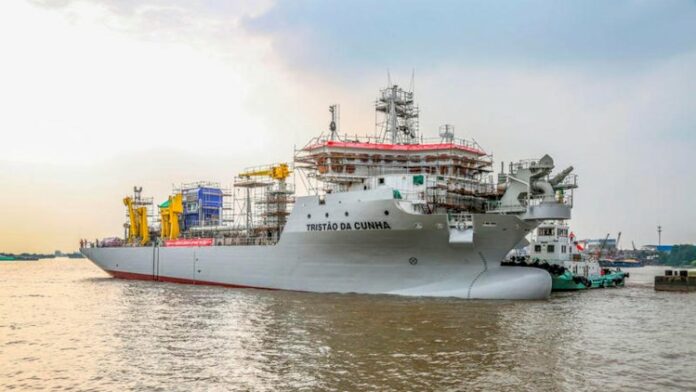
Early this week, the maintenance dredging works in the marinas of Nieuwpoort on the Belgian coast, got underway. A large part of these works are executed by means of the Cutter Suction Dredger Hendrik Geeraert and the split hopper barges Magellano and Verrazzano. 

Earlier this year, Jan De Nul Group announced its commitment to emit 15% less CO2 on this project. To achieve this goal the vessels Magellano and Verrazzano will be equipped with renewable biofuel from certified and sustainable waste flows. Together with the Alexander von Humboldt, Jan De Nul Group now has three vessels in the Benelux sailing on sustainable biofuel.

To further highlight its pioneering role, Jan De Nul Group has set up its newly developed energy-efficient construction shed, which consumes about 80% less energy than a standard construction site office, for its local office in Nieuwpoort. A first in Belgium.

As earlier mentioned, three Jan De Nul vessels in the Benelux are currently running on 100% sustainable fuel. And the ambitions are to go much higher. 

Michel Deruyck, Head of the Energy Team of Jan De Nul Group, says:

“In early 2020, our brand new trailing suction hopper dredger Sanderus will come to Belgium to execute maintenance dredging works on the river Scheldt and alongside the coast. Like all our new vessels, this new dredger is a ULEv (Ultra-Low Emission vessel). It is equipped with a state-of-the-art exhaust gas treatment system that extracts up to 99% of the nanoparticles from exhaust gases. Add to this the renewable fuel that will be used for this vessel and you’ll have a huge CO2 reduction and strongly decreased air emissions.”

Besides, measurements show that these vessels emit more than 90% less nitrous oxides (NOx). Michel Deruyck adds:

"It is exactly the emission of this nitrous oxide that appears to be problematic during the execution of the replenishment works ‘Kustlijnzorg’ in the Netherlands.”

Jan De Nul Group also invests in the energy efficiency of its infrastructure and starts rolling out its ACT GREEN programme on the site in Nieuwpoort. 

The site is equipped with the very latest energy-efficient construction shed. Through the extra insulation of walls, roof and floor, combined with triple glass, door pumps and an improved air density, heat and cold losses are minimised. Solar panels on the roof provide energy, a heat pump ensures heating and cooling. Conventional lights are replaced by led lighting. 

All these measures result in 80% less energy consumption. Michel Deruyck says:

“With our construction shed 2.0, we show both our employees and clients our high sustainability ambitions throughout all our business operations: from the very smallest to the highest energy consumers. In this way, we at Jan De Nul want to show to our colleagues within the construction industry that energy efficiency needn’t be difficult.”

In its invitation for tenders for maintenance dredging works in the coastal marine of Nieuwpoort, the Flemish government, through its agency ‘Maritieme Dienstverlening en Kust’ (Marine and Coastal Services MDK), encouraged tenderers to pay maximum attention to CO2 reduction through innovation. The submitted CO2 reduction proposals were taken into account when assessing the tender and contract allocation.

Nathalie Balcaen, Administrator-General of the MDK Agency, says:

“As a Flemish marine government agency, we want to focus on limiting our environmental impact in all ways possible. That is why we pay special attention to ecological criteria when inviting for tenders. This already results today in a concrete CO2 reduction thanks to the ecologically sound execution of dredging works based on the initiatives of the contractors with which we work together.”

Silverstream сollaborates with SWS on newbuild development projects

0

Silverstream Technologies, the leading air lubrication provider for the shipping industry, has today announced the completion of three joint development projects with SWS (Shanghai Waigaoqiao Ship Building Co., Ltd) across two new energy efficient vessels.

The projects spanned a 180,000dwt dual fuel bulk carrier design that has gained Agreement in Principle from Lloyd’s Register and a separate 300,000dwt dual fuel VLCC design that has achieved Agreement in Principle from both Lloyd’s Register and ABS.

The Joint Development Projects will see Silverstream’s team of naval architects and marine engineers support the yard to integrate the Silverstream® System from the very beginning of the design phase of the new vessels.  This reflects the growing demand for the implementation of proven clean technologies that drive operational and environmental efficiencies on newbuilds.

By integrating clean technologies at this early stage in a vessel’s lifecycle, optimum efficiency gains can be designed and priced into the overall newbuild plan, lowering the barrier to entry for the adoption of clean technology even further.

The announcement took place at a press conference hosted by SWS at Marintec China in Shanghai, during which the Agreements in Principle were handed over from Lloyd’s Register and ABS.

Positioned centrally within a suite of innovative technologies incorporated into each vessel design, the Silverstream® System will deliver proven, validated improvements to energy efficiency, thereby reducing fuel costs and associated emissions.

The Silverstream® System is expected to generate efficiency savings of between 5-10% across the two vessels, depending on their particular characteristics.

Speaking on the signing, Noah Silberschmidt, CEO of Silverstream Technologies, said:

“By signing these projects with SWS today, we are demonstrating that the appetite for proven clean technology with our industry has never been stronger. Incorporating efficiency solutions at the design phase of newbuild vessels is one of the immediate ways that owners and operators can realise fuel savings and also lessen their impact on the environment.

In further strengthening our ties with shipyards like SWS, we remove more barriers to the widespread uptake of clean technologies like ours. We are extremely excited to see the results of these Joint Development Projects and look forward to working with SWS, Lloyd’s Register, ABS, and our other project partners.”

Liu Jianfeng, Chief Technologist, SWS, commented:

“We have focused on developing clean and smart ships that are technically reliable and commercially feasible. We are proud to design advanced ships that will benefit ship owners and lead eco-friendly shipping.”

The Silverstream® System creates a carpet of microbubbles that coats the entire flat bottom of the vessel, reducing frictional resistance between the hull and the water and thereby dramatically reducing fuel consumption and related emissions.

NORDEN enters new biofuel collaboration

0

NORDEN has entered into a partnership with Danish based Kvasir Technologies, a spinout from the Technical University of Denmark with a patented technology to produce fuel from plant material.

Henrik Røjel, Fuel Efficiency and Decarbonisation Manager at NORDEN, says: 

“At NORDEN, we want to drive the shipping industry towards a cleaner future. If we are to truly make a difference, testing fuel alternatives is the right starting point. The collaboration with Kvasir is highly welcomed, both as part of our aim to be a front runner in the decarbonisation agenda and because companies thinking outside the box is a necessity in the process of finding the solutions of tomorrow”.

Kvasir Technologies focuses on transforming the part of biomass known as lignin and using it in fuel production. Lignin is often seen as a waste product, discarded without being used, yet easily accessible and found in large quantities, allowing for a high degree of scalability compared to other feedstocks.

There are a number of ways to convert biomass to liquid fuels. Kvasir’s technology stands out as it is, unlike most other technologies, able to convert not only cellulose but also lignin into a liquid biofuel product.

Joachim Bachmann Nielsen, CEO at Kvasir Technologies, says:

"This project will demonstrate the suitability of our biofuel as bunkers and further accelerate the technological development."

NORDEN’s interest in a partnership of this nature comes as a result of the company’s ever-growing wish to make shipping more sustainable. Finding better and greener alternatives to fossil fuel is thus highly prioritised within the company, which is already experienced in the testing of biofuel. In September 2018, NORDEN became the first ever to conduct a test voyage on a large ocean-going vessel powered by CO2 neutral biofuel.

Henrik Røjel adds:

“NORDEN wants to be a front runner in this phase of experimentation and help gather intelligence that will hopefully make a positive impact on greenhouse gas emissions and help the industry reach the ambitious goal for 2050 set by the International Maritime Organisation. In the effort to be a front runner, NORDEN is assisting in the testing and development of biofuel on owned vessels while working on making biofuel a standard on the company’s long-term chartered vessels.”

A full-scale test of Kvasir’s fuel will be conducted on one of NORDEN’s vessels at a later stage during the 3.5-year collaboration, where the purpose is to achieve better knowledge of the characteristics of biofuel and prove its suitability for future use. NORDEN will continuously share its vast insights into the handling of vessels and what properties the fuel must have in order to be a viable and functioning option.

The biofuel collaboration between NORDEN and Kvasir Technologies is part of ShippingLab – a joint industry initiative aimed at developing Danish competences in the fields of digitalization, autonomous shipping and environment-friendly technology. ShippingLab is supported by Innovation Fund Denmark, the Danish Maritime Fund, Orient’s Fund and Lauritzen Fonden.

Magnus Gary, Project Director at ShippingLab, says:

“Denmark is rightfully perceived as a leading nation within shipping and development of green technologies, and the collaboration between NORDEN and Kvasir Technologies is an excellent example of this, which we are very happy to support.”
 

JRC and Intellian announce new strategic maritime Satcom systems partnership

0

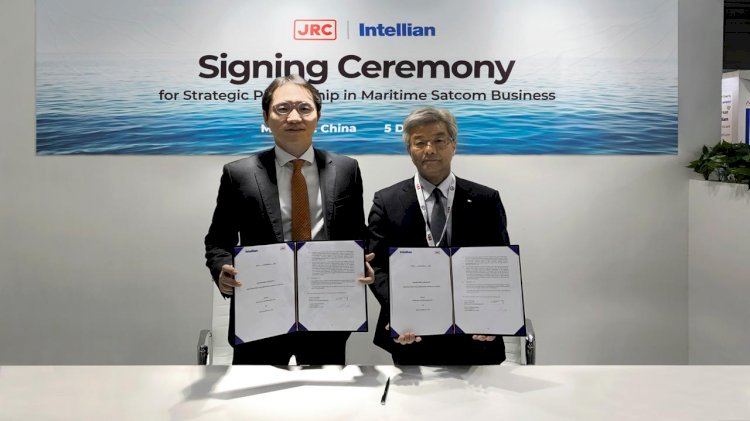
Intellian, the global leader in mobile satellite communication antenna systems, today announced that it has signed a strategic partnership with Japan Radio Co., Ltd. (JRC) in maritime satellite communication antenna technology. 

The marine industry is moving forward with the era of smart shipping, and demand from ship operators to share ship-to-shore navigation information, which is aimed at increasing efficiency and productivity in ship operations, has rapidly grown in recent years. In this purpose, highly reliable and high-speed connection between ships-to-shore is critical.

Through this strategic partnership, Intellian and JRC will start from the mutual provision of satellite terminals and technologies, considering joint development in the future.

Key to the partnership is Intellian’s ability to provide a full range of proven, quality antennas to JRC, which is one of the largest and oldest companies in the maritime industry. This will strengthen JRC’s satellite communications business in the maritime business with the new partner, Intellian, having a large selection of maritime satellite antenna terminals.

Takayuki Komiya, Executive Officer of Marine Systems Division at JRC said:

“The maritime industry is moving toward the era of smart shipping, and ship operators are looking for more insight into their operations to increase efficiency, productivity and to comply with regulations.

In order to contribute to this demand, JRC provides a service to share navigation information between ships and land through JRC equipment installed on approximately one third of the world’s commercial vessels. What’s critical is a reliable, high-speed connection between the ships and land, and thus JRC believes firmly that this new partnership will lead to further improvement of customer satisfaction.”

Eric Sung, CEO of Intellian, said:

“Intellian is the global leader in mobile satellite communication antenna systems, and a logical choice to partner with JRC. Our cooperation will broaden the market for both brands, allowing us to serve our combined customer bases across a wider range of applications. By sharing our expertise and experience, Intellian and JRC will provide a range of products and services which are second to none.”


ABS and CATL work together to research lithium battery propulsion

0

ABS and the Contemporary Amperex Technology Co., Limited (CATL) are to work together to research lithium battery propulsion for next generation vessels.

The Frame Cooperation Agreement, signed at Marintec, will see ABS and CATL jointly carry out the research on the technical standards for battery-powered vessels, including key safety-related technologies such as the propulsion system, charging system, power battery compartment layout and fire control.

The project also covers research into the technical standards of lithium batteries, including various battery material properties and combustion mechanisms as well as the performance of safety system, such as monitoring and early warning of thermal diffusion. The work will support revision of the classification of lithium battery inspection guidelines and drive improvements in the standard system for lithium batteries for ships.

Dr. Xiaozhi (Christina) Wang, ABS Vice President, Global Marine, said:

“Vehicle designs have taken advantage of new battery technologies such as Lithium batteries originally developed for the telecommunications industry with considerable success. ABS and CATL are at the forefront of exploring how to harness the potential of these new battery technologies to power ocean going vessels. Battery technology can certainly contribute to fuel savings and therefore GHG emissions reduction in a number of ways which make this an exciting area for practical research.”

Qu Tao, Assistant to the Chairman of CATL, said:

“The Li-Ion battery technology of CATL is already being applied to electric passenger vehicles, buses, electric trucks and a range of other vehicles.  We look forward to working with ABS to expand this technology to vessels and realizing our shared vision of a more sustainable society in the near future.”


NYK joins decarbonICE project transforming exhaust CO2 into dry ice

0

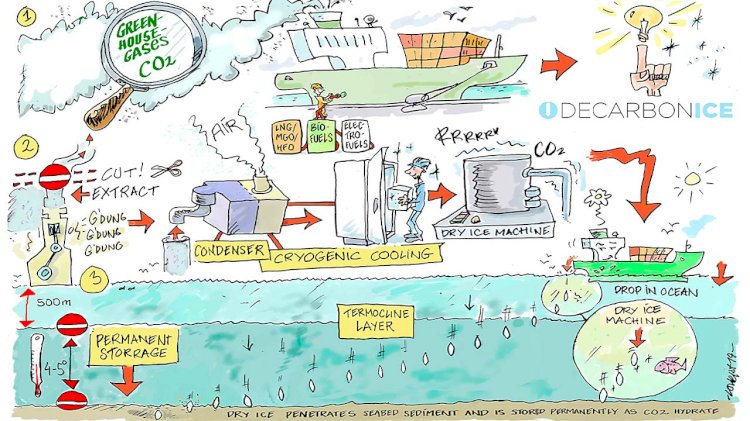
NYK has joined the international DecarbonICE project that will be conducting a feasibility study to capture onboard carbon as dry ice and store it in seafloor sediments.

The shipping industry is looking for carbon-free solutions to achieve the IMO 2050 target of a 50% CO2 emissions reduction (compared to the 2008 level). In response, new zero-carbon solutions are being developed around the globe, including alternative low-carbon fuels such as LNG fuel that can be used in place of heavy oil.

The DecarbonICE project was launched on October 1 by the Denmark-based Maritime Development Center, which has teamed with global shipping companies (including NYK), shipbuilders, and others to conduct a feasibility study on solutions to onboard carbon capture and storage, and to initiate discussions on environmental impact assessments and the IMO-approval process for the technology.

During the study, CO2 in the ship exhaust will be captured on board in a cryogenic process and turned into dry ice. It will then be transported into seafloor sediments during normal ship operations. There, the CO2 will be safely and permanently stored as liquid CO2 and CO2 hydrate.

The NYK Group is dedicated to achieving the SDGs through the group’s business activities and its medium-term management plan “Staying Ahead 2022 with Digitalization and Green.” NYK will continue its efforts to reduce CO2 emissions through initiatives such as the introduction of new technology and fuel conversion.

Learnmarine announced ultimate winter e-learning sale

0

With a new year quickly approaching, there’s never been a better time to learn a new skill. Whether you want to give your résumé a boost, start a side hustle, or just climb up the career ladder, we’ve got 4 eLearning Courses from Maritime Training Provider – TM Learnmarine that can help you get there.

There are courses in Maritime and Offshore Safety, Electrical Engineering, Maritime Cybersecurity, and most popular, Resilience in the Maritime Industry – just to name a few. And the best part is, they’re all an extra 50-70% off for the whole December 2019.

Learn something new before 2020 or even give the gift of knowledge to a friend. Just use the promo codes from the below table at checkout and you can slash an extra 70% off the sale price.

Each course certified by the  "Training & Certifying Centre of Seafarers", based in Odessa, Ukraine.

EX-Basics – The Fundamentals of Hazardous Area 14 Codes Left | UcsuGOPu | kPlwgNDR | UXfcAmNP | puxm4EIt | 5WdJtxjWUVz1uHBw |RNHcvmUK | DdAGVBEl | 5vT6TQ8z | 1q5sDCuz | PuG3SxB8 | qO1gvC9f | NM8901M2 | l1bAH655 | mH7KLFuy63FPqnax |
Maritime Cyber Security Awareness 13 Codes left K0rpYFlX | PPP7qEY4 | iGKfaJOv | zbmJEUkq | YiJoC1q6 | TTxC3BMp   | UVz1uHBw | | mCODTocd | ZuM6fcY3 | VYQ5Pvzs | VZodevOi | lp5zMtf4 | QRkIXUfG | BsnxprcO |
Resilience in the Maritime Industry 15 Codes left | taWRg64t | eqLLdXJu | ZKEBEY2R | G1oZWY1D | 5xtx6Qhe | |RNHcvmUK | oDUxybto | OEgy7k9s | vSpY4PFZ | 6bF6m3KL | 8N1UguZf | 1FAB6kVW | Plxm44X5 | hyrTWqgN | 3zUbtwbg | UVz1uHBw | DdAGVBEl1|
H2S Basic Training 13 Codes left  | oDUxybto | OEgy7k9s | vSpY4PFZ | 6bF6m3KL | |eqLLdXJu | RNHcvmUK | 63FPqnax | tX4EWgyG | AflvhkDA | nzx0H47V | AiMdZY0V | qmPbOm59 | l7buRkux | FgLzYe7H | iGKfaJOv |