2.7 C
New York
Home Blog Page 1051

IMO to adopt new approach over STCW White List process

0

IMO agreed to re-approach its listing process regarding the STCW Convention’s White List. As the South African Maritime Safety Authority (SAMSA) informed, this development came as the drawing up of the list of countries for delisting from the STCW Convention ‘White List’ did not follow due process.

According to SAMSA acting Chief Executive Officer, Sobantu Tilayi, the withdrawal of the threat took place after discussions between SAMSA, other Member States of the IMO and the organization.

Namely, Mr. Tilayi said that:"Discussions on the matter between the parties concerned came to a conclusion that the drawing up of the list of countries for delisting from the STCW Convention ‘White List’ earlier this year did not follow due process."

As a result, the IMO agreed to withdraw the list of affected countries and start a new process, that will be more transparent over the next year or two. Thus, the list that was drawn up will no longer be presented to the IMO Maritime Safety Committee that is scheduled to take place in June.

This means that concerns over South Africa possibly being delisted, have been prevented and the country no longer faces a threat of being delisted from the IMO STCW Convention White List.

"South Africa remains on course to complete its compliance work during the period that we understood to be required. In fact, we will have completed the work by the end of 2019, way ahead of schedule as we have now begun to speed up the process, with assistance we have sought from the IMO"…Mr. Tilayi added.

IMO holds a 'White List' containing countries who have confirmed to the IMO’s Maritime Safety Committee (MSC) to be following the relevant provisions of the International Convention on Standards of Training, Certification and Watchkeeping for Seafarers, 1978 (STCW Convention).

The Sub-Committee was provided with a list containing only those Parties which had communicated the relevant information, representing a significantly smaller number of Parties than those on the current “White List” set out in MSC.1/Circ.1163, IMO informed.

Specifically, nearly two-thirds (58%) of flag states on the current list would be wiped off if they were forced to comply with reporting standards, according to Nautilus International.

Among them could be Panama, the world’s largest flag state by deadweight tonnes, Bahamas, South Africa, UK, Norway, Netherlands, Sweden, Switzerland and the Philippines.

STCW-95 non-compliant Member States are often described as being on a ‘black list’. Ships flagged by a black-listed country can be denied entry to a port, inspected intensely, or detained when attempting to enter a port.

Source:safety4sea


Boosting data-sharing to improve Short Sea Shipping Performance: Evidence from Limassol port calls analysis

0

UNCTAD informed that it now acknowledges PortCDM as an enabler for improved performance in short sea shipping based on a study made on the role of enhanced collaboration and data sharing between ports for better performance in short sea shipping.

This study chooses to focus on short sea shipping in the Eastern Mediterranean for port calls made in Port of Limassol, Cyprus, and was published in the Sustainability Journal.

There is no standard, unequivocal definition of Short Sea Shipping (SSS). However, the European Union (EU) defines SSS as the movement of cargo and passengers by sea between ports situated in geographical Europe or between those ports situated in non-European countries with a coastline on the enclosed seas bordering Europe.

For shipping, and particularly for SSS, there are obvious and immediate benefits from improving data sharing systems. Assisting all those involved in the port call process (shipping companies, port service providers, and ships’ agents) to give better information, more easily is essential for better decision making and improved efficiency. An analysis of recent port call statistics for the Port of Limassol, Cyprus, indicates that there is scope to improve port call data sharing through applying the Port Collaborative Decision Making (PortCDM) concept.

Why reducing time in ports helps improve efficiency and how PortCDM can help

As nodes within maritime transport networks, ports are crucial to the success of many of the available intermodal options. Frequently, however, they are seen as bottlenecks in the transport chain that reduce the competitiveness of maritime corridors. This is because of such things as the lack of good road and rail links to ports, the low adaptability of port capacity to SSS, but, a less than optimal level of reliability and often un-coordinated administrative formalities.

Port charges make-up 40 to 60% of overall transit costs in SSS, whereas port charges in deep-sea transport are only 5–10% of the costs[ii]; thus, increasing port efficiency by reducing waiting and turnaround times is important. Within this context, an appropriate analysis of port efficiency, therefore, becomes an absolute prerequisite to identifying the port-centric factors that crucially influence the success or failure of policies to promote more sustainable freight transport and to inform future policy on such matters. An efficient port has the scope to charge higher prices by providing faster and more reliable services or allowing shippers to reduce resources elsewhere in a supply chain.

A conservative reduction of the time in port of up to four hours together with a corresponding speed reduction at sea, provides the potential for increased energy efficiency of between 2% and 8%. A port’s turnaround efficiency is one of the most important determinants of waterborne transport costs.

Port operators and service providers all need a sound framework and accurate data for planning their operations. To realize a port call that meets expectations, such as fast turnaround, just-in-time operations, and minimal waiting times for all involved, all parties need to ensure that they have access to the necessary data for their planning in a timely fashion. This includes data related to a port’s internal capabilities (such as the availability of resources and infrastructure required to serve a ship), as well as data on external conditions (such as the progress of a ship being served in a previous port and/or ship travelling towards a specific port). This means, for example, the ability to forecast with high precision the time of departure of a ship from a specific berth location, especially when another ship is planning to use the same berth soon. The same goes for ship movements.  A port should be able to forecast with high precision the Estimated Time of Arrival (ETA) of a particular ship to its service area. Data sharing is key to realizing a successful and timely port call, as described in the PortCDM concept.

To both manage and avoid unforeseen disruptions, STM includes PortCDM as the mechanism for expanding the planning horizons of port call processes, and the alignment of all actors in port call operations. Coordination is based on standardised data sharing that captures the spatial and temporal nature of a port call. These shared data can also constitute a valuable system of record for efficiency analysis and port planning.

PortCDM builds upon the idea that the timing of intentions and time when actions are completed are shared via a standardized message format. Each message has a timestamp (for example, when an event is planned), along with the required resources and location, as appropriate. The shared data should cover all the different dimensions of the port call process, from a ship’s intended arrival at the port area until it leaves after having been served according to the purpose of call.

As identified during validation of PortCDM, there is a desire for a downstream port to know the progress in the current port visit and to know the status of subsequent ports in a sequence of port visits. Special focus is directed towards the provision of data of the estimated and actual time of departure from the previous port (ETD and ATD) and the ETA to the next port. These data when accurately communicated between ports can form the basis for better coordination of the port call activities at the port of destination, especially when there is only a short distance between the visited ports. This is particularly important in SSS because of the short time horizon for the planning of operations.

Short Sea Shipping in the Cyprus Context

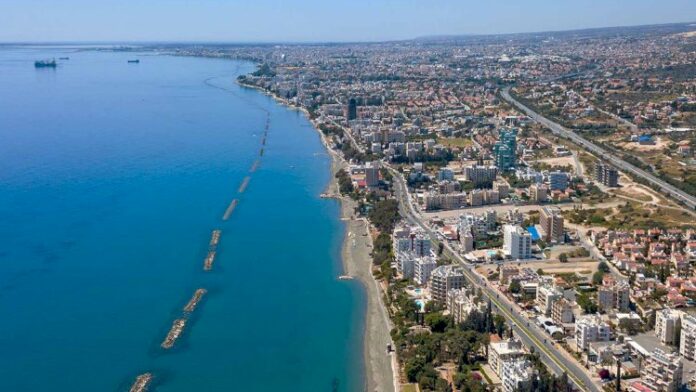
In the case of Cyprus, more than 90% of its seaborne transport is currently SSS. The geographical location of Cyprus encourages the use of its ports as transhipment hubs for SSS (see Figure 1).

To be a successful transhipment hub, a port must be able to plan its operations precisely and ensure that relevant data are available for visiting ships as well as for neighbouring ports. This is particularly important for Cyprus as the distances between Limassol and its neighbouring ports are quite short.

Over the last three and a half years, the Port of Limassol has participated in the validation of the PortCDM concept as part of the Sea Traffic Management (STM) Validation project. In doing so, it has progressively developed a maturity in sharing relevant data among key port call actors. PortCDM enables real-time situational awareness for all participants involved in a port’s activities leading to increases in operational efficiency within and around the port. The scope of this work extends from coordinating operations within the port to collaborative decision-making between ports of departure and arrival. The recent introduction of the S-211 digital data exchange standard for sharing time stamp data provides a foundation for developing new services for Port-to-Port (P2P) collaboration.

P2P communication is a lubricant of SSS and is particularly important for the various operators at Limassol. The main problem currently identified by all operators is the inability of ships and shipping agents to provide accurate estimates of a ship’s intended arrival (ETA).

Analysis of Limassol Port Call Data

Port call data for 8070 port call visits to Limassol in 2017 and 2018 were analysed, and they clearly show the need to improve the efficiency of port calls. The results may be typical of many other ports. The analysis looked at various combinations of ship type, origin, port call managing agent and the impact on arrival, berthing times and berth occupancy. In all cases, there was a wide variation in effectiveness. As has been recently shown in the validation of PortCDM, the cause of this variation stems from the lack of sharing timely and reliable data on the planning and progress of key port call events, such as ETA and the availability of resources, both in port and in the case of SSS, between ports of departure and ports of arrival.

Ship Type and Port Efficiency

Passenger ships achieved a high arrival punctuality with 61% of them arriving within 30 min of their ETA and an additional 31% arrived within 60 minutes. This should be expected since passenger ships operate on very strict schedules. However, for all other classes of vessel the 30-minute arrival punctuality reached between only 41% and 49%.

Not unsurprisingly, passenger ships also experienced the shortest berth waiting time with 97% of vessels waiting less than an hour. For container and general cargo vessels, the berth waiting time of less than an hour dropped to around 56%, while for bulk carriers and tankers it was below 30%.

Berth utilization followed similar patterns to berth waiting times, with statistically significant differences among all ship categories. Once again, passenger ships exhibited high berth utilization (95%) as they typically proceed to berth without delay and remain there until departure.

Vessel Origin and Port Efficiency

The Port of Limassol data indicated vessel traffic from 448 ports in 66 countries. The Eastern Mediterranean region accounted for 57.9% of the total traffic to the Port of Limassol, while 17.3% came from other ports in Cyprus. The Western Mediterranean and Black Sea regions contributed 11.3% and 9.6%, respectively, while the remaining regions accounted for 3.9%.

Ships arriving from Northern Europe and Asia exhibited high arrival punctuality (61% and 58% arrived within 30 minutes of their ETA, respectively), while ships arriving from the Black Sea and Asia regions suffered the longest waits for a berth, with only 11% and 15%, respectively, berthing within an hour of arrival in the port area.

Shipping Agents and Port Efficiency

In the two years of data that was analysed, the 8070 port calls were managed by 92 different shipping agents. Nine agents handled about half of the traffic at the Port of Limassol. The top 27 agents each managed more than 100 port calls each and accounted for 86% of the total traffic.

Among the top 27 agents, there were significant variations in arrival punctuality (arrival within 30 minutes of ETA) which varied between 29% and 92%; while berth waiting time (berthing within an hour of arrival) varied between 3% and 93%. Based on the observed data, some agents were highly effective in ensuring that their ships arrived just-in-time at the port and were berthed with minimal delay, while others exhibited the exact opposite behaviour. Overall, the analysis revealed that there was considerable variation in the performance of shipping agents.

Considering the port call data analysis described above and the experience from validating PortCDM, the ports of Cyprus, and especially the Port of Limassol will be upgraded as information hubs, exchanging information with both nearby ports and ships in the Eastern Mediterranean. This will enhance the capabilities of all port actors involved in the port call process including the shipping agents. Moreover, the enhanced data sharing capability is expected to help establish the Cyprus ports as transhipment hubs for SSS, which will be realized in the newly approved STEAM project, by improving their competitiveness.

The experience of the Cyprus ports is not unique, it illustrates a phenomenon that exists all over the world. It follows that every port should become connected to other ports to provide more efficient SSS. Many of the world’s ports, large and small, are confronting the same issues about making SSS more efficient – this applies equally in developed and developing countries. Better data sharing based on the PortCDM concept can help overcome problems observed and contribute to make shipping cleaner, safer and more efficient and to meet sustainability goals advocated by the United Nations.

By Mikael Lind, Research Institutes of Sweden – RISE – and Chalmers University of Technology, Sweden; Michalis Michaelides, Cyprus University of Technology – CUT, Cyprus; Robert Ward, RISE, Herodotos Herodotou, CUT; Richard T. Watson, RISE and University of Georgia, USA.

Source:safety4sea

Wärtsilä simulator software selected to teach modern navigational skills at three Netherlands training locations

0

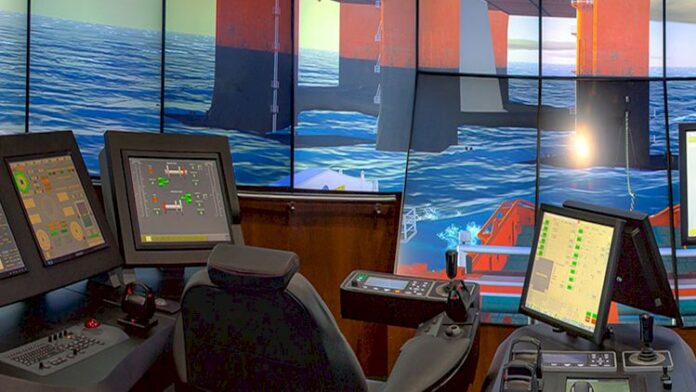
Software solutions from the technology group Wärtsilä have been selected for installation in three maritime training centres.

The turnkey systems will allow training to commence immediately following the site acceptance.The systems have been ordered by the Rotterdam based STC Group, an international maritime transport and logistics education provider. The order with Wärtsilä was booked in April 2019.

The Wärtsilä Navi-Trainer Professional (NTPRO) 5000 software will enable the teaching of the latest approaches to navigation, and equip trainees with the skills needed onboard modern vessels. Wärtsilä’s unique and tailored approach to the set task, together with its highly customisable software solutions were cited as being key considerations in the contract award.

“Safety at sea requires that crews be fully and properly trained. Our simulator software is designed to ensure that trainees can attain hands-on, realistic experience with the latest navigational systems. In collaboration with our friends and partners at training institutions across the globe, we have developed a comprehensive, flexible and customisable product maintenance and development programme,” says Alex Ponomarev, Sales Expert for Wärtsilä Voyage Simulation and Training.

“The three new simulator classrooms to be installed at STC Group locations in Rotterdam, Stellendam, and Katwijk will allow our vocational students to spend even more time on practical simulator training. It will also ensure that maritime education at all STC Group locations in the Netherlands is identical and future-proof, while being made possible by our ERDF*-financed project ‘Standing Strong for Rotterdam-South’”, says Joep Bonten, senior Project Manager Simulators at STC Group.

The Wärtsilä solutions will be installed and ready for use by the end of August 2019, in time for the start of the new academic year. In addition to the software, Wärtsilä will also provide project management and training. An extensive maintenance agreement to ensure optimal performance of the system will also be entered into.

World’s largest semisubmersible crane vessel christened in Singapore

0

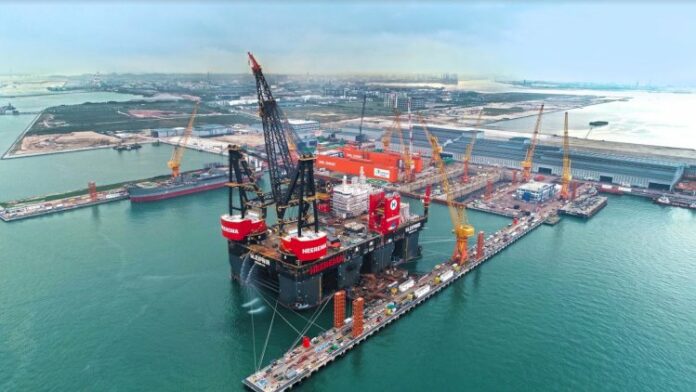
 Sembcorp Marine has completed the semisubmersible crane vessel Sleipnir for Heerema Marine Contractors (HMC).

Named after the Norse God Odin’s eight-legged stallion, the vessel was recently christened by Maha Hatfield at Sembcorp Marine’s Tuas Boulevard Yard in Singapore.

The SSCV Sleipnir has a 220-m (722-ft) by 102-m (335-ft) reinforced deck area, making it the largest crane vessel to be built, according to Sembcorp Marine. It also has two 10,000-metric ton revolving cranes which can lift loads of up to 20,000 metric tons in tandem. The cranes are capable of a 129-m (423-ft) lifting height.

It is also the world’s first crane vessel with dual-fuel engines running on Marine Gas Oil (MGO) and Liquefied Natural Gas (LNG). Coupled with an IMO- and US Coast Guard-approved ballast water management system, the Sleipnir will operate sustainably across all environmental jurisdictions.

The vessel can accommodate 400 persons and will be deployed globally for installing and removing jackets, topsides, deepwater foundations, moorings, wind turbines, and other offshore structures.

HMC has secured contracts to deploy the vessel in various offshore energy developments, including: Leviathan topsides installation in the Mediterranean Sea; Tyra jackets and topsides installation and removal in the Danish North Sea; Brae B jackets and topsides removal in the UK North Sea; and transportation and installation of the Hollandse Kust Zuid Alpha HVAC platform offshore the Netherlands.

At its peak, the construction of the Sleipnir involved up to 3,700 workers in a single shift. The project has a current Lost Time Injury Rate of 0.35 per million-man hours worked, according to Sembcorp Marine.

The vessel will leave for sea trials shortly and is scheduled for delivery to Heerema soon afterward.

Source:offshore-mag

10 dead in Chinese ship repair accident

0

Ten workers were killed and 19 injured due to carbon dioxide leak on the Chinese cargo ship Jin Hai Xiang that was being repaired at Xixiakou ship repair yard in Shandong province.

According to the notice released by Shandong Weihai Municipal People’s Government, 10 people were dead and 19 had been send to hospital.

Based on the initial investigation, the accident was caused by carbon dioxide leak in the fire extinguishing system while a team was conducting maintenance operation on the ship. The third officer of the ship has been detained by local police as it is believed his actions were likely to be responsible for the accident.

The 69,000 dwt cargo ship, Jin Hai Xiang, owned by Fujian Shipping Company, was built in 1994. The company has sent a team to Shandong for further investigation together with local police.

Source:seatrade-maritime

Star Bulk Carriers agrees to acquire eleven dry bulk vessels from Delphin Shipping

0

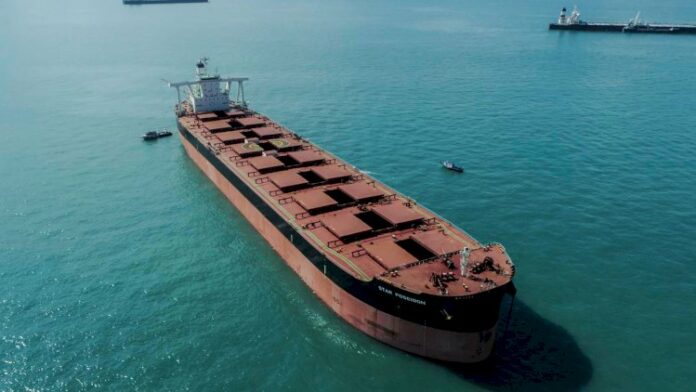
Star Bulk Carriers Corp. , a global shipping company focusing on the transportation of dry bulk cargoes announced today that it has entered into an en bloc definitive agreement with entities controlled by Delphin Shipping LLC, an entity affiliated with Kelso & Company, pursuant to which the company will acquire eleven operating dry bulk vessels for an aggregate purchase price of $139.5 million, payable in the form of a) $80.0 million in cash and b) 4.503 million common shares of Star Bulk.

The company has secured exhaust gas cleaning systems for all of the Vessels with attractive delivery dates. The cash portion of the purchase price will be financed through proceeds of a new seven-year capital lease of up to $93.6 million with China Merchants Bank Leasing, and an additional tranche of $15.0 million for financing of Scrubbers, thus offering approx. $9.0 million of additional liquidity for Star Bulk.

The vessel acquisition, which is expected to be consummated in June 2019, remains subject to the execution of definitive finance agreements and customary closing conditions. The technical management of the 11 vessels will remain with an entity affiliated with Technomar, while commercial management will be taken over by Star Bulk.

As a result of the contemplated transaction, entities affiliated with Kelso are expected to own approximately 4.6% of the outstanding common shares of the company. After giving effect to the vessel acquisition, Star Bulk will have a fleet of 120 vessels on a fully delivered basis, aggregate  2 cargo-carrying capacity of approximately 13.1 million deadweight tons and vessels with an average age of 7.8 years.

Source:portnews

PGS initiates $675m refinancing

0

Norwegian offshore survey service provider PGS has initiated a refinancing program seeking to raise about $675m in total.

The company plans to raise $525m in a 5-year first lien term loan and another 5.5-year $150m of second lien debt.

The proceeds will be used to repay the company’s existing $380m term loan maturing in March 2021 and $212m senior notes maturing in December 2020, and to reduce drawings under its revolving credit facility that are currently outstanding.

Final terms and amounts will be decided following a book building process and the transactions are expected to close by mid June.

Additionally, PGS has secured a 4.5 years commitment for a $250m extension of the company’s current $350m revolving credit facility.

Source:splash247

Green Maritime Methanol Project Shortlists Nine Ships

0

The Green Maritime Methanol consortium has selected nine ships for research on the application of renewable methanol as a marine fuel. New designs, newbuildings as well as existing ships of Boskalis, Van Oord, the Royal Netherlands Navy and Wagenborg Shipping were selected.

The vessel sizes vary in length from between 40-160 meters, with tonnage ranging from 300-23,000dwt and in installed power from one to 12MW. Research for these ships will start with determination of the cost for implementation and use of methanol fuel systems. The results of this research will be compared with low sulfur marine diesel.

Each of the ships has its own specific operational profile, providing a specific insight into the feasibility of methanol for a certain ship type, its sailing route and cruising speed. Not only cargo vessels are being evaluated in this phase, as attention will also be paid to ferries, dredgers and support vessels operating in coastal waters.

For each scenario the most attractive technical, operational and economical configurations will be determined. The parties envision sharing and exchanging knowledge within the consortium with opportunities to further develop methanol as a transport fuel for the maritime sector.

Recently, the consortium welcomed three new entrants that provide extra knowledge, power and skills to the consortium, the Royal Netherlands Shipowners’ Association (KVNR), Bureau Veritas and Lloyds Register.

Green Maritime Methanol now has a list of partners which includes: Bio MCN, Royal Boskalis, Bureau Veritas, C-Job Naval Architects, Damen Shipyards, Defence Material Organisation, Feadship, Helm Proman, Royal IHC, Royal Netherlands Naval Institute (KIM/FMW), Royal Association of Netherlands’ Shipowners (KVNR), Lloyds Register, MARIN, Maritime Knowledge Centre (MKC), Marine Service Noord (MSN), Methanol Institute, Port of Amsterdam, Port of Rotterdam, Pon Power, TNO, TU Delft, Van Oord, Netherlands Association of Importers of Combustion Engines (VIV), Wagenborg Shipping and Wärtsilä.

The project is supported by TKI Maritiem and the Dutch Ministry of Economic Affairs and Climate Policy and runs until December 2020.

Earlier this year, the Port of Antwerp in Belgium initiated a project to produce sustainable methanol as part of its ambition to be a carbon-neutral port.

Elsewhere, the Methanol Institute is backing a project at Nanyang Technological University of Singapore which will be the first evaluation of methanol as a marine fuel in Asia.

Source:maritime-executive

Damen and Hanson sign contract on new dredger vessel

0

On 10 May 2019, Damen Shipyards Group and Hanson Aggregates Marine signed a contract for construction of a Marine Aggregate Dredger (MAD) 3500 vessel, the company said in its release. The ship will be used to extract aggregates offshore up to depths of 55 metres, for use in the onshore construction industry. 

Due for delivery in March 2021, the vessel will be constructed in Damen’s shipyard in Galaţi, Romania. The dredge equipment and screening installation will be constructed by Damen Dredging Equipment (DDE) in Nijkerk, The Netherlands. 

Hanson UK is a leading supplier of heavy building materials to the construction industry, and produces aggregates (crushed rock, sand and gravel), ready-mixed concrete, asphalt, cement and cement-related materials. Hanson’s marine business is Europe's largest producer of marine-dredged sand and gravel. It owns a purpose-built fleet consisting of six aggregate dredgers distributing aggregates from a network of wharves.

The MAD 3500 design achieves the optimal balance between payload and efficiency within limited dimensions and is ideally suited to operating within the dimensions of Shoreham lock on the English south coast. With the specific lock passage limiting the vessel’s overall length to approximately 103.5 metres, a deadweight of just under 6,800 tonnes and a speed at loaded draught of approximately 12.5 knots are within the vessel’s capability. The vessel’s length and width offer the optimal amount of cargo space to achieve maximum transportation efficiency on each passage through the lock.

This dredger will be used by Hanson’s marine business to extract aggregates in the British Channel and North Sea, aided by a number of special features specific to its innovative design, including a 1,400 kW permanent magnet electric motor, which powers the dredge pump for collecting aggregates at -55m. This particular vessel will also feature a dry unloading system built by Damen’s partner PLM Cranes BV.

The MAD 3500 is the latest vessel in Damen’s series of newly designed and recently launched specific marine aggregate dredgers. The application of innovative maritime engineering technology provides the capability for the vessel to function impressively under heavy weather conditions without compromising comfort or the safety of the crew. The bow is enclosed to protect deck equipment, all dredge pipes are situated above main deck level for safety, and the modular construction of the DDE dredge systems allows easy replacement of parts on the piping and screening installation.

This sale marks Damen’s second contract for a MAD 3500, following an earlier order from the UK in 2018. Joppe Neijens, Damen sales manager, is convinced Hanson won’t be disappointed with their order. “A great deal of market research and modern engineering went into the development of the MAD series,” says Joppe. “These vessels are ideally equipped to bring aggregate dredging fleets into the 21st century. It’s a privilege to provide Hanson with a product we trust will enhance their future operations, and we look forward to a fruitful collaboration with Hanson in the future.”

Chemical blast onboard KMTC feeder sends more than 200 to hospital + Video

0

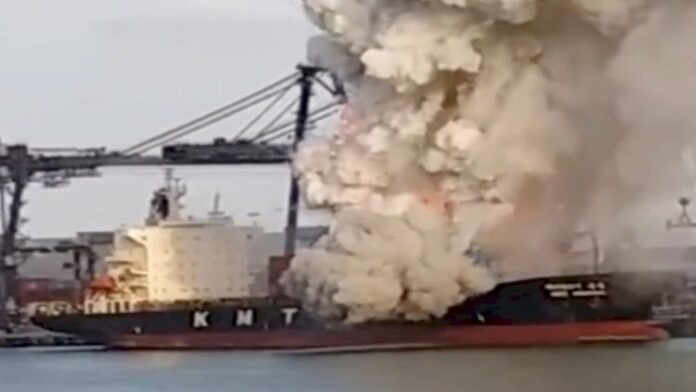
The Thai authorities continue to investigate the huge fire onboard the 21-year-old boxship KMTC Hongkong that saw more than 200 people head to hospital.

The 1,585 teu ship, owned by South Korean company KMTC, arrived at Laem Chabang from Hong Kong on May 24.

The fire occurred on Saturday morning and was eventually put out late that night with investigators dispatched to the scene yesterday.

The team found calcium hypochlorite in 13 containers and chlorinated paraffin wax in another five containers. The owners of these shipments had not declared the toxic chemicals to the Thai Customs.

The Pollution Control Department (PCD) said today that the threat from hazardous air pollution caused by the chemical fire had decreased to safe levels. Since the fire occurred, around 200 people, including local residents, have been hospitalised for treatment after they suffered from noxious smoke.

The water used in firefighting has also created contamination concerns. PCD has already coordinated with the Thailand Port Authority to place floating booms around the area to prevent further chemical contamination in the sea.

“Both firefighting officers at the scene, the local people and medical staff treating the injured people did not know what they were really dealing with. This lack of information contributed to improper protection against chemical exposure for the officers at the site, danger to people around the seaport, and made it harder for medical personnel to treat the injured people,” Somnuck Jongmeewasin, an environmental expert, told Thai newspaper The Nation.

“The Thailand Port Authority needs to heighten surveillance of every shipment that passes through its seaports, or else we could suffer from a deadly chemical blast, like what happened in Tianjin port in China, in the future,” Jongmeewasin said.