2.7 C
New York
Home Blog Page 1050

Russia Launches Nuclear-Powered Icebreaker

0

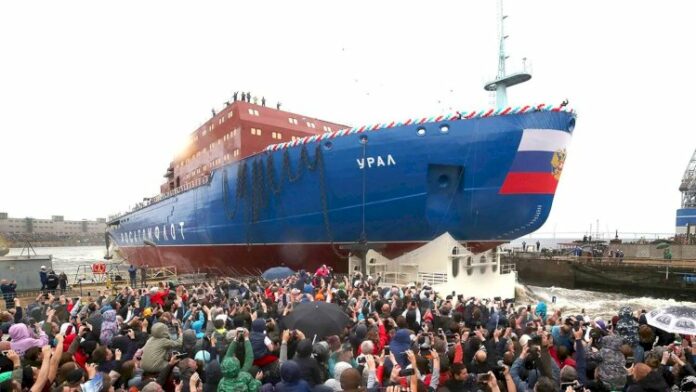
Russia's nuclear energy agency, Rosatom launched the nuclear-powered ice breaker Ural at the Baltic Shipyard in St. Petersburg.

"With the ceremonial launch of Ural, Russia’s nuclear energy giant, Rosatom, has completed another step towards ensuring all-year round navigability of the Northern Sea Route (NSR)," said a press release.

The 173 metre-long ‘Ural’ is equipped with two highly efficient and compact RITM-200 nuclear reactors on board, capable of generating up to 350MW combined, allowing the ship to break through ice as thick as 3 meters.

The cutting edge RITM-200 type reactor makes its world debut on the ‘Ural’ as well as on its sister vessels from the 22220 project, the ‘Arktik’ and the ‘Sibir’, before Rosatom deploys it in floating and landlocked nuclear power plants.

Another unique feature of the project 22220 vessels including the ‘Ural’ is its dual-draught design. Ballast tanks inside its hull can be adjusted easily to alter the ship’s draught depending on whether the vessel needs to navigate the Arctic sea or shallow river estuaries.

With this smart design solution, Rosatom is essentially getting two types of ice breakers for the price of one, representing a potential cost saving of hundreds of millions of dollars.

Commenting on today’s ceremonial launch, Rosatom Director General, Alexey Likhachev, said: “The ‘Ural’ together with its sisters are central to our strategic project of opening the NSR to all-year activity. Our goal for 2024 is for more than 80 million metric tons of shipments to pass through the NSR. We also plan to add two more project 22220 ships to our nuclear icebreaker fleet by 2027. The contract for construction of these icebreakers is expected to be signed by the end of this August”.

The Russian government has given Rosatom the lead in the development of the NSR infrastructure. The total amount of funding for the NSR development project is 734.9 billion roubles for six years. Up to a third of that, 274 billion roubles, will be provided from the government budget.

The remaining two-thirds, over 460 billion roubles, will be funded by investors, including Rosatom, Rosneft and Novatek and others, who are interested in transporting cargo along the Arctic sea route.

Source:marinelink
Hutchison Ports inks deal to develop Canadian deepwater container terminal

0

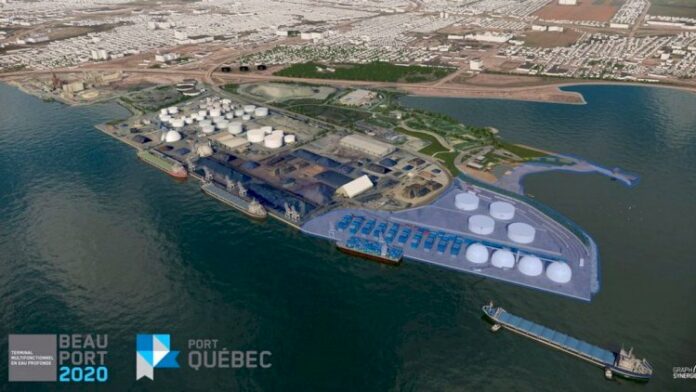
Hutchison Ports has been selected by Canada’s Québec Port Authority (QPA) to work alongside Canadian National Railway (CN) to build and operate a new deepwater container terminal known as project Laurentia.

The CAD775m ($575m) project will be financed primarily through the joint investment of the three partners.

“Québec City will become Hutchison Ports’ gateway to the East coast of North America. With its fully intermodal deepwater port, its strategic location to reach the midwest market, and the strong support shown by the local authorities, the Québec project has all the attributes to be successful in this highly important market,” said Eric Ip, group managing director of Hutchison Ports.

Previously known as project Beauport 2020, the QPA has rebranded the container terminal to Laurentia to reflect the continental reach and importance of the facility on the Saint Lawrence.

The Laurentia terminal is a major inland deepwater terminal in North America and the only facility in Saint Lawrence which could accommodate the new generations of very large ships.

The terminal also benefits from a direct railway and highway connection and has all the necessary space to handle thousands of containers per year.

According to a study from KPMG, for the construction phase alone, the project will generate CAD500m in economic benefits and an average of 1267 jobs a year. Ultimately, the project will generate CAD84m in economic benefits a year and will create nearly 800 jobs, including 500 direct ones, in Québec.

The deepwater container terminal project is currently under an environmental assessment process with the Canadian Environmental Assessment Agency.

Hutchison Ports was selected after a competitive process in which QPA invited the leading international port operators to provide proposals to participate in the project.

“Today, through a joint venture with Hutchison Ports and CN, we are setting the stage for this project to become a North American success in terms of business and social acceptability not to mention a vector of economic development for Québec, allowing the Saint Lawrence to gain additional growth and competitiveness with US ports,” commented Mario Girard, president and ceo of QPA.

Offshore prepares for third UK auction battle

0

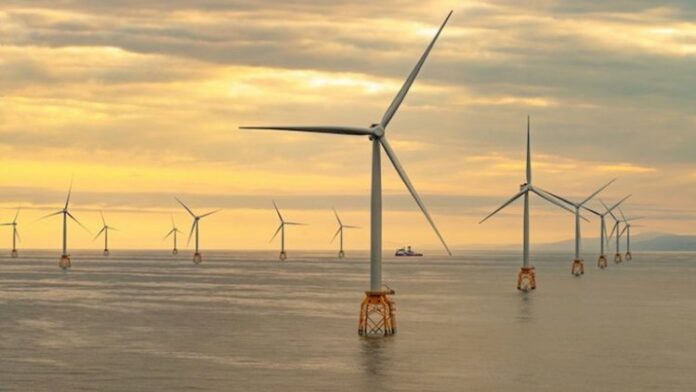
Offshore wind developers with consented projects totalling over 8GW are planning bids in the UK's latest Contract for Difference auction round, which opens tomorrow.

Available capacity at the auction is limited to 6GW and so competition among developers to secure 15-year price support will be fierce.

Developers will compete in the so-called Pot 2 less established technologies of the auction against remote island wind and wave and tidal projects, among others.

How low those prices are and when those projects are planned to be commissioned will determine how much capacity is awarded in this auction

Developers have until 18 June to enter their projects into the CfD3 auction.

They are allowed to bid in four different variations of each project, but each variation must be bid at a different strike price and cannot be bigger than the base bid.

Projects eligible for inclusion off Scotland are Red Rock's 700MW Inch Cape and SSE's 1.5GW Seagreen Phase One.

Off the coast of England, ScottishPower Renewables' 1.2GW East Anglia Three, Innogy's 1.4GW Sofia and three SSE/Equinor sites totalling 3.6GW in the Dogger Bank are all in the chase.

Unsuccessful bidders will likely re-submit projects into the next auction round in 2021.

“There is still no clear route to secure large enough PPA deals to go merchant. BEIS has committed to auctions until 2030, which means developers can resubmit projects in a couple of years basing them on new technology that will make them even more competitive,” Frias said.

ScottishPower chief executive Keith Anderson said: “Offshore wind works. British innovation has driven down costs and supported the development of a diverse supply chain across the UK."

We’re currently building the first and biggest project to be delivered under the government’s supply chain plan and it has the highest UK content of all, above the current industry average of 50%, ensuring the benefits are felt across the country.

Now with the Sector Deal in place investing £250m into the UK supply chain this latest auction offers a huge opportunity to businesses across the UK.

Source;renews

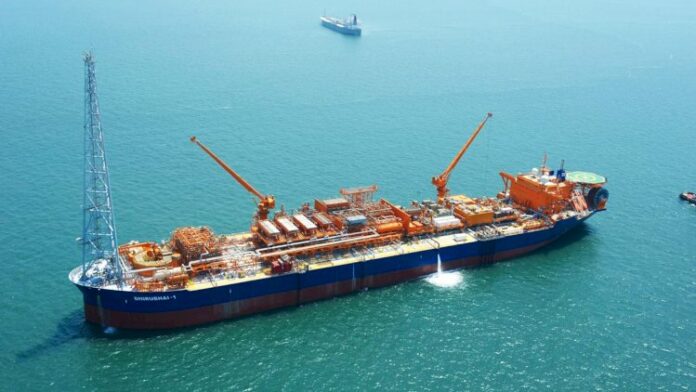
Ocean Yield announces extension of option for long-term charter with Aker Energy for the FPSO Dhirubhai-1

0

On the 12th of February 2019 Ocean Yield ASA entered into an option agreement with Aker Energy AS ("Aker Energy") for a long -term bareboat charter of the FPSO Dhirubhai-1.

The option period expired on the 1st of May but was extended until the 30th of May 2019. Ocean Yield has agreed with Aker Energy to further extend the option period until 1st September 2019 against an additional compensation.

Aker Energy is currently evaluating different opportunities for the FPSO at the Deepwater Tano Cape Three Points (DWT/CTP) block offshore Ghana. As there is uncertainty related to a contract for Dhirubhai-1 with Aker Energy, Ocean Yield is in parallel pursuing other employment opportunities for the FPSO. In that respect, Ocean Yield has entered into an agreement to perform a fully paid Engineering Study for the potential use of the unit on behalf of a non-related independent oil company.

When reviewing future dividends of Ocean Yield, the prospects for long-term employment of the FPSO will be taken into consideration. If no satisfactory employment can be firmed up within the end of Q1 2020, an adjustment of the current dividend level of USD 0.191 per share per quarter will be considered. Based on the expected earnings from the existing portfolio of vessels with long term charters and the company's continued growth ambitions, a quarterly dividend of about USD 0.15 per share as from Q1 2020 is currently considered to be an appropriate dividend level until a new employment contract is secured for the FPSO.

Ocean Yield ASA is a ship owning company with investments in vessels on long -term charters. The company has a significant contract backlog that offers visibility with respect to future earnings and dividend capacity.

Source:Portnews

IRClass Hosts Multi-Stakeholder Seminar on IMO Sulphur Limit Compliance and GHG Emissions Strategy

0

Indian Register of Shipping hosts multi-stakeholder seminar on IMO sulphur limit compliance and GHG emissions strategy.

MUMBAI, INDIA, 28 May 2019 – The Indian Register of Shipping (IRClass), a leading ship classification society, recently hosted a seminar in which industry stakeholders discussed the impending 2020 IMO fuel sulphur regulation and the initial IMO Strategy on reduction of greenhouse gas (GHG) emissions from ships.

Held at IRClass’ head office in Mumbai, India, the one-day ‘Fuel 2020 & GHG Emission’ session drew participation from ship owners, ship operators, consultants, marine engine suppliers and bunker suppliers.

In his welcome address, Mr Vijay Arora, Joint Managing Director of IRClass, spoke about the rapid advancements in marine fuel technology and the need for both short-term and long-term plans to implement IMO’s GHG emissions strategy. He also mentioned that the industry today faces challenges which are both regulatory and technical in nature which need to be deliberated by all stakeholders to gain insights.

Guest-of-Honour Capt. Ashok Mahapatra, former Director of IMO’s Maritime Safety Division, highlighted in his keynote address the hitherto lack of clarity amongst ship owners, underwriters and charterers in dealing with non-compliant fuel post-sulphur limit.

The seminar featured presentations by subject matter experts from Indian Register of Shipping (IRClass), Reliance Industries, Great Eastern Shipping, Cummins India and Indian Oil Corporation. The presentations provided various perspectives – operational, technical, legal and commercial – regarding both fuel sulphur limit compliance and GHG emissions.

The seminar concluded with a lively panel discussion on the disposal of non-compliant fuel, the availability of compliant fuel and the development of joint industrial guidelines for shipowners. The panel agreed on the need for ongoing multi-stakeholder dialogue to pre-empt and address industry challenges of an increasingly multi-faceted nature.

Mr Arun Sharma, Executive Chairman of IRClass, said: “It is important that we include stakeholders from the supply side, such as fuel suppliers and equipment manufacturers, when debating how the industry should respond to the IMO sulphur limit, we are likely to see a shift in our energy future where LNG, fuel cells and methanol will take a more prominent role.”

Latest Subsea 7 vessel designed for longer tiebacks

0

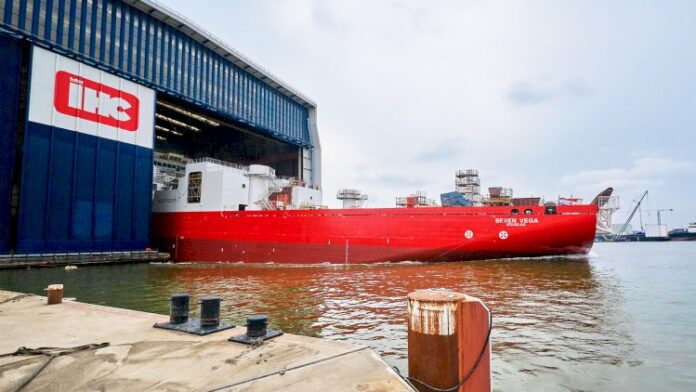
 Subsea 7’s latest reel-lay vessel Seven Vega has undergone a naming ceremony at Royal IHC’s shipyard.

According to Stuart Fitzgerald, executive vice president Strategy and Commercial, the vessel, due to be delivered in early 2020, “will be one of the most capable and cost-effective reel-lay vessels in the market…

“It has been designed to deliver flowline technologies that address the growing market trend towards longer and more complex tieback developments…This system will be capable of installing complex rigid flowlines including pipe-in-pipe systems and electrically heat traced flowlines in water depths up to 3,000 m [9,842 ft].”

IHC designed the Seven Vega in close cooperation with Subsea 7. Among the claimed innovations are its compact dimensions, achieved through the positioning of the three engine rooms and main reel, efficient use of the superstructure, and a low air draft pipelay tower.

There is a large aft working deck, while the optimized mass distribution is said to minimize the ballast water requirement.

The twin-tensioner pipelay ramp tilts to allow pipe placement in shallow waters and in depths of up to 3,000 m. A large multi-level workstation is said to optimize efficiency of operations in and around the firing line, while the positioning of the main and auxiliary reels recessed into the main deck provides payload flexibility.

In addition, the all-electric main crane allows lift parameters to be swiftly altered without the need to adapt the active heave system.

The Seven Vega has an overall length of 149 m (489 ft), a breadth of 33 m (108 ft) and a Class 3 DP system. Its reel-lay system has a 600-t top tension capacity comprising a 32-m (105-ft) main reel and a 17-m (56-ft) auxiliary reel with respective storage capacities of up to 5,600 t and 1,600 t. The main cranes provide a lifting capacity of 250 t and 50 t, with various smaller cranes alongside two side-launching work-class ROVs.

This will be the ninth vessel IHC has delivered to Subsea 7.

Vroon vessels to support BP’s Caribbean operations

0

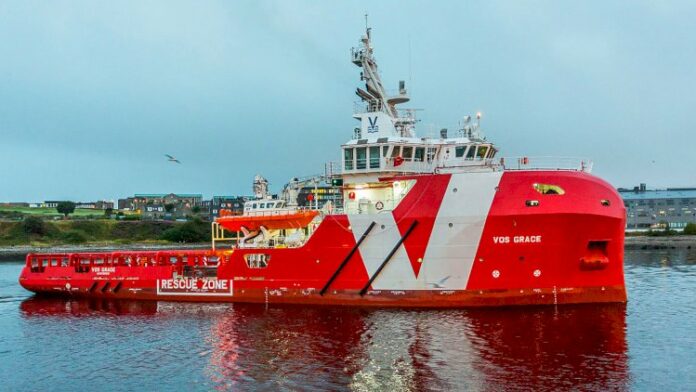
 BP Trinidad and Tobago has awarded Vroon Offshore Services Aberdeen a three-year contract to supply three emergency rescue and response vessels.

The VOS GorgeousVOS Fabulous, and VOS Grace will support BP’s operations in the Caribbean.

The vessels are equipped to recover and rescue crew members from the water, provide a place of safety and medical aid, monitor the safety zone, help avoid collisions, and act as a first response in handling oil spills and as a reserve radio station.

All three vessels and their crews have departed the North Sea to service the contract and Vroon Offshore will establish a support presence in Trinidad and Tobago.

Source:offshore-mag

US Coast Guard warns on renewed cyber attacks aimed at shipping

0

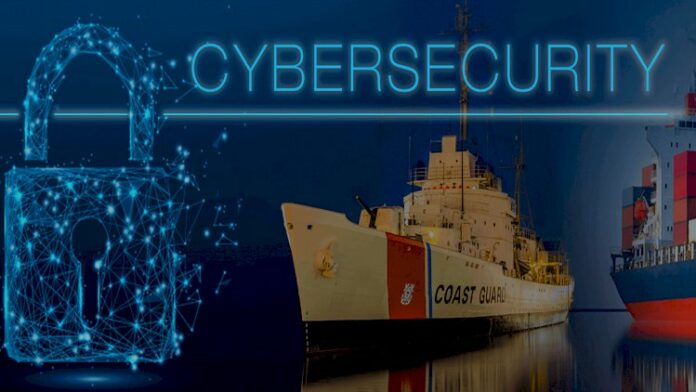
The US Coast Guard (USCG) has warned of renewed phishing and malware attacks targeting shipping.

In a safety bulletin issued on May 24, the USCG warned of “cyber adversaries” taking aim at commercial vessels.

Hackers are attempting to gain sensitive information including the content of an official Notice of Arrival (NOA) using email addresses that pose as an official Port State Control (PSC) authority such as: port @ pscgov.org.

Additionally, the Coast Guard has received reports of malicious software designed to disrupt shipboard computer systems.

The Coast Guard has urged maritime stakeholders to verify the validity of the email sender prior to responding to unsolicited email messages. If there is uncertainty regarding the legitimacy of the email request, vessel representatives should try contacting the PSC authority directly by using verified contact information. Additionally, the USCG said vessel owners and operators should continue to evaluate their cyber defence measures.

Source:splash247

How important is subsea inspection, maintenance, and repair for equipment

0

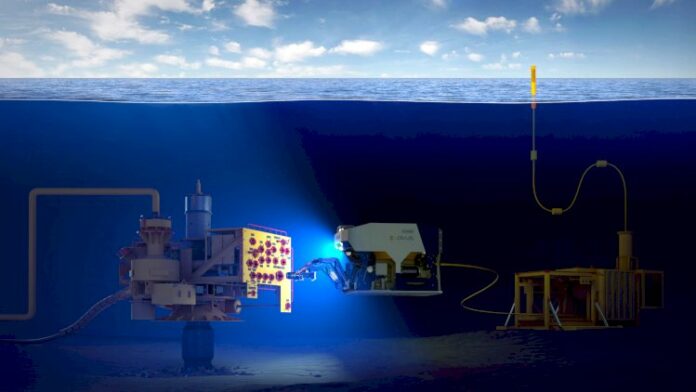
ABS published an advisory addressing the importance of subsea inspection, maintenance, and repair (IMR). In the advisory it discusses options for damaged equipment and the procedure for life extension assessments.

The IMR aspects of the subsea integrity management provide detailed methods and action items for managing the integrity of each system or components of equipment. The subsea integrity management process also explains the benefits of cost savings, efficiency in repairs, and detailed information on the asset and its anticipated life.

The inspections can also provide detailed information that can be utilized for damage assessments for life extension projects. The refined data can then provide vital insight into analysis that can predict the remaining life of a structure or equipment.

The specific challenges regarding IMR include:

  • Lack of inspection technologies capable of deep depths;
  • Industry resistance;
  • Unreliable/incomplete data needed for analysis.

As the industry is continuing to advance technologies related to the installation, operation, and maintenance of subsea equipment, the implementation of the subsea integrity management process will continue to improve project execution.

In fact, the implementation of subsea integrity management across the globe is increasing. For this reason, ABS says that there is great importance in planning and maintaining the longevity of structures, equipment, and systems.

Moreover, integrity management is crucial for both new and aging subsea assets. The increasing awareness of asset integrity has driven the inclusion of integrity management into project planning and has increased the understanding of the conditions affecting the remaining life of existing structures and systems.

For new projects, subsea integrity management can evaluate risks, establish the inspection and maintenance intervals and repair expectations, and limit the possibility for failures or lost time. Namely, subsea integrity management can benefit operators, manufacturers, and regulators by boosting confidence that the equipment or system will function properly, will be safely installed and operated.

For existing assets, a subsea integrity management plan can assess the condition and set out a baseline to advance inspections, maintenance, and repair via fitness for service assessments. A subsea integrity management plan may also increase the original design life through a life extension assessment.

"Subsea inspection, maintenance, and repair (IMR) are key components within an overall integrity management system. Inspection of systems can provide assistance in identifying areas of improvement or noncompliance. The maintenance plan is the pathway for equipment to maintain the longevity that it was originally designed for, or even extend service life"…ABS states.


CMA CGM, MSC join TradeLens blockchain project

0

TradeLens announced that CMA CGM and MSC are joining the blockchain project. This addition boosts the already extensive and diverse ecosystem of supply chain partners that are part of TradeLens. The companies will promote TradeLens and create complementary services on top of the platform for their clients.

TradeLens ecosystem includes a variety of partners, from customs and other government authorities to ship owners and operators.

As Reuters reported, by taking part in the platform, MSC and CMA CGM will have nearly 50% of all cargo shipped by sea tracked using distributed ledger technology (DLT).

Rajesh Krishnamurthy, Executive Vice President, IT & Transformations, CMA CGM Group commented "Digitization is a cornerstone of the CMA CGM Group’s strategy to provide an end-to-end offer tailored to our customers’ needs."

Whereas, André Simha, Chief Digital & Information Officer, MSC, added.."Digital collaboration is a key to the evolution of the container shipping industry. The TradeLens platform has enormous potential to spur the industry to digitize the supply chain and build collaboration around common standards."

TradeLens blockchain project provides many benefits to those participating;

For shippers, the solution can help reduce trade documentation and processing costs and help eliminate delays associated with errors in the physical movement of paperwork. It will also provide real time insight into cargo as it advances through the supply chain.

For customs authorities, the solution will give real time visibility, significantly improving the information available for risk analysis and targeting, which will lead to increased safety and security as well as greater efficiency in border inspection clearance procedures.

The participants don't have the ability to modify, delete or append any record without consensus of the rest in the project; Therefore, the transparency level provides liability in reducing fraud and errors.

In the past, Maersk and IBM experienced problems concerning their blockchain project, TradeLens. Yet, both companies seem to have overcome their difficulties by having Modern Terminals joining and supporting the project and ports such as Port of Valencia, Port of Montreal, Saudi Arabia, Port Authority of Bay of Algeciras and ZIM.