2.6 C
New York
Home Blog Page 1030

Yang Ming to launch new India-Europe direct service IEX

0

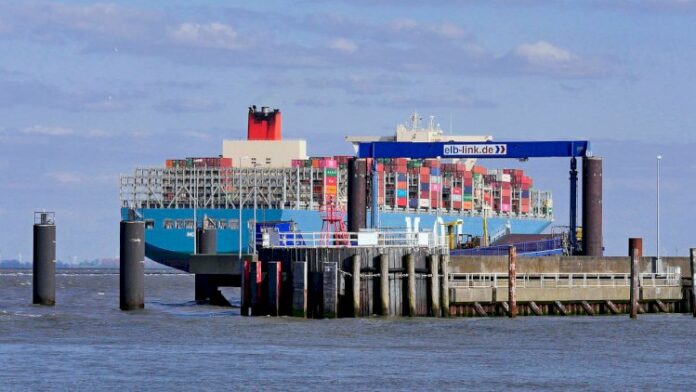
Yang Ming Marine Transport Corp. (Yang Ming) will launch a new service, East India and North Europe Express (code: IEX). The first voyage will begin from Vizag on Oct 26th 2019.

The new service is jointly operated by Yang Ming, COSCO SHIPPING Lines, Hapag-Lloyd, Ocean Network Express(ONE), and OOCL with a fleet of nine 6,500 TEU vessels. The port rotation for the weekly service is Vizag – Krishnapatnam – Chennai – Tuticorin – Colombo – Cochin – Damietta – Piraeus – Rotterdam – London Gateway – Hamburg – Antwerp – Le Havre – Damietta – Jeddah – Colombo – Vizag.

IEX is the first direct service from East and South India to North Europe. It will shorten transit time and provide more frequencies between Damietta, Piraeus and North Europe.

Given the market demand between Europe and South Asia and in order to meet customer requirements worldwide, Yang Ming pledges to continue enhancing its global service network and providing customers with more reliable and comprehensive delivery services.

SCHOTTEL has supplied propelled barges and floating cranes for Hassyan PP

0

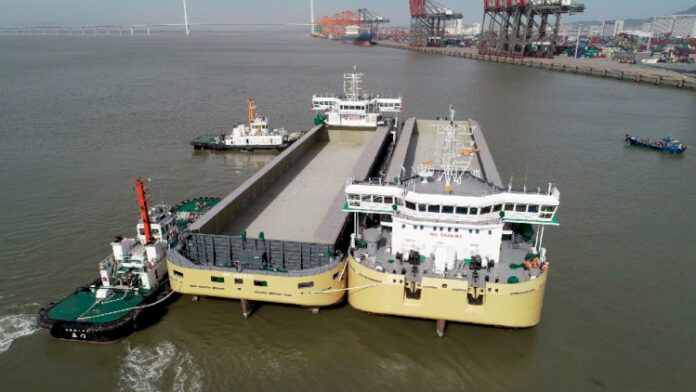
SCHOTTEL has supplied propulsion systems for four Full Azimuthal Electrical (FAZEL) barges and two Floating Crane Transhipper Units (FCTU) dedicated to transhipment for Dubai’s Hassyan coal power plant.

The FAZELs and FCTUs are built to European standards and operated in the UAE by Louis Dreyfus Ports & Logistics, a subsidiary of the French company Louis Dreyfus Armateurs. The German propulsion expert SCHOTTEL equipped the vessels with a total of 20 rudderpropellers.

“For the Hassyan project in Dubai, we opted for SCHOTTEL as they have decades of crucial expertise in the field of azimuth thrusters and will support us with a competent service team,” states Mathieu Muzeau, General Manager of Louis Dreyfus Ports & Logistics. “Particularly in this project, the reliability of the propulsion systems is of essential importance. SCHOTTEL with its worldwide on-site service and spare parts stocks enables downtimes to be kept as short as possible.”

Each of the shallow draft barges is equipped with four azimuth thrusters (two at the stern and two at the bow). The main propulsion of one self-propelled barge comprises four vertically installed 780 kW electric motors, each driving a SCHOTTEL Rudderpropeller type SRP 260 L FP with a propeller diameter of 1.6 m. Additionally, each FAZEL barge is equipped with a SCHOTTEL Masterstick control system. This enables the captain to control all four thrusters with one single lever and to manoeuver more precisely. The 102.9 m long and 24.6 m wide FAZELs are almost equivalent to a DP system. Thus, the berthing manoeuver and approach speed is controlled in such a manner that no tug assistance is required. Each of the FCTUs is driven by two electric motors acting on a SCHOTTEL Rudderpropeller which is structurally identical to those of the FAZELs. The 48 t SWL floating crane has an overall length of 64.2 m and 24.0 m in width by a lifting height of 35.0 m.

FCTUs and FAZELs will be used to unload capesize vessels and deliver coal at daily rate exceeding 36,000 metric tonnes. The coal-fired power plant is expected to produce sufficient electricity for nearly 250,000 households in Dubai. It is located on a four-square-kilometre site 60 kilometres south-west of Dubai and will be the first coal-based power plant in the region.
The fleet has already been delivered to Dubai and is scheduled to enter operation in 2019.  

Northwester 2 construction works at sea kicked off

0

The Northwester 2 wind farm will count 23 V164-9.5MW MHI Vestas Offshore Wind turbines and will be the first project to ever install this model.

The turbines on monopile foundations will link through an offshore high voltage station to Elia’s Offshore Switch Yard (OSY) to export its electricity. As of 2020, the Northwester 2 wind farm will power approximately 220,000 households in Belgium.

The Northwester 2 project will introduce a new design for the external access platforms on the foundations: the box platform. The platform has an innovative design developed and patented by Parkwind that consists only of steel plate material.

Peter Caluwaerts, Project Director Northwester 2 at Parkwind states:

“At Parkwind, we continuously look for optimizations and cost-effective solutions while developing offshore wind farms. The box platform is a show case of this attitude. Indeed, this innovative design reduces the overall cost of the foundation fabrication by introducing ship building techniques in the fabrication process. Moreover, the box platform simplifies and reduces offshore maintenance activities over the lifetime of the windfarm. It is great to see the initial ideas now coming to life at the start of the offshore construction works.”

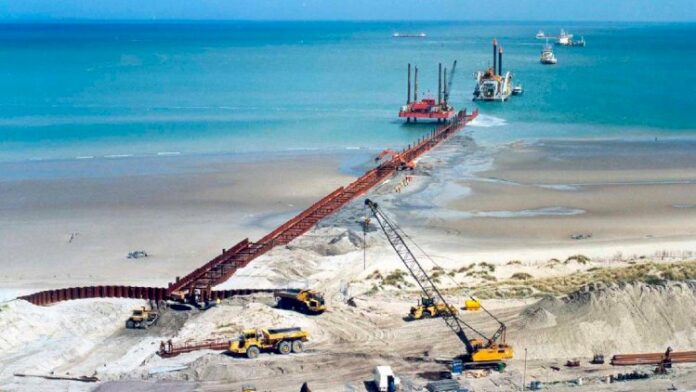
Jan De Nul Group has just finished the offshore scour protection works on the different wind turbine locations. At each location, Jan De Nul Group’s subsea rock installation vessel Simon Stevin has installed a 32 m diameter wide and 700 mm thick rock layer to stabilize the seabed around the foundation. Jan De Nul Group is now gearing up to install the first foundation in the coming days. The monopile foundations for the wind turbines will be hammered directly through the rock layer into the seabed.

Photo: Jan De Nul Group

Stan Logghe, Senior Project Manager Northwester 2 at Jan De Nul Group, confirms:

“A full year of preparation is now coming to an end with the start of the construction phase. With the installation vessel Vole au vent returned to Ostend, Jan De Nul is now ready to commence the installation of the foundations for the Northwester 2 wind farm.”

Jan De Nul Group equipped its Vole au vent with the most advanced monopile gripper to date, delivered by Huisman. The monopile gripper has a modular, tailor-made design and is unique in its capacity and versatility. The gripper allows use on a wide range of projects already under construction, but also in the future for which the specifications are yet to be determined. Jan De Nul Group will deploy this most advanced gripper for the first time on the Northwester 2 project.

5 belgian companies promise to revolutionize the marine energy sector

0

The partners strongly believe that solar photovoltaic (PV) panels in offshore waters are one of the essential future green energy sources. Combined in the same location with aquaculture and offshore wind power, this innovative technology allows for a more efficient use of available space.

Taking solar technology to a rough offshore environment needs the existing solar PV panels to be adapted to resist salty water and withstand strong currents and wave action. In addition, a cost competitive concept for the floater structure should be designed. Finally, ecosystem integration of the floating PV panels will be investigated from the start, to reduce the impact as much as possible.

The consortium partners bring together all required skills and expertise to make this innovative project a success. While Tractebel has built strong engineering skills in both PV technology and offshore engineering, DEME and Jan De Nul Group are highly experienced in marine operations and involved in numerous windfarm developments and installations. Soltech is an expert in specialized solar PV panels and Ghent University is one of the leading knowledge centers in offshore engineering, aquaculture and ecosystem research.

The consortium, led by Tractebel, was set up in the framework of the Flemish Blue Cluster and is strongly supported by VLAIO. For this initiative, the budget of about € 2 Mio is a result of joined forces between industry and government support. With these means, the consortium aims to develop new concepts and perform laboratory and field testing to take the first steps towards the commercialization of the technology.  

The partners of the consortium are the first in Belgium to explore this pioneering offshore solar solution.  Their ambition is also to be the first to realize offshore solar farms in the Belgian North Sea – eventually in combination with windfarms or aquaculture. In this way, the partners position themselves in this new, fast-evolving market.
 

HIT has implemented XVELA’s Berth Tool Application

0

XVELA, the world’s first maritime business network for ocean carriers and terminal operators, announced that Haina International Terminals (HIT) has implemented XVELA’s collaborative berth tool application. The application allows real-time collaboration between the terminal and the carrier and local agencies, increasing the service quality to the customer, reducing idle time and improving the use of berth space and associated resources for RIO HAINA, the only truly multipurpose port terminal in Dominican Republic and one of the main ports in the Caribbean region.

‍Due to increased pressure to improve supply chain predictability, establishing certainty around the berth time of a container ship is one of the main challenges the industry faces today. Currently, many terminals create their berthing prospects according to the long-term schedules (pro-forma) provided by the carriers. However, the reality of daily business (e.g. weather conditions, breakdowns, operational issues and lack of visibility) forces both parties to change these berthing prospects for almost all ship calls.

‍Traditionally, berth changes have been processed via emails and phone calls across multiple closed systems.  This creates significant inefficiencies with real operational costs due to excessive fuel consumption, wasted stevedoring resources, missed pilot schedules, suboptimal berth utilization, or missed berth prospects on arrival or departure, creating even further operational costs downstream.  Ultimately this can all be attributed to lack of collaboration and real-time visibility between the key stakeholders.

‍XVELA’s collaborative berth tool application addresses these issues for HIT by giving carriers, terminals, agents and port authorities visibility into each other’s status, enabling all players to optimize their operations.

‍“With XVELA we will be able to allocate the resources to operate all the vessels in an efficient environment to boost both productivity and revenue,” said Armando Rivas, VP of Operations at HIT.  “XVELA’s collaborative berth tool application will help us deliver forward in time to local agents and line carriers whether we can receive vessels at a specific date and time and give them options as to when will be better for them to arrive to avoid delays and costs.  We will be able to better allocate and plan for resources at the terminal to maximize our assets and investments.”

‍The collaborative berth tool application provides real-time visibility and estimated time of arrival (ETA) values aligned with validated berth prospects. It also enables ocean carriers to determine their navigation routes and the speed required by their vessels, thus optimizing fuel consumption. Real-time collaboration between the terminal, local agents and carriers using the same platform increases the service quality provided to the customer and improves the use of berth space and related stowage decisions while reducing idle time. In addition, it avoids wasting expensive stevedoring resources by ensuring vessels will arrive at the designated times. Real-time incremental move count information complementing pro-forma counts with downstream terminal arrival conditions, carrier stowage instructions and terminal plans improves the collaboration required for optimal berth prospects. Connectivity with the TOS makes it possible to know in real time any variations in the estimated times of completion for operations, enabling collaborative decision-making in the event of overlaps with future operations  or required adjustments to meet specific deadlines.

APM Terminals Callao launches Peru’s first digital customer platform

0

APM Terminals has become the first Peruvian port to introduce a customer platform that logs, streamlines and coordinate General Cargo operations in the port of Callao. During the pilot phase, the platform, which was developed together with maritime and customs agents, enabled users to complete transactions 67% faster and operations were completed 12% faster.

APM Terminals Callao invested nearly USD 1 million in the implementation of MOST, a new state-of-the-art platform that can be used by maritime agents, customs agencies and carriers, among others. MOST can be used to register cargo and view real-time information, make online payments and generate authorizations for the loading and unloading of all types of General Cargo, from anywhere, anytime. The platform is a clear milestone in the efficient management of port logistics using world-class technology.

Customs Agents can associate and assign a load to the transport companies with which they work, therefore MOST functionality reduces face-to-face procedures and improves security. In addition, it enables users to more accurately plan equipment and personnel. It also enables the terminal to allocate yard and quay resources more effectively per shift. Lastly, it streamlines and simplifies the billing process, which is carried out automatically using information logged in the system. 

MOST provides a clear graphical interface for monitoring operative movements in the port, warehouses and onboard vessels. It provides the status of the cargo in terms of quantities, weights, detailed location and dispatch. Furthermore, its vessel schedule shows real-time vessel berthing and departure times.

APM Terminals Callao, Peru’s largest multipurpose terminal, handles around 40% of the country’s total container traffic and more than 70% of Peru’s non-containerized general cargo, including steel products, grains, RoRo cargo, cement, chemicals and frozen fish. With volumes growing rapidly, this investment in the MOST platform provides General Cargo customers with greater accessibility, versatility, speed, safety and efficiency for their foreign trade operations. 

The terminal completed a $460 million terminal modernisation and expansion plan in 2016. New equipment, combined with improved procedures, planning has significantly increased productivity. Port infrastructure improvements continued in 2017 with the modernization of the hydrocarbons dock, which handles close to 90% of the country’s liquid volume. This year, the terminal, also completed a USD 2 million investment in storage improvements. An area of 36,900 m2 was asphalted to increase the storage of full dry and reefer containers. A second area was asphalted for general cargo storage. This has increased capacity by enabling containers and cargo to be stacked higher. It has also improved traffic flows for vehicles inside the terminal. 

BOEM Announces Next Steps for Proposed New York – New Jersey Wind Energy Transmission Line

0

The Bureau of Ocean Energy Management (BOEM) announced the publication of a ‘Request for Competitive Interest’ for the development of the New York and New Jersey Wind Energy Transmission Line, an offshore transmission system that would deliver offshore wind energy to the onshore electric grid. The publication marks the next step in BOEM’s review and consideration of a potential New York-New Jersey Wind Energy Transmission Line.

Anbaric Development Partners, LLC (ADP) has requested a right-of-way grant to develop the NY/NJ Ocean Grid, but prior to reviewing the right-of-way application, BOEM must determine whether there are other developers interested in the same area. BOEM will publish a Request for Competitive Interest in the Federal Register on June 19, 2019.

“Offshore transmission infrastructure will be critical to the long-term success of the offshore wind industry,” said BOEM Acting Director Walter Cruickshank. “We look forward to working with our state and local government partners, industry and others as we continue to oversee responsible offshore wind development while diversifying our nation’s energy portfolio.”

In addition, BOEM is providing an opportunity for the public and interested stakeholders to provide comments on the ADP right-of-way request. Comments may include information relating to potential effects on the environment and marine habitats; geological and geophysical conditions (including bottom and shallow hazards); archaeological, historic, and/or cultural resources; and the multiple uses that exist in the area, including commercial and recreational fishing. Feedback received will be incorporated into an Environmental Assessment (EA) analyzing the potential impacts of granting a right-of-way and associated survey activities. The EA will include additional opportunities for stakeholders to provide feedback and additional comments.

ADP’s proposed project would entail the construction, installation, and operation of an offshore transmission system to deliver offshore wind energy to the onshore electric grid. This includes the siting of several offshore collector platforms (OCPs), each connected to one or more high voltage subsea export cables to onshore points of interconnection. Each proposed OCP would be designed to handle 800 to 1,200 megawatts of offshore wind energy, with the ability to connect multiple offshore wind projects and accommodate phased development within BOEM’s designated Wind Energy Areas.

If BOEM receives indications of competitive interest from qualified entities, the bureau may decide to move forward with the right-of-way grant issuance process using competitive procedures. BOEM will continue to consult with the state task force and partners regarding the proposed transmission project.  

Unique sighting with Carnival cruise ship on top of the Boka Vanguard in Freeport

0

Royal Boskalis Westminster N.V. (Boskalis) successfully loaded cruise ship Carnival Vista on its semi-submersible heavy lift vessel BOKA Vanguard and transported it to a shipyard facility in Freeport, Bahamas for a unique dry docking operation.

Commencing last Saturday 13 July at sunrise the BOKA Vanguard loaded and lifted cruise ship Carnival Vista in a successful operation a few miles off the coast of Freeport. The loading operation including the refloat took twelve hours. The BOKA Vanguard then safely transported Carnival Vista to Grand Bahama Shipyard where repairs will take place whilst the cruise ship is resting on the BOKA Vanguard. Upon completion of the repairs, Carnival Vista will be offloaded in time for its next scheduled cruise voyage from Galveston in Texas on 27 July.

The BOKA Vanguard is the world’s largest semi-submersible ship uniquely positioned to lift and transport extremely heavy cargoes in a dry and safe manner. The vessel has an impressive track record transporting large offshore oil and gas structures, but can also carry other vessels and act as a floating offshore dry dock facility.

BOKA Vanguard is unique in that is has an open and flat stern and bow-less deck measuring 275 meters by 70 meters allowing the vessel to lift and transport cargo’s longer and wider than these deck dimensions. By filling its ballast tanks, the ship deck is submerged in a controlled manner, allowing it to lift deep draught cargoes. This creates an alternative for dry docking allowing inspections and repairs to be safely and efficiently conducted at a location where traditional dry dock alternatives are not available.

DNV GL Launched a Web-Based Application to Support 2020 Sulphur Compliance

0

To facilitate 2020 Sulphur Compliance IMO has developed guidelines which include an indicative template for a Ship-specific Implementation Plan (SIP), which shipping companies are recommended to use. The plan is not mandatory and is not subject to endorsement by the flag state or a recognized organization (RO). However, PSC may consider the preparatory actions described in the SIP when verifying compliance. The plan addresses issues related to the use of compliant fuel oil and how to identify any safety risks associated with such fuels.

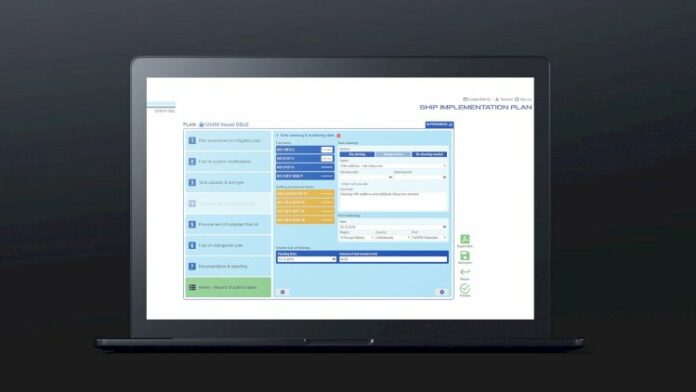
DNV GL has developed a web-based application to support ship owners and managers in preparing their Ship-specific Implementation Plans and maintaining an overview of their fleet.

Christos Chryssakis, Business Development Manager at DNV GL – Maritime says:

“As we approach 2020, good preparation will be essential to ensure a smooth transition into using compliant low-sulphur fuels. This includes technical actions, such as hardware upgrades, tank cleaning, and a fuel changeover plan, but also commercial preparations like updating charter party clauses and agreements between owners and charterers on how to best prepare each vessel to minimize operational disruptions. It is important to build flexibility into the plans, to make sure ships prepared for using different types of compliant fuels, depending on their availability.”

Items covered by the plan can include, as appropriate, but not limited to:

  • Risk assessment and mitigation plan (impact of new fuels);
  • Fuel oil system modifications and tank cleaning (if needed);
  • Fuel oil capacity and segregation capability;
  • Procurement of compliant fuel;
  • Fuel oil changeover plan (conventional residual fuel oils to 0.50% sulphur compliant fuel oil);
  • Documentation and reporting.

Benefits of the web-based Ship Implementation Plan app:

  • Save time & effort with a user-friendly tool for developing ship implementation plans;
  • Helps you focus on preparing quality plans by making informed decisions;
  • Instant overview of your fleet and the progress of your plans;
  • A solid implementation plan ensures a smoother transition into 2020 and can serve as documentation for charterers and authorities.

The SIP application is free of charge and available in the market place of Veracity, DNV GL's digital platform and industry ecosystem. More than 300 shipping companies are already using the SIP app with over 1,700 vessels registered and actively preparing their Ship Implementation Plans

ShipChain and GTX Corp Launch Global NFC Blockchain Shipment Tracking Solution

0

Blockchain-based logistics ShipChain and GTX Corp (GTXO), a global tech leader offering a suite of GPS and NFC tracking location-based services, announced a new partnership for a new comprehensive NFC blockchain shipment tracking solution.

Under the agreement, ShipChain will use GTX’s temperature enabled NFC smart tags to track temperature-sensitive shipments. The tag requires no scanners, or wires, and records temperatures based on customer-defined intervals and durations. Besides, GTX offers other NFC products that ShipChain will utilize to optimize its Track and Trace Platform.

“ShipChain’s new partnership with GTX is another step toward reaching our goal: a transparent, unified, end-to-end logistics platform. Until now, availability and cost of sensors was always a stumbling block. However, GTX’s smart tags – integrated into ShipChain’s track and trace platform – provide low cost, powerful tool to give our customers even more information about their shipments.[…]The possibilities are endless, and we cannot wait to watch this partnership unfold and evolve.”

Said John Monarch, ShipChain CEO. Patrick Bertagna, GTX Corp CEO, stated:

“We are all about relationships that help enhance value propositions and ShipChain checks all the boxes. […] By collaborating and integrating our technologies with ShipChain, we will enhance our speed to market while providing a much needed comprehensive solution for the industry.”

The NFC tags provide real-time temperature sensing and data logging across the supply chain necessary with transportation temperature-sensitive products that can be negatively affected by conditions in transit. These built-in security measures can prevent the distribution of contaminated supplies in the marketplace and unauthorized modification of data logs. Thus the brands, retailers, distributors, and freight forwarders may verify shipment quality.

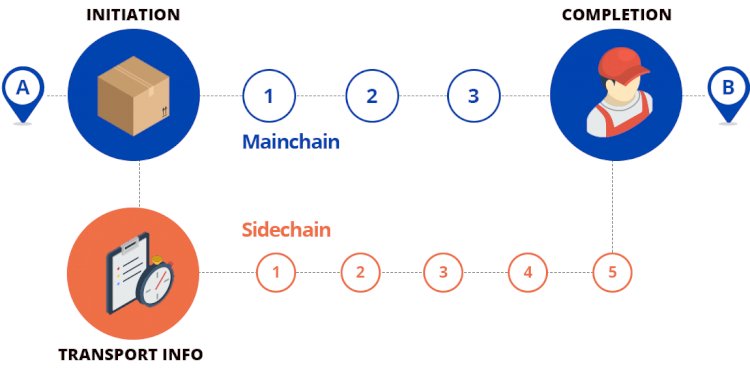
Sketch: Technology Diagram

The encrypted data collected from the tags will securely upload to the ShipChain blockchain backend providing completely secure and seamless authentication and chain of custody. A new “Tap & Track” service will enable temperature-sensitive shipments to be efficiently monitored while in transit, with the potential to manage a range of new government regulatory requirements for perishable deliveries. Integration between ShipChain and GTX has already begun, and a joint customer will be announced once all details have been finalized.

Additionally, ShipChain will begin offering GTX enabled services to all customers as part of the expanding partnership.

“We are thrilled to partner with ShipChain and see tremendous value in coupling their blockchain platform with our NFC technology. We see more and more demand for efficient, secure, and cost-effective supply chain management solutions and this partnership will deliver all of that plus the tools for data analysis to help reduce shipping costs, comply with regulatory requirements and provide brands with the peace of mind that they are not delivering tainted products prior to retail consumption”.

stated Theresa Gordon, GTX Corp NFC business leader.