-3.5 C
New York
Home Blog Page 1015

Woodside first enterprise-wide deployment of Schlumberger DELFI environment

0

Schlumberger has announced an enterprise-wide deployment of the DELFI cognitive E&P environment through a seven-year technology collaboration with Woodside Energy.

Woodside will leverage this secure cloud-based software environment to increase consistency, reduce study cycle time and foster innovation in its subsurface characterization and development activities.

The DELFI environment delivers extensive integration and connectivity across E&P domains from planning to operations, built around openness and extensibility. The environment leverages 40 years of E&P domain software expertise and digital technologies, including security, analytics, machine learning and high performance computing (HPC) to improve operational efficiency and deliver optimal production.

Trygve Randen, president, Software Integrated Solutions, Schlumberger, said:

“The DELFI environment will help Woodside meet their ambitious corporate goals by enabling their teams to collaborate seamlessly and work on the leading E&P software platforms and the new native
solutions for the DELFI environment. Woodside will also be adding their own intellectual property and workflows to achieve accelerated innovation.” 

Shaun Gregory, chief technology officer and executive vice president exploration, Woodside Energy, added: 

“Woodside pioneered the Australian LNG industry more than 30 years ago, and now we are taking steps to lead the E&P industry’s digital transformation. Enterprise deployment of the DELFI environment will help us achieve our growth strategy by reducing time to final investment decision and
lowering technical unit costs.”

The seven-year technology collaboration will give 200 global petrotechnical users at Woodside full access to the DELFI environment, including the Petrotechnical Suite, the Planning Suite and the developer capability for further collaborative innovation  projects. The data management and transition services provided will enable successful deployment.

About Schlumberger

Schlumberger is the world's leading provider of technology for reservoir characterization, drilling, production, and processing to the oil and gas industry. With product sales and services in more than 120 countries and employing approximately 100,000 people who represent over 140 nationalities, Schlumberger supplies the industry's most comprehensive range of products and services, from exploration through production, and integrated pore-to-pipeline solutions that optimize hydrocarbon recovery to deliver reservoir performance.

About Woodside Energy

Woodside is the pioneer of the LNG industry in Australia, and the largest Australian natural gas producer. The company has a global portfolio, and is recognised for world-class capabilities as an integrated upstream supplier of energy.
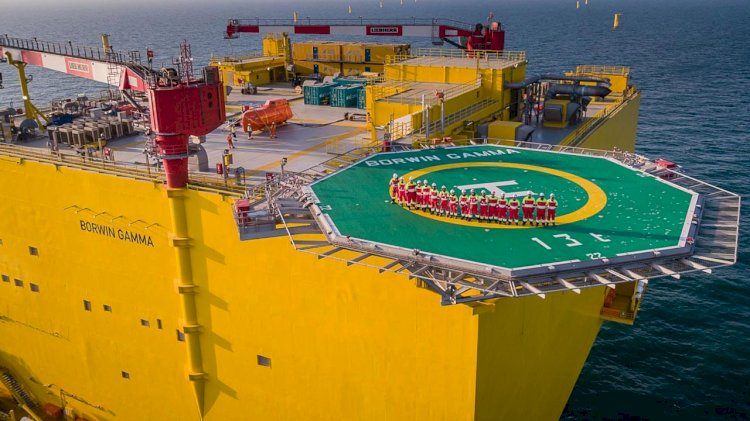
BorWin3 offshore wind grid connection has started to transmit power

0

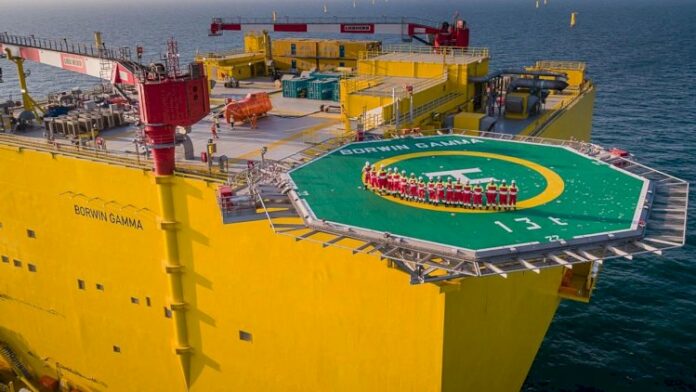
The 900 MW project is now converting three-phase electric power generated by offshore wind farms into direct current and transmitting it 160 kilometres back to shore into the German national grid, from where it will soon supply more than one million of the country’s households with clean electricity from wind power.

Petrofac, in consortium with Siemens, were awarded the BorWin3 offshore grid connection project contract in 2014 by TenneT, the German-Dutch transmission grid operator, with responsibility for the engineering, procurement, construction, transport and offshore installation of the platform offshore. The jacket foundation was installed in May 2018, and the topside integrated in October 2018 following its sea voyage from Dubai where it was fabricated and the completion of a mammoth float-over installation procedure.

George Salibi, Chief Operating Officer – Engineering & Construction at Petrofac said:

“We are delighted to have reached this key milestone with BorWin3 ready for action. The additional grid connection being put into operation is a significant contribution to the energy transition in Germany and a further demonstration of Petrofac’s expansion into adjacent sectors, including renewable energy.”

AIDA Cruises and Corvus Energy cooperate to ring in electrification of the cruise industry

0

Michael Thamm, Group CEO Costa Group and Carnival Asia said:

“Our goal is the emissions-neutral ship operation. The electrification of our ships is another important milestone on this path. Thanks to the cooperation with Corvus Energy, already in a few month, AIDA Cruises is going to launch this innovative technology on a large cruise ship.”

The Norwegian-Canadian company Corvus Energy is one of the most renowned suppliers of marine batteries and is considered a pioneer in the development of maritime energy storage systems. Further partners of the project will be the companies ABB and Siemens.

Following the introduction of low-emission LNG operations in cruise shipping, AIDA Cruises is now also stepping up into the practical use of electrical energy from battery storage systems on board large cruise ships. Thanks to the use of this technology, the consumption of fossil fuel will be reduced further and the efficiency of ship operations will be increased significantly. It is planned to incorporate the valuable experiences from this pilot operation of battery systems on board other AIDA and Costa cruise ships as well.

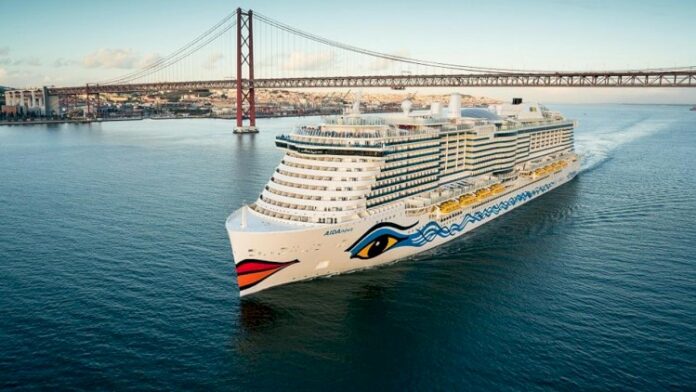
The use of a battery system on an AIDA ship is another important step in the implementation of the “Green Cruising Strategy”. Previously, by the end of 2018, AIDA Cruises had pioneered a technology leap forward with the launch of AIDAnova, the world’s first cruise ship operating entirely on low-emission LNG (LNG). Just a few days ago, AIDA Cruises was awarded the Blue Angel, the German Federal Government’s ecolabel for AIDAnova’s environmentally friendly ship design. By 2023, two more AIDA LNG vessels will be put into service.

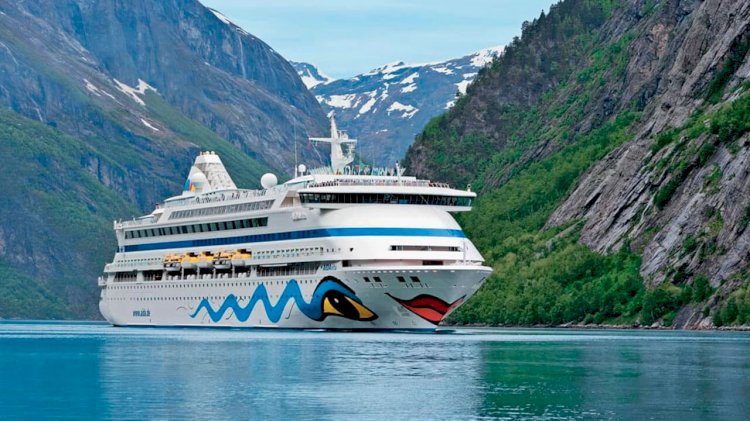
AIDA Cruises is also a trailblazer in many other areas. As early as the end of 2020, 12 of 14 AIDA cruise ships will be able to receive shore power where available. Since 2017, AIDAsol has been using the shore power plant in Hamburg-Altona in regular operation.

As part of its “Green Cruising Strategy”, AIDA is also exploring the possibilities of CO2-free production of liquefied gas from renewable sources (“Power to Gas” project) or the use of fuel cells in cruise shipping. Already in 2021, in cooperation with Meyer Werft shipyard and other partners the first fuel cell test is scheduled on board an AIDA ship.

About AIDA Cruises

AIDA Cruises is Germany’s leading cruise line and currently employs around 15,000 people from over 50 countries, 13,500 on board its 13 ships and 1,500 at the company headquarters in Rostock and Hamburg. After putting AIDAnova, the world’s first cruise ship that can be fully powered with low-emission LNG, into service in December 2018, the company will build two more of these innovative ships by 2023. By the end of 2023, ninety-four percent of all AIDA guests will be sailing on ships that can be fully powered with low-emission LNG or, where possible, green shoreside energy at port.
 

UMITRON launches the world’s first ocean-based fish appetite detection system

0

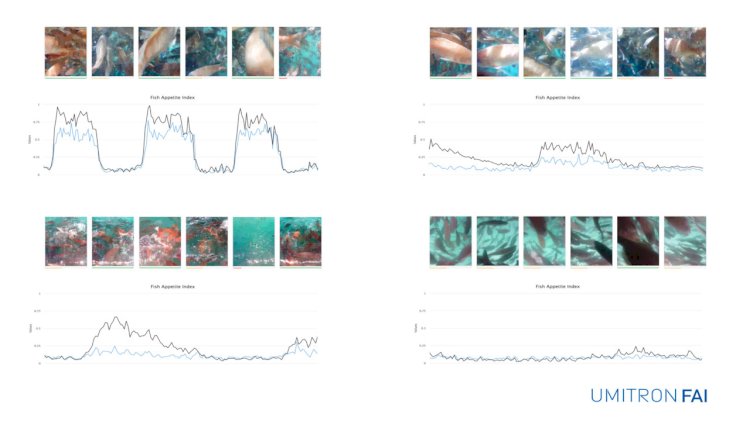
UMITRON PTE. LTD. launches Fish Appetite Index (FAI), the world’s first real-time ocean-based fish appetite detection system. UMITRON FAI uses efficient machine learning and image analysis techniques to extract relevant data that can then be used to accurately quantify fish appetite. FAI software has already been rolled out to existing customers to optimize their feeding operations.

Over the past twenty years the aquaculture industry has been expanding at an exponential rate with annual production tripling during this brief time span. This rapid expansion has largely been driven by strong demand from both an ever-increasing global population, and increasingly affluent consumers in Asia looking for healthier sources of protein. At the same time, however, aquaculture feed prices have also risen dramatically due to a lack of key ingredients such as fish meal and fish oil. This presents an ever-growing challenge for farmers since feed costs account for a majority of their operational overhead.

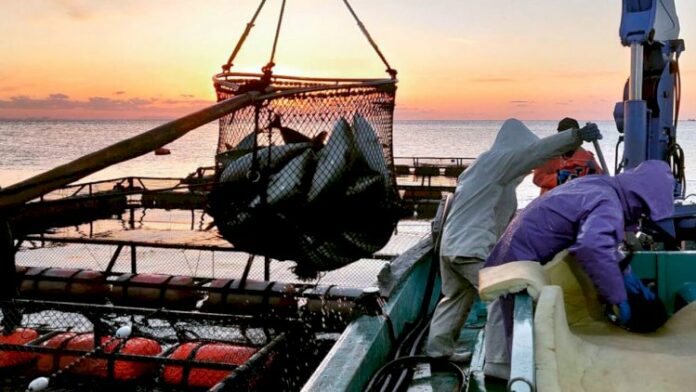
Farmers must walk a tight line—underfeeding their fish risks lower growth rates and slower time to market—while overfeeding increases costs and potentially harms the environment. In some cases, a farmer only has a limited amount of time to feed and observe each cage before needing to move onto the next one. New technologies such as IoT devices and machine learning offer farmers a solution to improve their feeding operations with the use of efficient data analytics.

FAI takes the guesswork out of fish feeding. The FAI algorithm takes in the same visual information that humans would and then scores fish appetite and presents it in an easy to understand chart. When used in tandem with a smart feeder such as UMITRON CELL, the feed time intervals and amounts can be automatically adjusted with minimal human interference. Farm operators can utilize FAI to fine-tune their feeding schedules, ensuring fish are always satiated. This is easily done via their smartphones with the UMITRON app, where they can check and remotely adjust feed settings based on the FAI feedback.

FAI benefits farmers by reducing wasted feed, improving profitability as well as environmental sustainability. Additionally FAI improves farmers work life by eliminating the need to be out on the water during dangerous conditions. Many smallholder farmers work seven days a week, only taking a rest for emergencies or special occasions. FAI in combination with technology such as CELL allows farmers to stay onshore during weekends while still keeping a close eye on their fish stocks. Furthermore, it reduces the need for every employee to be an expert at feeding and instead frees workers to focus on other tasks that improve fish welfare.

Existing UMITRON customers have already begun using FAI alongside CELL. 

Masahiko Yamada, managing director of UMITRON, said:

“Today, there are many companies developing machine-learning algorithms for a variety of industries but only testing them under ideal conditions. The UMITRON Fish Appetite Index on the other hand is already being embraced by our existing customers at their ocean-based farm sites where it operates under real world conditions. It might be difficult for some of our potential customers to completely trust artificial intelligence at first, but FAI is an important tool that can be used to increase productivity and reduce waste.”

Takuma Okamoto, CTO of UMITRON, added:

“Our appetite analysis approach is being developed with customer feedback in mind UMITRON will continue to develop similar value-added software services that can be automatically rolled out to our existing customer base. Also, we are open to developing other practical applications after discussions with potential customers or equipment partners.”

UMITRON is looking for partners interested in using FAI for species such as Atlantic salmon, rainbow trout, European sea bass, and gilthead sea bream. 

About UMITRON

UMITRON is a Singapore and Japan based deeptech company whose aim is to solve worldwide food and environmental problems by empowering aquaculture through technology. UMITRON builds user-friendly data platforms for aquaculture by using IoT, satellite remote sensing, and artificial intelligence (AI).

New light oil discovery in the Barents Sea

0

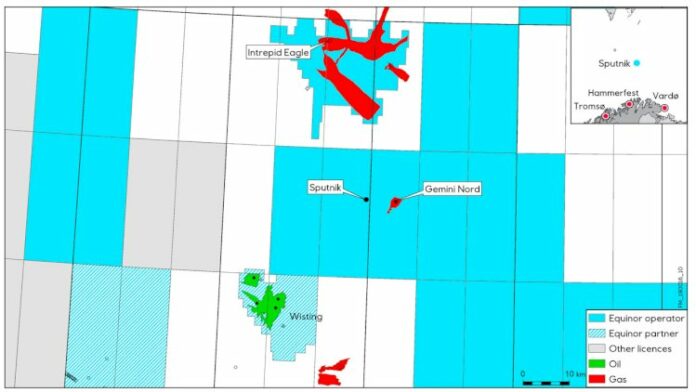
Equinor and partners OMV and Petoro have made an oil discovery in the Sputnik exploration well in the Barents Sea. Recoverable resources are preliminarily estimated at 20-65 million barrels of oil.

The Sputnik well was drilled in licence PL855, approximately 30 kilometres North East of the Wisting discovery. The well encountered a 15 metre oil column in a Triassic sandstone reservoir. Fluid samples contain light oil and water.

Nick Ashton, Equinor’s senior vice president for exploration in Norway and the UK, says:

“We are encouraged by this result as it confirms the presence of oil north of the Wisting discovery, where Equinor has acquired a strong acreage position. The geology in the Barents Sea is complex, and more work lies ahead to determine commerciality. But this discovery shows that persistence and our ability to learn from previous well results does pay off.”

In 2017, Equinor’s Gemini Nord well resulted in a very small, uncommercial oil discovery in a reservoir channel system within the PL855 licence. In 2018, a larger channel complex was targeted in the neighboring PL615 licence, with the Intrepid Eagle well. This well proved a 200 metre gas column, but no oil. The Sputnik well, which is the second well in  PL855, has proven oil in a large channel system. 

Nick Ashton adds:

“Detailed fluid analysis combined with geological and geophysical mapping will be carried out to fully understand the commercial potential of the Sputnik discovery. If confirmed that the structure comprises volumes that can be recovered in a commercially viable way, the partnership will assess possible development solutions.”

The Sputnik well (7324/6-1) was drilled to a vertical depth of 1569 metres below the seabed by semi-submersible drilling rig West Hercules, which has now moved on to drill the Equinor operated Lanterna well in PL796 in the Norwegian Sea.

Equinor is operator and holds 55% of the PL855 licence. Partners are OMV (25%) and Petoro (20%). 

NCEAS’s study: Human impacts on oceans have doubled in the decade

0

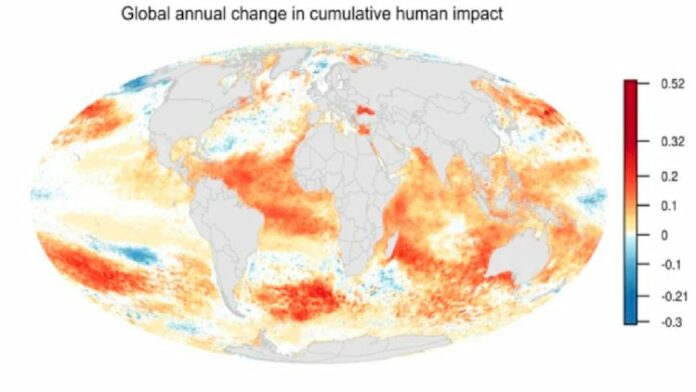
Over the recent decade, total human impacts to the world’s oceans have, on average, nearly doubled and could double again in the next decade without adequate action, says a new study by researchers from the National Center for Ecological Analysis and Synthesis (NCEAS) at UC Santa Barbara.

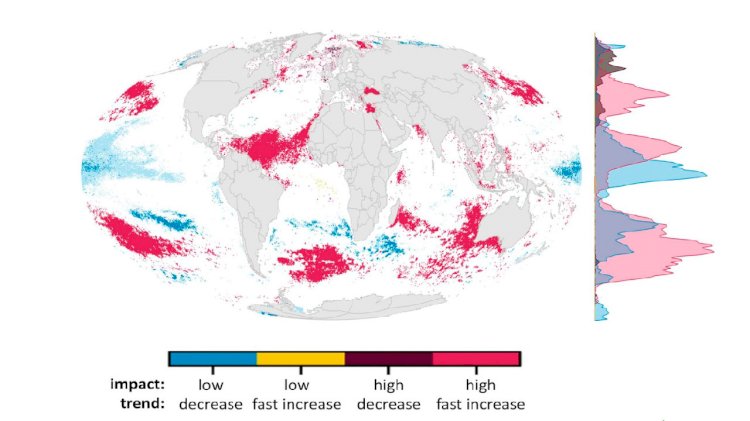
Published August 12th in the journal Scientific Reports, the study assessed for the first time where the combined impacts that humans are having on oceans – from nutrient pollution to overfishing – are changing and how quickly. In nearly 60 percent of the ocean, the cumulative impacts are increasing significantly and, in many places, at a pace that appears to be accelerating.

Climate change is a key factor driving the increase across the world, as seas warm, acidify and rise. On top of that, commercial fishing, runoff from land-based pollution, and shipping are intensifying progressively each year in many areas of the ocean.

Lead author Ben Halpern, director of NCEAS and a professor at UCSB’s Bren School for Environmental Science and Management, said:

“It’s a multifactor problem that we need to solve. We can’t just fix one thing if we want to slow and eventually stop the rate of increase in cumulative impacts."

The study also projected the impacts one decade into the future, based on the rate of change in the recent past, finding that they could double again if the pace of change continues unchecked.

The assessment provides a holistic perspective of where and how much human activities shape ocean change – for better or worse – which is essential to policy and planning.

Halpern added:

“If you don’t pay attention to the big picture, you miss the actual story. The bigger picture is critical if you want to make smart management decisions – where are you going to get your biggest bang for your buck.”

Regions of particular concern include Australia, Western Africa, the Eastern Caribbean islands and the Middle East, among others. Coastal habitats such as mangroves, coral reefs and seagrasses are among the hardest-hit ecosystems.

There is an upside to the story, however. The authors did find “success stories” around every continent, areas where impacts have declined, such as the seas of South Korea, Japan, the United Kingdom and Denmark, all of which have seen significant decreases in commercial fishing and pollution.

These declines suggest that policies and other actions to improve ocean conditions are making a difference – although, the analysis does not attribute specific actions to those declines.

To assess the pace of change, the authors leveraged two previous and similar assessments conducted by several of the same team members and others in 2008 and 2013, which provided first glimpses into the full, cumulative extent of humanity’s impacts on oceans.

Co-author Melanie Frazier, a data scientist at NCEAS, said:

“Previously, we had a good measure of the magnitude of human impacts, but not a clear picture of how they are changing.” 

Frazier was surprised to see in the data how dramatically ocean temperatures have increased in a relatively short period of time.

Frazier commented:

“You don't need fancy statistics to see how rapidly ocean temperature is changing and understand the magnitude of the problem. I think this study, along with many others, highlights the importance of a concerted global effort to control climate change.”

McDermott, Zachry and Chiyoda announce first liquid from Freeport LNG Train 1

0

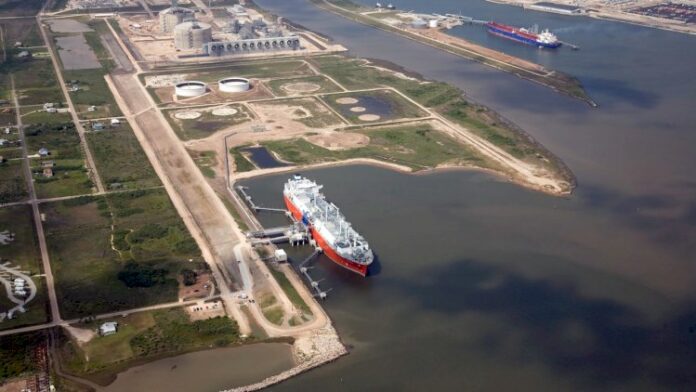
McDermott International, Inc. along with its partners, Chiyoda International Corporation and Zachry Group, has announced that Train 1 of the Freeport LNG project on Quintana Island in Freeport, Texas, has begun producing liquefied natural gas (LNG). While production is in the initial phases, this significant project milestone is a precursor to first cargo, which is expected later this month.

Mark Coscio, McDermott's Senior Vice President for North, Central and South America, said:

"When a facility starts producing a product, it is always a notable achievement, especially for large-scale projects, such as Freeport LNG. We are proud of the project team, which has worked hard to accomplish this milestone with exceptional safety performance during the construction phase. We look forward to celebrating first cargo for Train 1 soon with the same focus to safety and quality."

Zachry Group, as the joint venture lead, partnered with McDermott for the Pre-FEED in 2011, followed by FEED works to support the early development stage of Trains 1 and 2 of the project as a one-stop shop solution provider. Later Chiyoda joined the venture and the joint team provided engineering, procurement and facility construction as well as commissioning and initial operations for Train 3 of the project. The project scope includes three pre-treatment trains, a liquefaction facility with three trains, a second loading berth and a 165,000 m3 full containment LNG storage tank.

Freeport LNG Trains 2 and 3 remain on track to meet their previously announced schedules, with Train 2 initial production of LNG scheduled for Q4 of 2019 and Train 3 initial production of LNG scheduled for Q1 of 2020.

About McDermott

McDermott is a premier, fully integrated provider of technology, engineering and construction solutions to the energy industry. 

About Zachry Group

Zachry Group is North America's pacesetter in turnkey construction, engineering, maintenance, turnaround and fabrication services to the power, energy, chemicals, manufacturing and industrial sectors.

About Chiyoda

Chiyoda Corporation, headquartered in Yokohama, Japan provides services in the fields of engineering, procurement and construction on a global basis for petroleum refineries, petrochemical complexes, other hydrocarbon or industrial plants, particularly LNG plants in the USA, South East Asia, the Oceania regions, the Middle East and Russia.

JFD and Y-40 to commence pressurised submariner training

0

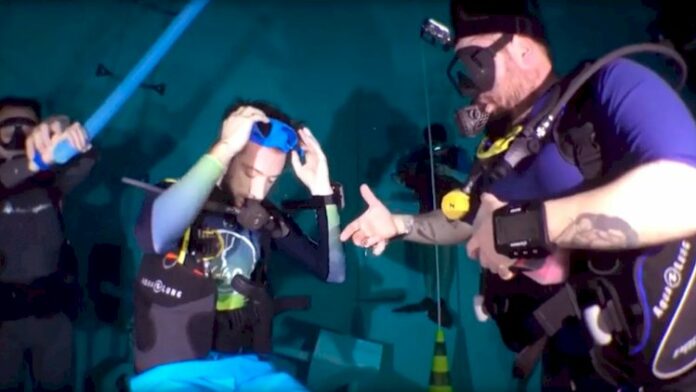
JFD, the world-leading underwater capability provider serving the commercial and defence diving markets and part of James Fisher and Sons plc, has formed a strategic partnership with Y-40, owner and operator of the world’s deepest pool (42.15m), to facilitate submarine escape training as required by navies worldwide.

The partnership is in line with JFD’s strategy and ongoing commitment to providing submariners with a total support capability from training through to the delivery of a complete submarine rescue service.  The development further strengthens JFD’s presence in the Italian market, and going forward the company will expand the use of the pool to include training for military and commercial divers.

The new training simulates the experience of escaping from a distressed submarine in a safe and controlled environment. JFD and Y-40 will commence pressurised submariner training in Q4 2019.

Giovanni Corbetta, Managing Director, from JFD commented:

“We see great potential in this new partnership which allows JFD to provide pressurised submarine escape training at the Y-40 facility which is a central location accessible for many navies.  It allows us to deliver against our commitment to provide the best possible training to submariners that will maximise their chances of survival in the event of an incident. This partnership means that we will have the necessary resources and facilities in place to equip submariners with pressurised training that delivers potentially lifesaving skills. In time, we look forward to extending our partnership with Y-40, so that commercial divers can also benefit from this world-leading training.”

Emanuele Boaretto, Architect and CEO, from Y-40 commented:

“We are pleased to partner with JFD on this new project, which will enable us to use the existing facilities at our deep-water pool improve the safety of the global submariner community. As the first and only deep pool that runs on thermal waters, we’re able to keep operating costs down. This means the training offered at our facility and delivered by JFD will be both affordable, as well as easily accessible.”

As part of JFD’s strategy to provide complete SMERAS (Submarine Escape & Rescue Surface Abandonment and Survival) capability support from escape training through to a full submarine rescue service, JFD has expanded its base of operations for escape training to provide further choice to the market.  The recent partnerships with both Aquacentrum Den Helder and Y-40 in Italy allow customers the choice of pressurised training facilities at which they can undertake submarine escape training in the facility which best suits their needs and location.

JFD operates at the forefront of innovation and is a global leader in the provision of submarine rescue and support services, working with most of the advanced navies in the world.  Using its market knowledge and long experience, the company continually looks to set new standards in the delivery of comprehensive systems, technologies and training that break new ground in safety and protecting life at sea.

VIDEO: Norwegian Encore float out

0

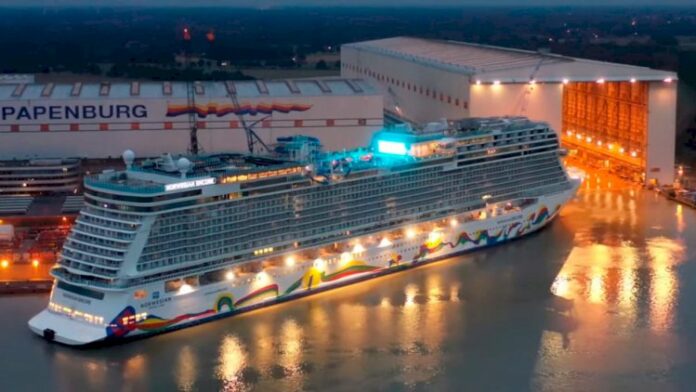
Norwegian Encore was built for the American cruise shipping company Norwegian Cruise Line. 

The ship left the building dock II at MEYER WERFT shipyard at approx. 2:00 am on Saturday, 16 August. 

Norwegian Encore will remain in the shipyard port for further out-fitting work and on-board trials until its passage through the river Ems up to the North Sea, which is expected to take place end of September.

LR awards world’s first digital type approval to HHI

0

Hyundai Heavy Industries Co., Ltd. (HHI) has received type approval from LR for the network security digital component of its Integrated Smartship Solution (ISS), confirming that the approved component performs its functionality seamlessly. The is the first ever type approval of a digital component. 

Digital type approval delivers an assurance system to provide confidence in the market for the supply of digital components and offers all the benefits of traditional type approval; reassurance on supply chain quality and robustness within the marine environment. Digital type approval can apply to both components within information technology (IT) and operational technology (OT) systems.

Type approval of HHI’s first line network security component confirms it complies with the latest LR type approval test specifications and the requirements specified in LR’s type approval system procedure for components that are part of digital systems onboard ships. 

HHI’s first line network security component plays an important role as it establishes a barrier between controlled internal networks and untrusted outside networks. This helps to mitigate against information and operational vulnerabilities, as an increasing amount of data is stored, processed and transmitted by digital systems onboard ships.

HHI Senior Executive Vice President, Mr. Hyung-Kwan Kim, commented:

“We are glad to receive this digital type approval certificate from LR for the first line network security component of our smart ship system, ISS. We will continue our efforts to lead the digitalisation of the marine and offshore industry in order to maximise the benefit for our customers with new technology, ensuring it is applied safely.”

Young-Doo Kim, LR’s North Asia Technical Support Office Manager said:

“We have been working closely with HHI to ensure that the first line network security component of their smart ship solution meets our digital type approval requirements. We are very pleased to issue this digital type approval certificate to HHI and we believe this is the first step in moving towards digital ships consisting of approved digital components with safeguards in place to protect against cyber incidents.”