
Achieving efficient design and construction to meet the increasingly advanced and complex requirements for ship performance
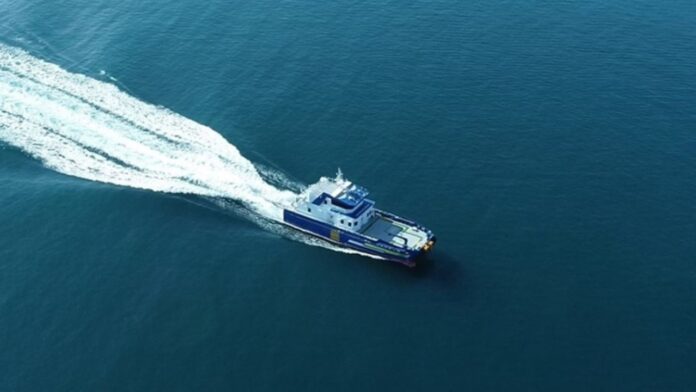
NYK has jointly implemented a crew transfer vessel (CTV) newbuilding project that applies 3D technology as a core platform throughout the design and construction process.
This project is being carried out in collaboration with Kosaba Shipbuilding Co., Ltd. and Smert Design Co., Ltd.
CTVs transporting crews to offshore wind farms must meet high standards of safety, operability, and maintenance and inspection efficiency. Consequently, the design and construction phases now demand a deeper and more comprehensive level of scrutiny.
Conventional design and construction methods based on 2D drawings have posed challenges in sharing design intent and managing design changes, often leading to rework and additional adjustments during construction.
In designing the CTV, a full 3D model was used to examine the hull structure, equipment arrangement, and ease of operation and maintenance.
This enabled the project team to identify potential interferences between structural components and equipment at an early stage, improving the accuracy of layout planning and enabling design front-loading that reduced design changes and rework during construction.
This approach enabled the identification of thermal deformation and assembly tolerances specific to aluminum twin-hull vessels (catamarans), contributing to quality verification and improvement.
The project also developed 3D digital finished drawings that centrally manage specifications, drawings, construction comments, and measurement data linked to the 3D model.
By adopting the concept of a 3DA (3D annotated) model, the project transcends conventional 3D geometric representations. In this model, each component is enriched with relevant technical data and records — ranging from specifications and construction-related notes to measurement data — which are systematically annotated and linked to individual parts of the vessel.
By using the 3D model as an entry point, users can intuitively access related equipment and documentation, which is expected to improve efficiency in vessel management operations such as inspections and maintenance after the vessel enters service.
The knowledge gained through the construction of an actual vessel is expected to be applied to subsequent CTVs, as well as to other vessel types, operational and maintenance phases, and academic research.
Vessel Specifications
- Length overall: Approx. 28 meters
- Breadth: Approx. 9 meters
- Gross tonnage: Approx. 145 tons
- Shipyard: Kosaba Shipbuilding Co.


