
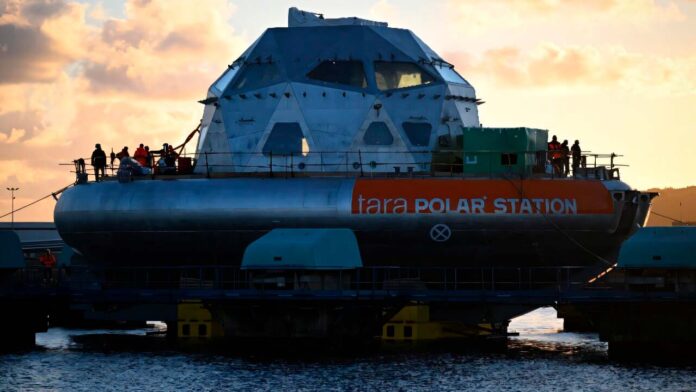
A floating research station resembling a giant aluminum igloo has departed from France to begin a long-term Arctic expedition that will see it drift with polar ice through one of the planet’s most extreme environments.
The Tara Polar Station was designed with a unique rounded structure that allows it to withstand pressure from sea ice and remain trapped in the ice pack while moving with ocean currents in a controlled manner. The mission aims to collect data on Arctic biodiversity and monitor the effects of climate change in one of the world’s least-studied regions.
The station was built in France, but the expedition involves around 30 research institutions from 12 countries, including Germany, Canada, Spain, the United States, Switzerland and Japan.
“The Arctic is an ocean that has been little studied and is already changing significantly. It is undergoing a major transformation,” said Romain Trouble, executive director of the Tara Ocean Foundation. He added that long-term observations are essential, as “you cannot understand the environment if you only spend two months a year there.”
The floating laboratory left the western French port of Lorient, where French Minister for the Sea Catherine Chabaud attended the departure ceremony alongside hundreds of supporters.
The station is built to endure sea-ice pressure and temperatures as low as -52°C. From mid-August, it will travel eastward along the Russian Arctic coast with support from an icebreaker before becoming embedded in the pack ice in early September.
Once frozen into the ice, Tara Polar Station is expected to drift at an average speed of around 10 kilometres per day, eventually reaching the Fram Strait between Greenland and Svalbard by the end of 2027.
The expedition is the first of ten planned missions that will take place between 2026 and 2045, with new Arctic drifts scheduled every two years.
During the winter period, the station will accommodate 12 people, including six scientists, while up to 18 crew members will be present during summer operations. Participants were selected through medical and psychological assessments designed to ensure they can work effectively in an isolated environment.
The winter crew will face several months of complete darkness, extreme cold, limited living space and the risk of encounters with polar bears. Crew members have received firearms training for emergency situations, while a specially trained dog will help detect approaching animals.
Scientists aboard the station will collect more than 10,000 samples from seawater, the atmosphere and sea ice using onboard instruments and equipment deployed through an opening in the hull.
Researchers hope the data will provide new insights into Arctic ecosystems and help assess how environmental changes are affecting species adapted to polar conditions.
“There is biodiversity at the North Pole that is uniquely adapted to this environment. If the environment changes, that biodiversity might disappear,” Trouble said. “We could potentially lose an entire chapter of evolution of life on this planet without even having had time to document it.”


