
High-speed passenger vessels with diesel engines are currently the least environmentally friendly form of passenger transport – but they do not have to be.
The shipping industry must cut its climate emissions, and express ferries are the means of passenger transport that causes the most pollution per kilometre.
The Norwegian government has been saying it will introduce requirements for zero emissions in new tenders for express ferry services for several years now. However, according to the government, the requirements have to be postponed because the technology is not yet fully developed.
A new solution shows that this is not the case. By combining batteries and fuel cells, it is entirely possible to slash emissions.
Using a new method developed by NTNU, it is possible to calculate which high-speed passenger routes can be operated with zero-emission express ferries.
Emissions to be halved within five years
Express boats are vessels that travel at speeds exceeding 20 knots and play an important role in passenger transport. Around 200 high-speed passenger vessels operate along Norway’s approximately 20,000-kilometre coastline.
Due to the long distances and challenging conditions on several of the 100 routes, it is difficult to implement zero-emission transport with the battery technology that currently exists. Only ten routes can be operated using express boats that can be charged or have their batteries swapped out along the way. The remaining routes must use other technologies, or a combination of technologies.
Exactly which ones can now be determined using the new method. It was developed by Samieh Najjaran in her doctoral project at the Department of Marine Technology.
Took the toughest route
“Express boats are difficult to electrify. Batteries and hydrogen solutions are also significantly heavier than traditional diesel engines. More weight increases resistance, which in turn requires more energy – a classic vicious circle,” said Najjaran.
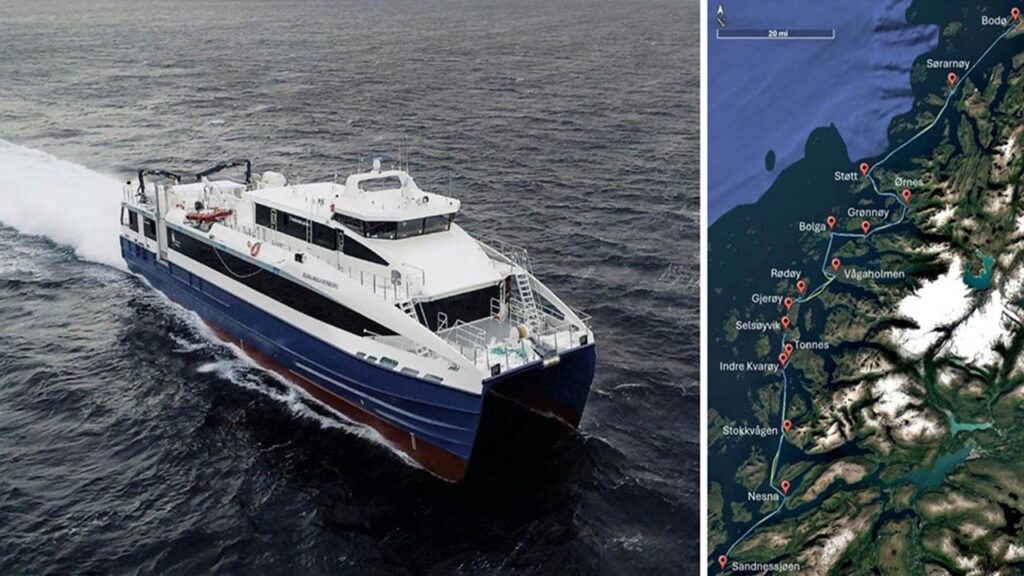
While developing the model, she used the Bodø–Sandnessjøen high-speed passenger route along the Helgeland coast as a guinea pig. The route is approximately 220 kilometres long and is considered one of the most challenging in Norway.
“If we can make this stretch a zero-emission route, it basically means that all the other routes have the same potential. This is one of the most challenging routes, with many ports of call and limited time for charging,” Najjaran said.
The Nordland Express
The Nordland Express route (Nordlandsekspressen) relies on two virtually identical high-speed passenger vessels. One of them is the catamaran MS ‘Elsa Laula Renberg’. This vessel is built from carbon fibre, can accommodate 220 passengers, and has four diesel engines providing a cruising speed of 33 knots.
“We have calculated the vessel’s operational profile based on detailed information from the Automatic Identification System (AIS) over an entire year. This enables us to account for almost all weather scenarios and variations in wind, currents and wave conditions across all four seasons,” said Najjaran.
This information has been incorporated into a model for calculating resistance and energy consumption for a typical high-speed passenger catamaran of the same size. The model was developed during John Martin Kleven Godø’s doctoral work at the same department.
The results have been incorporated into an optimization model for energy management in the on-board electrical power system. In this system, the load is distributed between the vessel’s batteries and fuel cells.
Scalable
The model is general enough so that different parameters can be scaled and adjusted.
“This means it can be used on all similar vessels and routes,” said Najjaran.
The researchers studied three possible alternatives:
- Battery-only operation – with charging or swapping batteries at selected ports
- Hybrid solution with fuel cell and battery – no charging at ports, powered solely by fuel cells.
- Plug-in hybrid solution with fuel cells and batteries – involving battery charging at various pre-designated ports
In this study, only the possibilities that already exist in a vessel were investigated, not what would happen if the vessel was modified, for example by lengthening it.
“The biggest challenge is the increase in weight and thus increased resistance and energy requirements. The use of batteries alone on the existing Nordland Express vessel is not feasible,” explained Najjaran.


