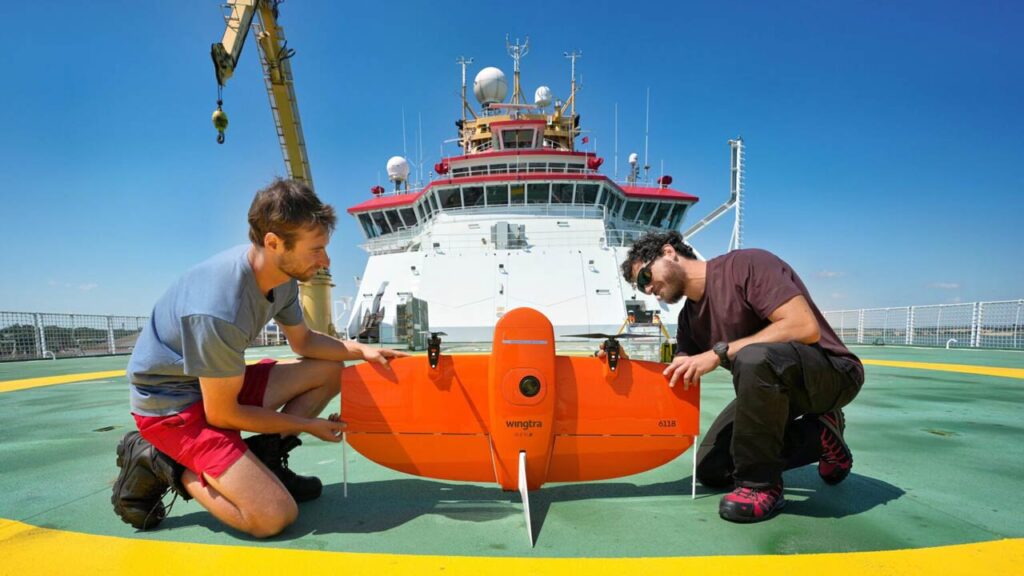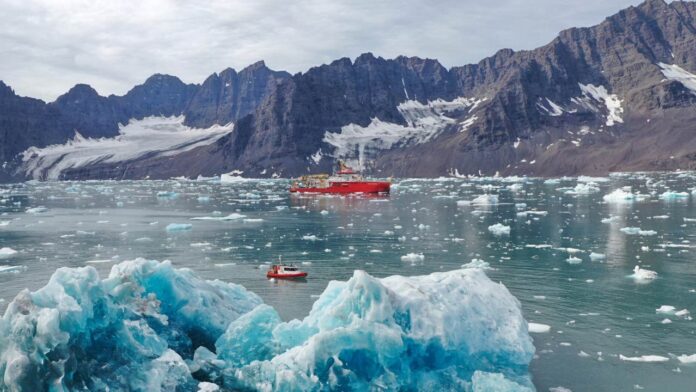
An international team of researchers are heading to Greenland this week for a six-week expedition to study how quickly the ice sheet’s rapidly melting fjord glaciers are pushing the Atlantic Ocean towards a critical climate tipping point.
The team will travel on the UK’s polar research ship RRS Sir David Attenborough, and use a range of sophisticated equipment, such as a fleet of airborne drones, marine robots, satellites and sensors to study the glaciers and surrounding ocean. The data collected will be used to improve our predictions for the future of Greenland’s glaciers and their impact on the surrounding ocean as they melt.
Their fieldwork is part of a five-year project called GIANT (Greenland Ice sheet to AtlaNtic Tipping points), a large international collaboration of 17 partners (including seven international partners) led by British Antarctic Survey (BAS) and funded by the Advanced Research + Invention Agency (ARIA), as part of their Forecasting Tipping Points programme.
Greenland’s rapidly melting ice is adding vast quantities of freshwater into the ocean. Scientists are concerned this could affect a major Atlantic Ocean current system – the North Atlantic Subpolar Gyre. This ‘whirlpool’ of ocean currents affects the Atlantic Meridional Overturning Circulation (AMOC) – the planet’s ocean conveyor belt that moves heat and nutrients around the world and keeps our planet stable.
The AMOC brings warm, salty water from the tropics to the north. This is cooled by the cold, sub-Arctic air, and sinks. This sinking ocean pulls more water up from the south, driving the 3-dimensional conveyor belt of water. However, fresh, cold meltwater from Greenland’s melting fjord glaciers could put a ‘cap’ on the Subpolar Gyre and reduce the water beneath it from sinking. If this happens, the AMOC could slow, with serious implications for the regional climate, including the UK. Some estimates suggest this change could happen within decades.
The RRS Sir David Attenborough will transport researchers from the UK to south-east Greenland, where they will study tidewater glaciers near Kangerlussuaq Fjord. These glaciers flow through long, narrow fjords and end in towering ice cliffs, up to 100m tall. Frequent iceberg calving creates an ice mélange; a dense, slushy pack of sea ice and chunks of icebergs that can act as a brake on the glacier and slow its flow into the ocean. When this debris clears in the summer, calving rates increase and glaciers can retreat rapidly.
Scientists will use this floating laboratory to conduct detailed measurements of fjord depth and shape, as well as ocean temperature, salinity and currents. The ship is also a launch platform for a range of autonomous vehicles that will sample in the hazardous region near the ice.
Using these instruments, researchers will study fjord and glacier behaviour on different scales, looking at individual cracks in the ice to the flow of meltwater and icebergs into the North Atlantic.
Among the many advanced tools being deployed as part of this mission is Meltstake. This first-of-its-kind instrument measures melting directly at the ice face. Lowered by a remotely operated boat, this sensor will drill into the ice 100m below the surface to measure how water transfers heat to the ice.
DriX – a surface skimming robot – will map the shape of the glacier under the water with a scanning sonar. It will track changes in melt rate on daily or even hourly timescales. It will also collect information about ocean, such as current strength and direction, temperature and saltiness, helping researchers to make connections between ocean properties and glacial melt.
A family of robots – Gavia and EcoSubs that swim in coordination with each other using acoustic positioning technology – will dive hundreds of metres below the surface as a team, collecting data from the glacial ice face. They can go closer to the ice face than DriX, mapping the submerged glacier front, and collecting data about the ocean.
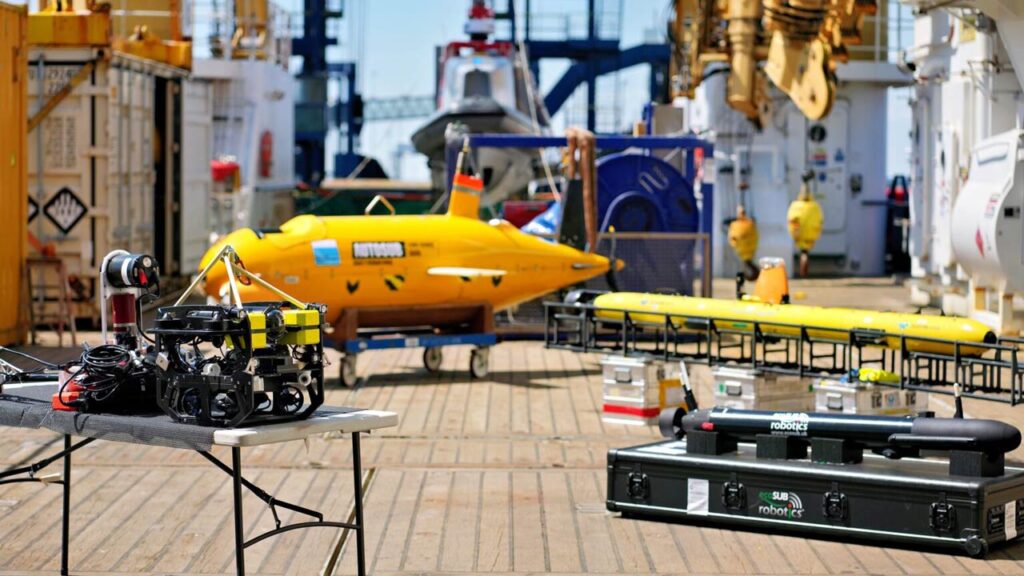
The UK’s most famous underwater robot – Boaty McBoatface – will also be part of the fleet. The Autosub Long Range, developed by the National Oceanography Centre, will dive 1500m deep below the mélange, a chaotic aggregate of icebergs that choke some of the fjords, to map its geometry, and study how it impacts the surrounding ice and ocean as it melts.
A small team of researchers will also be camping near the glacier itself, to collect even more data about how the ice is behaving. An instrument called Adios will be installed on the glacier to measure the precise position of the glacier and how fast it’s moving. It uses radar to study internal ice layers, helping track how the ice is moving and straining. They’ll also deploy small instruments called Geopebbles – GPS-enabled seismic sensors which record cracking and calving events.
This array of data collection is so vital because current climate models don’t accurately represent the complex ways in which Greenland’s glaciers interact with the warming ocean. Boosted by machine learning and AI, the data collected this summer will feed directly into a hierarchy of ice, ocean and climate models. This includes the next-generation UK Earth System Model, which – because of GIANT – will be better equipped to predict how Greenland ice loss impacts global climate change.
The researchers also plan to develop a prototype Early Warning System to provide advance notice of rapid glacier change.