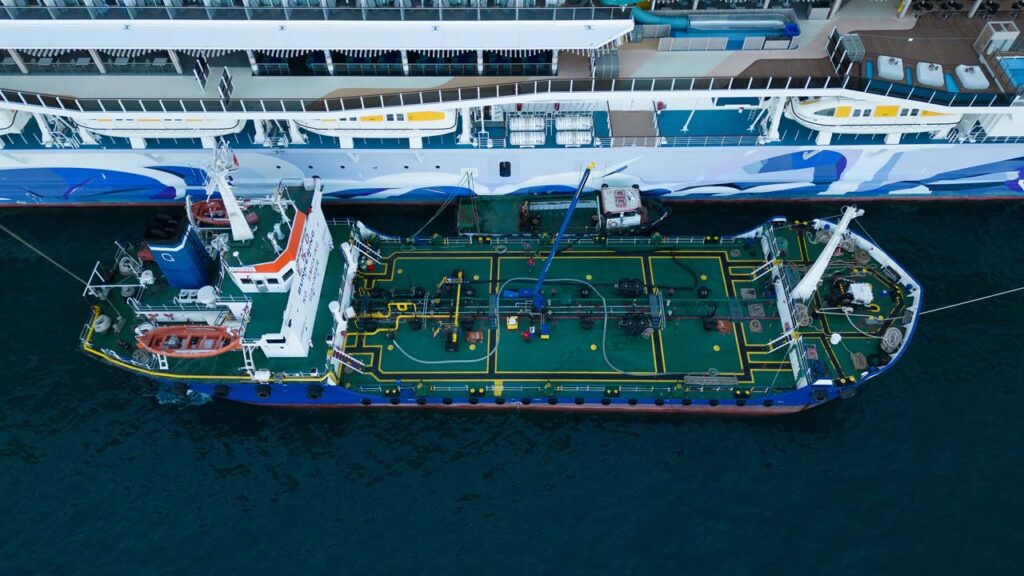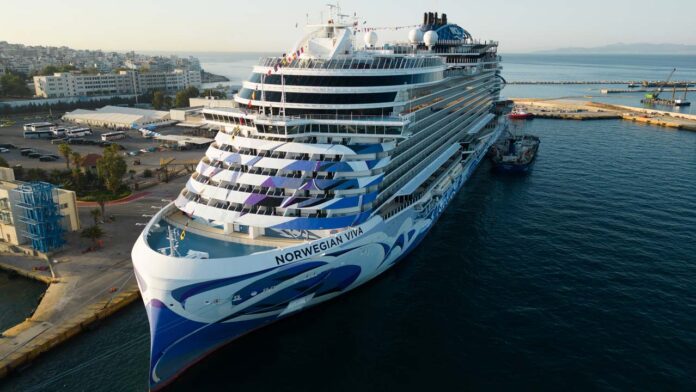
World Fuel Services, a World Kinect company announces that Norwegian Cruise Line Holdings has carried out one of the first commercial biofuel bunkerings for a cruise vessel in Greece, with Norwegian Viva receiving a waste-based marine fuel blend in Piraeus.
Coordinated by World Fuel, in collaboration with Greek supplier EKO, the delivery highlights how international cooperation is enabling the cruise sector to reduce emissions today.
The delivery builds on Norwegian Cruise Line Holdings’ previous biofuel operations in Europe, including successful trials in Gibraltar, Copenhagen, and the Amsterdam-Rotterdam-Antwerp (ARA) region, as well as a biofuel delivery in Piraeus on 20th July. Together, these operations highlight the cruise line’s commitment to integrating sustainable fuel solutions across its fleet and World Fuel’s pivotal role in enabling these projects.
Kimberly Westmoreland, Senior Director Cruise and Energy Transition, World Fuel, said: “This collaboration demonstrates how the cruise industry can access certified alternative fuels right now – not someday. By uniting our global supply network with strong local execution, we’re able to support forward-looking operators like Norwegian Cruise Line Holdings turn low carbon fuels access into meaningful progress on decarbonization.”
“This biofuel operation in Piraeus reflects the kind of pragmatic progress we’re making under our Sail & Sustain program,” said Lory Urdaneta, Senior Director Energy Strategy at Norwegian Cruise Line Holdings. “It’s one more way we’re scaling lower-carbon solutions across our fleet while maintaining the guest experience we’re known for. Collaborating with partners like World Fuel and EKO enables us to accelerate our decarbonization efforts and extend our sustainability impact across new geographies.”
Chrisanthopoulos Konstantinos, Manager, Marine Fuels & Services Division, EKO said: “EKO is proud to contribute to this important milestone in Greece. By supplying waste-based biofuels locally, we are demonstrating the readiness of the market and the potential for wider adoption across the Mediterranean.”