0.5 C
New York
Home Blog Page 964

Newbuild Q7000 is delivered to Helix Energy Solutions

0

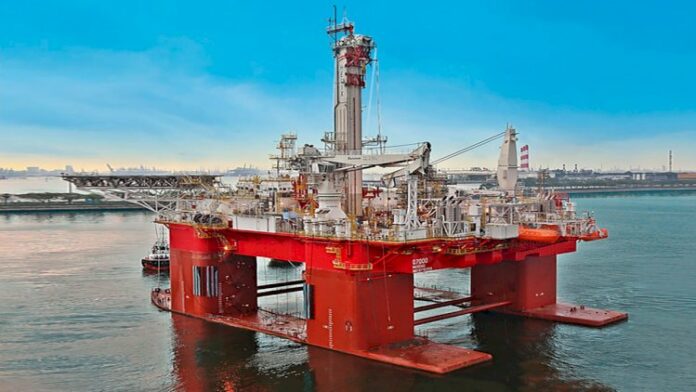
Helix Energy Solutions Group has taken delivery of the Q7000 well intervention semisubmersible vessel from Sembcorp Marine in Singapore.

Equipped with an IMO-certified Class 3 Dynamic Positioning System and the Helix-designedIntervention Riser System, the Q7000 is able to execute well intervention and decommissioning operations in water depths ranging from 85m to 3,000m.

With its open deck plan and tri-axial configuration, the Q7000 is capable of a wide range of Production Enhancement operations as well as well clean-up and field development support. It is equally optimized for Well Decommissioning, including suspension, tubing removal, tree recovery and sea floor clearance.

During operations, the vessel has a variable deck load capacity of circa 3,000t in addition to well intervention and service fluids. The Q7000 is arranged with a sophisticated (active and passive heave compensation) 600t well intervention tower on the upper deck, and has a large flush deck with skidding system for Well Intervention support equipment and tubulars storage. It has below deck twin work class ROV systems, bulk fluids storage and pumping systems.

The Q7000 features a full suite of Schlumberger equipment as part of the joint Subsea Services Alliance, providing an integrated approach to subsea well services. The Alliance combines the expertise and capabilities of Helix and Schlumberger to form an advanced subsea well construction, intervention and decommissioning portfolio, including marine support, well services, project management, and subsea well access and control.

The Q7000 is currently transiting to West Africa to commence its first subsea services project scheduled to begin in January 2020.

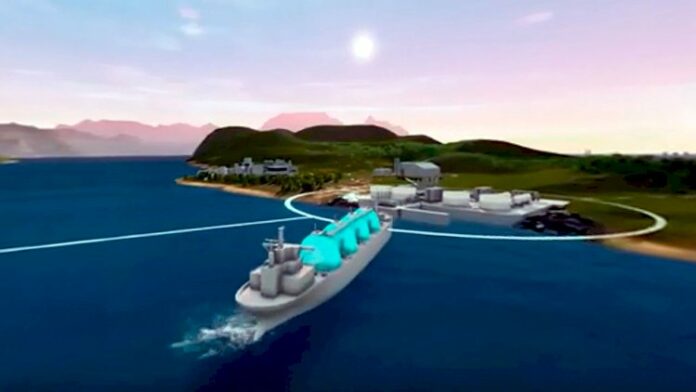
VIDEO: MAN LNG-to-power come alive in virtual reality

0

MAN Energy Solutions presents flexible LNG to power solution.
This is the way that does not require an existing infrastructure and is available all from one source.

Wärtsilä and PSA Marine join forces to achieve clean energy shipping

0

The technology group Wärtsilä and Singapore-based PSA Marine have agreed to collaborate in the co-creation of smart technologies for the marine sector. The focus will be on solutions that are human-centric and deployable. The Letter of Intent was signed on November, 14 as part of the events celebrating the anniversary of the opening of the Wärtsilä Acceleration Centre in Singapore.

Specific collaboration areas envisioned include the use of electric or hybrid technologies that further the use of low-emissions energy and propulsion systems; the incorporation of next-generation smart vessel technologies; the adoption of secured connectivity to facilitate ship-to-shore data exchange; and marketing and branding activities that generate awareness.

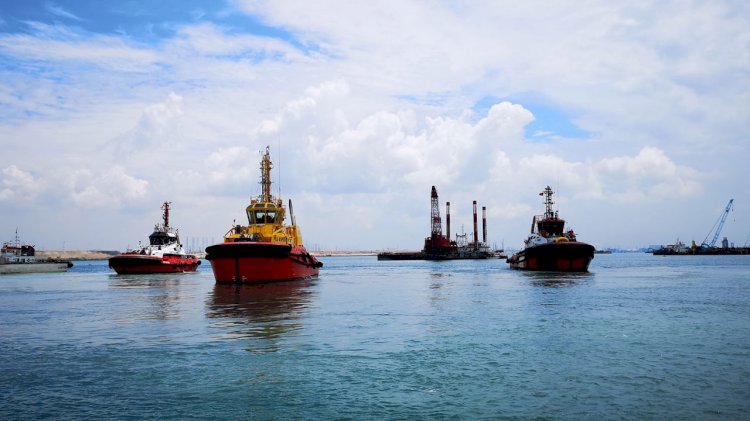
With one dual-fuel harbour tug running on LNG already in service, and another joining the PSA Marine fleet by the end of this year, PSA Marine and Wärtsilä have pledged to design and develop more solutions for smart and low-emissions harbour craft. The intention is to integrate the deep capabilities developed in the IntelliTug project with new configurations and concepts of hybrid, electric, and other clean energy sources.

Mervin Ong, Managing Director, Wärtsilä Singapore, said:

“The Acceleration Centre promotes innovation and joint projects with qualified partners in support of Wärtsilä’s ambition of a Smart Marine Ecosystem that will deliver huge advances in efficiency, safety, and environmental performance. Our on-going IntelliTug project was the Centre’s first co-created initiative together with PSA Marine, the Maritime and Port Authority of Singapore (MPA), Lloyd’s Register, and the Technology Centre for Offshore & Marine Singapore (TCOMS). This cooperation with PSA Marine is now being continued through this agreement, and we look forward to continuing our innovative and important work together.”

Peter Chew, Managing Director of PSA Marine, commented:

“PSA Marine and Wärtsilä intend to lead and develop smart, scalable, and clean energy solutions for the longer term, as we play our part towards decarbonisation and the reduction of greenhouse gas emissions.”

The Wärtsilä Acceleration Centre has played an important role in the IntelliTug project, which is bringing an autonomously operated harbour tug concept to feasibility. The concept is undergoing testing aboard PSA Marine’s ‘PSA Polaris’ tug. Among the enabling technologies thus far employed are the joystick and digital control of the vessel’s azimuth thrusters, virtual anchoring to hold position, smart navigation with automatic path planning, and situational awareness for detecting and avoiding the risk of collisions.

The IntelliTug project has also been largely instrumental in the launch of Wärtsilä’s Smart Technology Lab in Singapore. It provides facilities for testing integrated technologies in close cooperation with customers and end-users in a co-creative and collaborative environment. The Lab also enables potential technological and holistic solutions that address the needs and challenges faced by customers, to be jointly explored.

Wärtsilä has also recently established an Expertise Centre in Singapore to enhance its global provision of various value-adding customer support functions. These include, for example, asset diagnostics and remote monitoring for customers having Lifecycle Solution agreements with Wärtsilä.

The signing ceremony was attended by Finland’s Minister of Economic Affairs, the Finnish Ambassador to Singapore, the Singapore Ambassador to Finland, and top executives from both Wärtsilä and PSA Marine.


World’s first arctic high-bandwidth satellite service for icebreaker Polarstern

0

Kepler Communications, a pioneer in nanosatellite telecommunication services, has demonstrated delivering over 100Mbps connectivity service in the Arctic region to the German icebreaker Polarstern. The vessel is located around 85oN and is the home to the MOSAiC scientific expedition. The demonstration marks the first time in history that the central Arctic is successfully connected through a high-bandwidth satellite network.

Kepler’s two polar-orbiting satellites are being used to transfer data for scientists taking part in MOSAiC, the most extensive research expedition ever to the North Pole. MOSAiC is an international expedition consisting of hundreds of scientists and operations crew, which will remain locked into the Arctic ice sheet to study the environment. The team will spend the next 12 months drifting along with the ice sheet, with the purpose of the mission being to take the closest look ever at the effects of climate change on the Arctic.

Thanks to Kepler, the Polarstern is equipped with the world’s only high-bandwidth satellite data link delivered from low-Earth orbit (LEO) that is available in the Arctic. With the vessel operating well outside the range of traditional high-throughput satellites, Kepler is providing 100x higher data speeds, when the satellite passes the vessel than would be otherwise available to the ship. This improved data transfer capability means scientists can share large data files between ship and shore, improving the ability to share, analyze, and disseminate information.

Mina Mitry, CEO at Kepler, explained:

“Our Global Data Service provides a cost-effective means to transfer large data volumes that will be gathered over the course of MOSAiC. Rather than only storing data locally and analyzing once physical storage can be sent back with supply vessels, we are giving scientists the ability to continuously transfer test and housekeeping data sets over our unique LEO satellite network.”

Kepler’s Global Data ServiceTM will save time, money and, most importantly, improve the ability for MOSAiC scientists to carry out their critical mission of studying climate change.

In charge of MOSAiC’s logistics is the Alfred Wegener Institute Helmholtz Centre for Polar and Marine Research (AWI), from Germany. They are responsible for leading this international expedition that involves the joint efforts of 19 countries around the world. With over USD 158 million in funding, the most advanced technology on a research icebreaker, and an astonishing quantity of planning and logistics, MOSAiC is the largest expedition to the North Pole ever in history.

Professor Markus Rex, MOSAiC project leader and atmospheric scientist at the Alfred Wegener Institute in Potsdam, outlined:

"The high polar regions are the last frontiers of the globe where high bandwidth data connections could not be established so far. Kepler's new Global Data Service now enables us to send back bulk data, including key data files for monitoring the status of instruments together with experts at home. This will contribute to the success of MOSAiC."

The MOSAiC expedition began when the Polarstern set sail from Norway this past September and will continue for more than a year. Findings from the mission will help better assess the future of Earth’s climate, and provide valuable information to help fight climate change.

Kepler is the world's only provider of high-bandwidth satellite services in the poles. Aboard the Polarstern, Kepler has demonstrated data rates of 38 Mbps downlink and 120 Mbps uplink to a 2.4m Ku-band VSAT (Very Small Aperture Terminal).

VIDEO: The renewed quay in the Port of Savona

0

The "renewed" Calata Delle Vele quay dedicated to cruises in the historic port of Savona, together with the Palacrociere terminal 1, was officially inaugurated on November, 14.

The total investment for the renewal of the quay, by the Port System Authority of the Western Ligurian Sea, and of the terminal, carried out by Costa Crociere, is approximately 22 million euros.

The works were completed on schedule, which guaranteed the main quay dedicated to the cruise ships to adapt to the needs of the new generation ships. Costa Crociere has thus returned to its historic port of call, which has seen millions of passengers land in the historic centre of the city for about fifteen years, making the hub of Savona one of the main cruise ports in Italy and Europe.

To allow the wharf to accommodate the latest-built cruise ships it was necessary to bring the seabed from the initial -9 meters to -11 with a consolidation of the nine and ten docks and the construction of a deck supported by columns on the front of the quay 8. The 17 million euro investment by the Port System Authority of the Western Ligurian Sea was made by Fincosit srl and RCM Costruzioni, fully respecting the project schedule, with the docking of the flagship Costa Diadema.

Work on the quay and terminal 1 of the Palacrociere was carried out in anticipation of the arrival of the Costa Smeralda, a new flagship that will be calling at Savona every Saturday from 21 December 2019. Costa Smeralda represents a real turning point in terms of minimizing the environmental impact, because it will be fed, both in port and at sea, with liquefied natural gas (LNG), the cleanest fossil fuel in the world. The use of LNG makes it possible to eliminate emissions of sulfur oxides and particulates almost completely, as well as significantly reducing nitrogen oxide and carbon dioxide emissions.

VSAT connectivity for green shipping company

0

Green shipping company with a sustainable way of producing a range of drinks from deep sea water selects Marlink for connectivity, crew communications and operational efficiency.

The innovative, eco-friendly French company OFW Ships has chosen Marlink to provide a multi-band connectivity solution, combining high-throughput global VSAT with an L-band back-up for connectivity redundancy.

OFW stands for ‘Ocean Fresh Water’, reflecting the company’s simple but profound purpose: to sustainably convert saltwater into drinks. With 7.3 billion people on the planet, water is an over-exploited, increasingly precious resource in more and more places globally. However, an OFW Ships vessel equipped with a seawater selected filtration system and bottling plant will be able to produce 2,500,000 liters of premium drinks every week.

Pure and mineral-rich saltwater is drawn from the high seas, then filtered to remove sodium chloride while preserving naturally occurring minerals. The processed deep sea water is bottled, packaged and stored on board, then delivered to port, after which the vessel’s five-day production cycle begins again. OFW Ships’ environmental consciousness incorporates a promise to recover as many empty bottles as full ones delivered. The collected bottles will subsequently be recycled and transformed on board into pallets to be used for ensuing deliveries. The overall process divides by 10 the average carbon footprint of a bottle of water.

The adoption of Marlink’s multi-band connectivity will help OFW Ships to provide seamless crew connectivity including enabling crew to use their own devices onboard. This is an important factor because only specially hired, technically qualified crew can ensure the successful completion of all technical tasks on board. Greater operational efficiency will be achieved by operating in a more satcom-enabled digital maritime environment and by adapting new applications for smarter decisions and on-board safety.

OFW’s contract with Marlink is based on the multi-band combination of global Ku-band Sealink VSAT with L-band back-up, which ensures seamless global coverage and connectivity in all maritime conditions. The service comes with a Committed Information Rate (CIR) establishing a bandwidth guarantee to ensure enough throughput is available for critical applications used for operations and safety. Network control and crew account management will be handled cost-effectively by Marlink’s XChange communication management platform.

Tore Morten Olsen, President Maritime, Marlink, says:

“OFW Ships’ environmentally responsible mission is a very timely and intelligent solution to an urgent global problem. It is very exciting for us to support this project by a true green shipping company that is making such an important contribution to creating a more sustainable model for the future, with our connectivity solutions.”

Régis Revilliod, CEO & Shipowner, OFW Ships, adds:

“Reliable, top-quality connectivity is vital for us if we are to carry out our operations as safely and effectively as possible. A well-equipped, well-informed and happy crew is also an efficient crew. Teaming up with Marlink will enhance our working life and help us to serve our clients in the digital world we live and work within.”

Arista’s fleet to use processed data from the ABS’ application

0

Arista Shipping is beginning the path to smart shipping operations with an ocean data agreement with ABS.

Arista’s fleet and managed vessels will use processed data from the ABS Metocean Hindcast Data application to guide operational decision making.

Advanced ABS data processing is applied to over a decade of Metocean Hindcast model data from the U.S. National Oceanic and Atmospheric Administration to determine the wind speed, wind direction, wave height, wave period, and wave direction corresponding to a specified vessel’s route. This can be compared with a vessel’s operational tolerances to guide safer voyages.

Kashif Mahmood, ABS Senior Vice President of Digital Solutions, said:

“This is a powerful example of the potential of digital technologies to drive safety performance and operational efficiencies. The ABS Metocean Hindcast Data Application is cloud-based and available anytime, anywhere in the world. It is the first step for Arista along the road to smart shipping operations and we are proud to partner with them on this journey.”

Antonis Trakakis, Arista Shipping Technical Manager, said:

“Digital solutions can truly enhance the efficiency of operations. Historic data of wind and sea condition is an indispensable input for an accurate follow up of fleet performance. ABS has been selected for the provision of this service on the grounds that it can offer a broader cooperation and support for the evaluation and the safe handling of the data from on board the ships, and ultimately to become a partner towards a smart ship in the near future.” 

nauticAi signs up as new Inmarsat Fleet Data application provider

0

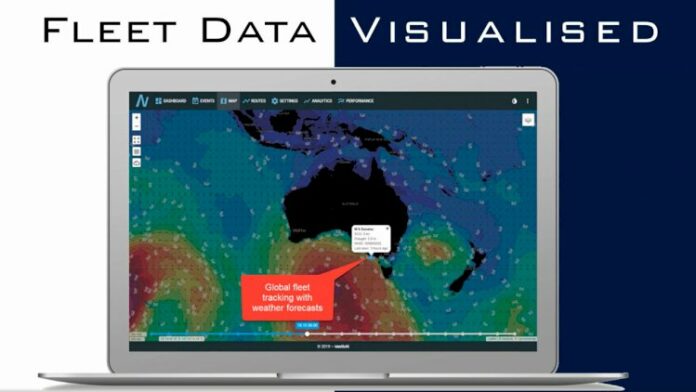
Finnish start-up nauticAi and Inmarsat, the world leader in global, mobile satellite communications, have signed an agreement for nauticAi to join the fast growing group of certified application providers to provide a dedicated application for Inmarsat’s Fleet Data service.

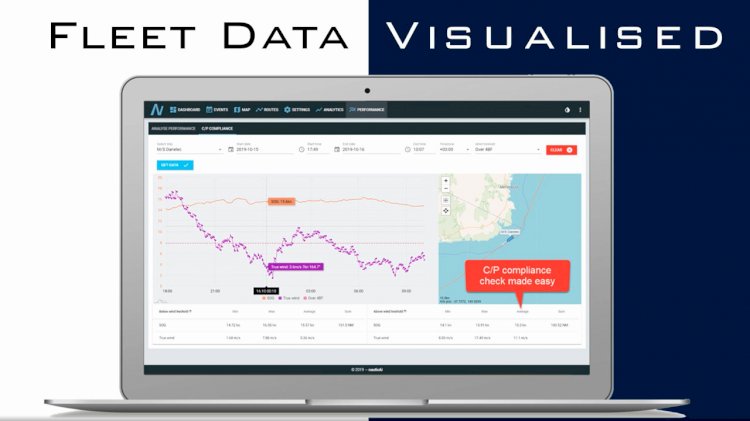
Developed by Inmarsat and Danelec Marine, and made commercially available earlier this year, Fleet Data collects data from onboard sensors, pre-processes that data, and uploads it to a central cloud-based database, equipped with a dashboard and an Application Programming Interface (API).

nauticAi will use the Fleet Data API to provide their Bridge Operations Quality Assurance BOQA-solution – a methodology adopted from the flight industry – as a simple way to proactively utilise VDR data and to automate and standardise Operational Quality Assurance across fleets of ships.

Capt. Henrik Ramm-Schmidt, CEO and founder of nauticAi, says:

“Working with Fleet Data is great, since it removes the hassle of visiting ships and building expensive interfaces to the Voyage Data Recorder (VDR) and other ship systems. For us this is a true enabler and we can leverage our own expertise in creating highly visual and affordable analytic solutions in the cloud. For our customers it is even better, since it means that they can now easily and securely implement BOQA in their own operations with a simple and modest monthly subscription.”

The BOQA-methodology (Bridge Operations Quality Assurance) is inspired by its equivalent in the flight industry, and it was first introduced to maritime operations by the large cruise liners Royal Caribbean and Carnival some years ago. The need was to have a safety-solution which can provide a 24/7 continuous monitoring of sensor data and alarms, and to raise alerts if defined operational limits were deviated from. BOQA is also a way to proactively use the ships’ VDR data, as outlined by the Oil Companies International Marine Forum (OCIMF) in 2013.

BOQA is essentially an automated event tracker, which uses various rules and artificial intelligence techniques to detect anomalies and deviations in operational behaviour. Some of the key event types include route plan deviations, heavy weather, heavy motions, sudden stops at sea, under keel clearance, excessive rudder movement, black-outs and crash stops. New event types, such as close encounter detection, minimum CPA and TSS-violations are constantly in development.

Marco Cristoforo Camporeale, Head of Digital Solutions, Inmarsat Maritime, said:

“We are delighted to be working with an innovative start-up such as nauticAi. Safety at sea is part of our DNA and this partnership will help standardise the data collection of safety operational data and ultimately reduce incidents at sea and make ships safer. It will allow ship operators and managers to implement their own BOQA systems, through the  nauticAi application on Fleet Data and via a secure platform that is fully scalable, fleet-wide and now commercially available on both Fleet Xpress and FleetBroadband.” 

With the help of Fleet Data API, nauticAi can now take BOQA to a new level, by introducing ship performance and VDR alarms into the mix. This allows for new types of intelligent monitoring, including for example Charter party-compliance checks and alarm data trend analysis across a large fleet of ships. The goal with BOQA is to improve operational quality, increase safety and reduce fuel consumption.

 

Saipem awards a new subsea contract in Guyana

0

Saipem: new subsea contract in Guyana and variation orders on ongoing offshore E&C contracts worth overall approximately 880 million USD.

Saipem has been awarded a subsea contract by ExxonMobil subsidiary Esso Exploration and Production Guyana Limited (“EEPGL”) for the proposed Payara development project located in the Stabroek block offshore Guyana at a water depth of around 2000 metres. The contract scope includes Subsea Structures, Risers and Flowlines. 

Saipem was awarded earlier subsea contracts for the first two phases of the Liza development in Guyana by EEPGL in 2017 and in 2018, respectively.

Subject to government approvals, project sanction by EEPGL and its partners HESS Guyana Exploration Ltd and CNOOC Nexen Petroleum Guyana Ltd and an authorization to proceed with the final phase, Saipem will perform the detailed Engineering, Procurement, Construction and Installation (EPCI) of a large subsea production facility. This facility will include approximately 130 km of flowlines, rigid risers, associated terminations and jumpers together with the installation of manifolds, flexible risers, dynamic and static umbilicals and flying leads. Testing and pre-commissioning of the subsea field will follow installation.

Before the necessary government approvals and project sanction, the contract award will allow the start of limited activities, namely detailed engineering and procurement.

Saipem’s flagship vessels FDS2 and Constellation will perform the offshore operations using an optimized combination of different pipe-lay methods – J-Lay and Reel-lay.

Stefano Cao, Saipem’s CEO, commented:

“The award of this new contract strengthens Saipem’s presence in Guyana. The long-term basis of our cooperation with our clients is at the very foundation of our business model. Working with ExxonMobil, especially on the continued oil & gas development projects in Guyana, represents both an opportunity and a responsibility to preserve our relationship with stakeholders through sustainable performance. Our relentless attention to safety, environment, innovation and cost efficiency are key to consolidate our position as one of the leading companies in the offshore subsea”.

Furthermore, Saipem has been awarded certain variation orders for additional works linked to ongoing offshore E&C projects in Saudi Arabia, Azerbaijan and in the North Sea.

The overall value of the above-mentioned contracts, together with the contract in Guyana, is worth approximately 880 million USD.

Kyklades Maritime uses SQLearn’s e-learning services for its fleet

0

SQLearn has announced its new partnership with Kyklades Maritime Corporation by providing e-learning services for its entire fleet of 19 vessels via the Dolphin System.

The Dolphin System is a web-based e-learning system specifically designed for the shipping industry and it comprises of the ashore and vessel installation as well as the Training Management System. Kyklades Maritime Corporation through the Dolphin Library will use for the training of its crew the Resilience Training Programme, a library of e-learning modules available to improve the crew’s ability to successfully manage stressful challenges or events and make effective decisions.

As the CEO of Kyklades Maritime Corporation Dimitris Patrikios said:

“Kyklades Maritime Corporation is a shipping company focused on modern and efficient vessels, while operating them with the most sophisticated and comprehensive management systems available in the market. Therefore, we believe that our cooperation with SQLearn will meet the high standards we set for providing our crew with specialized and complete training through innovative e-learning courses. Since we have at the core of our activities the well-trained crew and safe operations, our collaboration with SQLearn was αn inevitable decision for us”.

Spyros Goumas, the CEO of SQLearn, said:

“We are more than pleased to welcome Kyklades Maritime Corporation in the “fleet” of SQLearn. The e-learning courses we provide to our clients in the shipping industry combine the required knowledge and the specialized information with the state-of-the-art technology. The dedication to the needs of our clients is at the center of our values.”