-5.3 C
New York
Home Blog Page 934

Italian Police and SAIPEM sign agreement to prevent cybercrimes

0

The Italian State Police and SAIPEM S.p.A. today signed an agreement in Rome which aims to prevent and combat cyberattacks that target information and services systems of companies of special importance for the country.

Signed by the Chief of Police-Director General of Public Safety, Franco Gabrielli, and the CEO of SAIPEM S.p.A., Stefano Cao, the agreement falls within the framework of the directives issued by the Minister of the Interior regarding the bolstering of cybercrime prevention measures by means of agreements struck between operators managing cutting-edge technologies.

SAIPEM S.p.A. is a leading company in the energy and infrastructures sector. It is present in over 70 countries and has 32,000 employees of 120 different nationalities. Its business activities are deemed vital for Italy’s economy, meaning that SAIPEM S.p.A is of national importance. For this reason, it is essential for the company to ensure the integrity of the information systems needed for the pursuit of its mission.

This agreement is a major step in the process of building a working relationship between the private and state sectors. It is a project which, given the insidious nature of the threats to IT systems and the ever- changing nature in which they appear, is a key instrument in the realisation of an efficient system for fighting cybercrime based on information sharing and operational cooperation.

For the Italian State Police, this task falls to the CNAIPIC (National Crime Centre for the Protection of Critical Infrastructure) of the Postal and Communications Police Service which for years has been protecting private and state-run information networks that are both significant and of strategic importance for the country.
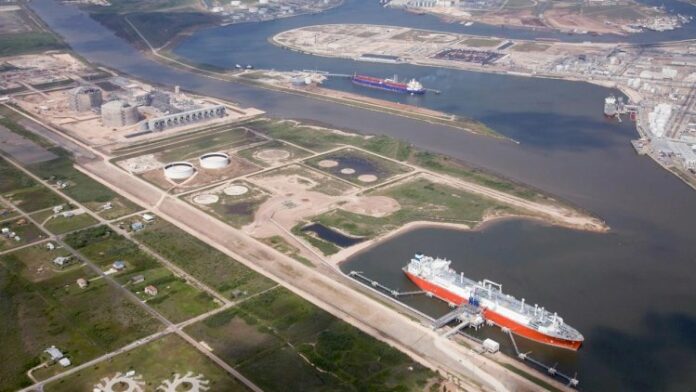
 

Freeport LNG achieves start of commercial operations for second liquefaction train

0

Freeport LNG today announced the start of commercial operations for the second liquefaction train, of its three train facility, with the commencement of gas deliveries from BP under its 20 year tolling agreement with Freeport.

Freeport LNG’s Train 1 began commercial operations last month, with the commencement of Osaka Gas’ and JERA’s tolling agreements.

Michael Smith, Founder, Chairman and CEO, Freeport LNG, said:

“We are thrilled to now be providing service to BP, in addition to Osaka Gas, and JERA. We are also especially pleased with the performance of our electric motor drive liquefaction units. Freeport’s electric drive motors not only reduce emissions by over 90% relative to other plants which use combustion turbines, they should also require less maintenance with less downtime. The performance test on Train 2 was completed in only 37 days after first gas was delivered to the liquefaction facilities, down from 107 days on Train 1. We are extremely pleased with the current operational efficiency and performance from both trains.”

Construction on Freeport’s Train 3 is essentially complete. Gas has been introduced to the pre-treatment facilities and the Company expects Federal Energy Regulatory Commission (FERC) approval to bring gas to the liquefaction site next month. Train 3 remains on track for a commercial start date in May.

Wärtsilä to supply the integrated solutions for new cruise ships

0

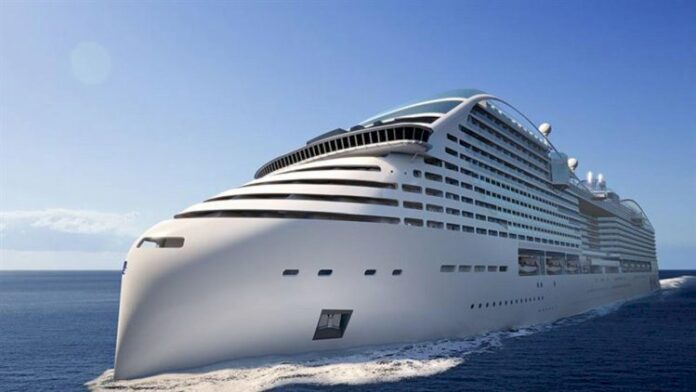
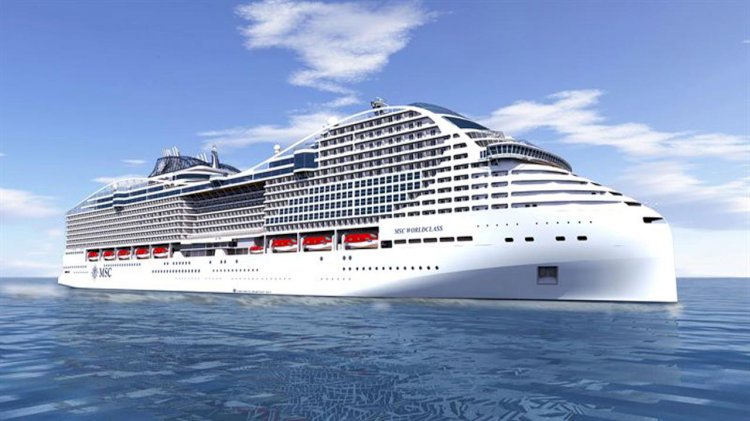
The technology group Wärtsilä will supply Chantiers de l‘Atlantique, France, a comprehensive package of integrated solutions designed to support and enhance the efficiency and environmental sustainability of the first two World Class cruise vessels being built for Geneva, Switzerland based MSC Cruises.

The ships will operate on clean burning LNG fuel, and with optimal environmental performance. The orders with Wärtsilä were placed by Chantiers de l’Atlantique in Q3 2018 and Q1 2019. These will be the first two cruise ships to run on LNG with Wärtsilä 46DF engines, and with Wärtsilä LNGPac systems.

The cruise industry’s profile in general is today very much geared towards sustainable operations. Wärtsilä’s Smart Marine vision, whereby high levels of digitalisation and connectivity are utilised to deliver greater efficiencies and better environmental performance, strongly supports this trend. 

Stefan Nysjö, Vice President, Marine Power Solutions, Wärtsilä, says:

“The focus of our solutions is on reducing energy and fuel consumption in order to promote efficiency. At the same time, our nitrogen oxide reduction and LNG solutions enhance environmental sustainability, which together with the higher efficiency, is very much in line with Wärtsilä’s Smart Marine strategy.”

Yves Pelpel, Technical Director, Chantiers de l’Atlantique, says:

“We are very familiar with Wärtsilä’s products and they have always provided us with excellent support in newbuild projects. These two new cruise ships will represent the latest thinking in minimising the environmental impact and reducing fuel consumption, which is in line with our Ecorizon plan, and Wärtsilä is playing a major role in this.”

The full scope of Wärtsilä’s supply of fully integrated solutions includes, for each of the two vessels, five 14-cylinder Wärtsilä 46DF dual-fuel engines fitted with nitrogen oxide reduction (NOR) units, two Wärtsilä LNGPac fuel storage and supply systems, seven Wärtsilä thrusters, and two Wärtsilä fixed pitch propellers. The Wärtsilä 46DF engines are IMO Tier III compliant in gas mode, and are compliant in marine diesel oil (MDO) mode in combination with the NOR units. The Wärtsilä equipment is scheduled for delivery in mid-2020 for the first ship, and in mid-2022 for the second.

The steel cutting ceremony for the first of the two vessels, the ‘MSC Europa’ was held at Chantiers de l‘Atlantique in the end of October and it is scheduled to be launched in May 2022. Delivery of the second World Class vessel is scheduled for 2024. MSC Cruises is the world’s largest privately held cruise operator, and these two new ships will operate worldwide.

Photo: Chantiers de l‘Atlantique

Spire Maritime launches Dynamic AISTM to solve data gap problem

0

As maritime traffic continues to grow and trade routes become more congested, gaps in AIS data have become the leading problem in the maritime industry.

These gaps in data directly impact ship safety, trading, revenue, and insurance claims. To address this growing problem, Spire Maritime launched Dynamic AISTM. This solves this growing data gap problem and delivers more unique MMSI (up to ten thousand per day) with near-real-time latency, and up to six million additional AIS messages per day. 

Dynamic AISTM is a world-first innovation from Spire Maritime that allows you to benefit from thousands of satellite-enabled AIS receivers traveling throughout the busiest shipping lanes in the world. It provides an unprecedented frequency of position updates in areas that are out of the reach of terrestrial collection and overwhelm other satellite AIS providers. 

Spire Maritime combines three types of AIS collection (Terrestrial, Satellite, and DynamicTM) into one service. In a sample taken over a 24-hour period, we delivered 56% more messages and 25% additional unique MMSIs in the South China Sea. Maritime intelligence and data analytics customers found the results groundbreaking. 

Solis Marine launches global Fire and Chemicals emergency response consultancy

0

Solis Marine has introduced a global Fire and Chemicals emergency response operation. The new division will be led by global expert Sander Loef who will be based out of a new strategically located office opening in the Netherlands.

Sander Loef joins Solis Marine as Marine Consultant, Fire and Chemicals Specialist, and becomes General Manager of the Rotterdam based operation. His appointment meets client demand for specialist advice in relation to fire, chemical and oil spill response and risk assessment.

Going forward, Solis Marine will now offer on-site attendance or remote advice round the clock to clients for the investigation of fire and chemical incidents involving all vessel types, cargo fire or spills in port, offshore or at sea.

Sander is an acknowledged marine fire and chemicals expert and has been involved in a number of emergency response operations worldwide. Over the past 17 years he has worked as a firefighting expert, dangerous goods and hazmat specialist and oil spill response co-ordination and safety officer. He also brings experience in maritime commercial, operational, logistical, financial, legal and insurance matters. Sander has also investigated a number of incidents and provided expert reports including giving expert evidence in court and tribunals.

Sander has previously held senior positions at international consultancies. His expertise complements the existing strengths of the Solis Marine casualty management team and its multi-disciplined approach to incident investigation.

Solis Marine Consultants co-founder and Senior Partner Captain John Simpson said:

“We are developing our services to meet client demand for specialist fire and chemical advice and risk assurance. The arrival of Sander means we can expand our operations into an area of growing risk which is generating significant losses for the industry.

We see significant demand for our core services of casualty management, casualty investigation, expert witness and distressed cargo management, and also for our project cargo and marine warranty services. As with all of our offices, our new base in Rotterdam will provide support to Solis Marine’s clients on a worldwide basis as well as providing direct support to our growing client base in Europe.

The Port of Rotterdam is the largest in Europe and a major maritime hub and so this was a natural choice of strategic location for Solis Marine’s latest expansion in Europe as we look to grow our global footprint and the range of client services we offer.”

Sander said:

“Fires and explosions on board vessels continue to generate very large losses. Insurers have rightly flagged incidents like these as a growing risk in recent years. The combined expertise and know-how provided by Solis Marine allows for a pragmatic approach to help investors, owners, financial institutions, insurers and cargo interests take concrete steps to mitigate the risk of fire and chemical marine disasters.”

As well as incident investigation, Solis Marine also specialises in salvage cases, acting on behalf of insurers, insured interests and salvors. Work undertaken will now include the constant monitoring and control of operations and potential and existing hazardous situations involving combustible, polluting and chemical spills.

In addition, Solis Marine will provide risk assurance to help clients navigate complex law and jurisdiction regards fire safety by assessing compliance and evaluating risk.

New dual-fuel tug delivered to Ningbo port

0

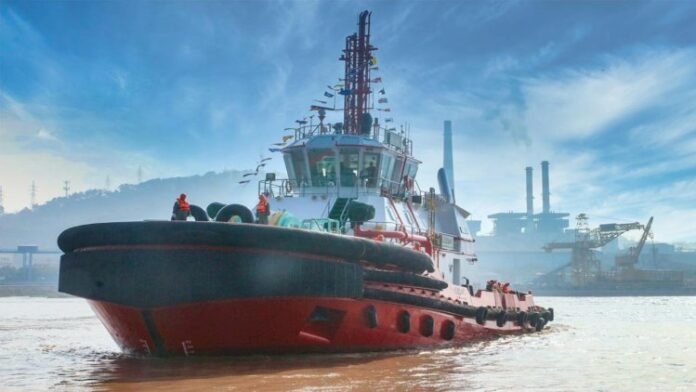
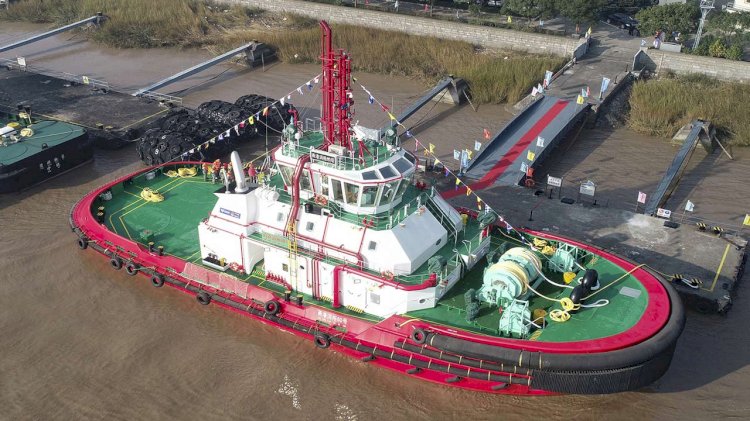
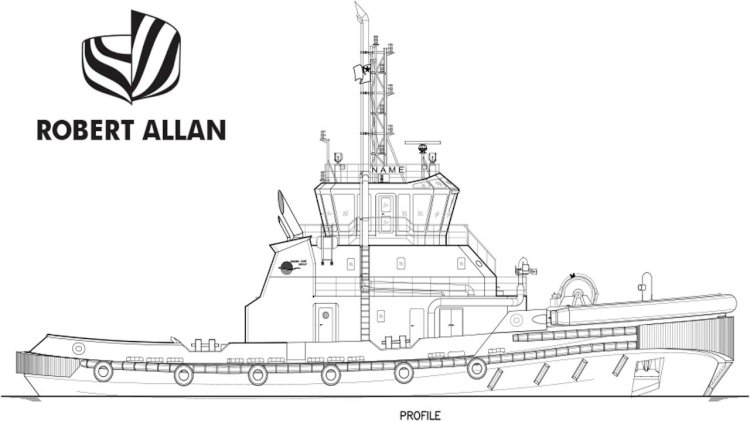
Ningbo Zhoushan Port Company Ltd. of Ningbo, China, has recently received delivery of Yong Gang Xiao Tuo 60, a dual fuel RAstar 3800-DF tug from Jiangsu Zhenjiang Shipyard in China. 

This first ever RAstar 3800-DF tug is the 10th custom designed vessel by Robert Allan Ltd. in close collaboration with Ningbo Port Company. The vessel is also the first Robert Allan Ltd. designed dual-fuel tug to operate in China.

The new RAstar 3800-DF tug is powered by a pair of Niigata 8L28AHX-DF dual-fuel engines, each rated for 2,389 kW at 800 rpm, and driving Kongsberg US 255 CP 2.8 metre diameter controllable pitch Z-drives. Bollard pull recorded on trials met all expectations and is certified as 80.3 tonnes ahead. Recorded speed ahead is 13.5 knots.

The LNG tank and fuel gas system have been supplied by Gloryholder Liquefied Machinery (DL) Co., Ltd. of China. Gross capacity of the tank is 55 m³, which is suitable for a range of over 700 nautical miles in gas mode and can be supplemented by additional range of nearly 1,700 nautical miles in diesel mode.

The double drum hydraulic hawser winch forward is supplied by Singapore’s W-Rig, who are also supplying capstans for both the forward and aft decks, as well as the anchor windlasses. The tow hook aft is supplied by Mampaey.
A Fi-Fi 1 class off-ship fire-fighting system with pumps driven off the front of each main engine is also part of the tug’s outfit and capabilities, with equipment supplied by Norway’s Jason Engineering AS.

MLC 2006 compliant accommodations are provided for a crew of up to 10 persons in the two-level deckhouse, including 6 single occupancy officer cabins on the 2nd deck, plus two double crew cabins in the first tier of the deckhouse. The tug is outfitted with a full galley, and a large crew mess and lounge is a key feature of the accommodations.

GE to supply wind substations for NnG offshore wind farm

0

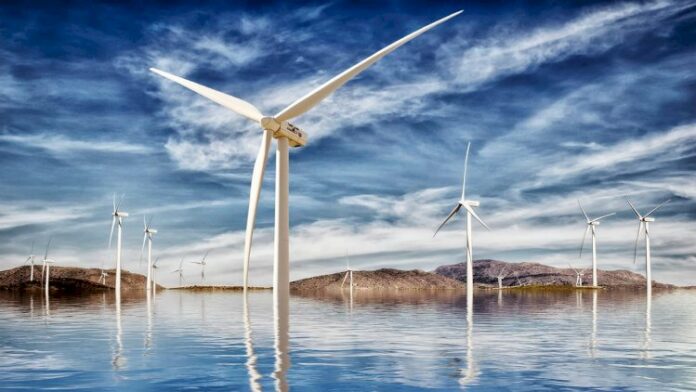
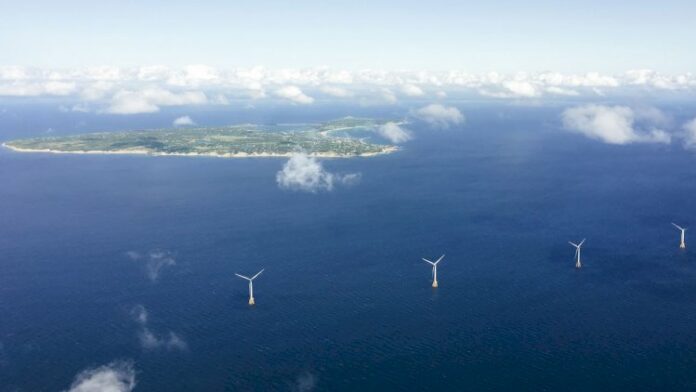
GE Renewable Energy’s Grid Solutions business has been awarded a multi-million dollar project for the design, supply, construction and commissioning of onshore and offshore wind substations for the Neart na Gaoithe (NnG) offshore wind farm, 12 miles off the Fife coast in Scotland.

The offshore wind farm project is jointly owned by EDF Renewables and ESB. EDF Renewables is one of the UK’s leading renewable energy companies and ESB is an Irish Energy Company operating across the electricity market on the island of Ireland, with an established and growing presence in Great Britain. GE is responsible for the turnkey delivery of all infrastructure within the perimeter, including ground works and civil construction. NnG is expected to be fully operational in 2023.

Wind power is Scotland’s fastest growing renewable energy technology. Some say that the country is in the midst of a “wind energy revolution.” Figures from Weather Energy show that between January and June of 2019, wind turbines in Scotland provided enough electricity to power the equivalent of 4.47 million homes—almost twice the entire country’s domestic power requirements.

Neart na Gaoithe (which literally means “Strength of the Wind”) will play a major role in meeting the carbon emissions reduction targets of both the Scottish and UK governments. The 400/220 kilovolt (kV) onshore wind substation will be built on a greenfield site. Once NnG is operational, it will offset more than 400,000 tons of CO2 emissions each year and provide enough electricity to power more than 375,000 Scottish homes.

Gerhard Seyrling, GE’s Grid Solutions president & CEO Europe, Russia & CIS, said:

“GE’s Grid Solutions business is very proud to work with our consortium collaborators to support both shareholders in their growing portfolios of onshore and offshore wind farms as well as to help deliver low carbon electricity generation in the UK.”

In a consortium arrangement, GE is collaborating with HSM Offshore BV in the Netherlands and IV-One. HSM will provide the offshore topside platform designed by IV-One, that will house GE’s 220kV and 66kV substations.

The project’s onshore and offshore substation equipment includes four power transformers, four reactors, the static synchronous compensator (STATCOM), power quality components, and gas insulated switchgear — at 66kV, 220kV and 400kV — as well as protection and control, SCADA, and telecommunications systems. This solution will allow for 450 megawatts (MW) of low carbon energy to be connected to the Scottish electricity grid.

Report: modest outlook for container shipping market

0

The outlook for the container shipping market remains soft despite the welcome boost of the ‘phase one’ trade agreement signed by the US and China, according to Drewry’s recently published Container Forecaster report.

Drewry is now predicting that world container port throughput will increase by 3.3% in 2020, following an estimated 2.3% rise last year. The current year forecast represents a downgrade of 0.7 points on the previous outlook given at the end of September 2019.

Simon Heaney, senior manager, container research at Drewry and editor of the Container Forecaster, said:

“A swift and amicable end to the US-China trade dispute has the potential to give the global economy a boost. However, that outcome is still only a tantalising possibility and much more work is needed to be done to secure a more permanent trading arrangement between two countries that have a number of seemingly intractable differences to resolve. It’s a step in the right direction that removes one layer of uncertainty, but as with previous truces the foundations are flimsy and there is still a reasonably high chance that hostilities will be resumed.”

The report also highlighted the risk of further protectionist policies on the container market with the threat of extra duties being imposed by the US on cars and components shipped from Europe, which are a major commodity bloc for the containerised transportation industry.

In summary, for 2020, Drewry is forecasting faster demand growth than in 2019, a slight increase of overcapacity, higher rates (including bunkers) than in 2019 and a small reduction in (already low) annual carrier profits.

Heaney said:

“Carriers should still prepare for a bumpy ride in 2020 and not assume that the previous China-centric trade flows will resume now that a resolution to the trade war is in sight. Having been down this road before, shippers will rightly be wary and are likely to continue examining contingency plans that will require more diverse shipping networks.”
 

Vessels offered free shore power during Parkkade trial in Rotterdam

0

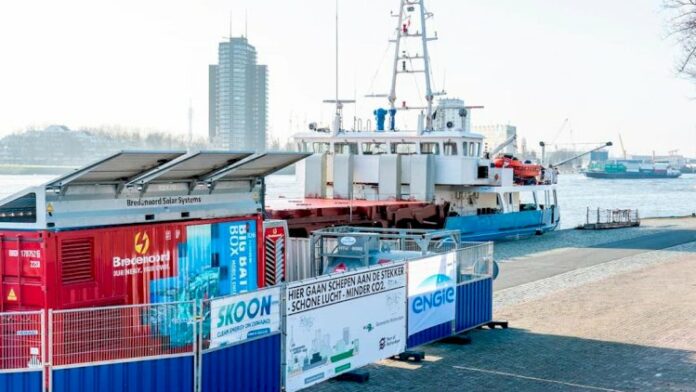
Coasters taking part in the mobile shore power trial on Parkkade in Rotterdam are being supplied with free electricity.

The aim is to stimulate shipping companies to take part in the trial. Using shore power reduces air and noise pollution, as vessels do not need to use their diesel generators. The initial reactions are very positive.

The trial started in December. Mainly vessels from Wilson shipping company have taken part so far. In total, five different mobile shore power systems will be tested over a five-month period. Engie, Bredenoord and Skoon’s hybrid system is currently being tested: a Big Battery Box, integrated with a motor generator on biofuel (HVO).

As Parkkade was very busy over Christmas, the period in which this system was used on Parkkade was extended by a week. This gave more vessels the opportunity to connect. The next system will be installed in the second half of next week. The trial is a partnership between the Municipality of Rotterdam and the Port of Rotterdam Authority.

Fugro wins geotechnical site investigation contract off the Dutch coast

0

Following last year’s geotechnical contract for the Hollandse Kust (west) Offshore Wind Farm Zone, Fugro has been awarded a geotechnical site investigation contract for the Ten noorden van de Waddeneilanden Wind Farm Zone (TNWWFZ).

The final deliverable for the Netherlands Enterprise Agency (RVO.nl, part of the Ministry of Economic Affairs and Climate Policy) will be a data package which can be used to prepare a detailed integrated geological and geotechnical soil model, on which wind farm developers will base future tenders.

The fieldwork will take place from February to May this year, and the project will comprise two phases: a shallow subsurface investigation completed in Phase 1, followed by a borehole drilling programme, and standard and advanced laboratory testing, in Phase 2.

Sven Plasman, Project Director at Fugro, said:

“This latest award for the Dutch wind farm industry underlines our commitment to support the offshore wind industry in the global energy transition and proves that technical innovation wins contracts. Our innovative and continuously upgraded seabed and downhole tools, such as the SEACALF® Mk IV and WISON® Mk V, now fully operational on our vessels, are a major asset. Furthermore, this award from RVO.nl recognises the importance of Fugro’s initiatives to improve project sustainability by reducing the carbon footprint of our site investigations.”

Frank van Erp, RVO.nl’s project manager, said:

“We aim for continuous improvement in site data for Dutch Wind Farm Zones to accelerate the development of Dutch offshore wind energy. With Fugro on our team, we look forward to achieving this goal.’’  

The TNWWFZ is 46 nautical miles off the north coast of the Netherlands. The total surface area is approximately 120 km2 and the zone will accommodate 700 MW.