-1 C
New York
Home Blog Page 560

Shell and Baker Hughes to deliver smart oil condition monitoring for the marine sector

0

Shell announces the launch of VitalyX, powered by Shell Remote Sense and Bently Nevada, a Baker Hughes business, as an intelligent, advanced analytics-based oil condition monitoring and machine health service for the marine sector.

VitalyX combines Shell Remote Sense’ lubricant analysis expertise with Bently Nevada’s 60-year experience in condition monitoring and protection to offer an early warning system that remotely monitors oil quality to increase machine uptime.

By deploying industrial internet of things (IIOT) and artificial intelligence (AI) technology in innovative ways, the service uses real-time sensor data and machine learning to provide customers with actionable insights to optimise equipment health, lower maintenance costs and increase operational efficiency of marine vessels.

Shell Marine’s general manager Services & Technical, Marcus Schaerer, said:

“We are delighted to bring the advanced capabilities of Shell Remote Sense to our marine customers in partnership with Bently Nevada. Shell understands the importance of good lubricant management and its impact on equipment life. With Shell Remote Sense, ship owners and operators can continuously monitor oil conditions across multiple components on a vessel. Customers will have vital and predictive information at their fingertips to make proactive decisions on maintenance planning and extend equipment life.”

Ed J. Boufarah, vice president, Bently Nevada, a Baker Hughes business, said:

“Digitalization is maturing rapidly in the marine sector, with the data drawn from real-time remote monitoring not only enhancing operations and improving safety, but also delivering significant efficiency gains. VitalyX provides operators with the predictive capability to optimize maintenance cost management, by switching from a time-based to a health-based approach. This partnership between Shell and Bently Nevada combines the best of our expertise, as we invest for growth to further advance digital transformation and industrial asset management.”
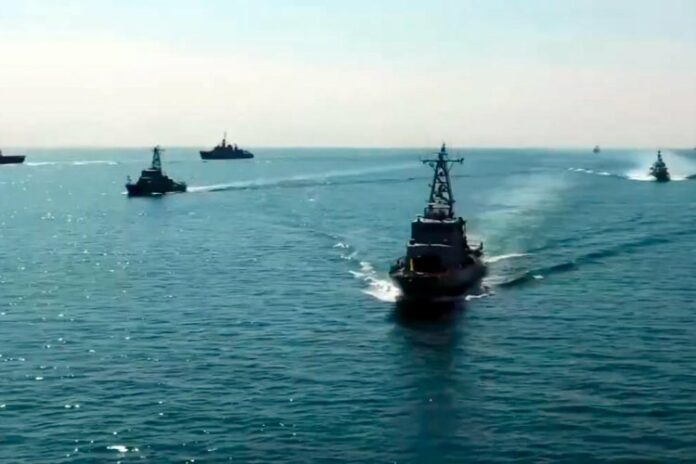
VIDEO: Ukraine holds the first naval parade after a long break

0

Previously, Ukraine held similar parades in Crimea, together with the Russian Navy. Relations between Kyiv and Moscow collapsed after Russia annexed the Crimean peninsula in 2014 and the outbreak of war between Ukrainian troops and Russian-backed forces in eastern Ukraine that Kyiv says has killed 14,000 people in seven years.

The occupation of Crimea took place rapidly and Ukraine was unable to withdraw its ships from the naval bases in time. Russia sank several of the captured ships and appropriated the rest of the ships. 

Since then, the situation in the Black Sea has remained very tense. According to international law, Crimea is Ukrainian territory, as the water area around the peninsula. However, Russia regularly makes provocations in these waters. In 2018, Russia attacked Ukrainian navy ships, and in 2021 there was an incident with the British warship HMS Defender.

Meanwhile, Ukraine is taking steps to rebuild its fleet. In June 2021, the British company Babcock International Group (Babcock) has signed a tripartite Memorandum of Implementation (MoI) in Odesa with the Ministry of Defense of Ukraine and the UK Government. The Group has been chosen to lead in the delivery of the scope of the broad ranging Ukrainian Naval Capabilities Enhancement Program (UNCEP). On August 13, in Berdyansk, the base point of the Marine Guard Division of the State Border Service was solemnly opened.

On August 24, in addition to Ukrainian naval sailors, the naval forces of NATO member states and partners took part in the naval parade in Odesa.

Maersk accelerates fleet decarbonisation with new vessel order

0

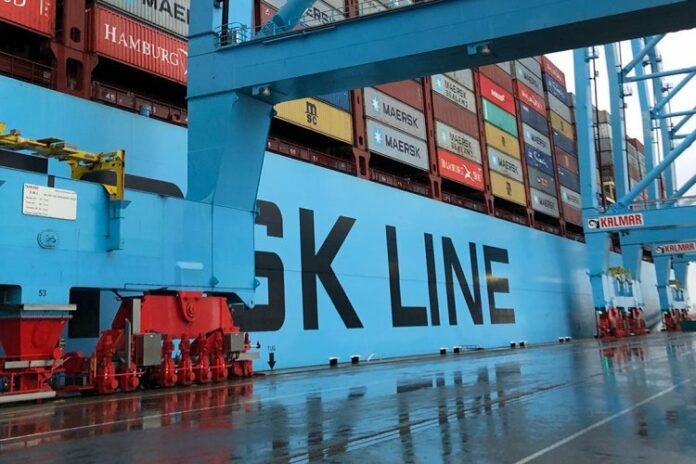
In the first quarter of 2024, A.P. Moller – Maersk will introduce the first in a groundbreaking series of 8 large ocean-going container vessels capable of being operated on carbon neutral methanol.

The vessels will be built by Hyundai Heavy Industries (HHI) and have a nominal capacity of approx. 16,000 containers (Twenty Foot Equivalent – TEU). The agreement with HHI includes an option for 4 additional vessels in 2025. The series will replace older vessels, generating annual CO2 emissions savings of around 1 million tonnes. As an industry first, the vessels will offer Maersk customers truly carbon neutral transportation at scale on the high seas.

More than half of Maersk’s 200 largest customers have set – or are in the process of setting – ambitious science-based or zero carbon targets for their supply chains. As part of Maersk’s ongoing collaboration with customers, corporate sustainability leaders including Amazon, Disney, H&M Group, HP Inc., Levi Strauss & Co., Microsoft, Novo Nordisk, The Procter and Gamble Company, PUMA, Schneider Electric, Signify, Syngenta and Unilever have committed to actively use and scale zero carbon solutions for their ocean transport, with many more expected to follow.

The vessels come with a dual fuel engine setup. Additional capital expenditure (CAPEX) for the dual fuel capability, which enables operation on methanol as well as conventional low Sulphur fuel, will be in the range of 10-15% of the total price, enabling Maersk to take a significant leap forward in its commitment to scale carbon neutral solutions and lead the decarbonisation of container logistics.

Soren Skou, CEO, A.P. Moller – Maersk, said:

“The time to act is now, if we are to solve shipping’s climate challenge. This order proves that carbon neutral solutions are available today across container vessel segments and that Maersk stands committed to the growing number of our customers who look to decarbonise their supply chains. Further, this is a firm signal to fuel producers that sizable market demand for the green fuels of the future is emerging at speed.”

Maersk will operate the vessels on carbon neutral e-methanol or sustainable bio-methanol as soon as possible. Sourcing an adequate amount of carbon neutral methanol from day one in service will be challenging, as it requires a significant production ramp up of proper carbon neutral methanol production, for which Maersk continues to engage in partnerships and collaborations with relevant players.

The vessels will be designed to have a flexible operational profile, enabling them to perform efficiently across many trades, and add flexibility regarding customer needs. They will feature a methanol propulsion configuration developed in collaboration with makers including MAN ES, Hyundai (Himsen) and Alfa Laval which represents a significant scale-up of the technology from the previous size limit of around 2,000 TEU. The vessels will be classed by the American Bureau of Shipping and sail under Danish flags.

Henriette Hallberg Thygesen, CEO, Fleet & Strategic Brands, A.P. Moller – Maersk, said:

“We are very excited about this addition to our fleet, which will offer our customers unique access to carbon neutral transport on the high seas while balancing their needs for competitive slot costs and flexible operations. To us, this is the ideal large vessel type to enable sustainable, global trade on the high seas in the coming decades and from our dialogue with potential suppliers, we are confident we will manage to source the carbon neutral methanol needed.”

Opinion: CCS could have material impact on carbon emissions of LNG projects

0

The use of carbon capture and storage (CCS) could have a material impact on LNG projects’ carbon emissions. Depending on the strategy adopted, more than 25% of overall carbon emissions could be removed, says Wood Mackenzie, a Verisk business.

LNG is one of the most emissions-intensive upstream resource themes in the energy sector. With pressure increasing on LNG players to cut emissions, significant steps are required to decarbonise portfolios.

Wood Mackenzie senior analyst Daniel Toleman said:

“Around 40% of the total scope 1 and 2 LNG emissions are from the process of gas liquefaction. That said, not all LNG projects are created equal from an emissions perspective. Each plant has a unique emissions profile and hence the best way to reduce the carbon footprint of an Arctic LNG plant may vary significantly from one in Qatar or Australia.

“The main options for reducing LNG emissions include CCS, carbon offsets, methane leakage reduction, electrification, and the use of renewables and batteries. CCS can have a material impact on reducing emissions of LNG projects. Depending on the CCS strategy adopted, we estimate that more than 25% of carbon emissions can be removed.

“The good news is that LNG players are well placed to lead the CCS charge, with strong balance sheets, operational capability and reservoir expertise. There are also economic incentives for pursuing CCS as reducing emissions mitigates against a carbon tax, helps future-proof the asset and can offer pricing upside.”

There are two main approaches to deploying CCS at LNG projects: capturing CO2 from the reservoir and capturing post-combustion CO2.

Various factors that can impact CCS project costs include proximity of CO2 source to the injection site, onshore versus an offshore injection, project economies of scale, and availability of existing infrastructure for repurposing.

Approach one involves capturing reservoir CO2. There are significant cost advantages to this approach versus post-combustion capture. Irrespective of whether reservoir CO2 is sequestered or vented, all LNG projects must remove CO2 from the feedgas stream before liquefaction to prevent the CO2 from freezing and blocking processes. As such, the acid gas removal unit (AGRU) used to capture CO2 does not incur additional costs. Reservoir CCS can reduce the overall intensity of LNG projects by 25%, and in some cases up to 50%.

In contrast, the second approach, post-combustion CCS, involves capturing CO2 from the LNG flue gas stream. Post-combustion CCS is more expensive compared to reservoir CCS. However, there are cost benefits of adding post-combustion CCS to a new-build LNG facility, due to design and location synergies.

Tax credits or other policy incentives may also help improve the economics of post-combustion CCS. For example, in the US, new-build post-combustion projects can become very competitive as well with the application of the 45Q tax credit for carbon sequestration.  

Toleman said:

“CCS will play a significant role in reducing emissions from LNG projects as long as country-specific legislation progresses, and costs can be brought down. Low cost reservoir CCS projects are likely to be the first to move ahead. Look out for projects in Qatar, Australia, Malaysia and Timor Leste. LNG players in the US, who benefit from the 45Q tax credit, will likely be the first LNG players to take post-combustion CCS forward.”

Incat Crowther builds 42m patrol boat for Thailand

0

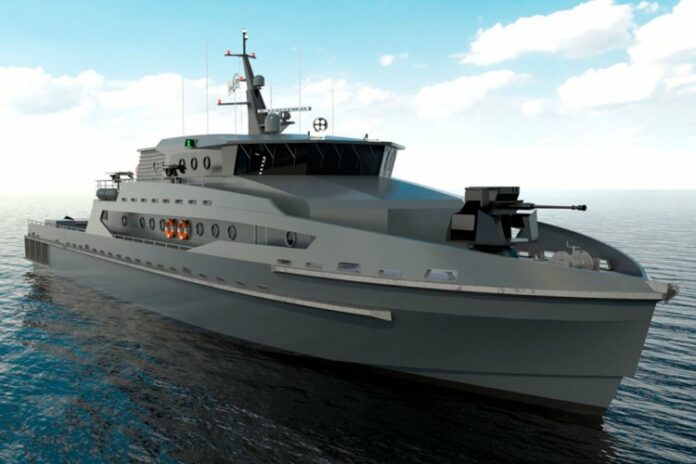
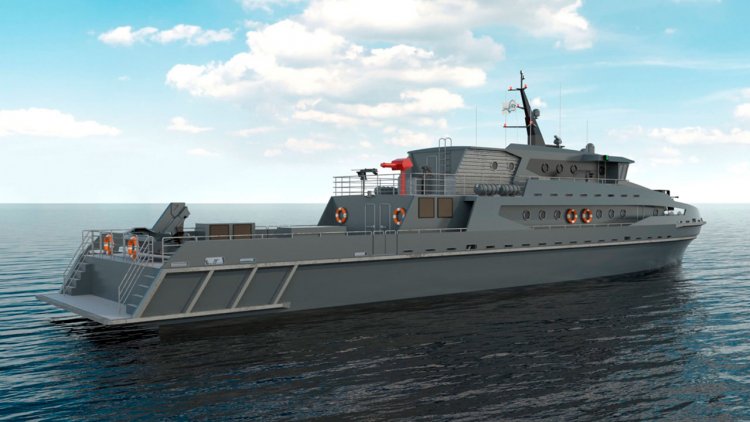
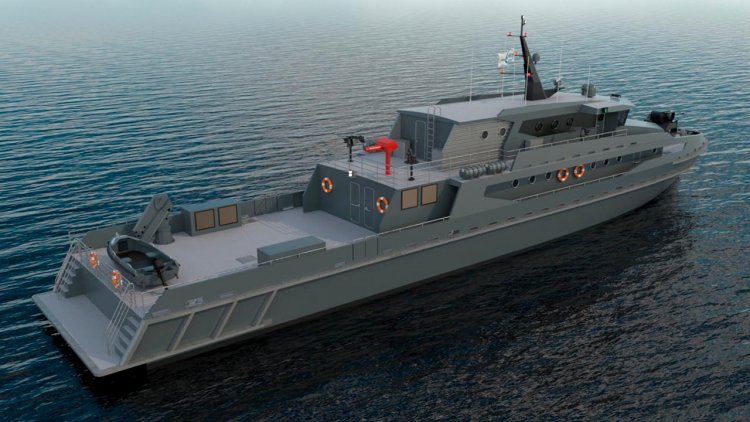
Incat Crowther has announced that construction is well underway on a 42m Patrol Vessel for operation in Thailand.

The vessel will be the eighth Incat Crowther vessel to be built by Seacrest Marine and will accommodate 16 crew and 6 officers below decks with a fourteen-day autonomy.

The main deck will house crew and officer messes, galley and stores, laundry, captain’s cabin and arms stores with a full walkaround deck. The aft deck has a deck crane and a fast rescue vessel for at-sea boarding activities.

The upper deck houses a radio room and ship’s office. Deck mounted armaments are located around the exterior decks, a well as a fire-fighting monitor.

Powered by three MTU 16V2000 M86 main engines driving fixed-pitch propellers, the vessel will have a top speed of over 34 knots. Low draft was a key requirement, which has been addressed by the incorporation of Incat Crowther’s highly efficient propeller tunnels.

The vessel is scheduled for sea trials later this year.

PRINCIPAL DIMENSIONS

  • Platform – Monohull
  • Length Overall – 42m
  • Length Waterline – 38.8m
  • Beam – 7.9m
  • Draft Hull – 1.5m
  • Draft Max – 1.9m
  • Depth – 4.3m

CAPACITIES

  • Passengers – 23
  • Crew – 5
  • Fuel – 24 000 litres
  • Fresh Water – 10 000 litres
  • Grey Water – 1 000 litres

PROPULSION AND PERFORMANCE

  • Main Engines – 3 x MTU16V2000 M86
  • Installed Power – 3 x 1 630kW @ 2450rpm
  • Propulsion – 3 x fixed-pitched propellers
  • Generators – 2 x 134ekW
  • Construction Material – Marine grade aluminium

ABB to fit Tallink Megastar ferry with shore connection for emission-free port stays

0

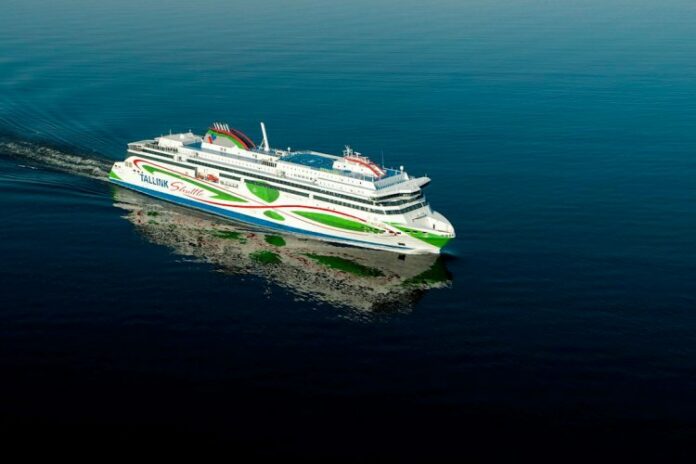
Fueled by low-emission liquefied natural gas, passenger and car ferry Megastar makes three return journeys between the Estonian and Finnish capitals per day, with an overnight stay in Tallinn where it needs to keep generators running to ensure energy availability for onboard systems. With ABB’s shore connection solution, the vessel will be able to cover its energy needs in port by drawing on land-based power.

With commissioning due to take place in January 2022 while the ferry is in operation, Megastar will become the second vessel in the Tallink fleet to feature ABB’s shore connection solution. The second vessel is MyStar, currently under construction in Rauma Marine Constructions shipyard in Rauma, Finland, will have the technology pre-fitted upon its delivery in 2022. Both ferries will leverage the ABB shore power systems installed at the Old City Harbor, Port of Tallinn in 2020. Designed in compliance with international regulations, the plug-in solution automates the ship-to-shore connection process and offers a high level of safety and reliability.

Captain Tarvi-Carlos Tuulik, Head of Ship Management at Tallink Grupp, said:

“We are delighted to continue driving environmentally-friendly ferry operations across our fleet. From next year, both shuttle ferry Megastar and our newbuilding MyStar – the most environmentally friendly vessel on the Baltic Sea – will be able to leverage the ABB shoreside infrastructure that already exists at the Port of Tallinn’s Old City Harbour, to cut down harbor emissions and noise during overnight stays. This is another important step for Tallink Grupp towards achieving greener energy use and eco-friendliness for our shipping operations close to city centers, and it will make a big difference to local community in terms of minimizing noise and air pollution.”

Jyri Jusslin, Head of Service, ABB Marine & Ports, said:

“The Baltic Sea is a global hub for sustainable shipping initiatives, and we are honored to support Tallink on its sustainability journey. Our shore connection solutions comprise onboard and shoreside infrastructure and will allow Tallink to reduce the overall impact of its operations and contribute towards a cleaner port environment in a historical part of Tallinn.”

Delivered by the Meyer Turku shipyard, Finland in 2017, Megastar carries up to 2,800 passengers and 646 cars at a time. ABB’s scope of supply for the retrofit includes switchboard, shore connection cabinet and a shore connection control board with three separate ship-to-shore communication links to safeguard against loss of connection – redundant Wi-Fi, optical fiber and hardwired serial data communication. Megastar also features ABB’s propulsion motors, medium voltage generators and thruster motors.

Having executed its first shipside installation in 2001, ABB has a long and successful history in shore connection technologies. To date, ABB has commissioned, or is contracted to commission, shore connection technology on 150 vessels of various types, including ferries, cruise ships, container ships, gas carriers and more. The company has also equipped several newbuild cruise ships with shore connection switchboards, in readiness to connect to shore power as soon as it becomes available in ports of call.

BV delivers world’s first AiP for offshore floating solar technology to SolarDuck

0

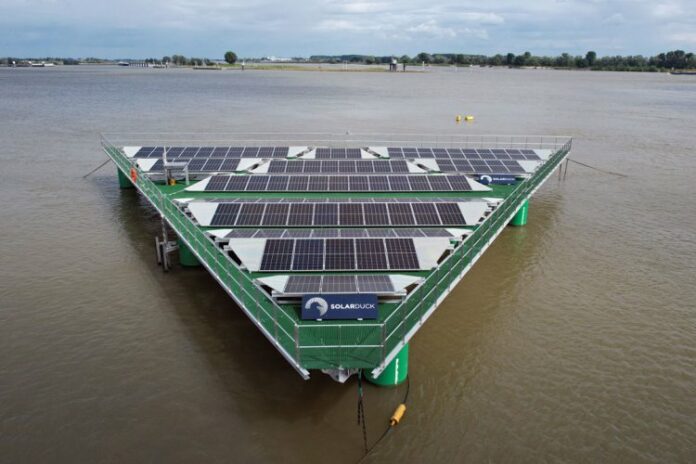
Bureau Veritas (BV), a world leader in testing, inspection, and certification (TIC), has delivered an Approval in Principle (AiP) to Dutch renewable energy company SolarDuck for its offshore floating solar solution ‘King Eider’. 

Launched in April, SolarDuck’s first pilot ‘King Eider’ consists of four triangular-shaped units, which are mounted by 156 solar panels and deliver a combined electrical output of 64 kWp to the grid. The project was deployed in IJzendoorn, in the Netherlands. The structure holds the solar panels more than three meters above water level. The platform is designed to handle coastal sea conditions and hurricane-force winds. It is also optimized for offshore sites in estuaries, natural harbours, as well as near-shore sites.

The project was born from the ambitions of a group of maritime and energy engineers, who founded SolarDuck in order to play an active role in getting the world to net zero. Upon realizing that solar energy is the cheapest and most efficient form of renewable energy for many cities, islands, and regions around the globe, but inaccessible to many of these regions due to land scarcity constraints, the team initiated the project to make solar panels float offshore.

Bureau Veritas was involved in the project from the design stage. The AiP covers the design methodology of the unit’s structure and validates the relevant parts against guidance note NI631 on the Certification Scheme for Marine Renewable Energy Technologies, and NI572 on the Classification and certification of floating offshore wind turbines. These guidance notes provide the requirements to certify novel marine renewable energy technologies.  

Don Hoogendoorn, CTO of SolarDuck, commented:

“In my decade in the maritime industry, I have learned how to optimize design for reliability, ease of maintenance and safety, while keeping them cost efficient. At SolarDuck, we aim to design systems that will last over 30 years, as I was used to doing when I built ships. Getting external official validation that our system performs as it should makes me proud of my team.” 

Høglund awarded contract to deliver Fuel Gas Supply System for four Utkilen chemical tankers

0

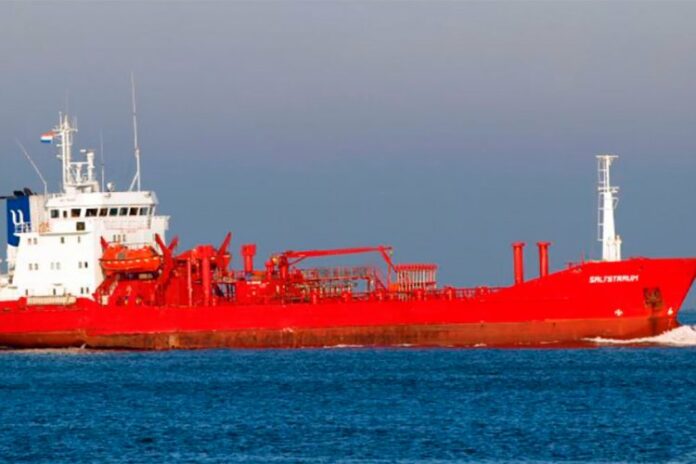
The project, a fully Norwegian collaboration between the owner, Høglund and fellow Norway-based design, piping and welding company Skarweld AS, will see the design and installation of FGSS on four Utkilen LNG-ready sister vessels: M/T Mostraum, M/T Vikstraum, M/T Saltstraum and M/T Sydstraum.

Høglund has been commissioned to supply and deliver a FGSS, a control system and a monitoring system as part of an overall energy turnkey solution.

Apart from the tank installation, which will be carried out whilst the vessels are at a yard, the retrofit itself will, for the main part, be delivered whilst the ships are in service in order to reduce downtime. By installing new high-quality gas systems without interrupting operations, Høglund is pioneering a new way to complete installations that will have significant benefits for the industry. This type of installation makes future-proofing shipping assets compatible with the ongoing activity of the vessels, overcoming potential commercial barriers to retrofits.

Partner company Skarweld AS will contribute to the project by designing and implementing the piping system for the vessels. The four vessels, the most modern within Utkilen’s fleet, will boast shore power capability as well as shoreside monitoring capacity through Høglund’s systems.

These retrofits complement Utkilen’s sustainability commitment to reduce its impact on the environment and invest in a greener future for its fleet. The new FGSS on board will enhance the four sister vessels’ energy rating and help future-proof them in advance of upcoming regulations on carbon emissions, and to adhere to the ISO 14001 standard.

This project further exemplifies shipowners’ and operators’ increasing recognition of systems integration as a key element to improve the environmental performance of individual vessels and wider fleets.

Commenting on the contract, David Gunaseelan, VP Sales & Marketing at Høglund Marine Solutions, said:

“This project will be particularly interesting due to the fact that, despite being LNG-ready, the four vessels lack gas energy systems, which is something that we are increasingly noticing in the industry. With this in mind, we are looking forward to using our engineering expertise to change this and make the systems onboard the vessels work to maximise their sustainability credentials.”

Leif Larsen, Director Newbuilding and Projects at Utkilen, added:

“Having worked with Høglund back in 2017, we are happy to announce that we have commissioned them again to further improve the environmental performance of four of our chemical tankers.”

SGMF supports growth of gas as marine fuel in Asia with first regional committee

0

The new body held its first meeting on 22 June and already has an ambitious work agenda. Its first tasks will be to prepare a publication on the pathway to green ammonia and a regional dashboard tracking trade patterns to measure the multi-faceted impact of conversion to gas as marine fuel. This dashboard will build on an existing East Coast Australia dashboard developed by DNV, released late 2020.

Capt. Walter Purio of P&H Marine has been named as the first chairperson of the committee, with vice chairs from three sub-regions: Tony Brooks of BE&R Consulting (Australasia); Chetan Sood of Eastern Pacific Shipping (Southeast Asia) and Jose Navarro of Lloyd’s Register (North Asia).

Mark Bell, General Manager, SGMF, added:

“The APAC Committee represents a vital step for SGMF into regional representation and we look forward to robust strategic discussion to supplement the ongoing output from our Technical and Environmental Committees.”

The committee draws on a diverse range of perspectives across SGMF’s APAC membership, which comprises around 35 companies from segments including shipowners, ports and shipyards. Other committee members come from companies including BHP, Rio Tinto, China Classification Society, Korean Register, MPA, Petronas, Woodside Energy, ENN and Pilbara Port Authority.

The newest members, BHP and Rio Tinto, bring world-leading expertise and scale in dry bulk. The companies are driving the uptake of LNG fuel in their sector, each recently signing long-term charters for multiple gas-fuelled ‘Newcastlemax’ vessels. These APAC trades will help build the infrastructure and experience required for future growth in gas-fuelled shipping, as well as highlighting the critical role that APAC plays in the global development of gas as a marine fuel.

Banu Kannu, Membership & Engagement Manager – APAC, SGMF, said:

“The region has much to offer the global gas as marine fuel community and we are looking forward to facilitating critical conversations and producing relevant output through the work groups formed in the APAC Committee.”

Karstensens Shipyard again selects Wärtsilä propulsion solutions for newbuild fishing vessels

0

The technology group Wärtsilä’s strong relationship with the Danish ship builder Karstensens Shipyard is once again emphasised with main propulsion equipment orders for two new fishing vessels. During the past year alone, the Karstensens yard has selected Wärtsilä solutions for seven vessels. These latest orders were placed in July.

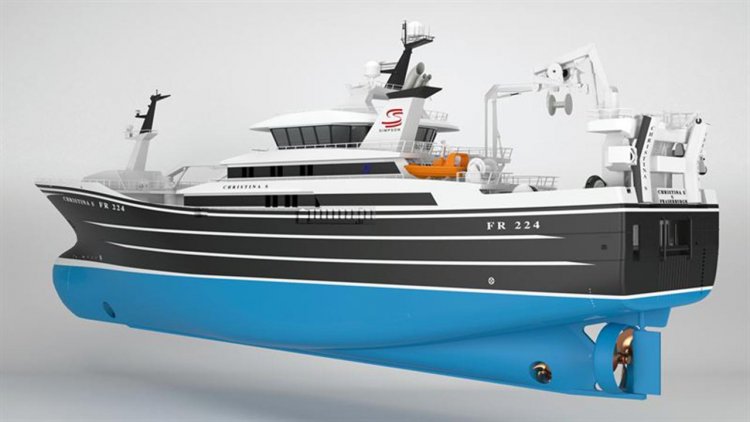
A custom designed 77-metre overall length fishing vessel, the ‘Christina S’, will be owned and operated by the Fraserburgh, Scotland based Simpson family’s Christina S Fishing Company in partnership with P&J Johnston. It will replace an existing vessel of the same name. The ship will be powered by a Wärtsilä 31 main engine, and will also feature other Wärtsilä solutions including an NOx Reducer emissions reduction system, the reduction gear, controllable pitch propeller, and ProTouch propulsion remote control system. The equipment will be delivered during summer 2022.

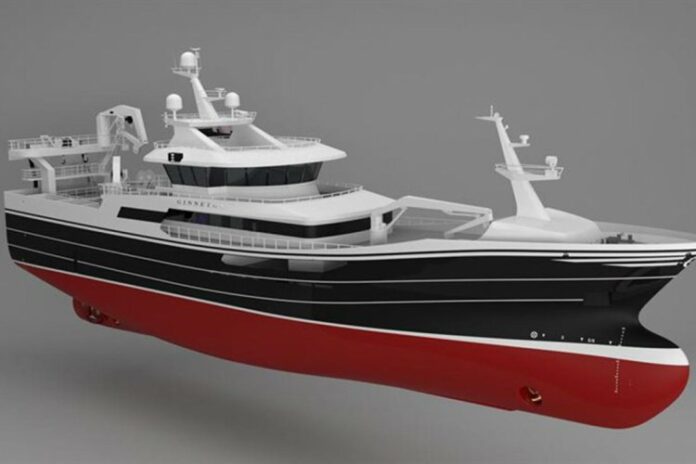
Swedish fishing concern Gifico has ordered a 64-metre long fishing vessel to be named the ‘Ginneton’. The design incorporates a Wärtsilä 32 main engine, as well as other Wärtsilä solutions, including the reduction gear, controllable pitch propeller, and ProTouch propulsion remote control system. The equipment is planned for delivery towards the end of 2022.

Philip Claeson, owner, Gifico, says:

“We have worked with Wärtsilä on building the right concept for this vessel. We feel that Wärtsilä’s technology is always a step ahead, and their service support is top class.”

Kent Damgaard, Director, Karstensens Shipyard, says:

“We have a long tradition and a strong reputation in building high quality fishing vessels of all types. This means that both the design and the machinery selected have to be of the highest quality, and in this respect, we feel, that Wärtsilä is a suitable project partner. They offer technically optimized competitive solutions, while the Wärtsilä engines’ high efficiency, low fuel consumption, and extended overhaul intervals are of benefit to the end-costumers.”

Johan Hanstén, Sales Director, Wärtsilä Marine Power, says:  

“Repeat orders are the best indication of a satisfied customer, and with every new order our relationship with Karstensens Shipyard is strengthened. We aim always to not only deliver efficient and reliable products and systems, but to provide quality support to the customer throughout the project cycle.”

The ‘Christina S’ is scheduled to be delivered to the owners in July 2023, and the ‘Ginneton’ in August 2023.