-12.2 C
New York
Home Blog Page 240

Wärtsilä to participate in US project to build zero-emission high speed ferries

0

Technology group Wärtsilä has signed a strategic partnership agreement to provide its Fleet Electrification and Systems Integrator Services for a project to build the first zero-emission high speed ferries in the USA. The fully electric vessels will be built for San Francisco’s Water Emergency Transportation Authority (WETA), the operator of the San Francisco Bay Ferry system.

The project, and several others Wärtsilä will work on under this partnership, are a part of the agency’s Rapid Electric Emission-Free (REEF) Ferry Program, a phased decarbonisation of high-speed, high-capacity ferry service in the San Francisco Bay. Wärtsilä’s track record with hybrid and zero emission ferry projects, as well as its expertise acting as an integrator for the delivery of hybrid and fully electric propulsion solutions were key factors in the company’s selection as a project partner. Wärtsilä will work within the WETA project team to finalise vessel and charging system concepts.

“We’re proud to operate the cleanest high-speed ferry fleet in the nation, but a zero-emission future for our system is within reach,” said WETA Executive Director, Seamus Murphy. “Wärtsilä’s expertise and experience will be incredibly valuable given the complexity our ferry decarbonisation program entails.”

“This is a major project within the maritime sector’s journey towards decarbonisation, and we are proud to be a part of it,” said Hanno Schoonman, Director of sales for AMER region, Wärtsilä Marine Power. “Wärtsilä joins an industry leading team tasked to develop newbuild battery electric vessels that combine innovative technology and sustainable practices. Wärtsilä is well qualified to provide this project support, and this agreement is a clear endorsement of our strong track record in systems integration and emission-free propulsion.”

After completing the conceptual phase, WETA will move on to the initial construction phase of a multi-vessel programme. This phase will involve the building of three smaller ferries with a capacity of approximately 150 passengers each and two larger ferries capable of carrying at least 300 passengers. Additionally, the scope of this phase will encompass the inclusion of battery charging floats. The construction of the first electric-powered vessel is slated to commence before the conclusion of 2023, with commercial operations expected to launch in 2025.

Berg Propulsion provides systems integration for new Buksér og Berging offshore tug

0

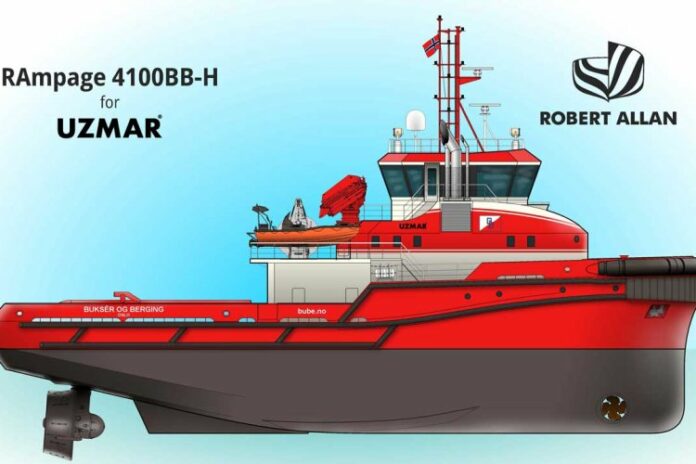
Berg has been contracted to provide the full electrical power and control package for the Robert Allan-designed Rampage 4100BB-H tug, which will join BuBe’s North Sea operations in December 2024. 

Supply will include the electric motors, drives, main switchboard, power management system, alarm monitoring system, control system and mode selector. The order builds on  longstanding relationships with BuBe and Uzmar, as well as accumulated in-service operations of integrated Berg systems equivalent to over 100,000 hours.

Berg’s scope of supply also includes twin MTA834CP azimuth thrusters and one MTT114CP bow thruster for the 120-ton bollard pull tug.

Vetle Sverdrup, CEO of Buksér og Berging AS, commented: “Working with Berg Propulsion, Robert Allen, and Uzmar Shipyard has brought together world-class expertise to create a vessel that will set new industry performance standards. Berg’s integrated hybrid system and automation solutions have been chosen for their ability to optimize tug efficiency and operational flexibility in a single package.”

Switching seamlessly between operating modes, Berg’s propulsion control package will be decisive in the tug’s superior responsiveness and its ability to continuously optimize energy efficiency. Options comprise power mode (twin diesel engines + gensets, with load sharing managed by Berg’s MPC800A unit); mechanical + PTO mode; Eco mode (electric power from gensets, main thrusters run via PTI motors – main engines disengaged); and standby. 

A. Noyan Altug, CEO, Uzmar Shipyard, said:

“This is a milestone project for Uzmar in every respect, and a significant win within our important Norwegian client base. Berg Propulsion has developed long and successful working relationships with Uzmar and BuBe. Past experience with Berg has been key for the owner in its selection – just as it is for Uzmar as delivery partner.”

In an example of Berg’s close working relationship with Uzmar, Mustafa Müslüm, General Manager, Berg Propulsion Eurasia, said:

‘Hardware in the Loop’ tests of electrical integration, the automation system and associated equipment would be conducted as a simulation of the future sea trial at Berg’s production facility before factory acceptance tests.

“Such an extensive test will eliminate any interface issues before delivering products to the yard, which will optimize time management during the ship acceptance tests and the harbor acceptance tests,” Müslüm explained.

Jonas Nyberg, Managing Director Advanced Solutions, Berg Propulsion, said:

“Our partnership with BuBe is an excellent example of Berg’s role as integrator across advanced operational systems, including the interface with intricate mechanical solutions. We have dug deep into BuBe’s specific operational and service needs to ensure that every piece of equipment delivers its full potential. We focus on the way the crew interacts with these systems, particularly in the bridge area, in an integrated approach that guarantees not only seamless functionality but also an enhanced user experience, making operations intuitive and efficient.”

Norwegian Hydrogen to fuel zero-emission fishing vessel

0

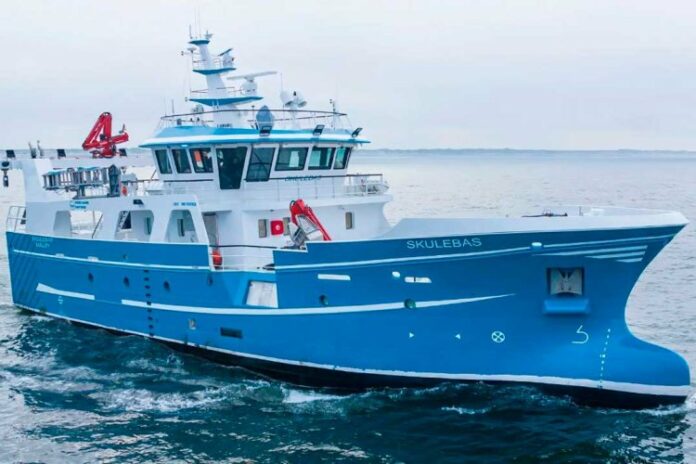
Norwegian Hydrogen has entered into an agreement with the county council that enables emission-free sailing with green hydrogen as soon as Skulebas is ready for hydrogen operation during summer 2024. 

Based in Måløy, Skulebas will soon be able to fill locally sourced, green hydrogen produced at Norwegian Hydrogen’s factory in Hellesylt.

The state-of-the-art fishing vessel Skulebas was delivered to Vestland County Council earlier this autumn. The vessel is used in the training of students at Måløy High School’s program for fisheries, aquaculture and maritime subjects and is equipped with the latest innovative technology. This includes a propulsion system with a hydrogen-powered fuel cell in combination with a battery pack.

Norwegian Hydrogen has entered into an agreement with the county council that enables emission-free sailing with green hydrogen as soon as Skulebas is ready for hydrogen operation during summer 2024. Based in Måløy, Skulebas will soon be able to fill locally sourced, green hydrogen produced at Norwegian Hydrogen’s factory in Hellesylt, which will be operational next year. With this factory, green hydrogen is now made available to maritime customers and other industries in the region who want to lead the way in the green transition.

Jørgen Kopperstad, Head of Maritime at Norwegian Hydrogen says:

“Skulebas is the first fishing vessel in the world that will sail on green hydrogen, completely emission-free. This will be a milestone, not only for us in Norwegian Hydrogen, but also for the maritime and fisheries industry. And not least for Måløy High School and the students there. We find it inspiring to supply hydrogen to a training vessel that will educate future seafarers, as it is precisely these that will propel these new technologies further.”

“MS Skulebas has secured an agreement for access to green hydrogen. This hydrogen will be used in the fuel cell installed on board around mid-2024. For MS Skulebas, it is of the utmost importance that the hydrogen is produced in an environmentally friendly way using green power. Local production at Hellesylt is also a key requirement, as it limits the need for transport to and from the vessel,” says Stig Antonsen, project manager for MS Skulebas.

The Norwegian maritime industry supplies the complete hydrogen solution to Skulebas. Corvus will deliver the fuel cell system, while Hexagon Purus will deliver a hydrogen storage solution for the school vessel built by Hvide Sande Shipyard in Denmark.

“This is a very important contract for us. First and foremost, we are grateful that Vestland County Council has chosen us as the supplier for a ship that is so prestigious and important for both the county municipality, Måløy High School, and everyone who works to promote green shipping. This makes us proud, and we are really looking forward to getting started,” says Jens Berge, CEO of Norwegian Hydrogen.

Damen introduces fully electric SOV with offshore charging

0

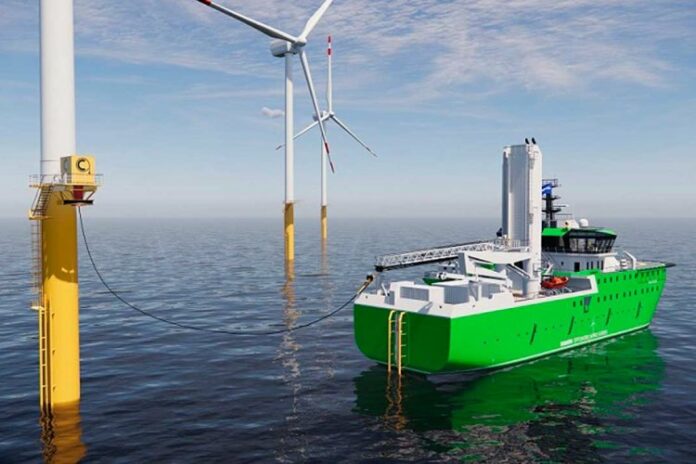
With its offshore charging capabilities, the vessel paves the way for significantly reduced emissions in the maintenance of offshore wind farms. 

To achieve offshore charging, Damen has partnered with UK-based MJR Power & Automation – a company that has previously developed an offshore charging system for a crew transfer vessel. MJR took up the challenge, developing a system that was fast, efficient and, above all, safe.

The charging system uses the motion-compensated gangway to create a connection between the vessel and a turbine or substation offshore, in much the same way a personnel transfer is undertaken. Damen and MJR selected the charging method in order to maximise safety and efficiency. The gangway is controlled from the wheelhouse, requiring no manual interaction with charging equipment. It has the added benefit of utilising pre-existing offshore infrastructure, thereby adding considerable cost-efficiency. 

Charging is carried out while the vessel is in a low power, so-called ‘green’ DP mode, requiring less energy than the hotel load. A full charge typically requires energy produced in just a few hours by a single turbine. The system is designed according to international recognised safety standards, including IEC/IEEE 80005-1. 

Additionally, it is about to obtain DNV AIP (Approval In Principle) and is designed in accordance with forthcoming offshore charging standards under collaborative development by DNV UK and Norway. MJR has developed a 4MW charger connector, sufficient for a 70-metre vessel. The company is also working on a scaled up 8MW, version that will enable charging of larger vessels, up to 90 metres.

Lhyfe secures bid to transform Nantes Saint-Nazaire Port into green hydrogen hub

0

This call for proposals, which was launched on 21 November 2022, concerned the provision of land located at the heart of the port’s industrial and logistics ecosystem, in Montoir-de-Bretagne, for a project to set up an industrial renewable hydrogen production activity.

By focusing for many years on the energies of tomorrow, Nantes Saint-Nazaire Port has embarked on a path towards a new low-carbon economic model for its business, which is still heavily dependent on fossil fuels. Nantes Saint-Nazaire Port wanted to offer a solution to encourage the development of the hydrogen industry in the region.

As part of this project, Lhyfe will build an industrial unit with a production capacity of up to 85 tonnes per day of green and renewable hydrogen (installed electrolysis capacity of 210 MW) located in the north of bulk port terminal. This site should be operational by 2028.

Lhyfe produces green and renewable hydrogen through the electrolysis of water, at production units powered by renewable energy. The company’s first site has already been in operation since the latter half of 2021, and seven other sites are currently in construction throughout Europe (France, Germany and Sweden).

This project will contribute to the decarbonization of the industrial port complex and of the maritime transport. It is consistent with the action program for the development of a “Low Carbon Industrial Zone” (ZIBaC), supported by the Association des Industriels Loire Estuaire (AILE), Saint-Nazaire Agglomération, the Estuaire and Sillon areas and the Pays de la Loire Region. An ambition and a roadmap have been drawn up to transform the Loire Estuaire territory into a low-carbon energy hub. This project confirms this ambition and the momentum that has been built up to accelerate the energy transition in the industrial port area of the Loire estuary.

The project’s implementation is subject to the granting of operating authorizations and construction permits, as well as to financial investment decisions.

The three-year cruise is canceled

0

The cruise was originally due to depart Istanbul, Turkey, on November 1, but shortly before that date, departure was postponed to November 11 and relocated to Amsterdam in the Netherlands, and then to November 30, again from Amsterdam. But on November 17 – less than two weeks before the third departure date – passengers were informed the cruise was off.

Some of the passengers who booked the 111 cabins sold are still in Istanbul, having made their way there ahead of the original departure date. Others say they have nowhere to return to, having sold or rented out their homes in anticipation of the round-the-world voyage, as well as jettisoning their possessions.

Most have spent tens of thousands of dollars on what was meant to be the experience of a lifetime, and now face a wait of at least several months to get their money back. The company has said it will make repayments in monthly installments, starting from mid-December and completing repayments in late February. It has also offered to pay for accommodation until December 1 and flights home for anyone now stranded in Istanbul. But some say they have no homes to return to.

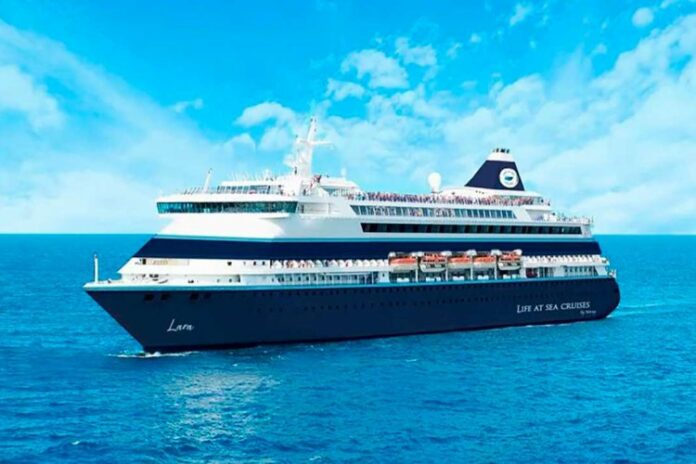
Life at Sea Cruises had been planning to buy the AIDAaura, a ship retired this summer by AIDA Cruises, a German subsidiary of Carnival Corp. It was due to be rechristened as the MV Lara. The company had originally slated the sale to go through by the end of September, before working on the ship in dry dock in Germany, then renovating it before sailing to Istanbul to start the cruise.

But after six weeks of uncertainty, during which Life at Sea repeatedly told guests that the sale was taking longer than planned, on November 16 another company, Celestyal Cruises, announced that it had bought the AIDAaura.

A day later, Life at Sea’s former CEO Kendra Holmes – who had resigned days earlier and said she was not speaking on behalf of the parent company, Miray Cruises – recorded a 15-minute video for passengers, admitting that the cruise would not be going ahead. It’s unclear why Holmes was chosen to make the announcement, which was provided to CNN by a passenger. She has declined to comment to CNN.

Forty eight hours after Holmes’ video, passengers received a message from Vedat Ugurlu, the owner of Miray Cruises, which owns Life at Sea. Declaring himself “extremely sorry for the inconvenience,” he confirmed the cruise would not be departing as planned. The reason: they couldn’t afford the ship.

In his message, Ugurlu claimed that “Miray is not such a big company to afford to pay 40-50 million for a ship,” but that it had “presented the project to investors, and had official approval from some of them to buy the vessel.”

He said that while the company had made the down payment for the ship, the investors “declined to support us further due to unrest in the Middle East.”

Hamas attacked Israel on October 7, a week after the ship’s sale was originally supposed to have concluded. Life at Sea didn’t respond to a query about what prior unrest they were referring to that could have impeded the completion of the transaction.

Ugurlu also told passengers that day that the company then tried and failed to buy another ship, and that it was working on a third.

“If we will not be able to sail on December 1, we will offer you to sail on another departure date or refund all the payments within a short schedule,” he wrote. “We have tried everything to make your dreams come true and we will continue to do so.”

He added that the company could, in theory, launch the cruise on the MV Gemini, Miray’s smaller ship which it had originally planned for the voyage, before deciding it was too small.

“We choose not to because we have promised you a larger, newer vessel,” he wrote. The Gemini is at the heart of a defamation lawsuit brought by Miray against former managing director of Life at Sea Cruises, Mikael Petterson, who was one of several employees to split from the team in May. The lawsuit states that Petterson called the ship “unseaworthy” – a claim that Miray vehemently denied.

Just a day after Ugurlu’s glimmer of hope, another staff member of Life at Sea, Chief Operating Officer Ethem Bayramoglu messaged passengers to confirm that the cruise was off. “In case we weren’t clear, the Life at Sea cruise trip is canceled,” Bayramoglu wrote, giving instructions on the refund process, and how passengers can retrieve “pods” full of their belongings – which they’d shipped in advance of the cruise.

Yet at the same time, Bayramoglu added, the company “intend[s] to honor our commitments.”

“Although we are all disappointed and frustrated that we didn’t sail this time, it is important to us that you feel positive overall about your experience with us,” the message reads. “Vedat in particular is still hopeful that Miray will someday soon have an option for you to consider.”

Bayramoglu subsequently met with stranded passengers in Istanbul to help plan their returns home.

Would-be cruisers – who wanted to remain anonymous until their refunds come through – have told CNN of their shock and dismay that the trip has been canceled. Some had sold their homes or wound up businesses to join the cruise.

“I’m very sad, angry and lost,” said one. “I had the next three years of my life planned to live an extraordinary life, and now [I have] nothing. I’m having a hard time moving forward.

“I was proud and feeling brave, now I don’t trust anyone or anything. I know it’ll work out and life will go on, but I’m uncertain of the direction.”

Another said they felt “incredibly sad and incredibly betrayed.”

“The company seems to have no consideration about what they’ve done to our lives,” they said.

“I never imagined I’d be in this position as a senior citizen.”

In the meantime, Life at Sea’s erstwhile CEO, Kendra Holmes, who resigned last week, claims she’s planning to offer a new long-term cruise with a different company.

Source: CNN

Tanker in Middle East Safe from attackers After U.S. Navy responds, officials say

0

The tanker, which had been carrying a cargo of phosphoric acid, was identified as the Central Park by the vessel’s company. The officials did not identify the attackers.

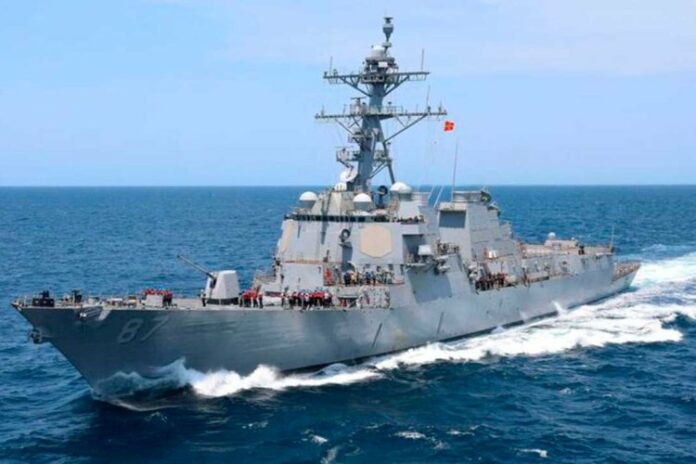
In a statement, the U.S. military said the USS Mason, with help from allied ships, demanded that the commercial ship be released by the attackers.

Five armed individuals tried to escape on a fast boat but were chased by the U.S. warship and they eventually surrendered.

The statement added that two ballistic missiles were fired from Houthi controlled parts of Yemen towards the general direction of the Mason and Central Park, but they landed about 10 nautical miles away from them and there was no damage or injuries.

The incident is the latest in a series of attacks in Middle Eastern waters since a brutal war between Israel and the Palestinian militant group Hamas broke out on Oct. 7.

It followed a seizure of an Israeli-linked cargo ship by Yemen Houthis, allies of Iran, in the southern Red Sea last week. The group, which also fired ballistic missiles and armed drones at Israel, vowed to target more Israeli vessels.

Central Park, a small chemical tanker (19,998 metric tons), is managed by Zodiac Maritime Ltd, a London-headquartered international ship management company owned by Israel’s Ofer family. The Liberian-flagged vessel was built in 2015 and is owned by Clumvez Shipping Inc, LSEG data showed.

Zodiac Maritime said in a statement that Central Park, which is carrying a full cargo of phosphoric acid, was involved in a suspected piracy incident while crossing international waters, approximately 54 nautical miles off the coast of Somalia.

Phosphoric acid is mostly used for fertilisers.

“Our priority is the safety of our 22 crew onboard. The Turkish captained vessel has a multinational crew consisting of a crew of Russian, Vietnamese, Bulgarian, Indian, Georgian and Filipino nationals,” the statement added.

There was no immediate comment from Houthi officials.

Britain’s Maritime Trade Operations agency (UKMTO) said on Sunday it was aware of a possible attack in southwest Aden and called on other vessels to exercise caution.

Copyright 2023 Thomson Reuters.

ABB to power new Spanish Navy submarine rescue vessel

0

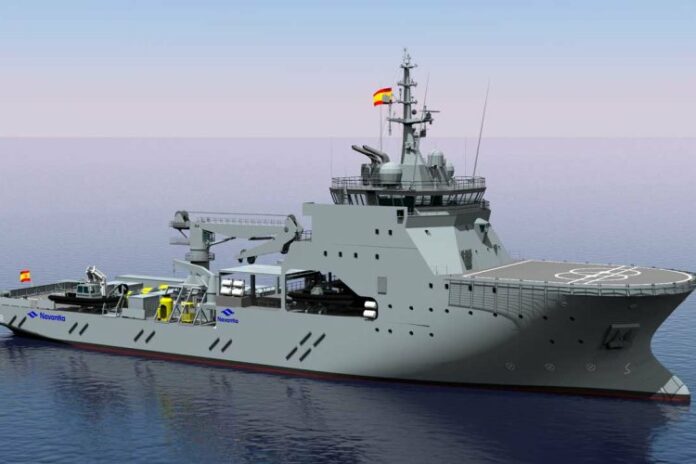
ABB has secured an order with Spanish state-owned shipbuilding company Navantia to supply the Spanish Navy’s forthcoming submarine rescue vessel, Poseidon, with high-performance, DC-based power and distribution. 

Following the delivery scheduled for 2026, the vessel will be the first of its kind equipped with this system. The ship will be responsible for executing and supporting submarine missions, including diving operations, intervention and rescue in accidents and shipwrecks and underwater surveillance, including protection of cultural heritage.

Comprising ABB Onboard DC Grid™, transformers, alternators, battery system, and ABB’s PEMS™ power and energy management system, ABB’s scope of supply will allow Poseidon to meet the Spanish Navy’s demanding requirements for dynamic positioning and strict position keeping capability as well as systems reliability and redundancy. Onboard DC Grid™ will deliver the high efficiency and platform flexibility to support the vessel’s varied and challenging operations, with the battery system covering peak power demands during rescue missions. Meanwhile, power and energy management system will ensure Poseidon’s total power resources are used in a way that optimizes safety and operational efficiency.

ABB’s DC-based power and distribution system represents a low-risk, high-reward investment. The solution is built on widely proven commercial technology and offers high levels of fault tolerance and redundancy, helping ensure high levels of vessel availability. In addition, the Spanish Navy will gain access to ABB’s global service network, which includes a strong presence in Spain, including its robust support offering throughout the vessel’s lifecycle. In the future, as environmental regulations become increasingly stringent, the Spanish Navy will also benefit from the ability of the Onboard DC Grid™ system to integrate future energy sources.

“The extremely demanding nature of submarine rescue missions calls for the highest standards in safety, fault tolerance and systems integrity from the onboard power and distribution system,” said Sindre Satre, Business Line Manager, Coast Guard and Navy, ABB Marine & Ports. “This order is the latest testament to the operational, service, financial and risk mitigation benefits that come with choosing a commercial, off-the-shelf solution like Onboard DC Grid™ from a reliable technology partner such as ABB. We are proud to have been selected for this project and to continue our collaboration with Navantia and the Spanish Navy.”

ONE launches West India North America service

0

India has been playing an increasingly important role in world trade, with an export volume of approximately 453 billion USD for merchandise trade with an   annual growth rate of 15% in 2022, according to World Trade Outlook and Statistics published by World Trade Organisation. 

ONE India was established right at the beginning back in 2018 and have since built a network of 25 offices with 410 employees by 2022. As of November 2023, ONE provides 22 weekly services which collectively covers 11 ports in India. Please refer to the service map for more information. 

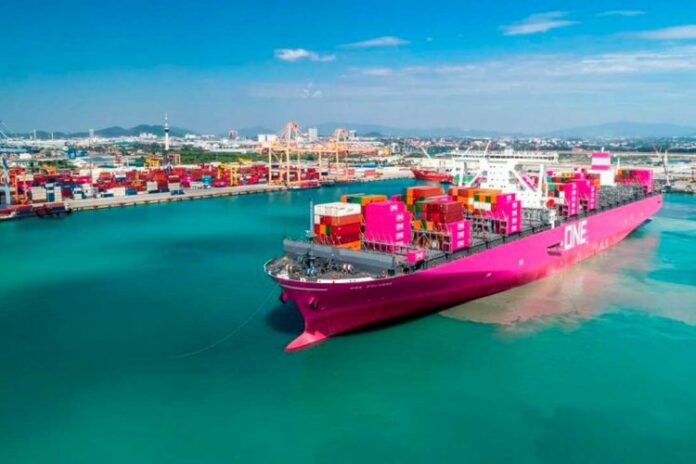
The new WIN service will offer a weekly route from Hazira, Nhava Sheva, Mundra to New York, Norfolk, Savannah, Charleston. The service will also call at Damietta, Algeciras, Jeddah, which offers further connection to Mediterranean destinations in combination with other services. 

The new service will be operated by a fleet of nine vessels, all of which are operated by ONE. The independent nature of the WIN will provide reliability and flexibility to our valued customers.

Apramapar Singh, General Manager of India Marketing in ONE India talked about the uniqueness of the new service, said:

“At ONE, we have been committed to the India market since day one, and the new WIN is another milestone for our business. Hazira container terminal is a gateway to the industrially vibrant belt of South Gujarat, North Maharashtra and Central India. The main commodities include FMCG (fast moving consumer goods) such as electronics, perishables such as foodstuff and retail goods including textile and apparel. Furthermore, chemical moving between these two countries will benefit from the direct and increased capacity. ONE’s new WIN will provide customers in this region with a fast and direct service to meet their needs for on-time delivery to and from North America.” 

ONE NA spokespersonZach Connors, Senior Director and Head of Sales of ONE North America said:

“At ONE, we strive to embrace and support our customers’ growth patterns. The rapid move of so many toward India is ripe for collaboration; our new WIN service is a flexible and dynamic product, designed to catalyze development of the India-North America market and beyond. Enhanced access to additional growing economies along this new route, by direct call and transshipment, will provide even further value to ONE’s partners in their pursuit of supplier/buyer diversification.” 

The ninth multipurpose frigate Spartaco Schergat launched

0

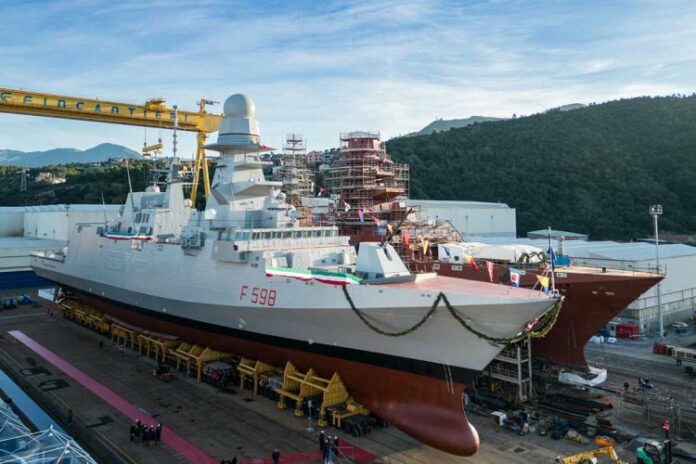
The 10 FREMM vessels have been commissioned to Fincantieri by the Italian Navy within the framework of an Italo-French international cooperation program, under the coordination of OCCAR (Organisation Conjointe de Coopération  en matière d’Armement), the joint organization for European cooperation in armaments.

The godmother of the launch was Arianna Somma, granddaughter of the Golden Medal for Military Valor Spartaco Schergat, from whom the ship takes its name.

Among others, the event was attended by the President of the Regional Council of the Liguria Region, Gianmarco Medusei, the Deputy Minister of Infrastructure and Transport, Edoardo Rixi, the Deputy Chief of Staff of the Italian Navy, Admiral Giuseppe Berutti Bergotto, the Director of OCCAR, General Joachim Sucker, and the Director of the General Directorate of Naval Armaments – NAVARM, Vice Admiral Giuseppe Abbamonte, welcomed by the Chairman of Fincantieri, General Claudio Graziano and Dario Deste, General Manager of the Naval Vessels Division.

After the launching, the fitting activities of the unit will continue at the Muggiano shipyard (La Spezia), with delivery scheduled in 2025. The Spartaco Schergat vessel, like the other units, will feature a high degree of operational flexibility and will have the ability to operate in all tactical situations. 144 meters long, with a beam of 19.7 meters, the ship will have a full load displacement of about 6,700 tons. It will be able to reach a speed of over 27 knots with a maximum capacity of about 200 people on board.

The FREMM program, representing the  Italian and European defense state of the art, stems from the need to renew the line of units of the Italian Navy, including the “Lupo” and “Maestrale” class frigates, built by Fincantieri in the Seventies and Eighties. The vessel Carlo Bergamini was delivered in 2012, the Virginio Fasan in 2013, the Carlo Margottini in 2014, the Carabiniere in 2015, the Alpino in 2016, the Luigi Rizzo in 2017, the Federico Martinengo in 2018 and the Antonio Marceglia in 2019.

Chief Petty Frogman Spartaco SCHERGAT – Golden Medal for Military Value

He was born in Koper on July 12, 1920. Voluntary in the Royal Italian Navy starting from March 1940, and part of the “Frogmen” category, after having attended the course held at the C.R.E.M. School of San Bartolomeo (La Spezia) where he got the diver license, he entered in the 1^ Squadron M.A.S. (called 10^ M.A.S. Fleet in June 1941) as operator of special assault vehicles. He took part in the Gibraltar forcing missions in May and September 1941 and in the quest of Alexandria at the dawn of December 19 of the same year when, as 2nd operator of the “maiale” underwater assault vehicle led by Captain Antonio Marceglia (to whom the FREMM n. 8 is entitled), he placed the mine under the English battleship Queen Elizabeth, which sank in the port, due to the bursting of the charge, being unable to take part in the conflict a long time due to the damages sustained. He was captured and taken in the n. 321 English prison camp in Palestine, while in October 1944 he returned home participating in the War of Liberation in the Assault Vehicles Group. He retired in November 1945, becoming a member of the Role of Honour with the degree of Chief Petty.

Motivation for the G.M.M.V.

“Heroic fighter, loyal partner of his Officer, he shared the risks of a tenacious and dangerous training, following him in the most daring quests, inspired by the same fiery determination to succeed. He participated with him in an expedition of underwater assault vehicles, forcing one of the most powerful and defended enemy naval bases, with an action in which operational understanding and practical application brilliantly matched with the cold courage and self-sacrifice of men. After having covered several miles under water, overcoming difficulties and obstacles of any kind, he was a valid and faithful help to the Officer; he attacked the ship with firm skill, joining the fate of his Officer in captivity, constantly refusing to provide the enemy with any information; superb example of bravery when in action and possessing extraordinary moral qualities”.