6.2 C
New York
Home Blog Page 1232

Baleària launches one of two LNG-fueled ferries to operate in Mediterranean

0

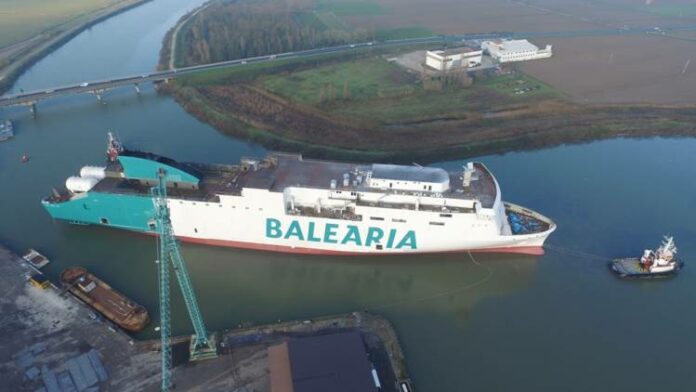
Spanish ferry operator Baleària announced the launch of its newest LNG-fueled ferry 'Marie Curie' at the Italian shipyards Cantiere Navale Visentini. The vessel is one of the company's two LNG-powered ferries to operate in the Mediterranean from 2019. In the meantime, construction is underway for its twin 'Hypatia de Alejandría', which will be performing sea tests when it will be completed.

The 'Hypatia de Alejandría' will begin its operations at the beginning of 2019 and the 'Marie Curie' will follow a couple of months later. The construction of these two LNG smart ships reached approximately 200 million euros.

As far Marie Curie is concerned, the 50% of its construction is done and now the company focuses on the clearance of the passenger and crew areas. Both engines, LNG tanks and main equipment are already placed on board.

Meanwhile, the Hypatia de Alejandría is to be finished. Right now, the vessel is placed in a dry dock where the antifouling silicone is being applied to the live work of the hull. When ready, it will perform navigation tests using both LNG and fuel.

Both of the LNG vessels share the same features such as, 186.5 meters in length, maximum speed of 24 knots, capacity for 810 people, 2,180 linear meters of cargo, 150 vehicles, as well as LED lighting.

In addition to the two vessels, the company recently announced the construction of the first fast ferry with LNG engines to sail in the world. Baleària will invest 90 million euros in this ferry, with construction scheduled to begin next December and the vessel to enter into service in the summer of 2020.

What is more, the company has been engaged in a project to convert six of its ferries to LNG with partial funding from EU CEF (Connecting Europe Facility) project. Last week, LNG retrofitting began for one out of the six vessels. The EU supports the move by funding the project with 12 million euros, on a total investment of 72 million.

Baleària has earlier revealed its goal to have at least half of its fleet of ferries sailing with this clean energy in the following three years and reach 100% of the fleet within a period of ten years.

Source:safety4sea
Wärtsilä marks advances in automated shipping in latest tests

0

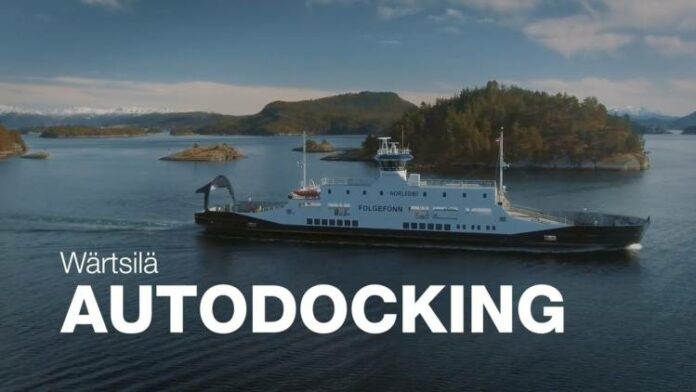
Wärtsilä, the technology group, conducted a successful round of tests on its automated dock-to-dock solution. The system was tested on ‘Folgefonn’ ferry, which visited all three ports serviced by the vessel, with the autonomous operation being utilised uninterrupted for the entire route.

The testing was conducted in the presence of the Norwegian Maritime Authority (NMA). The test began when the operator chose the vessel's next destination by selecting 'sail', which enables the autonomous controller control the vessel. The ferry left the dock, manoeuvred out of the harbour, sailed to the next port, manoeuvred through the harbour entrance, and docked alongside the terminal.

Moreover, all vessel's action occurred without any human interference. It is thought to be the first fully automated voyage dock-to-dock for a vessel of this size. The navigation of the vessel is controlled through the use of a series of tracks and waypoints, which guide the ship to its next destination.

The autonomous controller, controls the vessel’s speed, position on the pre-defined track, and heading. GNSS is used as the primary sensor, while a Wärtsilä Guidance Marine CyScan AS is being tested as a secondary position sensor for the approach to the berth.

The 'Folgefonn’ vessel belongs to Norwegian ferry operator Norled. It was used also for the initial testing of the Wärtsilä autodocking solution, which took place in the early part of 2018. The vessel includes innovations such as a wireless inductive battery charging solution and energy storage systems.

Finally, innovation Norway, an investment fund, has provided grants to both Wärtsilä and Norled for the testing of the auto-docking technology.

Source:safety4sea

Modern Terminals joins TradeLens blockchain project

0

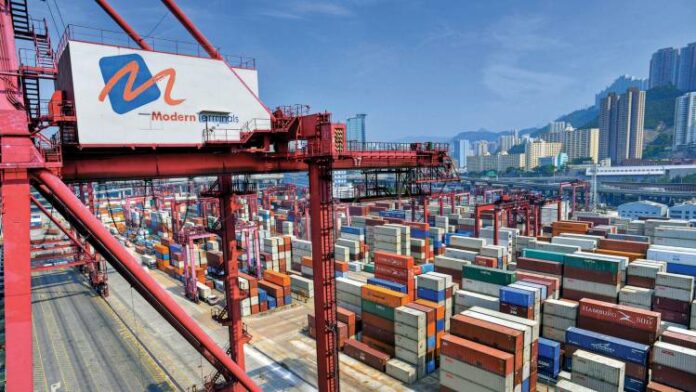
Modern Terminals, the second largest container terminal operator in Hong Kong, has joined the TradeLens project, a blockchain-enabled technological solution developed by Maersk and IBM, aiming to minimize traditional shipping documentation and ease transactions in the global supply chain.

This decision came at a time when Maersk and IBM seemed to be having difficulties with their blockchain platform, since there were not many carriers eager to join the project.

TradeLens aims to alter the traditional process of the global supply chain into a modern digitalized one by increasing its efficiency and reducing the cost. The purpose of Modern Terminals' participation is to evaluate the performance of TradeLens and offer any suggestions on to what extent technology can be enhanced. In the past, Modern Terminals has also made a giant investment leap in information technology and port infrastructure, as part of the company's direction.

According to Peter Levesque, Group Managing Director of Modern Terminals Limited, the initiative is expected to generate major savings in the future, while in the meantime will enhance the global supply chain security, since until today the documentation in shipping is still paper-based and therefore inefficient and open to fraud.

TradeLens combines more than 20 port operators and terminals globally, factoring 234 docks on 5 continents including Port of Valencia, PSA Singapore, Patrick Terminals, Port of Halifax, Port of Bilbao, PortBase, PortConnect and the Port of Philadelphia.

Source:safety4sea

FIRST orders Sea Swift platforms for shallow-water Nigeria fields

0

FIRST Exploration and Petroleum Development Co. has contracted the Aquaterra Energy/Maerlin Nigeria consortium to provide two Sea Swift conductor-supported offshore platforms.

Both are destined for the Anyala and Madu fields in Oil Mining Leases 83 and 85 offshore Nigeria, in the Niger Delta basin. The planned development will recover around 185 MMbbl of oil and 637 bcf of gas.

Aquaterra Energy will manage the project with engineering and onsite fabrication support performed in Nigeria.

The work scope includes structural design, topsides engineering, equipment selection, procurement, fabrication management and logistics.

On completion, the platforms (which are different designs) will be installed in water depths of 35-55 m (115-180 ft). First oil should flow in late 2019.

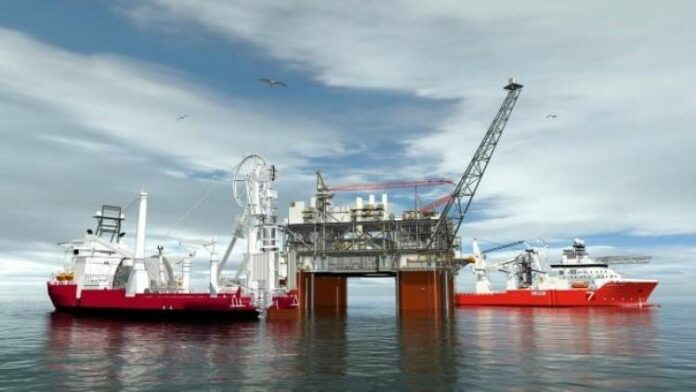
Aquaterra Energy describes its Sea Swift design as a modular system that combines an offshore platform with the rig-run benefits of a subsea development. This is said to give operators flexibility that allows them to cut construction and installation costs, and reduce time to first oil in shallow-water fields.

Source:offshore-mag

BP names Mad Dog 2 platform

0

BP has reported that the new floating production unit for the Mad Dog 2 project in the deepwater Gulf of Mexico will be named Argos.

The name, chosen by the project team and an employee survey, is a reference to Odysseus’ loyal dog from “The Odyssey,” and a nod to the Mad Dog spar, an existing production facility operated by BP that is located about six nautical miles away from the Argos site.

The Mad Dog 2 project includes the Argos semisubmersible platform with the capacity to produce up to 140,000 gross b/d of crude oil through a subsea production system from up to 14 production wells and eight water injection wells.

“Selecting Argos as the name of our newest platform is an important milestone for the Mad Dog 2 project, which remains on track and on budget,” said Starlee Sykes, BP’s regional president for the Gulf of Mexico and Canada. “This project is key to delivering high-margin production from one of the largest fields in the Gulf of Mexico, and it will strengthen our position in the basin for years to come.

The platform will be the first new BP-operated production facility in the Gulf of Mexico since 2008, when Thunder Horse came online. It will be the company’s fifth operated platform in the Gulf of Mexico and it will help extend the life of the super-giant Mad Dog oil field beyond 2050.

Originally estimated to cost more than $20 billion, BP worked with co-owners and contractors to simplify and standardize the platform’s design, reducing the overall project cost by about 60%. The final investment decision for the $9-billion project was approved in early 2017 by BP (60.5%) and co-owners BHP (23.9%) and Union Oil Company of California, an affiliate of Chevron U.S.A. Inc. (15.6%).

The hull and topsides of the Argos platform are currently under construction in South Korea. First oil is expected in late 2021.  

Source:offshore-mag

GreenSteam launches next generation fuel saving platform

0

This month, leading marine data intelligence company GreenSteam launched the next generation of their fuelsaving platform GreenSteam Manager (GSM). Using unique machine learning technology and an intuitive new user interface the platform provides accurate and clear fuel-saving advice.

In 2020 fuel prices are set to rise dramatically, so ship owners and charterers need to get the most out of their fuel to stay competitive. Machine learning holds the key to this by being able to build a precise vessel performance baseline.
GreenSteam have been developing machine learning technologies specifically for the shipping industry for over a decade and proven its value many times over. GSM uses this machine learning technology as its backbone but now offers the output from it as advice through a clear dashboard where a user can clearly see the amount of fuel wasted and, importantly, where it was wasted.
GSM offers different services that lead the user through the discovery of fuel wastage, and the cost of this, through to analyzing specific problem areas, such as hull fouling and trim. Beyond fuel savings, the platform also offers the ability to act as a new technology analyzer by enabling the assessment of new technologies through identifying and plotting changes in performance.

Daniel Jacobsen, GreenSteam CTO and co-founder commented: “The new GreenSteam Manager is more of a revolution than evolution. By applying our machine learning technology to vessel data enriched with MetOcean and other data, we can provide much more accurate performance baselines than those offered by traditional approaches. However, we wanted to go beyond that; accuracy is a great starting point, but our goal is to make it as easy as possible for users make better operational decisions. Through a user-centric design philosophy and by involving customers in the design, GSM now offers a highly intuitive user experience. You can quickly see the true performance of any vessel, highlight problem areas and make the best decisions to save fuel.

Source: GreenSteam

Watch: Hutchison Ports Thailand welcomes its largest ship ever

0

Hutchison Ports Thailand (HPT) recently welcomed the container ship 'ONE Columba', the largest vessel to ever call Terminal D at Laem Chabang Port.

The ship, owned by the Japanese joint venture Ocean Network Express (ONE), with a total length of 364 meters and a total gross tonnage of 145,647 tons, became also the largest container vessel ever to call at Laem Chabang Port in Thailand.

The vessel was met by delegates of Terminal D in the morning of 24 November, having departed Laem Chabang Port one day later. The vessel was met with new remote-controlled quay cranes and remote-controlled rubber tyred gantry cranes that HPT used to discharge container boxes from the vessel to the yard with fast and safe operations.

Source:safety4sea

CMA CGM receives the Award for Most Accomplished Asia Pacific Ship Owner at the Maritime2020 Summit in Singapore

0

The CMA CGM Group, a worldwide leading shipping group, is proud to have been awarded the Most Accomplished Asia Pacific Ship Owner Award 2018 at the Maritime2020 Summit, which was held in Singapore on November 27, 2018. This award recognizes the shipowner who demonstrates the greatest efforts to make its fleet more sustainable, efficient and environmentally friendly, the company said in a press release.

CMA CGM is indeed firmly committed to the reduction of its carbon footprint and to the protection of the environment. The Group has already reduced its CO2 emissions per container transported by 50% between 2005 and 2015, and it has committed to a further 30% reduction by 2025.

These important milestones are achieved by sponsoring breakthrough innovations. These include the 2005 introduction of bamboo-floor containers, the 2017 order for nine LNG-powered giant containerships, and the ongoing investments to be compliant by January 1, 2020 with the International Maritime Organization’s new Low Sulphur Regulation. Building upon this well-established environmental commitment, the award bestowed today will further reinforce the Group’s ambition to serve as a leader on environmental progress in the shipping industry.

The Group is a transport and logistics market leader in Asia-Pacific, with a strong presence of 118 agencies in 19 countries, employing more than 4,000 people and operating 4 brands in the region: CMA CGM, APL and ANL for the long-haul, and CNC for Intra-Asia. Since 2016, the Group has set its Regional hub in Singapore, where it offers more than 100 services per week thanks to its best-in-class network of Ocean Alliance, North-South and Short-Sea lines, and from where it operates its Fleet Navigation Centre for the APAC region.

New Russian Icebreaker Catches Fire at St. Petersburg Yard

0

On Tuesday, a fire broke out aboard the new diesel-electric icebreaker Viktor Chernomyrdin, which is nearing completion at St. Petersburg's Admiralty Shipyard. Two individuals were injured in the incident, including one who was hospitalized. 

According to state media, the fire broke out at about 1900 hours Tuesday evening. A massive response effort involving 140 personnel and 39 firefighting vehicles brought it under control by 2100 hours, and responders fully extinguished it by 2215. 

The blaze affected the vessel's third and fourth deck levels, and it burned about 3,200 square feet of the vessel's interior space, according to TASS. The fire reportedly affected compartments containing electrical equipment and wiring, among other areas.

The Viktor Chernomyrdin was nearing completion at the time of the fire, and she was due to enter service by the end of this year. At 22,000 tonnes, she will be the largest diesel-electric icebreaker in the world, though less powerful than several Russian and American vessels of the same class. She is designed to make two knots through seven feet of ice, both ahead and astern. 

The Chernomyrdin's construction has already been set back by three years due to a combination of internal and external factors, including Western sanctions, currency devaluation and design errors. In late 2013, one year after her keel was laid, engineers discovered that she would be 2,500 tons overweight due to a mistake in drafting. Admiralty Shipyard, a St. Petersburg yard that normally specializes in submarines, took over her construction last year.

Source:maritime-executive

USS McCain Exits Drydock After Collision Repairs

0

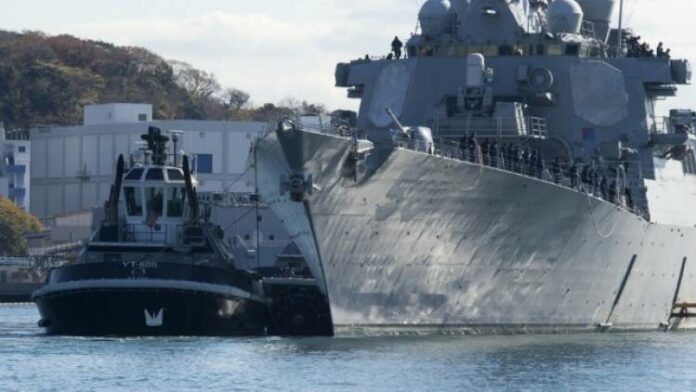
The USS John S. McCain is afloat once more, 11 months after she entered drydock in Yokosuka to repair damage from a collision with a merchant tanker.

Preparations for her return to service will continue alongside the pier, and she is expected to be ready for a period of sea trials early next year. According to a spokeswoman for Ship Repair Facility-Japan, the McCain's $220 million overhaul is one of the largest projects that 7th Fleet's yard has ever undertaken. 
NAVSEA commander Vice Adm. Thomas Moore visits USS McCain in shipyard, Yokosuka, August 26 (USN)


USS McCain collided with the merchant tanker Alnic MC while underway near the Strait of Singapore on August 21, 2017. In a rapidly-evolving chain of errors, her bridge team developed a false impression that the destroyer had lost steering, then veered into an adjacent traffic lane and crossed the bow of the Alnic MC. The team was not aware of the approaching tanker until the collision. Ten sailors lost their lives in the flooding that followed.

After the incident, the McCain transited to Changi Naval Base, Singapore for temporary repairs and loading onto a heavy lift ship. The Navy decided to repair the McCain in Yokosuka rather than incurring the additional time and expense of shipping her back to a yard in the United States. The destroyer USS Fitzgerald, which also suffered extensive damage in a collision in the Western Pacific, was shipped to Ingalls Shipbuilding in Mississippi for a more complex set of repairs. 
The damaged Arleigh Burke-class destroyers USS McCain and USS Fitzgerald aboard heavy lift ships in Tokyo Bay, December 2017 (Syke Minadzuki / Twitter)

After the two deadly collisions, the U.S. Navy conducted several reviews of readiness at Seventh Fleet and throughout the service. It found that high operational tempos and little down time had allowed serious deficiencies to develop, especially in forward-deployed units. "These [deviations] culminated in a Navy culture replete with examples of accepting 'good enough' for the moment rather than the imperative of what is vital for the future," the Navy's strategic review panel wrote. 

Source:maritime-executive