-2.1 C
New York
Home Blog Page 1063

ABS Chairman Shares Insights on Digitalization

0

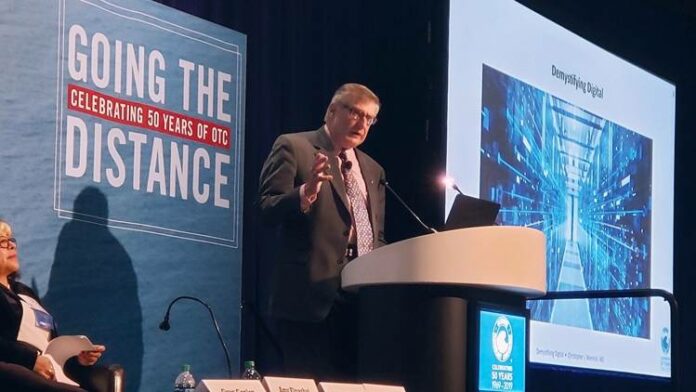
ABS Chairman, President and CEO Christopher J. Wiernicki explored the transformational potential of digital technologies in the offshore industries at the Offshore Technology Conference (OTC) 2019 in his presentation ‘Demystifying Digital’.

“The digital oilfield is a complex ecosystem of technologies, structures, people and processes operating in harmony. The development and operation of offshore oilfields is being greatly enhanced by digital technologies through improved data collection, analysis and real-time decision making. Performance and predictive analytics made on data-in-motion can dramatically improve safety, reduce cost, and enhance operational visibility and decision support,” said Wiernicki.

“Technologies have helped us evolve – working smarter, becoming more efficient and delivering stronger results – and will be pivotal on our ongoing journey to a cleaner and safer future,” he added.

He emphasized that safety thinking must evolve and adapt to the changes introduced by digital technologies.

“Today, we live in a world where safety focuses on the systems we see and can touch. Tomorrow, safety will focus on the systems that we don’t see, such as software and data,” said Wiernicki.

“Cyber and software will become the third leg of the safety stool, joining structure and machinery, adding a new dimension to an asset’s safety system and recognizing that software is the safety system no one sees,” he pointed out.

Source:marinelink

Norway Builds Drone Fleet for coastal “Sulfur Patrols”

0

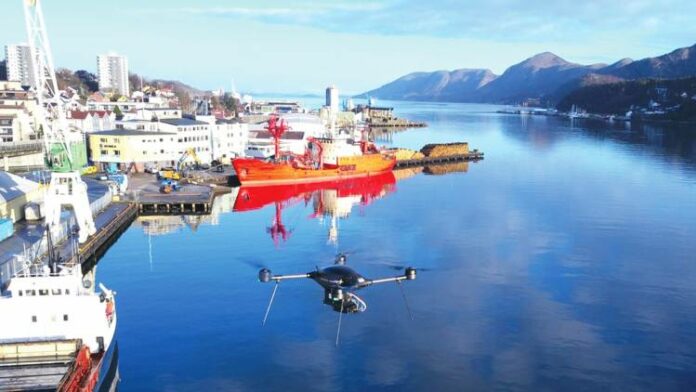
Norway is growing its arsenal of military grade drones for missions that’ll take them into the exhaust streams of ship’s funnels. With the IMO now supporting the 0.1 percent sulfur cap on marine fuel from Jan. 2020, and with southern Norway below the 62nd parallel officially a European Emissions Control Area, or ECA, the Norwegian Maritime Authority, the NMA, is cracking down on illegal sulfur emissions.

Oslo’s NMA and its domestic enforcement allies — the Norwegian Coast Guard (Kystvakten), the Norwegian Coastal Administration and the police — will share the burden of making shipping to and from Norway compliant with EU, IMO and new Norwegian rules on emissions of sulfur, or rather sulfur-oxide. Checking for illegal levels of SOx is the job of NMA principal surveyor, Svein Erik Enge, who we meet in Haugesund, a sleepy town in Western Norway being transformed into Norway’s “clean-tech” cluster.

Enge in June of 2018 coordinated and supervised the NMA’s test drone project at the entrance to Bergen Harbor. For a week, a sensor-laden drone operated from the bridge of Kystvakten’s KV Tor was flown into the vapor stream of several ships to take samples of SOx. The exhaust’s electronic sulfur count was instantly transmitted to the KV Tor’s computer screens. Though the drone had kept its safe distance of 50 meters from the vessels, illegal levels of sulfur were detected. The Kystvakten contacted the NMA ashore, and a ship inspection was planned.

“We use it like a police breathalyzer test,” Enge says, adding, “But we still go onboard.” Still, the test inspections were a total success. The drone was “impressive.” It took five minutes for the drone to analyse samples using the leased chemical sensors it carried. The possibilities were endless: “You can notify the next port. You can issue a fee, or you can ask for a (fee payment) guarantee.” The highest fee issues to date has been to the tune of 650,000 kroner, or $75,000. It is understood to have gone to a cruise ship operator.

Since that fateful 2018 test, the Kystvakten has grown its fleet of drones from one to three and is reportedly ready to buy five new ones each year: or five sensors. The information we get from different sources seems contradictory. Enge says, “We only buy the sensors (not the drones),” while another source says the sensors are rented out from commercial players and Norway’s research institutes, like AMOS, who have developed their own “chemical-sniffing” spectral cameras.

Zero-emissions
The Kystvakten was ideal for the job of inspection because it already had the vessels and could look after the drones. The coastal guard already inspects “50 to 100” ships each year inside the ECA, although that number is expected to rise sharply, and in 2018, ship inspections in all regions reached over 200. The IMO is now in on the sulfur cap, and from the beginning of 2026, Oslo begins enforcing a zero-emissions regime for cruise ships in the fjords. Until then, the IMO-recognized sulfur cap rules apply below 62 degrees North latitude, and after Jan. 1st, 2026, the area above will be subject to the sulfur cap. In 2030, the entire Norwegian littoral — an area as long as the West Coast of the United States — will be “emissions free.”

So, Enge and the Kystvakten’s new R-70 Sky Ranger drone are law enforcement pioneers at the dawn of a new low-emissions age. Like other trailblazers before them, they’ll build on existing experience. The Kystvakten is understood to have already used a Lockheed Martin Indago drone equipped with infra-red and 30×200 cameras to spot and chart oil spills during the day and at night. The new R-70s are from FLIR company Aeryon will also rely on fitted sulfur sensors, for now, while other sensors for other environmental elements are developed and procured in anticipation of further environmental tightening. “With IR for the first time, we could see how deep the oil was in the sea. You could locate the oil spill on a chart. It made it much, much easier,” Enge says. Now, ease was also being cited in that first sulfur inspection of a ship’s funnel exhaust: “You could see the drone lift off from the deck and follow the ship. It was better than a toy,” Enge says, an apparent reference to Aeryon’s vessel-tracker. Other stately first responders wanted one, too, so in 2018, five new R 70’s were ordered, their sensors unique to services that included the Norwegian Radiation Protection Authority; the Coastal Administration; the NMA and the Kystvakten.

In April 2019, Norse Asset Solutions, or NAS, delivered the Sky Rangers’ sulfur sensors and GIS, and the drones with sniffers became a 14 million kroner contract in March 2019. Canadian company Aeryon Labs (owned and now called Oregon-based FLIR) built the drones and supplied Aeryon Mission Control Systems originally made for the military market. The R-70’s are man-portable at 80 centimeters wide; fly at speeds of up to 50 km/h for 50 minutes to five km away. They can handle 70 km/h winds and, during sulfur inspections, will “ideally” be followed by a support craft, autonomous or not.

But as with all drones, it’s payload, payload, payload. The 2.5 kilogram drone can carry a 2.5 kg camera and sensor payload. The NAS sulfur sniffer is tiny, but only needs to suck in a miniscule air sample to replicate the analysis trained surveyors have always done in NMA labs.
“We can change out the sensor, and you can check for other gaseous elements as well,” said Enge, who admits, “We’re still working on the software for this one.” Indeed, the new drones the NMA will procure come with Aeryon Labs secure Application Development Kit and Payload Development Kit “to enable rapid third-party software integrations and payload developments”, and that’s exactly what happened.

When the Sky Ranger was introduced in 2015, TrellisWare Technologies, Datron, Aeryon Labs and Black Diamond Advanced Technologies reportedly presented the SkyRanger to the US Marine Corp with a TSM radio that enabled real-time streaming and thermal imaging over a mobile ad-hoc network, or MANET. It’s not known whether any of this technology is being used in Norway.

Super drones
Drone sales for maritime applications have been a big hit in Norway, although structure integrity missions have been the main draw. Since 2015, Stavanger-area outfit, Nordic Unmanned, struck a distribution deal with Lockheed Martin for their Indago VTOL drones.  

Since then, Nordic Unmanned has earned contracts pulling hydro power pilot lines and dropping objects for electric grid operators as well as surveys for the national railroad. Kongsberg Maritime Broadband Radio, a satellite-independent system, is at least aboard the Indago drones, one of two types tested, since a deal exists between Nordic Unmanned and Kongsberg. The MBR also streams real-time surveillance video in real-time between ground, air and marine assets.

The new NMA orders of Sky Ranger drones are understood to be R70’s that can operate from -30 degrees Celsius to 50 Co. They’re intuitive enough that the surveyor need not be an engineer, although they will receive training from NAS and, or Nordic Unmanned and FLIR.

“This drone is the first of its kind that’s being combined and integrated as a finished package,” NAS operations leader, Joachim Hovland, was quoted by stately chroniclers as saying. “Before this, we did not have the opportunity to inspect vessels that are sailing, but now we’re the first in the world to systematically use drones for this type of work. The drone will therefore ensure that we make more effective the way we inspect sulfur emissions from vessels.”

One thing is certain: Enge was “extremely pleased” with the navigation and flight control of the Sky Rangers from the KV Tor’s deck, with its camera controls. “The touch screen system allows the execution of dynamic flight plans,” a manufacturer’s note says. And Enge and the NMA will also use a point-and-click XRF pistol that scans fuel and can determine sulfur content within 30 seconds — or about as long as the Sky Ranger has to remain in the exhaust stream of a ship’s funnel.

Source;marinelink

Floating wind powers cheaper oil recovery

0

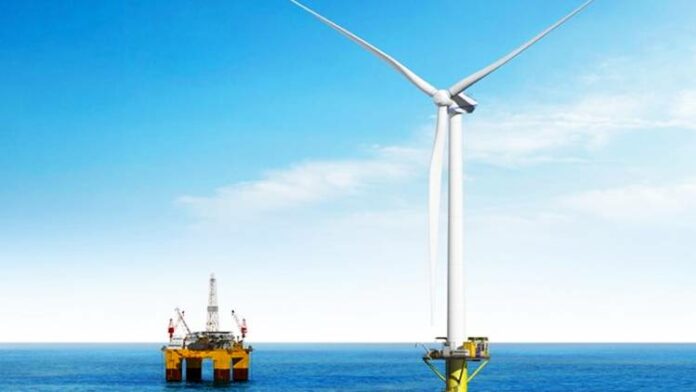
DNV GL is urging offshore oil and gas operators to implement a new solution using floating wind turbines to power water injection for oil recovery.

The ‘wind powered water injection’ (WIN WIN) concept is now ready for prototype development after two joint industry projects have shown the concept to be both cost efficient and technically feasible, according to DNV GL.

Water injection is an effective method for exploiting oil reserves, but the process is often inhibited by the high costs associated with large gas or diesel generators and complicated subsea infrastructure.

By using a floating wind turbine, the WIN WIN concept allows the injection system to operate independently, eliminating the need of long flowlines from the platform.

DNV GL has worked extensively with oil and gas companies since 2015 to prepare the concept for prototyping.

The first phase of research explored the techno-economic feasibility of the wind powered water injection.

The recently completed second stage involved proof-of-concept lab tests.

DNV GL chief executive Remi Eriksen said: “Wind power working for oil and gas, and oil and gas working for wind power, not only captures the imagination in these times of transition, but makes a lot of business sense."

The question, now, is who is going to take this concept into physical reality?”

Project director Johan Sandberg added: “From the start, this project has always had a commercial focus.

As operators know too well, conventional water injection is expensive, with the power plant occupying valuable deck space and expensive flowlines running to the injection site.

With WIN WIN, the power is supplied in situ at potentially much lower cost, with increased flexibility and without emissions, he said.

Source:renews

IMO considers issues on electronic certificates of seafarers

0

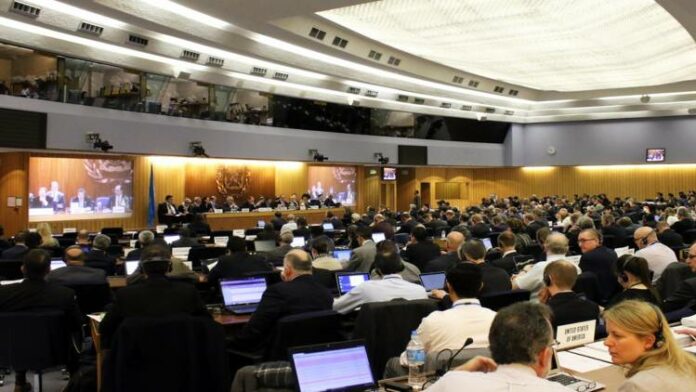
During the 6th session of its Sub-Committee on Human Element, Training and Watchkeeping (HTW 6) on 29 April-3 May, IMO established a correspondence group to consider how to address the use of electronic certificates and documents of seafarers.

The group will consider a number of issues which need to be addressed, including:

  • verification of authenticity;
  • security assurance;
  • data form;
  • physical location (storage);
  • privacy; and
  • any other matters which may arise during the course of the work.

The correspondence group has also been asked to identify provisions of the STCW Convention and parts A and B of the STCW Code that might need to be amended in order to allow and facilitate the use of electronic seafarers' certificates and documents and prepare draft amendments, as necessary. The group will report to HTW 7.

IMO's FAL 39 Committee in September 2014 had agreed that electronic certificates should be treated as equivalent to traditional paper certificates and agreed that electronic certificates viewed on a computer should be considered as meeting the requirement to be "onboard".

The Committee then adopted accordingly the FAL Circular on Guidelines for the use of electronic certificates.

This was further revised by FAL 40 at which the Committee approved a revised FAL circular on Guidelines for the use of electronic certificates, reflecting Member States' experience gained in using electronic certificates.

Agreement signed to improve Industrial-Internet-of-Things environments

0

Rajant Corporation entered into a strategic partnership with Extronics, to make dangerous areas safer. Extronics will provide Wi-Fi tags for personnel and assets tracking, which will be combined with Rajant’s firmware to be safer and certified for use in hazardous work areas.

Extronics Wi-Fi-based tags enable the wireless network infrastructure to track the location and condition of valuable assets or people. The small battery-powered, rugged, programmable tags send short 802.11 messages at a predefined interval.

The tags have long battery life, flexible mounting options, call button and tamper-proof options, onboard sensor capabilities, the capability to store and receive data messages, and a clear channel assessment to avoid Wi-Fi data traffic interference.

According to Geoff Smith, Rajant’s Executive VP of Sales & Marketing, this is especially relevant to personnel tracking, which could be proven useful for industries such as oil and gas, petrochemical and ports.

Source:safety4sea

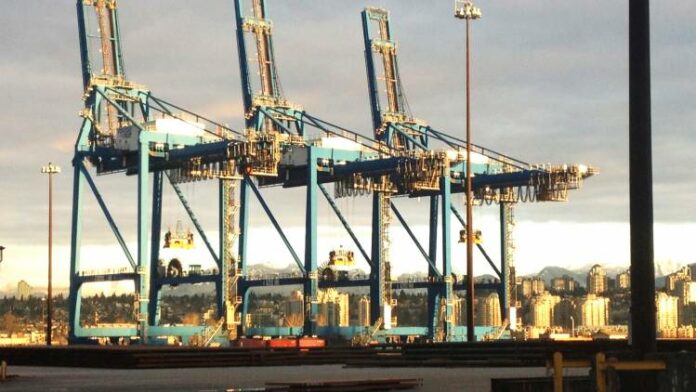
DP World agrees to buy Canadian terminal Fraser Surrey Docks

0

DP World agreed to buy Canadian marine terminal Fraser Surrey Docks from a Macquarie Group fund. The terminal will be purchased through the Canadian subsidiary DP World Canada Investment Inc, which is 45% owned by Caisse de dépot et placement du Québec (CDPQ).

According to Reuters, the purchase is calculated to be under $300 million.

The deal is expected to finalize during the first half of 2019, with the terminal being bought from Macquarie Infrastructure Partners, which is a fund managed by the Macquarie Infrastructure and Real Assets (MIRA) division of Macquarie Group.

Te terminal is located in the wider Vancouver and is considered one of the city’s key steel import terminals.

Speaking about the deal, DP World Chairman Sultan Ahmed Bin Sulayem informed that there is rising demand for multi-purpose facilities in the region and Fraser Surrey Docks will be able to service this demand.

The terminal features 1,200 meters of berth and 189 acres of yard, while during 2018 it handled more than 1 million tonnes of grain and 250,000 twenty foot equivalent shipping containers.

Source:safety4sea

IMO validates two new courses on IGF Code training

0

The 6th session of IMO's Sub-Committee on Human Element, Training and Watchkeeping (HTW 6), held from 29 April to 3 May, validated two new IMO model courses on IGF Code training.

​The purpose of the International Code of Safety for Ship Using Gases or Other Low-flashpoint Fuels is to provide an international standard for ships, other than vessels covered by the IGC Code, operating with gas or low-flashpoint liquids as fuel.

The two new courses validated concern:

  • Advanced training for masters, officers, ratings and other personnel on ships subject to the International Code of Safety for Ship Using Gases or Other Low-flashpoint Fuels (IGF Code); and
  • Basic training for masters, officers, ratings and other personnel on ships subject to the IGF Code.

Following discussions on the process to develop, revise and validate model courses, the Sub-Committee agreed on the systematic use of the Model Course Trust Fund to hire experts for the development and revision of model courses under its purview, subject to the Secretariat's contracting process.

The Sub-Committee also discussed the possible conversion of IMO model courses to e-learning versions and agreed to advise the Maritime Safety Committee (MSC), as the parent body, that this would need further careful consideration.

Converting to e-learning would change the current approach and goals of IMO model courses.

However, the Sub-Committee on Implementation of IMO Instruments (III) could be invited to consider how e-learning material could assist with the implementation of instruments other than the STCW Convention.

IMO model courses assist Member States and other stakeholders to develop detailed training programmes, to effectively implement the provisions of IMO instruments.


Sovcomflot Gets Funds for LNG Carrier Duo

0

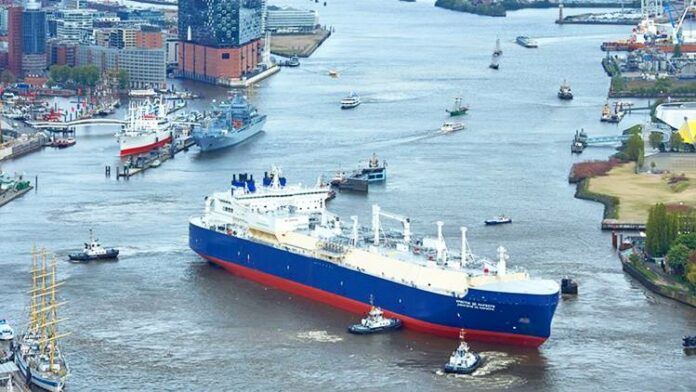
Russian maritime shipping company specializing in petroleum and LNG shipping, (SCF Group) has signed a new $297 million limited recourse credit facility to finance its two next-generation LNG carriers.

The financing deal, with a duration of up to ten years, was concluded with three international banks – ING Bank, KfW IPEX-Bank, and Crédit Agricole Corporate and Investment Bank.

The funds will be used towards pre- and post-delivery financing of two new-generation 174,000-cubic metres Atlanticmax LNG carriers, which will operate under long-term charters to Shell.

The vessels feature a slow-speed dual-fuel X-DF diesel engine and gas boil-off partial liquefaction system. The first of these vessels is scheduled for delivery in the second half of 2020, the other in the first half of 2021.

The addition of these vessels will increase the Group’s liquefied gas carrier fleet to sixteen vessels, and is fully in line with the Group’s strategy of expanding its long-term business with core clients.

This deal follows a similar USD 149 million credit facility signed in November 2018, between SCF Group and these three banks, to finance the construction of an LNG carrier, which will operate on long-term charter to Total.

Nikolay Kolesnikov, Executive Vice-President & CFO of Sovcomflot, said: “SCF Group is pleased with this new LNG project financing with its long-standing financial partners: ING Bank; KfW IPEX-Bank, and Credit Agricole CIB. We very much value the involvement of these three prominent lenders in this deal, which was accomplished in direct continuation of a similar LNG financing concluded with these banks in November 2018, reflecting the banks’ long-term and strong commitment to SCF Group. With the conclusion of this deal, the Group has addressed in full its capital expenditure funding requirements for the next two years.”

Source:marinelink

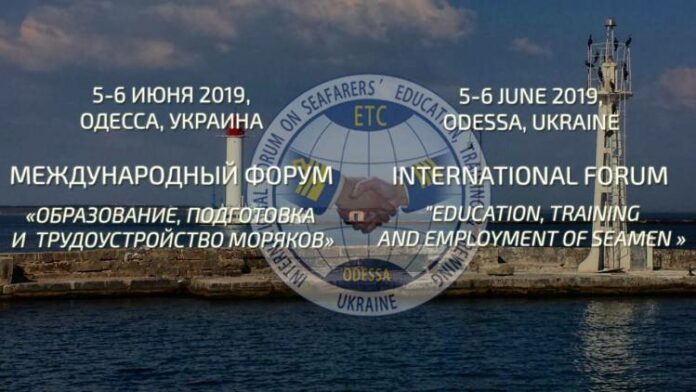
International Forum on Seafarers’ EDUCATION, TRAINING & CREWING

0

Participation in the Forum as a speaker / delegate provides wonderful opportunities for brands promotion, and establishing connections and business partnership with the maritime branch professionals.

Ukraine is among the top five countries that supply the world merchant fleet with qualified officers.

Being the marine capital of Ukraine, the city of Odessa is one of the largest centers of education, training and employment of seafarers in Europe. There are several higher maritime educational establishments, seafarers training and certifying centers; representative offices of more than 200 shipping, manning, and crewing companies; the leading maritime publications and about 80 thousand employees of the maritime industry and training institutions in Odessa.

Major Forum Topics

  • legal regulations of training, certification and labour of seafarers
  • competence standards and seafarer employment requirements of shipping, manning and crewing companies
  • maritime education and training (MET) systems
  • quality management systems
  • on-board training and cadet programs, training fleet
  • simulator training
  • distance education (e-learning) and training programs designed for developing seafarer education and skills
  • assessment of knowledge, comprehension and proficiency
  • career enhancement & qualifications upgrade courses
  • educational materials and media promotion
  • seafaring popularization
  • higher educational establishments in-service instructors training
  • anti-piracy crew members protection
  • human factor and safety of navigation
  • human resources management: seafarers psychological adjustment to multicultural crew
  • on-board medical treatment and care
  • crew members insurance
  • MET investment projects

More information click here

New partnership aims to address safety challenges for global manufacturing

0

Lloyd’s Register Foundation and the Global Manufacturing and Industrialisation Summit announced a new partnership focusing on the safety challenges for global manufacturing and support safe innovation.

The collaboration provides research into identifying and assessing the knowledge gap, safety challenges, risks and opportunities associated with the deployment of Fourth Industrial Revolution (4IR) technologies in critical manufacturing infrastructure.

Specifically, the Global Manufacturing and Industrialisation Summit (GMIS) is a joint initiative by the United Arab Emirates (UAE) and the United Nations Industrial Development Organization (UNIDO).

The developing automation in the shipping industry results to more complex networks and a state of wireless IoT connections, which in the end comes with cyber security risks and threats; Today, people are more exposed to risk elevating unanswered questions on the safety standards of the Fourth Industrial Revolution (4IR).

Recognising the vast skills gap and the imperative to anticipate and mitigate risks in order to facilitate the adoption of 4IR technologies, this outcome-driven partnership will contribute knowledge, promote safety and enhance public understanding of risk, ultimately resulting in a better and safer world for all.

Professor Richard Clegg, Chief Executive, Lloyd’s Register Foundation commented…"As new manufacturing techniques are increasingly adopted and automated, where control systems are autonomous, and where complex networks and the internet of things enable rapid connections, how do we ensure that the things we make and the people that make them are safe?"

Lloyd's Global Manufacturing and Industrialisation Summit unites manufacturers, governments and NGOs, technologists and investors, in a mission to transform manufacturing to enable the regeneration of the global economy.

The partnership reinforces the missions of both organisations, prioritising safety from conceptualisation, and highlighting the importance of tackling some of the challenges presented by the 4IR to unlock their transformational impact on society.

In addition, technologies as the blockchain and the IoT are still complex and applying them brings a number of risks; Privacy and cybercrime is amongst them.

Concluding, to be protected from cyber threats and truly be in line with 4IR technologies and reap significant rewards, manufacturers must better understand their vulnerabilities and be educated and equipped to manage the risks.