2.5 C
New York
Home Blog Page 1037

Vestas receives 58 MW repowering order with auction win in Denmark

0

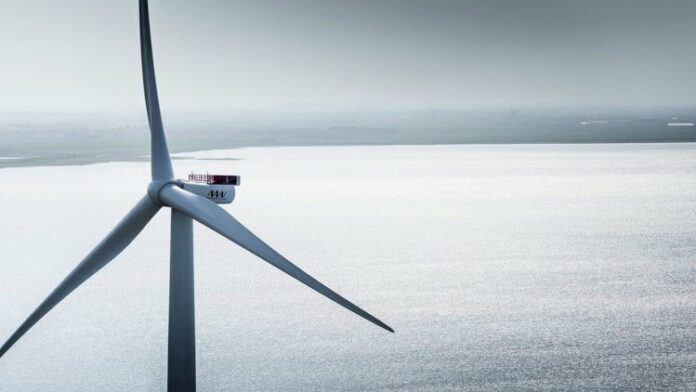
Vestas has received a 58 MW repowering order for the first phase of the 94 MW Overgaard 1 wind park in Randers Municipality in Denmark. The order is placed by SE Blue Renewables, a joint venture between the Danish energy company SE* and Denmark’s largest pension company, PFA Pension.

The firm order includes supply, installation and commissioning of 16 V126-3.45 MW turbines delivered in 3.6 MW Power Optimised Mode as well as a 20-year Active Output Management 5000 (AOM 5000) service agreement.

Highlighting Vestas’ auction capabilities as well as Denmark’s large repowering potential, the order is Vestas’ second announced repowering project derived from Denmark’s first energy-neutral auction. Once completed, Overgaard phase 1 will consist of 26 new turbines, which will almost quadruple the current site’s energy production, demonstrating the strong business case in replacing older turbines with newer and more efficient variants.

”When fully completed, Overgaard 1 will be the largest onshore wind project in Denmark, and taking the first step now is a great milestone for SE Blue Renewables. Even more importantly, the project will underline that the green transition must be realised with onshore wind energy as an important part of the energy mix”,

says

Jan Bach Jensen, CEO, SE Blue Renewables.

“With this project, we continue to demonstrate Denmark’s repowering potential as well as our ability to support customers in submitting winning auction bids for the country’s energy auctions. We are proud to partner with SE Blue Renewables on this project and we will continue to support our new customer with efficient service and broad project management expertise, utilising our profound experience in the Danish market”,

 says Christer Baden Hansen, Vice President Sales North and West, Vestas Northern & Central Europe.

Deliveries are expected to begin in the second quarter of 2020, while commissioning is planned for the middle of 2020.

Cavotec reaffirms leadership in automated mooring with new order in Finland

0

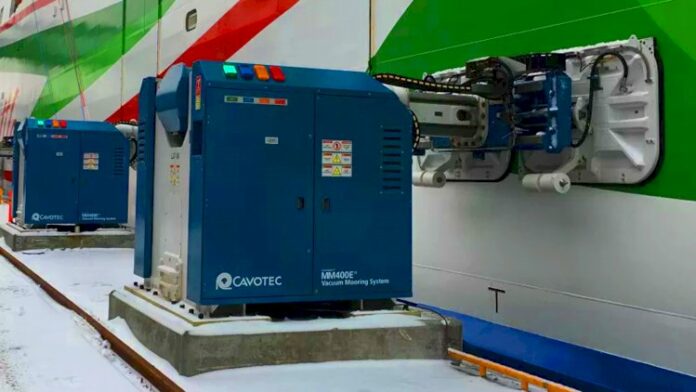
Cavotec has won another order for its innovative MoorMaster™ automated mooring technology for a ferry berth at the Port of Turku in Finland. The system will be delivered in 2020.

The MoorMaster™ system is the only proven and widely used automated mooring technology available in the world today and we’re delighted to have been selected for this key project,”

says Patrick Mares, President Cavotec Ports & Maritime. 

“Our customer has chosen MoorMaster™ as the best technology to improve their operational efficiency while also improving safety and sustainability,”

Mares adds. 

Cavotec will design, supply, commission and service a multi-unit MoorMaster™ automated mooring system at the Viking Line berth at the Port of Turku, southwest Finland. 

The system will moor the 218 metre-long passenger and vehicle ferries Grace, and the new-build Glory. Grace entered service in 2013, and Glory is scheduled to make its maiden voyage in 2021. 

A similar MoorMaster™ system was installed at the Port of Helsinki in 2016. Since then, the system has performed some 5,000 moorings to date. 

MoorMaster™ improves safety, reduces environmental impact, and substantially increases operational efficiency by removing conventional mooring lines from the mooring process. This dramatically reduces mooring times, vessel motion, fuel consumption and emissions.

More than 80 MoorMaster™ systems have performed some 500,000 moorings at ferry, bulk and container handling ports, as well as lock and ship-to-ship applications worldwide. 

Twenty years after the first system entered service, MoorMaster™ is still the only established automated mooring technology on the market. With its key patents and optimized hydraulics, the system offers superior performance to that claimed by any other system on the market, while maintaining low energy consumption. 

Buckskin goes online in the deepwater Gulf of Mexico

0

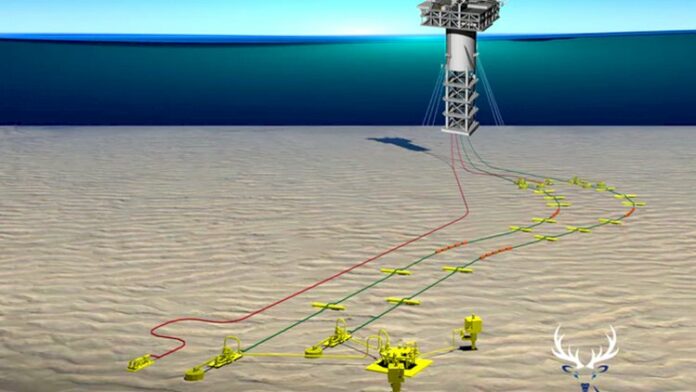
LLOG  Exploration Company,  L.L.C.  (“LLOG”)  announced today  that it  has  initiated  production  from  the  Buckskin  Project  in  the  deepwater Gulf  of  Mexico.   Buckskin  is located  on  Keathley  Canyon  blocks  785,  828,  829,  830,  871 and  872 in  approximately  6,800 feet  of water.  

The  initial  phase  of  this  large-scale,  deepwater  project  consists  of  two  wells  in  Keathley Canyon  829 and  a  six-mile  subsea  tieback  to  the  Lucius  platform  at  Keathley  Canyon  875.   Drilling and  completion  of  the  initial  two  wells,  which  were  drilled  to approximately  29,000 feet,  occurred  in 2018.   Installation  of  subsea  facilities  to  complete  the  tieback  occurred  in  2019.   The  drilling, completion,  and  subsea  installation  were  completed  ahead  of schedule  and  on  budget.   Once  fully established,  the  phase  one  production  rate  is  anticipated  to reach  30,000  gross  barrels  of  oil per day.   Additional phases  of development  will be  required  to  fully  develop  the  field,  which  is  estimated  to contain  nearly  five  billion  barrels  of  oil  in  place.

LLOG  Exploration  is  the  operator of  the  field  and  LLOG  affiliate  companies  own  a  33.8%  working interest  in  the Buckskin  development.    Additional  partners  in  the  field  are  Repsol  E&P  USA  Inc.  (22.5%), Beacon  Offshore  Energy  Buckskin  LLC  (18.7%),  Navitas Buckskin  US,  LLC  (7.5%)  Ridgewood  Energy1 (17.50%.). Philip  LeJeune,  LLOG’s  President  and  Chief  Executive  Officer  commented,  “The initiation  of production  at  Buckskin  marks  a  significant  milestone  for LLOG  considering  the  scope  of  the  field  and its  position  as  our  first  deepwater  development  in  the  Lower  Tertiary  trend.  

The  successful  execution of  this  project  perfectly  illustrates  one  of  LLOG’s  key  strengths  which  is  the  ability  to  create  significant value  by  reducing  cycle  times  and  introducing  development  efficiencies  to  world  class  assets.    

LLOG is  looking  forward  to developing  future  phases  of  the  project  and  embarking  on  additional opportunities  in  the  Lower  Tertiary.  Later  this  month  LLOG  will  spud  a  delineation  well  at  the  Leon discovery  with  the  goal  of  bringing  it  to development  in  the  near future.  This  is  an  exciting  time  for LLOG  and I  am appreciative  and  proud  of  the  efforts  of  our  employees,  partners,  and  contractors 

Ørsted and Vattenfall link up offshore wind farms in the North Sea

0

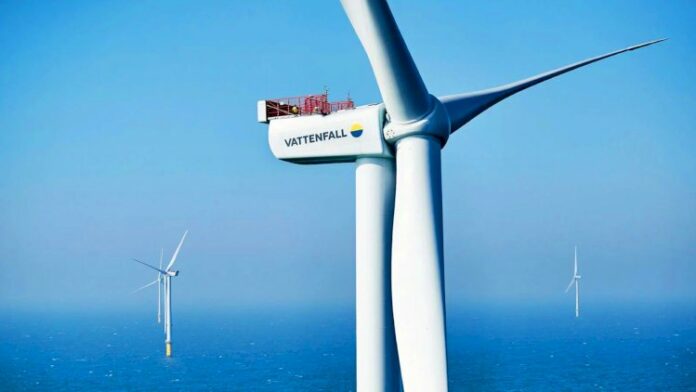
A new eight-kilometre cable between Horns Rev 2 and Horns Rev 3 allows the two offshore wind farms to supply each other with electricity if the export connection to land is disconnected. The cable was used for the first time recently when the Danish system operator, Energinet, disconnected the export cable to Horns Rev 2 for four-days of scheduled maintenance work.

The owners of the two offshore wind farms, Ørsted and Vattenfall, invested in the 33 kV cable that creates additional security for the two energy companies’ billion-kroner investments in the North Sea. If there is a problem with the export connection to land, this is not only critical for the supply of electricity to customers on the mainland; it is also critical for the wind turbines.

“Offshore wind turbines must always be supplied with electricity; otherwise there is a risk of significant damage from for instance  humidity. The cable also enables a quick and easy start-up of the offshore wind farm once the export connection is back in service. In addition, we save a lot of diesel fuel and operating hours for the emergency generators for both the wind turbines and the service boats”,

points out Niels Møller Jensen, Interface Manager at Horns Rev 3.

The cable, which was completed in April, is an optimal solution both in terms of the environment and with regard to investments and operating costs. It was used for the first time recently when Energinet had to disconnect the export cable from Horns Rev 2 for four days for maintenance works. During this time, the wind farm was supplied with electricity from Horns Rev 3.

“We are really happy that we could supply our 91 wind turbines with back-up electricity from Horns Rev 3 during Energinet’s planned inspection of the export cable’s high voltage switch. Thanks to the new cable, we were able to resume generation of renewable power much faster”,

says Allan Due Overbeck, Head of Operations Horns Rev 2.

The wind turbines at Horns Rev 2 normally get emergency power from a central generator on an offshore platform. At Horns Rev 3, each turbine has a small emergency generator.

This is the first time the two offshore wind farms, which have different owners, have backed each other up in this way. Horns Rev 2 has been in operation since 2009, while Horns Rev 3 first began supplying power to the electricity grid in December and will be operating at full capacity by the end of the summer.

ABB transforms MHI Vestas at Moray East

0

MHI Vestas has contracted Swiss company ABB to supply transformers for the turbines at the 950MW Moray East offshore wind farm off the coast of Scotland.

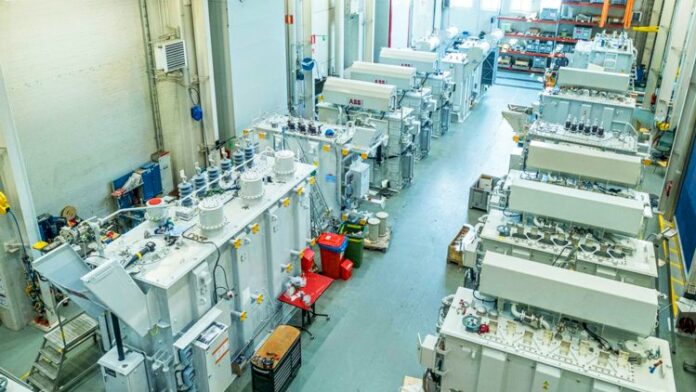
ABB will manufacture 100 WindStar transformers at its factory in Vaasa, Finland, for the project.

The transformers, which will be placed inside the turbines, will allow the 9.5MW MHI Vestas hardware to generate electricity at 66kV.

“They will increase the voltage of the turbine-generated electricity to enable efficient transmission with reduced losses,”

ABB said.

ABB transformer business managing director Laurent Favre said: “ABB transformers are a critical factor in offshore wind electricity generation, helping to ensure an economically feasible and sustainable future for the industry.

Our innovative WindStar transformers are specially designed to meet specific application needs under the mechanical and structural constraints of offshore wind farms.

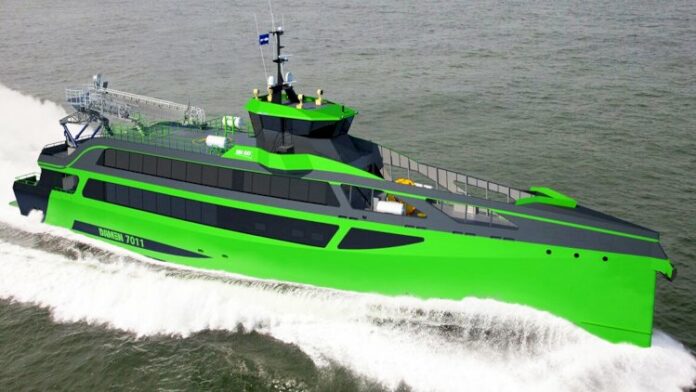
Keel laid for the first of Damen’s revolutionary new FCS 7011 Crew Change

0

Two and a half years on from the genesis of the FCS 7011 concept in response to extensive feedback from the offshore energy sector, the build of the first of this revolutionary design has begun at Damen Shipyards Antalya, Turkey. This milestone, the result of many thousands of hours of discussions, development work, engineering and cross-industry collaboration, was marked by a traditional keel-laying ceremony held at the yard.

70 metres in length, it will be the largest monohull vessel to be built in aluminium by Damen and is scheduled for launch in August 2020. A prospective client can realistically look forward to delivery by the end of that year.

The FCS 7011 represents the future of crew change. It promises to offer greater efficiencies than ever before through its ability to carry larger numbers of personnel – up to 250 – greater distances – 200nm and more – at speeds of up to 40 knots. The integration of technologies including stabilisers, active interceptors and marine access systems will ensure that the men and women on board are delivered safe, well rested and ready for immediate work. While the design of the vessel allows it to operate in a wider range of weather conditions than conventional fast crew vessels, its capacity, speed and range means that multiple offshore installations can be served in a single round trip, thereby delivering substantial savings in both time and operational costs.

Developed in close cooperation with the offshore energy sector, as the concept becomes reality interest in operating and chartering is building from both the oil & gas and renewables sectors. Momentum for exactly this type of vessel is growing rapidly as the oil majors recognise the benefits to be gained by scaling up crew deliveries in terms of size, serviceability, flexibility and safety. Customer interest is such that Damen expects that within a few years a number of FCS 7011 vessels will be operating on both sides of the Atlantic and elsewhere.

Damen Shipyards Antalya is the ideal location for the build of the FCS 7011. A leader in the build of high-speed craft in both composites and aluminium, it also has experience in larger passenger vessels with recent projects including a 55-metre RoPax Fast Ferry and a Yacht Support Vessel.

Concordia Damen ships 18 hulls from Shanghai to Rotterdam

0

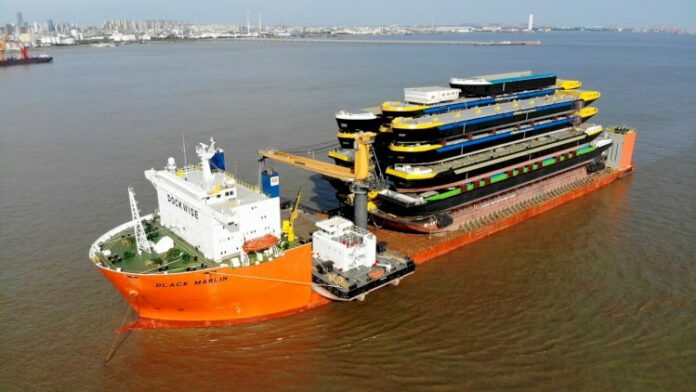
On Monday, 17th June, heavy-lift vessel Black Marlin departed Shanghai. On deck with eighteen Concordia Damen inland shipping vessel hulls and a Damen Crane Barge 6324, bound for Rotterdam. Concordia Damen regularly conducts such heavy-lift transportations as a means of providing its customers with cost-efficient vessels.

The hulls and crane barge had been constructed at yards in China. They are scheduled to arrive in the Port of Rotterdam mid-August. Upon arrival the hulls will be towed to Concordia Damen and other local yards for outfitting and the Crane Barge to Damen Shipyards Gorinchem.

The idea of constructing the hulls in China is to ensure a cost efficient product. However, with the market for these types of vessel being mostly found in Europe, it is important that repositioning the hulls is done in a manner which maintains this cost efficiency.

Bert Duijzer, technical manager, Concordia Damen explains the logic behind heavy lift transportation, Sending one large vessel, with many smaller ones, is far more efficient that sending multiple small vessels. This way we are able to pass on the cost efficiency we have gained in construction to our clients in Europe, at the same time as minimising the environmental footprint of our operations.

On this particular shipment, most of the hulls have already been purchased, though one of them will be placed on stock. In the way, this process also ensures our clients of a very fast delivery of their new vessel.

The Damen Crane Barge, built for stock, will become available for a visit or demonstration from the end of August 2019.

Maersk introduces Maersk Spot, a new fully online product that simplifies the buying process for customers

0

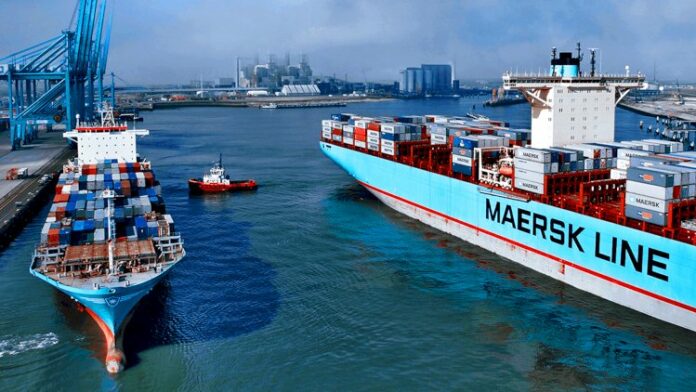
Maersk has expanded its product offering with Maersk Spot. Fully digitally enabled, the new online product provides customers a cargo loading guarantee at a fixed price upfront. With the launch of the new product, Maersk takes further steps towards simplifying the supply chains of its customers by addressing some of the fundamental inefficiencies that exist across the industry.

“It is not uncommon to see overbookings to the tune of 30%, and often this leads to rolling of the customers’ cargoes since there is overbooking to compensate for the high downfall. This creates a lot of uncertainty for our customers,”

says Silvia Ding, Global Head of Ocean Products at Maersk. With Maersk Spot, we provide full visibility of the price and terms that will ensure cargoes get on board. Ultimately allowing customers to move their cargo in a much simpler and more reliable way.

With Maersk Spot, customers can search and get competitive rates online 24/7. The all-in price is calculated and fixed when the booking is confirmed, which happens instantly. This dynamic online pricing fixed at booking creates one transaction for the customer from quotation to booking confirmation, profoundly simplifying the buying process. 

“Maersk Spot radically simplifies the buying experience for our customers. Today’s offline process can be up to 13 individual steps, often involving a lot of communication and paper work from rate sheets to terms and conditions and surcharges, etc. With Maersk Spot, this cumbersome process is reduced to five simple and integrated steps – all online,”

says Ding. 

When a booking is confirmed by the customer, Maersk commits to load and grants certainty in operational execution. This is a mutual commitment between the customer and Maersk which ensures that the vicious cycle of overbookings is addressed. In case of booking cancellations, fees apply at the customer’s charge. If cargo is rolled, Maersk compensates the customer. The mutual commitment paired with increased visibility of sailings and certainty of prices has been to date embraced by more than 3,000 unique customers each week, with already over 50,000 Forty-Foot-Equivalent (FFE) units booked in Q2. 

One of the customers already using Maersk Spot is The Ramco Cements Limited. The company sends around 120-200 containers from Kattupalli port to Colombo every week, making their bookings one to two weeks in advance to ensure they can deliver to their customers on time with the best deal possible.

“We are quite proactive about our bookings but there were still cases where our shipments were not loaded due to capacity issues which resulted in the loss of trust with some of our customers,”

says Ramakrishnan D, General Marketing Manager of The Ramco Cements Limited. With Maersk Spot, we no longer have the uncertainty of not knowing if we can actually provide our customers with their shipments.

Maersk Spot is now available on all trades, except in and out of U.S. Currently available as BETA site, the product will be implemented on maersk.com at the beginning of August. 

IG CIRCULAR: The 2020 Global Sulphur Cap

0

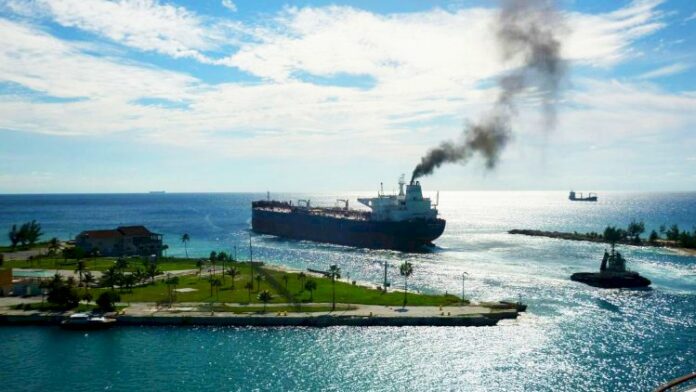
On and after 1 January 2020, the MARPOL permitted limit for sulphur content in ships’ bunker fuel oil will be reduced from 3.50% mass by mass (m/m) to 0.50% m/m for ships operating outside designated emission control areas. The MARPOL Emission Control Area (ECA) limit of 0.10% will still apply, as will any applicable local regulations.

The IMO’s Marine Environment Protection Committee (MEPC 73) has approved a prohibition on the carriage of non-compliant bunker fuel which will come into force on 1 March 2020 (Regulation 14 MARPOL Annex VI), with certain caveats. Ships fitted with exhaust gas cleaning systems (scrubbers), which are designed to remove sulphur oxides from the ship’s engine and boiler exhaust gases in order to reduce sulphur emissions to a level not exceeding the required fuel oil sulphur limit, can continue to carry fuel with a sulphur content of more than 0.50%.  Members should check before calling at a port if the port has any ban or additional requirements relating to the use of open loop scrubbers or for dealing with wash waters from scrubbers.

The IMO has developed further guidance, including a fuel oil non-availability report (FONAR), which is on the IMO’s website LINK. Under Regulation 18 of MARPOL Annex VI, it will be possible to submit a FONAR to State parties recording the steps taken when a ship cannot acquire compliant fuel. It is important to note that a FONAR is not an exemption; it is one of a number of documents to be taken into account by State parties when considering enforcement action against a non-compliant ship and Port State Control (PSC) guidelines have also been published by the IMO to assist in this regard.  When facing enforcement action, Members should be able to fully document the efforts which they have taken to comply.

A limited exception to the 2020 Global Sulphur Cap requirements is allowed for any emission necessary to secure the safety of the ship, saving life at sea or any emission resulting from accidental damage to a ship or its equipment (subject to certain conditions).

P&I Club Cover

The International Group Clubs recognise that the 2020 Global Sulphur Cap presents important challenges to the shipping industry and are closely monitoring discussions at the IMO.

Penalties for non-compliance are likely to include fines, detentions and possibly, in extreme cases, PSC banning orders. The 2020 Global Sulphur Cap does not require any amendments to be made to existing Club Rules. As has always been the case, Clubs do not condone breaches of MARPOL. However, liabilities, including fines for purely accidental discharge of non-compliant emissions, are capable of P&I cover subject always to the Rules and any terms and conditions of cover. This would also include the obligation to reimburse liabilities for fines incurred by another party.

Cover in respect of other fines, for example, for breach of documentary or other MARPOL requirements, including inaccurate or inadequate record keeping or carriage or use of non-compliant bunker fuel, is only available at the discretion of a Club’s Board of Directors at the conclusion of a case. Until a decision has been made by the Board on cover on such discretionary cases, Clubs may be unable to provide security and, even if they do, this will only be in exchange for acceptable counter-security, which would usually be in the form of cash or a bank guarantee. The position in this respect is the same as set out in previous International Group circulars issued on the subject of MARPOL breaches.

It is recognised that the 2020 Global Sulphur Cap could result in P&I liabilities not previously seen which may arise in limited circumstances, for example where there is a technical failure of an otherwise approved scrubber undetectable by the exercise of due diligence that causes the accidental discharge of non-compliant emissions or the discharge of polluting wash-water. There have been suggestions that non-compliance with the Sulphur Cap provisions in MARPOL may have the effect of rendering a vessel unseaworthy which in turn would prejudice the availability of cover. Whilst every case will depend on its individual circumstances, the International Group Clubs wish to make clear both that an infringement of the Regulations will not necessarily be characterised as unseaworthiness and, to the extent it were to be, it is not a necessary consequence that it would deprive a Member of cover.

TechnipFMC Reaches Global Resolution of U.S. and Brazilian Legacy Investigations

0

TechnipFMC has agreed to resolutions with the U.S. Department of Justice (DOJ), the U.S. Securities and Exchange Commission (SEC) Staff and the Brazilian authorities (the Federal Prosecution Service (MPF), the Comptroller General of Brazil (CGU), and the Attorney General of Brazil (AGU)) to resolve anti-corruption investigations in Brazil and relating to the intermediary, Unaoil.

The Company has agreed to pay a total of $301.3 million to these authorities to resolve investigations into conduct dating back over a decade ago. TechnipFMC fully cooperated with these authorities, and this is the first simultaneous resolution to include all U.S. and Brazilian authorities. TechnipFMC will not be required to have a monitor and will, instead, provide reports on its anti-corruption program to the Brazilian and U.S. authorities for two and three years, respectively.

Doug Pferdehirt, Chairman and CEO of TechnipFMC, stated,

“Today we announce the resolution of these investigations. This conduct dating back over a decade ago, taken by former employees, does not reflect the core values of our Company today. We are committed to doing business the right way, and that means operating with integrity everywhere. Our strong compliance program supports this commitment, and we will continue to enhance our program to ensure that our employees have the practical tools and resources to do business the right way. We will remain focused on rewarding the trust that our clients have put in TechnipFMC by delivering industry-leading innovation, superior client service, and exceptional project execution.”

As part of this resolution, TechnipFMC entered into a three-year Deferred Prosecution Agreement (DPA) with the DOJ related to charges of conspiracy to violate the Foreign Corrupt Practices Act (FCPA) related to conduct in Brazil and with Unaoil. In addition, Technip USA, Inc., a U.S. subsidiary, pled guilty to one count of conspiracy to violate the FCPA related to conduct in Brazil. The Company will also provide the DOJ reports on its anti-corruption program during the term of the DPA.

In Brazil, TechnipFMC subsidiaries Technip Brasil – Engenharia, Instalações E Apoio Marítimo Ltda. and Flexibrás Tubos Flexíveis Ltda. entered into leniency agreements with both the MPF and the CGU/AGU related to conduct in Brazil dating back over a decade ago. The Company has committed, as part of those agreements, to make certain enhancements to their compliance programs in Brazil during a two-year self-reporting period, which aligns with its commitment to cooperation and transparency with the compliance community in Brazil and globally.

Additionally, TechnipFMC has reached an agreement in principle with the SEC Staff, subject to final SEC approval.

As previously disclosed, TechnipFMC has also been cooperating with an investigation by the French Parquet National Financier (PNF) related to historical projects in Equatorial Guinea and Ghana. To date, this investigation has not reached resolution. TechnipFMC remains committed to finding a resolution with the PNF and will maintain a $70 million provision related to this investigation.