
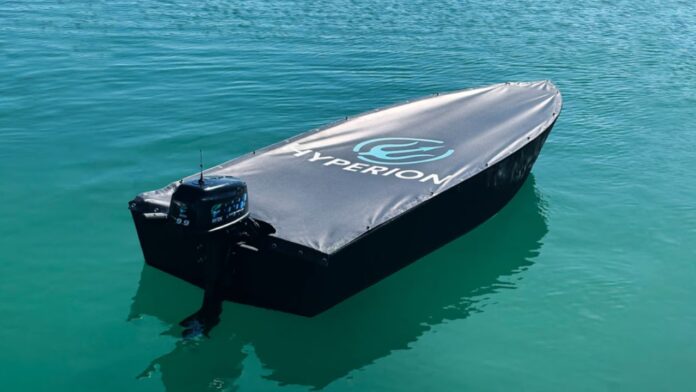
Western Australia-based Hyperion Systems has introduced what it describes as the southern hemisphere’s first 3D-printed uncrewed surface vessel (USV).
The vessel was designed by Australian naval architecture company Versatile Marine, while autonomous functions and AI-powered navigation are being provided by Greenroom Robotics. Production will take place at Hyperion’s facilities in Henderson, Western Australia.
The project’s 4.6-meter hulls will be manufactured through large-format additive manufacturing (LFAM) using recycled polymer materials. Development is being carried out by a Hyperion-led consortium with support from a number of Australian partners.
Navigation and control capabilities will rely on Greenroom Robotics’ GAMA autonomy platform. According to Hyperion, the system offers a tested and adaptable solution capable of supporting different USV designs and operational configurations.
Hyperion CEO Joshua Wigley said the hull manufacturing process is expected to take roughly 40 hours using LFAM 3D printing technology – significantly shorter than the four to six weeks typically required through conventional boatbuilding methods.
Greenroom Robotics co-founder and COO Harry Hubbert said the company’s autonomy software is well suited for Hyperion’s rapidly configurable 3D-printed platforms. He noted that quickly adapting vessels to changing mission demands could provide important operational advantages in complex environments.
Hubbert also highlighted the speed of the production cycle, noting that manufacturing, autonomy integration and deployment can be completed within days. According to him, this could create new opportunities for scalable and distributed maritime defense operations.
Hyperion stated that the vessels are expected to become among the world’s first LFAM-built 3D-printed USVs. The company also plans to produce a larger eight-meter prototype, which is intended for delivery to a European navy for participation in a major naval exercise later in 2026.
Pending successful completion of sea trials scheduled to begin later this month, the autonomous vessel is expected to offer a top speed of around 40 knots, cruising speeds between 20 and 30 knots, and an operational range of up to 180–200 kilometers. Planned capabilities include multi-mission operations, discreet transportation of small teams, performance across different sea conditions, and modular payload options for surveillance, security and defense applications.
Wigley added that combining Hyperion’s AI development capabilities with scalable LFAM production technology is intended to create a broader family of USVs in multiple sizes and configurations. In addition to production at Henderson, the company plans to use modular manufacturing cells that could allow vessels to be printed directly in remote locations.


