
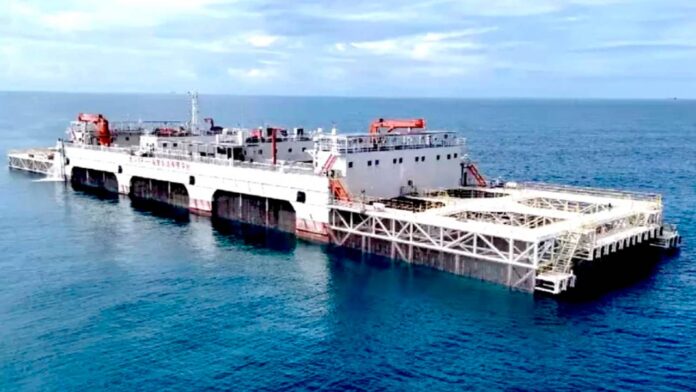
China has commissioned its largest offshore aquaculture platform, a semi-submersible fish farm capable of holding more than 64,000 cubic metres of seawater and producing over 4,000 tonnes of fish annually.
The facility, named Xinhuan No. 1, has begun operations off the coast of Sanya in Hainan Province. The platform is expected to receive around three million juvenile fish this month, primarily fourfinger threadfin and pearl grouper. Its compartmentalized design allows fish to be raised at different growth stages and supports year-round production cycles.
According to farm operator Li Xihuan, the platform is designed to produce two harvests per year, each yielding about 2,000 tonnes of fish. In addition to aquaculture, the project will also include tourism-related activities such as recreational fishing and sightseeing.
The semi-submersible structure uses a ballast system that enables it to adapt to changing sea conditions and withstand severe weather, including typhoons. It also features a continuous seawater exchange system intended to maintain conditions similar to the surrounding marine environment.
The launch of Xinhuan No. 1 reflects China’s broader efforts to expand industrial activities offshore. While it is the country’s largest offshore fish farm, it remains smaller than Norway’s Havfarm 1, currently the world’s largest floating aquaculture facility.
Environmental groups and researchers continue to monitor the impact of large-scale offshore fish farming, noting that waste discharge and ecosystem effects can be more difficult to assess in open-water environments than at land-based facilities.


