
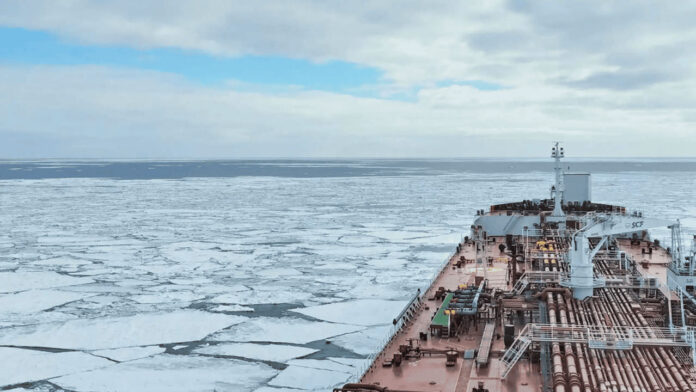
Russia has significantly expanded its use of the Northern Sea Route (NSR), assembling a record convoy of oil tankers to transport crude oil to Asia as it seeks to maximise exports during the short Arctic navigation season.
According to shipping data cited by gCaptain, more than a dozen Suezmax, Aframax and Medium Range tankers were operating along the Northern Sea Route or waiting in the Kara Sea as of 3 August. Together, the vessels are expected to carry approximately 8 million barrels of crude oil to Asian markets.
The largest concentration of tankers has formed in the Kara Sea, where vessels are believed to be waiting for nuclear icebreaker escorts or improved ice conditions before continuing through the most challenging sections of the route.
To support the convoy, Russia has deployed three nuclear-powered icebreakers — Sibir, Yakutia and Ural — which are operating across different stretches of the Northern Sea Route to assist commercial traffic.
During the entire four-month Arctic navigation season in 2025, Russia transported around 13.1 million barrels of crude oil via the NSR. The current convoy alone accounts for roughly 60% of that volume, despite the 2026 shipping season only recently getting underway.
Although Arctic sea ice retreats during the summer months, navigation remains challenging. Ice coverage typically reaches its annual minimum only in late September, meaning many parts of the route continue to require icebreaker assistance throughout much of the season.
Russia’s growing reliance on the Arctic corridor comes as security risks continue to affect traditional shipping routes. Ongoing attacks on commercial vessels in the Red Sea, tensions around the Strait of Hormuz and Ukrainian strikes on Russian energy infrastructure have increased the strategic importance of the Northern Sea Route for Moscow.
Since Western sanctions redirected much of Russia’s crude exports away from Europe, China and India have become its primary buyers. The unusually large concentration of tankers in the Arctic suggests Russia is aiming to maximise exports before the seasonal shipping window closes later this year.


