
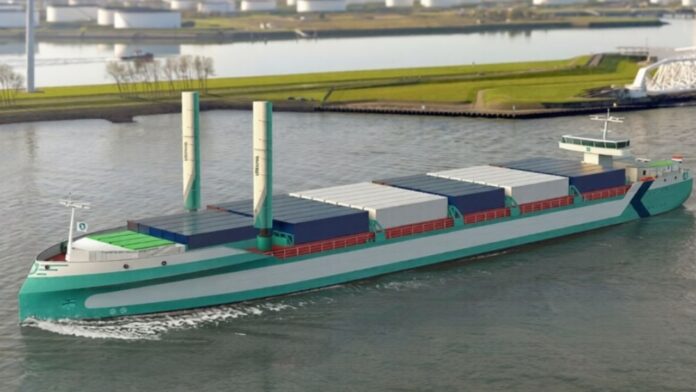
Tharsis Ship Management has secured funding from the EU Innovation Fund for the eSeaRiverBarge Project. The project covers the development, construction, and operational deployment of two first-of-a-kind zero-emission sea-river container vessels.
The open-top container hold is optimised for 30- and 45-foot cargo containers and has a capacity of up to 378 TEU. The vessels will feature a dedicated storage hold on the fore and aft ship for sixteen swappable ISO energy containers, connected via plug-in Megawatt Charging System (MCS) connectors — the same high-power charging standard emerging for heavy-duty road transport. These containers can house a wide range of energy carriers, such as batteries, hydrogen or ammonia. Two biofuel generators will serve as back-up power.
They are combined with wind-assisted propulsion units, hull air lubrication, a triple electric propulsion setup, and an optimised hull design for combining seagoing capabilities with the ability to navigate rivers during low-water periods.
In this project, the swappable energy containers will be ZESpacks: battery-based units provided by Zero Emission Services under its Energy- and Charging-as-a-Service (ECaaS) model. This enables emission-free operations on the inland trajectory between the Netherlands and the United Kingdom, with efficient battery swaps at charging stations eliminating downtime.
The use of ZESpacks at sea will be scaled up over the course of the operational period.
The project demonstrates the first-of-a-kind zero-emission container liner service for sea-river shipping — a niche market that offers direct, seamless transport between European seaports and inland terminals — reducing greenhouse gas emissions in freight transport and supporting the EU’s climate goals for maritime and inland waterways.
It strengthens sea-river shipping as a sustainable alternative to road transport and paves the way for scaling the ECaaS model across short-sea shipping in Europe.
Construction is scheduled to start in early 2027, with the first vessel entering service in 2029. Which yard will build the vessels has not yet been revealed, but the vessels will be completely built in the EU.
‘This EU funding is a major milestone. It allows us to build, deploy, and operate these vessels, proving how innovative technologies like swappable energy containers and hybrid propulsion can decarbonize coastal and inland shipping in full commercial operations,’ says Jan Albert Bosma, Tharsis Ship Management.


