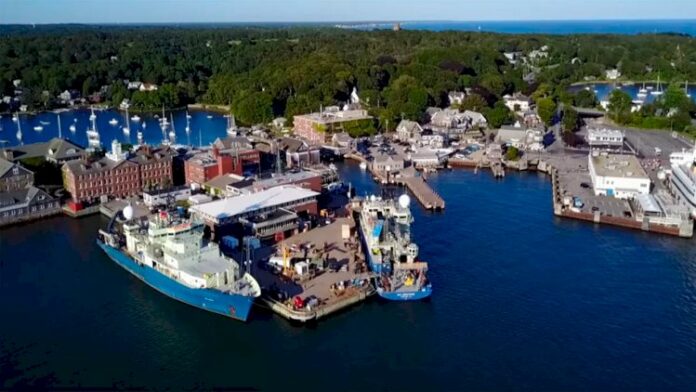
Members of WHOI’s Ocean Twilight Zone team, particularly the lab led by marine biologist Annette Govindarajan, are pioneering the use of environmental DNA (eDNA) sampling and analysis to provide a more finely tuned picture of what lives deep beneath the surface of the ocean.
Tidal energy: Re-installation of D10 turbine near Ushant Island
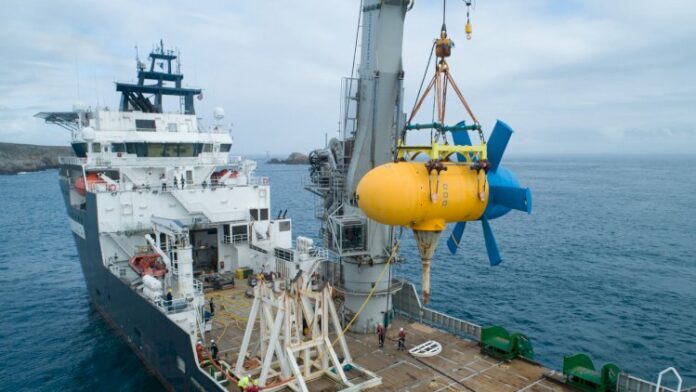
SABELLA’s D10-1000 turbine was successfully redeployed onto its gravity-based foundation in the Fromveur Passage, one of the most energetic tidal sites in France. The subsea cable enabling electricity export towards Ushant’s Island grid was then connected to the tidal turbine during the night.
Despite Hurricane Lorenzo causing high swell conditions allowing only a short weather window, the operations were successfully performed by INYANGA, with whom SABELLA has have a long and successful working relationship. The operation was conducted using the Offshore Construction Vessel Olympic Challenger chartered from Reach Subsea. With a length of 106 meters, this ship is well suited to this kind of operation, thanks to her DP2 dynamic positioning system (optimized for high current flow), allowing her to safely hold station in the strong currents of the Fromveur Passage, and her 200-tonne AHC (Active Heave Compensated) crane and her two work-class ROVs (subsea robots).
After operating continuously for several months following its redeployment in October 2018 (as part of the European ICE project led by Bretagne Développement Innovation) and a continuous electricity production over several months at the end of last year, SABELLA's team focused on testing new control methods at the beginning of 2019 in order to significantly improve the efficiency of the turbine. In parallel, a defect was detected in the nacelle’s cooling system, that allows the various inboard electrical components to be cooled. This defect did not prevent the operation of the turbine but limited its operating conditions due to the possible rise in temperature of the components, which could have caused greater damage to the electrical system. As result the turbine was recovered by the Olympic Zeus in April 2019. Since then, the cooling system has been updated in order to increase reliability.
SABELLA seized the opportunity of this onshore period in order to carry out a full maintenance of the control system installed on Ushant Island, which had originally been designed for a one-year demonstration period. An energy storage system is now integrated into the onshore substation which will allow load-levelling of the electrical output produced before injecting it into the grid.
The D10 tidal turbine will be progressively commissioned within the next few weeks in order to begin the electricity injection to Ushant’s Island grid by the end of October. It will be operated until 2021, after which the commissioning of the PHARES project, led by AKUO Energy, including two SABELLA tidal turbines, an onshore wind turbine, solar energy and energy storage (implemented by EDF SEI) will be installed.
Diane Dhomé, Project Manager for SABELLA commented:
"We are very pleased to have completed this operation in such a tight weather window and pleased to have the turbine ready to produce and provide electricity to Ushant Island."
Richard Parkinson, MD of Inyanga Marine Projects and Offshore Operations Manager commented:
"The site at Passage Du Fromveur has unique challenges- persistent swell conditions, combined with high currents and overfalls. It is a testament to the robustness of the technology and operations strategy that we have safely completed these operations on time and on budget."
Update: Bourbon Rhode lost in eye of Hurricane Lorenzo
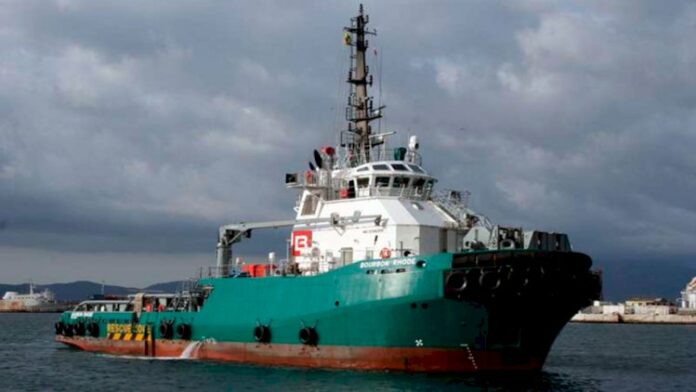
According to our information, the vessel Bourbon Rhode has not yet been found.
The location of the crew is also not known. Search and rescue operations are ongoing. Other maritime means are being mobilized in order to provide assistance to the crew, as well as air support from NHC (National Hurricane Center).
The crisis cell is working in very close cooperation with the Regional Operational Center of Surveillance and Rescue (Cross) of West Indies-Guyana. Weather conditions remain particularly adverse and the search zone is affected by the outer edge of Hurricane Lorenzo.
Update 28/09/2019:
As informed, few (3 confirmed) crew members been rescued by piet ship.
Who have any updated info on this topic please share it in FB group
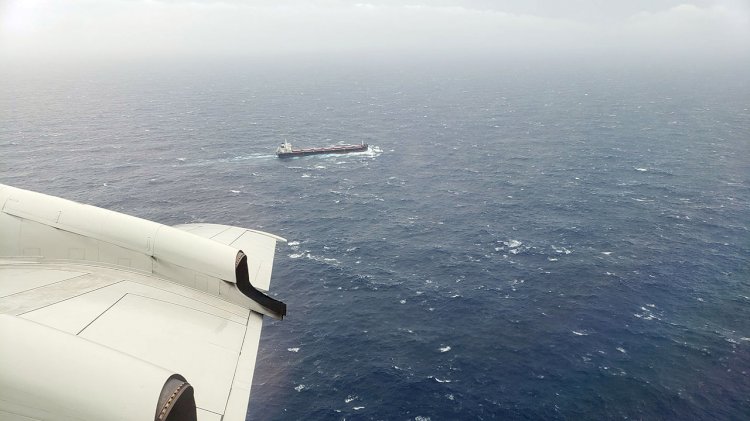
Update 28/09/2019, 5:35 PM
In the context of search operations of tug supply vessel Bourbon Rhode started on September 26, the mobilized rescue teams have recovered a lifeboat with 3 crew members on board, the lifeboat having been identified by a Falcon 50 especially equipped for this type of mission and sent by the French Navy. The 3 crew members are currently taken in charge by the medical support team onboard the commercial vessel, which provided assistance, and are currently placed under medical observation.
It has been confirmed that the vessel has sunk. The search continues to be carried out in weather conditions that are improving. All necessary means are implemented by the Cross AG and the French Navy, under the authority of the Prefect representing the State’s maritime authority, namely numerous flyovers carried out by the Falcon 50 over the search zone. Numerous commercial vessels have had their course changed in order to bring assistance, as well as a plane of the U.S. National Hurricane Center.
The crisis cell put into place by BOURBON works in very close collaboration with the Cross AG and the French Navy. BOURBON’s teams are mobilized to keep the families of the crew members informed and bring them full support in this difficult time.
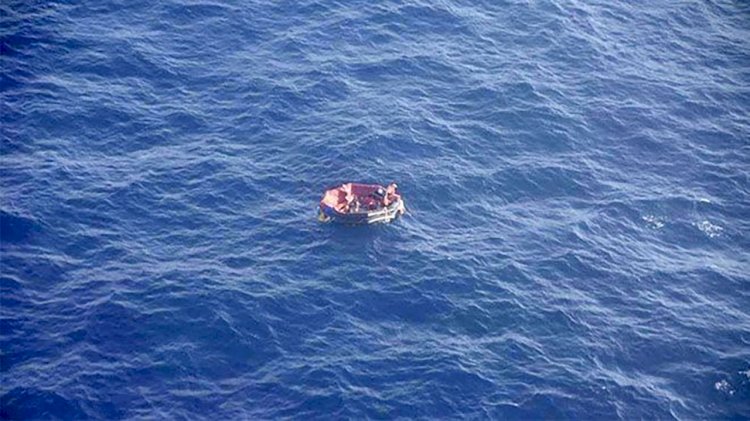
Update 29/09/2019
Bourbon's official information
The search for tug supply vessel Bourbon Rhode continues with the full support of Cross AG (Regional Operational Center of Surveillance and Rescue) and the French navy, under the authority of the Prefect representing the French national maritime authority. Five commercial vessels have changed course in order to bring assistance to the rescue teams. A Falcon 50 of the French navy as well as the aircraft of the American National Hurricane Center (NHC) conducted numerous overflights of the search area. The French navy’s surveillance frigate “Ventôse” and “Panther” helicopter will intervene tomorrow, September 30.
Yesterday, in the beginning of the night, a capsized fast rescue craft was spotted first by the NHC aircraft and then by the Falcon 50. A commercial vessel engaged in the operation is currently headed in its direction in order to try to recover it.
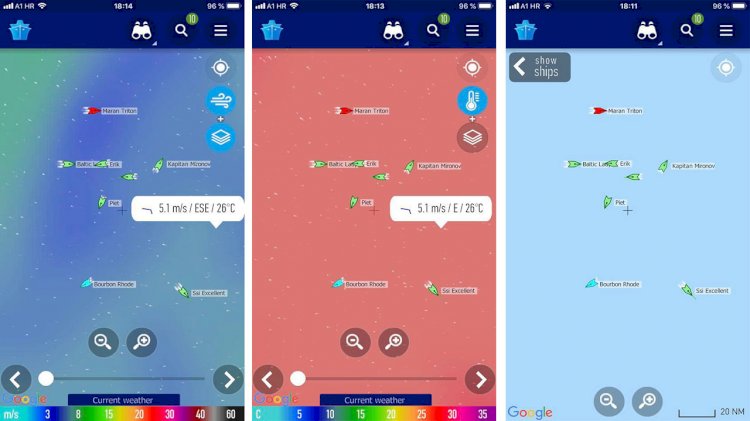
Latest update from French Navy.
Rigid inflatable spotted in search for Bourbon Rhode.
Rescue operation at sea Pointdesituation – Bourbon Ship Rhode. Sunday 29 September at 12 pm.
Since Thursday, September 2019, 26, the regional operational centre for surveillance and rescue (#Cross) Antilles-Guyana has been coordinates the search and rescue operation of the ship #bourbon Rhode.
Yesterday, Saturday, September 28, at the beginning of night, the us aircraft of the National Hurricane Center (#Nhc) spotted a semi-rigid returned probably from the bourbon ship. Due to the stress of the night that prevented its relocation by a maritime means, the national aircraft of the National Navy was able to repositioning the boat at sunrise this Sunday, September 29 A trade ship, engaged in the operation, is currently on its way to try to recover this semi-rigid.
This new discovery allows Cross Antilles-Guiana to refine the aéromaritime device. Five Commercial Ships are currently engaged in a rather large research area, in addition to the Falcon50 of the National Navy.
Update: States reaction
Croatian Minister for European and Foreign Affairs Gordan Grlic Radman reiterated today that three of the 14 crew members were rescued, while others – including Croatian citizen Captain Dino Miskic – are still being searched.
– Colleagues are in constant contact with Dino Miskic's family, all naval and air forces involved in the rescue are involved. The search continues and we hope for a truly positive outcome. The Croatian representatives are in direct contact with the French company and the French crisis headquarters.
Ministry of Foreign Affairs of Ukraine keeps track of the situation and maintains contact with the families of the crew members too. The Marine Transport Workers’ Trade Union of Ukraine (MTWTU) asks relatives of sailors to call for help by phones:
+38 (0482) 42-99-01, +38 (095) 550-75-55, or in FB group.
Update 30/09/2019
Bourbon's official information
BOURBON is sad to report the death of one of the crew members of the Bourbon Rhode. The body of the missing seafarer was located by one of the aircraft involved in the search and has been recovered by one of the five vessels that came to assist. The seafarer's family was immediately notified and they requested that the identity not be disclosed.
Rescue operations are continuing to find the other crew members, with significant maritime and air search resources deployed by the French and American authorities.
Gaël Bodénès, Chief Executive Officer of BOURBON Corporation, declared:
"All our thoughts and prayers go to his family and loved ones. This tragedy affects all BOURBON employees who express their full support to the seafarers' families. We remain fully mobilized on search operations to find the other missing seafarers and I would like to express our gratitude to the rescuers, all the teams of the CROSS (Regional Operational Centre for Surveillance and Rescue) and the teams of the crisis cells who are working tirelessly to this end."
Update 01/10/2019
Bourbon's official information
BOURBON today mourns the death of two other crew members of the Bourbon Rhode. The bodies of our two mariners were recovered at sea last night and transferred on the French navy "Ventôse" frigate. BOURBON stands by the seafarers' families and is fully mobilized to support them in this terrible time.
The research operations carried out by the French authorities with the support of the US authorities are part of exceptional measures, further intensified in recent days. Since the beginning of the operations on September 26, ten commercial vessels have been mobilized in the area. Daily overflights are performed by a Falcon 50 of the French Navy, supported by a C 130 Hercules aircraft from the US Coast Guards. The Navy frigate, accompanied by its helicopter "Panther", is at the heart of the system and coordinates the grid of nearly 40 search areas.
BOURBON Corporation CEO Gaël Bodénès declares:
"On behalf of all BOURBON employees, I would like to pay tribute to the deceased sailors. Our thoughts and prayers are with the families and loved ones who are grieving over this dramatic event. We stand in full solidarity with them in this ordeal and assure them of our strongest support. Research operations are continuing on this sixth day and the mobilization of the maritime world is unprecedented. I would like to express our gratitude to all the research teams and those who volunteer."
Update 02/10/2019
BOURBON today mourns the death of another crew member following the sinking of the Bourbon Rhode in the Atlantic Ocean on September 26.
The body of this fourth seafarer was discovered yesterday and transferred on the French Navy’s "Ventôse" frigate.
BOURBON Crisis Cell Director Cyrille Le Bris declared:
"On behalf of BOURBON, I would like to express our condolences to the family and friends of the deceased seafarer. We are at their side to accompany them through this terrible ordeal. Despite significant search resources for the rescue of the crew, the fate of the missing is an ever-increasing source of anxiety for the families. We remain fully mobilized to pursue relief operations and reiterate our warm thanks to all the teams that have volunteered and are helping us in our search."
Over the past 7 days, an exceptionally extensive search operation has been implemented by the CROSS French West Indies-Guyana (Regional Operational Centre for Surveillance and Rescue) and the French Navy, under the authority of the Prefect representing the State’s maritime authority, with the support of the American authorities. Significant maritime and air resources continue today to be deployed over research areas.
Update 05/10/2019
Bourbon's official information
Search operations carried out since September 26 by the CROSS French West Indies-Guyana and the French Navy have enabled to find three survivors of the Bourbon Rhode shipwreck, as well as the bodies of four of our seafarers. Seven other crewmembers are still missing.
Several vessels have continued to survey the search area today, with no results for the past 4 days. The CROSS has decided to make the search operation evolve. It will regularly disseminate messages to vessels in the shipwreck zone and ask them to carry out adapted watch.
BOURBON Corporation CEO Gael Bodénès declared:
"BOURBON and all its employees are in mourning today and I would like to reiterate our sincere condolences and our full support to the families and loved ones of the victims. We are working in close cooperation with the various stakeholders to understand the facts and circumstances of this tragedy. Finally, we thank the entire maritime community for its many signs of solidarity, so precious in these difficult times. I would like to reiterate our heartfelt thanks to the CROSS teams, the crews of the French Navy and the commercial vessels involved in search operations."
Update 07/10/2019
Bourbon's official information
The three survivors of Bourbon Rhode’s crew arrived yesterday in Fort de France on board the French Navy frigate "Ventôse". They were welcomed by civil and military authorities, and by BOURBON representatives. The three seafarers, in good health, have been taken care of by the health structures and have already been reunited with their families.
The bodies of the seafarers who died during the sinking, were taken care of by the funeral services and will be repatriated to their families.
BOURBON reminds that an exceptionally extensive search operation, with maritime and air resources, has been implemented since September 26 by the CROSS Antilles-Guyane, responsible for managing and coordinating search and rescue operations on behalf of the French maritime authorities. To date, the search operations decided by the CROSS continues: the Alp Striker vessel – a 90 m AHTS capable of operating over very long distances – is still surveying the area to find the missing seafarers and all merchant vessels operating in this area are mobilized to set up an appropriate watch.
BOURBON teams are providing daily support to the families of the crewmembers. Crisis cells are pursuing their action and working very closely with the various stakeholders to understand the facts and circumstances of this tragedy.
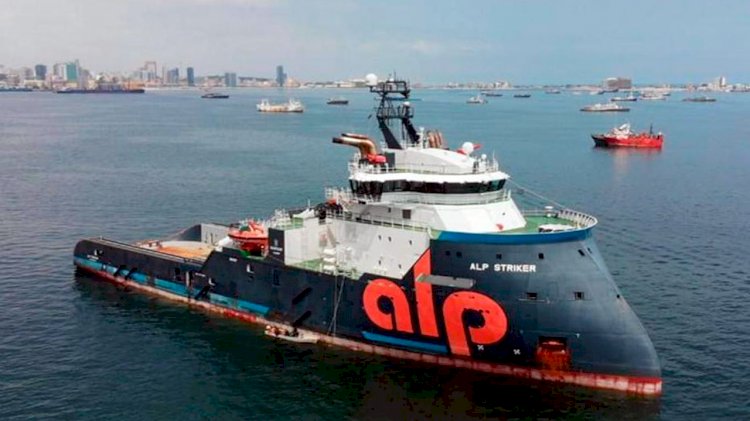
Update 08/10/2019
From the french newspaper Le Parisien
On Sunday night the vessel Alp Striker reported to CROSS Antilles-French Guiana Crisis Headquarters that two observers on the bridge saw white and red pyrotechnic signals that they interpreted as possible distress, the prefecture explains, French newspaper Le Parisien writes.
"The origin of this signal coincides with one of the hypotheses about the search area for survivors of the Bourbon Rhode shipwreck," the prefecture said in a statement.
The Regional Operations Surveillance and Rescue Center "immediately requested that three merchant ships turn off and go to the area they would reach (as of Tuesday)." He also requested that "every ship in the area be awake." Finally, Tuesday morning, "a U.S. Coast Guard Hercules C-130 aircraft will also fly over the area."
Bourbon's official information
Following reports by two seafarers onboard the Alp Striker during the night of Sunday to Monday, of signals that they interpreted as potentially emanating from a distress flare, the vessel immediately set a course for the area, in coordination with the CROSS Antilles-Guyane. The CROSS called on 3 additional commercial vessels to change course and head to the area reported as being the origin of the signal. It also received air support from U.S. authorities by way of the aircraft Hercules C-130.
The search operations led by the Alp Striker, involving namely drones, as well as the operations carried out by the three other vessels, and the flyover by the U.S. aircraft Hercules C-130, have delivered no result at this stage.
The crisis cells are pursuing their actions and BOURBON’s teams are offering daily support to the families of crewmembers of the Bourbon Rhode.
Update 09/10/2019
The Marine Transport Workers’ Trade Union of Ukraine (MTWTU):
The wind of hope for all who have been praying for the Bourbon Rhode crew for the second week
Yesterday, on October 8, the launch of a signal missile in the Atlantic Ocean was recorded, and there was a reason to believe that the signal came from the crew members of tug supply vessel Bourbon Rhode, the search for which has been ongoing for the second week.
A missile is a sign that the search with the maximum use of all available means and equipment should continue.
Today, on October 9, according to the European Maritime Safety Agency, which was also confirmed to us by our colleagues from the Croatian Maritime Labor Union, satellite photographs did indeed reveal a raft that could contain missing sailors. The satellite transmits an image with a delay of two hours, so now all the ships nearby are mobilized and sent at the indicated rate.
MTWTU hopes that the alleged information will be confirmed that it is nevertheless a raft with part of the crew of the Bourbon Rhode ship, which managed to escape and survive.
Update 11/10/2019
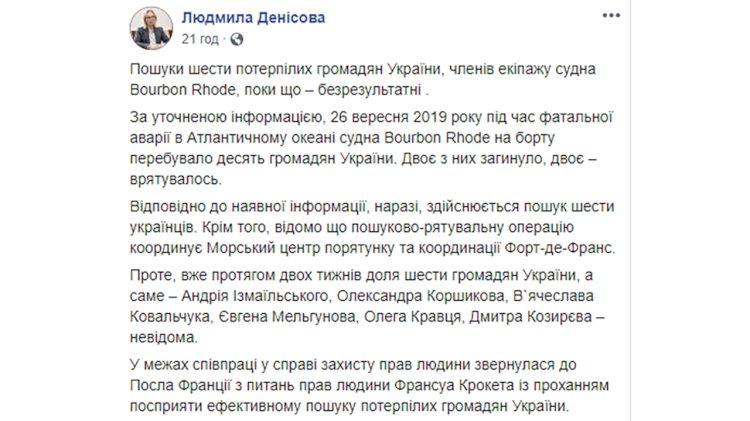
Ukrainian ombudsman Lyudmila Denisova has published on Facebook the names of Ukrainian seafarers who cannot be found yet.
Denisova notes that Andrei Izmail, Alexander Korshikov, Vyacheslav Kovalchuk, Evgeny Melgunov, Oleg Kravets and Dmitry Kozyrev have been looking for two weeks, but their fate is still unknown.
Denisova said she had turned to the French Ambassador for Human Rights with a request to help the effective search for affected Ukrainians.
Update 12/10/2019
Families and friends of the missing AHTS Bourbon Rhode seafarers have open fundraising to continue the search.
They said:
"On September 26th 2019 the Ship Bourbon Rhode with 14 Crew members sunk in the Atlantic.
The Search and Rescue Mission lasted only 7 days, during which time bodies of 4 seafarers were found (God bless their soles), and 3 seafarers were found alive in a life raft.
The rescued seafarers have confirmed that all 4 life rafts were successfully launched! That means that the missing 7 crew members have a good chance of being alive, but still – the SAR mission is already suspended. We cannot stop looking for them as long as there is hope that they can be saved!
With this campaign we want to collect funds to continue the search with whatever means needed.
We have started a Petition and have collected more than 38.000 people that signed the petition, that the SAR (Search And Rescue) Mission shall be continued.
We have created a Facebook Group where we collect Information we can get about the sunken Ship and lost Crew.
We are Friends and Family of the Missing Captain, and with the blessing of other families of crew members lost at sea, we ask you to help us continue the search until every living Crew member will be found!
Thank you all for your donations! Every cent helps! If you cannot donate, please share this story to those that might."
For those of you who were unable to make the donation through the Go Get Funding web site, here is all the data you need to make your payment directly to the account for the “Help us find Bourbon Rhode Crew Lost in the Atlantic” campaign:
BANK ACCOUNT OWNER NAME: MANGOPAY SA
IBAN: FR7618829754160284210614460
BIC: CMBRFR2BCME
WIRE REFERENCE ID: MGxs8u0dyg
Thank you for all your support!
Bourbon's official information
Following the report of a possible distress flare on the night of Sunday 6 to Monday October 7, the CROSS French West Indies-Guyana (Regional Operational Centre for Surveillance and Rescue) dispatched 4 ships to search the area, with the support of an overflight by the US Coast Guards aircraft. Over the past week, search has been intense and extensive to try to detect a sign after on the one hand, the report of this potential distress flare and on the other hand, the satellite photo obtained from the European Maritime Safety Agency (EMSA). These new searches have unfortunately been unsuccessful.
As a whole, search operations have not found any trace of life or life rafts for more than 10 days now despite measures of exceptional magnitude.
As a reminder, search and rescue operations have been going on for 16 days, with the sinking of the ship taking place on September 26 as it faced hurricane Lorenzo. As decided by the CROSS, search operations are no suspended and won’t stop on a specific date. But they are entering a new phase of active monitoring during which the CROSS will mobilize all vessel transiting in the area to implement an adapted monitoring.
BOURBON CEO Gaël Bodénès declared:
“Our priority is to provide families and relatives of the BOURBON Rhode crew with all possible support under these tragic circumstances. On behalf of all the employees and in particular all those who work tirelessly within the BOURBON crisis cells, I want to reiterate how much our thoughts are with the families of the missing seafarers.”
Bid to reconstruct richness of prehistoric oceans
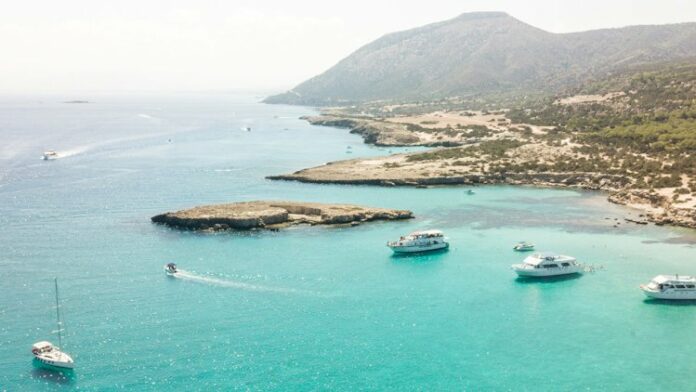
Scientists are reconstructing the world’s “pristine” prehistoric oceans.
Ocean conservation is a global concern, but the researchers say we don’t currently know what the oceans were like before major impacts caused by humans.
Using sediments, shells and bones, and a host of cutting-edge analysis techniques, the Seachange project aims to find out.
Jointly led by the University of Exeter, the University of York, Johannes Gutenberg University Mainz (Germany) and the University of Copenhagen (Denmark), the project will discover how depleted the current marine environment is, what measures are needed to help biodiversity to recover and how long this might take.
The project has been awarded European Research Council Synergy Grant of 11.75 million euros (£10.5 million).
Professor James Scourse, of the University of Exeter, said:
“We will be able to reconstruct the full richness and diversity of the oceans immediately before they were impacted by significant human activity, for instance before Iceland was settled or there was significant whaling in Antarctica. This will provide a basis for assessing whether regions that we regard now as pristine, or not impacted significantly, are actually degraded remnants of a formerly much more diverse ecosystem.”
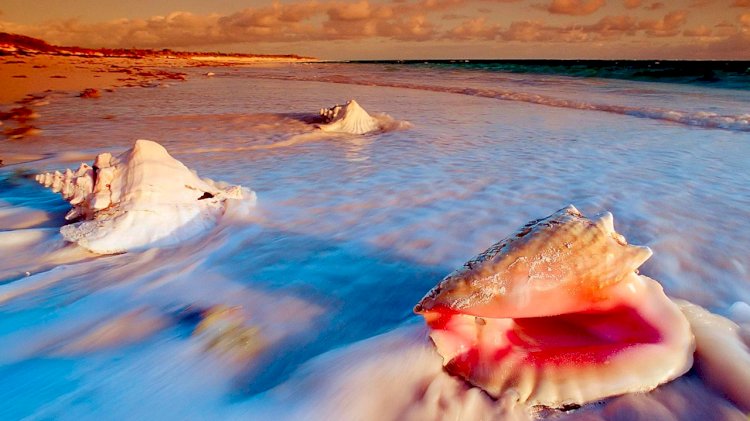 The project will test the scale and rate of biodiversity loss as a result of fishing and habitat destruction over the last 2,000 years in the North Sea and around Iceland, eastern Australia and the west Antarctic Peninsula, as well as the earlier transition from hunter-gatherer to farming communities in northern Europe around 6,000 years ago.
The project will analyse the shells of bivalve molluscs, marine sediment cores and archaeological kitchen waste materials including shells and bones.
These will be precisely dated and analysed using zooarchaeological and palaeoecological, stable isotope geochemical and environmental DNA metabarcoding analyses.
Professor Callum Roberts, from the University of York, said:
“In developing detailed, dated time-series of ocean ecosystem change, we expect to be able to detect the earliest signs of human influence on the sea. And by understanding how the seas of today are different from the past, we will be able to better manage them for the future.”
Deltamarin provides RMC with design services for the Tallink ferry project
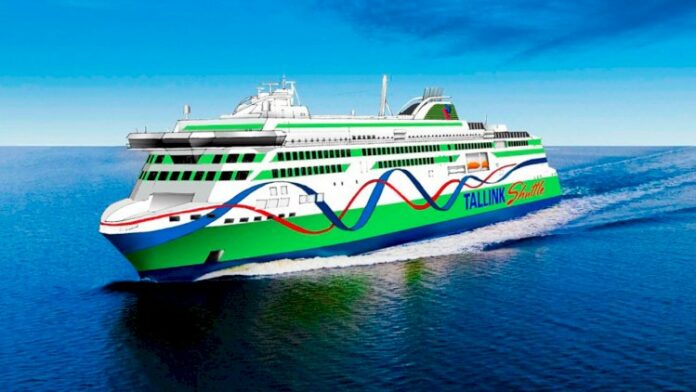
Deltamarin is strengthening its position as a trusted designer of ro-pax vessels with the latest contract signed with Rauma Marine Constructions (RMC). The contract covers basic and detail design services for Tallink’s new LNG-powered shuttle ferry set to operate between Helsinki in Finland and Tallinn in Estonia.
Deltamarin’s commission covers basic and detail design services for the hull, machinery and electrical systems. The value of the contract with RMC is about €7.5M. The work will be carried out over a period of about 16-18 months at Deltamarin’s offices in Finland and Poland with the assistance of network companies.
Jyrki Heinimaa, CEO of Rauma Marine Constructions, says:
“We are very pleased to continue our fruitful cooperation with Deltamarin. Rauma Marine Constructions’ aim is to be a leading car and passenger ferry provider, and our extensive network of strategic partners plays a vital role in achieving this. We look forward to working together with Deltamarin and providing Tallink with this state-of-the-art, modern and environmentally-friendly vessel.”
Deltamarin CEO, Janne Uotila, says:
“Naturally we are very happy and proud to participate in this ferry project and continue our strategic partnership with RMC. We look forward to further developing cooperation with the yard, providing them with excellent services.”
The Tallink shuttle ferry is the biggest vessel yet to be built by RMC. It will accommodate 2,800 passengers and will have 1,900 lane meters for articulated road vehicles, cars, lorries, etc. Utilising the newest technology and innovative solutions, the ferry will be extremely environmentally-friendly and energy-efficient. It will run on dual fuel with the main source of fuel being low-emission liquefied natural gas (LNG). The ferry is expected to be delivered early in 2022.
Fundraising: families ask to continue the search Bourbon Rhode crew
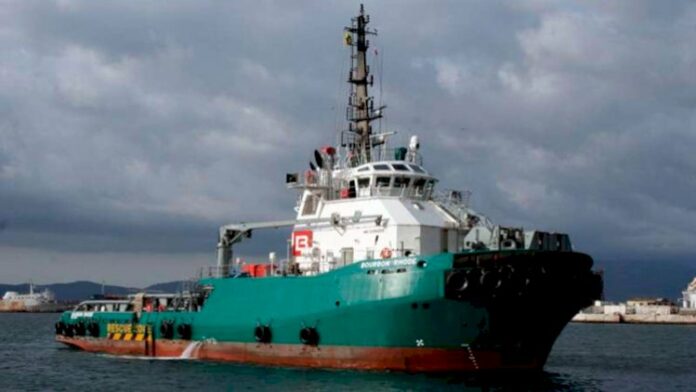
Families and friends of the missing AHTS Bourbon Rhode seafarers have open fundraising to continue the search.
They said:
"On September 26th 2019 the Ship Bourbon Rhode with 14 Crew members sunk in the Atlantic.
The Search and Rescue Mission lasted only 7 days, during which time bodies of 4 seafarers were found (God bless their soles), and 3 seafarers were found alive in a life raft.The rescued seafarers have confirmed that all 4 life rafts were successfully launched! That means that the missing 7 crew members have a good chance of being alive, but still – the SAR mission is already suspended. We cannot stop looking for them as long as there is hope that they can be saved!
With this campaign we want to collect funds to continue the search with whatever means needed.
We have started a Petition and have collected more than 38.000 people that signed the petition, that the SAR (Search And Rescue) Mission shall be continued.
We have created a Facebook Group where we collect Information we can get about the sunken Ship and lost Crew.
We are Friends and Family of the Missing Captain, and with the blessing of other families of crew members lost at sea, we ask you to help us continue the search until every living Crew member will be found!
Thank you all for your donations! Every cent helps! If you cannot donate, please share this story to those that might."
For those of you who were unable to make the donation through the Go Get Funding web site, here is all the data you need to make your payment directly to the account for the “Help us find Bourbon Rhode Crew Lost in the Atlantic” campaign:
BANK ACCOUNT OWNER NAME: MANGOPAY SA
IBAN: FR7618829754160284210614460
BIC: CMBRFR2BCME
WIRE REFERENCE ID: MGxs8u0dyg
Thank you for all your support!
Fugro completes deepwater AUV surveys for Shell
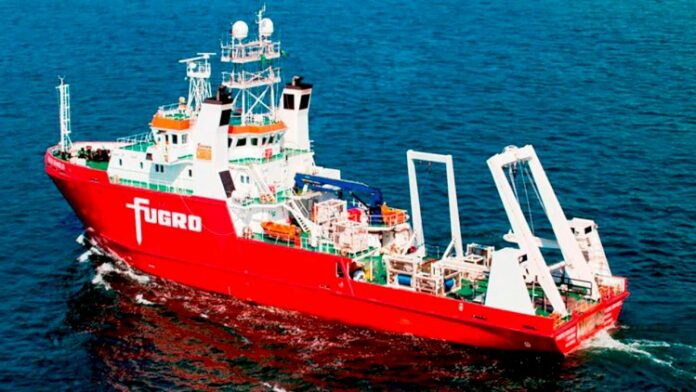
Fugro has completed several deepwater geophysical surveys in the Gulf of Mexico for Shell International Exploration and Production Company.
The project required data collection over multiple deepwater lease blocks in the greater Perdido and Mars development areas to support clearance of potential environmental, engineering, geological and archaeological hazards ahead of planned drilling activities.
As the preferred contractor for this project, Fugro deployed a Hugin autonomous underwater vehicle (AUV) from its purpose-built survey vessel, the Fugro Brasilis. The Hugin AUV is depth-rated to 3000 m and equipped with multibeam echosounder, side scan sonar and sub-bottom profiling sensors. As such, Fugro was able to acquire critical seabed information over the project area safely and efficiently, despite the challenging water depths. Fugro also used a mix of onboard and in-house processing resources to meet an accelerated interpretation and reporting schedule.
“Shell’s 2019 AUV survey campaign onboard the Fugro Brasilis is another example of collaboration between Fugro and Shell to bring innovative technology and techniques to site investigations in ways that reduce HSSE exposure and survey duration, while simultaneously providing superior data quality and ancillary datasets,” said Shell Project Manager, Deanne Hargrave.
A leader in deepwater geophysical surveys, Fugro has acquired more than 172 000 km of AUV data in the Americas region since the early 2000s. The current work for Shell began in July and finished in early October. The completed project totals over 8500 km of survey data.
ShipNet supports Maersk Tankers by hosting its technical solutions
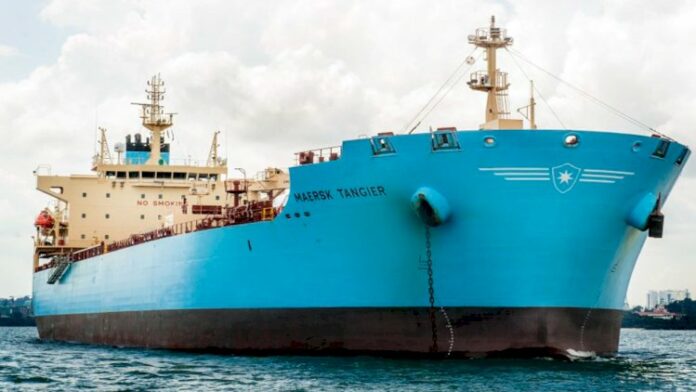
ShipNet has announced that a contract between ShipNet and Maersk Tankers has been signed, as part of which ShipNet extends its services to Maersk Tankers, supporting further collaboration across technical and procurement management applications.
ShipNet will support Maersk Tankers by hosting its technical and procurement management solutions in a secured cloud-based environment. This not only supports the business users by providing a better experience across the current applications deployed but also provides Maersk Tankers options to scale the choices of investments on their systems landscape globally. The relationship will also foster greater collaboration amongst the teams providing additional possibilities where the applications can get more innovative and enhance the user experience.
Suren Thadani, CEO from ShipNet, shares:
“The partnership with Maersk Tankers has been a very strategic partnership for ShipNet. By working with some very bright individuals at Maersk Tankers, we have been able to simplify and innovate our solutions. We are also grateful to Maersk Tankers for always supporting us as a very valuable customer and showing us pathways on innovations within the industry”.
Port of Rotterdam plans to reinforce its power grid
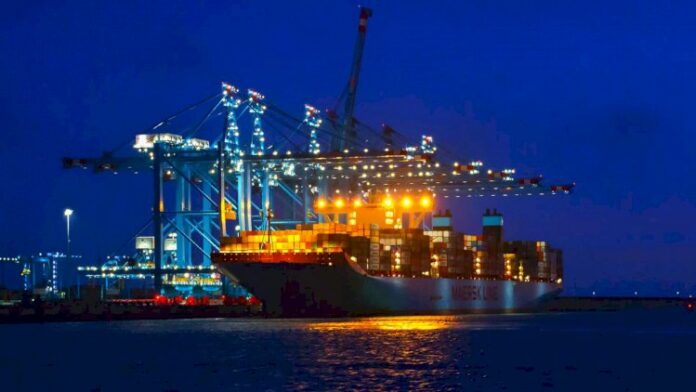
Over the next few decades, there will be a substantial increase in the demand for green and other electric power on the part of Rotterdam’s industrial sector. The companies will need this extra power for the electrification of industrial processes, the production of green hydrogen and for electric transport.
The demand for electricity is expected to increase by a factor of two – and possibly even four. This means that Rotterdam is required to reinforce its power grid. However, there is only limited space for extra infrastructure. Moreover, reinforcing the grid will lead to lower costs to society and shorter lead times when this is done based on a long-term vision instead of existing legislation and regulations. These are the findings of a study performed by the Port of Rotterdam Authority, Stedin and TenneT into the consequences of the energy transition for the power grid in Rotterdam’s port area.
The joint study concludes that this issue is particularly urgent because the capacity of the existing power grids and connections in the port of Rotterdam does not suffice to accommodate future plans for a sustainable port area. The lead time for realising new high voltage substations and power lines can be anything from 3 to 10 years. The point of departure of the study was that in the decades ahead, the Netherlands’ energy transition will be in line with the Paris Agreement on Climate Change, with renewable electric power and green hydrogen playing key roles in this process.
The study includes three recommendation to ensure that the necessary reinforcement of the network is completed in due time and at the lowest possible cost to society.
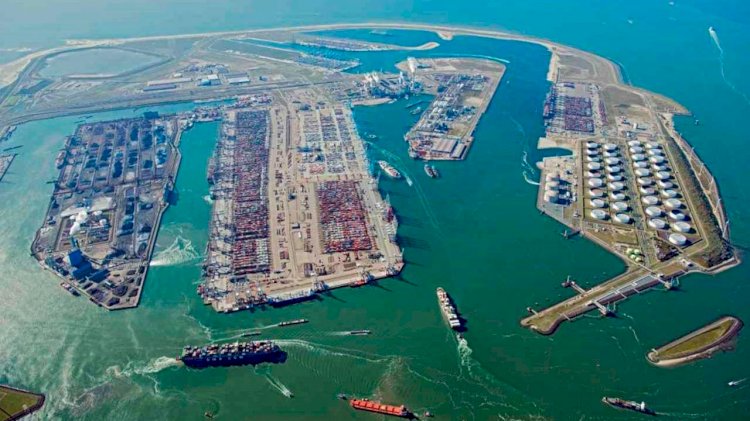 The first recommendation concerns the adaptation of legislation and regulations, to enable the step-by-step realisation of infrastructure based on a long-term vision (for 2050) – rather than a piecemeal response to the requests of individual companies. This can result in lower costs for society (avoiding the unnecessary installation of parallel power cables), shorter lead times and can minimise physical bottlenecks. After all, there is only limited space available in the port area. In this process, the right balance has to be struck between the timely completion of infrastructure and the lowest possible risk of this capacity being temporarily or permanently underutilised.
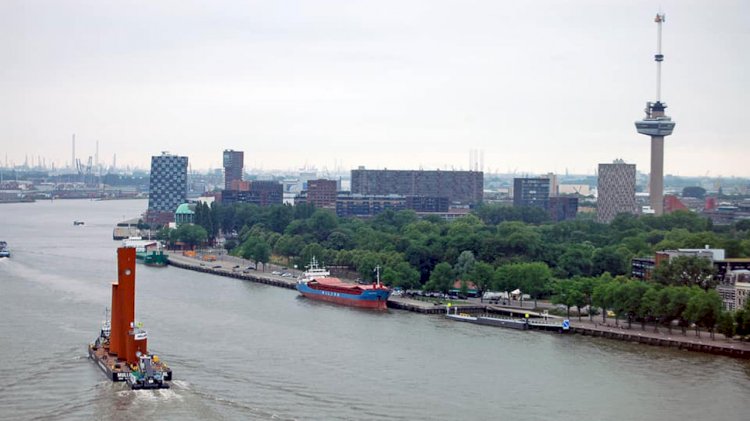 The second recommendation is that the Dutch Ministry of Economic Affairs and Climate Policy (or the participants in the ‘Klimaattafel Industrie’ roundtable) select locations directly along the coast for the large-scale conversion of electric power (generated using offshore wind) into hydrogen and other energy carriers. The underlying reasoning is that hydrogen transport requires far less space and lower investments than transporting electric power. Incidentally, the economic feasibility of large-scale hydrogen production is dependent on a substantial reduction in the costs of the process of electrolysis.
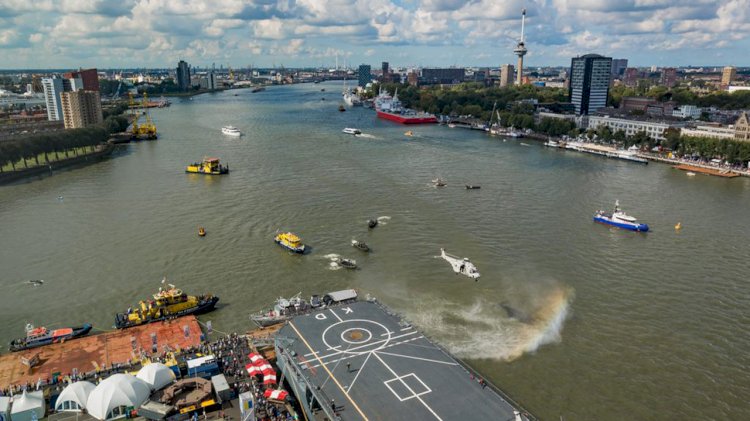 The third recommendation is to already reserve space in the port for future electricity infrastructure, enabling the step-by-step realisation of a robust and future-proof power grid.
To increase insight into the required adjustments to the power grid, the two grid operators and the Port Authority have explored a variety of technical alternatives. In this process, they have centred on the development of a robust network that can accommodate the growing demand for electric power at the lowest cost to society. The connecting theme in the plans to reinforce the grid is the increased transport at higher voltage levels (150 kV and higher) combined with smaller service regions at lower grid levels (66 kV and below). It is clear that this approach calls for a larger number of high voltage substations. This decision will limit the number of new underground power lines that need to be installed, which in turn reduces the claim to scarce space in the pipeline corridors (fewer physical bottlenecks).
One promising alternative for the power grid is dividing the 150 kV network into a western, central and eastern section. Creating a larger number of substations within the distribution network will ultimately result in fewer power lines in the pipeline corridors and shorter connecting lines to the clients’ respective locations.
The most effective electric infrastructure for Rotterdam’s port area can not be realised without changing existing regulations. At present, new client applications for extra connection capacity are handled independently of each other and on a ‘first come, first served’ basis. This is a result of the principle laid down in current regulations that grid operators’ procedures need to be non-discriminatory. In many cases, the result is that new and existing clients are hooked up to the public grid via long connecting lines and are confronted with substantial connection costs.
Careful coordination could limit the increase in the number of new electric connections – and, as a result, the total cost to society. Constructive collaboration between TenneT, Stedin and the Port of Rotterdam Authority will prove of vital importance in the decades ahead. After all, while the electric infrastructure is managed by two grid operators, it is in fact a single, coherent system. The Port Authority is responsible for managing the scarce space that accommodates this grid, and moreover has insight into the other infrastructure required for a successful energy transition.
Total expands pre-salt footprint in Brazil
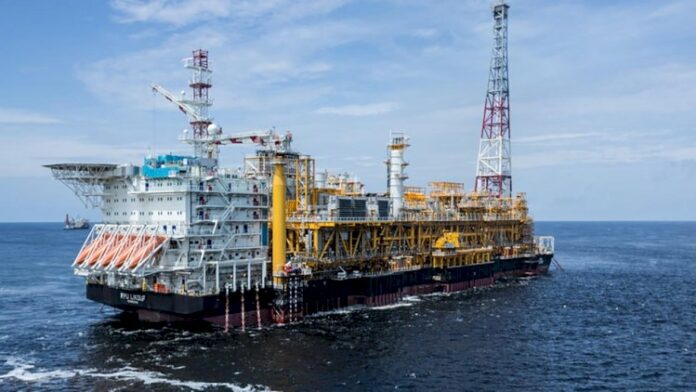
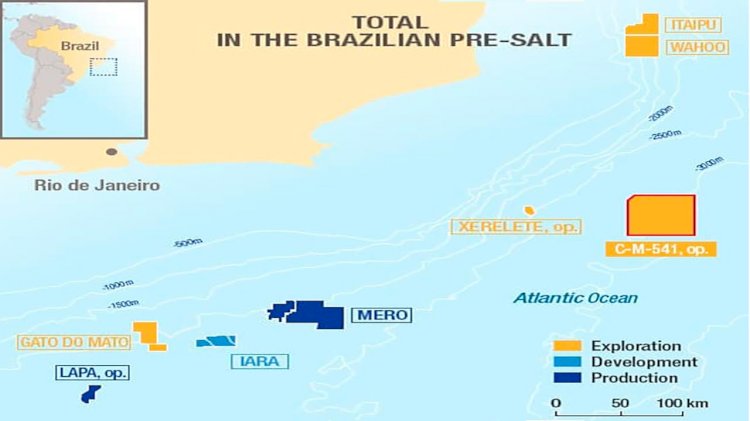
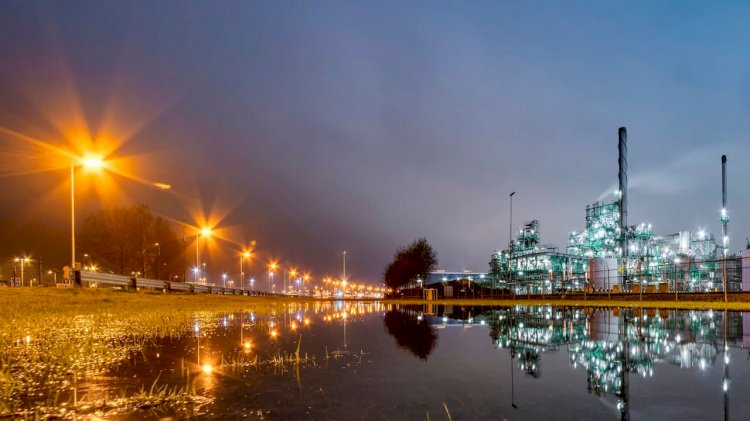
Total, operator, and its co-venturers Qatar Petroleum and Petronas have won the C-M-541 deep offshore block in the 16th Bidding Round held by Brazil’s National Petroleum Agency (ANP). The acreage is located in the pre-salt Campos Basin in a water depth of about 3,000 meters.
Patrick Pouyanné, Chairman and CEO of Total, said:
“Total is pleased to expand its footprint in the Campos Basin with this new operated exploration block, alongside two strategic partners. It is another demonstration of our ability to seize high quality exploration acreage in a key growth area for the Group. This is in line with our strategy to continue building our operator positions in Brazil’s deep offshore, where we can add value thanks to our deepwater competencies. It follows on from our acquisition in 2016, through successful direct negotiations with Petrobras, of operatorship of the Lapa field and an interest in the Iara concession. We have also launched development phases 1 and 2 of the giant Mero field. In this context, Total confirms that it will not participate in the upcoming Transfer-of-Rights (TOR) Surplus Round, as the competitive tender is only offering non-operated interests.”
Total will operate the block with a 40% interest, alongside Qatar Petroleum (40%) and Petronas (20%). The consortium plans to drill a first exploration well in 2021.
This entry into a new block follows the FID made by Total and its partners in June 2019 for the second FPSO of the Mero project (Libra Block), which is expected to start up in 2022. Currently under construction, the first FPSO of the Mero project is progressing according to schedule, with start-up planned in 2021. The first FPSO of the Iara project is expected to start up later this year and the second one in 2020.
Total has been present in Brazil for over 40 years and has more than 3,000 employees in the country. The Group now operates in all segments: exploration and production, gas, renewable energies, lubricants, chemicals, and distribution.
Total Exploration & Production’s portfolio currently includes 23 blocks, with nine operated. In 2018, the Group’s production in the country averaged 19,000 barrels of oil equivalent per day.
In 2017, Total and Petrobras formed a Strategic Alliance encompassing exploration and production and gas, renewables and power activities. Through the Alliance, the two groups are implementing R&D projects on topics such as artificial intelligence leading to efficiency gains, with direct applications in Brazil.
Total recently entered the fuel distribution market in Brazil with the acquisition in December 2018 of Grupo Zema’s distribution activities. Total thus owns a network of 280 service stations, as well as several storage facilities for petroleum products and ethanol.