-3.8 C
New York
Home Blog Page 940

Choules and Sycamore made first delivery of evacuees-by-sea from Mallacoota

0

HMAS Choules and MV Sycamore are part of a Royal Australian Navy task group that departed from Fleet Base East early on New Year’s Day, in support of multi-agency efforts to provide assistance to communities affected by bushfires on the Australian east coast.

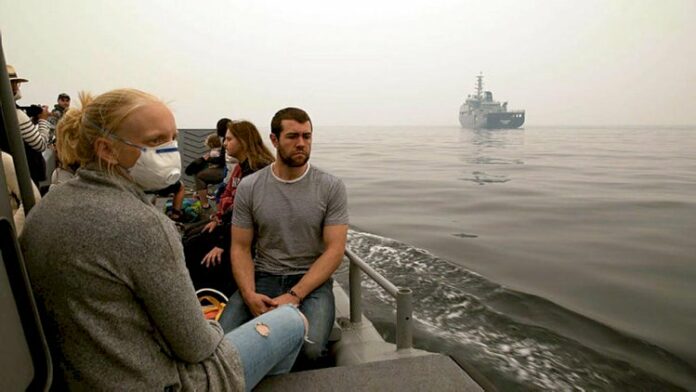
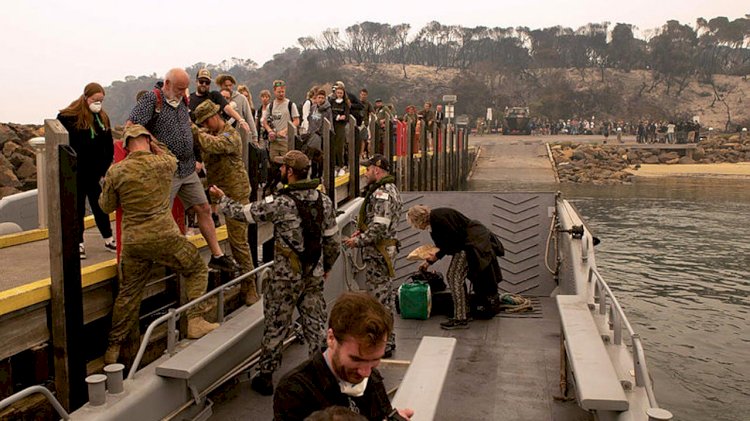
Evacuation of residents and visitors of Mallacoota, Victoria, has commenced with over 1000 civilians embarking in HMAS Choules and MV Sycamore on 3 January. 

Since arriving offshore of Mallacoota on 2 January, ships’ companies of both vessels have been preparing to receive the people who chose to accept the opportunity to evacuate the area that has been devastated by the recent bushfires.

Choules’ Commanding Officer, Commander Scott Houlihan, said that the embarkation was a key milestone achieved through close coordination with various government and non-government agencies.

Commander Houlihan said:

“Since arriving we have quickly and effectively integrated with counterparts from Emergency Management Victoria, Victoria Police, the CFA, the local council, Red Cross and other agencies.
The embarkation process started at around 8am, with people being moved from the community centre to the pier by buses provided by community members, and then moved across to the two ships using five landing craft embarked in Choules."
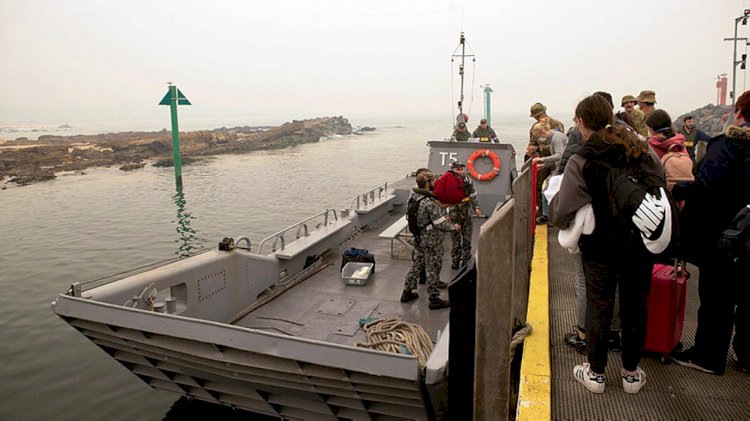
Executive Officer Lieutenant Commander Arron Convery oversaw the welcome of all evacuees on-board Choules. He said:

“The general spirit among of our guests has been one of appreciation mixed with relief to get away from the devastation, and the heavy blanket of smoke that has engulfed the region.”

The first 58 evacuees-by-sea arrived at the Bluescope Steel Wharf in Hastings on 4 January 2020, delivered to safety by the Royal Australian Navy training ship MV Sycamore. 

The ship HMAS Choules arrived in Western Port, Victoria on 4 January 2020, having evacuated 1117 residents and holidaymakers from Mallacoota. The transit to Western Port took about 20 hours.

Following the completion of the disembarkation, Choules’ got straight back to work, working into the night to prepare the ship and load essential supplies and equipment that will be transported back to Mallacoota to assist in recovery efforts.
New Antarctic crustacean species described after 82 years

0

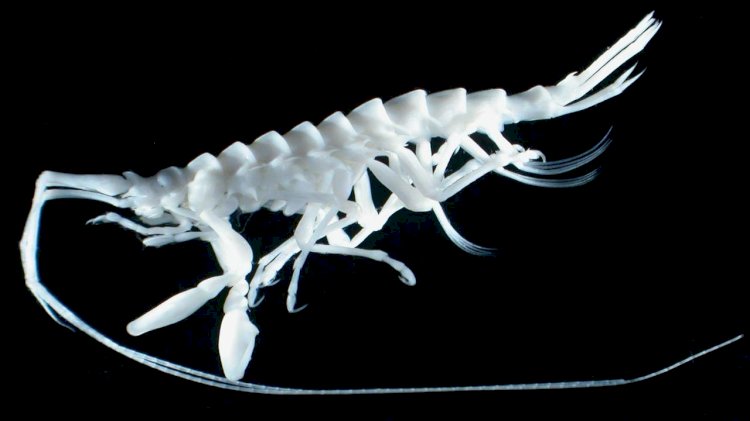
A spectacular new species of Antarctic deep-sea crustacean armed with spines, large claws and the raptorial mouthparts of a predator, has been described by National Oceanography Centre (NOC) taxonomists.

The description of the species has been published in the Zoological Journal of the Linnean Society and is based on specimens collected during a research expedition led by the British Antarctic Survey on board the RRS James Clark Ross in 2016.

Joint lead author of this research, taxonomist Dr Tammy Horton from the NOC, said:

“We were excited when we noticed these newly collected specimens were the same as one collected by scientists on board the RRS Discovery II back in 1937 and kept in the NOC’s Discovery Collections ever since. Having multiple specimens allowed us to finally describe this new amphipod species, 82 years after it was first collected. Describing species is not a simple process – it is important to be certain that what you have is new to science and this requires detailed study of the specimens you have and of other closely related species from the region. It is also important to have adult specimens and the earliest collected specimen was a juvenile female.”

The enlarged gnathopods (claws), spines along the back and sides of the body, and elongated mouthparts, along with the grasping legs, suggest that this new species is an ambush predator which likely perches on larger seabed-dwelling invertebrates to sit and wait for prey.

Tammy continued:

“We placed this species in the very rarely collected family Podosiridae which has just two species described to date and is known only from waters deeper than 650 metres. We sequenced the genetic material of the new species and used this to suggest that podosirids may be part of a completely different amphipod lineage than they are currently classified in.”

The new species has been named Acutocoxae ogilvieae after the maiden name of the wife of one of the lead authors, Dr Oliver Ashford. It was collected from the seabed in the icy waters of the Southern Ocean between 775 and 1140 metres deep.

Neoteric uses Trelleborg’s abrasion-resistant material for its hovercrafts

0

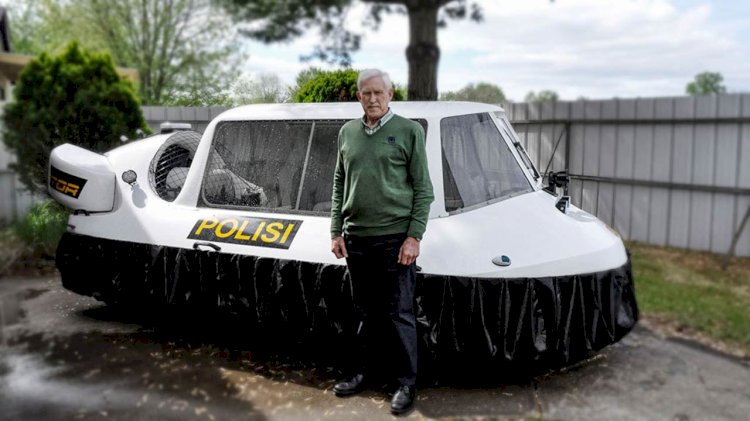
Neoteric Hovercraft’s vessels are used by rescue services worldwide. When the company needed a more durable solution for its hover skirts, it turned to Trelleborg for hard-wearing coated fabrics.

Now perhaps the world’s leading manufacturer of light hovercraft, Neoteric Hovercraft had humble beginnings. Founded by a group of teenage Australian Air Training Corp cadets in 1960, the company is still led today by one of those cadets, Chris Fitzgerald, now located in the U.S. state of Indiana.

Neoteric Hovercraft has customers in more than 50 countries, serving those in industries that include emergency services and leisure.

Fitzgerald, now 74 years of age, is a true hovercraft pioneer. He has devoted nearly 60 years of his life to the thriving business.

Neoteric’s success rests partly on its reverse thrust control system, which at 60 percent reverse thrust is proportionally far more powerful than the 18 percent of jet aircraft. This makes it the only hovercraft in the world that has effective brakes!

Search and rescue teams in particular appreciate the hovercraft’s stability on terrain from frozen lakes to swampy marshes. It means that rescuers can stand at the edge of the craft to pull someone on board without the risk of it capsizing.

Fitzgerald says:

“I’m happy to say our hovercrafts have helped save a lot of lives over the years, including in ice accidents in the Nordic Region.”

He once met a Finnish man who fell through the ice into a lake and was rescued by one of Neoteric’s hovercraft.

But uses for the hovercrafts go beyond rescues. Mining companies utilize them to apply dust control sealants inside mines, and they have been employed by agencies working to clean up oil spills. Then there are those who just love the thrill of racing them—especially in Europe.

Despite successful applications, Fitzgerald found that the hover skirts were wearing out too quickly under the stresses of everyday use on surfaces such as ice, sand and concrete:

“We’d been using 16-ounce (0.5-kg) neoprene-coated nylon for years, but this is too expensive and heavy. We’ve also used packcloth, but for proper durability neoprene-type material is required. You have to remember that a hovercraft is essentially a boat that’s sitting on a bubble of air. You need a material for the skirt that’s got to hold in the air but is not too heavy for the engine. You want to be touching the surface but let the air ‘lubricate’ the hovercraft’s movement.”

Having previously sourced materials from Reeves Brothers, Fitzgerald started researching coated fabrics. This led him to approach Trelleborg, which had acquired Reeves Brothers in 2006. 

David Behrens, Regional Sales Manager within Trelleborg Coated Systems, says:

“The challenge was to find an abrasion-resistant material that could wear like iron yet would still be lightweight and air-retentive enough, so that the hovercraft could still operate effectively. Our research and development department produced some samples for Neoteric, and these were tested thoroughly.”

Neoteric’s testing machine is called the Flagellation Rig. It runs the material in a chamber at enormous speed and friction, like a hurricane hitting a flag, until the material comes apart. Trelleborg’s neoprene-coated fabric performed exceptionally well.

Fitzgerald says:

“The fabric is working really well and I’m happy with it, although there’s huge scope for improving these fabrics further, given a bigger market. Ultimately I’d like to find a company that would be interested in taking over. But I’ve been in that mindset since I moved Neoteric Hovercraft to the United States back in 1975. It’s been my whole life."

Baffinland to charter the multifunctional icebreaker Botnica

0

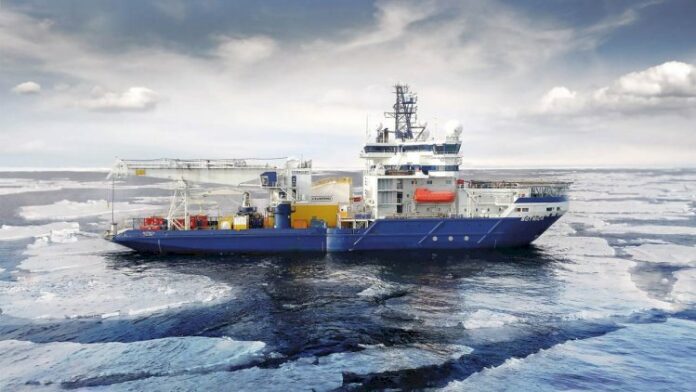
Baffinland Iron Mines Corporation (hereinafter: “Baffinland”) declared of using the contractual option to charter the multifunctional icebreaker Botnica in 2020 during the period from the end of June to the end of October. The exact number of chartering days depends on weather and other conditions.

In the beginning of summer 2018, the subsidiary company of AS Tallinna Sadam, OÜ TS Shipping, signed an agreement with Baffinland for chartering m/v Botnica for the 2018 summer period and annual call options for the summer periods in 2019-2022. Baffinland is a Canadian mining company, engaged in the mining of iron ore on Baffin Island in Northern Canada. According to the agreement m/v Botnica provides escort ice management services, oil spill and emergency response services.

In the last two years, m/v Botnica assisted Panamax-type cargo vessels in Arctic waters of northern Canada for exporting iron ore from the Milne Inlet port to the ocean. While in 2018 the work was performed in two parts and meanwhile m/v Botnica visited Tallinn in late August during the ice-free period in the Arctic, in 2019 the vessel remained in the Baffin Archipelago for a three-week ice-free period and assisted Canadian scientists in research of seabed and Arctic waters as an additional work.

The 2019 work period with mobilization lasted from the end of June to the beginning of November. According to an agreement with the Estonian Maritime Administration, m/v Botnica provides icebreaking services in Estonian coastal waters from 20th December to 20th April.
 

Siemens Colombia ships one of its largest transformers

0

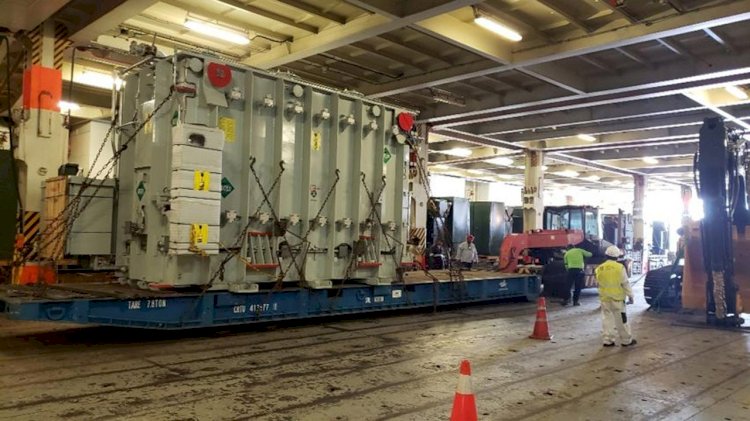
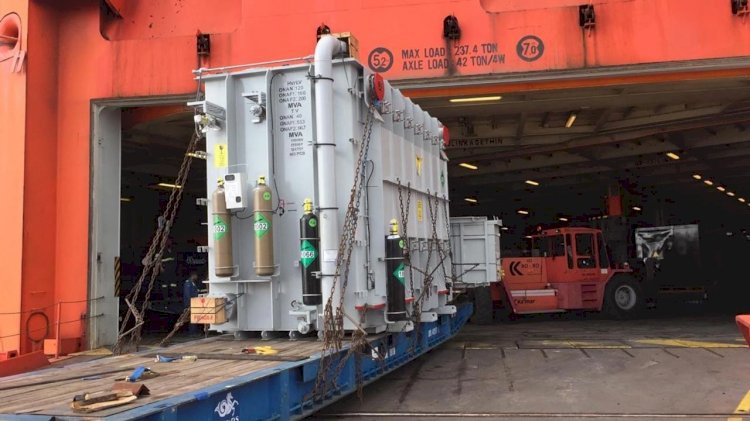
One of the largest transformers ever manufactured by Siemens Colombia has embarked on a 10-day RoRo voyage to power a Californian office complex.

Shipping any oversized piece of machinery is a complex undertaking. When the product in question is a giant, high value transformer – one of the largest manufactured in recent years – destined for a power plant that supplies energy to tens of thousands of people, the operation becomes even trickier still.

That’s the challenge that faced Siemens when it needed to ship a valuable transformer from the company’s factory in Colombia to its new home at an office complex in California.

Leonardo Romero Ramirez, export control professional at Siemens, said:

"We needed a transport option that would reduce manoeuvring and handling and give us the under-deck integrity we required."

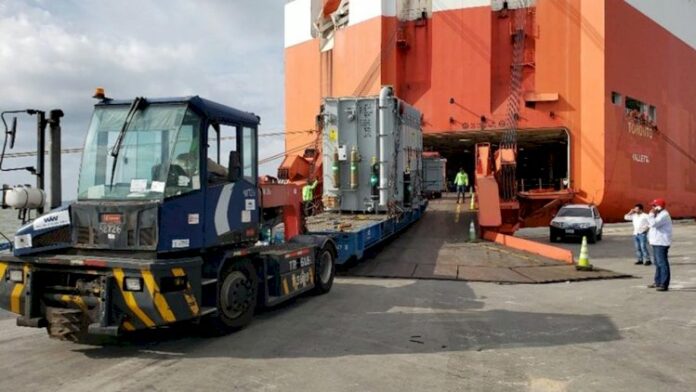
The transformer – the heftiest manufactured by Siemens Colombia in the past three years – measured 6.86m in length, 3.88m in width and 4.2m in height. WW Ocean’s RoRo service was chosen for the shipment from port of Cartagena in Colombia, via Panama, to Puerto Hueneme in California.

Valued at approximately $1.1m, the transformer will be used to replace an existing unit at the substation of an energy plant that currently produces electricity for more than 65,000 residents in Palo Alto, California. With such a valuable cargo at stake, a quick transit time and experience handling similar products were essential logistics requirements for Siemens.

The minimal lifting required for RoRo shipment means it is the safest way to transport cargo like transformers. Instead of being lifted, the giant unit was placed on three 40-foot roll trailers to roll it on and off the vessel.

Leonardo Romero Ramirez explains:

“We needed a transport option that would reduce manoeuvring and handling and give us the under-deck integrity we required.” 

WW Ocean’s liner service, specialised equipment and highly trained handling team ensured a smooth journey.

Javier Rodriguez, line manager at Naves, WW Ocean’s agent in Colombia, says:

“Most importantly, Siemens needed a reliable service with a competitive transit time. Expertise with this type of product, availability of equipment and daily traceability were also important customer requirements. WW Ocean was able to meet all of the customer’s requirements on cargo handling, having worked on other shipments for Siemens Colombia since 2018.

WW Ocean has become a strategic ally for Siemens, facilitating the transportation of oversized and heavy equipment from Colombia to North America “in places where project vessels or charter vessels do not arrive safely and quickly.”

Siemens’ transformer factory in Colombia has been designing, manufacturing and reconstructing power transformers with voltages of up to 230 KV for 60 years – 65% of which are exported to more than 15 countries around the world.

Rare ship find in the middle of Stockholm

0

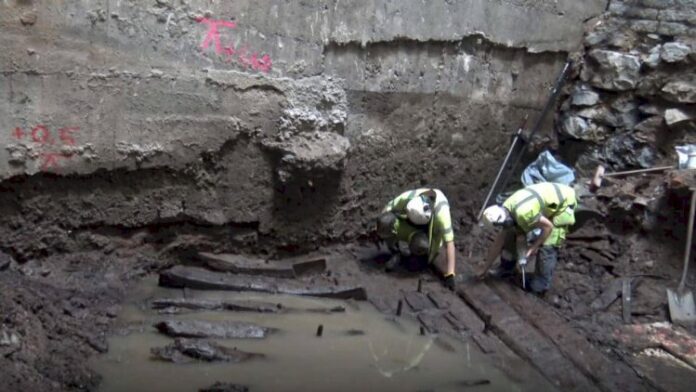
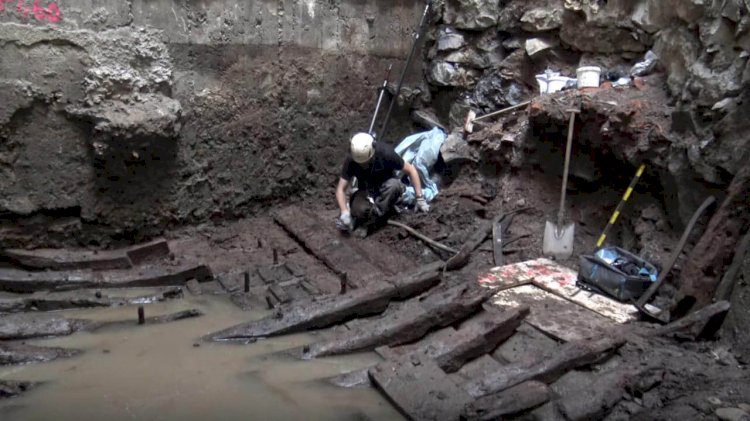
In a courtyard at Kungsträdgården in the middle of Stockholm, a shipwreck from the late 16th century has been found. 

Parts of an old wooden hull were discovered under the courtyard. Now analysis and identification is done with the help of marine archaeologists from the Norwegian Maritime and Transport History museums.

The wreckage is most likely to come from the Swedish ship Samson. Duke Karl ordered the fitted cargo ship in 1598. It was built by Anders Pedersson in Enånger in Hälsingland. The wood's annual rings are from the 1590s.

First integrated maritime IoT system on active working vessel

0

The vessel, owned and operated by Kongsberg, is using KVH Watch™ IoT Connectivity as a Service and the Kognifai Vessel Insight platform as part of an innovative maritime IoT bundled solution

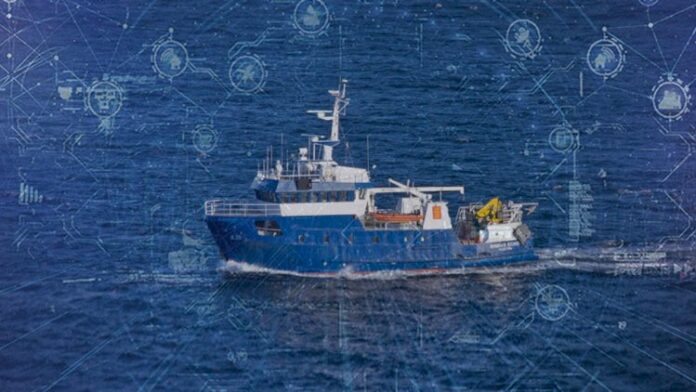
KVH Industries, Inc., and Kongsberg Digital announce the successful installation of their first joint maritime IoT system on an active working vessel. The team installed a KVH Watch VSAT antenna for IoT connectivity and the Kognifai Vessel Insight platform on Simrad Echo, a Norwegian research vessel owned and operated by Kongsberg, which will continue normal operations during the pilot maritime IoT project. Together, KVH Watch and Kognifai Vessel Insight provide an integrated infrastructure for IoT connectivity and vessel-to-shore data.

Maritime IoT is a focus of great interest among ship owners, ship managers, and maritime equipment manufacturers who are seeking ways to improve vessel operations through real-time monitoring and data analysis. This bundled connectivity solution by two leaders in the commercial maritime market, KVH and Kongsberg Digital, is one of the first cases of an active working vessel using an integrated maritime IoT solution.

Simrad Echo will rely on Kognifai Vessel Insight to monitor main and auxiliary systems on the vessel and help ensure 100% availability. For example, the Kongsberg Mapping Cloud application will move high-resolution echo sounding data from vessel to shore in real time so that shore-based experts can provide analysis to optimize vessel operations.

Vigleik Takle, Kongsberg Digital’s senior vice president of maritime digital solutions, says:

“While Vessel Insight works as an infrastructure for accessing contextualized quality data from a vessel or fleet, KVH is providing an alternative for IoT connectivity that enables the transfer of data from ship to cloud. We are very happy to be able to offer this as a connectivity option to our users.”

The data flow from Simrad Echo will be facilitated by KVH Watch IoT Connectivity as a Service, a VSAT solution that leverages KVH’s end-to-end maritime connectivity services and high throughput satellite (HTS) network. KVH Watch features two modes: Watch Flow, for 24/7, machine-to-machine data delivery compatible with major IoT ecosystems such as Kognifai; and Watch Intervention, for on-demand high-speed sessions for face-to-face support, remote equipment access, and very large data transfers. The two companies plan to utilize Simrad Echo as a platform to develop tighter integrations for remote support and smart bandwidth utilization that will benefit both new and existing customers.

Robert Hopkins, Jr., KVH’s senior director of maritime services, says:

“Vessels are complex systems of systems that must work together for the vessel to perform reliably and efficiently. During the Simrad Echo pilot, Watch Flow will deliver a complete view of those systems to shore on a Kognifai Vessel Insight dashboard. One system, Kongsberg Mapping Cloud for very high-resolution bathymetry, is particularly data intensive, making it a great use case for our high-throughput Watch antenna.”

KVH and Kongsberg Digital will use the Simrad Echo pilot program to continue to enhance their maritime IoT solution, which is designed to enable remote equipment monitoring and performance optimization for vessels ranging from small research vessels to tankers, bulk carriers, and containerships. 

Note to Editors: For more information about KVH Watch IoT Connectivity as a Service, please visit kvh.com/watch. For more information about Kongsberg Digital’s Kognifai platform, please visit kognifai.com/platform. High-resolution images of KVH products are available at the KVH Press Room Image Library, kvh.com/Press-Room/Image-Library.

Enabling business outcomes through digitalization at Neptune Energy

0

Neptune Energy's CIO, Kaveh Pourteymour, on how digitizing operations enables stronger business outcomes.

"The goal of digitalization at Neptune is simple: it’s how, through technology and digitization, you can enable an E&P organisation to be safer and more responsible, ensure that production efficiency and growth is optimised and fast-track the efficient discovery of new hydrocarbons.

By applying technology smartly you can maximise efficiencies. And being efficient means you can reduce waste in every area of your business.

Our aim is to reduce the cycle of our projects and deliver assets more efficiently, ensuring that our people collaborate while continuing to retain and attract the best talent in the industry. Through technology, we’re making sure they’re engaged, productive and have the best access to information and knowledge.

That’s really the remit of Digitialization. It’s about enabling business outcomes – it’s not about technology. Technology delivery is the easy part; impacting business outcomes and ensuring that they’re enabled through technology and digitisation – that is the most important element of all.

It’s about business transformation enabled through technology.

Far too much emphasis is put on riding the next wave of technological development, and often it becomes an isolated thing in E&P organisations – a geeky preoccupation with the means rather than the end.

Relative to other industries the upstream as a whole has been  slow in the uptake of technology, and being a conservative industry we haven’t traditionally looked at technology to change ways of working.

It’s only in recent years where we’ve had market pressures on this industry – increasing regulation; disruptive industries within the energy sector – that E&P industries have had to turn to technology and digitization to start reinventing themselves and looking at how to do things differently.

I’ve been in the technology industry for 30 years now and it’s really only in the last five years that we’ve seen the technology curve rising at a good pace in our sector. We talked about Artificial Intelligence (AI) 30 years ago, but it was just concepts. Now Machine Learning and AI have got to a stage where you can start applying them to solve enduring business problems.

My philosophy is to look at technologies holistically – you identify the outcomes you’re looking for and then put various solutions together to achieve those outcomes.

Start with the end in mind: if you want to improve the reliability of your assets and make sure production is optimised, how do you make sure you can predict equipment failures, incidents and downtime before they happen?

How can you be sure to schedule your maintenance at the right periods of time to maximise uptime?

How do you optimise the performance of your drilling by recognising the right patterns and anomalies that may exist, so the machine continuously learns?

People can now communicate with their assets. With the advancements in Augmented Reality (AR) solutions it’s not a theory any more – now you can be offshore with your AR goggles, supplying a huge amount of information about your equipment and diagnosing problems quicker.

People talk a lot about AI and machine learning taking people’s jobs – for me, there is a more significant element of AI which is augmented intelligence, as opposed to artificial intelligence – you are actually enhancing human intelligence.

If a machine tells you that some equipment requires maintenance at a particular time, that’s a piece of intelligence the maintenance engineer and operations manager can use to decide how to react.

Through these technologies, you’re removing some of the labour-intensive, manual tasks and freeing your people to focus on the more creative, qualitative, problem-solving tasks that really require human intervention. This is where true value can be added. You want your people to continuously improve your operations, your ways of working, to be a future-proof organisation.

It’s about capturing the right information to enable you to systematically improve your operations and business. And that requires human intelligence, fundamentally. It’s not about technology replacing jobs."

WindFloat Atlantic project starts supplying clean energy in Portugal

0

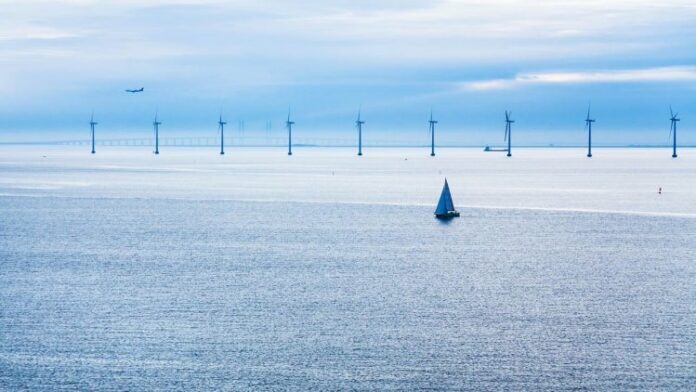
WindFloat Atlantic wind farm is now operational.

After the energisation of the 20-km cable connecting the offshore wind farm and the substation of Viana do Castello, the first of the three platforms comprising the Windplus consortium’s wind farm, was successfully connected on 31st December. The other two units will be connected successively, until they reach 25 MW of the WFA project.

The WindFloat Atlantic units –measuring 30 metres in height and with a 50-metre distance between columns– accommodate the world’s largest wind turbines installed on a floating structure of 8,4 MW, helping to increase power generation and drive significant reductions in lifecycle costs. The project took another step forward, once the second of the three platforms that make up the WindFloat Atlantic had arrived at its final destination in the past days. Once fully operational the three Wind Turbine generators making up the wind farm, with their 25 MW of installed capacity, will be able to generate enough energy to supply the equivalent of 60,000 users each year.

The commissioning of this wind farm facilitates access to untapped marine areas and represents a significant technological leap towards shaping a carbon-free economy in Portugal. The WindFloat Atlantic platforms are anchored with chains to the seabed at a depth of 100 metres. They are designed to be transported by standard towing craft, as opposed to bottom-fixed projects which require expensive vessels to be mobilized for transport, and their on-shore assembly helps scale back logistics, financial and environmental costs associated with marine construction. All of these technological advantages make it viable for the project to be replicated anywhere in the world, at a much larger scale.

About WindFloat Atlantic

The project is led by the Windplus consortium, comprising EDP Renewables (54.4%), Engie (25%), Repsol (19.4%) and Principle Power Inc. (1.2%). WindFloat Atlantic project builds on the success of the WindFloat1 prototype, which was in operations between 2011 and 2016. The 2MW prototype successfully generated energy uninterruptedly over five years, surviving extreme weather conditions, including waves up to 17 metres tall and 60-knot winds, completely unscathed.

The platforms have been built in cooperation between the two countries on the Iberian peninsula: two of them were manufactured at the Setúbal shipyards (Portugal), and the third at Avilés and Ferrol shipyards (Spain). The project uses WindFloat® disruptive technology, which enables wind platforms to be installed in deep waters, inaccessible to date, where abundant wind resources can be harnessed.

This initiative has had the support from public and private institutions, encouraging companies that are leaders in their respective markets to take part in the project; while the Government of Portugal, European Commission and the European Investment Bank have provided financial support.

The partners that have made this project possible include, in addition to Principle Power, the joint venture between Navantia/Windar, the A. Silva Matos Group, Bourbon, the wind turbine supplier MHI Vestas and dynamic cable supplier JDR Cables.
 

First agreement for commercial use of offshore/onshore EastMed pipeline

0

Energean and DEPA agreement paves the way for commercial operation of EastMed pipeline

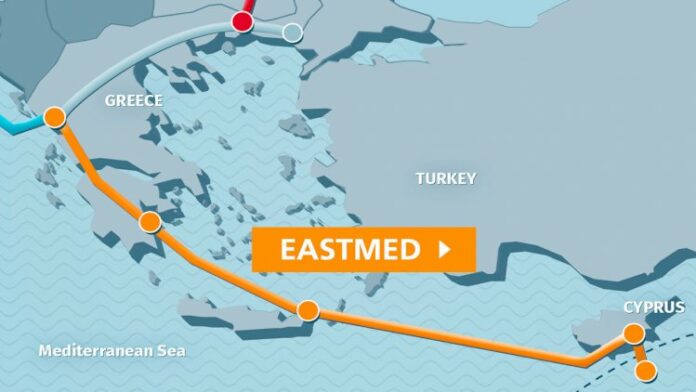
Energean and the Public Gas Corporation of Greece have agreed to cooperate to further support the EastMed Pipeline Project. Ahead of the Intergovernmental Agreement on the EastMed Pipeline, was signed by the Ministers of Cyprus, Greece and Israel responsible for Energy, Energean and DEPA had signed a Letter of Intent (“LoI”) for the potential sale and purchase of 2 BCM natural gas per annum from Energean’s gas fields offshore Israel, where Energean is investing $1.7 billion for the development of the Karish & Tanin fields through the FPSO “Energean Power”.

DEPA, as a 50% shareholder of the “NATURAL GAS SUBMARINE INTERCONNECTOR GREECEITALY-POSEIDON S.A.” (“IGI Poseidon”) – a Joint Venture with Edison S.p.A – is developing the EU Project of Common Interest (PCI) EastMed Pipeline and is a leading player in natural gas supply and retail activities in the Greek and S. E European markets and in the development of major natural gas related infrastructure projects with the objective of enhancing the security and diversification of supply of Greece and the broader region.

Additional details, including terms, delivery points, gas composition, the shipper of the EastMed pipeline etc. will also be agreed and detailed in the GSPA.

Mr. Konstantinos Xifaras, CEO of DEPA, stated:

“With the agreement we have signed today – the first agreement for the commercial use of the EastMed pipeline – we are taking a decisive step for the project’s commercial viability and its realization. With the present LoI, DEPA expresses its intention to buy 2 BCM of gas, which corresponds to 20% of the EastMed’s initial capacity. Thus, a major producer of East Mediterranean gas (Energean) and a key distributor of gas in South East Europe (DEPA) are joining forces to ensure the success of the pipeline.

DEPA is steadily expanding its international trade activities and is developing, along with international partners, infrastructure projects that guarantee diversification of energy sources and security of supply in both Greece and Europe. By systematically strengthening its international role, our company is becoming a key player in the energy developments of the wider region.”

Mr. Mathios Rigas, CEO of Energean, stated:

“The agreement with DEPA is an important development in the context of the EastMed pipeline project, which now has not only the support of Governments and the EU but is also attracting commercial interest from buyers and sellers of gas in the region. The EastMed pipeline provides Energean with another monetization route for its strategy to fully utilize the Energean Power FPSO that has an 8 BCM/y capacity and further allows us to continue the exploration and development of our 9 licenses offshore Israel.

We are very pleased to have signed the LOI with DEPA which is the first commercial agreement for the EastMed pipeline and look forward to further assisting the development of the project, which will substantially benefit the economies, the security of supply and the consumers of the Eastern Mediterranean and Europe”.