-5.7 C
New York
Home Blog Page 931

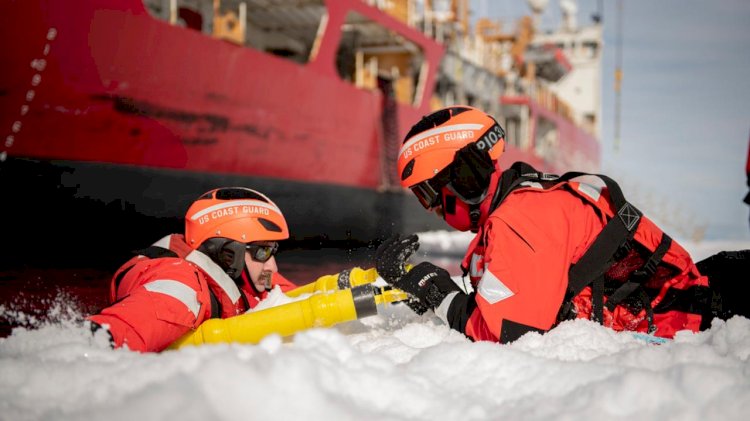
Coast Guard’s only heavy icebreaker arrives in Antarctica

0

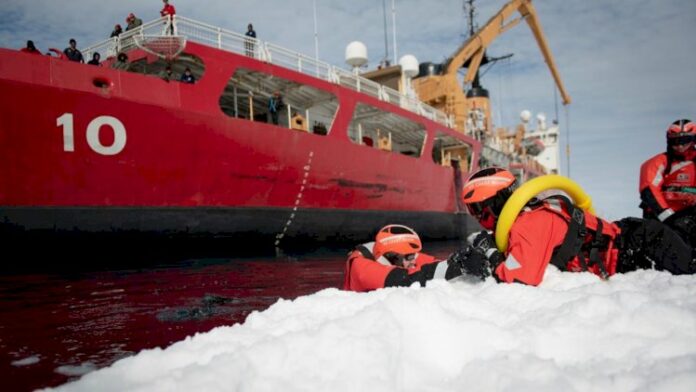
The 159 crewmembers of the U.S. Coast Guard Cutter Polar Star (WAGB 10) arrived Jan. 22 at McMurdo Station, following a 58-day transit from the United States. The cutter departed its’ homeport of Seattle on Nov. 26.

This year marks the Polar Star’s 23rd journey to Antarctica in support of Operation Deep Freeze, an annual joint military service mission to resupply the United States Antarctic stations, in support of the National Science Foundation, the lead agency for the United States Antarctic Program.

The 399-foot, 13,000-ton Polar Star arrived after creating a 23 mile channel through the ice to McMurdo Sound, which will enable the offload of over 19.5 million pounds of dry cargo and 7.6 million gallons of fuel from three logistic vessels. Together these three ships carry enough fuel and critical supplies to sustain NSF operations throughout the year until Polar Star returns in 2021.

Each year, the Polar Star crew creates a navigable channel through seasonal and multi-year ice, sometimes as much as 21-feet thick, to allow refuel and resupply ships to reach McMurdo Station.
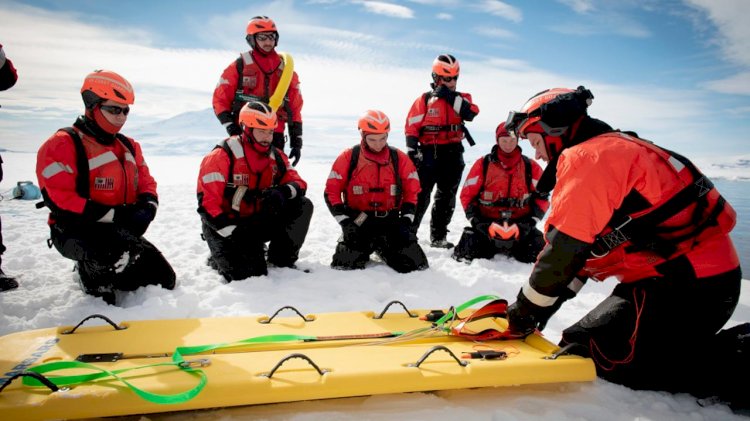
Greg Stanclik, commanding officer of the Polar Star, said:

“I am immensely proud of all the hard work and dedication the men and women of the Polar Star demonstrate each and every day. Maintaining and operating a 44-year-old ship in the harshest of environments takes months of planning and preparation, long workdays and missed holidays, birthdays and anniversaries with loved ones. The Polar Star crew truly embodies the ethos of the Antarctic explorers who came before us — courage, sacrifice and devotion.”

Commissioned in 1976, the Polar Star is the United States’ only operational heavy icebreaker. Reserved for Operation Deep Freeze each year, the ship spends the winter breaking ice near Antarctica, and when the mission is complete, returns to dry dock in order to conduct critical maintenance and repairs in preparation for the next Operation Deep Freeze mission.

If a catastrophic event, such as getting stuck in the ice, were to happen to the Coast Guard Cutter Healy (WAGB 20) in the Arctic or to the Polar Star near Antarctica, the U.S. Coast Guard is left without a self-rescue capability.

By contrast, Russia currently operates more than 50 icebreakers – several of which are nuclear powered.
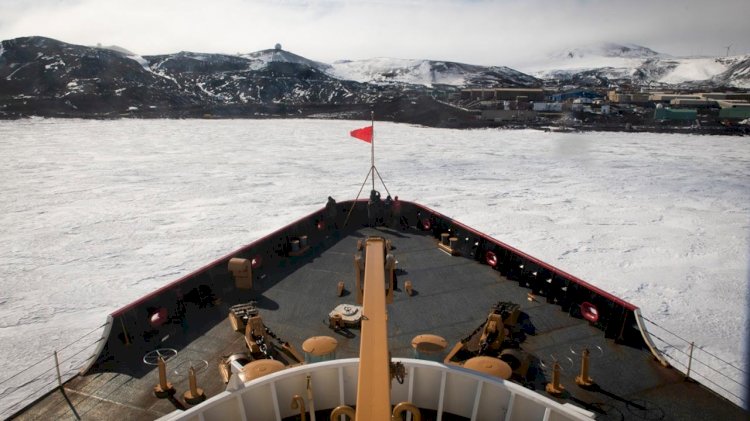
The Coast Guard has been the sole provider of the nation’s polar icebreaking capability since 1965, and is seeking to increase its icebreaking fleet with six new polar security cutters to ensure continued national presence and access to the Polar Regions.

In April, the Coast Guard awarded VT Halter Marine Inc. of Pascagoula, Mississippi, a contract for the design and construction of the Coast Guard’s lead polar security cutter, which will be homeported in Seattle. The contract also includes options for the construction of two additional PSCs.

Vice Adm. Linda Fagan, commander of the Coast Guard's Pacific Area, said:

"Replacing the Coast Guard's icebreaker fleet is paramount. Our ability to clear a channel and allow for the resupply of the United States' Antarctic stations is essential for continued national presence and influence on the continent."
DEME to execute the turbine installation at the SeaMade offshore wind farm

0

DEME Offshore has reached a remarkable milestone with the installation of turbine number 2,200! The 7 MW turbine was installed at the 714 MW East Anglia ONE offshore wind farm in the UK by our jack-up vessel ‘Sea Installer’.

As a pioneer in the industry, DEME Offshore has an unmatched track record in offshore turbine installation. The first turbines, with a capacity of 1.5 MW, were already installed in 2000 at the 10.5 MW Utgrunden offshore wind farm in the Baltic Sea in Sweden. Since then, turbines of all types and sizes have been installed at 45 different offshore wind farm projects across Europe and in China.

The 2,200 turbines have a combined capacity of 9,316 MW of renewable energy, enough to power about 9.3 million homes. This is enough to power a staggering 9.3 million homes – or in other words almost twice the amount needed annually to supply every single Belgian household with green energy.

Michael Glavind, Business Unit Director at DEME Offshore, says:

“We are very proud to have installed turbine number 2,200 and would like to thank and congratulate our crew and project teams who have contributed to this remarkable milestone. I would also like to thank our customers and contractors for their continued support and confidence. The experience gained from each of these different installations, carried out in various seabed and weather conditions, means that we have an unrivalled knowledge from which we can draw upon for any future offshore wind project. We also use this expertise to lead the market as a developer of pioneering new designs for installation equipment.”

In the next few months, DEME Offshore will execute the turbine installation at the SeaMade offshore wind farm in Belgium with jack-up vessel ‘Apollo’ and the Borssele 1 & 2 wind farm in the Netherlands, deploying ‘Sea Installer’ and ‘Sea Challenger’.

The world’s first supply vessel fuelled by pure carbon-free ammonia

0

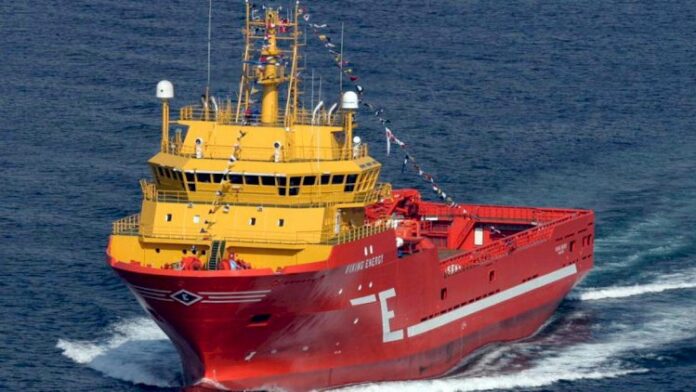
Equinor has signed an agreement with Eidesvik Offshore shipyard for the construction of the Viking Energy supply vessel, capable of covering long distances fuelled by carbon-free ammonia. The vessel will transport supplies to installations on the Norwegian continental shelf (NCS).

Equinor has awarded Eidesvik Offshore a five-year contract with effect from April 2020, when the current contract expires. The Viking Energy supply vessel will in the contract period be part of a research project developing, installing and testing long-distance sailing fuelled by carbon-free ammonia fuel cells. The technology will be tested on the vessel from 2024.

Cecilie Rønning, senior vice president for Equinor’s joint operations support, says:

“Equinor aims to reduce the emissions in our supply chain, and regards the use of ammonia as a promising solution. Viking Energy may become the first supply vessel in the world covering long distances fuelled by pure carbon-free ammonia.”

Together with the Konkraft partners Equinor earlier this year launched a joint ambition to reduce the greenhouse gas emissions from oil and gas operations in Norway by 40 percent by 2030, and to near zero by 2050.

The project will test whether the technology can deliver 100 percent carbon-free power over long distances.

According to the project plans ammonia will meet 60 to 70 percent of the power requirement on board for a test period of one year. Viking Energy will still be able to use LNG as fuel, and the remaining power requirement will be met by battery.

Equinor is part of the European innovation project ShipFC, a consortium of 14 European companies and institutions coordinated by NCE Maritime Cleantech.

The main partners of the five-year research project are NCE Maritime Cleantech, Eidesvik Offshore, Wärtsilä, Prototech and Equinor. Wärtsilä will deliver the power technology and ammonia storage and distribution systems. Prototech will deliver the fuel cell system.

Henriette Undrum, Equinor’s head of future value chains, says:

“If we solve this the ship industry will for the first time use a fuel that does not generate emissions during combustion. Much work remains, but Equinor will contribute both to technology development and as a customer. We have never before used a carbon-free fuel on a large vessel without range anxiety.”

Ammonia research on Viking Energy has a total budget of NOK 230 million, a substantial part of which is EU funded. The partners also have a good dialogue with Innovasjon Norge and Enova about potential additional funding of the project.

Equinor has since the early 2000s proactively addressed ways of cutting emissions from supply vessels on the NCS. Viking Energy was the first LNG-fuelled vessel in Equinor’s fleet in 2003, and the first vessel with hybrid battery power in 2016.

Hybrid battery power and power from shore are now part of the requirements for all supply vessels that sign long-term contracts with Equinor.

During 2020 all the 19 supply vessels on long-term contracts with Equinor will feature battery power and power from shore. Ammonia-fuelled vessels will be a new step in the right direction in the efforts to reduce the carbon footprint from maritime operations.

Austal awarded high-speed catamaran ferry contract for SGTM Mauritius

0

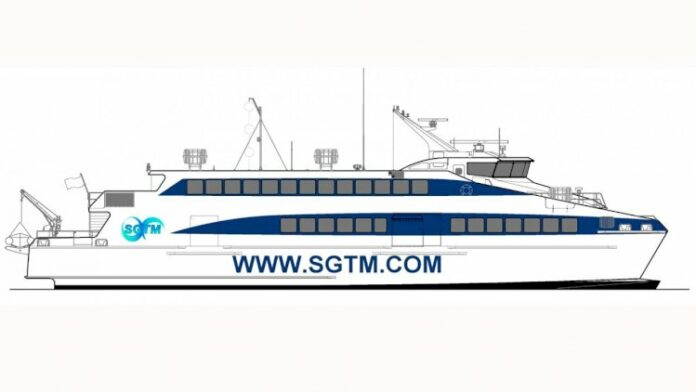
Austal Limited has announced that it has been awarded a A$15.5 million (US$10.7 million) contract for a 41 metre, high-speed catamaran. The vessel will provide production continuity to Austal Vietnam as it completes the fabrication of a 94 metre ferry for a customer in Trinidad and Tobago. The contract will become effective when the required down payment is received, which is expected in the next few days.

The new vessel is based on an existing and proven Austal Australia designed vessel, with customer defined design modifications to be undertaken in Vietnam before construction commences there by March, 2020 with delivery approximately one year later.

Austal Chief Executive Officer David Singleton said the new contract was welcome as Austal continued to build on its investment in facilities and people in the Company’s new Vietnam shipyard. Demand for vessels in this size category indicates the potential for follow-on vessels.

Mr Singleton said:

“We’re very excited to be building this new ship for SGTM, our first destined for the Comoros Islands, and especially pleased that our proven vessel design continues to evolve to meet the needs of operators worldwide. In the highly competitive 40–50 metre high-speed catamaran market, Austal has led the global marketplace, with 80 vessels now built by the Company since the early 1990s.”

At the awarding of the contract, SGTM Director Mr Michel Labourdere highlighted the company’s great trust in Austal to build its first new ferry, based on the success of the pre-owned vessel ‘Marine View’ (Austal Hull 58) that SGTM has operated since 2013.

Mr Labourdere said:

“Based on the outstanding performance of Ntringui Express (Austal Hull 58), which was originally delivered to Japan in 1997 and bought by us in 2013, we knew we had to talk to Austal about our first new build.”

Established in 2004, SGTM is The Comoros’ leading ferry company, operating three passenger vessels and two freight transport ships between the islands of Mayotte, Anjouan and Great Comoros, carrying more than 100,000 passengers annually.

The Passenger Express 41 catamaran features a length overall (LOA) of 41.2 metres, beam of 10.9 metres and draft of 2.0 metres. Over two decks, the vessel can accommodate 400 passengers and mixed cargo of up to 20 tonnes, loaded via two ramps. To be fitted with Austal’s renowned Motion Control System (including active interceptors and T-foils), 4x MTU 12V2000 M72 engines and 4x Kamewa 56A3 waterjets, the new catamaran will achieve 31.5 knots at 100% Maximum Continuous Rating (MCR), with a range of approximately 370 nautical miles.

KONGSBERG is going to install and test autonomous technology on two vessels

0

KONGSBERG is going to install and test autonomous technology on two vessels in different operational environments. This project is receiving funding of almost NOK 200 million (Euro 20.1 million) – one of the largest grants ever given to Norwegian players – from Horizon 2020, an EU research programme. 

Egil Haugsdal, CEO of Kongsberg Maritime, says:

"The Norwegian maritime cluster, of which KONGSBERG is a part, is the world leader in autonomous shipping. Now we are further strengthening our position through the AUTOSHIP project, which will accelerate the realisation of next-generation autonomous ships and create a roadmap for commercialising autonomous shipping in the EU in the next five years."

AUTOSHIP, a four-year Horizon 2020* project, is a collaboration between KONGSBERG and Norway's leading research organisation, SINTEF, as well as several European partners. The Research Council of Norway is also providing support.

Two autonomous vessels will be demonstrated for use, especially in short sea coastal shipping and Europe's inland waterways.

Iselin Nybø, Norway's Minister of Research and Higher Education, said:

“The AUTOSHIP project gives Northern Europe, with Norway, a leading edge in developing the next generation of autonomous vessels. The race is underway internationally. The technology contributes to safer, more efficient and sustainable operations at sea, both in transport and aquaculture. The project will now receive one of the largest allocations ever made from the EU's Horizon 2020 program to a Norwegian player. This is a NOK 200 million mark of quality."

The event took place in Kristiansund on board the Eidsvaag Pioneer, which is one of the two vessels that will now be equipped for remote-operated and autonomous maritime transport. This ship is owned by the Eidsvaag shipping company and operates along the Norwegian coast and in vulnerable fjord areas where it carries fish feed to fish-farms.

The markets for both short sea coastal shipping and transport on inland waterways are expected to dramatically expand in the next few years, both in Norway, Europe, and worldwide.

Haugsdal says:

"We will demonstrate that it is possible to remotely operate several ships from land and over large geographical areas. The technology is used in different ways on the vessel to show that the solutions can be applied widely. This is a market with a significant potential."

The aim of the project is to test and further develop key technology linked to fully autonomous navigation systems, intelligent machinery systems, self-diagnostics, prognostics and operation scheduling, as well as communication technology enabling a prominent level of cyber security and integrating the vessels into upgraded e-infrastructure.

Hege Skryseth, the CEO of Kongsberg Digital, says:

"We will contribute by developing cloud-based communications systems and advanced simulations to test and ensure that the autonomous vessels operate safely and optimally."

The other vessel to be equipped with autonomous technology is a Belgian pallet shuttle barge owned by Blue Line Logistics NV. This operates on canals in Europe, transporting goods to and from large container ports. Europe's inland waterways can achieve major environmental gains by using new technology. An autonomous barge in operation is expected to take around 7,500 trucks off the roads each year and will result in reductions in both traffic congestion and emissions.

Haugsdal say:

"There is increasing market demand for waterborne transport in the EU. The results of the AUTOSHIP project will lead to safer and greener transport in Europe with one of the major outcomes being a shift of goods transport from roads to waterways."

New technology with AI to monitor the growth of the salmon

0

With an increasing global population, the urgency to find new and innovative ways to address food demand is felt around the world. Since 1970, fish farming has existed in the Nordics and developed into a major industry. Norway Royal Salmon (NRS) is a leading producer of sustainable salmon, selling about 70,000 tons of salmon every year. This equates to one million salmon meals per day, all year round.

In the harsh and sometimes dangerous environments of the most northern parts of Norway, NRS sought to increase the safety of its employees, reduce operational costs and prioritize sustainability of Nordic aquaculture.

Through an artificial intelligence (AI) for salmon analytics pilot, ABB and Microsoft co-created a solution with NRS to produce quality food in a safer and more environmentally responsible way. The pilot showed that NRS can increase the efficiency and safety of its workers, who now aren’t required to be at open sea as often as before. The new technology will have an impact on the CO2 footprint due to less operations and better fish welfare, resulting in cleaner seas and improved efficiencies.

Arve Olav Lervag, COO Farming, NRS, said:

“Norway Royal Salmon has always focused on extensive research, development, cooperation and innovation. To continuously improve sustainability and increase the safety of our individuals, we worked with ABB and Microsoft to co-create innovative ways that empower us to achieve more on every level.”

ABB and Microsoft implemented technology with remote visual object detection for biomass estimation and fish population counting. The technology will monitor the growth of the salmon and reduce the workload of NRS workers, while providing an edge in collecting critical data from the production of salmon.

Underwater cameras capture images of the salmon in their submerged fish pens, floating kilometers offshore at sea. A layer of AI on top of the video footage makes it possible to measure and count salmon automatically.

ABB Chief Digital Officer Guido Jouret said:

“ABB is fully committed to helping bring about a more sustainable future, and here we’re using AI to revolutionize aquaculture and deliver on that promise. By monitoring fish health and performance, to minimizing environmental impact and reducing operational costs, ABB Ability™ is enabling NRS to reach a new level of competitiveness.”

First foundation installed at Triton Knoll Offshore Wind Farm

0

Triton Knoll confirms that the first of its 90 wind turbine monopile foundations has been safely and successfully installed, 32km off the Lincolnshire coast.

The c.600 tonne steel monopile and its bright yellow transition piece was installed by Seaway7’s ‘Strashnov’ which is contracted to transport and install all 90 of the wind turbine foundations, as well as the two offshore substation platforms and their foundations.

Julian Garnsey, project director for Triton Knoll and innogy said:

“Our first clear weather window of the year has presented us with a great opportunity, and I’m delighted to confirm that the first monopile and transition piece have been safely and successfully installed at Triton Knoll.

It’s great to see our offshore infrastructure beginning to rise above the surface of the North Sea, thanks to years of hard work, planning and preparation by the project team and innogy. We will continue to press ahead with the foundations programme, as the weather permits, and look forward to installation of the project’s offshore substations and cables later this summer.”

With continuing concern over the pace and impact of climate change, the need for nationally significant offshore wind projects like Triton Knoll to help decarbonise the UK’s energy infrastructure is greater than ever. The state-of-the-art offshore wind farm will have a maximum installed capacity of 857megawatts and, once fully operational, will be the most powerful in the innogy fleet and capable of powering the equivalent of over 800,000 UK homes.

The project is located over 32 kilometres off the Lincolnshire coast, with a turbine array that covers an area of 145 square kilometres, bigger than the City of Manchester. It is jointly owned by innogy, J-Power and Kansai Electric Power, with innogy managing the wind farm’s construction and long-term operation and maintenance works, on behalf of its project partners.

Konecranes automated RTGs to three European container terminals

0

Konecranes has signed contracts with Yilport for the delivery of Automated RTG systems to three of Yilport’s European container terminals, two in Portugal and one in Sweden. Automated RTG operation is coming of age in Europe, driven by Konecranes. The order was booked in December 2019.

Yilport has global ambitions to become a top-ten global operator of container terminals. This investment in three Konecranes Automated RTG systems, each with six Konecranes ARTGs operated under a supervised operation concept, is a major step towards achieving those ambitions. The systems will be built as extensions to the container yards of Yilport’s Gävle container terminal in Sweden and the Liscont and Leixões terminals in Portugal. Each system will have four Remote Operating Stations (ROSs).

Robert Yuksel Yildirim, President and CEO of Yildirim Group, which owns Yilport, said:

“Konecranes have a very solid and good reputation for their reliable, automated e-RTG cranes. Since 6 of these e-RTG cranes are going to be used in Sweden and 12 in Portugal, we believe Konecranes’ technical support will be key in our decision to choose Konecranes.”

The 18 Konecranes ARTGs on order are fully electric machines powered by busbar systems. They are 16-wheel machines stacking 1-over-6 high and 7 containers + truck lane wide in Gävle and Liscont, and 6 containers + truck lane wide in Leixões. They will be equipped with the Konecranes Active Load Control (ALC) system, which eliminates container sway and enables highly productive automated operation. They will also be equipped with a suite of smart features under the supervised operation concept.

Ville Hoppu, Konecranes Regional Sales Manager, Port Solutions, said:

“Yilport has been a Konecranes customer for some years. I’m very pleased that Yilport has decided to take this authoritative step to automated container handling operation with Konecranes. We look forward to working with Yilport’s experts to raise the bar of automated RTG operations as high as it can go.”

This contract with Yilport is part of Kone­cranes’ path to port automation, where container terminals improve productivity and safety in manageable steps.

Prysmian Group presents an advanced cable laying vessel Leonardo da Vinci

0

Prysmian Group is active in the field of new installation solutions across the globe. With three of the most specialized cable-laying vessels already in operation (Giulio Verne, Cable Enterprise and Ulisse). Prysmian now has a fourth vessel in build, Leonardo da Vinci, that will reinforce the fleet by 2Q 2021.

Hakan Ozmen, EVP Projects BU, said:

“Leonardo da Vinci will be the most efficient cable layer in the world and will support the Group’s long-term growth in the submarine cable installation business, strengthening our leadership in the interconnection and offshore wind farm markets.”

With basic design phase complete, steel cutting and preliminary works under way and the keel laying kicked off in September 2019, the 171-metres vessel with a 34-metres beam represents an overall investment of more than €170 million and is being built by Vard Norway SA, part of Fincantieri Group.

The ship’s cable handling and installation equipment have been entirely developed and designed by Prysmian to boost its capacity of submarine cable installation. Indeed, it will be possible to achieve higher precision operations and to allow more cables to be transported thanks to the largest cable loading capability. Once completed, the new vessel will be the most advanced cable laying vessel thanks to a series of cutting-edge features:

  • 2 rotating platforms of 7,000 and 10,000 tons to ensure the highest carousel capacity in the market. The vessel is equipped to carry out the deepest power cable installations of up to 3,000 metres also thanks to the new generation cable technology armoured with composite material, based on aramid fibers.
  • The capstan capacity of up to 100 tons is double the industry average.
  • Bollard pull of about 200 tons, more than double that of the Giulio Verne, it has the highest pulling/towing capacity in its class.
  • DP3 system. The vessel will be classified for improved redundancy of power generation and control systems for back-up dynamic positioning.
  • Hybrid propulsion with 6 generators and 2 Energy Storage Systems (750 kW each) for a total of 21 MW. The battery packs accumulate ‘peak shaving’ when energy demands are high, allowing the vessel to a limited use of generators in specific operative conditions, thus resulting in lower fuel consumption and emissions.
  • Designed with an operational autonomy of 90 days and a transit speed above 14 knots that can lead to a reduced transportation time from the factory to the site, improving overall project efficiency.
  • Two enclosed hangars for Remotely Operated Vehicles (ROVs).
  • A helideck certified for take-off and landing of Sikorsky S92 type (18 passengers) and AW 101.

Crew comfort and safety are other further high priorities and the onboard accommodation for 120 people is designed to offer ample working spaces and recreational areas, including a fully equipped gym, auditorium, games room, dayroom and officers’ lounge.

New technology promises to reduce manual working at offshore wind farms

0

GE Renewable Energy and the Offshore Renewable Energy (ORE) Catapult are backing the development of a new technology which promises to reduce manual working at offshore wind farms, slashing one of the industry’s biggest maintenance costs by 80 per cent.

The technology concept, EchoBolt, is the brainchild of Peter Andrews, founder of the Stratford-based microbusiness Energy Integrity Services. Once fully developed, it will drastically reduce the cost of inspecting and retorquing wind turbine bolts – one of the biggest maintenance tasks that face wind farm operators. The cost saving for the European wind industry (offshore and onshore) will be an estimated £250 million per year.

The project, which is funded by Innovate UK, will develop the existing EchoBolt prototype for deployment and testing at ORE Catapult’s Levenmouth Demonstration Turbine and then on one of GE’s operational wind turbines.

The technology uses ultrasonics to test the tension on the bolts that hold wind turbine structures together. Each turbine has over 1,000 of these critical fasteners, which require regular, manual tests by offshore technicians using heavy-duty hydraulic wrenches. EchoBolt relies on a hand-held ultrasonic inspection device that records sound echoes within bolts, demonstrating exactly when a bolt needs retightening, with the potential to reduce the frequency of bolt maintenance significantly.

An additional advantage of the solution is the data it will supply to wind farm operators, allowing them to predict the loss of tension likely on a turbine’s bolts and schedule routine inspections more accurately, reducing unnecessary work days spent offshore.

Peter Andrews came up with the innovative idea after working as a wind farm O&M manager and founded Energy Integrity Services to support the industry in driving down its maintenance costs. He explains:

“The first time I visited an offshore wind farm, I witnessed technicians having to work in very confined, hazardous spaces in the foundations. I thought there must be a far less labour-intensive (and safer) way of doing the job. That’s when the seed for EchoBolt was sown. Working with ORE Catapult has enabled us to obtain Innovate UK funding, access their expertise and put us into contact with GE Renewable Energy. We now have the very precious opportunity to test the idea in both simulated and real-world conditions.”

With the UK Government targeting a five-fold increase in exports from UK offshore wind suppliers (to £2.6 billion per year) by 2030, the announcement of industry backing for a high-potential home-grown product is significant. In the next two years alone, Peter expects to grow his company by an additional 10-20 employees in readiness for commercial roll-out.

Chris Hill, Operational Performance Director at ORE Catapult, comments:

“EchoBolt is set to reduce the need for manual work in a crucial operational area, bringing huge safety and cost benefits. This is also a story about a sole entrepreneur who has won heavyweight industry backing through sheer ingenuity. The UK supply chain needs many more stories like this one, and we will be providing EchoBolt with expertise from our engineering team, access to our world-leading test facilities and business development support right up to the point of commercialisation.”

Vincent Schellings, General Manager for Engineering and Product Management, GE Offshore Wind:

“We are excited to support an idea that has such potential to help us in our development of next generation technology for the wind industry. We look forward to seeing how EchoBolt performs in real-world conditions: digitalising operations is a focus of our own research for equipping the renewables industry of the future.”