5.7 C
New York
Home Blog Page 888

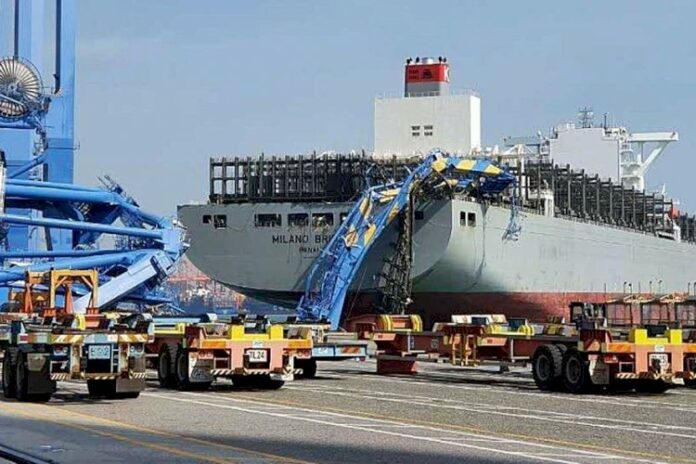
Milano Bridge hits Port of Busan gantry crane

0

The 13,870TEU container ship Milano Bridge has collided with a gantry crane at Busan Port, South Korea, which caused the collapse of the crane.

The terminal crane immediately collapsed and partly ended up on the ship. The incident happened Monday afternoon local time. As shown in the video, the ship was not loaded.

According to the maritime incident website Maritime Bulletin, it first sailed against another ship, the ‘Seaspan Ganges’. Immediately afterwards, the ‘Milano Bridge’ came into heavy contact with three cranes of container terminal Busan New Port. One of the three cranes collapsed. As far as is known, one incident was injured in the incident.

Milano Bridge suffered considerable damage, as part of the crane ended up on the deck. Reportedly, the Seaspan ship was hardly damaged, if at all, and was able to continue its journey.

The vessel is understood to have just left drydock for repairs following a collision with another vessel some months ago.

DNV GL’s new remote approach to MPMS

0

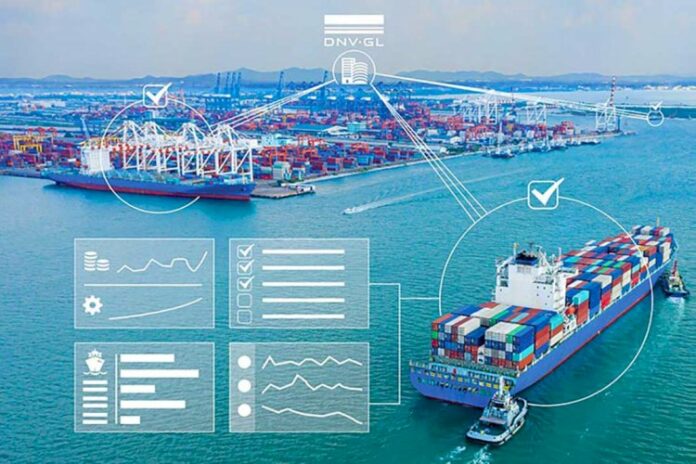
Machinery Maintenance Connect (MMC) is DNV GL’s new remote approach to the machinery planned maintenance system (MPMS).

Instead of requiring surveyors to travel to each individual vessel and go onboard, machinery data can be processed via algorithms and presented to customers in a digital dashboard – enabling the survey of a complete fleet in one process and unlocking new insights into vessel and fleet performance.

Knut Ørbeck-Nilssen, CEO of DNV GL – Maritime,  says:

“In another example of the benefits our customers are seeing from increasing digitalization, MMC will bring substantial efficiencies to vessel maintenance and fleet management. By using the data from the vessels, alongside a powerful learning algorithm, we can remotely perform the maintenance survey of a customer’s whole fleet in one process, saving time and reducing the disruption of daily operations.”

When owners start sharing vessel machinery data with DNV GL, then after accessing the MMC app in Veracity, the data for all vessels can be seen immediately. A minimum of one year’s data must be provided before digital MPMS surveys can be performed.

Rolf Petter Hancke, Surveyor and Principal Engineer at DNV GL, explains:

“Once we have the verified MPMS data, to get going with MMC we sit down with management for an initial company audit that also functions as their annual survey. This reduces the time required significantly, in one case we completed surveys on 49 vessels in roughly four hours, something that would normally take 50 separate onboard surveyor visits. And the data is all right there – easily and directly accessible by management in real time.”

The MMC system provides a complete breakdown of any maintenance already completed and overdue, with the dates of the work. By collating and presenting the data owners and operators can access data in real time to create a maintenance plan that can predict the requirements of individual vessels and, with AIS, utilize repair yards local to the position of the vessel.

Karl Uno Holm, Ship Manager, Klaveness Ship Management, says:

“Machinery Maintenance Connect gives us improved transparency from vessel to office in following up on maintenance. I can easily monitor jobs done and see postponements across the fleet. I can also now do an audit on the vessels on a regular basis and the time we need for this is less than an hour.”

The MMC dashboard is split into two parts, a fleet overview that contains details of the owner’s entire fleet, and a vessel overview which details the maintenance tasks completed and any work that remains outstanding on individual vessels in the fleet. Both provide an overview of data across several systems including filter functionality, data quality, job due dates, completed and upcoming maintenance work, and an AIS map of vessel positions, which is also linked to weather data.

With MMC, owners have much better control over the maintenance regimes of all their vessels, allowing them to plan ahead for vessel downtime and offer their clients more reliable service. Every vessel is also surveyed in the same way, offering a more objective survey and providing easily benchmarking of their fleet’s maintenance. In addition, advanced analytics on machinery maintenance are available on request, and with all fleet and vessel data at hand, customers can easily provide machinery maintenance data to third parties.

Currently, DNV GL has more than 300 vessels using the scheme, with over 100 surveys conducted to date. As the service develops DNV GL is examining the potential use of the MMC approach for other survey types. MMC is available to all ship owners and operators, whether the vessels are DNV GL classed or not.

LR chosen for LNG Canada export terminal project in Kitimat

0

LR has signed a 55-month LNG contract to support LNG Canada with the safe construction and delivery of a new liquefied natural gas (LNG) liquefaction plant and export terminal located at a site in Kitimat, BC, Canada.

The contract is for third party verification and Canadian Registration Number (CRN) services that LR will perform during the pre-commissioning, commissioning and start-up phases of the project. With this tender award, LR becomes the only third-party verifier working on Canadian LNG projects.

LR’s third party verification services will ensure that individual components have been constructed and tested in accordance with the quality assurance programme expected by Liquefied Natural Gas Facility Regulation (LNGFR). This will see LR verifying the project quality assurance programme for the design and procurement phases, followed by the Inspection Test Plans and Inspection Test Records during the project construction and commissioning phases.

LR will also validate Technical Integrity Verification plans for engineering, fabrication and commissioning, and the Change Management Plan (CMP) for the design and construction phases. Throughout this contract, LR will provide additional audit and engineering services at site to verify the compliance of safety critical equipment and systems, such as gas fired equipment (incinerator and gas turbines), across the entire facility. This will align with audit activities performed by British Columbia Oil and Gas Commission (BCOGC).

For the CRN services, LR will use a British Columbia Alternative Safety Approach (ASA) to demonstrate compliance with the power, boiler, pressure vessel and refrigeration safety regulation.

LR will assist in developing a complete life cycle Pressure Equipment Safety Management Plan, from vendor selection through to the module yard, as well as the final handover to LNG Canada at the Kitimat Site which will be used to support the project ASA application.

John Hicks, LR President of Americas Marine & Offshore said:

“Winning this major project demonstrates LR’s strong capability and long history in the LNG space, following recent wins with Goldboro, Bearhead and LNG Canada, three of the largest LNG projects in Canada makes LR the preferred classification society to work with in Canada. We are incredibly proud to be awarded this contract and look forward to working with all the stakeholders, including BCOGC and LNGFR on this project.”

ABS guides industry on harnessing digital potential

0

ABS has underlined its track record of support for digital innovation with the launch of two new Advisories designed to help harness the potential of digital technologies for the maritime and offshore industries.

The ABS Advisory on Structural Health Monitoring: The Application of Sensor-Based Approaches focuses on the use of sensors to determine structural health status and predict future condition. Sensors on modern assets provide vital information on the structural health, indicating the need for repairs/modifications to prevent further deterioration or future failures.

The Advisory addresses common challenges the industry faces: how to define and implement the sensor-based structural health monitoring for maximized benefits; what sensor package, in terms of types, number, installation locations, and specification, is suitable for the purpose; and how to integrate the sensor approach with analysis and simulations to form a structural digital twin for more accurate and reliable structural condition insights.

The ABS Advisory on Data Quality for Marine and Offshore Application provides an overview of the relevant standards and industry best practices to meet stringent data quality requirements in commercial applications. It offers specific guidance for the marine and offshore industry on data quality assessment, monitoring and control with a practical data quality framework and detailed data quality rules, metrics and dimensions customized for marine and offshore applications.

Patrick Ryan, ABS Senior Vice President, Global Engineering and Technology, said:

“Sensor data is increasingly fundamental to the efficient operation of modern marine and offshore assets but collecting quality data is a challenge in these environments. Unique variables such as noise, dust, temperature, humidity, electronic and magnetic interference can all be an issue, as can location since they are typically far from land-based infrastructures. ABS is committed to helping the industry capitalize on this exciting new potential safely, with accurate and reliable sensor-based structural health monitoring.”

ABS is involved in a range of data and digital projects with commercial and government clients all over the world, daily applying best practices from its extensive list of advisories.

WOC supports launch of emergency funding campaign for seafarers

0

The World Ocean Council (WOC) – the Global Blue Economy Business Organization – invites support for the charity crowdfunding campaign to raise funds for vulnerable seafarers and their families as the COVID-19 pandemic affects those with less secure financial and health resources.

All funds raised will go to the International Seafarers’ Welfare and Assistance Network (ISWAN), a UK registered charity, and dispersed through their Seafarers Emergency Fund (SEF). Their membership includes seafarer associations throughout the developing world alongside shipping companies and shipping organizations.

Along with our colleagues at ISWAN, the WOC encourages the maritime industry, the international business community and the general public – all of whom depend on the global shipping industry – to show their support for the seafarers who are severely affected by the pandemic.

Many seafarers from the poorer regions are facing real challenges due to COVID-19. Some mariners are in lockdown with casual contracts and are now unable to work; others are facing difficulties due to lockdowns when they leave ships and are unable to return to their families; there are even reports of seafarers being shunned on their return to their homes for fears of the virus. There is also the issue of their families not having sufficient income to support themselves, with the situation likely to get worse.

Roger Harris, Executive Director, International Seafarers’ Welfare and Assistance Network, said:

“We warmly welcome this initiative as we are receiving more and more calls from seafarers to our helpline SeafarerHelp. Many are from Filipino and Indian seafarers whose lives are being adversely affected by the COVID-19 pandemic. The funds raised will be used to assist seafarers and their families who are facing hardship because of the pandemic.”

Paul Holthus, Founding President and CEO, World Ocean Council, said:

“The men and women working in shipping and the other ocean industries that make up the ocean economy are vital to all of us in this time of crisis. They are essential to ensuring that supply chains of food, medicine, energy and other goods keep operating. Please help support them as they are faced by the additional challenges that the COVID-19 pandemic is imposing on them.”

Neptune Energy announces carbon intensity reduction target

0

Neptune Energy has announced ambitious targets to reduce carbon and methane intensity by 2030 from the managed production of its low-cost, long life and geographically-diverse portfolio.

The company already has one of the lowest carbon intensities in the sector. It is now targeting carbon intensity of 6kg CO2/boe by 2030, which represents a 60% reduction from forecasted levels if no action was taken – and well below the industry average of 18kg CO2/boe1.

To achieve this, Neptune will build on its experience of capturing and storing CO2 gained through long-established projects in Norway and the Netherlands and progress with the ground-breaking PosHYdon project to generate offshore hydrogen via its operated Q13a platform in the Dutch North Sea. It will also reduce flaring and venting, and replace operational equipment with new and more efficient technologies.

Neptune also has one of the lowest methane intensities in the sector at 0.02% and is targeting net zero methane emissions by 2030. Methane is the primary component of natural gas and is a potent greenhouse gas. While it has a shorter lifespan than CO2 – staying in the atmosphere for about a decade, compared with 200 or more years for CO2 – it has a much higher global warming impact.

The targets were detailed as part of the company’s new Environment, Social and Governance (ESG) strategy, published in its Annual Report and Accounts for 2019.

Neptune’s Executive Chairman, Sam Laidlaw said:

“As our sector deals with the twin challenges posed by the COVID-19 pandemic and lower commodity prices, sustainability has never been more important. To secure a sustainable future we need to protect the health and welfare of our people, preserve the resilience of our business and stay focused on providing  the secure supplies of lower carbon energy essential for the energy transition.

Neptune’s ESG strategy demonstrates our commitment to being at the forefront of that transition and recognises that gas remains an important part of the solution, in both its present and future forms. While the carbon and methane intensities of our managed production is already industry-leading, we have set ambitious targets to reduce them even further by 2030, requiring both investment and innovation – and we are making much progress already.

In a net zero emissions scenario, scaling up technologies is essential and requires extensive collaboration between policymakers and industry. Our sector is uniquely placed to help, with the skills and experience to implement large-scale engineering projects, emissions reduction initiatives and innovative technologies.”

Neptune’s ESG strategy encompasses how, through its core activities, the business directly supports the UN Sustainable Development Goals. It also outlines the company’s commitment to ensuring the highest standards of governance, ethics and integrity throughout its operations by adopting the Wates Corporate Governance Principles, which cover leadership, board composition, director responsibilities, opportunity and risk, remuneration, and stakeholders.

Hydrocarbon seeps fuel biological production in the Arctic Ocean

0

Beneath the Arctic seafloor are large sources of discovered and undiscovered petroleum hydrocarbons, including methane and gas hydrate reservoirs.

Fluids and gas escaping from these reservoirs can migrate toward the seafloor and be released into the ocean. Evidence of hydrocarbon seepage is widespread in the Barents Sea and other regions of the Arctic, and what is only now being more fully appreciated is the extent to which leakages from these reservoirs are a source of energy for many components of the marine ecosystem at high latitudes.

Akvaplan-niva scientists Prof. JoLynn Carroll and Dr. Michael Carroll led an interdisciplinary research team at the Centre for Arctic Gas Hydrate, Environment, and Climate, a Research Council of Norway (RCN) Centre of Excellence based at the Department of Geosciences, UiT – The Arctic University of Norway. Working together with early career scientists, Dr. Emmelie Åström and Dr. Arunima Sen, they have just published a synthesis of research findings on benthic communities associated with sites of methane gas seepage in the Arctic. Their work sheds new light on a previously underappreciated energy resource for life in the Arctic in the context of the unique marine habitats and ecosystems they support.

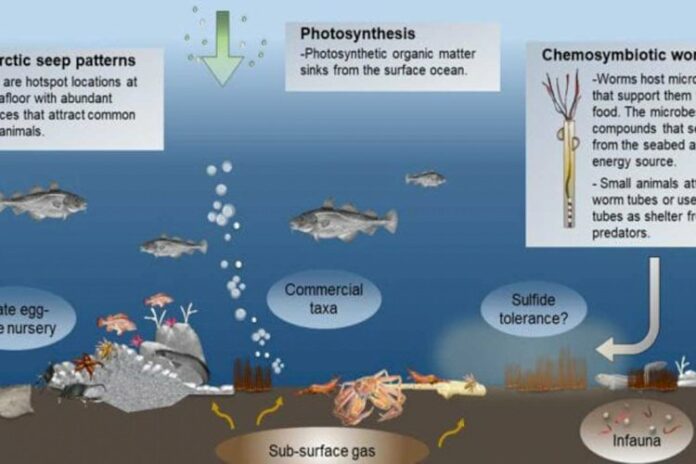
Some sites of gas seepage on the seafloor, also known as cold seeps, are oases of biological activity. At these locations, methane and sulphide play an essential role for biological production via specialized microbes in a process known as chemosynthesis. This production occurs locally at the seabed and is available year-round, in contrast to the episodic supply of photosynthetic organic matter sinking from the surface ocean. In addition, reef-like structures formed by the precipitation of carbonates during seafloor methane seepage provide extensive habitat complexity.

Dr. Emmelie Åström informed:

“One of the reasons, cold seep ecosystems in the Arctic have remained relatively underappreciated is that they are highly localized, on an otherwise vast and uniform seafloor. Only with the use of modern seabed mapping technologies, have we been able to locate and investigate these features in detail. Collaboration with Prof. Martin Ludvigsen’s ROV team at the Centre for Autonomous Marine Operations and Systems – Norwegian University of Science and Technology was essential for the success of this research.”

Dr. Michael Carroll added:

“Once we were able to visually locate cold seeps on the seafloor, we carried out a specialized sampling protocol for benthic sampling. The samples were processed at the Akvaplan-niva benthic laboratory using accredited analysis procedures and species identifications were carried out by Akvaplan-niva’s world renown Arctic taxonomy experts.”

A remarkable finding of the research was that these Arctic cold seeps attract large aggregations of animals that commonly occur in the Arctic, including several commercial species. This research raises many new intriguing questions about the ecological role of seep habitats for the Arctic. What is now known is that these unique habitats provide important ecosystem services with high relevance for Arctic marine ecosystems.

Oil discovery in the US Gulf of Mexico

0

The Monument exploration well found approximately 200 feet (c. 60 metres) of net oil pay with good reservoir characteristics in Paleogene sandstone.

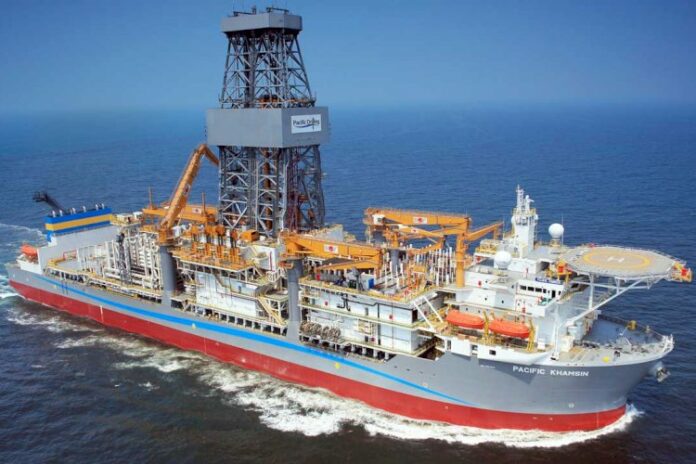
This provides an early indication of the productive reservoir interval at the well location. The well was drilled to a total depth of 33,348 feet (10,164 metres) using the Pacific Khamsin rig.

Bjørn Inge Braathen, senior vice president of Exploration in North America, said:

“We are pleased to have proved an accumulation of movable hydrocarbons in the Monument exploration well. However, determining the full potential of the discovery will require further appraisal drilling.”

The Monument exploration well is located in the central US Gulf of Mexico. It is operated by Equinor (50%) with partners Progress Resources USA Ltd (30%) and Repsol E&P USA Inc. (20%).

Monument is Equinor’s first operated exploration well in the US Gulf of Mexico since 2015.

Woodside joins Japanese consortium to study exporting carbon-neutral hydrogen

0

Woodside has signed an agreement with Japanese companies JERA Inc, Marubeni Corporation and IHI Corporation to undertake a joint study examining the large-scale export of hydrogen as ammonia for use decarbonising coal-fired power generation in Japan.

The consortium has received approval from Japan’s New Energy and Industrial Technology Development Organization (NEDO) for a feasibility study covering the entire hydrogen-as-ammonia value chain. The study will examine the construction and operation of world-scale ammonia facilities and the optimisation of supply chain costs.

As part of the study, Woodside will be investigating the transition from blue to green hydrogen for export. Blue hydrogen is produced from gas using steam methane reforming, with related carbon emissions offset. Green hydrogen is produced from renewable energy using electrolysis. In both production processes hydrogen is combined with nitrogen to form ammonia to enable it to be shipped as a liquid. Ammonia does not produce any on site carbon emission when consumed in a power plant.

Woodside CEO Peter Coleman said the agreement was another step forward in Woodside’s exploration of the potential of hydrogen as a clean fuel of the future. He said:

“JERA, Marubeni, IHI and Woodside will jointly contribute to studying the application of hydrogen as an energy source, including in the form of ammonia. The partners will consider further joint projects in areas where they identify synergies. Woodside and its partners in Japan have forged new energy pathways before and we can do so again, as we expect by 2030 to see large-scale hydrogen production around the world and we intend to be part of that.”

World’s first ever road transportable floating dry dock

0

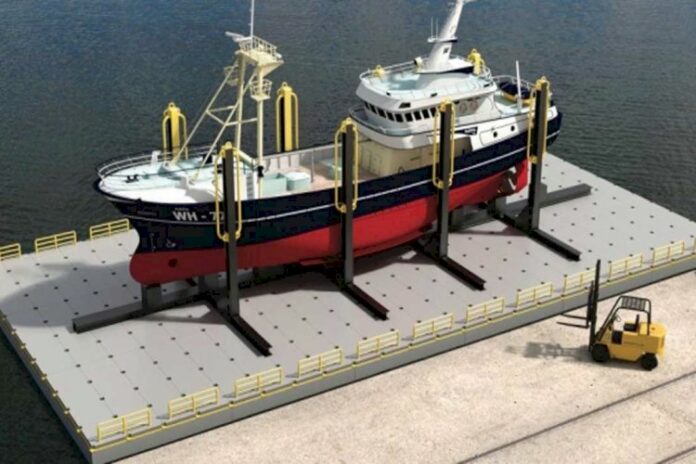
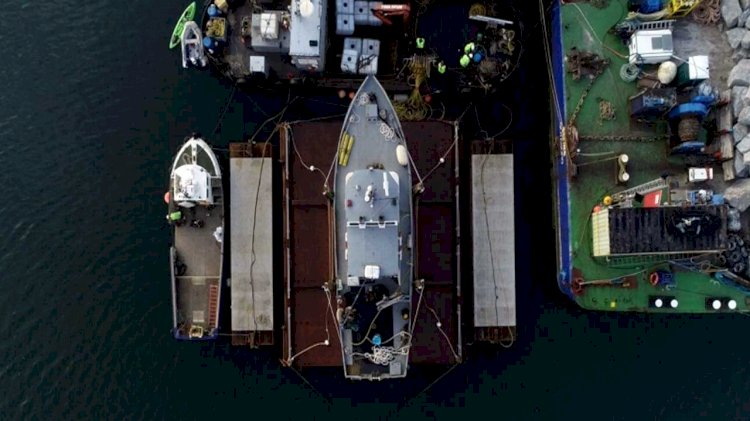
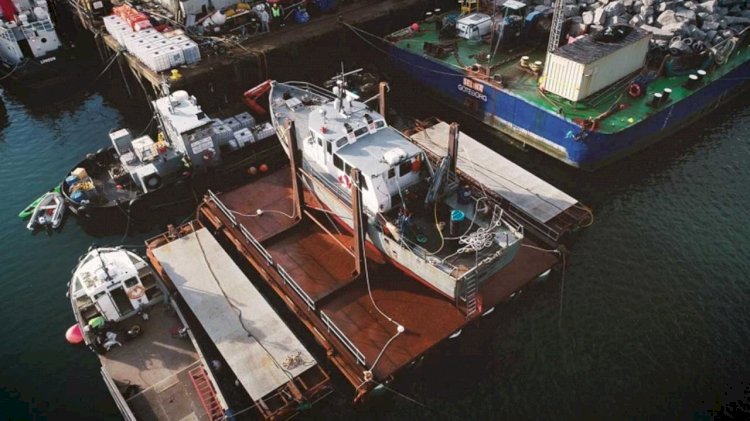
Tugdock is a patented modular floating dry dock with a difference. It is less cost to buy, less cost to operate and is far simpler to use than any present drydock system.

Deck dimensions can be increased or decreased to suit the size and shape of the vessel or floating structure to be lifted. Transportable as shipping containers for cost effect global delivery.

Solis Marine Engineering supported Tugdock with the development of its modular drydock which was successfully demonstrated in November 2019 in Falmouth where the company is based.

This involved stability calculations and design support, where hydrostatics were performed using the stability software GHS and docking simulation in OrcaFlex. This covered each stage of the operation with a range of possible loading scenarios.