-7.5 C
New York
Home Blog Page 721

EfficientFlow project has finalised the activity regarding the ports

0

All actors in the ports of Gävle and Rauma are now using a Port Activity App to share real-time port call information. Port planning is even easier for ships with route exchange capabilities.

More than one hundred users in the ports of Gävle and Rauma are currently sharing and getting real-time timestamps and plans for port calls. The beneficiaries come from all aspects of the port call: terminals, tugs, pilots, agents, arriving ships, port authorities, mooring personnel, captains and even the local shipbuilding company.

Linda Astner, Sustainability manager at Gävle Hamn, explains:

“There can be ten different partners involved in a port call and today they all call each other via phone to get in touch. There are often changes in a port´s operation due to time shifts, but also weather and wind has effects. If all involved actors get the right information about both planned and current times for arrivals the dockings can be smoother and the time that the ships spends waiting with the engines on can be minimized”.

A hands-on example from the Port of Rauma

One day there was one inbound vessel arriving 18:00 and two departing vessels scheduled at the same time. The limited number of tugs available led to changes. The first received order was served first, and thus the timetables for the other two ships were adjusted. All “pinned” partners could see the updated timetable for all three vessels without a single phone call.

The Netherlands and Denmark explore opportunities for offshore energy hub together

0

The Netherlands and Denmark have signed an agreement of intent in which they agree to have TenneT, Gasunie and Energinet carry out further research into a joint energy hub in the North Sea. 

Minister Wiebes (Economic Affairs and Climate) says:

“Denmark is an important partner for the Netherlands when it comes to climate and energy. Both countries are ambitious in the field of CO2 reduction. Denmark and the Netherlands are neighbours in the North Sea and are connected both literally, via the Cobra cable for the transport of electricity, and figuratively, by the shared commitment and ambitions for wind energy at sea.”

It is clear that the Netherlands could benefit from closer cooperation with Denmark. Opportunities include increasing interconnection capacity for security of supply, possible synergy with our national plans for offshore infrastructure in the north of the Netherlands and possible hydrogen opportunities in the Groningen/Eemshaven region. 

In June 2020, Minister Wiebes signed a Memorandum of Understanding (MoU) with Danish Minister JØrgensen of Climate, Energy and Utilities in which various energy policy themes were identified in which we would like to work closely together. An important theme is cooperation in the field of offshore energy hubs in the North Sea. Such ‘hubs’ are landing facilities in the sea (via an artificial sand island, a platform, or another physical form) for offshore wind farms, from which energy can be transported to different countries in the form of electrons or even, after electrolysis, in the form of (hydrogen) molecules.

Manon van Beek, CEO TenneT responds:

“Energy will increasingly become a cross-border business and cooperation across the borders of organisations and countries is the key to a successful energy transition. In this context, we are already realising cross-border offshore projects and many more opportunities lie ahead. Offshore wind will undoubtedly become the new powerhouse of North-West Europe, a region that is perfectly connected via the North Sea. And it will only be in a European context that we can and will make optimum use of every electron generated at sea. Intensive cooperation between TSOs, governments and other bodies involved – across borders – must be the rule in order to ultimately achieve a European sustainable energy system. “

Ulco Vermeulen, Executive Board Gasunie:

“Large-scale production of wind energy in the North Sea is the basis for making the entire energy system more sustainable. Intensive cooperation between gas and electricity companies from different countries around the North Sea is crucial to achieve a new sustainable energy system with as favourable a cost level as possible. This MoU is a useful step in the right direction. It is a compliment that both TenneT, Gasunie and Energinet have the confidence of the Dutch government to contribute to this as ‘knowledge leaders'”.

It has been agreed that additional analyses will be carried out by TenneT, Energinet and Gasunie on the joint development of an energy hub in the North Sea for connecting offshore wind farms. On the basis of these analyses, a decision must be taken by the Netherlands and Denmark before 2022 as to whether it is appropriate to continue this cooperation. Tennet, Energinet and Gasunie are already partners in the North Sea Wind Power Hub consortium. This consortium has been working for years on concept development and research into artificial islands at sea on which several large transformer substations can be built to connect offshore wind farms. 

LR and NETSCo to develop Jones Act compliant wind turbine installation vessel

0

Lloyd’s Register North America, Inc. (LR) has signed an agreement for a joint development project (JDP) with Northeast Technical Services Co., Inc. (NETSCo) to design and develop a Jones Act compliant wind turbine installation vessel (WTIV).

The Jones Act, or Merchant Marine Act of 1920, requires any vessel transporting cargo between U.S. ports, or between U.S. ports and offshore facilities, to be built and flagged in the U.S. In 2019, the U.S. House of Representatives passed the Expanding Access to Sustainable Energy Act which includes an amendment that would enforce Jones Act requirements for all offshore renewable energy production. This means that U.S.-built ships, flagged in the U.S., and manned by U.S. nationals will be required for the installation of wind power plants, and for the supply and service of facilities. In addition to this, last week the U.S. Senate passed the National Defense Authorization Act for the fiscal year 2021. This bill includes an amendment ensuring full enforcement of the Jones Act and other federal laws in offshore wind development.

As part of the JDP, NETSCo engineers and naval architects will be responsible for the concept design of the WTIV. NETSCo’s WTIV design will be focused on meeting the requirements of current developments along the U.S. East Coast and the U.S. Great Lakes such as crane capacity, deck space and water depth. Another key feature of the design is that it will use hull shapes that are common in the U.S. shipbuilding market, therefore ensuring it could be built in U.S. shipyards.

LR will review and evaluate NETSCo’s concept design to ensure the vessel complies with applicable rules and regulations. LR’s team of technical compliance experts will also evaluate the design against international codes and standards and the U.S. Coast Guard’s Code of Federal Regulations (CFRs).

Jan Flores, Vice President of NETSCo, commented:

“The lack of Jones Act-qualified compliant wind turbine installation vessels has become a major challenge for offshore wind turbine developers. With years of research and development in this industry, it is a perfect opportunity for us to leverage our engineering expertise in a strong collaborative enterprise with LR. This collaboration was a cumulation of efforts to better support the offshore wind turbine market with a Jones Act-qualified vessel alternative, as well as offering conversion options for vessels that have been dry-docked during this economic downturn. We look forward to our continued work with LR for their guidance and expertise in classification, compliance and advisory services in the offshore industry.”

Rafael Riva, LR’s Americas Marine & Offshore Commercial Manager, said:

“The offshore wind industry is expected to see exponential growth in the United States. There are currently no U.S.-built wind turbine installation vessels, and if the sector takes off as expected, there will be a pressing requirement for such vessels. What truly sets LR apart is our in-depth understanding of specific port logistics to handle WTIVs, from the significant advisory work undertaken for some of the designated U.S. East Coast ports and how this will impact the optimal operation of these vessels in the specific environment. This collaboration with NETSCo to develop a Jones Act compliant wind turbine installation vessel represents an essential development to support the U.S. offshore wind industry.”

HHI Group and DNV GL present green tankers of the future

0

In a recent “Green Tankers towards 2050” industry webinar, attended by more than 250 participants from shipping companies around the world, DNV GL and HHI Group presented the results of new joint research and explained how eco-friendly maritime solutions can help shipowners and managers to cope with stricter environmental regulations now and in the future.

The joint research was initiated by a memorandum of understanding (MOU) signed at Gastech trade fair in Houston 2019, when DNV GL and HHI agreed to develop low and zero carbon solutions for shipping. The results of the MOU were presented by lead researchers from HHI Group companies Korea Shipbuilding & Offshore Engineering (KSOE), Hyundai Heavy Industries (HHI) and Hyundai Mipo Dockyard (HMD) in a virtual format, co-hosted by DNV GL from their headquarters in Høvik, Norway.

Seong-Yong Park, COO and SEVP of HHI Group, said:

“Shipowners are faced with many uncertainties in the rapidly changing marketplace. We believe our research results, including proven engineering solutions and alternative fuels, will support them in developing their future strategy for ship operations and fleet renewal.”

During the webinar, DNV GL and HHI Group experts explained the recent development of regulations covering the greenhouse gas emissions from vessels, including the introduction of the design index for existing vessels (EEXI) and a new Carbon Intensity Indicator, which are due to enter into force in 2023. To respond to these regulations, HHI Group introduced their range of eco-friendly ships that are equipped with alternative fuel technologies and energy-reducing systems, among them 40 LNG dual-fuelled ships already delivered or under construction.

H. J. Shin, Head of Future Ship Research Department at KSOE, commented:

“The International Maritime Organization (IMO) is strengthening environmental regulations, including a 50% reduction in ship greenhouse gas emissions by 2050 compared to 2008. We will help the shipping industry to reach these ambitious goals by taking a leading position in the eco-friendly maritime era through research and development.”

By applying DNV GL’s data-based carbon robust model to its very large crude carrier (VLCC) and Medium Range (MR) tanker ships, HHI Group found that an LNG fuel propulsion system in combination with advanced energy saving devices (ESDs) can enable a vessel to meet the new Carbon Intensity Indicator over its expected lifetime.

Y. H. Chung, Head of Initial Design Department at HMD, stressed:

“It is important to use alternative fuels like LNG and technological solutions that are available now, and not wait until 2030 or beyond. Our joint research has shown that LNG as ship fuel combined with other energy saving devices can make a vessel both environmentally and economically fit for the next two decades at least.”

Christos Chryssakis, Business Development Manager at DNV GL – Maritime, explained:

“Since ESDs mainly have an impact on fuel consumption during sailing, the benefits are greater for large vessels such as VLCCs, which spend more days operating at sea. These ships are also less sensitive to price variations when it comes to selection of LNG as fuel. This is because the capital expenditures are paid back faster due to a higher fuel consumption.” 

For smaller vessels with lower fuel consumption, such as MR Tankers, a higher price differential between very low sulphur oil (VLSFO) and LNG was required to pay back the initial investment. Therefore, these vessels were more sensitive to volatile fuel prices, he added.

Trond Hodne, Senior Vice President Business Development at DNV GL – Maritime, said:

“We have no clear vision yet of the zero-carbon ship in deep sea shipping. As we work hard towards the zero emission vessel, the industry also needs to make newbuilding decisions today. Thus, we should not make perfect the enemy of good. As demonstrated by HHI Group and our experts, we have energy efficient designs and technologies at hand that will enable ships to meet the IMO emission trajectories through their entire lifetime. These highly efficient vessels are likely to be attractive to charterers and investors today, and even more so if CO2 will have a cost.”

NYK to expand the number of ships sharing data via ShipDC’s IoS-OP

0

Nippon Yusen Kabushiki Kaisha (NYK) and Ship Data Center Co. (ShipDC) have agreed to use the latter’s IoS-OP (1) to share data received from all NYK-operated vessels equipped with SIMS (2), expanding the total to about 200 NYK vessels.

Up until now, NYK had used ShipDC’s IoS-OP to share shipping data from some vessels equipped with SIMS, but the new agreement expands the data-sharing to all SIMS-equipped vessels within the NYK fleet.

This agreement will dramatically increase the amount of data being transferred via the IoS-OP and makes it possible to increase corporate value by utilizing the data for ship safety, economic pursuits, environmental efforts, and innovation within the shipping industry to enhance international competitiveness.

(1) Internet of Ships Open Platform (IoS-OP)
A universal platform that enables the sharing of vessel operational data among shipbuilders, manufacturers, and related service providers without compromising profits of data providers.

(2) SIM (Ship Information Management System)
A system developed by the NYK Group for timely sharing of detailed ship data such as operation status, fuel efficiency, and plant status between ships and shore.

NKCS launches ISM compliance support for cyber security

0

Regarding IMO Resolution MSC.428(98), which recommends that a safety management system should take into account cyber risk management in accordance with the ISM Code requirements, the number of flag states making it compulsory from 2021 is increasing. In particular, the U.S. Coast Guard (USCG) has announced that it will make this recommendation mandatory for U.S. flagged vessels and foreign flagged vessels that call on ports in the U.S. 

However, detailed information is not always enough at present, and NKCS is aware that many shipping companies are struggling with the specifics of how to handle this issue.

In response to this situation, NKCS has launched the service to incorporate cyber risk management into an existing SMS manual as its support for ship management companies in complying with ISM requirements for cyber security. 

Based on a systematic and comprehensive approach to the cyber risks that may occur onboard and the recommended elements (Identify, Protect, Detect, Respond and Recover) to be included in line with the MSC.428(98), NKCS provides a manual, network conceptual diagram and risk assessment template, which are tailored to the individual ship’s situation and easy to customize.

Solstad: contract awards in the Asia Pacific region

0

The three vessels will be utilized for projects on the east coast of India. The contract will commence early Q1 2021 and have a combined potential duration of approximately 450 vessel days, in addition to mobilization and demobilization.

In addition, Solstad has been awarded another contract with a large international contractor for Normand Frontier, after completion of the project in India. This contract is in Australia and will commence in Q2 2021, for a duration up to 3 months, excluding mobilization and demobilization.

Furthermore, Solstad have negotiated and agreed an early release of Normand Frontier from its current contract with Ocean Infinity to be able to undertake the contract in India and Australia. The early release comes as Ocean Infinity continues its transition to unmanned and robotic technologies with the introduction of its Armada fleet. 

Solstad and Ocean Infinity have agreed mutually beneficial terms for the remaining part of the firm contract period for the Normand Frontier taking account of the opportunity to deliver the vessel on the India and Australia contract, under which Ocean Infinity is expected to provide both ROVs and personnel.

VIDEO: BC Ferries’ fourth battery electric-hybrid vessel launches

0

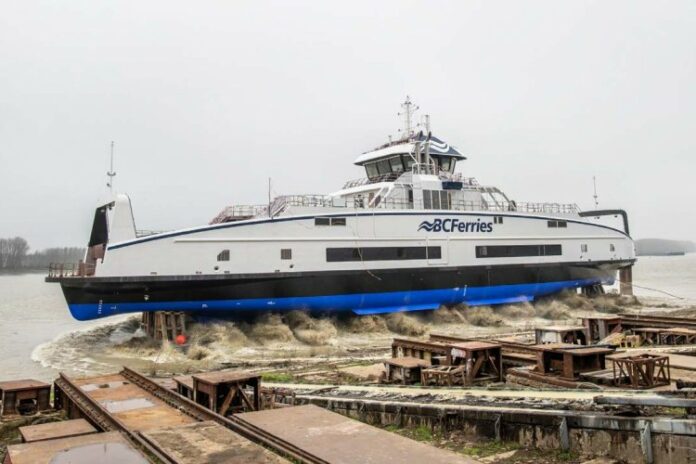
Following the successful launch of its third battery electric-hybrid Island Class vessel in October, BC Ferries’ fourth Island Class ferry launched early Thursday morning, entering the water at Damen Shipyards Galati in Romania.

Work will continue on the new ship until scheduled sea trials in April. Following successful sea trials, the vessel will make its way to Point Hope Maritime in Victoria in fall 2021 for final preparations. The yet-to-be named ship is the fourth in a series of six Island Class vessels joining the BC Ferries fleet, and the second assigned to the Campbell River – Quadra Island (Quathiaski Cove) route. Two-ship service is scheduled to begin on the route in 2022, replacing the existing Powell River Queen.

By replacing one larger ship with two smaller vessels on the route, customers will notice increased capacity per hour (from 59 to 94 vehicles per hour, on average), receive more frequent service, and experience reduced vehicle line-ups, improved safety, as well as reduced congestion on local roads. It also eliminates the need to consume more greenspace to increase the size of terminal holding compounds by moving more traffic through the same amount of space.

The Island Class is a battery-powered ferry with a number of key features that support BC Ferries’ Clean Futures Plan and the company’s goal to be efficient and environmentally responsible throughout its system. When electric charging technology matures to make electricity available in the quantities required, BC Ferries will operate these new ships as all-electric ferries, using clean energy. In the interim, these ships will use an on board low sulphur diesel hybrid system. Island Class ferries have the capacity to carry at least 47 vehicles and up to 400 passengers and crew depending on configuration, and allow for fleet redeployments and retirements of existing diesel fuelled vessels.

The first two Island Class vessels were deployed on the Powell River – Texada Island route and the Port McNeill – Alert Bay – Sointula Island route in mid-2020. The fifth and sixth new ships will provide two-ship service on the Nanaimo Harbour – Gabriola Island route in 2022.

BC Ferries issued a Request for Expressions of Interest (RFEOI) for the construction of the four latest vessels to leading shipyards in Canada and around the world in July 2018. Canadian shipyards were invited to participate in the competitive bidding process. BC Ferries received responses from 18 international shipyards and short-listed nine shipyards to proceed to the Request for Proposal (RFP) stage. No Canadian companies submitted a bid.

Inmarsat raises two innovative start-ups to Certified Application Provider status

0

Established maritime start-ups VesselBot and PortXchange join Certified Application Provider (CAP) programme after innovation potential is singled out in ‘Decarbonising Shipping’ initiative 

Inmarsat, the world leader in global, mobile satellite communications, has fast-tracked two innovative and established start-ups to Certified Application Provider status as part of this year’s ‘Decarbonising Shipping’ initiative run by venture developer Rainmaking.

The solutions, offered by VesselBot and PortXchange, have been accentuated by Rainmaking’s Trade and Transport Impact initiative which seeks to harness the power of start-ups and advanced technologies to meet UN targets on greenhouse gas (GHG) emissions.

VesselBot’s ‘Voyage TCE Optimization Decision Support System’ software uses advanced AI models that draw on both market and vessel data to support operational decision-making and increase voyage profitability. In addition to providing speed and routing optimisation based on weather conditions, the solution offers bunker procurement recommendations using real time data and measures time charter equivalent (TCE) performance at prevailing hire rates.

PortXchange is a digital collaboration platform for sharing real-time operational data from all local parties involved in a port call, standardising it, and creating a ‘single point of truth’ for shipping lines, carriers, agents, terminals, and port authorities to monitor all activities before and during the call. This data can be used to optimise port call efficiency to reduce CO2 emissions. Started at the Port of Rotterdam, the PortXchange platform is now used in ports across Europe, the UK and US.

In signing up as CAP participants, the companies join a fast-growing group of digital innovators providing dedicated applications for Inmarsat’s IoT platform for Fleet Xpress: Fleet Data. The platform collects data from onboard sensors, pre-processes it and uploads it to a central cloud-based database equipped an Application Process Interface (API) that is accessible by an owner’s software or third-party applications.

Constantine Komodromos, CEO and Co-Founder, VesselBot, says:

“We are delighted to collaborate with Inmarsat and utilise their API’s to obtain High Frequency Operational and Technical data seamlessly and efficiently for our customers. We developed this product in the last two years in collaboration with some of our customers, utilising our deep expertise in both data science and the maritime market. It brings significant financial benefits, both in respect to TCE increases and connectivity cost reductions, as well as substantial environmental benefits regarding GHG emissions reduction.”

Captain Abhishek Nair, International Business Consultant, PortXchange, comments: “With Inmarsat, we have a great partner in establishing the ship-shore operational data sharing link. The IoT data gathered from Fleet Data can be used to optimise voyages and facilitate Just-In-Time arrivals. We also want to explore multi-party collaborations with Inmarsat and other application providers on the CAP network to add greater value to users in the maritime industry.”

Marco Cristoforo Camporeale, Head of Digital Solutions, Inmarsat Maritime, says:

“We believe these solutions will find ready audiences in the shipping market because both use digital innovation to meet the key industry challenge of decarbonisation. We are very proud that our CAP programme continues to provide the ecosystem for digital problem solvers to bring their solutions to market quickly and seamlessly.”

Van Oord orders green cable-laying vessel

0

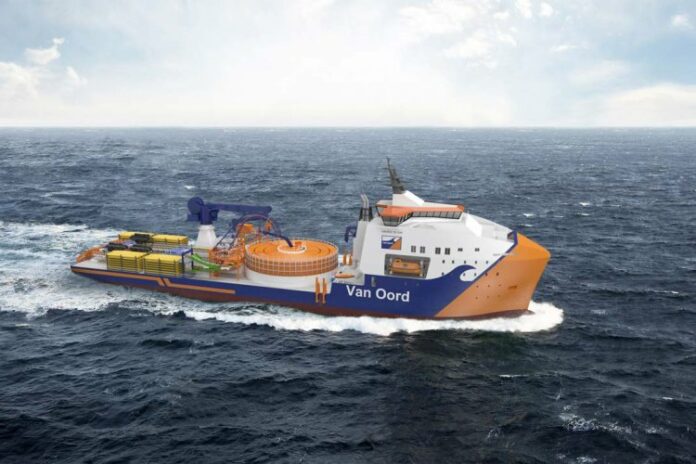
The vessel will be delivered from VARD in Norway and equipped with the latest sustainable technologies. The vessel will be fully operational in 2023.

This investment is part of Van Oord’s strategy to strengthen its leading position in the growing offshore wind market. Van Oord has a leading role in the laying and burying of offshore wind power cables. It highlights Van Oord’s drive to continuously reinforce its market position by investing in state-of-the-art sustainable technology. Van Oord has a dedicated cable unit to support all its cable projects.

The new vessel has been designed with the latest sustainable technologies in order to reduce the carbon footprint during operations and port standby. Apart from the possibility to run on bio fuel, this hybrid vessel has future fuel ready engines with built-in flexibility to anticipate e-fuels. It will have a large battery pack, a shore supply connection and a state-of-the-art energy management system. This sustainable set-up will result in a more energy-efficient vessel in order to reduce CO2, NOx and SOx emissions.

Pieter van Oord, CEO of Van Oord, said:

“Van Oord is committed to reducing CO2 emissions to become carbon-neutral by 2050, in line with the Paris Agreement. This investment emphasises our commitment to net-zero emissions.”

Mr. Alberto Maestrini, CEO of VARD, said:

“We highly appreciate the close and excellent cooperation that has been established between Van Oord and VARD’s project teams to enable this innovative vessel within the renewable segment. Our ambition is to contribute to our customers achievements, through environmentally friendly vessels and technological solutions focusing on safety, sustainability and efficiency performance, and we are looking forward to developing this cable-layer together with Van Oord.”

The new DP2 vessel will be equipped with a below-deck cable carousel and a second carousel on deck, with total cable-carrying capacity of 8,000 tonnes. The vessel will mainly be deployed on inter-array grid and export cables of offshore wind projects. The vessel is also able to install High Voltage Direct Current cables. Van Oord’s highly innovative cable trenchers can also be operated from this vessel.

This new vessel is Van Oord’s second cable-laying vessel in addition to the Nexus. Its intelligent cable lay control system will be a further evolution from Nexus. It measures 130 metres in length and 28 metres across the beam and will be Dutch flagged.