4.2 C
New York
Home Blog Page 491

Maryland selects Ørsted’s project as part of State’s Second Offshore Wind Solicitation

0

The award includes an 846-megawatt project, which will power approximately 250,000 homes in the Delmarva region with clean energy. 

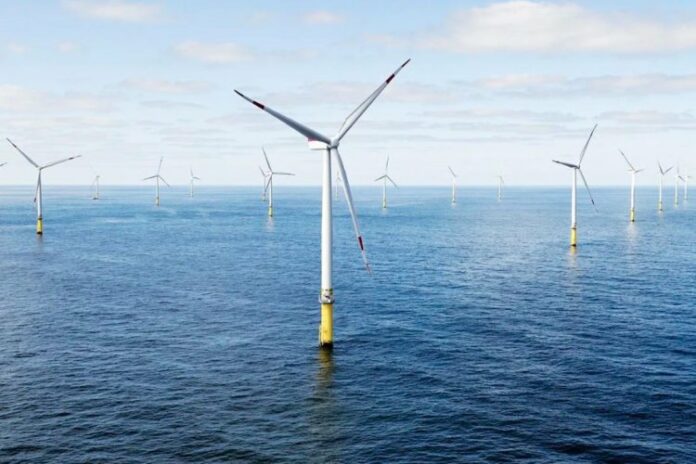
Skipjack Wind 2 will play a significant role in helping Maryland reach its goal of installing at least 1,200 MW of offshore wind energy by 2030. Ørsted’s new Skipjack Wind 2 project will deliver more than two-thirds of the state’s target.

David Hardy, CEO of Ørsted Offshore North America, said:

“We are honored that Maryland’s Public Service Commission selected Ørsted as a trusted partner in helping the state reach its ambitious renewable energy goals, and we’re proud that we’re once again able to leverage our market-leading portfolio of offshore wind projects to attract major supply chain companies to set up local manufacturing operations in Maryland.

Skipjack Wind 2 will contribute significantly to Maryland’s goal of sourcing 50 percent of its power from renewable energy sources by 2030, while positioning Maryland as a long-term offshore wind energy manufacturing hub. We look forward to delivering on our commitments now, and well into the future, so that Maryland residents benefit from offshore wind for decades to come.”

Skipjack Wind 2 is Ørsted’s second offshore wind energy project in Maryland. It will be located adjacent to the company’s 120 MW Skipjack Wind 1. Ørsted will build Skipjack Wind 1 and 2 as one project, with operations expected to begin in 2026.
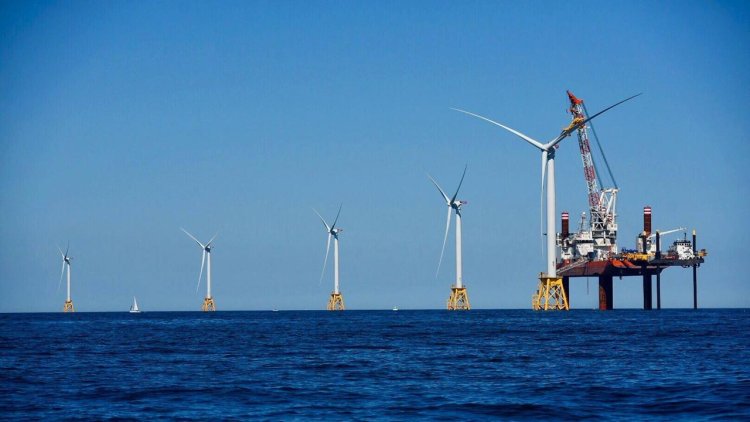
Ørsted has been partnering with local businesses since 2017 to develop Maryland’s first offshore wind project off the Delmarva Peninsula. Skipjack Wind 2 will generate approximately $510 million in supply chain investments in Maryland and create thousands of jobs, including in manufacturing, operations and maintenance. These investments further strengthen the region’s position as an economic and technical offshore wind energy hub, supporting the growing U.S. industry and the international market. In addition to these investments into the region’s port and manufacturing facilities, Maryland is also well positioned to serve as a training center for a new green workforce.

With Skipjack Wind 2, Ørsted is bringing a commitment to partner with Hellenic Cables SA to establish the U.S.’s first fully integrated array cable manufacturing facility in Maryland. Ørsted will also facilitate the construction of a world-class offshore wind tower manufacturing facility in the state, which can produce 100 turbine towers annually. Ørsted is already developing Maryland’s first offshore wind operations and maintenance facility in West Ocean City, and in October established Maryland’s first offshore wind steel fabrication center at Crystal Steel Fabricators in Federalsburg. 

The benefits of the emerging offshore wind industry will be felt throughout Maryland and Delaware. As the global leader in offshore wind, Ørsted is uniquely positioned to serve as a trusted, long-term partner, creating quality jobs and new business opportunities, and investing millions of dollars in local communities.

Subject to Ørsted’s final investment decision, Ørsted expects to commission Skipjack Wind 2 in 2026.
Isle of Wight Tidal Power project gains consent

0

The Isle of Wight Council unanimously approved the construction of a substation within the Southern Water Services compound to the west of Ventnor.

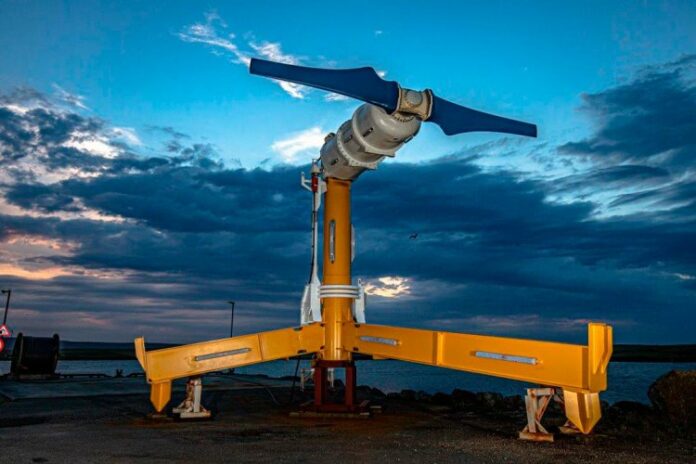
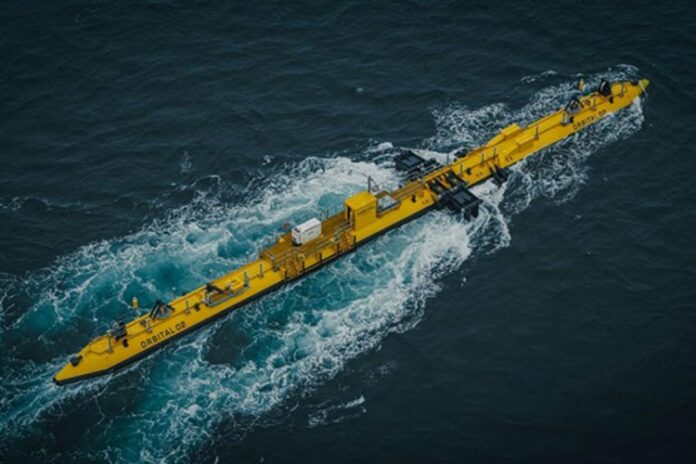
This approval is a huge boost to the UK’s renewable energy sector. PTEC now has all the consents in place to proceed with its proposal – England’s first multi megawatt tidal stream power generation project. By placing tidal turbines in the sea off the south coast of the Isle of Wight, the project will supply predictable, renewable energy direct to the national grid.

PTEC, with consenting activities being managed by the European Marine Energy Centre (EMEC), has already signed an agreement with technology developer Orbital Marine Power to deploy its innovative O2 turbine with the project.

EMEC led the reconsenting works at the site including an updated Section 36, full planning application and Environmental Impact Assessment, as well as managing an application to SSEN for access to the electrical grid. Crucial to the success of the project has been building supply chain partnerships across the UK with a strong focus on companies local to the Isle of Wight,  including RSK Group, AECOM, Athene Communications, Modh Design, Joe Hussey, and Mark Dickson Planning.

This planning approval is particularly timely given the government’s announcement in November that it will support the tidal energy sector. It has committed to give £20 million per year in the next Contracts for Difference (CfD) round, which opened yesterday.

Rob Stevens, Chairman of PTEC, said:

“At a time when the world’s reliance on fossil fuels is causing significant challenges, gaining permission for the onshore elements of the PTEC project is of national importance. Tidal energy is now a proven route to continuous, clean energy generation and has enormous potential. The government’s commitment comes at the perfect time, enabling the UK to take advantage of this source of carbon neutral energy generation.

“Once we have government support in place we can start work, with the aim to begin operations in 2025. Throughout the planning process, we’ve offered multiple opportunities and avenues for stakeholders and residents to engage with us, and their feedback has helped us shape our proposal. Going forward regular consultation and engagement will be fundamental to the construction process to make it as smooth as possible.”

Matt Storey, Technical Project Manager, EMEC, said:

“The PTEC site is crucial as it now provides a clear consented pathway for the commercialisation of tidal stream power in England and is fully compliant for applications under the government’s Contracts for Difference scheme. It has been a pleasure to manage a project of such potential national importance with a client who committed to growing the marine energy industry. A zero carbon energy mix is vital for the country to meet and hopefully exceed its climate goals.”

Oliver Wragg, Commercial Director at Orbital, said:

“With clear Government backing for tidal stream energy, we are now seeing significant commercial project opportunities come forward with the ability to secure a CfD in AR4 and move into construction. We very much see this as the UK Government firing the starting gun on what will rapidly become a new global renewable energy industry and paving the way for Orbital to provide meaningful volumes of clean and predictable energy to help turn the tide on climate change.

“Successful project applications will result in substantial inward investment in UK supply chain, with creation of hundreds of jobs across the length and breadth of the country. In addition to the manufacture of Orbital turbines, long-term local employment will be created to support the ongoing delivery of these flagship renewable energy projects.”

Onshore construction work is anticipated to commence in 2023, for completion by 2025. In line with the commitments made during the public consultation process, PTEC will work with local residents and businesses to ensure minimal disturbance.

The PTEC project will bring economic growth to the Isle of Wight, creating an innovative new industry sector for the island and renewed attention to this part of the UK, as well as helping the Isle of Wight Council achieve the targets it has set in its recently published ‘Mission Zero Climate and Environment Strategy 2021 – 2040’.

Rolls-Royce makes Duisburg container terminal climate-neutral

0

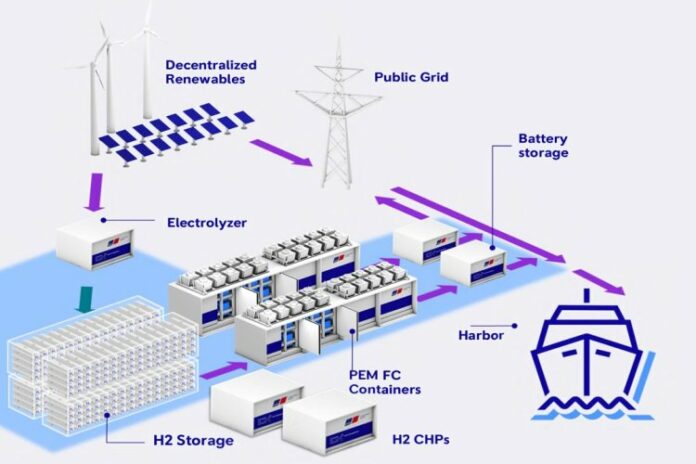
Rolls-Royce’s Power Systems business unit is supplying its latest mtu hydrogen technology for this purpose, in order to supply the future terminal with electrical energy and heat in a sustainable manner: mtu fuel cell solutions for electrical peak load coverage as well as mtu hydrogen heat and power generation station.

To this end, Duisport, one of the world’s largest inland ports, is working with several partners to build a hydrogen-based supply network by 2023 that includes several technologically sophisticated options for energy conversion and storage.

Hydrogen as one of the fuels of the future and as an essential building block for the energy transition will play a central role when, in a few years’ time, Duisburg, Europe’s largest inland port, shows what the energy supply of the future may look like: decentralised and climate-friendly. The largest container terminal in Europe’s hinterland is currently being built on the former coal island, once a transshipment point for bulk cargo. It will not only set new standards in cargo handling, but also in climate-friendly energy supply. The main role in this project, called “enerport II”, is played by fuel cells and mtu hydrogen engines – each with different tasks.

The hydrogen-powered mtu fuel cell solutions supply electrical power as soon as the public power grid reaches its limits, for example for the on-board power supply of ships berthed in the port or in the event of other load peaks. In addition, two combined heat and power plants with mtu hydrogen engines of the 4000 series convert hydrogen energy into electrical energy, which is fed into the supply network of the future container terminal or into the public grid. The waste heat is used for process heat or for heating buildings in and around the port.

Furthermore, photovoltaic systems and battery storage are integrated into the local supply network, which is being realized by the port operator Duisport, Westenergie Netzservice, Netze Duisburg, Stadtwerke Duisburg and Stadtwerke Duisburg Energiehandel together with the Fraunhofer Institute Umsicht. The project is being funded by the German Federal Ministry for Economic Affairs and Energy for a period of four years as part of the “Hydrogen Technology Offensive”.

Andreas Schell, CEO of Rolls-Royce Power Systems, says:

“Hydrogen technology is no longer a dream of the future, but hydrogen technology will prove itself in everyday use in Duisburg. The parallel use of fuel cell solutions and hydrogen engines shows that we have taken the right path with our technology-open approach to the development of new solutions for the energy supply of the future.”

KCC and Wartsila sign contract to deploy propeller add-on to boost fuel savings

0

Klaveness Combination Carriers “KCC” and Wartsila have signed a contract securing Wartsila EnergoProFin for CABU vessels MV Bakkedal, MV Bangor and MV Bantry. 

The device replaces the propeller boss of each vessel and is equipped with tailor-made fins to cancel any vortex from occurring from the boss cap, reducing drag from the vessel.

Aboard KCC’s vessels, the device is expected to give a fuel savings of approximately 2 to 3% and are compatible with the Becker Mewis Duct  planned for installation also on these vessels. Both devices are scheduled to be installed during these vessels’ planned dry dockings over 2022. 

KCC has previously installed the Wartsila EnergoProFin on the sister vessels MV Barcarena and MV Banastar, and feedback from these installations has been positive. With this order all five CABU I vessels built 2001-2007 are equipped with the technology. 

P&O Ferries and We4Sea sign contract on vessel performance monitoring

0

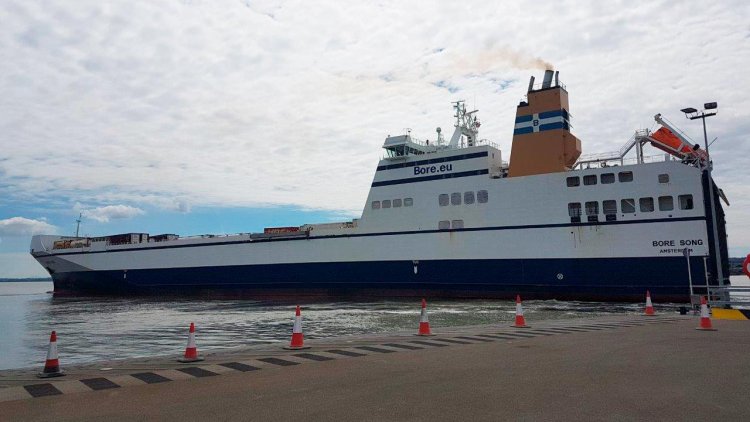
P&O Ferries and We4Sea have signed a cooperation agreement to roll-out the We4Sea Digital Twin based performance monitoring solution over the P&O Ferries chartered fleet. 

P&O Ferries are one of the UK’s largest ferry operators with a vast fleet of ships serving a network of ferries to France, Belgium, Holland, Ireland, England and Northern Ireland.

We4Sea, a Rotterdam based maritime scale-up focussing on increasing the fuel efficiency and reducing the emissions of seagoing ships, uses a Digital Twin based analysis as part of their online software platform. The Digital Twin is used to provide ship charterers and ship owners with improved analysis tools.

As part of their continuous efforts to reduce fuel consumption and emissions, P&O Ferries and We4Sea  have agreed to roll out the monitoring solution over the P&O Ferries chartered fleet.

‍P&O Ferries is not the owner of many of the vessels they operate. We4Sea’s software module has been developed with a focus on charterers, that do not have direct access to the vessel and do not have the option to install monitoring equipment.  

The proprietary Digital Twin technology of We4Sea enables the building of a digital sister vessel with all relevant technical characteristics of the real vessel. This data is enriched with other data sources, such as data on vessel speed, draught, weather conditions, wave heights, currents, and wind. The Digital Twin is capable of transforming this big data pool into real-time actionable management information.

This technology does not require the installation of hardware on-board and is therefore ideal for charterers.

Charterers like P&O Ferries can use a web-based platform to continuously monitor the fuel consumption and carbon emissions of their chartered vessels in real-time.

The software solution supports full transparency as to the operations of ships, and is used to optimize fuel efficiency and reduce emissions.


Scottish energy innovators win €2.5M to turn up the tempo of tidal power

0

TIDAL titans Nova Innovation have won €2.5 million to build an upscaled tidal energy turbine that will further slash the cost of tidal power and meet the needs of utility clients and coastal populations around the world.

The European Innovation Council (EIC) Accelerator Fund will finance Nova’s UpTEMPO (Upscaling Tidal Energy Manufacturing and Production Output) project – a two-year campaign to design, build, and demonstrate an enhanced version of Nova’s 100kW tidal turbine.

The advanced 200kW device will feature blade pitch control, increasing the amount of power and energy generated, and a more compact turbine body that will reduce the weight and cost of the device. Together, these innovations will cut the cost of tidal energy by 30%, smashing the EU Strategic Energy Technology (SET) Plan tidal energy cost target of €150/MWh by 2025.

Simon Forrest, CEO of Nova Innovation, said:

“Tidal energy is needed for our future renewable energy mix – it is clean, reliable, predictable and has no visual impact. The EIC funding will help us develop our world-leading tidal energy technology that has been generating energy to the grid since 2016. Our current M100-D tidal turbine, named ‘EUnice’, has delivered outstanding performance since deployment in Shetland in 2020. The UpTEMPO project will build on this success, driving down costs even further through innovation and economies of scale. The turbine will be designed to meet the needs of utility clients in our target markets around the world.”

In 2016, Nova Innovation was the first company to successfully deliver an offshore array of tidal turbines, in Bluemull Sound, Shetland. Nova is working on tidal energy projects across the UK, Europe, North America and Asia.

Siemens Gamesa commissions new hydrogen-ready SOV

0

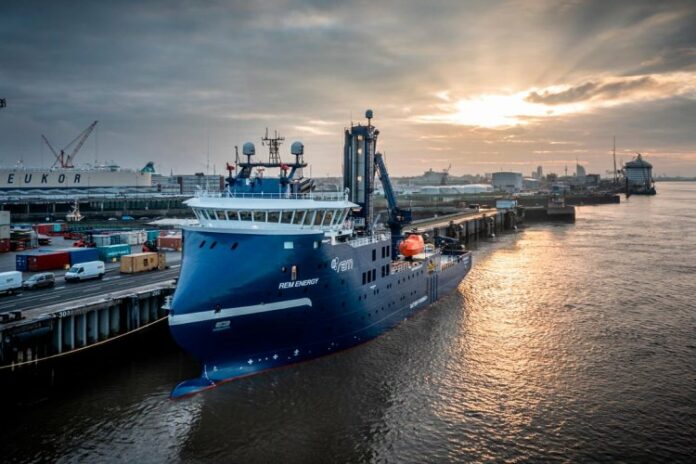
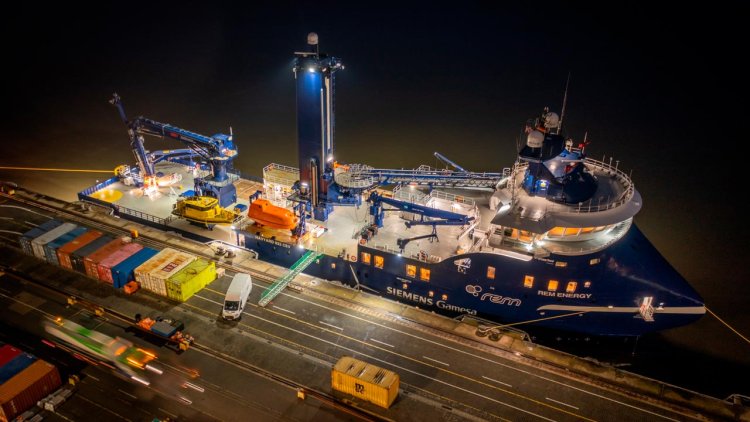
The latest member of Siemens Gamesa’s fleet of ships is equipped with environmentally friendly propulsion technology. The vessel is ready for the addition of a 12-MW battery which would reduce energy consumption during operation. The REM Energy is also capable to run emissions free on green hydrogen or with batteries and offshore charging. This puts the SOV ahead of its time. Until a green hydrogen economy is established in Germany, the ship will be conventionally powered by efficient diesel generators.

The REM Energy is almost 90m long and almost 20m wide. It will be the workplace and living quarters for up to 75 offshore service technicians and 24 crew members.

Stephan Hauhs, Managing Director of Siemens Gamesa Renewable Energy Deutschland GmbH in Bremerhaven, enthuses:

“The REM Energy is setting new standards in terms of occupational safety, sustainability and efficiency. With the new SOV, we will be able to optimize the service we are providing for our customers. We will increase the availability of the offshore turbines, thereby reducing the cost of electricity and ensuring more clean energy while increasing the safety for our offshore service technicians.”

Jonas Pagh Jensen, Sustainability Specialist at Siemens Gamesa, says:

“We are taking the first step in getting ready to cut our emissions in offshore service operations. The commissioning of the REM Energy is a strong signal highlighting the availability of clean technology to facilitate operation without emissions. Governments, industry and investors now need to partner up quickly to ramp up a green hydrogen infrastructure to facilitate the decarbonization of marine shipping.”

Worldwide marine traffic accounts for more than 900 million tons of CO2 emissions which is more than the entire nation of Germany emits. Shipping is a sector that is difficult to electrify. Green hydrogen and other power-to-X fuels produced with renewable energy are a key building block for reducing emissions. With the Brande Hydrogen pilot project and the development of an offshore-wind-to-hydrogen-turbine with integrated electrolyzer, Siemens Gamesa is leading the way to unlock a green hydrogen revolution.

Siemens Gamesa became carbon neutral in 2019 – five years ahead of schedule. In 2020, the company was powered by 100% renewable energy and had the SBTi (Science Based Targets Initiative) verify that our emission reduction targets until 2025 are meeting the most ambitious 1.5°C scenario. To document its progress, Siemens Gamesa publishes a Greenhouse Gas Emissions report annually which is externally verified.

Thanks to its azimuth thrusters which can be rotated 360 degrees around the vertical axis, the ship is extremely maneuverable, enabling it to safely move between the wind turbines even in rough seas. The ship has a gangway that stabilizes the wave movements and enables the technicians to safely transfer from the ship to the offshore wind turbine. To make the stay at sea as pleasant as possible, there is a fitness room, a cinema and a gaming room on board. The offshore service technicians will live on board and work in shifts. The Siemens Gamesa crew will rotate every 14 days, while the REM Energy itself is able to operate at sea for a total of more than a month before having to return to port again.

The ship was delivered from the Norwegian shipyard Green Yard Kleven on December 3, 2021 and was christened there in mid-November. Siemens Gamesa has chartered the REM Energy for 4 years, and will be operated by the shipping company REM ENERGY AS. The home port for the service operations will be Bremerhaven. The REM Energy will be deployed in the offshore wind parks Global Tech 1 and Trianel Borkum West.

New ocean floats to boost global network essential for climate research

0

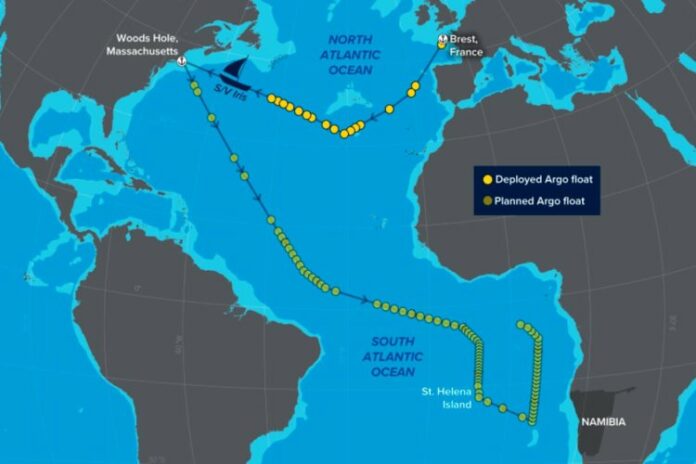
NOAA and partners have joined together to launch approximately 100 new Argo floats across the Atlantic ocean to collect data that supports ocean, weather and climate research and prediction. These will bolster the international Argo Programoffsite link, which maintains a global array of about 3,800 floats that measure pressure, temperature and salinity of the upper 2,000 meters (1.2 miles) of the ocean.

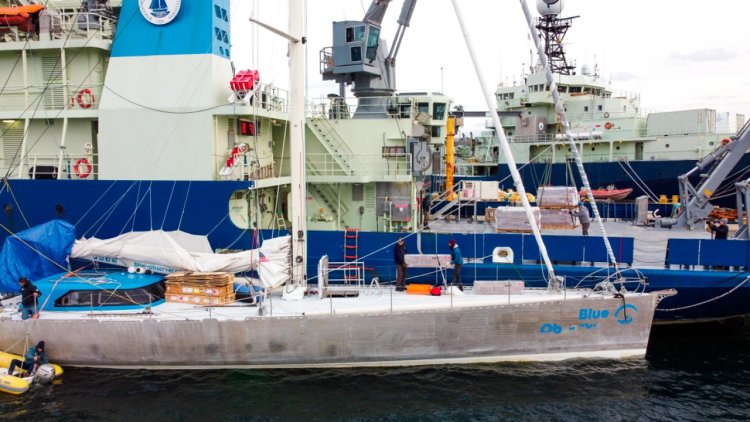
The French sailing vessel Iris arrived in Woods Hole, Massachusetts, this week after deploying the initial batch of 17 Argo floats across the Atlantic. While in Woods Hole, the S/V Iris crew will pick up the remaining floats for the second leg of the voyage in the South Atlantic, towards the island of St. Helena, off the coast of Namibia. The mission is one of the largest Argo float deployments in the Atlantic and is expected to last almost 100 days at sea, filling in crucial observing gaps.

This low-carbon research mission using an 82-foot sailing vessel was made possible through a new partnership between the private oceanographic company Blue Observeroffsite link and international Argo Programoffsite link partners from Woods Hole Oceanographic Institutionoffsite link, NOAA, Fisheries and Oceans Canadaoffsite link and Europeoffsite link.

NOAA Administrator Rick Spinrad, Ph.D., said:

“Coming at a moment when we need meaningful action to tackle the climate crisis, this low carbon emission research mission sets a strong example for future ocean observing research. This voyage is a model of global public-private partnership that is helping us improve data that drive life-saving weather and climate forecasts.”

During what is one of the largest missions by a sailboat to deploy profiling floats, the S/V Iris crew will deliver Argo floats to predefined GPS positions, replacing those at the end of their life, and deploying floats in some new, under-measured regions to strengthen the Argo array. The mission lifetime of each float is about five years. During a typical mission, each float reports a profile of the upper ocean every ten days, transmitting data to shore by satellite.

Peter de Menocal, Ph.D., president and director of the Woods Hole Oceanographic Institution, said:

“Argo has revolutionized our ability to detect and monitor how the global ocean is changing as climate changes. The whole ocean warming trends observed by Argo floats is proof positive that climate change is due to greenhouse gas emissions.”

The initiative was born during the international COVID-19 pandemic, when deployment of Argo floats and other oceanographic instruments by research and commercial vessels was sharply curtailed by COVID-19 restrictions.

Mathieu Belbéoch, a manager of the Global Ocean Observing System and partner, explained:

“About 1,000 Argo profiling floats must be deployed every year to sustain the Global Ocean Observing Systemoffsite link. Often, they are deployed opportunistically by research ships, but these are very costly, and their trajectories are tied to specific missions and are not able to fill all the gaps or work in all seasons. Collaborations with citizens allow us to reach remote and not yet well sampled areas of the ocean, filling critical observational gaps.”

The low-impact journey comes on the heels of the 2021 UN Climate Change Conference in Glasgow, Scotland, with its urgent message of curbing the planet’s warming emissions. This innovative collaboration between intergovernmental, public, and private sectors also takes place within the United Nations Decade of Ocean Science for Sustainable Development, and is funded by NOAA, WHOI, Fisheries and Oceans Canada and Euro-Argo.

In more than two decades, the broad-scale global array of floats has grown to be a major component of the ocean observing system and has changed the way scientists think about collecting data and collaborating internationally on data management for the scientific and operational forecasting community.

Susan Wijffels, senior scientist of physical oceanography at WHOI and an Argo Steering Team co-chair, said:

“Argo’s impact on ocean research has been profound: at least one paper a day is published using Argo data. The voyage of Iris will help us track vast regions of the Atlantic over the next few years by replenishing the array in very hard to access regions.”

Timothy Sargent, Deputy Minister, Fisheries and Oceans Canada, said:

“The Argo program is a true demonstration of the value of international collaboration. Since 2001, Canada has launched over 600 Argo floats throughout the Atlantic and Pacific oceans. This OCEANOPSoffsite link Blue Observer mission is another example of partners working together to provide ocean data to the world.”

Danfoss Drives solutions on board Maersk Tender help to reduce CO2 emissions

0

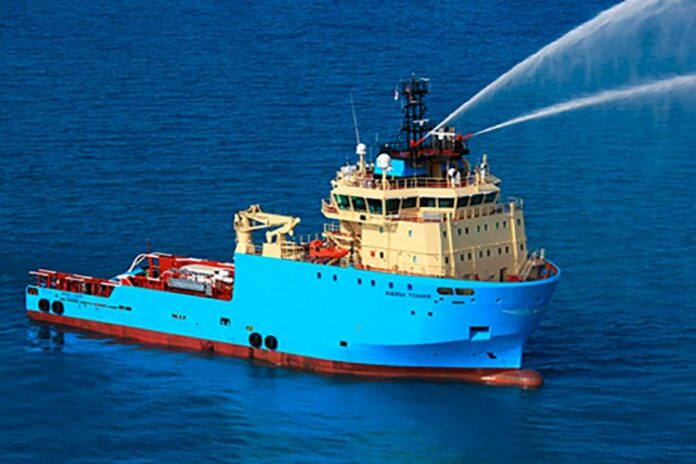
Biofuel is an expensive alternative to standard marine oil. However, despite the cost, this test provides valuable insight into technology which further reduces emissions in the long term.

The ship was retrofitted with AC drives from Danfoss Drives on each of its four thrusters. These drives help Maersk Supply Service to achieve even more energy savings, since the thrusters no longer rotate continuously and thus only consume electricity when actually required. Thrusters usually run at full speed. Now, they are controlled individually, and this is very useful when running Dynamic Positioning (DP) mode. Danfoss Drives supplied 2 x 800 kW VLT® AutomationDrive FC 302 and 2 x 500 kW VLT® AutomationDrive FC 302 units for control of the 4 thrusters.

In addition, Maersk Supply Service installed AC drives from Danfoss Drives to improve efficiency of all engine room fans. Efficient ventilation is another important contribution to ensuring fuel-efficient consumption.

The results of this study can now pave the way for similar upgrades to be carried out on several of Maersk Supply Services’ T-class vessels, explains Maersk Supply Service.

With the new solution, Maersk Supply Service has succeeded in reducing fuel consumption. When operating in Dynamic Positioning (DP) mode, fuel consumption is reduced by approximately 30%.

Caspar Daugaard Andersen, Key Account Manager at Danfoss Drives Sales Denmark, says:

“It has been an exciting process to help make a difference in reducing the carbon footprint at Maersk Supply Service. We have many other exciting collaborations in the pipeline, where we will hopefully achieve the same good results.”

Royal IHC supplies first Easydredge TSHD to Mexican Navy

0

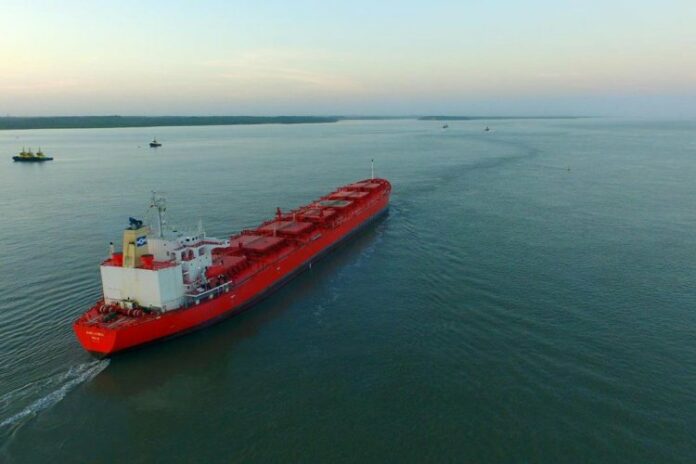
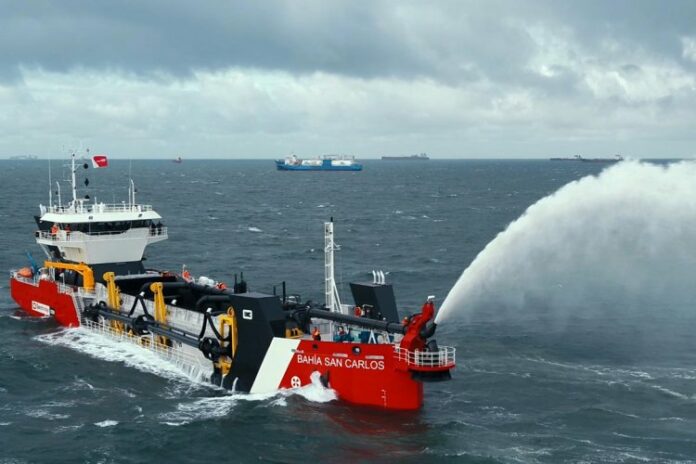
Royal IHC has delivered an Easydredge® 2700 trailing suction hopper dredger (TSHD) to SEMAR (Secretaria de Marina) at the Port of Veracruz in Mexico. Being built from the stock program allowed Royal IHC to comply with SEMAR’s request for an ultra-short delivery time. 

Following successful sea trials in the North Sea in October, the new vessel was delivered on time on 16 December for deployment on a national maintenance programme by the Mexican Navy. This will involve deepening rivers on the country’s east coast and helping to prevent flooding in Tabasco.

As the Easydredge® is a standardised series of vessels, it benefits from short lead times and is a cost-effective option for customers seeking quick delivery. The vessels are equipped to perform all normal dredging operations, are easy to operate. Their straight forward design and reliability of the vessel incorporate decades of hopper dredge innovation and will contribute to the efficiency of the SEMAR dredge fleet.

The BAHIA SAN CARLOS was outfitted with standard options as well as client specific modifications including  a hydrographic presentation system (DTPS) and the Operations Monitoring application for onshore monitoring and supporting of the operation. In line with the Royal IHC philosophy to remain engaged with their client during the operations, as a total solution partner, extensive training for the crew has been provided and spare parts for the vessel supplied.  

The relation with SEMAR dates back to the eighties when they first purchased dredger the Ciudad del Carmen. 

Ronald van Son, Director Dredging Vessels, says:

“Last year SEMAR purchased a Beaver® from Royal IHC and recognises its vast experience and proven track record in the dredging market. The fast delivery time of less than a year was a crucial factor in its decision to order the Easydredge®. This project has run very smoothly, and everything has gone according to schedule.”

SEMAR also recognises the quality and added value provided by Royal IHC, particularly in terms of training and spare parts. Project Manager Jan Willem Stuurman says:

“We had an excellent relationship with the new crew – they were really enthusiastic about the vessel and commented on the high level of quality.”

The BAHIA SAN CARLOS is the sixth Easydredge® vessel to be sold by Royal IHC and the company believes demand for its modular TSHDs will increase further. The line-up comprises four vessel sizes: Easydredge®700, 1700, 2700 and 3700, which range in volume from 500 to 4,000m3.