-1.6 C
New York
Home Blog Page 475

MSM Ocean and Sonardyne partner on tsunami early warning system

0

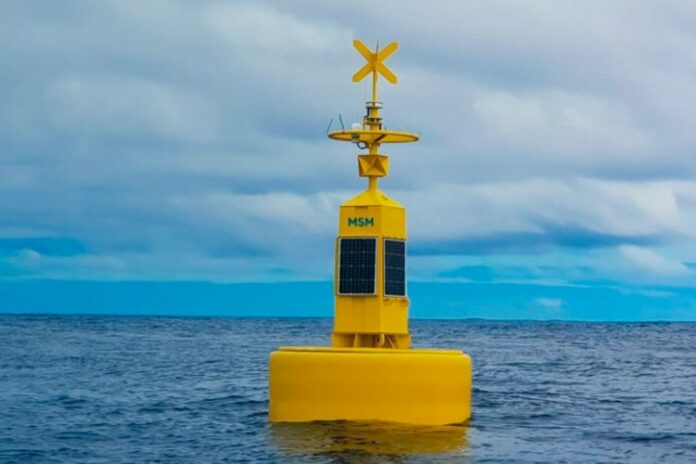
Metocean and environmental data measurement specialist MSM Ocean and marine technology company Sonardyne have agreed to team-up on the supply of a complete solution for warning coastal communities of a tsunami.

The agreement combines MSM Ocean’s expertise in oceanographic measurement buoys, on-board data processing and telecommunications and Sonardyne’s highly precise deep water pressure measurement and acoustic through-water telemetry capabilities.

Together, these allow minute changes in deep water pressure at the seafloor that indicate a tsunami to be reliably detected, triggering a direct alert to national emergency organisations via acoustic and satellite communications, all within seconds.

The tsunami early warning system is fully International Association of Marine Aids to Navigation and Lighthouse Authorities (IALA) compliant and can be deployed in areas of up to 7,000 m water depth.

Through the teaming agreement, MSM Ocean and Sonardyne have also agreed to explore further possibilities for combining their technologies in support of remotely connecting ocean scientists to their instruments on the seafloor via buoys.

Sonardyne has been supplying integrated Bottom Pressure Recorders (BPRs) configured for deepwater tsunami detection to organisations around the world since 2007. Combining precise sensing, long-life battery and reliable communications in one easy to deploy and recover instrument, they were developed following the devasting 2004 Indian Ocean tsunami. For the past decade, these have been integrated into MSM Ocean’s buoy-based Tsunami Early Warning Systems, which have been successfully installed along the Pacific coast of South America.

This includes two systems deployed off Ecuador which detected the January 15 tsunami, caused by the Hunga-Tonga submarine volcano eruption, 10,000 km away in the South Pacific. Alerts were raised by MSM Ocean’s buoys with the National Tsunami Warning Center of Ecuador just 35 seconds after the wave was detected by Sonardyne’s Bottom Pressure Recorder.

Cecile Zanette, CEO at MSM Ocean, says:

“Tsunamis present a threat to numerous coastal countries around the world mostly located around the Pacific Ring of Fire, but also in other areas maybe less present in our minds, such as in Europe and the Caribbean for example. Reliable and available systems of detection and early warning are a key component in the complex equation to mitigate the risk to the population. And this is exactly such a system, field-proven, that we have developed combining Sonardyne’s highly precise Bottom Pressure Recorder technology with our instrumented buoys’ expertise.”

Geraint West, Head of Science at Sonardyne, says:

“We have been working closely with MSM Ocean for more than a decade and together we recognised the benefit of providing a fully integrated and supported seafloor-to surface-to shore solution. By formalising our relationship, we can now offer a one-stop-shop for this critical capability to a wider range of coastal communities. Organisations can now approach either company for their remote tsunami early warning system configured to match their exact needs.”
Fincantieri: double delivery despite the pandemic

0

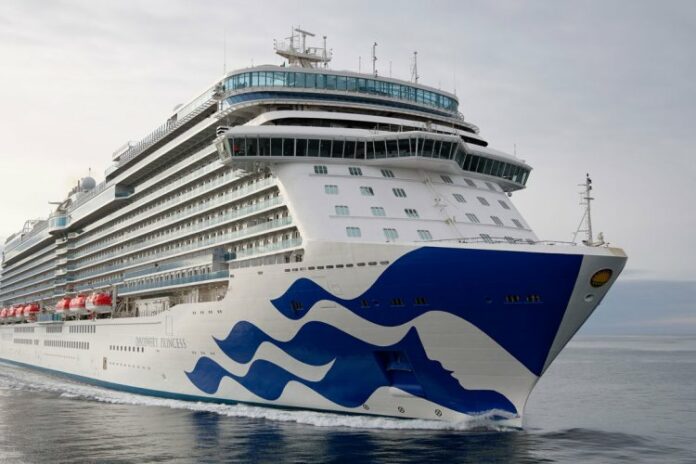
Fincantieri has delivered “Discovery Princess”, the sixth unit of the so well-received Royal-class built of Princess Cruises, a brand within Carnival Corporation, in the Monfalcone shipyard.

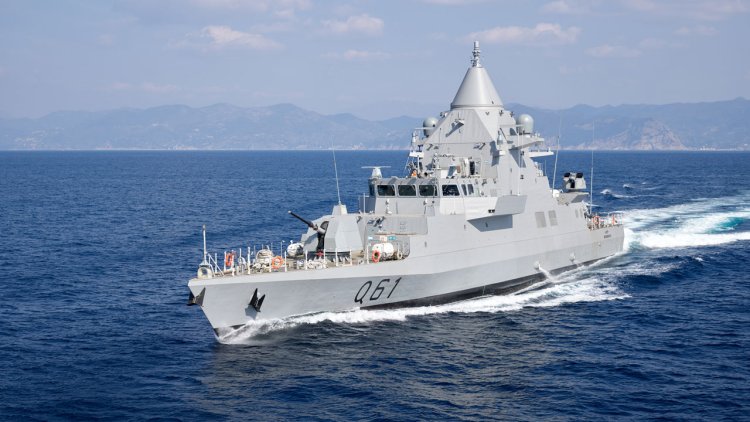
In Muggiano, the Group has delivered the first-in-class OPV – Offshore Patrol Vessel – “Musherib”, ordered by the Qatari Ministry of Defence.

As provided for in the contracts, the two deliveries have allowed the company to cash in a total amount of approximately 550 million euros.

“Discovery Princess” is the first cruise ship that Fincantieri delivers in 2022, and 6 other ships will follow during this year. Currently, the Group has 14 cruise ships – out of a total of 28 passenger units in the backlog – under construction at different levels of progression, extending the time-frame of this segment until 2027.

Building “Discovery Princess” and “Musherib” took overall 9.2 million work hours carried out by almost 8,000 people and involving about 650 companies of the Fincantieri supply chain.

This milestone relates to high-tech projects in different shipbuilding segments, confirming that Fincantieri is able to meet its commitments on time and on budget. More important from a management and organizational point of view: the goal has been achieved although lasting of the pandemic.

Svitzer awarded Western Australia LNG terminal contract with Woodside

0

Svitzer has entered into a 12 year contractual arrangement with Woodside Energy Limited (Woodside) for the provision of towage and pilot transfer services at Woodside’s LNG export operations in the Port of Dampier, commencing from the end of 2023.

Following an innovative open tender process, Svitzer will provide five modern 80-ton bollard pull tugboats to service the critical towage needs for the shipping of export LNG cargoes. Svitzer will also provide one new pilot transfer vessel for pilot transfer services to support Woodside and its joint venture operations.

This tender outcome will see Svitzer provide world-class services to Woodside that deliver value and efficiency, while significantly reducing emissions across fleet operations by deploying smart and innovative enhancements to the tugs’ design and operating model.

Commenting on the contract award, Nicolaj Noes, Managing Director for Svitzer Australia said:

“Svitzer looks forward to collaborating with Woodside to further reduce emissions from its tug operations by incorporating the latest proven new technologies over the term of the contract.

“It is a key priority for Svitzer to contribute positively to the local communities where we operate. A key outcome of the tender will be the commissioning of a new pilot transfer vessel to be built in WA, and providing a tailored training and professional development package for a WA-based workforce.”

Weather, cleanup keep oil slick away from Thai resort island

0

Favorable wind and sea conditions kept an oil slick away from beaches in eastern Thailand on Sunday, according to authorities, but concerns remained that the spillage may yet strike a popular resort island.

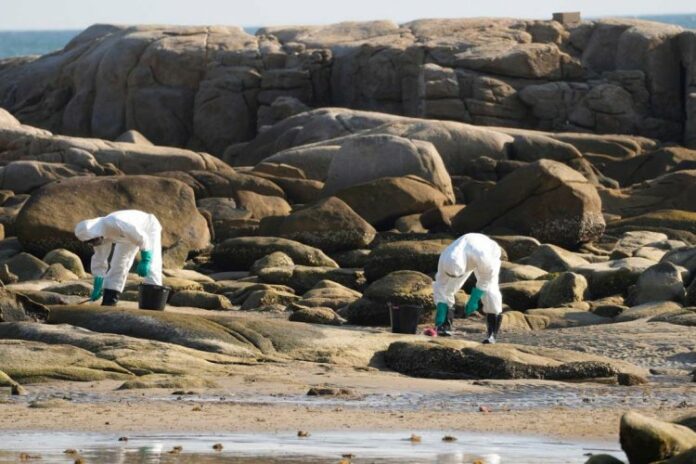
Emergency workers in protective gear removed contaminated sand from the Mae Ramphueng beach in Rayong province, southeast of Bangkok, which was shut on Saturday.

Some 20-50 tons of oil are estimated to have leaked Tuesday night in the Gulf of Thailand from an undersea hose used to load tankers at an offshore mooring point owned by the Star Petroleum Refining Co.

The leak was stopped within hours, the company said.

Most of the oil slick was being pushed toward Koh Samet, a popular tourist island that’s just beginning to recover from the coronavirus pandemic slump along with the rest of the country.

Natural Resources and Environment Minister Varawut Silpa-archa said authorities were taking steps to prevent it hitting the beaches there.

Aircraft have been dropping chemicals to disperse the oil and deploying floating booms to trap it so that it can be skimmed from the surface and removed.

Varawut Silpa-archa told The Associated Press after surveying the Rayong beach, said:

“I am very confident that for one we will be able to prevent the majority of the oil spill to ruin our natural resources, especially the corals.”

“Of course some of the corals will be damaged but the majority of it we will be able to save and we will be able to minimize the effects on the people.”

The beachside area is largely dependent on tourists. It has been suffering from the pandemic that has kept visitors away, and the spill will make recovery harder. The local fishing industry was also affected by the pollution.

Asked how long until he could declare the disaster over, Varawut said that “visually it should be over within a week but environmentally it would last years.”

Source: The Associated Press

Revised start-up date for Hammerfest LNG

0

The previous estimate for the start-up date was given with uncertainty particularly related to the development of the Covid-19 pandemic.

Grete B. Haaland, senior vice president for Equinor’s onshore plants, says:

“We work systematically to deliver on the plan we established, but challenges related to Covid-19 restrictions require that we need more time to prepare the plant for safe and stable start-up and operations.”

Extensive work has been carried out after the fire at the plant in September 2020. More than 22,000 components have been checked, 180 kilometres of electrical cables have been replaced and daily around 1,000 people have been working to get the plant back into operation.

Repairs of advanced equipment and compressors have been carried out in addition to executing a planned turnaround and ordinary maintenance. To limit Covid-19 infections, comprehensive measures and strict distancing rules have had to be maintained in all areas of the plant.

Thor Johan Haave, plant manager at Hammerfest LNG, says:

“The latest wave of infections, combined with restrictions and narrow working areas, impacts the progress. At times, half of staff have been in quarantine and isolation.”

“The project work is nearing completion and we`re doing what we can to finish the project. We are pleased with the good cooperation we have with Hammerfest municipality, employee representatives, safety delegates and suppliers. Now it is all about completing the job together.”

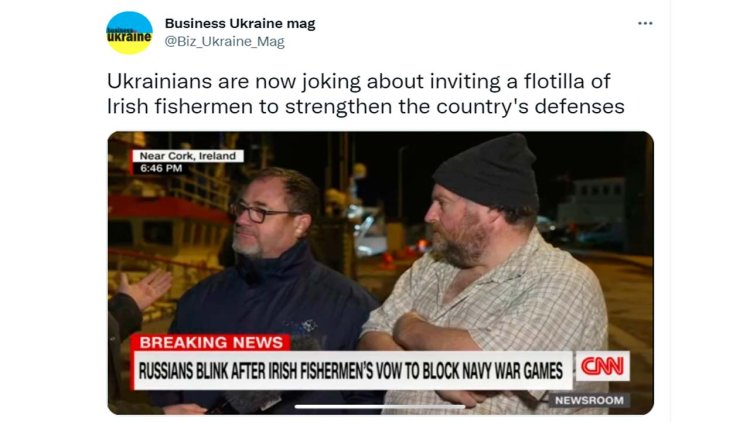
Russians back off after Irish fishermen vow to disrupt war games

0

Western powers’ diplomatic overtures to Russia, aimed at de-escalating tensions over Ukraine, have made little headway in recent weeks. Irish fishermen have seen more success.

Russia said it would relocate naval exercises scheduled to take place off Ireland’s southern coast beginning Feb. 3 following an outcry from local fishermen, who had pledged to protest the exercises and launched a diplomatic campaign to convince Russia to change course.

Yuri Filatov, the Russian ambassador to Ireland, said in a news release Saturday that Russia’s defense minister had decided, “as a gesture of goodwill,” to move the military exercises outside of Ireland’s exclusive economic zone “with the aim not to hinder fishing activities by the Irish vessels in the traditional fishing areas.”

Fishermen near Cork in southern Ireland cheered the announcement, and social media users circulated posts commending them for standing up to Russia.

The naval drills were slated to take place Feb. 3-8 about 150 miles off the coast of west Cork, within Ireland’s exclusive economic zone. Ireland retains control of all economic resources, including fishing, within the zone, which can extend to a maximum of 200 nautical miles from the shore.

International law permits the Russian military to carry out exercises in the area. But fishermen said the drills would threaten the fish stock and disrupt their traditional fishing grounds.

In what they described as a “peaceful protest,” the fishermen pledged to carry on with their fishing activities as usual, Russian warships or no Russian warships.

Filatov, the Russian ambassador, initially dismissed the controversy around the drills as “hugely overblown” and part of a “propaganda campaign” about an alleged Russian threat to Europe, according to the BBC.

Irish foreign minister Simon Coveney wrote to the Russian defense minister last week to ask Moscow to reconsider the naval exercises.

“I have made it clear to the Russian ambassador in Ireland that it’s not welcome. This is not a time to increase military activity and tension in the context of what is happening with and in Ukraine at the moment,” Coveney said last week, CNN reported.

The dispute came as tensions between Russia and Ukraine reach an apex. Russia has massed tens of thousands of troops on the border with Ukraine, and officials in Washington and London have warned a Russian military invasion is imminent.

Britain said Saturday it was preparing to send extra forces to Eastern Europe to shore up NATO allies, after President Biden said he would send some U.S. troops to the region for the same purpose. The U.S. military has issued “prepare to deploy” orders to 8,500 personnel, even as Russian and Ukrainian authorities accused Western officials of overhyping the likelihood of a Russian attack.

Ireland is not a member of NATO.

Brendan Byrne, chief executive of the Irish Fish Processors and Exporters Association, who also took part in talks with Russian embassy officials, told Sky News that his organization is now calling for a 10-year moratorium on naval exercises by any country within Ireland’s exclusive economic zone.

Brendan Byrne, chief executive of the Irish Fish Processors and Exporters Association, who also took part in talks with Russian embassy officials, told Sky News that his organization is now calling for a 10-year moratorium on naval exercises by any country within Ireland’s exclusive economic zone.

Russia “may have miscalculated” in selecting the area for its drills, he said.

“The Irish fishing industry wasn’t going to back down.”

Source: The Washington Post. By Claire Parker.

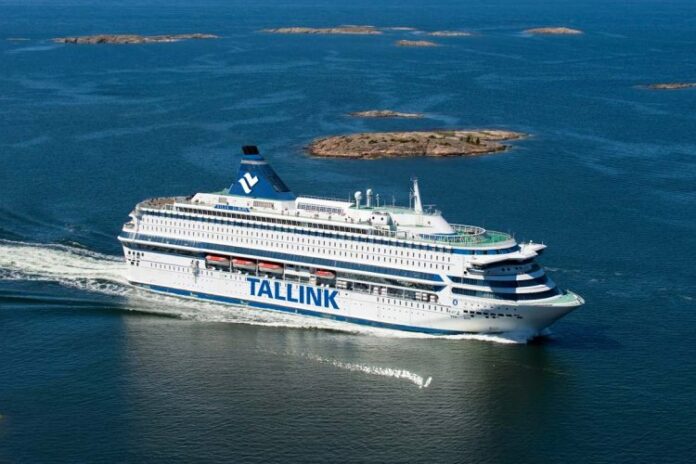
Tallink Grupp’s vessel Silja Europa to remain suspended from Tallinn-Helsinki route

0

During the suspension the vessel will undergo technical repairs before returning to the route and the company’s management has also decided to bring forward the vessel’s technical dry-docking, originally planned for 2023, to carry out all the necessary and planned works at once and avoid the vessel being off the route in 2023. 

The vessel was originally due to return to the Tallinn-Helsinki route during the February school holidays for one week and thereafter to the regular route and schedule in March. The shows and star artists planned for the vessel during the February school holidays and in March will now be postponed to later this spring. 

Paavo Nõgene, CEO of Tallink Grupp said:

“The low season and lower passenger numbers due to the continuing Omicron spread are currently enabling us to progress with and bring forward as many technical works as possible on many of our ships, which means that when travelling does recover and passenger numbers start going up again, we won’t have to make these suspension decisions and our ships will be in their best condition to sail without interruptions.“

“We sincerely apologise to all passengers whose travel plans this decision affects and we will be in touch with them to help make alternative plans and find the best solutions. We really hope that we are nearing the end of the rollercoaster ride of this pandemic and the constant changes and can soon sail on calmer waters according to normal schedules and routes once again.”

Port of LA partners with Port of Shanghai on green shipping corridor

0

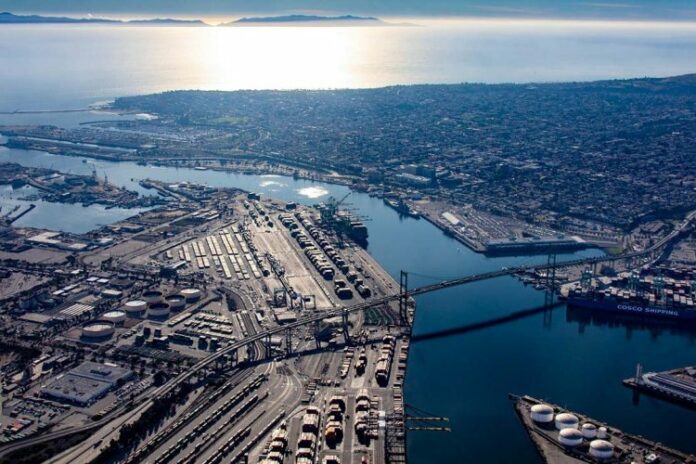
Los Angeles and Shanghai have announced a partnership of cities, ports, shipping companies and a network of cargo owners to create a first-of-its-kind green shipping corridor on one of the world’s busiest container shipping routes. 

Convened by C40 Cities and the ports of Shanghai and Los Angeles, and including key maritime stakeholders, this partnership has agreed to work on an initiative to establish a Green Shipping Corridor to decarbonise goods movement between the largest ports in the United States and China. The partnership intends to work together to achieve these goals by developing a “Green Shipping Corridor Implementation Plan” by the end of the 2022 calendar year that will include deliverables, milestones, and roles for the partnership.

Key decarbonisation goals for the Green Shipping Corridor partnership include:

  • The phasing in of low, ultra-low, and zero-carbon fuelled ships through the 2020s, with the world’s first zero-carbon trans-Pacific container ships introduced by 2030 by qualified and willing shipping lines.
  • The development of best management practices to help reduce emissions and improve efficiency for all ships using this international trade corridor.
  • Reducing supply chain emissions from port operations, improving air quality in the ports of Shanghai and Los Angeles and adjacent communities.

The City of Shanghai, the City of Los Angeles, the Port of Shanghai (through the Shanghai Municipal Transportation Commission), the Port of Los Angeles and C40 Cities initiated this Green Shipping Corridor partnership. Participating partners include A.P. Moller – Maersk, CMA CGM, Shanghai International Ports Group (SIPG), COSCO Shipping Lines, the Aspen Institute’s Shipping Decarbonisation Initiative, facilitators of Cargo Owners for Zero Emission Vessels (coZEV) and the Maritime Technology Cooperation Centre – Asia.

During his tenure as Chair of C40, Mayor of Los Angeles Eric Garcetti launched the C40 Green Ports Forum to decarbonise global supply chains that power our economies, one of his top priorities as Chair. The Port of Los Angeles, under the Mayor’s leadership, has been instrumental in developing the Los Angeles-Shanghai Green Shipping Corridor partnership.

Gene Seroka, Executive Director, Port of Los Angeles says:

“International collaboration is essential to decarbonise global supply chains. We look forward to partnering with the Shanghai Municipal Transportation Commission, the Shanghai International Port Group, leading shipping lines and major cargo owners to reduce greenhouse gas emissions in the maritime supply chain. It’s time to get started on this important work.”

Mark Watts, Executive Director of C40 Cities says:

“Accelerating efforts to decarbonise the shipping sector is urgent if we are to limit global heating to 1.5°C. By convening international coalitions of the willing and creating a scalable and replicable model for other cities to follow, we hope this ground-breaking green shipping corridor initiative will catalyse action on a global scale.” 

Dan Porterfield, President and CEO of the Aspen Institute says:

“The Aspen Institute is proud to support this important international collaboration. Through our Shipping Decarbonisation Initiative and in our role as the facilitator of the Cargo Owners for Zero Emission Vessels initiative, we look forward to working with our partners to help enable the deployment of the first vessels powered by zero life-cycle greenhouse gas emission fuels along this critical shipping route and to making this green corridor project a model of success for the rest of the world. It is inspiring that the United States and China have come together in this way to address the climate impact of this crucial global industry.” 

Indian Register of Shipping classes first 100 pax hybrid catamaran ferry

0

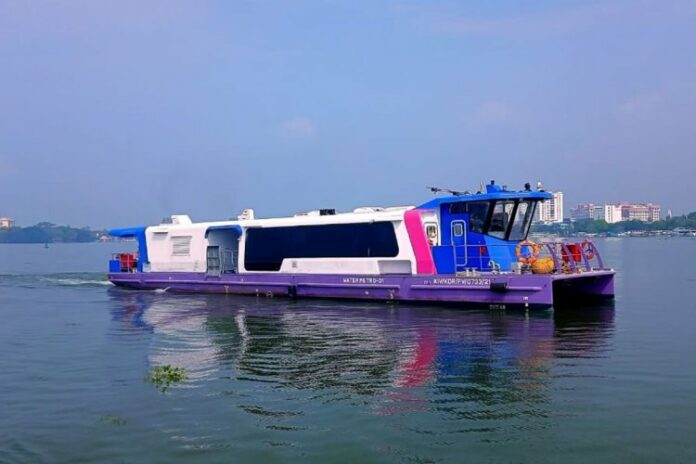
Indian Register of Shipping has recently classed a hybrid catamaran (battery powered) ferry – ‘Water Metro-01’. As decarbonisation gathers pace, industry stakeholders are actively working together to develop alternate propulsion systems with an aim to reduce overall carbon footprint.

The 24.8m catamaran ferry, designed for shore charging and certified to carry 100 passengers, is propelled by hybrid electric propulsion system by means of Lithium Titanium Oxide (LTO) batteries & DG Sets. 

The capacity of installed batteries is 122 kWh which are capable of fast charging. Additionally, the vessel can run on power generated by the onboard DG Sets as well as hybrid mode, which is a combination of both DG sets and batteries.

The vessel is owned by Kochi Metro Rail Limited (KMRL) and is a part of setting up of a world class Integrated Water Transport System for Kochi city. The vessels are expected to be operating on 15 identified routes connecting 41 jetties across 10 island communities across 76 km route network and 1 boatyard in Kochi.

The project is a step forward in India’s self-reliant initiative of AtmaNirbhar Bharat and represents the collective efforts of CSL, KMRL and IRS.

IRS has developed Guidelines for battery powered vessels and the vessel was assigned with the notation “BATTERY PROP “. The class notation BATTERY PROP is assigned to vessels where the battery systems are used for ship propulsion and are in accordance with the requirements of these Guidelines.

With the growing trend in use of battery power for vessel propulsion/ auxiliaries; the experience gained through this project has helped IRS to develop a greater understanding of the challenges in use of battery systems for domestic ferries. IRS is now fully geared up to provide a holistic solution to industry on battery powered vessels both for new builds and retrofits.

Mr. Vijay Arora, Managing Director, said:

“IRS Plan Approval Centre & Surveyors at site have worked closely with Cochin Shipyard Ltd. and other stakeholders in making this project a reality. IRS is actively working with the industry in developing technologies using renewable energy and alternate fuels in line with the IMO GHG Reduction Strategy”.

Two new bunker barges under construction for Port of Prince Rupert

0

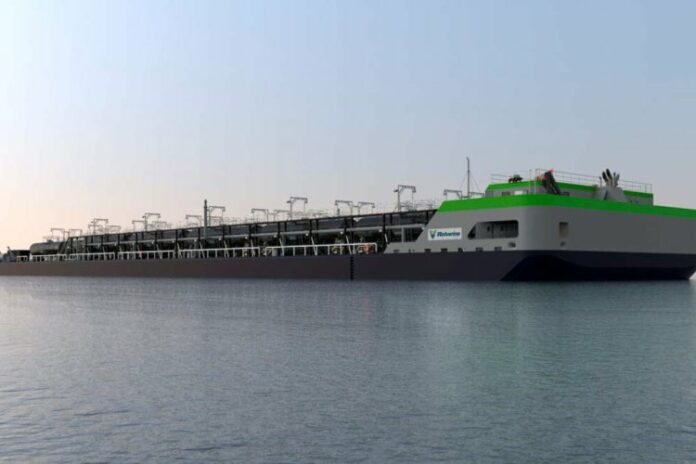
The two new Robert Allan Ltd. barge designs will be the main marine assets in Wolverine Terminals’ new marine fuels service for the Port of Prince Rupert, commencing operations in 2023. The service will offer marine fuel of differing grades and types to commercial vessel traffic entering the Port of Prince Rupert.

The two barges are unique designs specifically tailored for the site and intended operations. There will be a Rail/Terminal Barge and a Distribution barge for the following basic operations:

  • Transfer of tank rail cars on and off the rail/terminal barge at the existing Aquatrain Terminal in Prince Rupert
  • Tug assisted transport of the rail/terminal barge between the Aquatrain Terminal and a new Wolverine Terminals mooring site, a distance of approximately 400 meters
  • Transfer of marine fuel from rail cars into fuel storage tanks located within the rail/terminal barge
  • Transfer of marine fuel from rail/terminal barge to the distribution barge
  • Tug assisted transport of the distribution barge between the fuel service mooring site and approved locations within the Port
  • Transfer of fuels from the distribution barge into large cargo vessels

Both barge designs have been through detailed risk assessments and class approval to Lloyds Register and Transport Canada.

The 12,400 DWT, 142 metre x 30 metre rail/terminal barge design incorporates the loading and storage of multiple tank rail cars and in-hull storage of marine fuels. The design incorporates a double hull, cargo handling equipment, tank heating, spill prevention and recovery equipment, onboard and shore power availability at the operating facilities. The rail/terminal barge design solves many unique challenges in blending the rail and marine industries.

The 4,800 DWT, 78 metre x 20 metre distribution barge is very similar in design to other marine fuel distribution barges operating in the Port of Vancouver and other west coast ports. The design incorporates a double hull, cargo handling equipment, tank heating, spill prevention and recovery equipment, on-board power generation, and operating facilities.

Wolverine Terminals contracted Robert Allan Ltd. in 2017 to develop and design these blank sheet designs with input and expertise from industry experts, class, Transport Canada and the entire design team.