1.3 C
New York
Home Blog Page 419

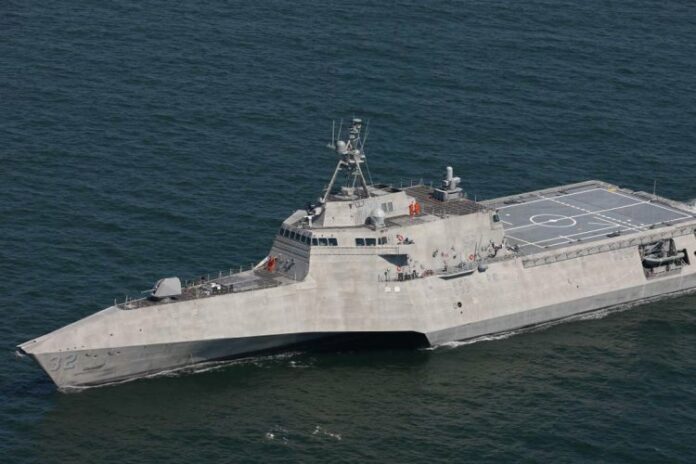
Austal delivers the future USS Santa Barbara to the US navy

0

Austal Limited Chief Executive Officer Paddy Gregg said the delivery of the Santa Barbara demonstrated Austal USA’s capability to maintain the delivery schedule of multiple naval vessel programs, while expanding shipbuilding capacity.

Mr Gregg said:

“Austal USA has continued delivering both the LCS and EPF (Expeditionary Fast Transport) programs for the US Navy while also establishing, opening, and now operating, a new steel shipbuilding facility, which is a credit to the entire team.”

“To deliver another LCS while preparing for the start of construction of multiple steel vessel programs, including the Navajo-class Towing Salvage and Rescue (T-ATS) ships, is an outstanding achievement. The Austal USA team has proven yet again they are up to the challenge, and I congratulate them and the Navy on this latest milestone.”

Littoral Combat Ships are built to operate in near-shore environments and support forward presence, maritime security, sea control and deterrence missions. Several Austal USA-built Independence-variant LCS have been deployed to the Western Pacific within the last year, including USS Jackson, USS Tulsa and USS Charleston.

Austal USA is currently constructing three 127 metre LCS, including the recently launched future USS Augusta. Final assembly is underway on the future USS Kingsville and modules are under construction for the future USS Pierre.

Austal USA is also constructing several 103 metre EPF vessels and construction has just begun on the first of two 80 metre, steel Navajo-class Towing, Salvage, and Rescue Ships (T-ATS) for the United States Navy. 

The company is also under contract to construct a 211 metre Auxiliary Floating Dry Dock Medium (AFDM) for the United States Navy – and up to eleven 110 metre, Heritage-class Offshore Patrol Cutters for the United States Coast Guard.

RRS James Cook completes rudder overhaul at Damen Shiprepair Amsterdam

0

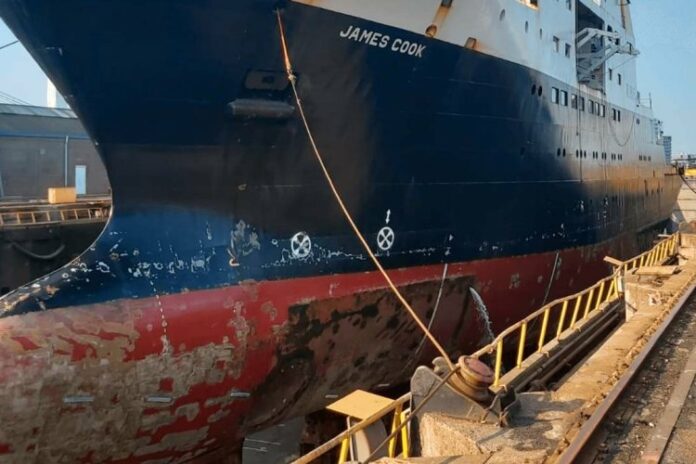
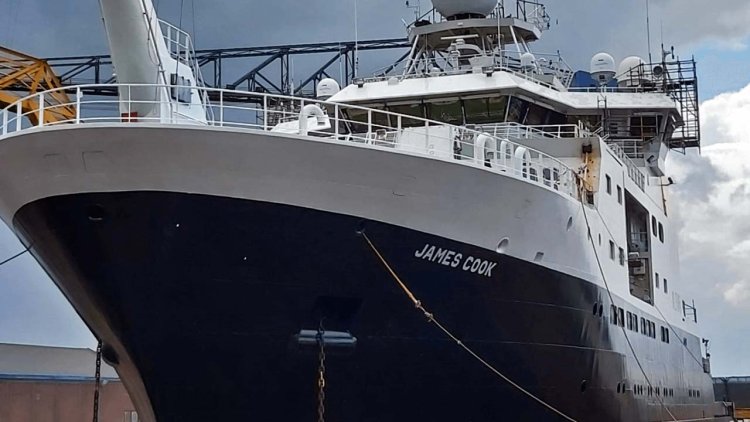
The Royal Research Ship ‘James Cook’ has recently completed a two-week, annual maintenance programme at Damen Shiprepair Amsterdam (DSAm). A significant part of the works was the complete overhaul of its twin rudders and steering gear.

The 89.5 metre, 5,401 GT vessel is operated by the UK’s Natural Environment Research Council and entered service in 2006 to replace the ageing RRS Charles Darwin. Her role is to undertake a wide role of oceanic and atmospheric research activities from the equator to the polar icecaps using the latest equipment and sensors. As such, she spends extended periods at sea in all weathers with teams of scientists and researchers on board.

Following an assignment in the South Atlantic, the RSS James Cook arrived at DSAm. As part of the two-week maintenance programme her flap rudders, designed and built by Damen Marine Components (DMC), were given their first complete overall in 15, very active, years. The rudders were removed from the vessel and taken away to be fully disassembled and inspected. Parts showing wear were overhauled, including the worn out rudder stocks.

DMC’s BARKE® flap rudders are specifically designed for ships engaged in activities such as research, fishing and dredging that require excellent manoeuvrability along with first-rate fuel economy. Their progressively rotating flaps generate high lift forces at large rudder angles and low drag at small rudder angles, delivering the necessary performance in all situations. The enclosed linkage system also provides overload protection and eliminates the risk of sand, ice and floating objects entering the rudder assembly.

DMC successfully completed the service project within the two weeks available and the flap rudders are now as good as new once again.

The next assignment for the RRS James Cook will be participating in a project researching the processes that form and preserve minerals of strategic importance to the transition to low-carbon societies. But wherever she is in the world in the future, she will be able to access Damen’s global network of Service Hubs for repairs to her rudders as well as any other systems that require repair or maintenance. With the Service Hubs spread across five continents, the Natural Environment Research Council can be confident that their key maritime assets will be assured of maximum uptime and availability from the Arctic to Antarctica.

K Line firm to build new battery-powered tugboat

0

Kawasaki Kisen Kaisha, Ltd. (“K” LINE) has announced that our group company, SEAGATE CORPORATION CO., LTD.(SGC), will build new electric tugboat powered by battery.

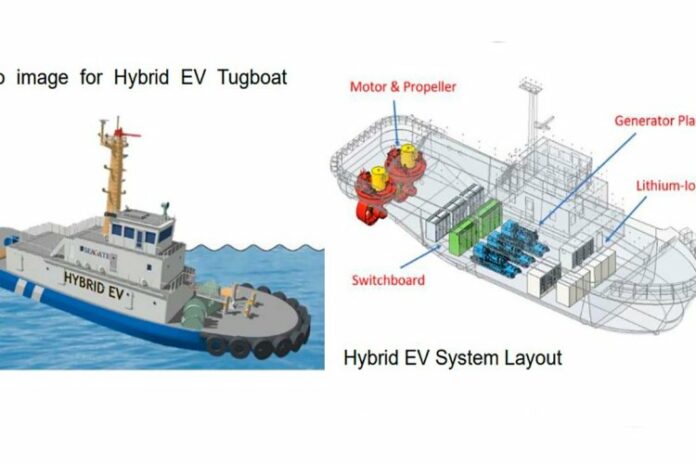
The new Tugboat is equipped with a propulsion system running on “Hybrid EV system”. It has electric motor as a main power source running by large capacity lithium-ion battery charged by land charger. It also equipped generator as the auxiliary power source.

The Tugboat will be first Tugboat which has electric motor as a main power source in Tokuyama and will be deployed in the first half of 2025 to reduce greenhouse gas (GHG) emission in Tokuyama area.

In the future, it will be possible to achieve zero emissions by replacing the fuel for the generator with zero emission energy.

In last November, “K” LINE has revised a part of our long term environmental guideline “K” LINE Environmental Vision 2050” and set our new target for 2050 as “The challenge of Achieving Net-Zero greenhouse gas (GHG) emissions”. 

While public attention to the greenhouse gas emissions including from shipping is becoming increasing, “K” LINE will strive to enhance our corporate value by contributing to the sustainable development of the economy and society, while protecting the environment through our business activities.

WHOI and CMA CGM Group deploy acoustic monitoring buoy near Norfolk

0

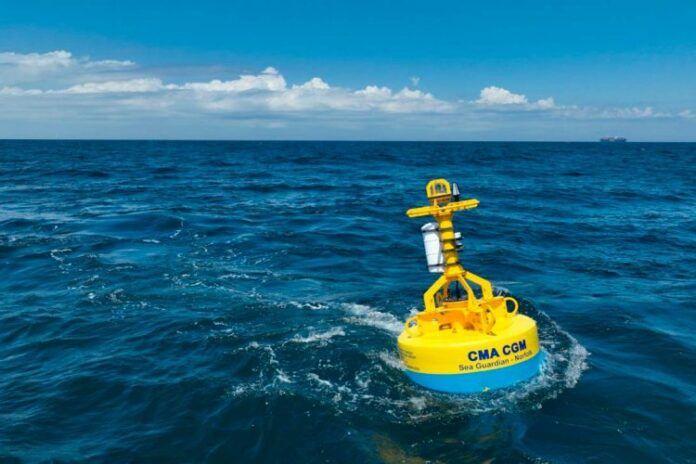
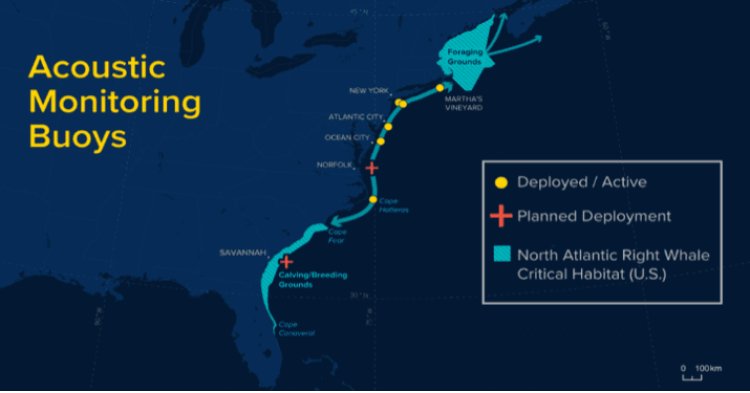
Woods Hole Oceanographic Institution (WHOI) and The CMA CGM Group, a global player in sea, land, air, and logistics solutions, have deployed an acoustic monitoring buoy 33 miles off the coast of Norfolk, Virginia. A second buoy is slated for deployment off the coast of Savannah, Georgia in the coming weeks.

The buoy deployment aims to aid in the survival of the critically endangered North Atlantic right whale; the species is under serious threats to their survival, and only approximately 336 of these great whales remain.

The WHOI-developed acoustic buoys play an important role in protecting marine animals. Each species of whale creates its own unique calls, and the buoys are equipped with an instrument that transmits information about detected sounds to shore every two hours. 

This WHOI technology can detect, classify, and report the sounds of marine mammals in near real-time, and the data is analyzed by an acoustician to determine which species are present. Results are displayed publicly on Robots4Whales and shared with mariners. This enables dynamic protections, including NOAA’s Slow Zones for Right Whales, which are areas with voluntary vessel-speed restrictions along the eastern seaboard that are established when right whales are detected.

Locations off the coast of Norfolk and Savannah were chosen for the new systems because the ports are among the busiest in the United States, which often puts ships directly in the path of migrating right whales. The new buoys will fill a critical gap as they join a monitoring network of six similar buoys along the East Coast, bringing the total number of buoys to eight.

In addition to the assembly and deployment of the new buoys to alert mariners of the presence of whales near critical U.S. ports, CMA CGM and WHOI will lead the development of an industry consortium focused on reducing risks to right whales from vessels and supporting the continued operation of the WHOI-developed digital acoustic monitoring buoys. This unique collaboration, started in the United States, aims to have a global impact by significantly improving marine mammal protection.

Mark Baumgartner, project principal investigator and WHOI marine ecologist, said:

“The deployment of these buoys are an important addition to a network of identical buoys along the East Coast that will let industry, government and the public know when whales are nearby. This network will be especially helpful for reducing risks to the North Atlantic right whale, a critically endangered species that migrates, feeds and gives birth along the East Coast and has only approximately 336 animals left.”

Huisman launches crane for handling wind turbine components

0

The move comes as a result of rising demand for large, 2,600mt and 4,000mt Skyhook Cranes for the load-out of foundation pieces and installation of floating turbines.

With this 700mt Travelling Quayside Crane, the load-out process of offshore wind turbine components can take place significantly faster compared to the regular methods that involve crawler cranes, or a tandem-lifting by two cranes with a capacity around 200mt to 300mt.

The new Quayside Crane has been designed fully electric, allowing for a direct connection to the quayside power grid. This allows regenerative energy to be directed back into the utility grid, thus drastically limiting the net energy consumption of the crane. Huisman has been a frontrunner in the electrification of heavy lift cranes to optimise energy efficiency since 1984.

Although the crane is designed to travel on a track 16m wide, this can be adapted to local requirements. Capable of lifting 700mt at a radius of 25m, the crane can bring many turbine components to any place in the hold of the majority of the cargo vessels currently used for turbine transportation. The ability to travel at decent speed with load in the hook enables a more flexible delivery schedule of components to the load-out quayside. This results in a more efficient use of the quayside and a quicker turnaround for the transportation vessel.

Cees van Veluw, Product Manager Cranes at Huisman:

“We see a need in the offshore wind logistics market for increased efficiency in smaller ports in newly developed offshore wind areas. The traditional use of crawler cranes or multiple smaller quayside cranes would require a very large backyard. It also requires the transport vessel to be moored along the quayside for an unnecessarily long time. With this new 700mt Huisman Travelling Quayside Crane, offshore wind ports can be ready for a quick load-out of turbine components in a sustainable manner”. 

Features & benefits of the 700mt Huisman Travelling Quayside Crane:

  • A full electrically driven crane, resulting in high positioning accuracy, efficient energy use, reduced maintenance, reduced noise, and high reliability
  • Track width of 16m, can be adjusted to local requirements
  • 700mt lifting capacity at a radius of 25m
  • Dual Main Hoist, allowing for flexible rigging configurations without the need for an extensive portfolio of slings and grommets at hand
  • A 57m long boom, adjustable for other configurations
  • Cabin “eye level” at 33.5m height above the quayside
  • Optionally the crane can be equipped with a “lift-off boost” system for increased speed
  • Design is adjustable for local requirements
     

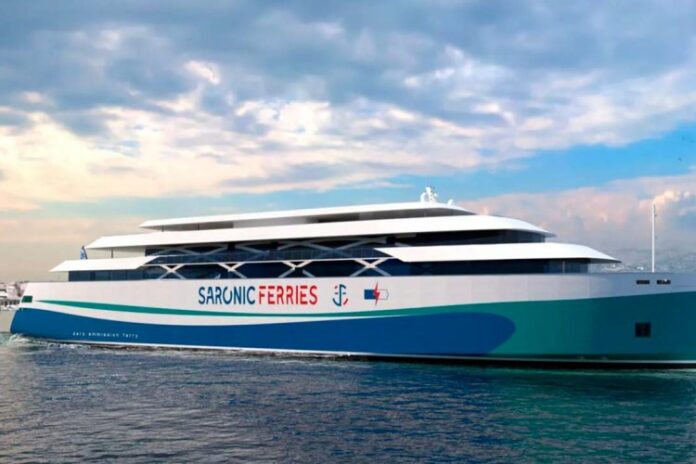
C-Job and Saronic Ferries create design of first fully-electric Ro-Pax ferry in Greece

0

The Greek maritime market is a large and important hub for shipping in the Mediterranean area, and is a key element of the Greek economy. Saronic Ferries, the largest ferry operator for the Saronic islands in Greece, went in search of the ideal electric ferry design in order to realize its mission to operate a purely emissions-free fleet by 2040 to all destinations. 

George Papaioannides, Partner of Saronic Ferries, says:

“We are taking a step towards a cleaner world and we envision our operation in the Saronic Islands to be the inspiration for others to initiate more green fleet renewal projects in Greece.

C-Job delivered the initial design to Saronic Ferries following an extensive sustainable fuel feasibility study. The results of the study determined that in regards to the desired route, type of vessel, and available infrastructure, a fully electric ferry was the best option for the project. The zero-emission sea-going ferry has a capacity of 800 passengers and will feature a variety of sustainable aspects, including fully electric propulsion. 

The ferry is envisioned to recharge in the port of Piraeus, though the proper infrastructure to support this, and other electric ferries in the future, still needs to be set up. The design will include state-of-the-art features in energy-saving solutions and top-in-its-class interior design, offering passengers utmost comfort at no expense to the environment. This is where the journey to zero harmful emissions in Greece begins.

The vessel is expected to join Saronic Ferries’ fleet in 2026, sailing between Piraeus and the islands of Aegina and Agistri, provided the infrastructure required in the port of Piraeus is in place.

Scientists discover world’s longest underwater avalanche after rescue of lost data

0

A study published earlier this week in Nature Communications shows that the data was recovered after anchors mooring these sensors to the seabed had been broken by these huge underwater flows.

Scientists worked with the Natural Environment Research Council (NERC) and the National Oceanography Centre (NOC) to recover the data, which will help predict hazards to seabed telecommunications cables and how future climate or land use changes may impact the deep sea. Funding for the research was provided by NERC.

Key research data on underwater avalanches of sediment (known as turbidity currents) were lost at sea when a colossal deep-sea avalanche surged through the Congo Canyon in January 2020. The deep underwater valley leads away from the mouth of the Congo River, off Africa’s west coast.

Five months earlier researchers had lined the length of the Congo Canyon with sensors designed to measure the velocity and behaviour of deep-sea turbidity currents.

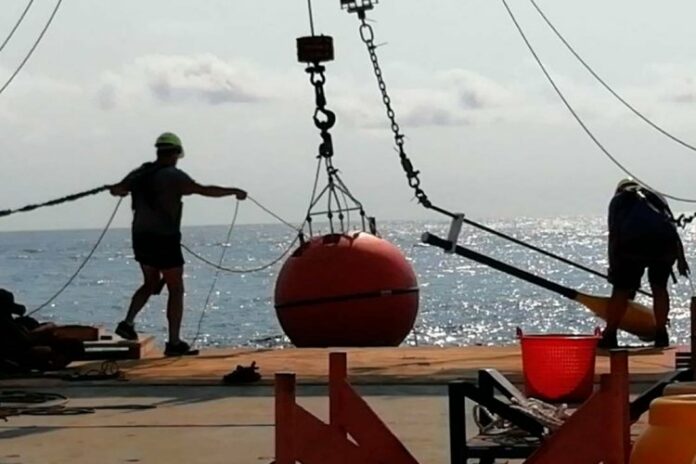
Eleven of these sensors broke free from their moorings between 14-16 January 2020, dislodged by an avalanche of sediment travelling at up to 8 metres a second. The sensors are contained in orange floats scarcely larger than a football, and these floats and their sensors then drifted across the surface of the Atlantic Ocean, carrying their unique data with them.

Peter Talling, Professor in Submarine Geohazards at Durham University and the study’s lead investigator, said:

“The odds of retrieving football-sized sensors were tiny, as they drifted in different directions, dragged by currents across hundreds of kilometres of ocean. Rescuing those buoys seemed entirely improbable.

“But, thanks to swift and flexible action by NERC, the National Marine Facilities at the National Oceanography Centre, French colleagues at IFREMER and senior colleagues in Hull and Durham Universities, together with several passing vessels, we achieved one of the most remarkable bits of field science in the ocean I’m ever likely to see.”

Each sensor was fitted with a beacon that transmitted its position, but as the beacon’s battery only lasted for about three months, the rescue timescale was very tight. Any normal rescue procedure was ruled out due to COVID-19 pandemic travel restrictions in spring 2020.

However, a private vessel travelling off the West African coast found one buoy and the captain agreed to help collect others.

The project team, and staff from NERC and the National Marine Facilities division at NOC acted quickly to assess the vessel’s suitability and arrange this emergency charter. In about 48 hours, NERC had assessed and approved the rescue attempt.

Over the next few weeks, researchers successfully chartered a variety of additional boats including a cable-laying vessel, a cargo ship and a ship servicing oil and gas rigs.

Fibre optic telecommunication cables operator Angola Cables also proved instrumental in securing necessary permits for the vessels to operate in Angolan waters through the project.

In total, nine of the 11 sensors and their data were recovered.

Natalie Powney, NERC’s Head of Marine Planning, said:

“Making this project possible required a huge team effort from everyone, including staff from NERC and the National Marine Facilities team at the National Oceanography Centre. Within just 48 hours, NERC had assessed and approved the rescue attempt.

“Funding was provided through our Discovery Science Portfolio, which encourages curiosity-driven, adventurous science. The research is hugely significant and identified a link between major river floods, spring tides and powerful turbidity currents.”

Prior to this study, directly measuring powerful deep-sea avalanches was considered impractical. But the rescued data provided direct monitoring of sediment flow in the Congo Canyon, enabling scientists to assess for the first time how major river floods connect to the deep-sea.

The Congo Canyon turbidity current broke not only the sensor moorings but also two seabed  telecommunications cables, cutting internet data speeds across west, central and south Africa.

National Oceanography Centre (NOC) researcher Dr Mike Clare, who is a co-investigator on the project, said:

“These remarkable data provide the first direct measurements of such a large and powerful flow. We now have a new understanding of how these events are triggered, and also the hazards they pose to seafloor infrastructure networks, such as the cables that underpin global communications.”

Seafloor fibre-optic cable networks carry around 99% of global data traffic, but can be damaged or broken by underwater avalanches. Breakages cause massive disruption to the global economy and day-to-day lives.

The study shows that the pattern of seabed erosion from this 2020 turbidity current was surprisingly localised and patchy, especially given how big the flow was. Scientists believe this may explain why it broke some submarine telecommunication cables, but others survived. This information could help cable companies in future to position cables so that they have the best chance of surviving these events.

MEYER WERFT lays keel for Carnival Jubilee

0

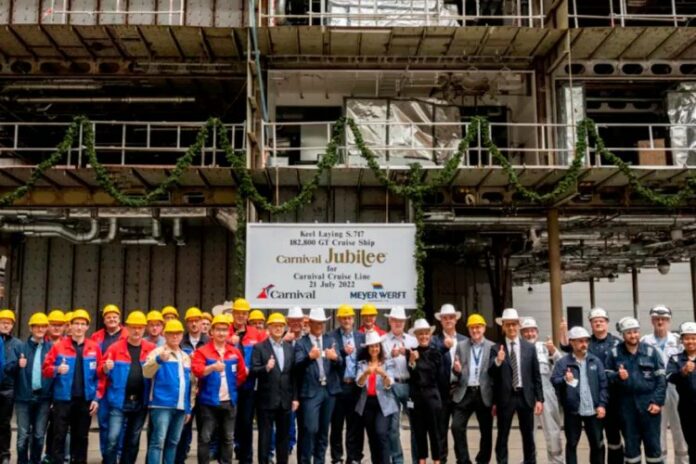
Carnival Jubilee is fixing to start sailing from Galveston, Texas, next year and Carnival Cruise Line’s third cruise ship to be powered by liquified natural gas (LNG) got its first taste of Texas today with the keel laying ceremony at Meyer Werft in Papenburg, Germany.

Wearing cowboy-shaped hard hats, Carnival Cruise Line President Christine Duffy was joined by Meyer Werft Managing Director Bernard Meyer and Carnival’s Senior Vice President of Newbuilds Ben Clement, among others, to celebrate the construction milestone by placing coins under a 375-ton keel block.

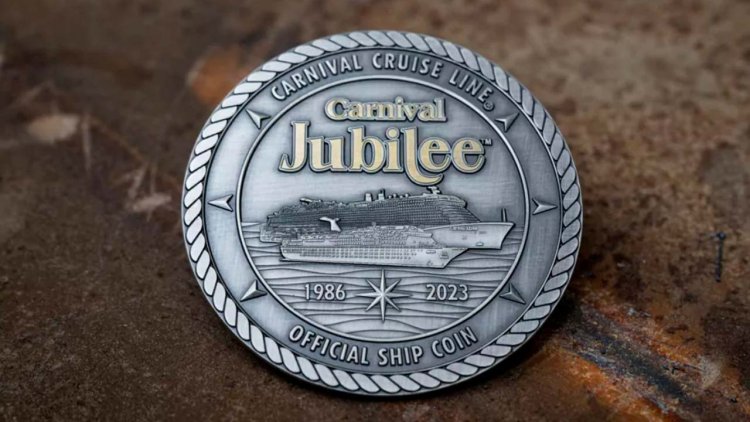
The coins signify good luck for the ship and will remain under its foundation as the structure is built. One of the ship’s lucky coins is an official ship coin, which commemorates an important part of Carnival history while celebrating its future by showing Carnival Jubilee alongside the original MS Jubilee from 1986. The coins will later be placed in a special compartment near Carnival Jubilee’s mast as permanent fixtures of the ship.

Carnival Jubilee will be the first Carnival Cruise Line ship built in Papenburg, Germany. Meyer Werft has already built four other LNG-powered ships for other cruise lines under Carnival Corporation. Carnival Jubilee will be Carnival’s third ship to run on a liquified natural gas (LNG) technology platform. Carnival Corporation pioneered the introduction of LNG fuel in the passenger cruise sector as part of the company’s ongoing commitment to sustainability and emissions reduction. Meyer Turku in Finland delivered sister ship Mardi Gras last year and will deliver Carnival Celebration later this year.

Bernard Meyer, Managing Director of MEYER WERFT, said:

“We are pleased to take another symbolic step in the construction of the Carnival Jubilee with the keel laying. The MEYER team will once again produce an advanced and innovative cruise ship that will provide a great vacation for millions of passengers.”

The Carnival Jubilee will now be completed in the world’s largest covered shipbuilding dock at MEYER WERFT and delivered at the end of 2023. Carnival Cruise Line will then deploy the ship for cruises to the Caribbean from the Texas port of Galveston. 

Carnival Jubilee is the third ship of a series MEYER Group is building for Carnival Cruise Line. MEYER TURKU has already delivered the Mardi Gras in 2020, followed by the Carnival Celebration in 2022. All ships are equipped with the low-emission LNG propulsion system. The highlight for passengers on board the three ships will be a roller coaster for the first time.

DNV signs MoU with Korean floating solar component manufacturers

0

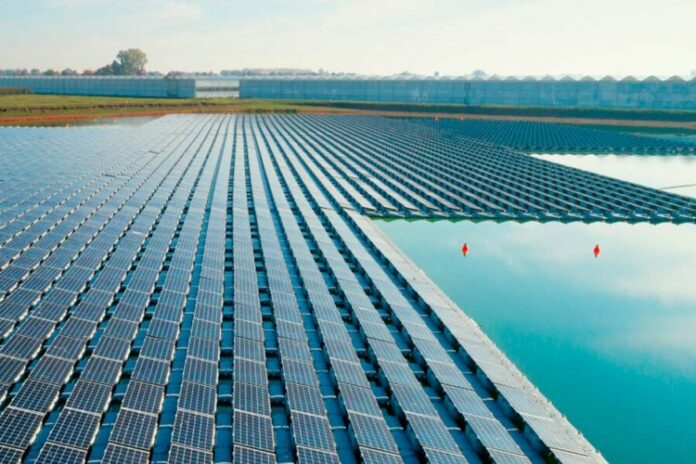
DNV has signed a Memorandum of Understanding (MOU) with Korean floating solar PV (FPV) suppliers which will explore business cooperation opportunities with the aim of increasing the number of FPV plants in Korea and globally, as the energy transition accelerates.

Under this MOU, DNV, the independent energy expert and assurance provider, will be collaborating on prospective business opportunities in the global FPV market with Korean partners which include:

  • steelmaker POSCO
  • power and automation solutions provider LS Electric
  • floating PV and marina and offshore structures solution provider SCOTRA
  • module producer SolarPark and floating PV and land PV structure producer DASCO.

The parties will exchange technical and proprietary information and know-how to develop and design systems in accordance with the requirements and practices of the global FPV market. The partners will identify projects and markets of mutual interest to the parties and cooperate on joint marketing initiatives. They will also test and verify that these FPV solutions can perform reliably in saline environments.

Floating solar has huge potential in areas where difficult terrain, land scarcity and competition for land may pose challenges to the development of ground-mounted solar systems. According to DNV estimates, the overall installed capacity of FPV will range between 10 and 30 GW by 2030. South Korea is taking an active role in this market with the Ministry of Environment’s announcement of a plan to install 2.1 GW of floating PV capacity by 2030.

Innovation has been key for most South Korean companies, which has seen their home-grown firms investing heavily in R&D and product development – factors which have enabled Korean companies to reap much success.

Dr. Lim Dong Ho, Market Area Manager for Korea, DNV states:

“The signing of this MOU represents a new level of collaboration between Korean FPV suppliers and marks the beginning of a partnership that is focused on innovation and accelerating the energy transition. In recent years, DNV has been involved in helping Korean domestic clean energy component manufacturers expand their reach to international markets. The signing of the MOU will lay the groundwork for the wider adoption of FPV plants in South Korea and the rest of the world.”

Brice Le Gallo, Vice President and Regional Director APAC, Energy Systems at DNV adds:

“Floating solar is an important element in Korea’s plan to achieve its net zero target by 2050. With eight of the top 10 markets for FPV demand sitting in Asia, this MOU involving Korean manufacturers is timely and couldn’t have been founded at a better place, focused on the key growing markets. The improvement in the quality and reliability of the solutions shaped by this partnership will allow investors to be better-placed to take up FPV opportunities.”

New NTNU`s robot makes studying the ocean easy

0

The USV is a joint effort by an interdisciplinary team – Andrea Faltynkova, a PhD candidate at the Department of Biology, and Artur Zolich, a postdoc at the Department of Engineering Cybernetics.

Faltynkova studies microplastics in the ocean. Microplastics are bits of plastic smaller than 5 mm, which is roughly the size of the end of a pencil. While researchers know that microplastics can have negative effects on marine or freshwater organisms, there’s less known about how they affect human health. But studying microplastics is a challenge because of the nature of the substance itself, she says.

“Microplastics are so heterogeneous. It’s a very large, diverse group of particles. Not only that but they are very unevenly distributed. Microplastic is not like other dissolved pollutants that can be detected even in small quantities of water or soil. If you go and you take a litre from the sea, and there’s no plastic in it, can you conclude that there is no plastic in the sea?”

“People go out with a boat and sample a few times, and then try to draw conclusions based on how much plastic they’ve picked up. But we really have no idea of knowing how good that estimate is.”

Faltynkova’s main research project is to adapting and developing a technique called hyperspectral imaging to identify and count microplastic.  Hyperspectral imaging is a technology developed in the mid-1980s for studying the Earth from aircraft or from space. It’s now widely used in everything from studying underwater shipwrecks to identifying different human tissue types.

This type of imaging is also used by the recycling industry to separate plastics, making it a perfect tool to study microplastic.

This new method emphasizes simplicity and speed; all Faltynkova has to do is take a picture of her samples using a hyperspectral camera. The rest of the work is done by the computer model she’s built to process the images.  The IDUN computing cluster at NTNU allows her to quickly process large amounts of data to determine what types of plastics have been collected in the sample.

But then there’s the issue of collecting enough samples from the ocean so that she can say something meaningful about what she has found.

Most microplastics sampling requires towing a net behind a boat at a very slow speed, which is both costly and time-consuming.

Faltynkova’s use of a hyperspectral camera to catalogue different types of plastics quickly and efficiently from her samples means that she can study a lot of samples.  Pamela’s low cost and ability to work independently means that Faltynkova can use it to collect multiple of samples quickly.

She said:

“What I’m trying to do is enable fast analysis (with hyperspectral imaging), paired with a method that allows fast sampling. That together is what’s really going to increase the overall ability for us to effectively map and monitor plastic pollution.”

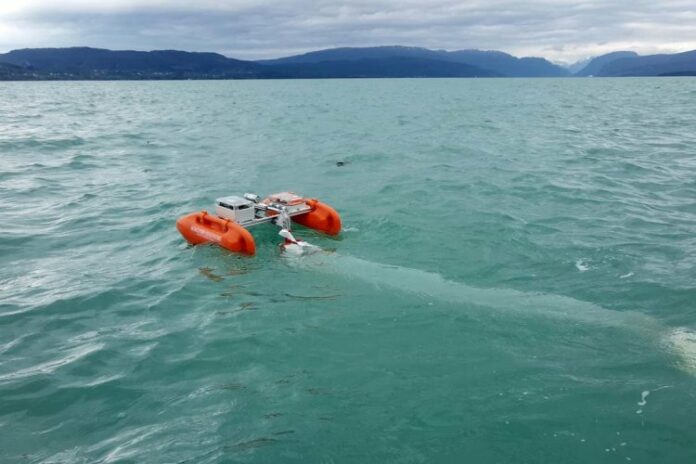
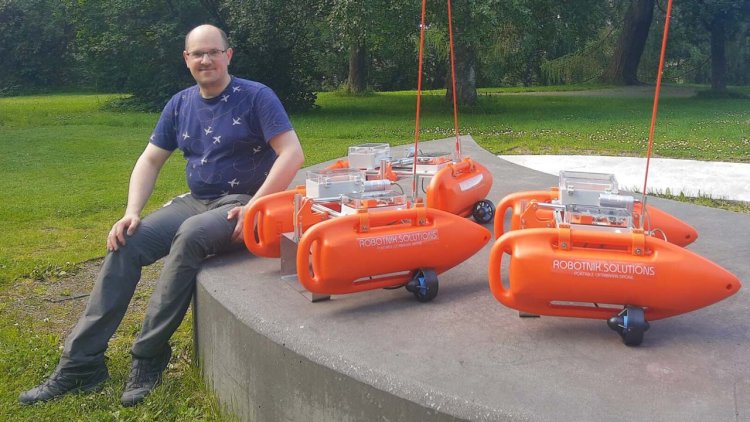
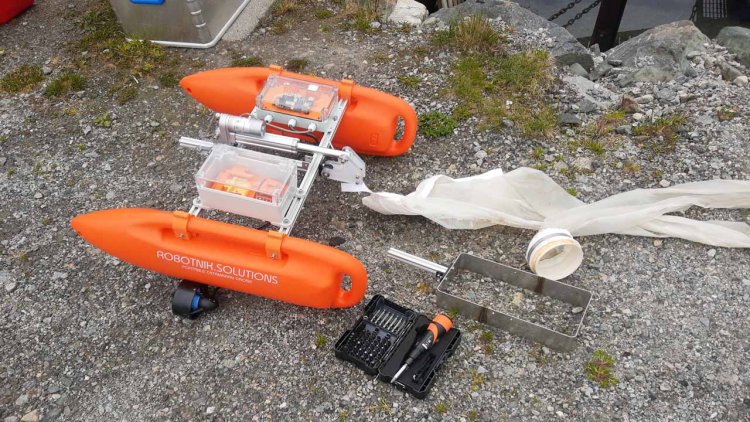
Pamela, buoyed by its two big orange floats, just like the ones from the popular TV series Baywatch, can travel a pre-programmed course without the need for a researcher to follow along or supervise the vehicle as it does its job, says Zolich, who invented the robot.

Faltynkova and Zolich’s collaboration was initiated by NTNU biologist Geir Johnsen, and has been supported  by Tor Arne Johansen from the Department of Engineering Cybernetics. Johnsen and Johansen are both key scientists at the Centre for Autonomous Marine Operations and Systems (AMOS).

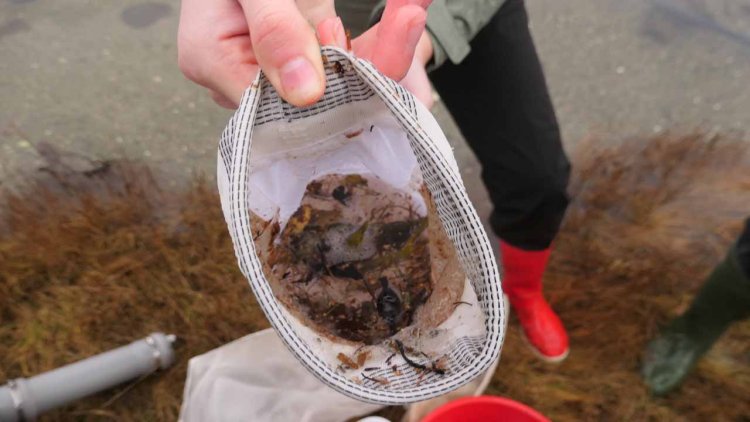
When Faltynkova’s marine biology colleagues saw Pamela, they immediately began to ask if it could be adapted to their work. She uses the robotic vehicle to tow a kind of net that is commonly used by biologists, called a plankton net, to collect surface water samples for microplastics.

The robot has been officially presented to a wider audience at the 9th Norwegian Environmental Toxicology Symposium and at a workshop for microplastic researchers in Athens, Greece. The researchers have also been contacted by international groups, including the Dutch NGO The Ocean Cleanup and the California State Water Resources Board.

Pamela is currently being tested to sample salmon lice as part of a larger study conducted by NTNU and researchers from the Norwegian Institute of Nature Research. The researchers, including Professor Bengt Finstad and PhD candidate Nathan Mertz, have developed a passive sampler to look at salmon lice larvae concentrations — which is the stage at which they spread most widely. Zolich shifted the location of the sampling net on Pamela so that it can sample salmon lice too. It is now being tested along with the passive samplers.