-6.7 C
New York
Home Blog Page 92

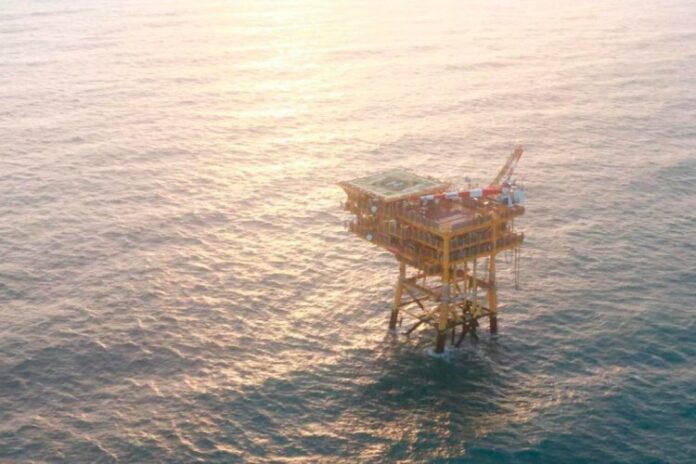
Gas discovery in the Norwegian Sea

0

Preliminary estimates indicate that the discovery contains 3-7 million standard cubic metres (Sm3) of recoverable oil equivalent (o.e.), which corresponds to 19-44 million barrels of recoverable o.e.

“Norwegian gas is in high demand and is crucial to Europe’s energy security. That’s why it’s important for us to continue exploring and making new discoveries so we can maintain a high level of deliveries. This discovery was made in an area where gas infrastructure is already in place, and which we’re also continuing to develop. We have active exploration efforts under way in this area, which have resulted in several discoveries in recent years,” says Grete B. Haaland, Equinor’s senior vice president for Exploration & Production North.

The licensees’ assessment is that this is a commercial discovery, and they will consider tie-back to existing infrastructure or development together with other discoveries in the area.

The discovery was made in the Åsgard and Kristin area in the Norwegian Sea. Mistral Sør is situated just a short distance north of Linnorm, the largest gas discovery on the Norwegian continental shelf (NCS) that has yet to be developed. Equinor took over the operatorship for Linnorm in 2023. A discovery was also made in 2024 in the Lavrans field. Lavrans is currently being developed with a tie-back to the Kristin Sør field.

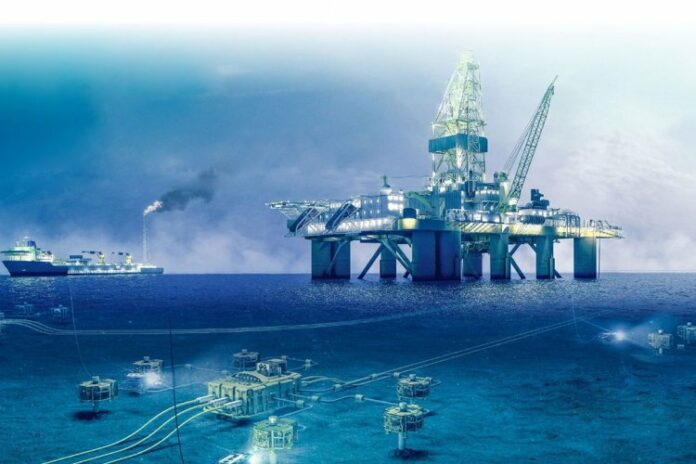
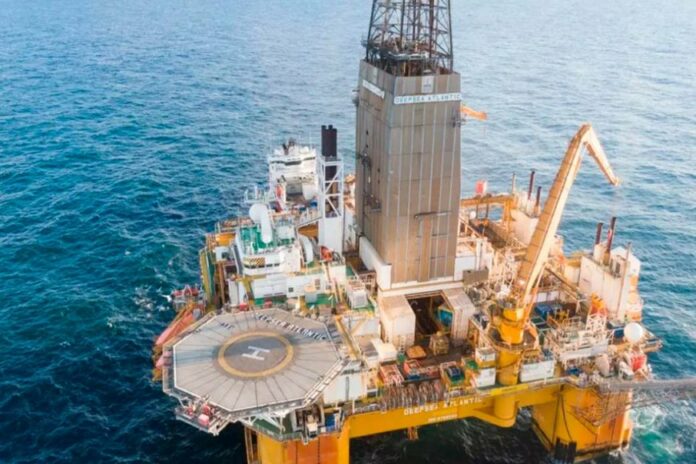
Mistral Sør was drilled by the Deepsea Atlantic (Odfjell Drilling) rig in production licence 1119. The objective of the well was to prove petroleum in Middle Jurassic sandstone in the Garn Formation, with a secondary target in the Ile Formation.

Well 6406/6-7 S encountered an approx. 45-metre hydrocarbon column in the Garn Formation, with good reservoir properties. The well was drilled to a vertical depth of 4024 metres below sea level, and was terminated in the Ror Formation in the Lower Jurassic. Water depth at the site is 256 metres. Extensive data acquisition and sampling have been carried out.

The well will be permanently plugged, and the Deepsea Atlantic will leave the location to commence drilling on 15/8-G-4 Utgard.

No hydrocarbons were proven in the secondary exploration target.
MacGregor wins contract to deliver 100T AHC crane for dive support vessel

0

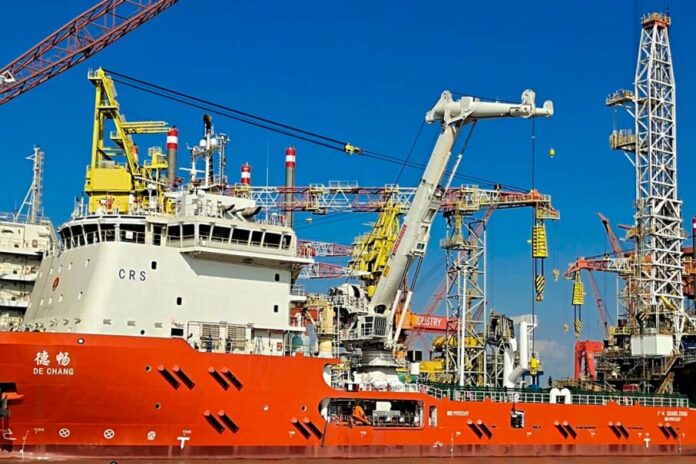
MacGregor, part of Cargotec, has been awarded a contract to deliver a 100T AHC crane for a Dive Support Vessel owned by Jana Marine Service Company.

The contract, which was booked in the fourth quarter 2024, is not reported as part of Cargotec’s orders received, as MacGregor is reported as part of discontinued operations. The crane delivery to the Guangzhou Salvage shipyard is scheduled in the second quarter 2026, with vessel delivery later that year.

MacGregor’s local sales team will work in close cooperation with Guangzhou Salvage throughout the project to ensure the crane’s seamless integration into the vessel and optimise its performance.

The customer chose MacGregor due to its satisfaction with a previous delivery of a similar crane, citing its high performance and lightweight.

“Timely delivery, reliability and innovation are core capabilities for us and qualities that we also seek from suppliers,” said Tang Renjian, Guangzhou Salvage Bureau Company. “We look forward to working with MacGregor again on the successful completion of a highly significant project for our yard”.

“We are delighted to have been awarded this contract,” said Pasi Lehtonen, Senior Vice President, Offshore Solutions, MacGregor. “Our 100T AHC crane is a proven solution that offers superior performance and reliability. We are confident that it will meet the customer’s needs and exceed its expectations.”

Norway announces two North Sea areas for CO2 storage

0

This is the sixth time that acreage is being announced for CO2 storage on the Norwegian Continental Shelf (NCS). 

Several commercial companies have made inquiries to the ministry with a desire regarding awards of one or more specific storage areas. These inquiries form the basis for the areas now being announced.

Announcement and possible allocation of area for a storage permit will take place after individual application. The permitting process is initiated by companies by applying for permits according to the storage regulations, after having established that they have a sufficiently good basis for applying. The application deadline is 24 April 2024.

Minister of Energy, Terje Aasland, said: “I am very pleased that several companies want storage areas for commercial storage of CO2 on the Norwegian continental shelf. We have developed a system that provides good access to promising areas.”

Cummins secures DNV AIP for methanol-ready marine engine

0

Cummins Inc. has received Approval in Principle (AIP) from DNV for its methanol-ready QSK60 IMO II and IMO III engines, available in power ratings from 2000 to 2700 hp (1491 – 2013 kW). 

The approval, granted in June 2024, validates Cummins’ retrofittable methanol dual-fuel solution for the global marine market, ensuring compliance with the highest standards of safety and performance.

Following extensive field testing, Cummins plans to launch the retrofit kits post-2028 to align with market demand and infrastructure readiness. Designed for diesel-electric systems, these kits can be integrated with battery technology to optimize efficiency and sustainability.

Dawn Wehr, Cummins Executive Director – Strategy, Product Planning & Digital, said: “Using a retrofittable solution dismisses the need for a major vessel overhaul and creates an immediate positive impact on carbon-emissions reduction. With our continual work on developing solutions for other alcohol fuels, including ethanol, we are committed to providing solutions that work for different operations and fuel infrastructure availabilities to ensure ease of adoption.”

The approval builds on Cummins’ August 2023 announcement permitting the use of renewable diesel, such as hydrotreated vegetable oil (HVO), across its high-horsepower engine range. By leveraging renewable diesel in dual-fuel solutions, ship operators can make significant progress towards reducing carbon emissions.

“Cummins is committed to delivering innovative power solutions to the marine industry,” added Gbile Adewunmi, Vice President of Industrial Markets – Power Systems Business. “Through partnerships with our customers, we can drive solutions that meet application requirements, sustainability targets, as well as bridge the longer-term goal of zero emissions. This announcement is a strong example of the investment and technology advancements Cummins is making to further our Destination Zero strategy.”
 

Exail supplies navigation systems to NOR Offshore Rental

0

This latest order comes ahead of NOR’s new office opening in the Asia-Pacific (APAC) region, further strengthening its presence in the market and addressing the growing demand for high-performance navigation technology.

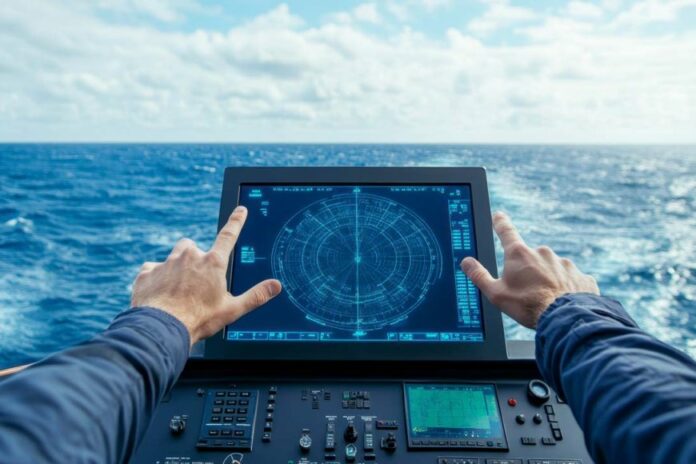
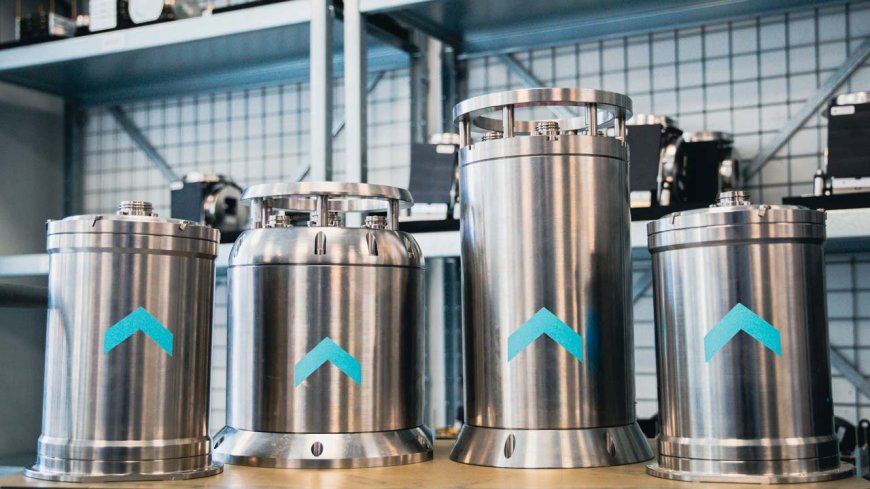
Exail INS and AHRS are engineered to operate at depths of down to 6,000 meters, providing reliable and precise navigation data for both shallow and deep-sea operations. Their robust design ensures consistent performance under extreme conditions, making them ideal for challenging subsea projects. The addition of these systems to NOR’s rental pool of equipment will further enhance its capabilities in the APAC region, where demand for advanced navigation solutions is increasing.

“We are pleased to continue supporting NOR with our advanced inertial navigation systems,” said Carl Trollet, Regional Sales Manager at Exail. “Our systems are trusted for their precision and reliability in the most demanding environments, and we are confident they will play a key role in NOR’s ability to meet the diverse needs of clients in the APAC region.”

This new order follows a significant order placed by NOR at the end of 2024, underscoring the strong collaboration between the two companies.

“We’re excited about the continued expansion of our fleet to better support the growing demand in the APAC region,” said Jostein Jansen, Chief Commercial Officer at NOR. “With this continued investment in Exail’s advanced systems, we further strengthen our commitment to providing our customers with state-of-the-art navigation technology. Our ongoing relationship with Exail has been invaluable, and we are pleased to continue working together.”

McDermott completes EPCIC project in Gulf of Mexico

0

McDermott announces the safe and successful completion of engineering, procurement, construction, installation, and commissioning (EPCIC) activities in the Gulf of Mexico for Shell Offshore Inc. (Shell), a subsidiary of Shell plc., to begin oil production at its Whale development.

Awarded in 2021 and completed last month, the project leveraged McDermott’s marine assets, including its North Ocean 102 vessel and the newly upgraded Amazon, to execute complex pipelay operations, reaching water depths of nearly 2,800 meters (9,100 feet). This included installing approximately 50 kilometers (30 miles) of pipeline and 15 kilometers (9 miles) of umbilicals connecting five subsea drill centers to the new Whale floating production platform. Seamless collaboration across multiple offices, plus skilled engineering and procurement guided by rigorous safety protocols, ensured the project’s success.

“The completion of the Whale project demonstrates the power of collaboration, engineering expertise, and ingenuity,” said Mahesh Swaminathan, McDermott’s Senior Vice President, Subsea and Floating Facilities. “Our relationship with Shell is one marked by trust, a focus on operational excellence, and solution-oriented project delivery. Together, we overcame challenges and made history with the debut of the Amazon in the Gulf of Mexico, highlighting its strategic value for subsea field developments in ultra-deepwater environments.”

Designed for complex offshore operations, the Amazon delivered an advanced ultra-deepwater pipelay system with a high-level of automation. In a Gulf of Mexico first, it installed five 3,350 meters-long (approximately 11,000 feet), steel catenary risers, showcasing the vessel’s high top tension capacity, and marking a significant milestone for subsea infrastructure projects.

The Shell Whale development, located about 200 miles southwest of Houston, features a semi-submersible production platform, with capability for remote operations and monitoring of almost every aspect of the facility – representing a significant advancement in sustainable, high-efficiency energy production.

Wärtsilä cargo handling systems chosen for three new Gas Carriers

0

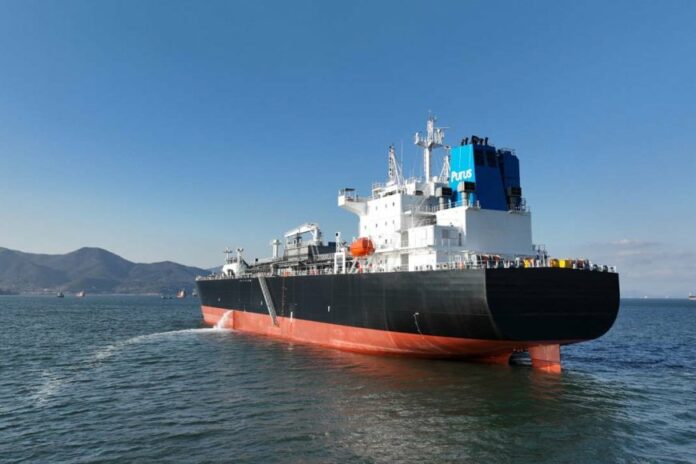
The order was placed by HMD and booked by Wärtsilä in Q1, 2025. Two of the ships have been contracted by Singapore and Hong Kong headquartered ship owner/operator Purus, and the third by Pasco Gas, based in Istanbul, Turkey. Both owners have previously ordered similar vessels fitted with Wärtsilä cargo handling systems.

Wärtsilä Gas Solutions is a world leading designer and supplier of advanced cargo handling and reliquefaction systems to gas carriers of all sizes. ​The company has established a close relationship with HMD over the years on a broad range of gas-related products and systems.

“HMD is a key customer in the medium-sized gas carrier market. Over the past decade, we have equipped more than 15 medium-sized gas carriers built by HMD. We are excited to continue with the latest project and several other ongoing ones,” comments Patrick Ha, Sales Manager, Wärtsilä Gas Solutions.

The Wärtsilä equipment is scheduled for delivery to the yard commencing in the latter part of 2025.

Fugro trials first automated eDNA sampler to transform biodiversity studies

0

The trial took place in the marina directly outside of the Fugro office in Portchester, UK. This advanced technology rapidly generates biodiversity assessments by collecting environmental DNA (eDNA) samples autonomously, reducing project time and costs.

The compact, programmable, and self-cleaning Autosampler enables in situ collection and preservation of eDNA samples with no human interaction, enhancing safety and efficiency, especially in remote or hazardous environments. Continuous collection of biodiversity data supports monitoring over extended periods. This provides a more representative sample for compliance with Biodiversity Marine Net Gain commitments. Comprehensive monitoring of marine biodiversity is crucial for understanding the impacts of energy infrastructure, such as offshore wind farms, on marine ecosystems.

The device streamlines the process by integrating eDNA collection into routine maintenance, with deployment options available off the back of a vessel, underneath buoys and moorings, or manually in rivers and lakes. Completely autonomous and programmable, it eliminates the need for personnel to be present and allows for tailored data collection over extended periods of time. The results show that the Autosampler provides data as reliable as manual methods, supporting long-term environmental monitoring, crucial for sustainable development projects.

Andy Addleton, Environmental Service Line Manager at Fugro, said, “Fugro’s expertise in environmental monitoring and our commitment to innovation has enabled us to integrate this advanced technology into our existing platforms, such as uncrewed surface vessels, SEAWATCH® Wind Lidar Buoys, and seabed landers. This offers clients a safer, more efficient, and flexible solution for long-term biodiversity assessments.”

Lloyd’s Register Type Approval awarded to Corvus Dolphin NxtGen Energy ESS

0

The LR Type Approval confirms that the energy dense and lightweight energy storage system (ESS) complies with the most stringent rules, regulations, and safety requirements in the industry, as defined by one of the leading maritime class societies.  

The Corvus Dolphin NxtGen Energy design features unmatched safety capabilities that surpass class and flag requirements, drawing on the proven Corvus Orca ESS—the world’s most widely installed marine battery system. These advanced safety measures include passive single-cell Thermal Runaway (TR) isolation and a TR gas exhaust system. With its lightweight construction, high energy density, and innovative modular design, the Dolphin NxtGen ESS is optimized for both space and weight efficiency, essential elements in vessel design. As a result, the Corvus Dolphin NxtGen Energy battery system is perfectly suited for both small and large battery installations where minimizing weight and maximizing available space are crucial. 

Additionally, Corvus Energy’s advanced Battery Management System (BMS) and proprietary digital solutions, including continuous remote monitoring and digital twin technology, enhance operational safety throughout the battery system lifetime. 

“We are very pleased that the Dolphin NxtGen Energy battery system has now also received type approval from LR, confirming that it meets the high safety standards required in the maritime industry,” says Fredrik Witte, CEO of Corvus Energy.  

He adds: “Achieving LR Type Approval is a major milestone in our work to power a clean future as LR is one of the major class societies and a key player in many segments where the adoption of hybrid and electric solutions are high.” 

In addition to securing LR, Bureau Veritas and DNV Type Approval, Corvus Energy is pursuing type approval certification from additional maritime classification societies for the Dolphin NxtGen Energy product going forward. 

A floating piece of Cypriot history: the Lambousa museum

0

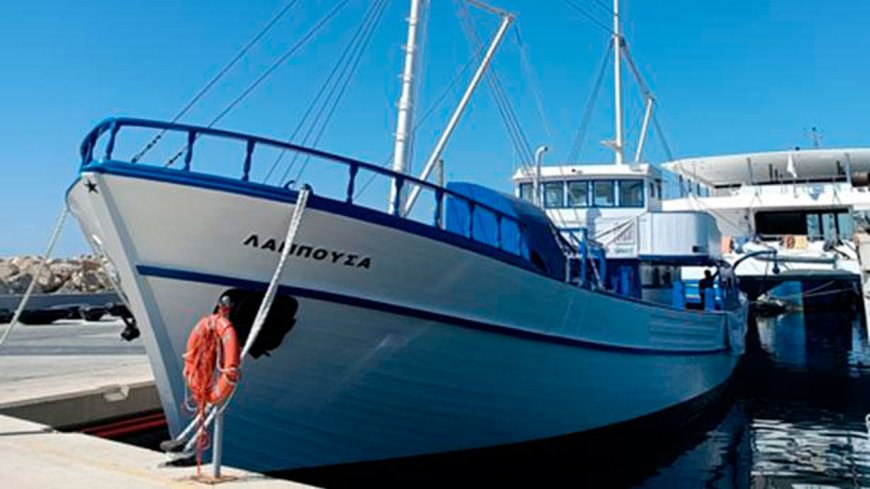
Lambousa is a vessel like no other: it provides a glimpse into the rich nautical past of Cyprus. Once an old wooden fishing trawler, it has been restored and transformed into a floating museum thanks to EU funding. 

First built in 1955, the Lambousa fished in the Eastern mediterranean for 50 years. By the end of its career, it was one of the last traditional fishing boats of its kind in Cyprus. 

In 2005, with its fishing days behind it, the Lambousa was withdrawn from service and given to the municipality of Limassol. Rather than scrapping the vessel, the municipality embarked on a project to restore the Lambousa to its original state and preserve this symbol of maritime heritage.

However, instead of limiting itself at restoration, the municipality brought together a team to transform the old fishing trawler into a floating fishing museum, to celebrate the rich fishing heritage of Cyprus. The municipality was able to use the European Maritime and Fisheries Fund for this purpose.

A floating museum

Onboard the Lambousa, visitors can see the fishing gear that has been accurately restored, to reflect the onboard reality from the Lambousa’s working years, and understand the techniques and tools used by local fishers.

As explained by Katerina Loukaidou from the Limassol municipality, ‘the Lambousa symbolises the transition from the past to the present, giving the opportunity to promote the fishing tradition in Cyprus and in the Mediterranean region in general.’

Preserving heritage for the future

The Lambousa has been a fixture of Cyprus for many years and provides insight into the relationship between Cypriot culture and its marine environment, and ultimately how fishing has shaped Cyprus’s cultural identity and traditions. 

The vessel has also played a role in different European projects, aiming to reconstruct its history, gather valuable information and ensure that its cultural heritage lives on, both physically and digitally. University students have further contributed to this effort by creating an eBook and interactive digital platform that delve into the ship’s story and the restoration process.

For now, from its mooring at a jetty in Limassol, the Lambousa and the team behind it are focused on preserving knowledge and history, and making it available to all visitors, both Cypriot and international. The future of the museum may extend to training in traditional fishing methods, to ensure their preservation beyond education and awareness.

Source: europa.eu