3.1 C
New York
Home Blog Page 906

i4sea signs up as new Certified Inmarsat Fleet Data Application Provider

0

Brazil-based startup i4sea and Inmarsat, the world leader in global, mobile satellite communications, have signed an agreement for i4sea to join the fast growing group of certified application providers to provide a dedicated application for Inmarsat’s Fleet Data service.

Fleet Data collects data from onboard sensors, pre-processes that data, and uploads it to a central cloud-based database, equipped with a dashboard and an Application Programming Interface (API).

The partnership came as a result of the Bluetech Accelerator, a program created by the Portuguese Ministry of the Sea in 2019 to create an ecosystem of maritime innovation and business acceleration. i4sea was one of 20 startups around the world – and the only one from Latin America – selected to develop pilot projects with maritime market leaders including Inmarsat.

Headquartered in Salvador, Brazil and with offices in São Paulo, Shanghai and London, i4sea will provide a high-precision sea and weather forecasting application with up to seven days forecasting in advance through i4cast®’s Atm Ocean® tool.

i4sea CEO Bruno Balbi says:

“As a Certified Application Provider, we will be constantly developing new features to generate increasingly powerful tools for the maritime market. Working with a company like Inmarsat is really a great deal for i4sea and this is the first smart system that integrates in a single platform, all the essential tools to support decision making regarding vessel’s maneuvers and port terminal’s operations.”

Six integrated tools are offered and includes services such as ocean and weather hyperlocal forecasts, dynamic draft prediction, terminal efficiency analytics and analysis and prediction of siltation or erosion dynamics of the seabed.

Marco Cristoforo Camporeale, Head of Digital Solutions, Inmarsat Maritime, said:

“We are delighted to be working with such an innovative start-up such as i4Sea, a company we worked with as part of the Portuguese Bluetech accelerator programme earlier this year. This tie-up will allow ship operators and managers to both route plan and improve terminal efficiency and this is all achieved through the i4sea application on Fleet Data and via a secure platform that is fully scalable, fleet-wide and now commercially available on both Fleet Xpress and FleetBroadband.”

Currently, i4sea’s clients include Brazilian companies such as TECON Salvador (Wilson, Sons), Açu Petróleo, CSN Coal and Ore Terminal, Cotegipe Port, Bahia’s Maritime Authority, Itajaí Port, Enseada, among others. There are also international contracts with the ports of Leixões and Sines, in Portugal.
Fugro and NOAA collaborate on new ‘opportunistic’ approach to EEZ mapping

0

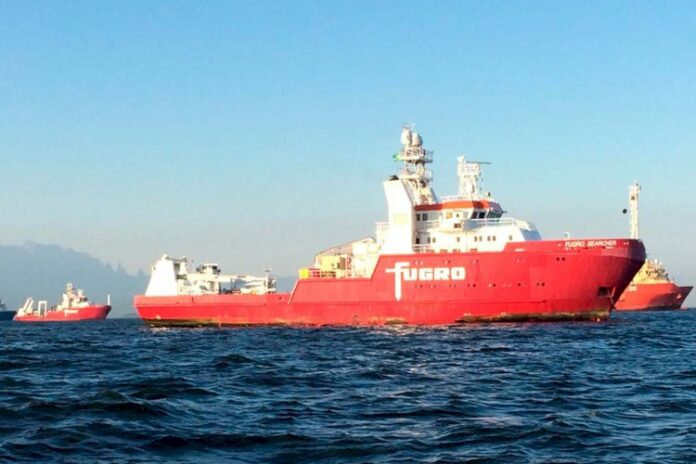
Fugro has partnered with the US National Oceanic and Atmospheric Administration Office of Ocean Exploration and Research (NOAA OER) to establish a new ‘opportunistic’ approach for mapping deepwater areas of the US Exclusive Economic Zone (EEZ).

As Fugro’s survey vessels transit to project sites through NOAA-identified areas of interest, remote command and control technologies are used to acquire high-resolution mapping data with minimal crew onboard.

A first test of the approach took place last autumn in the Blake Plateau region off the coasts of Georgia and Florida, resulting in 28 000 km2 of new EEZ mapping data delivered to NOAA in February. With only about 40 % of the US EEZ mapped and significantly less of the area characterised, the new Blake Plateau mapping data will contribute to the goals and objectives outlined in a November 2019 Presidential Memorandum on Ocean Mapping of the United States Exclusive Economic Zone and Shoreline and Nearshore of Alaska, which calls for bold action to map, explore, and characterise the ocean. Additionally, Fugro will contribute mapping data collected while transiting to and from the Blake Plateau project site as part of its ongoing crowdsourced bathymetry programme related to Seabed 2030.

David Millar, Government Accounts Director for Fugro in the Americas, said:

“We are excited to partner with NOAA on such an important and ground-breaking project. Over the past several years, we’ve developed and refined our remote service technology to streamline project schedules, reduce costs, continuously improve health and safety of our staff, and lower our carbon footprint. This same technology is utilised in the opportunistic mapping model. By leveraging the location and movements of suitable survey platforms, we can acquire high-accuracy, high-resolution bathymetry data with limited staff onboard. The approach is both efficient and cost-effective, and we believe it has tremendous potential in helping close bathymetry data gaps, not only in the US but all over the world.”

AecorLink granted a new patent on its unique communication platform

0

AecorLink announces that the company has been granted a new patent on its company’s unique communication platform.

The patented technology will further enhance the capacity for shore-ship communication via microwave links. The salient advantage with the patent allows the networks to further improve the capability providing high-speed and stable data connections. 

Ulf Harderup, VP and founder of AecorLink, says:

“We are delighted being granted this patent. This reinforce AecorLin´s position and increases our attractiveness as an Internet service provider in the maritime industry. We will continue to develop our technological edge to further expand our business opportunities.”

DCSA publishes implementation guide for IMO Cyber Security Mandate

0

Cyber security best practices to facilitate vessel readiness by January 2021

The Digital Container Shipping Association (DCSA), a neutral, non-profit group established to further digitalisation of container shipping through technology standards, today in conjunction with its nine member carriers, published the DCSA cyber security implementation guide to facilitate vessel readiness for the IMO (International Maritime Organization) Resolution MSC.428(98) on Maritime Cyber Risk Management in Safety Management Systems. The best practices outlined by DCSA provide all shipping companies with a common language and a manageable, task-based approach for meeting the IMO’s January 2021 implementation timeframe*.

The DCSA cyber security guide, DCSA Implementation Guide for Cyber Security on Vessels, can be freely downloaded from the DCSA website. The guide aligns with existing BIMCO and NIST (US National Institute of Standards and Technology) cyber risk management frameworks, enabling shipowners to effectively incorporate cyber risk management into their existing Safety Management Systems (SMS). The DCSA guide gives shipowners the tools they need to help designated technical crew members mitigate the risk of cyber attack, or contain damage (fail safe) and recover in the event of an attack.

Thomas Bagge, CEO, DCSA, said:

“As shipping catches up with other industries such as banking and telco in terms of digitisation, the need for cyber risk management becomes an imperative. Due to the global economic dependence on shipping and the complex interconnectedness of shipping logistics, cyber attacks such as malware, denial of service, and system hacks can not only disrupt one carrier’s revenue stream, they can have a significant impact on the global economy. As a neutral digital standards organization, DCSA is uniquely positioned to help vessel owners mitigate the increasing risk of cyberattack on their ships, and in turn, on the industry at large.”

The DCSA cyber security implementation guide breaks down the BIMCO framework into themes and maps these themes to the controls that underpin the NIST functional elements: Identify, Protect, Detect, Respond, Recover. DCSA provides non-technical explanations and specific actions to be taken to address each NIST element in accordance with a company’s level of cyber maturity within each BIMCO theme. Following DCSA guidance will provide vessel owners with a catalogue of cyber security safeguards aligned with each vulnerability identified during risk assessment, together with notes explaining any residual risk.

Jakob Larsen, Head of Maritime Safety & Security for BIMCO said: “The DCSA implementation guidance provides a thorough and refreshing deep dive into the challenge of how to implement cyber risk management in a shipowner company. Initially thought of as a tool for container carriers, the guidance can also inspire the thinking in other shipping sectors as well as the ongoing update of the major shipping associations’ benchmark document ‘Guidelines on Cyber Risk Management Onboard Ships’.”

* Compliance with IMO Resolution MSC.428(98) on Maritime Cyber Risk Management in Safety Management Systems is required no later than the first annual verification of the company’s Document of Compliance after 1st January 2021.

ABB wins contract for Japan’s first super-size wind turbine installation vessel

0

ABB’s advanced power systems chosen for the first self-elevating wind turbine installation vessel built in Japan will support nation’s fast-expanding offshore wind sector

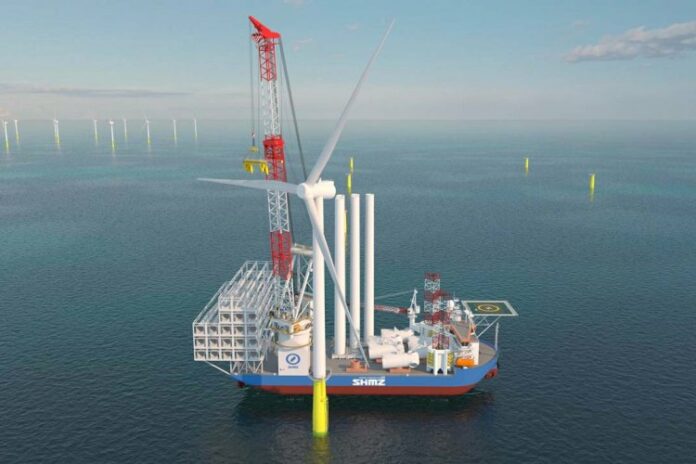
The 28,000-GT jack-up ship – a purpose-built, self-elevating wind turbine installation vessel (WTIV) delivered from a Japanese yard – will feature ABB’s advanced power and control technologies. The vessel, on order from builder Japan Marine United Corp., is due delivery to Shimizu Corp. in 2022.

Shimizu Corp.’s 142-meter newbuild will feature the greatest lifting and carrying capacity ever available on a wind turbine installation vessel. Using a 2500-ton crane capable of a maximum lift height of 158 meters, the ship will be able to transport and install seven 8MW wind turbines in a single voyage and operate in waters ranging between 10 and 65 meters deep.

ABB will deliver a closed ring configuration for the vessel’s dynamic positioning (DP) operations, enabling safe and predictable performance with high tolerance in the event of the power plant fault. Whether applied to newbuilds or retrofits, these solutions offer increased resilience to network disturbances, as well as timely and precise protection against power loss.

The Japan Marine United Corporation spokesperson said:

“ABB’s extensive experience with closed-bus systems for dynamically positioned vessels and wind turbine installation vessels in particular had been a decisive factor for this project. We recognize that closed ring solutions improve operational flexibility and engine running efficiency, while increased protection against power loss is a vital safety advantage. ABB’s vast experience with these technologies has been a decisive factor for us.”

ABB’s scope of supply also covers the delivery and system integration of generators, high voltage switchboard system, the variable speed drives and motors for main propulsion and bow thrusters, and the Power and Energy Management System (PEMS).

Juha Koskela, Managing Director, ABB Marine & Ports, said:

“We are honored to work with Shimizu Corp. and Japan Marine United Corporation in delivering this landmark vessel to the Japanese market at this important stage of the country’s renewable energy strategy. Sustainability is a core commitment for ABB Marine & Ports deliveries, and we are thrilled to secure this benchmark order that will be key in supporting offshore wind energy developments in Japan.”

In line with ABB’s “Electric. Digital. Connected.” vision, this vessel will have the capability to leverage the ABB Ability™ Remote Diagnostic Services for Marine. The network uses remote equipment monitoring and data analytics to enable predictive maintenance, planned interventions or even remote technical assistance, supported from seven existing shore-based ABB Marine & Ports’ Collaborative Operations Centers staffed by ABB experts.

Public attitudes and policy in Japan are favorable to renewable energy, where government recently passed a law to allow construction of offshore wind farms beyond port-related zones1. The go-ahead coincides with Global Wind Energy Council expectations that Asian offshore wind capacity will reach 165 GW by 20302. China will account for much of the growth, but analyst Wood Mackenzie recently forecast3 Japan’s offshore wind capacity would expand to 4 GW by 2028 – a 62-fold increase from 2018.

Delivering on these expectations is challenged by the sharp increase in water depths close to the Japanese coastline, which limits areas suitable for installing wind turbines. Maximizing the energy output requires large wind turbines, the installation of which, in turn, calls for large WTIVs. With most such vessels tied up with duties in European waters, Japan has an urgent need for high performance WTIVs, purpose-built to do the job.

Global Offshore to install cable at the Kincardine floating offshore wind farm

0

Global Offshore, a leading provider of cable installation, repair and trenching services to the offshore renewables, utilities and oil & gas markets and part of the Global Marine Group, has announced the contract award for cable installation and burial at the Kincardine Floating Offshore Wind Farm for Spanish developer and construction company Grupo Cobra.

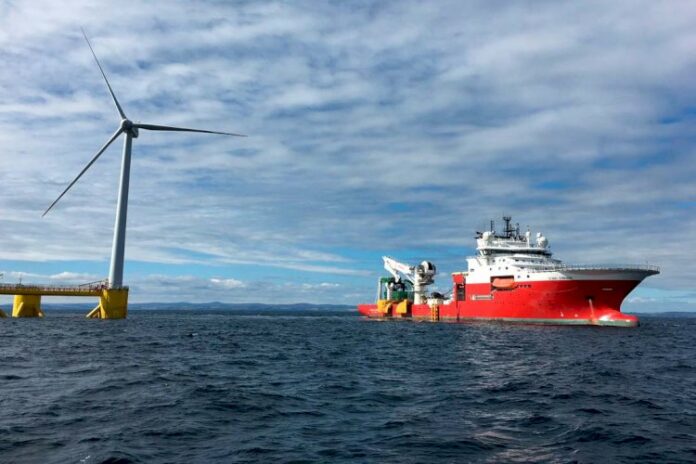
Utilising specialist cable installation vessel the Normand Clipper, the latest addition to their fleet, Global Offshore will install one export and five inter array cables at the site, totalling 30.3km. The project will commence in the spring with boulder clearance and route preparation work utilising a pre-lay plough, ideally suited to the varying seabed conditions expected in and around the wind farm location. Installation works will include the use of a dynamic riser to allow for movement of the platform, an engineering solution unique to this emerging floating sub-sector of offshore wind. Following the cable installation, remedial burial will be completed on parts of the route by a jet trencher to ensure the long term safety of the cable.

Mr Mike Daniel, Managing Director of Global Offshore commented:

“We’re pleased to be working with Grupo Cobra on this project, located just on the doorstep of our Head Office in Aberdeen. We are taking our extensive experience in installing dynamic umbilicals and flexibles in offshore oil and gas, and applying it to cable installation in the emerging floating wind farm sector, a growth area of offshore renewables. Utilising multiple assets from across the Group to deliver this project showcases the complete cable installation solution that we’re able to offer to our customers.”

DNV GL verifies floating solar design methodology for Ocean Sun

0

Ocean Sun introduces floating solar solution for man-made reservoirs and coastal waters. Floating solar opens up tremendous opportunities to provide the world with sufficient renewable energy.

The solution from Ocean Sun is the first floating solar design of its kind to receive a Statement of Conformity from DNV GL, verifying its accordance with global safety standard.

DNV GL has awarded a conformity statement to Norwegian Solar Energy company Ocean Sun for its floating solar design methodology.

The conformity statement is the first of its kind and was issued following a thorough verification process which sets the standard for the expansion of floating solar globally and opens opportunities to scale up solar energy production around the world.

The conformity statement verifies that the design methodology of the Ocean Sun floating solar structure, including design principles, methods and safety factors, complies with the relevant standards and recommended practices, such as the NS9415 standard for Norwegian aquaculture.

DNV GL is currently leading the technology qualification of the complete Ocean Sun floating solar solution where all aspects of the solution are being reviewed such as its energy production, PV cells, electrical system and membrane. The technology qualification process is being conducted in accordance with DNV GL’s Recommended Practice RP-A203.

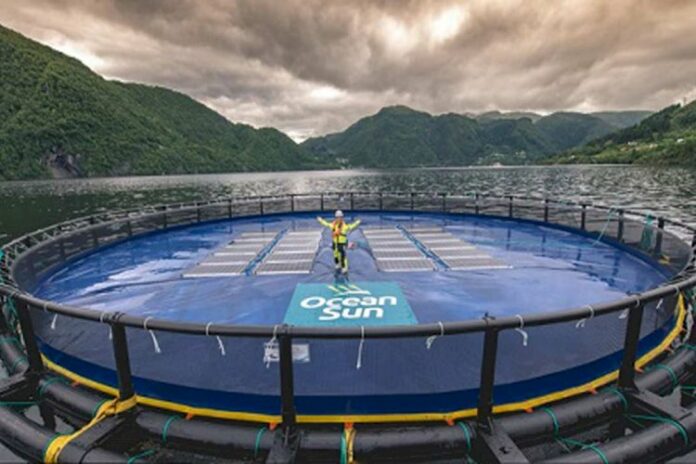
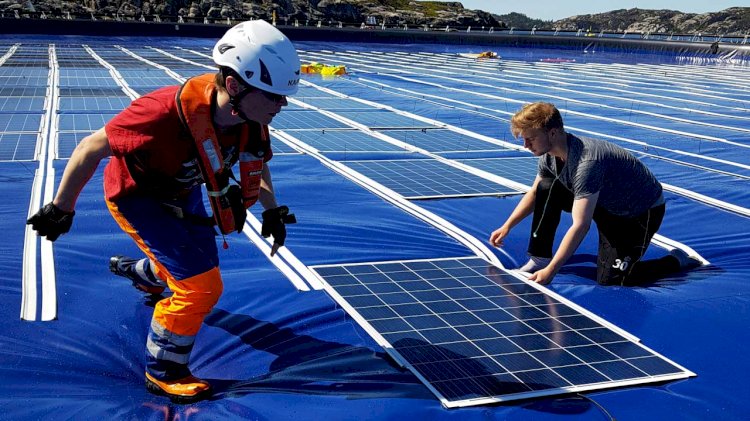
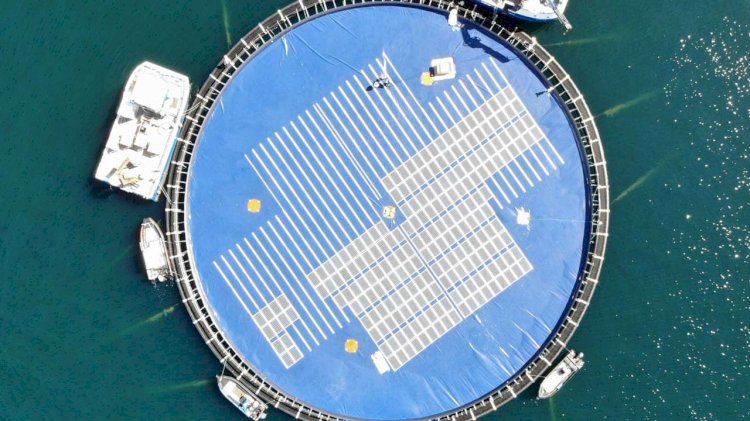
The solar solution is designed and build for operations in man-made reservoirs and coastal waters, with a design that combines solutions from open-sea salmon farms and the latest solar technology. The system is based on modified silicon solar modules mounted on a flexible hydro elastic floating membrane.

DNV GL’s Energy Transition Outlook reveals that society will need to grow solar power by more than ten times to 5TW in order to close the emissions gap, the difference between the forecasted rate at which our energy system is decarbonizing and the pace we need to reach, to limit global warming to well below 2°C as set out by the Paris Agreement.

According to a recent report from the World Bank, the global potential of floating solar, even under moderate assumptions, is 2000 Gigawatt-peak on man-made reservoirs alone. When adding coastal waters the potential becomes enormous.

Børge Bjørneklett CEO of Ocean Sun said:

“Hydropower operators have large plans to invest in floating solar solutions in their man-made reservoirs and hook it up to their already existing grid connections, but they need to be sure that the floating solar structure is sustainable, durable and safe. This verification by DNV GL is acknowledged by authorities around the world, and is a vital first step in demonstrating Ocean Sun’s readiness for deploying robust floating solar solutions.”

Prajeev Rasiah, Executive Vice President for DNV GL’s Energy business in Northern Europe, Middle East and Africa, added:

“Developing and expanding floating solar power opens tremendous new opportunities in providing the world with sufficient renewable energy. We’re pleased to work with industry leaders like Ocean Sun to verify innovative solutions that are set to have a significant impact on the advancement of the technology in the future.”

Intellian to build a range of OneWeb User Terminals

0

Intellian, the global leader in mobile satellite communication antenna systems, has signed a contract with OneWeb, the global communications company with a mission to bring connectivity to everyone everywhere, to manufacture User Terminals for use on the OneWeb Network.

OneWeb and Intellian announced their partnership to develop a wide range of User Terminal types for fixed enterprise and maritime markets in 2019, and promised availability for delivery in the fourth quarter of 2020. Now that OneWeb has signed the production agreement with Intellian, the first User Terminals will go into production immediately.

The User Terminals will be deployed to offer global service using OneWeb’s satellite constellation, delivering high throughput and low latency digital connectivity for enterprise, cell backhaul, maritime and government markets.

In a preliminary test setup, Intellian has already demonstrated superior data speeds and extremely low latency using the newly designed Intellian OneWeb User Terminals connected to OneWeb’s Low Earth Orbit (LEO) satellites.

Eric Sung, President and CEO, Intellian Technologies Inc. said:

“Intellian is excited to be moving into the production phase with the signing of this contract, which represents a significant milestone for both Intellian and OneWeb in our joint partnership to deliver connectivity around the planet. We have seen, in real life testing, how our Intellian technology and OneWeb’s network will change lives.”

Larry Alder, Chief Operating Officer OneWeb, said:

“This partnership with Intellian is another demonstration of how OneWeb is delivering on its promises and bringing together all the elements needed to deliver global connectivity for everyone, everywhere. We are excited that with this production agreement, we will soon bring a range of new User Terminals to the market that will improve connectivity for the likes of the enterprise, cell backhaul, maritime, and government markets. We look forward to continuing to grow our relationship with Intellian now and in the future.”

This contract includes the production of a wide range of dedicated OneWeb User Terminal types in a variety of antenna sizes, designed to suit various customer application requirements including businesses in rural areas, cellular backhaul networks, schools, hospitals, farms, merchant shipping and governments.  This contract also incorporates an option of utilizing existing Intellian NX series terminals with an ability to upgrade them to operate on the OneWeb LEO constellation in the future.

ThayerMahan and iXblue sign MoU to provide unmanned maritime services

0

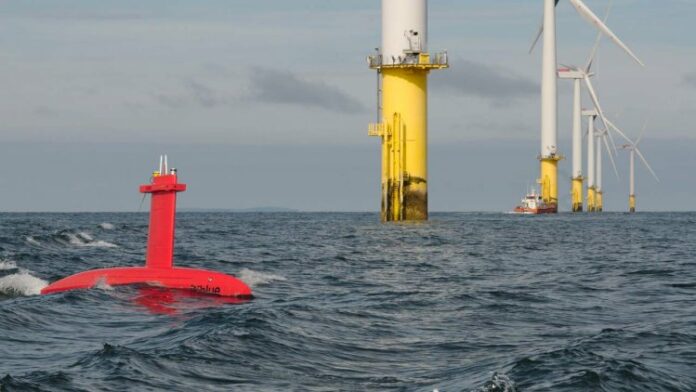
Groton-based ThayerMahan Inc., a world leader in autonomous maritime security solutions, announced today that it has teamed with iXblue, a global high-tech company specializing in navigation, acoustic positioning, and underwater imaging,  to provide unmanned maritime and survey services using iXblue’s DriX Unmanned Surface Vehicle (USV) in North America as well as in other parts of the world. ​​​​​

Benefitting from ThayerMahan’s far-reaching expertise in maritime domain awareness, and from iXblue’s multi-purpose and cost-effective Unmanned Surface Vessel (USV), both companies will be able to address a wide range of maritime and survey applications including offshore renewables, Oil & Gas, hydrographic surveys, ISR, as well as monitoring and tracking operations.

Founded by retired Admiral Mike Connor in 2016 to promote the use of unmanned autonomous systems for the U.S. Navy and other government deep-sea domain awareness programs and missions, ThayerMahan is excited about this new collaboration with iXblue.   

ThayerMahan’s CEO, Mike Connor, stated:

“We are thrilled to be working with iXblue in a number of areas.  Their creativity and design discipline combined to produce a rugged, long endurance, unmanned surface vessel that takes ThayerMahan systems to new places.  Together, we can expand our service offerings to our customers in government, industry, and academia.”

Looking forward to this new collaboration, iXblue CEO, Fabien Napolitano adds:

“We are convinced at iXblue, that partnerships are key to the advancement of our industries. Thanks to ThayerMahan’s exceptional leadership and deep understanding and experience in the maritime, security, and defense domains, combined with our expertise in advanced maritime and naval technologies and strong spirit of innovation, both our companies are now well-positioned to deliver innovative solutions in critical areas such as port and maritime security, as well as environment monitoring and offshore operations.”

ClassNK releases CBM Guidelines

0

Leading Classification Society ClassNK released its CBM Guidelines that explain the revised rules for using Condition Based Maintenance (CBM) in class surveys to promote the use of CBM technology.

Condition based maintenance, a method for monitoring the operating state of equipment, diagnosing the state of said equipment based upon the information obtained from such monitoring, and then performing necessary maintenance and inspections, has been attracting attention in recent years. ClassNK first introduced the concept of the CBM in its class rules in 1994.

Subsequent amendments to its Rules for the Survey and Construction of Steel Ships stipulate that maintenance methods based on the results of condition diagnosis can be used for class surveys, but CBM has not yet become widespread on ships with diesel engines.

On the other hand, with the development of measurement technology, information-communication technology, and information-processing technology in recent years, initiatives related to CBM have become very active in the industry. In addition to offering safe operation and reduced operating costs, CBM is also considered to be an indispensable technology for Maritime Autonomous Surface Ships (MASS).

In light of the situation, ClassNK reviewed the structure of its requirements for planned machinery surveys, revised its rules as needed to provide more detailed requirements for the adoption of CBM in class maintenance surveys, and released its CBM guidelines. The revision of the rules came into force in January 2020.

The CBM guidelines contain not only explanations of the revised rules and how to apply to use CBM in class surveys, but also general explanations and future outlooks on CBM.