-6.2 C
New York
Home Blog Page 806

ClassNK launches “Innovation Endorsement” service for certifying innovative technology

0

In February 2020, the Society announced the “ClassNK Digital Grand Design 2030” which shows its future vision for the digital society of 2030, aiming to support the evolution of ocean-related business by meeting the new needs of clients brought about by digital technology and data distribution, and contribute to the further improvement of safety.

The Digital Grand Design cites three fundamental policies, with one of them being to “diversify certification services and expand their scope”. The “Innovation Endorsement” certification service which targets innovative digital technology is being launched in line with this policy.

With the development of information technology, attempts to share and utilize data from ships have already begun, and many innovative technologies have emerged. By proactively providing certification services for these innovations and promoting their spread and development, ClassNK strives to support the preservation of the marine environment, further improve safety at sea, and support the sustainable development referred to in the SDGs.

Speaking on the occasion, Dr. Toshiro Arima Corporate Officer, General Manager of Digital Transformation Center said:

“Up until now, we have carried out certifications in accordance with the mandatory requirements of international conventions and of our rules. On the other hand, it is likely that a clear evaluation standard has yet to be established for innovative technologies, which can occasionally hinder their diffusion. Accordingly, “Innovation Endorsement” will provide certification services regardless of existing standards based on the policies of “speed-focused” and “establishing evaluation criteria in cooperation with front runners”. In cooperation with technical front-runners, we will continue establishing appropriate evaluation criteria and providing prompt certification services.”

“Innovation Endorsement” certification will be carried out and classified under “1. Ships”, “2. Products/solutions” such as software and machinery, and “3. Providers” offering products/solutions.

1. Ships: A new class notation “Digital Smart Ship” will be established and will be given to ships applying digital technologies including various types of monitoring and autonomous navigation.
2. Products/solutions: Includes innovative products/solutions that are expected to be widely used in the future such as those involving CBM (Condition Based Monitoring), fuel efficiency improvement, data quality assurance, electronic logbooks, and more.
3. Providers: Certification of development methods for creating innovative technologies by companies and of the companies themselves.
OHT enters turbine installation market

0

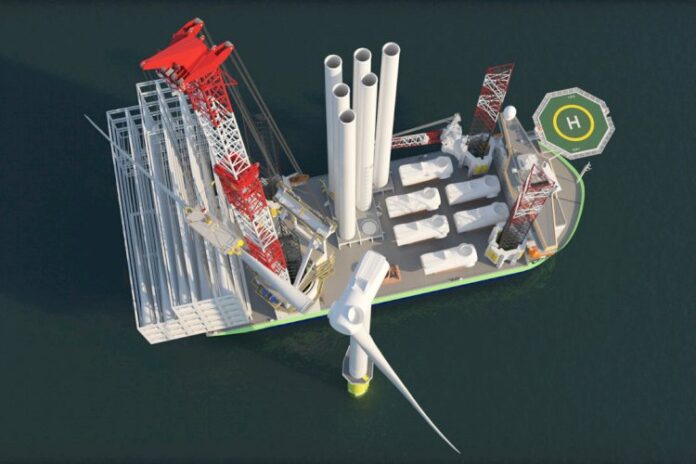
OHT has announced its entry into the offshore Wind Turbine Generator (WTG) installation sector, having entered into a binding Heads of Agreement with China Merchants Heavy Industry (CMHI) in Jiangsu, China for the construction of two WTG installation vessels with options for a further two units, through its wholly owned subsidiary VIND Offshore Installation AS.

The vessels will be jack-ups of GustoMSC design and will be prepared to efficiently handle the next generation WTGs, featuring a telescopic crane with maximum capacity of 2,500t and a maximum lifting height of approx. 165m. The units will be capable of efficiently installing in water depths up to 65m. Special emphasis has been placed on providing a class-leading environmental footprint by way of energy and heat recovery, battery hybrid solutions as well as a sophisticated electrical and control system, reducing CO2 emissions by 20% compared to similar units. As a future option, the vessels have been prepared for fuel cells powered by hydrogen to be installed to cut emissions even further. By working closely with GustoMSC, the shipyard and key vendors to optimize the design, the commercial and delivery terms are very attractive in today’s market.

The first unit will be delivered in early 2023. The delivery structure for the second unit is flexible.

Torgeir E. Ramstad, CEO for OHT, says:

“Through this initiative, OHT firmly establishes its position as a leading, fully integrated Transport and Installation (T&I) company for offshore wind. In doing so, we are responding to client concerns about the lack of capable vessel capacity in the booming offshore wind market. We hear them applauding the development of a capability by a single company to handle the T&I of next generation foundations and turbines.”

The venture is based on a concept and business model initially developed by VIND Offshore Installation AS and its founder Rune Magnus Lundetræ.

Rune Magnus Lundetræ adds:

“OHT already has the organization, systems, track record and market presence required to successfully deliver and execute this initiative. We look forward to our involvement in the world’s first integrated pure-play T&I company in the offshore wind segment with interesting triggers for further growth, including expansion of the Alfa Lift series of foundation vessels and possibly more jack-ups through exercising the options.”

OHT is already a leading company within heavy transportation, having routinely transported the World’s heaviest and largest structures over the last 14 years, dominated by Oil & Gas clients.

OHT saw an increasing number of opportunities in the offshore wind segment, characterized by high technical and operational complexity. Since 2017 the company has been targeting a leading position in this market, resulting in several contracts to transport offshore wind foundations. Most notably the ongoing Moray East project where OHT is transporting 48 jacket foundations from the UAE to Scotland.

Two years ago, OHT announced a contract to build the World’s largest and most efficient foundation installation vessel – Alfa Lift – at CMHI. This vessel, to be delivered next year, is designed to install monopiles and jackets from a floating vessel in dynamic positioning mode to achieve higher efficiencies and lower cost.

Combined with the existing transportation fleet, OHT will be able to deliver class-leading Transport & Installation services of the largest foundations, whether they are produced near to the windfarm or on a different continent.

16 months after ordering Alfa Lift, OHT announced the award of Dogger Bank A & B where Alfa Lift will transport and install foundations at the world’s largest offshore wind farm, from 2022.

Holland America’s changes name of newbuild and designates It the new flagship

0

In honor of some of the most memorable ships in Holland America Line’s nearly 150-year history, the premium cruise line is changing the name of its newbuild from Ryndam to Rotterdam and designating it the new flagship of the fleet. The seventh ship to bear this historic name, Rotterdam will be delivered one year to the date on July 30, 2021, pushed back slightly from its original delivery of May 2021 due to the global health situation.

When Rotterdam is delivered from Fincantieri’s Marghera shipyard in Italy, it will spend the summer exploring Northern Europe and the Baltic on roundtrip cruises from Amsterdam, the Netherlands. Guests and travel advisors with clients who were booked on the ship’s Premiere Voyage in May and itineraries through July 30 are being contacted with rebooking options.

Gus Antorcha, Holland America Line’s president, said:

“The first ship for Holland America Line was the original Rotterdam, the company was headquartered in the city of Rotterdam for many years, and the name has been a hallmark throughout our history since 1872 … so clearly the name is powerful and symbolic. With the current Rotterdam leaving the company, we knew we had a unique opportunity to embrace the name as our new flagship and carry on the tradition of having a Rotterdam in our fleet. Seven is a lucky number, and we know she’s going to bring a lot of joy to our guests as she travels across the globe.”

Holland America Line’s first ship was Rotterdam, which sailed its maiden voyage from the Netherlands to New York Oct. 15, 1872, and led to the founding of the company on April 18, 1873. Rotterdam II was built in 1878 for British Ship Owners Co. and purchased by Holland America Line in 1886. Rotterdam III came along in 1897 and was with the company until 1906. The fourth Rotterdam joined the fleet in 1908 and also served as a troop carrier when World War I ended. Following the war it made regular cruises from New York to the Mediterranean.

Rotterdam V, also known as “The Grande Dame,” set sail in 1959 and began sailing transatlantic crossings with two classes of service. It later converted to a one-class ship in 1969. She sailed with Holland America Line for 38 years until 1997, including several Grand World Voyages, and currently is a hotel and museum in the city of Rotterdam. Rotterdam VI, the most recent to cruise for Holland America Line, was introduced in 1997 and the first ship in the R Class.

Cruising aboard Rotterdam VII begins Aug. 1 with the ship’s seven-day Premiere Voyage departing from Trieste, Italy, to Civitavecchia (Rome), Italy, with port calls throughout the Adriatic Sea and southern Italy. The ship sails Aug. 8 from Civitavecchia on a 14-day cruise through the western Mediterranean and on to Amsterdam.

From Aug. 22 through Oct. 10, the ship will sail roundtrip from Amsterdam on three seven-day itineraries to Norway, one 14-day to the Baltic and one 14-day to Norway, Iceland and the British Isles. A trans-Atlantic completes the inaugural Europe season with a 14-day voyage from Amsterdam to Fort Lauderdale, Florida.

To accommodate guests booked on cancelled itineraries of Ryndam from May through July, Nieuw Statendam cruise itineraries also will see some changes to match up as much as possible with former Ryndam sailings.

Total announces third significant discovery in Block 58 offshore Suriname

0

Total and Apache Corporation have made a significant third discovery with the Kwaskwasi-1 well, in Block 58 off the coast of Suriname. This follows previous discoveries at Maka Central in January and Sapakara West in April.

The well was drilled by a water depth of about 1.000 meters and encountered a total of 278 meters net pay of hydrocarbons, which comprises 149 meters net in good quality Campano-Maastrichtian (composed of 63 meters of high quality oil and 86 meters of volatile oil & gas condensates reservoirs), along with 129 meters of net hydrocarbon pay in Santonian reservoirs, where further wireline logging is ongoing to confirm the quality of the fluids. 

Kevin McLachlan, Senior Vice President Exploration at Total, said:

“We are very pleased to announce a third discovery in a row, following the two oil discoveries at Maka Central and Sapakara West this year. This very encouraging results confirm our exploration strategy in this prolific zone, which targets large volumes of resources at low development costs.” 

The Kwaskwasi-1 exploration well was drilled by Apache, as operator with 50% working interest, and with Total as the JV partner with 50% working interest. The next and fourth exploration well will be drilled back to back on the Keskesi prospect. Total will take over as operator of the Block after the drilling of the fourth well 

In early 2021, an appraisal campaign will be carried out to better characterize the 2020 discoveries, along with an additional exploration campaign.
 

First of its kind LNG-powered vehicle carrier calls JAXPORT

0

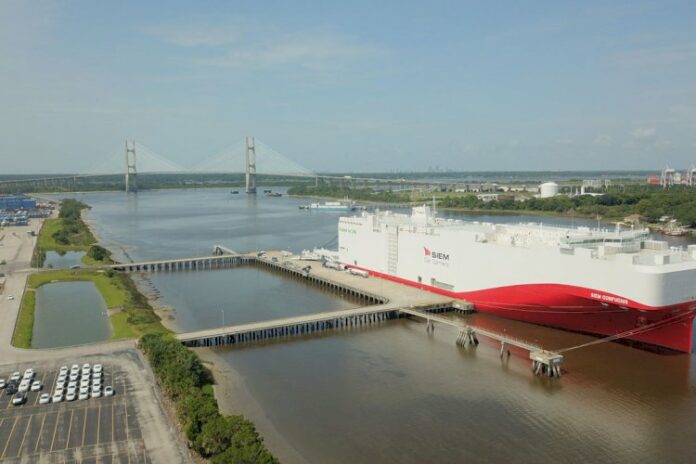
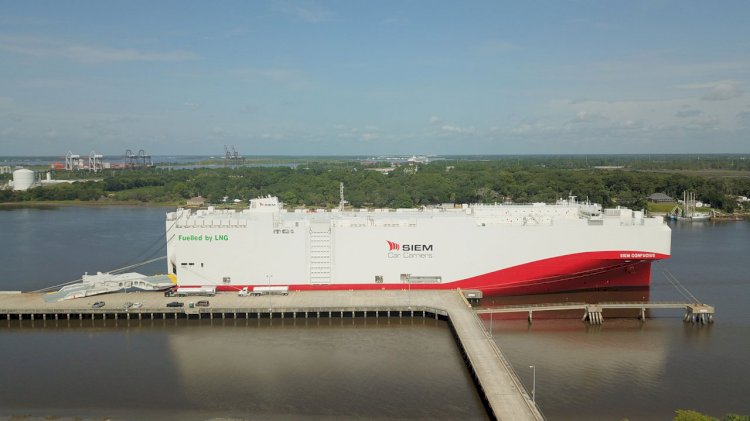
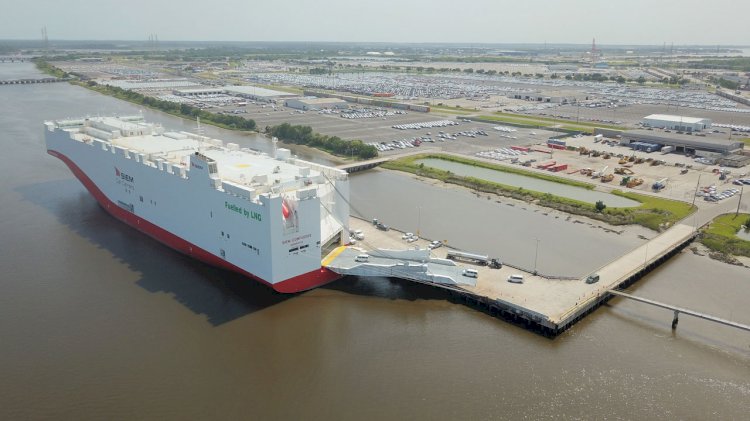
The vessel arrived at JAXPORT from Veracruz, Mexico and unloaded factory-new Volkswagen Group of America cars and SUVs at the port’s Blount Island Marine Terminal during its maiden voyage to the United States.

The 7,500-car-capacity Siem Confucius is the first of two new LNG-powered ships built by Siem Car Carriers AS and commissioned by Volkswagen Group of America. Siem Car Carriers says the ships reduce carbon dioxide emissions by up to 25 percent and sulphur oxide emissions up to 100 percent.

Siem Car Carriers President Jeffrey Campbell said:

“Siem Confucius and its sister ship, Siem Aristotle, are among the most modern and eco-friendly ships serving the automotive industry today. By investing in world-class technology and maintaining a modern and efficient fleet, we are able to reduce emissions and our overall carbon footprint, while delivering the world-class service our customers have come to expect from Siem.”

JAXPORT CEO Eric Green said:

“Northeast Florida is a global leader in the use of LNG as a preferred fuel type for the maritime industry. Some of the world’s most environmentally friendly vessels call JAXPORT and we are proud to support these initiatives and do our part to make the supply chain cleaner and greener for the communities we serve.”

Jacksonville is the nation’s No. 2 vehicle-handling port and the only U.S. East Coast port offering on-dock and near-dock LNG fueling capabilities.

Four LNG-powered vessels are homeported at JAXPORT. Three LNG production and storage facilities operate in Northeast Florida, and a fourth facility is currently under construction.

Equinor transfers operatorship of Bressay project to EnQuest

0

The initial consideration is GBP 2.2 million, payable as a carry against 50% of Equinor’s net share of costs, with a contingent consideration of USD 15 million following authority approval of a field development plan for Bressay.

Arne Gürtner, Equinor’s senior vice president for UK & Ireland offshore, says:

“This transaction supports Equinor’s strategy to continually optimise our portfolio. We welcome EnQuest as the new operator of Bressay and believe the knowledge and experience both parties can share from our existing Mariner and Kraken developments will further strengthen the project.”

The Bressay oil field was discovered east of Shetland in 1976 and Equinor became operator in 2007. The concept selection for the field development was deferred in 2016 due to challenging market conditions and the need to simplify the development concept.

Gürtner says:

“Equinor will continue to be the U.K.’s leading energy supplier, and we are committed to delivering oil, gas, wind power and hydrogen to the country – playing our role in creating jobs, boosting investment and lowering carbon emissions. We look forward to working with EnQuest and the U.K. authorities to progress the Bressay project.”

The transaction is subject to customary conditions, including partner and authority approval, with an estimated completion date in Q4 2020. Following completion, EnQuest will have an 40.8125% interest and operatorship, Equinor will have 40.8125%, with Chrysaor retaining a 18.375% interest.

APM Terminals first to launch fully digital export management system in Russia

0

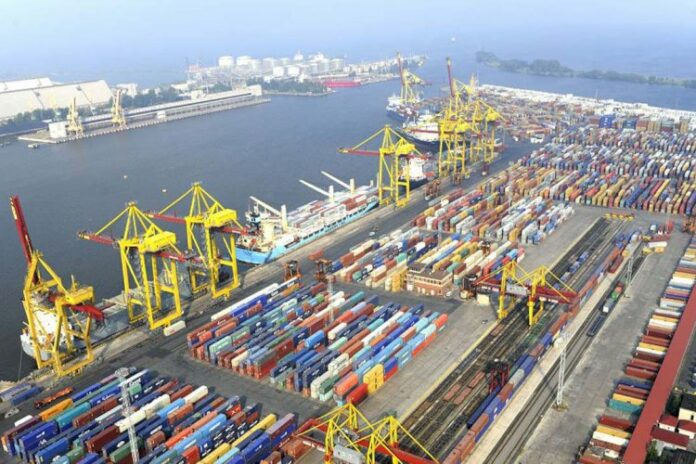
Following successful testing at the Turukhtanny customs post in June this year, First Container Terminal (FCT), will become the first Russian terminal to transfer to a fully paperless export management system for containers.

The proprietary technology enables the digital exchange of legally binding documents with the customs authority and is based on Global Ports’ customer portal and Sea Port’s Portal software functionality (1). 

Global Ports is a joint venture that combines the global expertise of APM Terminals (30.75%) with the local knowledge of Delo (30.75%), one of the largest private transportation and logistics holding companies in Russia. 

The new digital export management system allows forwarding companies to upload orders and customs will issue documentation digitally. This enables the terminal to commence the loading of a container onto a vessel immediately without additional approval. 

The forwarding company, customs authority, terminal and the shipping line all have online access to information about the status of the container at all stages of the process. This significantly decreases the time required to handle a shipment of export containers and will greatly simplify the interaction between the process participants.

Alexey Yermolin, Director of Information Technology at Global Ports, noted:

“Global Ports is working hard to make its service as convenient as possible for customers and partners. Shipment orders remained the last “paper” element in export shipments. Due to our efficient interaction with customs, we have now made this document digital as well. Now, an export shipment may be ordered and traced on our customer portal. The technology we use guarantees data protection and integrity of data after it is entered into the electronic document flow system.”

During 2020, the service will be rolled out across all Global Ports terminals in Russia. The technology will also be developed to include shipping lines’ functionality into the system, which will allow the digital preparation of documents that foreign economic activity players require to confirm the zero VAT rate application (2).

Global Ports is the leader in digitalisation among all of Russian ports – as a result of the continued development by the Group’s IT Services, paper document flow at the Group’s terminals has reduced by 2.5x in the last six years.

(1) Developed by the FCS and intended for issuance of documents for vehicles and goods carried by vessels across the customs border of the Customs Union, on the basis of the electronic document exchange system.

(2) Sale of goods exported under the export customs regime is subject to VAT at a zero percent tax rate provided that the exporter submits to the tax authority the documents set forth in Article 165 of the Tax Code of the Russian Federation.

Fugro starts shallow water phase for 2Africa fibre-optic subsea cable project

0

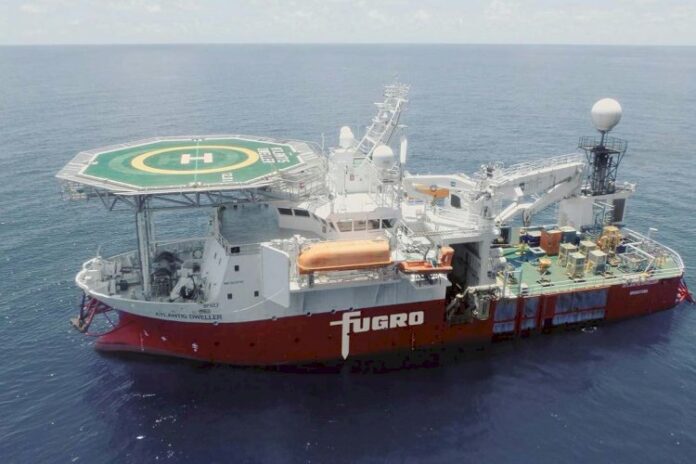
Fugro has begun their shallow water campaign for the “2Africa” subsea fibre-optic cable project which, once installed, will connect 23 countries in Africa, the Middle East and Europe and deliver more than the total combined capacity of all subsea data cables serving Africa.

Fugro is supporting the project with offshore and onshore survey expertise, including a geophysical route survey and shallow geotechnical testing to overcome any challenges along the planned route.

Fugro started their survey programme for Alcatel Submarine Networks (ASN), which includes a pre-installation and engineering survey, permitting support and desk study consultancy, back in March and work will continue for approximately one year from their multipurpose 70 m vessels Fugro Gauss and Fugro Supporter, excluding any route development and additional work. By conducting the deep-water reconnaissance survey first, Fugro has already expedited the cable engineering and manufacturing phase by providing multibeam echosounder data to the ASN project team “on the fly” during the first phase of the project.

Malte Cesson, Fugro’s Commercial Manager for Marine Site Characterisation in Bremen, Germany, said:

“We are proud and honoured to be selected by ASN for this project, which in its base configuration will be one of the largest of its kind. The challenging scope of work is further complicated by Covid-19 and the associated protocols but our unrivalled strategic partnership with ASN means we are confident of successful completion within the required time frame and budget.”

The 2Africa cable system is based on the latest fibre-optic technology and will enable resilient and improved low-latency network traffic in times of growing bandwidth demand. Working towards a cable completion date in 2023/early 2024, the system will be more than 37 000 km long, supporting the growth of 4G, 5G and fixed broadband access for hundreds of millions of people and businesses.

DP World Komatipoort becomes the first dry port east of Gauteng

0

DP World’s Komatipoort inland container depot in South Africa, has become the first dry port in the region, east of Gauteng, following its licencing by the South African Revenue Service (SARS) as an approved bonded container depot.

The location of the depot is also close to a fully-fledged South African Customs and banking infrastructure, which will facilitate South African customs clearance of goods at Komatipoort.

Christian Roeder, CEO of DP World Maputo, said:

“The approval of our Komatipoort facility as a bonded container depot, is a ‘game changer’ for the Maputo corridor. This means that international container imports landed in Maputo port and destined for the South African hinterland, can now be moved under bond to Komatipoort, where full customs clearance can be provided and made ready for delivery across South Africa.

DP World’s primary aim for the Komatipoort facility is to make the hinterland’s supply chain faster, more reliable and provide total cost savings, by opening a superior supply chain routing for cargo owners.”

DP World Komatipoort’s strategic location, full-service offering, and seamless link via the Maputo Corridor to DP World Maputo’s modern and efficient container terminal, where there is no vessel and port congestion and with fixed berthing windows available to major shipping lines, offers customers considerable transport savings and the avoidance of delays for consignees in Mpumalanga, Limpopo and Gauteng.

This trade corridor also offers South African businesses based in the region export opportunities from DP World Komatipoort via Maputo to international markets anywhere in the world.

DP World Komatipoort, began operations in August 2019, and is part of Dubai-based DP World’s international network of 127 business units in 51 countries across 6 continents.

SMD secures new LARS contract with Orange Marine

0

Subsea vehicle and launch and recovery systems (LARS) specialists Soil Machine Dynamics (SMD) has won contracts to supply two solutions to marine telecommunications company Orange Marine Group. The new LARS systems will be used to launch custom trenching ROVs for the burial of underwater fibre optic cables.

The solutions are an evolution of SMD’s specialised Wide Angle A-Frame, creating a bespoke system to accommodate a high vessel freeboard, allowing the Orange Marine trenchers to operate in higher sea states.

Matthew Woodward, business development manager for handling systems at SMD, who has worked closely on the project, said:

“The most dangerous time for an ROV launch is as the vehicle is released from the A-Frame and enters the often rough ocean splash zone, and when it is being raised back onboard.

SMD’s Wide Angle A-Frame has a greater outreach and working arc than that of a conventional A-Frame system. This means that the air gap between the ROV and the water is minimised during launch, which reduces the pendulum effect caused by vessel motions on the vehicle. Limiting these forces is important to ensure a clash between the ROV and vessel structure is avoided and the vehicle’s umbilical cable is not overstressed. Ultimately this simple solution makes it much easier and safer for operators to launch and recover the vehicle without damage in high sea states.

At SMD, we pride ourselves on the relationship we foster with our client base. For this project, we have worked very closely with the technical team at Orange Marine and discussed many options to arrive at this preferred solution.”

The first system is due for delivery to Orange Marine’s Italian subsidiary (Elettra Tlc spa) in Sicily at the end of 2020, with the second system expected to start work near Singapore in mid-2021. SMD will also provide structural assessments on the vessel decks, installation, and commissioning support once the handling systems are onboard to ensure they are fully operational before the trenchers are first launched.