2.8 C
New York
Home Blog Page 790

ITF: Ukrainian seafarers caught in Kharatyan scam, but unions get them home

0

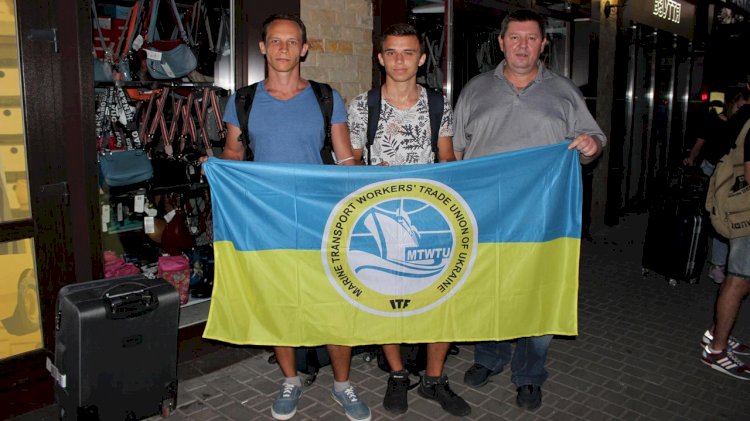
At the beginning of July, 20 Ukrainian seafarers signed employment contacts through the Ukrainian manning agent Artur Kharatyan, the founder of Kharatyan Crew Management, to work onboard the ships MV Arif Kaptan and MV Rachel Borchard. Soon after signing the contract, the Kharatyan transported the crews to the Turkish city of Karasu, where they were supposed to join the ships there.

The seafarers were sent to a hotel in Karasu, waiting to board for their new tours. But with each new day, the crew did not board their ships. And then, suddenly, Artur Kharatyan broke the contact and switched his phone off.

With no communication from Kharatyan and in a foreign port, the Ukrainian seafarers now found their problems mounting. Their accommodation at the hotel had not been paid, either by the shipowners or the manning agent, and after a while the seafarers discovered they had accumulated significant debts for room and board in Karasu. The hotel owner seized their travel passports to guarantee that the debt to him would be paid off. The seafarers were now stuck in Turkey.

MTWTU First Vice-Chairman Oleg Grygoriuk says that, before undertaking travel to join a ship, seafarers should use the various free websites and mobile apps available to look up the location of vessels and ensure what they are being told by manning agents and shipowners matches publicly available information:

“Afterwards, when the problem unfolded, our union contacted the owners of both ships to find out that neither of them had ever had any relations with Kharatyan Crew Management. Incredibly, the MV Arif Kaptan has been laid up and non-operational for three years already!

For several years now, criminal proceedings have been ongoing against this fraudster Kharatyan for extortion of seafarers, and taking bribes from them. What makes this worse is that the 20 Ukrainian seafarers had to pay Kharatyan to enter the fake contracts, from USD 1,500 to USD 7,000 each.”

In early August, 14 of the seafarers returned home to Ukraine at their own expense. The remaining six were unable to pay accommodation debts to the hotel owner and recover their passports. Furthermore, many couldn’t afford to get home from Turkey.

And the MTWTU asked the ITF for support. Oleksandr Dimchev, Ukrainian Vice-Consul in Istanbul, successfully argued for and won a reduction in the crew’s accommodation debt.

Grygoriuk said:

“We immediately bought out the seafarers’ passports, having covered the accommodation debts. Money was sent to the crew to buy food and basic necessities and we booked the next available flight home. Given the crew had prepared to be months at sea, we bought extra baggage, and ensured they had transfers from the hotel to Istanbul airport and from Kiev Borispol airport to Odessa.

The conned seafarers now intend to join the other over 50 victims of the unscrupulous manning agent Kharatyan to seek help from law enforcement authorities to stop this man.”

By 12 August, the six seafarers had been safely returned to Odessa from Karasu.

AKVA Group to supply new feed barge to Iceland

0

The feed barge will be put into operation at the company’s locations in eastern Iceland.

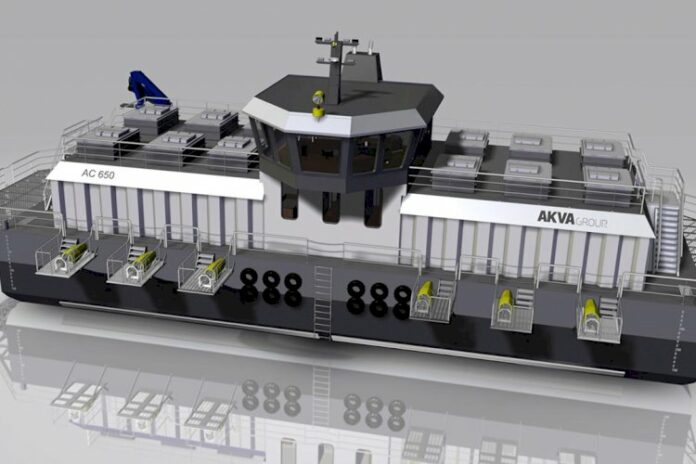
AC 650 Panorama has a large feeding capacity of 650 metric tons in 12 silos, has 8 feeding lines with selector valves and options for AKVA Hybrid battery pack.

The AC 650 Panorama feed barge is the second feed barge AKVA group delivers to Laxar Fiskeldi, which is a key player in the growth of salmon production in Iceland.

Hans-Øyvind Sagen, Sales Director Nordic in AKVA group, says:

“Iceland is an exciting, up-and-coming market with great opportunities for further growth. With this delivery we are consolidating our leading position as a supplier of feed barges to Iceland.”

Laxar Fiskeldi has recently received an increased production license on the east coast of Iceland and is now heading for a production capacity up to 16,000 tonnes annually. Gunnar Gunnarsson is Production Manager in the company. Vast experience within the aquaculture industry provides him with perfect insight on the essential requirements for a feed barge.

Gunnarsson says:

“We need feed barges with superior safety, stability and durability. In addition, silo, silage and feeding capacity and functionality are key. Good equipment is a significant success factor for us to succeed, and AC 650 Panorama from AKVA group has the qualities we are looking for.”

AC 650 Panorama has a large feeding capacity of 650 metric tons in 12 silos, has 8 feeding lines with selector valves, options for AKVA Hybrid battery pack, and is delivered with a veterinary room, workshop, control room, wardrobe, cabin and more.

Laxar Fiskeldi is located close to AKVA group’s service station in Eskifjordur, and already has a delivery and service agreement with AKVA group for net equipment.

Sagen says:

“It is a good foundation to further develop our collaboration in fish farming equipment. We look forward to following Laxar’s production and further growth.”

Laxar Fiskeldi operates 2 smolt facilities and 1 post-smolt facility in southern Iceland and operates a pen-based fish farming facility in Reyðarfjörður on the east part of Iceland. The head office is located in Eskifjörður.

AC 650 Panorama

  • Feed storage capacity: 650 metric tons (12 silos)
  • Silage: Up to 60 metric tons
  • Length/width (ex. platforms): 31,3 m/12 m
  • Dimensioned to withstand up to 4m significant wave height (Hs)
  • Modern living quarters, veterinary room and suitable accomodation for longer stays

Saipem will develop one of the first wind farm in the Adriatic Sea

0

Saipem will co-develop a wind farm in the Adriatic Sea off the coast of Ravenna.

The company thus confirms its increasingly active presence in the field of initiatives linked to the development of offshore wind and its presence in the sector also in Italy. To this end, it has recently signed a Memorandum of Understanding (MoU) with AGNES, a company that develops renewable energy projects in the Adriatic Sea, in particular offshore and nearshore wind farms, floating solar panels at sea, energy storage systems and hydrogen production from renewable sources, and QINT’X, an Italian company specialising in renewable energy, specifically solar, wind and hydroelectric energy and e-mobility (electric vehicles).

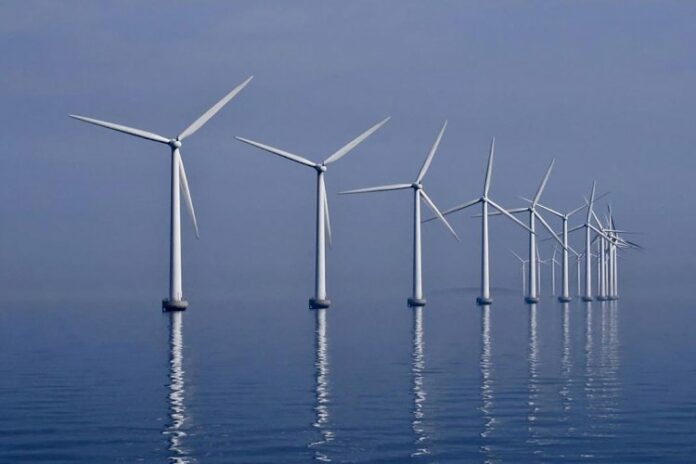
This project will involve the installation of approximately 56 turbines on fixed foundations on the seabed at two different sites: one located more than 8 nautical miles from the shore, and the other more than 12 miles from the shore. The overall installed power will be approximately 450 MW. As part of this project, innovative technologies will also be used such as floating solar technology based on the proprietary technology of Moss Maritime, which is part of Saipem’s XSIGHT division dedicated to developing innovative solutions to speed up decarbonisation process in the energy sector. In this respect, the XSIGHT division has already begun developing integrated solutions for using renewable energy and for producing “Green” hydrogen. The Agnes project will be the first project to develop such integrated solutions, offering the opportunity to find an alternative solution to decommissioning O&G platforms in the Adriatic Sea.

This project will be implemented in a highly industrialised area and the local industry will be involved in supporting it.

Mauro Piasere, Chief Operating Officer of the XSIGHT Division, commented:

‘Saipem has long launched a process to strengthen its presence in the renewable energy sector. In particular, through the XSIGHT division, the company’s new role as developer of offshore wind farms is being defined and the Memorandum of Understanding signed with AGNES and QINT’X constitutes a new important opportunity in this direction. This agreement is consistent with the new business model adopted by the company, which is increasingly becoming a leader in the field of energy transition, and introduced in 2019 as part of the agreement with Plambeck to develop wind farms with floating foundations in the Red Sea off the coast of Saudi Arabia. Through the XSIGHT division, Saipem is planning to launch similar projects in Sicily and Sardinia as well, using floating foundations for wind turbines, thus supporting the Italian shipbuilding industry”.

Alberto Bernabini, Chief Executive Officer of QINT’X, commented:

“This agreement marks another important step towards the realization of an ambitious project. Our vision is to create a new green energy hub in the Adriatic Sea, integrating multiple technologies to generate clean energy from the wind, sun and hydrogen. We are very proud and pleased to count on Saipem as a partner, a global leader in Offshore solutions, which is now set to be a main actor in the much-needed energy transition. This collaboration will allow us to harness many synergies transform Agnes Project into a reality”.

New Damen ASD Tug 2810 for Louis Meyer christened at Shipyards Gorinchem

0

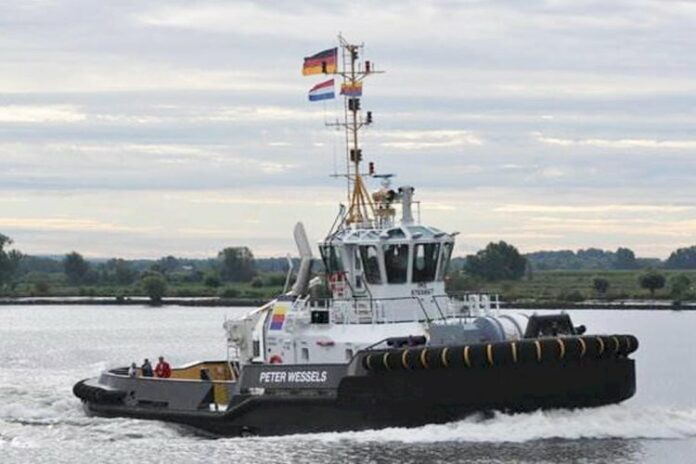
On the 14 August, the naming ceremony was held at Damen Shipyards Gorinchem for the Peter Wessels.

The new Damen ASD Tug 2810 handed over to Neue Schleppdampfschiffsreederei Louis Meyer GmbH & Co. KG (Louis Meyer) which is based in Hamburg. Even by Damen standards this was exceptionally fast. The contract for the new vessel was signed exactly four months earlier, on the 14th of April.

This particular vessel had been built for stock at Damen Song Cam Shipyard and then transported to Europe to meet just such a need as this.

The 28-metre ASD Tug 2810 is one of Damen’s most popular vessels, with over 150 sold since its introduction. With 60 tonnes of bollard pull, they are also highly manoeuvrable, and are built to a rugged design well known for its reliability and durability. They can be found working in ports and harbours around the world. The Peter Wessels features a number of options, most notably an aft winch which equips it for coastal towage of barges. It also has been fitted with a sewage treatment plant, a boiler and heated windows.

Louis Meyer, established in 1907 and now under the management of the fifth generation of the founding family, will be chartering the ASD Tug 2810 to Emder Schlepp-Betrieb GmbH (ESB), which operates from the busy Port of Emden, Lower Saxony. The arrival of the Peter Wessel will take its fleet up to five vessels and will be its first by Damen.

For Louis Meyer this is their second Damen tug, having taken delivery of a Damen ASD Tug 2411, named the Jan, in June 2019. This was an even faster delivery with the contract being signed almost exactly a year prior to that for the Peter Wessels, on April 11th 2019.

Damen sales manager Joschka Böddeling commented:

“We are very pleased to have been working with Louis Meyer again, and so soon. The fact that they have added two Damen vessels ships to their fleet in such a short space of time is very gratifying. We look forward to working with them again in the future. The Peter Wessels has very much been a ship of the Coronvirus era, with the contract signed remotely and the naming ceremony taking place under strict safety conditions. But it is proof that life did go on despite everything and our thanks go out to all involved.”

Edvin Kohlsaat, Managing Director at Louis Meyer, added:

“For us it was nice to work with another family business on the Peter Wessels. So it was a simple decision to return to Damen where they take our ideas into account and deliver high quality. We are confident that the Peter Wessels will be a great asset to ESB and their operations in Emden.”

The Peter Wessels has now been handed over to her Owners and commenced work in Emden.

Review: reefer shipping to outpace dry cargo trade despite container shortages

0

Growth in seaborne perishable cargo slowed in 2019 but is forecast to better weather the COVID-19 induced economic storm than the dry cargo trade given the broader resilience of the food supply chain. 

Meanwhile, availability of refrigerated container equipment is forecast to tighten as buoyant trade and continued modal shift boost expansion in reefer cargo carried by containerships, according to Drewry’s latest Reefer Shipping Annual Review and Forecast 2020/21 report.

Worldwide seaborne reefer trade recorded growth of just 1.7% in 2019 to 130.5 million tonnes, its weakest rate of growth since 2015. Traffic growth was held back due to lower shipments of both deciduous and citrus fruits on the back of extreme weather conditions in Europe and drought in South Africa and Chile, though aided by soaring pork traffic into China following the outbreak of African swine fever.

Drewry forecasts that seaborne reefer traffic will reach 156 million tonnes by 2024, representing average annual expansion of 3.7% which is faster than the anticipated growth in the wider dry cargo trade.

Drewry’s head of reefer shipping research Philip Gray said:

“Drewry expects the reefer trade to be more recession proof against the economic impacts of COVID-19. And near term, it will continue to benefit from African swine fever induced protein demand into Asia. The continuing trade standoff between the US and China remains a threat to transpacific trade, but could provide opportunities on other routes through trade substitution, such as East Coast South America to Asia.”

Meanwhile, reefer traffic continues to shift from the dwindling specialised vessel mode to fully cellular containerships. Drewry estimates that the former’s share slumped to 13% in 2019 and is projected to diminish further to just 8% by 2024, due to an ageing fleet and limited investment in newbuilds. Bananas and fish are the biggest commodities carried in specialised reefer ships and their largest trade route is West Coast of South America to Europe thanks to the dominance of the banana trade out of Ecuador.

By contrast, buoyant trade growth and modal shift have enabled reefer container cargo growth to fast outstrip that of the wider container shipping market. As a consequence, the volume of reefer cargo carried by the world’s fleet of containerships expanded 3.4% in 2019 to 5.3 million feu. And this trend is set to continue, with Drewry forecasting average annual containerised reefer growth of approaching 5% in the period to 2024, far outstripping that of dry the container trade.

Gray added:

“However, availability of refrigerated shipping container equipment remains a challenge, due to the highly imbalanced nature of reefer trade routes. And Drewry expects conditions to tighten as equipment fleet growth is not expected to keep pace with projected cargo demand.”

Based on analysis of the top 15 reefer trade routes covered in the report, Drewry estimates that global deep sea reefer trades are 82% imbalanced, with major exporting regions such as South and Central America, Oceania and Southern Africa limited by particularly high negative imbalance ratios.

Rolls-Royce launches Power Lab to drive future technologies

0

Rolls-Royce with its Power Systems business has set up a new organisational unit ‘Power Lab’ to focus on innovative and net zero carbon drive and energy solutions.

The Power Lab will concentrate on the development of cutting-edge technologies for the marine and infrastructure sectors, with a strong emphasis on fuel cell systems and the production and deployment of synthetic fuels.

Andreas Schell, CEO of Rolls-Royce Power Systems, said:

“We’ve made it our mission to leverage the trends we’re seeing in our markets by creating the new drive and energy solutions our customers are looking for which support a climate-neutral future. Therefore, it is essential that the development of our product portfolio is centered on new technologies which enable this future. The Power Lab is an important milestone on the path we’re taking.”

Rolls-Royce’s new organisational unit is headed by Dr Peter Riegger, who previously led the Research & Technology division; he sees a willingness to embrace new technologies as the key to success:

“Our research engineers now have more technological freedom to develop new ideas and refine them in cooperation with customers and partners.”

In this respect, long-term partnerships nurturing the development of technologies and capabilities will play a crucial role in enabling new markets to be captured. 

One of the new technologies on the Power Lab’s agenda involves producing and deploying fuels based on renewable energies (Power-to-X). 

Dr Arne Schneemann, responsible for pre-development in the Power Lab team, explained:

“Synthetic fuels can support the net zero carbon operation of both today’s existing drive and energy systems and those of the future, in addition to enabling the storage of renewables-based energies. We believe in this technology and are keen to endorse its development in collaborations and research projects.”

Dr Daniel Chatterjee oversees Technology Management and Regulatory Affairs in the Power Lab and also drives the company’s Green and High-Tech Program. He said:

“We’re placing the emphasis on improved efficiencies, alternative fuels, electrification, digitalization and integrated system solutions with the aim of continually enhancing the eco-friendliness of our drive and energy systems and bringing them closer to their CO2 neutrality.”

The Power Lab has also set its sights on the use of fuel cells in power generation and marine propulsion. Dr Philippe Gorse, whose team is responsible for conceptual work on the fuel cell in the Power Lab, said:

“In terms of overall efficiency, the fuel cell is the undisputed front-runner and on top of that generates ultra-low to zero emissions. That makes it a highly attractive option for contributing to the decarbonisation of drive systems and power generation.”

e5 Lab launches ROBOSHIP project to promote zero-emission electric vessels

0

e5 Lab Inc. has announced that the company—aiming to realize a sustainable society—has started developing the ROBOSHIP, the standard models of electrically powered vessels to realize zero emissions, as well as an integrated system called the “ROBOSHIP BOX,” which brings together telecommunications, the Internet of Things (IoT), and software.

Through this initiative, e5 Lab is working to address critical issues facing Japan’s ocean shipping and maritime industries, including a shortage of seafarers, environmental concerns, safety, and the sustainable growth of the shipbuilding/ship machinery sectors. With strategic partners in Japan and overseas, the development project team targets the commercialization of electric-powered merchant vessels that adopt world-class propulsion systems at the most competitive price in the global market.

The team developed two types of electric vessels in the ROBOSHIP Ver. 1.0, with standard gross tonnage specifications — 499 tons and 749 tons. They will be able to achieve the same speed and sailing range as vessels currently in service, while achieving zero-emission operation in port, due to the large-capacity storage batteries in combination with a diesel-powered generator. These vessels will achieve higher energy efficiency than other vessels in service with the e5 Lab partners’ knowledge and experience, as well as the world’s most efficient electric devices (DC grids, PM motors, AI technology).
The ROBOSHIP Ver. 1.0 can significantly reduce not only the workload of seafarers, but also lower the risk of mechanical problems and decrease maintenance costs, because the motors are powered only by electricity. The team’s current target is to keep construction costs less than 5% above the cost of comparable existing vessels.

Electric Vessel, DX Accelerate Evolution of Ocean Shipping and Maritime Affairs with ROBOSHIP BOX e5 Lab, along with the partners, will promote the ROBOSHIP and accelerate maritime digital transformation (DX) by offering the ROBOSHIP BOX as well as the EV powertrain, which is a key technology of the ROBOSHIP, to all interested shipyards and shipowners. The ROBOSHIP BOX is the foundation that connects the vessel and shore and enables shore-side support using digital technology. The broad application of the ROBOSHIP and ROBOSHIP BOX will realize competitive and value-added vessels from various aspects such as environmental friendliness, economy, quality, and performance, with the goal achieving a transition to electric vessels and digitalization in the ocean shipping and maritime industries.

e5 Lab and its partners will continue to develop and market the ROBOSHIP, fostering sustainable development in Japan’s ocean shipping and maritime industries and fueling the creation of new values. 

Environmental changes in the Arctic put pressure on fisheries data collection

0

Recent warming events in the Bering Sea have accelerated ecosystem changes that extend throughout the Arctic region, putting pressure on marine resources and the agencies tasked with monitoring the ecosystem and sustainably managing commercial, recreational, and subsistence fisheries and hunting.

The National Oceanic and Atmospheric Administration (NOAA)’s mission includes conservation and management of coastal and marine ecosystems and resources. The NOAA National Marine Fisheries Service (NMFS) is specifically responsible for the stewardship of living marine resources such as fisheries and marine mammals in US federal waters. The Alaska Fisheries Science Center (AFSC) carries out the NMFS mission in Alaska and the Arctic. 

‍Arctic ice is in constant motion. Sea ice grows and shrinks with the seasons, moving with the winds and the currents. In “normal” years, by March, the ice extends south through the Bering Strait and well into the Bering Sea. Sea ice plays an important role in the Arctic ecosystem: It provides habitat for phytoplankton, birds, and marine mammals like seals and polar bears, and affects the migration routes of whales and seabirds. As sea ice forms, it leaves behind cold, briny water; when it melts, the water becomes less salty. The annual freeze/thaw cycle of sea ice is essential to the health and productivity of the ecosystem.

The Bering Sea “cold pool” is a large mass of frigid water that forms under the ice—temperatures in the cold pool are usually less than 2°C (36°F). The cold pool impacts the distribution of species, acting as a barrier between southern Bering Sea fishes and northern species.

A few years ago, scientists expected that sea temperatures in the Arctic would climb slowly and that, in the future, they’d need to address commercial fish species movement into the northern Bering Sea. But recent marine heatwaves accelerated the process significantly. In 2018, the cold pool was the smallest in the history of AFSC’s annual research survey, which spans 40 years. Alaska pollock and Pacific cod extended their habitat north, while key Arctic species, like Arctic cod, were scarce in the northern areas of the Bering Sea where they are commonly found.
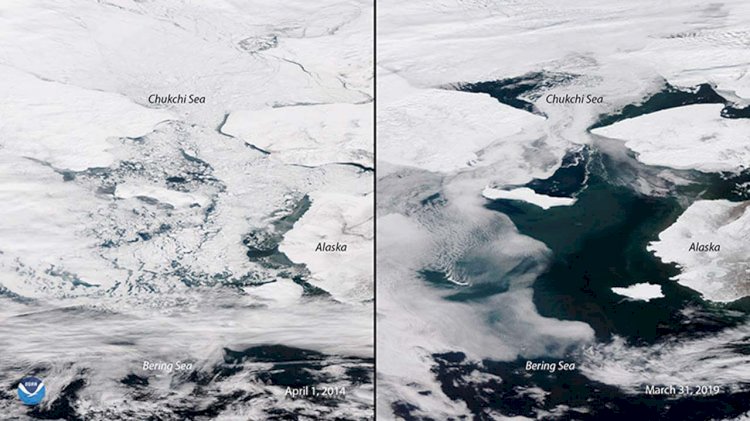
Photo: Satellite images showing an adverse change in sea ice coverage in the Bering Sea on April 1, 2014 (left) and March 31, 2019 (right). Courtesy NOAA.

Robert Foy, the science and research director of the Alaska Fisheries Science Center, said:

“It doesn’t mean the environment will not return to more normal conditions. It might. We might not even be having this conversation a year from now. But this is a glimpse of what’s to come, and it’s expanded our entire mission.”

Climbing sea temperatures isn’t the only area of concern in the Arctic; scientists have noted changes in CO2 (causing ocean acidification) and oxygen levels. Ocean acidification refers to a reduction in the pH of ocean water and can affect the ability of crustaceans and other calcifying organisms to build their shells. With lower pH, will crabs adapt? Will they move? Or will they disappear? Any one of those scenarios could have a dramatic impact on the ecosystem. Foy says that research conducted at the Alaska Fisheries Science Center shows that pollock and cod are not likely to be as affected by CO2 directly, but their food source might—pollock and cod feed on crustaceans, zooplankton, and smaller fish.

Foy said:

“We need to collect a wide variety of environmental variables, not just temperature and fish biomass. That’s where we need to work together with other organizations.”

The eastern Bering Sea and Gulf of Alaska, an area twice the size of the eastern seaboard, takes months of ship time to zigzag back and forth during annual surveys. But environmental changes—less ice, warmer waters—mean that some fish have moved some 1,000 kilometers (600 miles) north.

Foy explained:

“Our mathematical models need to be able to predict the impacts of these environmental changes so that we can also predict the behavior of the fishermen who will follow the fish. You might not have thought the longline fleet would move 1,000 kilometers north, but they did. In order to effectively manage these fisheries, NMFS has to be there, too.”
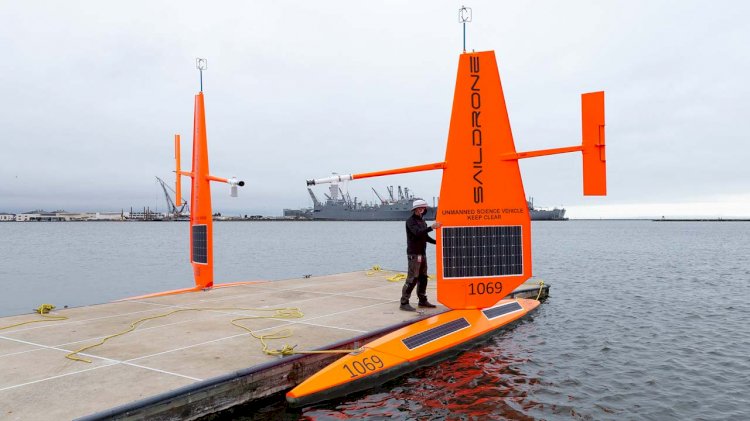
Saildrone’s fleet of autonomous wind and solar-powered vehicles carry a payload of science-grade sensors to collect data above and below the sea surface—air, sea, and skin temperature, wind speed and direction, relative humidity, barometric pressure, photosynthetically active radiation, salinity, dissolved oxygen, chlorophyll, and wave height and period. 

Foy says the idea is to use autonomous vehicles to augment ship-based surveys; the saildrones can cost-effectively ease the burden of data collection so that the humans onboard the ships can focus on collecting detailed biological and oceanographic data.

With several large-scale ship-based surveys in the region canceled due to the ongoing COVID-19 pandemic, scientists at AFSC undertook contingency planning to use saildrones to help fill the gap. The autonomous saildrone made it possible to conduct an acoustic survey and provide some helpful data in a year when it otherwise would not have been possible. The work this year builds off of a five-year collaboration between NOAA’s Pacific Marine Environmental Laboratory (PMEL), Saildrone, and AFSC.

Saildrone-based acoustic surveys are well-suited for the Bering Sea because pollock are the dominant fish species there, so scientists can be more confident the vehicle is actually measuring an abundance of pollock and not some other fish species.

Three saildrones were deployed in mid-May from San Francisco for the 2,000 nautical mile transit to the Bering Sea. Arctic missions usually begin from Dutch Harbor on Unalaska Island, but travel restrictions meant that the vehicles had to be deployed from Saildrone headquarters. After some 40 days at sea, the vehicles reached Unimak Pass and entered the Bering Sea to begin the survey.

Each vehicle took a third of the 600-nautical-mile-wide survey area between Alaska’s Aleutian Islands and the western edge of the US exclusive economic zone (EEZ). Based on previous year’s surveys, Foy says that while Pacific cod stocks had moved north, Alaska pollock had spread out. The area surveyed by the saildrones represents the footprint of the canceled acoustic-trawl survey. 

The saildrones continued to collect other environmental data throughout the survey, some of which were made available to weather forecast centers worldwide via the World Meteorological Organization’s Global Telecommunication System (GTS).

All three vehicles have completed their transects and are headed back to San Francisco to deliver the raw data for processing.

Houlder wins contract for IoMSPC’s new purpose-built barrery hybrid ferry

0

Houlder has won another contract with the Isle of Man Steam Packet Company (IoMSPC). Acting as technical advisor in the design and build of its latest battery hybrid ferry, Houlder will solve the challenging design requirements of increased vessel capacity, as well as tolerating harsh Irish Sea conditions throughout the annual cycle of vessel operations.

The project presents two key design challenges. Firstly, to provide a dependable lifeline throughout winter which can tolerate the harsh Irish Sea in its route between Douglas and Heysham, Lancashire. And secondly, increased passenger capacity, especially important during the two weeks of the Isle of Man motorcycle event, the annual TT.

Houlder will guide the shipyard during the build of this new vessel, ensuring it meets the design specification, as well as advising IoMSPC on technical and regulatory aspects, to ensure a high quality and timely delivery. The Houlder team will use its experience of the local regulation, knowledge of the routes, and operational and technical expertise to ensure a smooth process from concept to delivery.

David Wing, Ship Design & Engineering Director, Houlder, said:

“We are delighted to be working with the Isle of Man Steam Packet Company again on its latest project and providing pragmatic solutions to the various technical and logistical considerations for the new vessel. Solving design challenges and meeting ambitious targets, whether technical, operational or environmental, is where we do our best work.

“There are many challenges in this brief, including the vessel’s size constraints in tight ports while meeting lane metre requirements for freight, as well as meeting environmental expectations for the vessel’s life-span which includes reducing local emissions while in port. We are looking forward to working with Hyundai Mipo Dockyard and IoMSPC to ensure a smooth and successful delivery of this new vessel.”

MSC Cruises postpones restart of MSC Magnifica

0

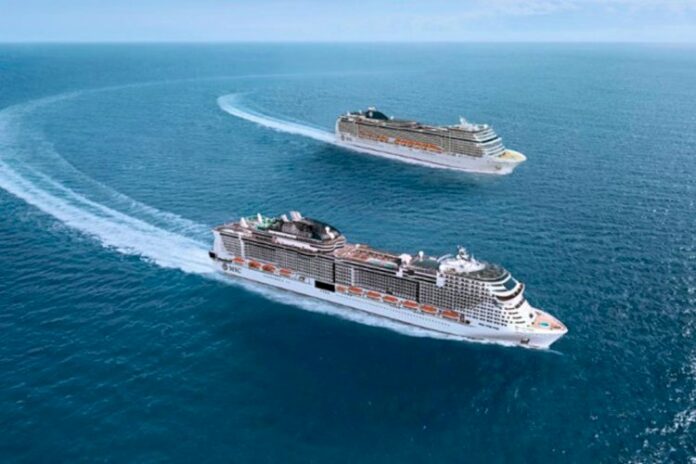
In connection with the recent introduction of additional testing measures for residents of Italy having travelled to Greece, the company is seeing cancellations and a softening in demand since the ship’s itinerary includes as many as three ports in that country. This has led to the decision to delay the restart of the ship by four weeks.

MSC Cruises believes that reservations will start to pick up again in the coming weeks due to the appeal of the itinerary. MSC Magnifica’s sales are open to residents of the Schengen area, at the same time in this early phase of restart the majority of guests are expected to be Italian nationals and residents.

As a result of this, MSC Magnifica cruise departures from 29 August to 19 September have been cancelled. The first cruise will depart from Bari, Italy with an unchanged itinerary on 26 September.

Guests affected by the cancelled cruises will either be re-protected onto another cruise – in particular on MSC Grandiosa, which is currently sailing in the West Mediterranean – or will receive a Future Cruise Credit (FCC) where they have the opportunity to transfer the full amount paid for their cancelled cruise to a future cruise of their choice – on any ship, for any itinerary — through to the end of 2021.

MSC Grandiosa is currently offering 7-night cruises with embarkation in the Italian ports of Genoa, Civitavecchia, Naples and Palermo and calling additionally at Valetta, Malta.

MSC Cruises also confirmed last month details of its Winter 2020/2021 Season , offering over 90 different itineraries across the Caribbean, Mediterranean, the Gulf, South Africa, South America and Asia – all of the regions where MSC Cruises traditionally operates. Itineraries range in length from two to 24 nights, along with the third MSC World Cruise departing in January 2021 and an extensive Grand Voyages programme.

1 Winter Season 2020/2021 runs from October 31 through to March 2021