3.3 C
New York
Home Blog Page 784

New partnership to launch inland shipping in Stockholm region

0

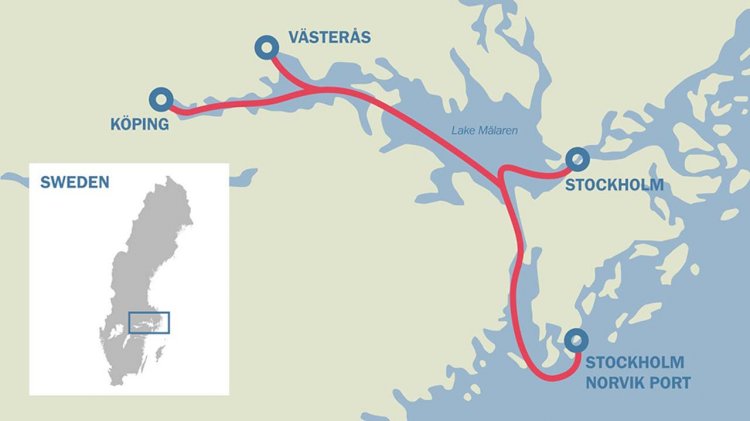
Ports of Stockholm, Hutchison Ports Stockholm, Mälarhamnar and Wallenius Marine have built a unique partnership to launch inland shipping between Stockholm Norvik Port and the strategically positioned Mälarhamnar ports of Västerås and Köping.

Ports of Stockholm’s all-new freight port, Stockholm Norvik Port, opened in May in a location that offers new opportunities for efficient and sustainable transportation in the expanding Stockholm and Mälardalen region. At the same time, the Mälarhamnar ports are conducting substantial expansion projects that will enable them to handle larger freight volumes. The development project designed to establish inland shipping, is being conducted by Mälarhamnar, Ports of Stockholm, and Hutchison Ports Stockholm in collaboration with Wallenius Marine.

Göran Söderdahl, Senior Commercial Manager, Wallenius Marine, says:

“We believe in the power of partnership and in shifting freight transports from land to water. This partnership will facilitate sustainable transportation in the greater Stockholm region, and the project is consequently of considerable interest to us.”

Pia Berglund, National Inland Shipping Coordinator at the Swedish Transport Administration, says:

“The national freight transportation strategy focuses on tomorrow’s transport systems, where shipping plays a key role in establishing modern, efficient, and sustainable transportation systems. Inland shipping is absolutely in line with the Government’s objectives and will help achieve a substantial shift of freight transportation away from our road.”

90 percent of all imported goods arrive in Sweden by sea, with the majority destined for the greater Stockholm region.
Carola Alzén, CEO of Mälarhamnar, says:

“If shipping companies, forwarding companies and cargo owners are to be able to operate and use an inland shipping system, the ports must work together in a chain, and there must be suitable fairways for the job. We, the ports, must, therefore, play our part and work together to implement the measures needed to enable this traffic to become a reality in Sweden.”

Stockholm Norvik Port is located closer than any other container terminal to what is, by far, Sweden’s biggest consumption area, and also offers a shorter route to the open sea than any other east coast port.

Johan Wallén, Marketing and Sales Manager at Ports of Stockholm, says:

“We are extremely positive about this collaboration. Stockholm Norvik Port provides a unique opportunity to create an inland shipping system that would enhance the efficiency of transportation in the Stockholm region. It will provide additional opportunities for our customers and will also reduce congestion and the environmental impact of the overland infrastructure.”

Transporting the goods by sea directly to Stockholm Norvik Port, and then on to the Mälarhamnar ports via Lake Mälaren, will offload the currently heavily congested road and rail networks, and will consequently help bring about a more sustainable transport network within the greater Stockholm region.
“Deepsea Yantai” awarded with three more wells

0

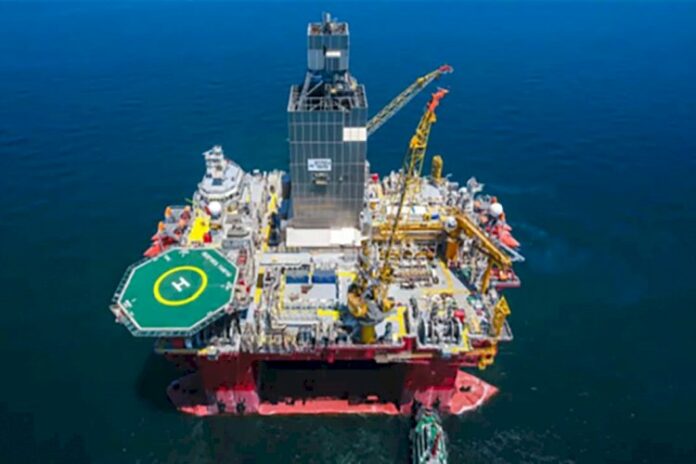
Recently, the “Deepsea Yantai” semi-submersible drilling platform, managed by CIMC Raffles Asset Operation and Management Center, was awarded with three more wells contract by Neptune energy, the mainstream oil and gas company of Norway, planning to operate in Fenja oilfield in Norwegian North Sea in 2021. In addition, the parties have agreed to increase the number of optional wells from the remaining five up to ten optional wells.

CIMC Raffles, teaming up with Norway’s first-class drilling contractor Odfjell Drilling, won the “6 + 10” wells drilling service contract from Neptune Energy in 2019 with two additional wells awarded in the same year. “Deepsea Yantai” has carried out drilling operations in different oilfields in Norwegian North Sea which is the most challenging offshore working environment in the world. “Deepsea Yantai” winning the contract has made an unprecedented record for domestic offshore enterprises to provide international high-end offshore services.

“Deepsea Yantai” is a midwater drilling platform built by CIMC Raffles equipped with DP3 dynamic positioning system and automatic drilling control system, suitable for the harsh environment in the Norwegian North Sea. CIMC Raffles cooperated with ODL to guarantee the right performance and quickly response to problem solving during the operation to meet the requirements of Neptune Energy.

Awarded with customer bonus for the on time start-up, “Deepsea Yantai” has carried out drilling operations in P1 Gjoa field, Duva field and Dugon field in the North Sea. Ever since the start-up, the drilling efficiency of the platform has been steadily improved to above the requirement of the client, winning the platform the drilling efficiency award. The average on hire rate is 95%, and in the last 4 months, it has reached 99.9%. According to Neptune Energy, “Deepsea Yantai” was involved in the exploration of Dugong well in July, 2020 and the find in Dugong well is estimated to contain between 40 and 120 millionbarrels of oil equivalent (boe), making the largest discovery in Norway so far this year.

Successful trial of remote surveys in Sembcorp Marine

0

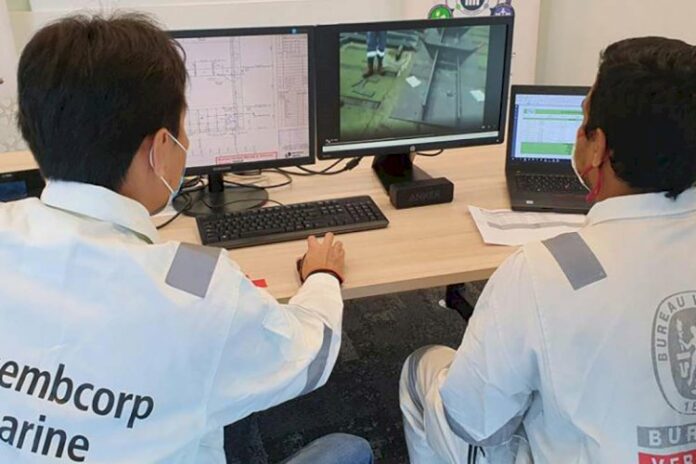
With COVID-19 severely disrupting traditional manned surveys in the marine and offshore industry, Bureau Veritas (BV) in Singapore, in collaboration with Nokia and Sembcorp Marine, has successfully completed remote surveys that pave the way for establishing a new class procedure for the remote inspection of vessels under construction.

Utilising digital technology, the new solutions enable remote surveys to be performed at multiple locations, with feedback transmitted to a single monitoring station. This optimises the waiting time between surveys and increases operational efficiencies by providing connectivity between all stakeholders involved, while minimising inspectors’ and workers’ exposure to onsite safety risks, especially during the COVID-19 pandemic. The entire solution was designed and implemented by professional services experts, using Nokia’s unique digital delivery model to accelerate industrial transformation.

At the pilot trial conducted in August 2020, BV, Nokia and Sembcorp Marine test-bedded remote surveys on a new-build vessel construction at Sembcorp Marine’s Tuas Boulevard Yard. Various checks were carried out to assess the integrity of the hull components, which were in various stages of construction. The checks included material verification, panel fit-up and visual inspections of the sub-assembly block.   

Using Nokia’s cloud-based collaboration platform and FastMile 4G Customer Premises Equipment (CPE), the remote monitoring centre at Tuas Boulevard Yard communicated effectively with Sembcorp Marine’s quality control (QC) inspectors located at the vessel’s fabrication and assembly sites. The QC inspectors were equipped with rugged head-mounted cameras with high-definition video streaming and voice communication functionalities that enabled the BV surveyor stationed at the remote monitoring centre to verify production quality and spot defects.

David Barrow, Bureau Veritas Vice-President – Marine & Offshore, South Asia and Pacific commented:

“This project reflects BV’s digitalization strategy for the marine and offshore sectors. The pandemic situation has led to an acceleration of remote survey techniques.  As we now move forward in our ever complex digital world, and manage new norms of working post COVID-19, we feel that true success is often about working collaboratively with stakeholders.

This project is a clear best practice example of working in a collaborative manner. Bureau Veritas, Sembcorp Marine and Nokia have clearly shown in this trial that technology provides both efficiency and quality gains. And one major benefit of digitalization and remote survey that must be emphasized is that of increased safety. This benefit must be recognized. This technology reduces risk for all involved.”

Stuart M Hendry, Head of Nokia Enterprise, Asia Pacific, said:

“We are delighted to be part of a collaboration with Bureau Veritas and Sembcorp Marine that promotes digital automation in the marine industry. With our Fastmile 4G CPE solution and cloud-based digital collaboration platform for remote tools, both BV and Sembcorp Marine teams working in the shipyard can communicate and work seamlessly together. Taking a lead in the digital transformation of Industries is Nokia’s focus. We are proud that both BV and Sembcorp Marine share this drive in bringing the use of technology to achieve their productivity and operation goals.”

As part of its innovation and sustainability strategy, Sembcorp Marine has embraced Industry 4.0 technologies including digital design, advanced manufacturing and the Industrial Internet-of-Things (IOT) to boost its production capabilities and capacity.

Sembcorp Marine Head of Research & Development Mr Simon Kuik said:

“The collaboration with BV and Nokia is in keeping with our ambition to achieve project execution leadership through continuous improvement in our production and process innovation. This will enable Sembcorp Marine to deliver safer, faster and more efficient project turnaround.”

With the successful pilot trial, BV, Nokia and Sembcorp Marine have further reinforced the feasibility of complementing remote surveying with specific traditional surveys without compromising personnel safety and survey quality.  Such remote service delivery will likely become the new normal in vessel surveys.  

Kongsberg Maritime and Shell sign JAWS agreement

0

Kongsberg Maritime, part of KONGSBERG, has signed an agreement with Shell International Trading and Shipping Company Limited (Shell), to deliver Shell’s patented draft and trim optimisation software, Just Add Water System (JAWS).

Kongsberg Maritime will deliver the software through its digital solution, including JAWS as an application in the K-IMS suite; a portfolio of specialised applications to support complex operations. This will enable JAWS to be immediately available to hundreds of LNG customers who are already benefiting from Kongsberg Maritime’s established, reliable K-IMS solution, as well as to new Kongsberg Maritime customers.

Egil Haugsdal, President, Kongsberg Maritime, said:

“We are looking forward to seeing JAWS and K-IMS contributing significantly to the reduction of greenhouse gas emissions and fuel costs for both vessel owners and charterers. The agreement between our companies sets an encouraging example to the industry, showing how shipping can become greener through close collaboration between different actors in the market, contributing to the creation of sustainable, value solutions which benefit everyone. From day one, the teamwork between Shell and Kongsberg Maritime has been of an excellent standard, and we are very excited to be kicking off this program.”

The technology has been developed by Shell, working with the University of Southampton, and has been deployed on more than 50 ships so far. Shell is increasing deployment of the software on its LNG fleet, starting with a further 20 vessels this year.

Grahaeme Henderson, Global Head of Shell Shipping & Maritime said:

“Regardless of the different pathways to decarbonisation, efficiency technologies will be the foundation for a decarbonised shipping industry. JAWS is a low cost, quick to deploy software that can deliver fuel savings and emissions reductions today. We have achieved up to a 7% reduction in emissions on our own ships using the software and, working with Kongsberg Maritime, we hope to see JAWS implemented across the industry.”

The JAWS software uses historic, high-frequency data from the vessel to determine the optimal conditions on previous voyages, which enables the system to advise on how best to enhance a vessel’s draft and trim at any given speed to reduce fuel consumption and lower emissions. JAWS also monitors and reports live fuel and emissions savings back to managers, to give real-time insight into the benefits of deploying this technology across a fleet.

Real-life testing of the JAWS system, delivered through Kongsberg Maritime’s interactive, web-based K-IMS (Information Management System) application suite, demonstrates that the software is an invaluable source of situational awareness, lending new insights to vessel handling and decision making.

The DNV GL Technology Qualification (TQ) is the process whereby the developer can provide evidence to an independent third party to assess whether new technologies will meet safety and reliability criteria with an acceptable level of confidence. DNV GL has assisted the development of JAWS by assessing the methodologies employed and ensuring that the calculations provided by the software are based on the accurate and reliable use of data.

Knut Ørbeck-Nilssen, Maritime CEO, DNV GL, said:
 “It is clear that decarbonisation is going to be a generational challenge for the shipping industry. This will require that the industry looks to unlock every efficiency to reduce fuel use, especially by taking advantage of the opportunities created by greater connectivity and digitalisation. At DNV GL we are proud to be able to help forward-looking companies like Shell and KONGSBERG realise these gains by ensuring that new technologies like JAWS can be deployed with confidence in their safety and reliability.”

By uniting all data-logging and communication channels into one secure solution, the collaborative K-IMS solution presents a comprehensive information flow which provides a common, user-friendly solution for fleet owners, charterers and third parties alike. To date, more than 200 deliveries of K-IMS have been made within the LNG sector, and K-IMS is also establishing an appreciable market footprint in the offshore segment.

Total and Macquarie partner to develop floating offshore wind portfolio

0

Located off the Eastern and Southern coasts of the country (Ulsan and South Jeolla Provinces), the projects have commenced on-site comprehensive wind data collection campaign. The partners aim to launch construction of the first project of around 500 megawatts by end 2023.

With the announcement of the “Green New Deal” plan last July 14th, South Korea has re-affirmed its strong ambitions to develop renewable energies which shall reach at least 20% of the power mix by 2030, including 12 GW of offshore wind capacities. The country has a significant potential for the development of a floating offshore wind segment benefiting from a strong governmental support and a unique set of local competencies amongst which the extensive shipbuilding know-how and the country’s ambitious R&D programs.

Patrick Pouyanné, Chairman & CEO of Total, said:

“Our entry in the floating offshore wind segment in South Korea is in line with Total’s strategy to profitably develop renewable energy worldwide and contribute to our net zero ambition. We strongly believe in the potential of floating offshore wind in South Korea, which will play a key role in achieving the country’s renewables objectives.

Thanks to its extensive experience in offshore projects, in cooperation with many Korean shipyards, Total is particularly well positioned to contribute to the successful development of this new technology in South Korea together with our partner GIG. We are indeed very keen to expand our long-term cooperation with South Korea, contribute to the diversification of its energy mix and support the emergence of a new industrial sector by maximizing Korean content within the supply chain of these projects”.

Subject to regulatory approvals and satisfaction of other conditions precedent, the partnership will become effective in the autumn of 2020.

Boskalis recently took on two exceptional projects

0

The first project involves the transport and installation of five floating wind turbines for the Kincardine floating wind farm off the coast of Aberdeen in Scotland. The second project involves the installation of bridge sections of the world’s longest suspension bridge, the Çanakkale 1915 Bridge in Turkey.

Decisive factors for the award of both contracts are Boskalis’ versatility in the field of offshore transport and installation work and the wide variety of specialized Boskalis equipment with which it is able to fully execute the projects.

For Cobra Wind International Ltd, Boskalis will transport and install five floating wind turbines for the Kincardine offshore wind farm fifteen kilometers off the coast of Aberdeen. This will be Boskalis’ first floating wind farm project. The turbines with a capacity of 9.525 megawatts each will be anchored at a depth of sixty to eighty meters. In September 2020, the heavy anchor handling tug (AHT) BOKA Falcon will start installing the anchors and chains on the seabed. In the meantime, the floating foundations will be transported from Ferrol in Spain to Rotterdam, for which Boskalis will deploy the Fjord as a semi-submersible barge. In Rotterdam, the wind turbines will be mounted on the foundations, after which the floating wind turbines are towed to the wind farm. In addition to the BOKA Falcon and Fjord, three Boskalis AHTs will be deployed on this project.

Boskalis will install twenty bridge sections for the 4,600-meter-long Çanakkale 1915 bridge in Southwest Turkey. The floating sheerleg crane Asian Hercules III, one of the few sheerlegs in the world with sufficient outreach, will be deployed for lifting and installing the sections. A Boskalis AHT will provide assistance during the execution of these activities, which will take place in 2021.

In 2019 Boskalis was already involved in the construction of the bridge with the installation of the foundations of the bridge pylons and various other lifting and transport operations of steel and concrete bridge elements. The client is DSLY; a consortium of the South Korean Daelim and SK Group, and the Turkish partners Limak Holding and Yapı Merkezi.

Maersk enhances customers’ end-to-end delivery experience

0

A.P. Moller – Maersk introduces strategic changes that will further improve customer experience and end-to-end service delivery. As part of this, the Safmarine brand will be integrated into Maersk to enhance customers’ access to the global integrated offering. In addition, the Damco brand’s Air and LCL (Less than Container Load) offering will be combined with Maersk’s logistics and services products to complement its end-to-end offering. Also, a more simplified and customer-centric global Ocean & Logistics organisation is being introduced. 

These changes represent a major step towards becoming an integrated container transport and logistics company, connecting and simplifying customers’ supply chains.

Vincent Clerc, CEO of Ocean & Logistics, A.P. Moller – Maersk, says:

“Our customers are at the heart of our vision. Their evolving supply chain needs are increasing the demand for multiple modes of transport and to meet these needs, we’re bringing our company’s expertise and capabilities even closer together. Taking these steps are key to accelerating our transformation.“

Over time, the value propositions of Maersk and Safmarine have converged, as both brands have been focusing on building a customer-centric culture and as the digital interactions with customers have increased.

Vincent Clerc says:

“With the integration of Safmarine, we can present Safmarine customers with the full ocean and supply chain offering and more scale. At the same time, I’m very excited to have Safmarine’s passion for customers closer to Maersk by uniting our teams.”

Since focusing purely on freight forwarding in 2018, Damco has demonstrated significant value to customers in the Air and Ocean LCL space. During this time, it has become apparent through close customer engagements that the value proposition of Maersk can be greatly enhanced with the expansion of multiple modes of transport. 

The integration of Air and LCL into Maersk will help meet these needs and give businesses access to a simplified, connected and agile experience under the Maersk brand, as well as to its scale. Maersk uses its own assets to offer unique value propositions, hence it will not pursue the Ocean FCL Multi-carrier product (NVOCC) as a general offering. 

Vincent Clerc continues:

“Businesses need Air and LCL products to connect their supply chains and with these offerings firmly placed in our global integrated portfolio, we aim to serve our businesses better and more efficiently across their supply chains. Our colleagues in Damco have delivered a remarkable effort under challenging market conditions, serving customers through focus, discipline and expertise which will now be a strong asset for our customers in Maersk.”

Due to the changes, the Safmarine and Damco brands will no longer be marketed by the end of 2020. 

In addition, Maersk will simplify its organisational structure across Ocean & Logistics globally to further improve customer centricity and efficiency. As part of this, the back offices of Maersk and Hamburg Süd will come closer together into more customer-centric teams, while continuing to meet customers as two separate brands with a differentiated service model. 

Kongsberg and Massterly to equip two zero-emission autonomous vessels for ASKO

0

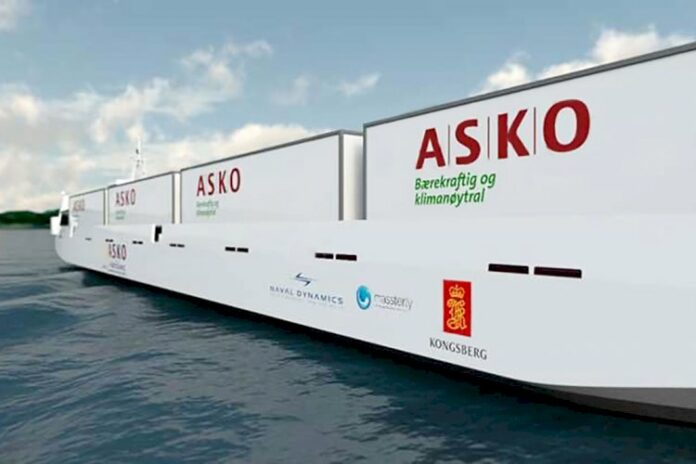
Kongsberg Maritime and Massterly (a Kongsberg Wilhelmsen joint venture) have signed contracts with the leading Norwegian grocery distributor ASKO to equip two new vessels with autonomous technology, and to manage their operations at sea.

With Norwegian companies delivering around 60% of the investment, this is a major milestone for the growth of sustainable maritime operations in Norway. The fully electric ships will replace 2 million kilometres of truck transport, saving 5,000 tonnes of CO2 every year.

ASKO – currently transporting their cargo by more than 800 trucks daily – is committed to sustainability and is investing heavily in new technologies such as electric and hydrogen-powered vehicles. At present, road transport is the single mode of transportation to link their warehouses on the western side of the Oslo fjord with their distribution centre on the eastern side. The new RORO (Roll on, Roll off) vessels will replace the current solution with a zero emission transport alternative.

Kai Just Olsen, Director, ASKO Maritime, explains:

“We have a clear ambition to be climate neutral and have set ambitious goals, including being a self-sufficient provider of clean energy and having 100% emission-free transport by 2026. These innovative ships are key to fulfilling that ambition and will form an essential component of a zero-emissions logistics chain linking our facilities. Fully electric trucks will take the cargo between the warehouses and the ports of Moss and Horten, and in shipments of 16 the trailers will be transported across the fjord on the battery-driven vessels. This solution is cost effective, sustainable and will remove trucks from a heavily trafficked road.”

ENOVA has supported the project – including the required port infrastructure – with 119 MNOK, in line with the Norwegian society’s commitment to reduce emissions and transfer transport from road to sea where feasible.

Kongsberg Maritime has a proven track record as an enabler for sustainable maritime logistics, and this ability has been further strengthened through the partnership with Wilhelmsen. The vessels will be equipped with the technology required for zero emission and unmanned operation by Kongsberg Maritime, while Massterly will ensure ship management and safe operations from their shore-based Remote Operations Centre. The two vessels will initially operate with a reduced crew, before moving towards unmanned voyages.

Egil Haugsdal, President, Kongsberg Maritime, said:

“When we teamed up with Wilhelmsen to form Massterly, this was exactly the kind of project we wanted to enable. By working together with us to bring autonomous, electric solutions into everyday use, ASKO are helping to achieve a sustainable, safer future for maritime operations while also demonstrating the efficiencies these technologies can deliver.”

Thomas Wilhelmsen, CEO of Wilhelmsen Group, added:

“The ASKO contract illustrates how Massterly is key in making autonomy a reality for short-sea shipping. We are proud to be the world’s first ship management company to operate unmanned vessels for commercial use.  Now we are one step closer to our goal of enabling sustainable trade: through cost effective, safe, and environmentally friendly logistics.”

Since the ASKO operation lies within Norway’s coastal jurisdiction, the Norwegian Maritime Authorities (NMA) must be satisfied that a sufficient level of safety has been achieved before they will issue an approval of operation for these vessels. NMA will therefore follow the project through a detailed risk assessment, based on IMO 1455 guidelines with regards to equivalent and alternative designs, new technology, verification, and approval for operation. DNV GL will also support this process as an independent third party.

The vessels, which are due to be delivered early in 2022, have been designed by Norwegian vessel designer Naval Dynamics and will be constructed at the state-owned Cochin Shipyard in India. The functionality enabling autonomous operation will be implemented and tested after arrival in the operational area in the Oslo fjord.

IMC Industrial Group chooses Veson Nautical’s Veson IMOS Platform

0

Veson Nautical, the leading provider of commercial maritime software and services; and IMC Industrial Group, an integrated maritime and industrial solutions provider; have announced the selection of Veson’s cloud-based Veson IMOS Platform (VIP) as IMC Industrial Group’s end-to-end maritime solution.

IMC Industrial Group comprises Shipping, Logistics, Marine and Offshore Engineering, Shipyards and Ports businesses, offering a wide-ranging set of services across multiple supply chains. When evaluating potential maritime systems, the Group sought a solution that was as comprehensive as their businesses; one that would support their vision and strategy across various company verticals, to better meet their customer needs.

In their Dry bulk & Parceling vertical, IMC identified the need for timely insight and voyage performance analysis to improve fleet competitiveness, to actively grow their cargo-based businesses. For Liquid bulk, IMC needed a centralized workspace to react quickly to market conditions and gain valuable insights into business opportunities. For ILBU (Tugs/Barges, FLF, and MV), IMC sought to digitalize their voyage management process to provide high quality, reliable service that would drive potential growth in new markets.

Frederik Guttormsen, Senior Director, Shipping, IMC Industrial Group commented:

“The Veson IMOS Platform was the clear choice for us. This future-fit solution will support and enable exponential growth for our core shipping businesses.  It will also provide analytics and business insight for timely and well-informed decision making, improve productivity, and standardize processes for greater efficiency as our competitive edge.”

ZIM and Konfidas launch new cyber subsidiary

0

The ever-growing threat of cyber-attack on the maritime industry has only been magnified by the Covid-19 pandemic. At the same time, the industry’s ongoing digitization of its business processes, while indispensable in modernizing, streamlining and enhancing the efficiency of these processes, has increased their exposure to cyber-attack.

Multiple recent cyber-attacks on the maritime industry have caused significant disruptions at great cost, raising awareness and highlighting the crucial importance of cybersecurity. According to a recent report by Cyber Risk Management, a major cyber-attack on Asia’s ports could end up costing the global economy as much as $110 billion. Other estimates predict that cybercrime could cost the world economy $6 trillion annually by 2021.

In response, ZIM is deploying its vast experience and long-standing cooperation with cybersecurity experts Konfidas to establish ZKCyberStar, a new subsidiary company offering a full range of cybersecurity services, tailor-made for the maritime industry, to increase cyber readiness and ensure business continuity in the event of cyber-attack.

ZKCyberStar will provide a suite of services to support operational cybersecurity readiness, including cyber and regulatory postures, strategy and planning, cyber awareness and executive training, incident response capabilities, supply chain risk management, ongoing threat intelligence, regulatory alerts and briefs, and more.

The ZKCyberStar team has a proven track record of success and years of experience in cybersecurity. The ZKCyberStar solution employs a unique methodology designed and developed specifically to achieve maximal readiness for and protection against maritime cyber-attack.

ZKCyberStar will be led by Ronen Meroz as CEO, Ram Levi and Eli Zilberman Caspi. Ronen is currently ZIM Global Intermodal Division Manager, an experienced ZIM senior manager with extensive knowledge of the maritime industry. Ram is an international cybersecurity expert, public speaker and advisor to global organizations on cybersecurity, and a former secretary of the Prime Minister of Israel’s National Cyber Initiative Task Force. Eli is Co-Founder and COO of Konfidas and an expert on business continuity readiness for cyber-attacks and cyber incident response management.

Eli Glickman, ZIM President & CEO:

“ZIM is uniquely positioned to tackle cyber threats in our industry. In recent years, I was approached by global companies seeking advice regarding cyber threats, and I have decided to create ZKCyberStar to support and advise organizations in our industry, using our long-standing cooperative relationship with the top cybersecurity expert team of Konfidas. With the creation of ZKCyberStar, we join forces to offer the most advanced and skilled services to cope with cyber threats and mitigate the risks and costly impact of cyber-attacks. We welcome Ram Levi, Eli Zilberman Caspi and the team of professionals at Konfidas to jointly create a top-level consulting company to help the industry cope with cyber threats.”

Ram Levi, Konfidas Founder & CEO:

“The maritime and logistics industries have witnessed an unprecedented rise in cyber-attacks in recent years. Those attacks serve as a wake-up call for an industry which is critical to modern trade and commerce. As we move towards heavily networked and increasingly automated systems, cybersecurity must be a top priority. Our unique partnership with ZIM, a global leader in container shipping, will enable ZKCyberStar to provide strong client-driven cybersecurity solutions with global expertise and implementation.”