0.5 C
New York
Home Blog Page 773

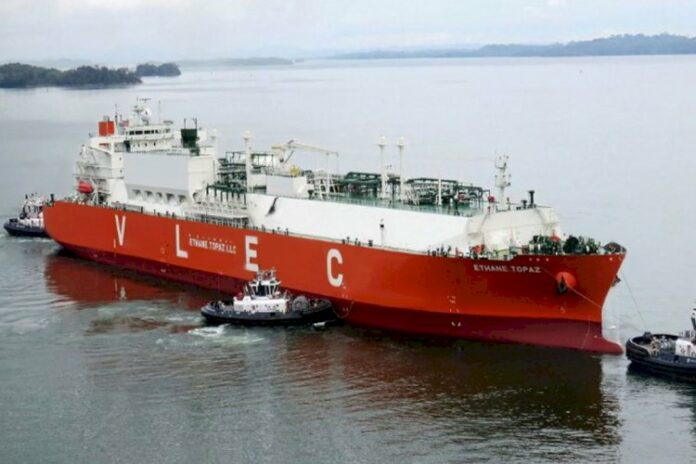
ABS to class another four VLECs for Zhejiang Satellite Petrochemical

0

These ethane-fueled VLECs are part of a Phase-2 order from STL and construction will be equally split between Samsung Heavy Industries and Hyundai Heavy Industries.

ABS is the leader in provision of classification services to VLEC owners. ABS was the classification society of choice for the very first order of the six dedicated VLECs by Reliance Industries in 2014. The 87,000 cbm VLECs have been successfully trading and laid the foundation for the next generation of larger VLECs. The Phase-1 order of six VLECs by STL not only had more cargo capacity, 98,000 cbm, but included additional technological advancements such as ethane-fueled engines and the ABS LNG Cargo Ready notation.

Patrick Janssens, ABS Vice President, Global Gas Solutions, said:

“ABS is a world leader in the classification of gas carriers and classes the vast majority of the large ethane carriers built to date, so we are delighted that STL has recognized our experience in this fast growing sector. ABS has a proud track record of supporting some of the most innovative gas carrier projects. These latest orders are the next step in continuing that trend.”

An executive for STL said:

“STL is delighted to be working with ABS, drawing on its experience and legacy of leadership in the VLEC sector that will support our Lianyungang petrochemical project by safely transporting ethane from the U.S. to China. The rapid expansion of our operations requires close partnerships with companies that reflect our own focus on technology innovation and the engineering excellence that supports projects that push the boundaries of complexity and improve the safety of our operations.”

ABS provides industry leadership, offering guidance in LNG floating structures and systems, gas fuel systems and equipment, gas carriers, and regulatory and statutory requirements. ABS has extensive experience with the full scope of gas-related assets and has been the classification society of choice for some of the most advanced gas carriers in service.
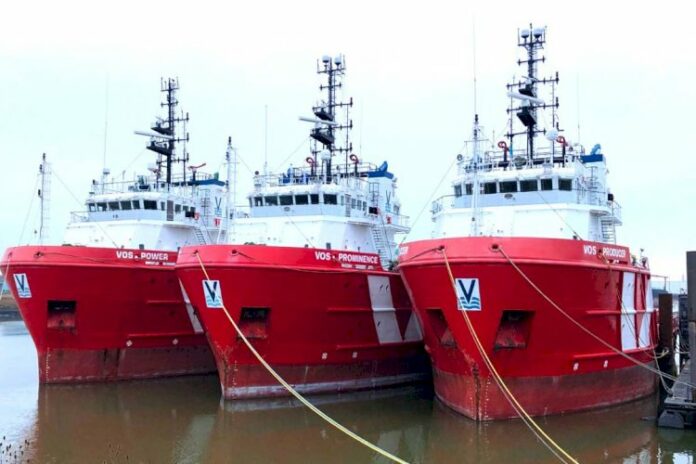
Vroon to recycle three PSVs

0

The vessels, VOS Power, VOS Producer and VOS Prominence, were built between 2006 and 2007 and joined the Vroon fleet on delivery from the shipyard.

Over the years, they have engaged in platform-supply operations for a large number of Oil & Gas operators in the North Sea.

All three vessels had been laid-up for some time in the North of The Netherlands. Although kept well maintained and in excellent technical condition throughout this period, the recent downturn in offshore Oil & Gas markets and continuing negative employment outlook resulted in a recent decision to divest the units.

The vessels will be repositioned from Harlingen to a specialised Dutch ship-recycling facility during the second half of this month. Here they will be dismantled in full compliance with both EU/national laws and all applicable international regulations and guidelines. Components and materials will be recovered in a safe and environmentally sound manner for re-processing and re-use to the largest extent possible.

VOS will continue to operate an extensive fleet of modern offshore-support vessels, including 17 PSVs, from offices in Aberdeen, Den Helder, Genoa and Singapore.

Boluda to continue providing sustainable towage services at Port of Zeebrugge

0

On Thursday, 17th September 2020, the signing ceremony was held at the headquarters of the port authorities in Zeebrugge. The concession is the renewal of an existing partnership for the duration of five years and extendable for a single period of three years.

The focus of this partnership between Port of Zeebrugge and Boluda Towage Europe lays in efficient, smooth, and safe handling of shipping, and puts forward initiatives regarding sustainability. The agreement includes eight powerful and modern tugboats in this port region, which are all certified with the highest firefighting standards and will be manned with local crew.

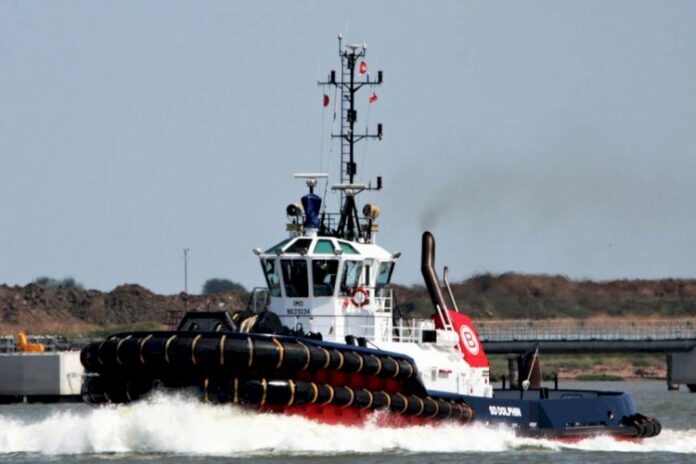
As part of this fleet, Boluda Towage Europe will bring in two Damen-newbuild 85-tonnes bollard pull ASD Tugs 2813, both complying with the most recent IMO Tier III emission standards, to the Port of Zeebrugge in December 2020.  These tugs, named VB Bolero and VB Rumba, are highly maneuverable and environmentally friendly vessels of modern design.

Aside from the Union Koala, that was already retrofitted to the IMO Tier III standards in 2019, Boluda Towage Europe will also retrofit the Union Panda this year. Other tugs in the fleet, in this port region will also be retrofitted in the first two years of the contract.

In order to highlight the long-standing cooperation between both parties, Boluda Towage Europe provided the ship’s bell of the tugboat ‘Brugge’  on permanent loan to MBZ. The ship’s bell was unveiled at the end of the ceremonial signing. The tugboat Brugge was the most powerful fire-fighting vessel when it was built in 1988, and was active in the port of Zeebrugge as a fire-guard boat for LNG tankers until 2009.

First Ten New Anglia Businesses Prepare To Get Fit For Offshore Renewables

0

Having engaged with over 100 companies across Norfolk and Suffolk, the programme received 53 expressions of interest, with 29 companies shortlisted and 10 winning companies selected.

Jointly funded by the New Anglia Local Enterprise Partnership, successful delivery of F4OR New Anglia was a top priority for them as part of their Clean Growth Covid-19 Recovery Plan, offering  10 places for innovators in the region, aiming to support the booming local energy supply chain to fuel the growth in offshore renewables and stimulate supply chain mobility and transition during the green economic recovery.

For the 10 winning companies: TECOSIM Simulation Ltd; Proeon Systems; Warren Services Ltd; Fern Communications Ltd; EnerMech; Stowen Clean Energy Ltd; Safinah Ltd; Prior Power Solutions Ltd (formally Prior Diesel); Aquaterra Energy Ltd; and Lintott Control Systems, the 12-month business improvement and supply chain growth programme will prepare them to compete for, and secure, contracts at UK offshore wind farms by making them more attractive to offshore renewables’ project developers. A key goal is to ensure that we focus attention on the skills, capability and experience of the regional supply chain to deliver UK content to offshore wind projects.

The East of England generates almost half of the existing offshore wind output in the UK, with a pipeline of future projects clearly defined, underling the important role the sector plays as an economic driver regionally, nationally and globally. The strong interest and engagement in the F4OR New Anglia programme have highlighted the appetite for future technology innovation and supply chain support programmes for the region.

Andy Holyland, ORE Catapult’s Regional Innovation Manager for East of England, said:

“The Norfolk and Suffolk region is home to some of the largest offshore wind projects in the UK and there is therefore a huge opportunity for local companies to take advantage of the economic opportunities this brings and to build on regional strengths to deliver local content to projects.

These first 10 companies will benefit from being part of a cohort, increasing industry engagement, growing confidence, raising profile and market awareness. They will be able to develop new relationships, technologies, capabilities and experiences, adding value to the regional and national supply chain.”

Chris Starkie, Chief Executive of New Anglia Local Enterprise Partnership, said:

“We’re delighted to be supporting the F4OR programme. The high quality of applications highlights our region’s very strong energy supply chain and supporting those businesses to grow and innovate will ensure that we can continue to deliver on our ambition to be the UK’s clean growth region.”

Developed with input from the offshore renewables industry and based on the successful Fit 4 Nuclear Programme, ORE Catapult developed the F4OR business improvement programme  in collaboration with HVM Catapult’s Nuclear Advanced Manufacturing Research Centre, with the aim of developing an increasingly competent, capable and competitive UK offshore renewable energy supply chain to ensure a strong representation of UK content in domestic projects, as well as supporting a vibrant export market.

The F4OR programme offers the opportunity for offshore wind developers to engage, contribute to and benefit from an initiative that encourages and supports improved supply chain performance. F4OR provides additional industry engagement opportunities for those already in the industry and promotes the cross-sector transfer of technologies.

Successful launching of cargo vessel built by CIMC Raffles

0

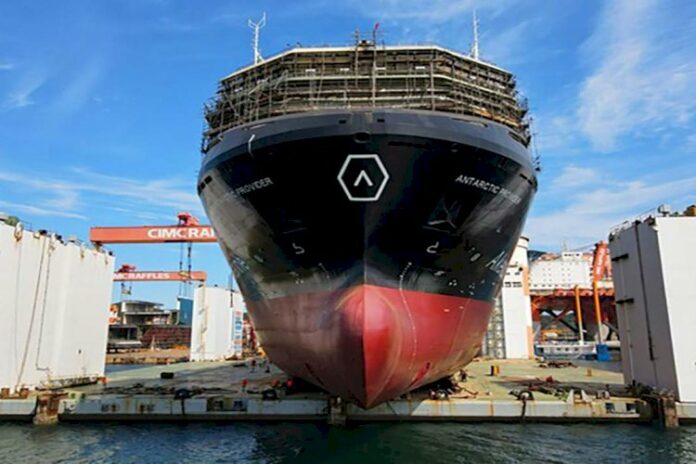
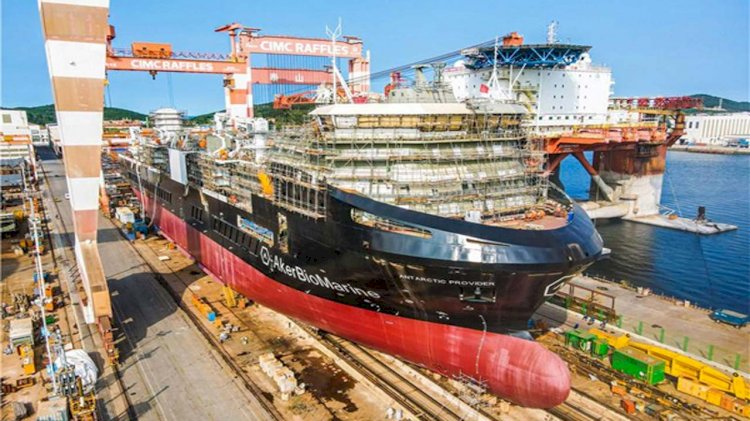
The project is built by CIMC Raffles Offshore Ltd. for Norway Aker BioMarine company. 

Antarctic Provider with length over all 167.6m, breadth moulded max 27m, depth moulded 18m, draft design 7m, speed design 15 knots, shall be built to the classification of DNV GL and mainly for krill product transportation between Antarctic fishing area and South America ports, fuel oil supply for fishing vessel, and stuff work shift transportation. 

The vessel is specially designed to satisfy the requirement of krill products transportation, with 4 high-capacity cargo holds which gross capacity is up to 40,000 cubic meters and moveable crane on top of each cargo hold, being able to handing loading and unloading operation in special environment, satisfying Polar Code Rules with superior requirements on hull strength and cold-proof, being able to face the extremely challenging Antarctic environment. The vessel is equipped with hybrid power propelling system and advanced heat recovery system, with great fuel economy, can further reduce carbon emission.

The vessel, as first built, is facing the challenge of global COVID-19 during project construction and effected correspondingly on the key blocks construction, material and equipment delivery and so on. CIMC Raffles is sticking to the plan nodes, putting into superior technical force, management and building team, working together to guarantee the quality, doing best to catch up progress. Under support of government, ship owner, class, designing company, vendors and subcontractors, the project achieved the launching as plan smoothly, providing a strong guarantee for project delivery before the krill harvest season.

Microsoft finds underwater datacenters are reliable and use energy sustainably

0

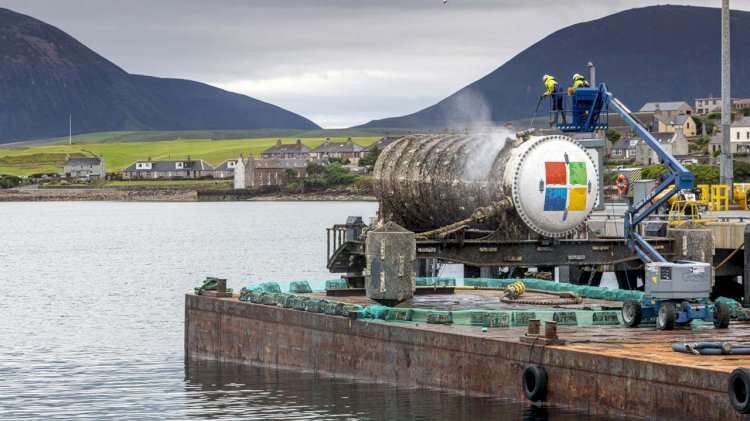
Microsoft’s Project Natick team deployed the Northern Isles datacenter 117 feet deep to the seafloor in spring 2018. For the next two years, team members tested and monitored the performance and reliability of the datacenter’s servers.

The team hypothesized that a sealed container on the ocean floor could provide ways to improve the overall reliability of datacenters. On land, corrosion from oxygen and humidity, temperature fluctuations and bumps and jostles from people who replace broken components are all variables that can contribute to equipment failure.

The Northern Isles deployment confirmed their hypothesis, which could have implications for datacenters on land.

Lessons learned from Project Natick also are informing Microsoft’s datacenter sustainability strategy around energy, waste and water, said Ben Cutler, a project manager in Microsoft’s Special Projects research group who leads Project Natick.

What’s more, he added, the proven reliability of underwater datacenters has prompted discussions with a Microsoft team in Azure that’s looking to serve customers who need to deploy and operate tactical and critical datacenters anywhere in the world.

The underwater datacenter concept splashed onto the scene at Microsoft in 2014 during ThinkWeek, an event that gathers employees to share out-of-the-box ideas. The concept was considered a potential way to provide lightning-quick cloud services to coastal populations and save energy.

More than half the world’s population lives within 120 miles of the coast. By putting datacenters underwater near coastal cities, data would have a short distance to travel, leading to fast and smooth web surfing, video streaming and game playing.

The consistently cool subsurface seas also allow for energy-efficient datacenter designs. For example, they can leverage heat-exchange plumbing such as that found on submarines.

Microsoft’s Project Natick team proved the underwater datacenter concept was feasible during a 105-day deployment in the Pacific Ocean in 2015. Phase II of the project included contracting with marine specialists in logistics, ship building and renewable energy to show that the concept is also practical.

The Northern Isles underwater datacenter was manufactured by Naval Group and its subsidiary Naval Energies, experts in naval defense and marine renewable energy. Green Marine, an Orkney Island-based firm, supported Naval Group and Microsoft on the deployment, maintenance, monitoring and retrieval of the datacenter, which Microsoft’s Special Projects team operated for two years.

Source: Microsoft 

Total and MOL officially name the world’s largest LNG bunker vessel

0

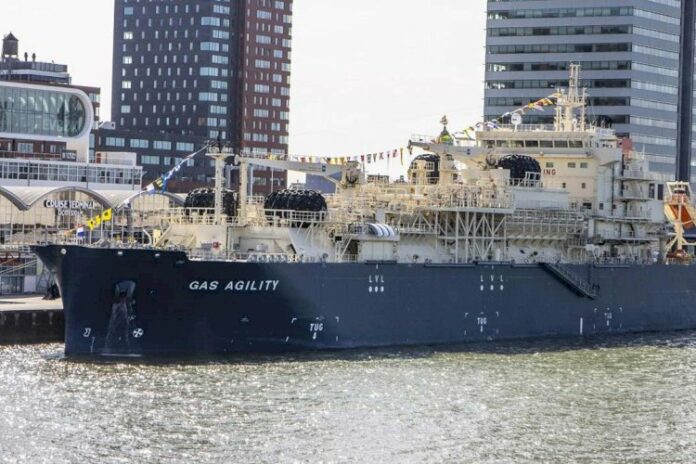
The 18,600-m³ GTT Mark III Flex membrane vessel has been named “Gas Agility”.

First LNG bunker vessel owned by Emerald Green Maritime Limited, a wholly owned subsidiary of Mitsui O.S.K. Lines, Ltd. (MOL), she is chartered by Total’s affiliate Total Marine Fuels Global Solutions (TMFGS).

In February 2018, TMFGS and MOL signed the Time Charter Party for this epoch-making LNG bunkering vessel. Construction started in China in November 2018 at Hudong-Zhonghua Shipbuilding’s yard. Delivered in April 2020, the “Gas Agility” meets the highest technical and environmental standards, using LNG herself as propulsion fuel, and integrating a complete re-liquefaction of the boil-off gas.

Jérôme Leprince-Ringuet, Managing Director of Total Marine Fuels Global Solutions, said:

“We are delighted to have officially named ‘Gas Agility’ as she embarks on a new chapter in delivering cleaner marine fuels. Her arrival in Rotterdam marks the culmination of 3 years of dedicated work with MOL and Hudong-Zhonghua Shipbuilding in Shanghai, to plan, build and create a major development in global marine LNG fuel supply. ‘Gas Agility’ is a clear demonstration of our ongoing drive to develop key logistical LNG infrastructures in the main bunkering hubs around the world, helping the shipping industry make the move to a more sustainable fuel solution.”

With her pioneering design and innovative equipment, the “Gas Agility” is an industry premiere made possible by a strong collaboration between the shipyard, the owner, the charterer and many partners, including Bureau Veritas and GTT.

Takeshi Hashimoto, Executive Vice President of MOL, said:

“I would like to express my sincere gratitude to all the people who have been involved in the project. I am very confident that our endeavour will be the great milestone and the turning point in this rapidly changing world. The transition from heavy fuel oil to LNG is competitive, environmentally efficient and an immediately available solution for maritime transportation. By providing the capacity to deliver LNG as a marine fuel, this partnership will be the leader in transition to a more fuel-efficient industry.”

In December 2019, TMFGS and MOL signed a long-term charter contract for a second large LNG bunker vessel, to be delivered in 2021. She will be positioned in the Marseille-Fos area in France to supply LNG as a marine fuel within the Mediterranean area.

NKT invests in power cable transportation to support the growing offshore wind market

0

The demand for offshore power cables is expected to grow in the years to come as offshore wind continues to be essential for the global transition to renewable energy.

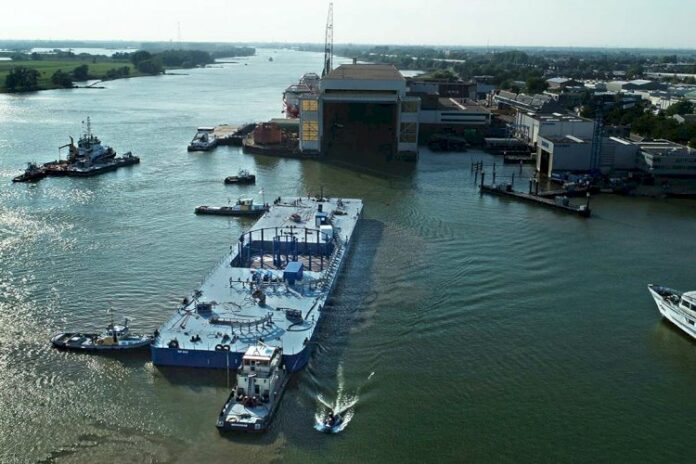
With the positive market outlook and a strong order backlog, NKT is now investing in a new specially designed barge built for cable transportation on the river Rhine to increase the transportation capacity and enhancing the security of delivery from its manufacturing site in Cologne. NKT also increases capacity in its logistical center in Rotterdam from where the offshore cables manufactured in Cologne are loaded to cable-laying vessels.

Executive Vice President Mika Makela, who is heading the manufacturing site in Cologne, says:

“With the investment in the purpose-built barge and in increased capacity at our logistical center in Rotterdam, we strengthen our position as a leading provider of offshore power cables. The investments are driven by a growing demand from the offshore industry and will enhance our delivery security even in times with abnormal weather conditions or with multiple projects being executed in parallel.”

The barge is designed and built by Neptune Marine for the changing condition of the Rhine and can operate in very shallow water and thereby minimizing the effects of low water levels. To minimize the environmental impact, the barge is powered by green electricity during cable loading at the harbour in Cologne where the factory is also powered by electricity generated from renewable energy.

With high-voltage cable factories in both Cologne and Karlskrona, Sweden, NKT is strategically well-positioned to deliver power cables for the growing offshore wind sector in the North and the Baltic Sea as well as for the interconnector market also being driven by the transition to renewable energy across Europe.

NKT expects the barge to be fully operational in Q4 2020.

Learnmarine introduces IGF Code online and simulator training

0

The 6th session of IMO’s Sub-Committee on Human Element, Training and Watchkeeping (HTW 6), held from 29 April to 3 May, validated two new IMO model courses on IGF Code training.

The purpose of the International Code of Safety for Ship Using Gases or Other Low-flashpoint Fuels is to provide an international standard for ships, other than vessels covered by the IGC Code, operating with gas or low-flashpoint liquids as fuel.

STCW minimum requirements for the training and qualification of masters, engineers and officers, ratings and other personnel on board ships are addressed in the Code, and an approved course of basic training is now required for any seafarer responsible for designated safety duties associated with the care, use or emergency response to fuel on board ships which are subject to the IGF Code.

The two new courses validated concern:

IGF Code: Basic training (full online training and online assessment).
IGF Code: Advanced training (blended learning – online theory course, LNG Bunkering Simulator and Firefighting Simulator, online build-in simulator assessment).

Learnmarine – is a provider of custom-made online and in-class training and competency assessment for the maritime industry based in Odessa, Ukraine. Company facilitate the efficient transfer of knowledge essential for improving performance and productivity and maintaining competence.

Maritime.Studio (part of “The Maritimemedia OU”, based in Tallinn, Estonia) is provider of custom maritime EdTech solutions. 

The construction of Finnlines’ second new hybrid ro-ro vessel started

0

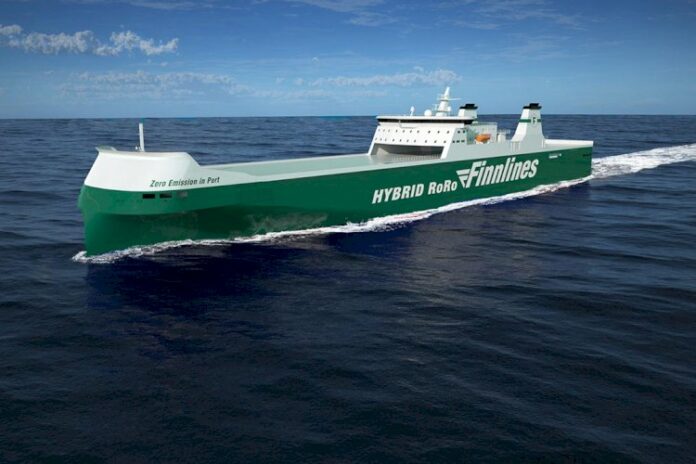
Finnlines newbuilding programme continues as planned. The construction of Finnlines’ second new hybrid ro-ro vessel started at the Chinese Nanjing Jinling shipyard. 

Finnlines’ ongoing EUR 500 million newbuilding programme, which includes three green hybrid ro-ro vessels as well as two eco-friendly Superstar ro-pax vessels, will further increase Finnlines’ energy efficiency. The vessels will be built with the top technical and environmental views in mind. In addition to lithium-ion battery banks, which enable ‘zero emissions in port’, they will be equipped with several advanced technologies to save energy and thus reduce emissions further. The ro-ro vessels are expected to be delivered during 2021–2022 and the Superstar ro-pax vessels are set to start in traffic in 2023.

The new hybrid ro-ro vessels will be named Finneco I, Finneco II and Finneco III in honour the green innovations.

Emanuele Grimaldi, CEO of Finnlines, says:

“We continue to implement our strategy with resolve and consistency. At Finnlines, we continuously develop our way of working. Over the past ten years, we have steered investments to energy efficiency and green technologies and our newbuilding programme focuses on further energy-saving features. These new ultra-green vessels will offer our customers very sustainable liner services in the future.”