-10.8 C
New York
Home Blog Page 760

Port of Long Beach uses new, zero-emissions cargo-handling tractors

0

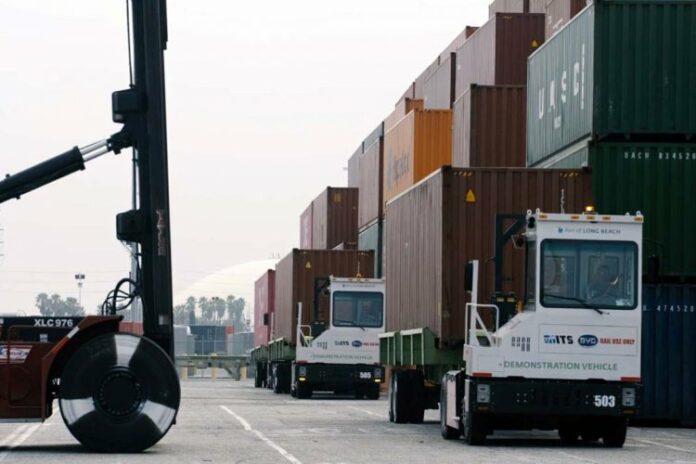
The terminal located at the Port’s Pier G is operated by International Transportation Service. ITS will demonstrate seven BYD battery-electric yard tractors for one year.

Seven traditionally powered yard tractors annually emit 11 pounds of diesel particulate matter, 1,331 pounds of nitrogen oxides and 311 metric tons of greenhouse gases. International Longshore and Warehouse Union members are operating the vehicles. 

Port of Long Beach Executive Director Mario Cordero said:

“We need equipment that can make it through an entire shift, with recharging during breaks. That’s one of the requirements for zero-emissions equipment to demonstrate that it can function in a real-world environment. Alongside partners like ITS, we are leading the industry to a more sustainable future.”

The project is part of a $9.7 million grant awarded by the California Energy Commission, which involves the design or creation of 21 new or converted electric cargo handling vehicles. The grant will pay for most of the $13.7 million project intended to help commercialize vehicles that will move cargo sustainably at seaports all around the world and help the Port of Long Beach meet its goal of a zero-emissions cargo handling fleet by 2030.

Long Beach Harbor Commission President Frank Colonna said:

“This project is an important step in realizing our Green Port aspirations. We would like to thank the California Energy Commission for their generous grant to help us clean our air and protect the communities around the harbor.”

ITS Chief Operating Officer Sean Lindsay said:

“ITS is proud to participate in this Port of Long Beach demonstration featuring zero-emission technologies and concepts that will play a vital role in our industry’s future. In line with ITS’ company priorities, we’re continuing to take the proper steps in reducing our carbon footprint for the benefit of our waterfront community and goods movement.”  

As part of the project, Southern California Edison also helped modernize the existing electrical infrastructure needed to support Port electrical equipment, worth approximately $450,000.

McDermott announces shipment of first MODEC FPSO Modules

0

The FPSO will be located in the Area 1 block, approximately six miles (10 kilometers) off the coast of Mexico in the shallow waters of the Campeche Bay at a water depth of approximately 105 feet (32 meters).

Samik Mukherjee , Group Senior Vice President for Projects, said:

“McDermott’s ability to deliver modular solutions, both onshore and offshore, helps us mitigate risk and improve efficiency. We draw from the strong, local workforce we have in Mexico to support this project as well as our experience and expertise as an EPCI leader to safely deliver excellent results on behalf of the customer.”

The MODEC project scope of work consists of five FPSO Topside Modules, which will be delivered to the client in two shipments. This first shipment includes modules that will provide compression, vapor recovery and a laydown area for the FPSO.

McDermott’s Altamira fabrication facility in Mexico is delivering the FPSO modules and EPCI fixed platform. Engineering support of the project is being performed by McDermott’s Houston and Altamira offices.

Sea Cargo Charter launches with 17 shipping firms volunteering GHG emissions data

0

The Sea Cargo Charter sets a new benchmark for responsible shipping, transparent climate reporting, and improved decision making in line with United Nations decarbonization targets.

A group of the world’s largest energy, agriculture, mining, and commodity trading companies will for the first time assess and disclose the climate alignment of their shipping activities.

United Nations agencies estimate the international shipping industry to carry around 80% of world trade flows and to be responsible for 2-3% of global greenhouse gas emissions annually.

Large industrial corporations are significant users of international shipping services. The shipping of crude oil, coal, iron ore, grain and other bulk commodities used worldwide make up over 80% of global seaborne trade. The Sea Cargo Charter is a global framework that allows for the integration of climate considerations into chartering decisions to favor climate-aligned maritime transport.

The Sea Cargo Charter establishes a common baseline to quantitatively assess and disclose whether shipping activities are aligned with adopted climate goals. The Sea Cargo Charter is consistent with the policies and ambitions adopted by member states of the International Maritime Organization (IMO), a specialized agency of the United Nations responsible for regulating shipping. This includes its ambition for greenhouse gas emissions from international shipping to peak as soon as possible and to reduce shipping’s total annual greenhouse gas emissions by at least 50% of 2008 levels by 2050, with a strong emphasis on zero emissions.

Jan Dieleman, President, Cargill Ocean Transportation and Chair of the Sea Cargo Charter drafting group, says:

“A standard greenhouse gas emissions reporting process will simplify some of the complexities often associated with reporting. It will encourage a more transparent and consistent approach to tracking emissions, which will be a critical part of making shipping more sustainable.” 

Rasmus Bach Nielsen, Global Head Fuel Decarbonisation, Trafigura, says:

“The shipping industry as a whole needs to adopt a transparent approach, advocated by the Sea Cargo Charter, in order to fully understand the sector’s overall greenhouse gas footprint and for us to collectively rise to the challenges faced.”

Grahaeme Henderson, Global Head, Shell Shipping & Maritime, says:

“Collaboration such as this, from across the sector, is vital to scale-up customer demand for low- or zero- emissions shipping. This same spirit of collaboration is also vital in the pursuit of the technological advances needed to unlock decarbonisation solutions, and in building industry support for regulation which can create an ambitious but level-playing field under which to invest. Building on this momentum we would like the IMO to use its 2023 strategy review to set the trajectory for the sector to move to net-zero emissions by 2050.”
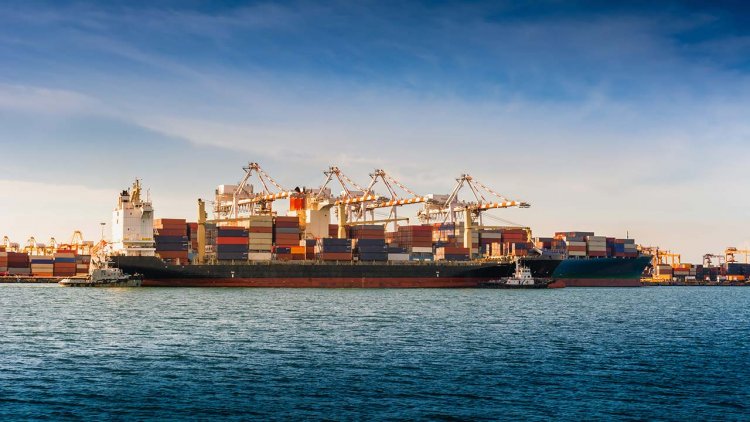
The 17 Founding Signatories of the Sea Cargo Charter include ADM, Anglo American, Bunge, Cargill Ocean Transportation, COFCO International, Dow, Equinor, Gunvor Group, Klaveness Combination Carriers, Louis Dreyfus Company, Norden, Occidental, Shell, Torvald Klaveness, Total, Trafigura, and Ørsted. All other responsible shippers are invited to join the initiative.

Johannah Christensen, Managing Director, Head of Projects & Programmes at international non-profit, Global Maritime Forum, says:

“The Sea Cargo Charter enables leaders from diverse industry sectors to use their influence to drive change and promote shipping’s green transition by choosing maritime transport that is aligned with agreed climate targets over that which is not.”

The Sea Cargo Charter is intended to evolve over time as the IMO adjusts its policies and regulations and when further adverse environmental and social impacts are identified for inclusion. They also aim to support other initiatives developed to address climate, environment, and social risks in shipping, such as the Poseidon Principles.

The Sea Cargo Charter is applicable to bulk charterers with interest in the cargo on board; those who simply charter out the vessels they charter in; as well as the disponent owners and all charterers in a charterparty chain. They apply globally, to all chartering activities where a vessel or vessels fall under the purview of the IMO.

The development of the Sea Cargo Charter has been led by global shippers – Anglo American, Cargill Ocean Transportation, Dow, Norden, Total, Trafigura – and leading industry players – Euronav, Gorrissen Federspiel, Stena Bulk – with expert support provided by the Global Maritime Forum, Smart Freight Centre, University College London Energy Institute/UMAS, and Stephenson Harwood.

New technology enables up to 50% methane slip reduction

0

With IMO targeting a 50% reduction in greenhouse gas emissions by 2050, LNG is becoming a natural choice for shipowners in the transition to carbon-neutral fuels. Methane slip regulations are a possibility on the horizon, but Alfa Laval and global Swiss engine developer WinGD have already cooperated on a solution. The Alfa Laval PureCool system is the main component in WinGD’s iCER technology, an option for next-generation WinGD X-DF engines that slashes methane slip and significantly boosts fuel and energy efficiency.

As a growing number of vessels turn to LNG as fuel, many shipowners are concerned about the potential appearance of methane slip regulations. LNG produces less CO2 than other fossil fuels when burned, but a small percentage of methane can slip through the engine without being combusted. Since methane has a higher global warming potential than CO2, even this small source of emissions may come into focus in meeting IMO’s ambitious climate goals.

David Jung, Business Development Manager at Alfa Laval, says:

“With IMO aiming to cut greenhouse gas emissions by at least 50% compared to 2008 levels, LNG has a major role as a bridge fuel in moving towards a carbon-neutral future. However, the awareness of methane slip and its influence on global warming is increasing. New regulations are not unthinkable, and any improvement from today’s environmental benchmark is important. With or without regulations, WinGD’s iCER technology with the Alfa Laval PureCool system will help the shipping industry align more fully with climate goals by minimizing methane slip.”

Developed by Alfa Laval in close collaboration with WinGD, PureCool is the cascade exhaust gas cooling system at the heart of the iCER concept. Short for Intelligent Control by Exhaust gas Recycling, iCER is the first development presented in X-DF2.0, WinGD’s second-generation dual-fuel engine technology.

Jung says:

“The iCER option is a standalone installation adjacent to the engine. During operation in gas mode, it improves combustion by cooling and recirculating about 50% of the exhaust gas through a low-pressure path with full turbocharger capacity. This minimizes methane slip, and the PureCool system provides the vital cooling function that makes it possible.”

Trials at WinGD’s dedicated engine test facility, which were the final step in a two-year testing programme, show a methane slip reduction of up to 50%.

Jung says:

“This is not fine-tuning or a marginal improvement of LNG technology. This is a major environmental gain that truly strengthens LNG’s profile. With the PureCool system at its heart, iCER will cut methane slip by as much as half.”

Beyond the methane slip reduction, the iCER solution with PureCool offers engine buyers significant operational benefits – thus creating value even prior to potential compliance regulations. When combustion is improved with iCER, fuel consumption in gas mode is reduced by 3%.

Jung adds:

“The PureCool system improves a vessel’s efficiency along with its emissions. The fuel savings inherent to iCER can have a positive impact on a vessel’s Energy Efficiency Design Index.”

Neptune Energy acquires additional interest in Dugong discovery

0

Neptune Energy has announced agreement with Concedo AS for the acquisition of a further 5% interest in the Dugong licence (PL882) in the Norwegian sector of the North Sea. On completion of the acquisition, Neptune will have a 45% interest in Dugong.

The payment will be partly cash, partly carry of future cost and partly a contingent payment.

The Neptune-operated Dugong discovery is the largest on the Norwegian Continental Shelf so far this year. Volumes are estimated to be in the range of 40-120 million barrels of oil equivalent (boe). Prospective resources for the Tail prospect are currently estimated at 33 million boe.

Neptune and its licence partners plan to drill two additional wells on PL882, an appraisal well on the Dugong discovery and an exploration well targeting the Tail prospect. Drilling will commence in the first quarter of 2021. 

Dugong is located 158 kilometres west of Florø, Norway, at a water depth of 330 metres, and is close to existing production facilities. 

The transaction is subject to approval by the Norwegian Ministry of Petroleum and Energy. On completion of the transaction, the Dugong partners will be Neptune Energy (operator and 45%), Concedo (15%), Petrolia NOCO (20%) and Idemitsu Petroleum Norge (20%).

Australia and Germany come together to assess hydrogen supply chain

0

The proposal could offer a pathway for Germany to achieve its emissions reduction target by 55 per cent on 1990 levels by 2030, as part of a longer term goal of net zero emissions by 2050.

With limited renewable energy resources and the largest electricity use in Europe, Germany has its work cut out achieving the emission reductions goals, so is looking for ways to import renewable energy.

Hydrogen is an emerging prospect, releasing no emissions when produced with renewables and able to be transported around the world in purpose built carriers.

Already the world’s largest exporter of liquified natural gas, Australian governments and energy companies see an opportunity to produce hydrogen for overseas markets using our riches of solar and wind resources.

Under the scenario, plentiful low-cost electricity from wind and solar farms would be used to power hydrogen electrolysers, with the emissions free hydrogen shipped around the world to countries that today rely on gas and coal imports.

Australia’s role as a gas exporter positions the country well amongst the field of possible hydrogen producers, thanks to established supply chains and trading partnerships with energy importing nations, infrastructure and no shortage of gas expertise.

Given it is impossible to tell how a unit of hydrogen has been produced, the National Hydrogen Working Group proposed a certification scheme with a guarantee of origin so buyers can be confident that hydrogen complies with local environmental and corporate commitments.

To help hydrogen electrolyser technology to get off the ground, ARENA is supporting demonstration projects around the country and will soon announce the winners of a $70 million hydrogen electrolyser funding round to build the country’s first megawatt scale electrolyser projects.

So far, ARENA (Australian Renewable Energy Agency) funding has supported projects led by gas companies ATCO, Jemena, BOC, Australian Gas Networks. Ammonia producers Dyno Nobel and Yara Fertilisers are scoping the possibility of using renewable hydrogen in their supply chains, and car manufacturer Toyota has built an education centre alongside a new electrolyser and hydrogen refuelling station.

Collectively these projects will show practical applications for hydrogen as a carrier of renewable energy, and help to bring down the costs of the technology needed to produce, transport and consume it in domestic and industrial applications.

Hydrogen technology is one of the priority technologies outlined in the government’s inaugural Low Emissions Technology Statement released last week, which will be delivered with support from ARENA.

Announcing the agreement with Germany, Trade Minister Simon Birmingham said partnerships like this will be critical to developing Australia’s future as a powerhouse in clean energy exporter.

He said:

“This study gets the ball rolling on the development of future hydrogen supply chain with Germany which could lead to billions of dollars in export earnings for Australia and help them meet their future clean energy ambitions.”

Minister for Energy and Emissions Reduction Angus Taylor said:

“Australia’s future hydrogen industry has the potential to generate 7,600 new jobs by 2050, many in regional Australia, with exports estimated to be worth around $11 billion a year in additional GDP.”

Anglo-Eastern to implement the Wärtsilä Cloud Simulation Solution

0

Wärtsilä Voyage Cloud Simulation Solution has been selected by leading ship manager, Anglo-Eastern, to provide online capacity for the company’s training centres in India, the Philippines and Ukraine.

The cloud-based simulators will be used for navigation, engineering, and liquid cargo handling simulator-based training. Anglo-Eastern has over 600 ships under management, and has a crew pool of more than 29,000 seafarers worldwide. It is the first global ship management company to implement the Wärtsilä Cloud Simulation Solution.

The addition of cloud-based simulation training to Anglo-Eastern’s existing repertoire of advanced training solutions represents another industry-leading commitment to digitalisation and the application of technology where it provides clear benefits and enhanced efficiencies. The Wärtsilä Cloud Simulation Solution is based on the same platform as the company’s physical simulators, and is a particularly effective means of providing online training services, both during the current Covid-19 pandemic and at other times when physical attendance at training centres may not be advisable or possible.

Anglo-Eastern’s CEO Bjorn Hojgaard explained:

“At Anglo-Eastern, we are transforming our ship management systems from separate analogue application into smart, integrated enterprise platforms for the future. Our vision is to augment our people and processes with cutting-edge technology to ensure safe and reliable vessel operations. Central to this vision is moving our applications and data to the cloud, for which the Wärtsilä Cloud Simulation Solution is thus an excellent fit.”

Neil Bennett, Director of Global Simulation Sales, Wärtsilä Voyage, said:

“Digital learning is without doubt a key training asset for shipping companies looking to the future. By making remote training via cloud services both feasible and highly efficient, Wärtsilä is providing a valuable tool that can support training organisations in their development of blended learning strategies. The cloud system is a further example of our strength in applying smart technologies to deliver greater efficiencies for our customers.”

Capt. Pradeep Chawla, Managing Director of QHSE and Training, Anglo-Eastern, said:

“Cloud simulation represents an additional, complementary tool that fits well into our overall training strategy for our crew pool of more than 29,000 seafarers. Future officers will be working on more sophisticated navigation equipment, and regular training on simulators will become the norm, similar to the airline industry.”

Wärtsilä has a well-established relationship with Anglo-Eastern. In addition to earlier deliveries of simulators to their training centres, Wärtsilä has also provided the company with its Fleet Operations Solution (FOS). FOS unites all navigational processes and voyage data on a single platform to enable safe, efficient and cost-effective voyage planning. Anglo-Eastern can take data collected via FOS and use it in simulators for training and research applications using cloud-based or physical simulators.

EU supports Antwerp@C innovative CO2 reduction project by granting CEF funding

0

Port of Antwerp brought seven leading chemical and energy companies together at the end of 2019 to investigate the technical and economic feasibility of building CO2 infrastructure in the port of Antwerp.

The consortium consists of Air Liquide, BASF, Borealis, ExxonMobil, INEOS, Fluxys, Port of Antwerp and Total. With the project entitled Antwerp@C the partners aim to keep CO2 out of the atmosphere and as such to make a significant contribution towards the climate objectives, thanks to applications for capturing and utilizing or storing CO2, all within a relatively short time span and at reasonable costs.

The consortium has announced that two applications for EU funding, submitted by Air Liquide, Fluxys, Total and Port of Antwerp to carry out studies for a liquid CO2 Export Terminal, a CO2 backbone within the Port of Antwerp and a CO2 cross border pipeline to connect to the Netherlands, were approved. With this financial support, Antwerp@C reaches a new milestone and can engage one step further. The consortium is strengthened in its ambition to reduce the CO2 emissions within the port (18.65 million tons of greenhouse gas emissions in 2017) potentially by half between now and 2030.

The partners of Antwerp@C are delighted that a Connecting Europe Facility (CEF) grant is awarded to the project to pursue detailed studies, since broad support – especially financial support – by the EU, the Belgian Federal Government and the Flemish Government is essential to ensure the success of the project. Antwerp@C is pursuing two pathways for cross-border CO2 transport infrastructure, one for transport via an onshore pipeline to Rotterdam and one for transport by ship to North-West Europe. Two subsidies for detailed studies – concerning an amount of circa € 9 million are now granted under the European funding program for Trans-European Energy Networks, CEF.

This CEF award is a positive step to support CCS as a CO2 abatement technology for the industry in the Port of Antwerp. In addition to this first step, a number of expression of interest applications are currently being prepared by the consortium partners for submission under the European Innovation Fund that will be a key enabler to support the development of the entire CCS value chain from capture to storage.

Port of Antwerp is home to the largest integrated energy and chemicals cluster in Europe. This makes it the ideal location to set up new, cross-border collaboration projects for innovative CO2 reduction. To this end, Air Liquide, BASF, Borealis, ExxonMobil, INEOS, Fluxys, Port of Antwerp and Total joined forces at the end of 2019 under the name of Antwerp@C, to investigate the technical and economic feasibility of building CO2 infrastructure to support future CCUS (Carbon Capture Utilisation & Storage) applications. Carbon Capture & Storage (CCS) and eventually also Carbon Capture & Utilisation (CCU) – i.e. reusing CO2 as a raw material for the chemical industry – are seen as important routes in the transition to a carbon-neutral port. This innovative cross-border CCUS project would be among the first and world’s largest multimodal open access CO2 export infrastructure.

Jacques Vandermeiren, CEO Port of Antwerp:

“The time is now to make the transition towards a carbon neutral economy. Europe leads the way on a global stage. With Antwerp@C, the port of Antwerp has the key to realize an innovative cross-border CCUS-project, a first of a kind in its concept and scale. We are proud to receive the necessary financial support for the study phase, as this project will contribute to the Flemish, Belgian and European climate goals and to the increased EU 2030 targets for emission reduction to at least 55%.”

Successful trial in port of Rotterdam with electricity platform

0

Working with solar panels and a battery, users trade energy they have produced themselves in a local market. This is the first time in the world that blockchain technology, artificial intelligence and high-frequency commodity trading have been combined in a single platform. The successful trial shows that it is possible to coordinate supply and demand in local markets 48 hours in advance through a platform on the basis of fair prices and transparent trading agreements.

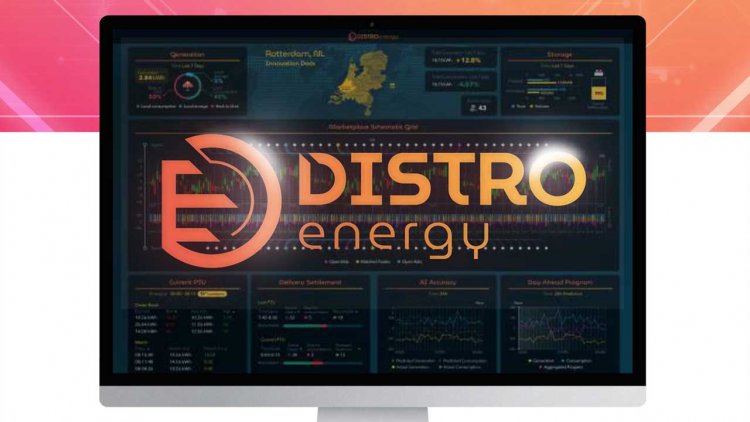
The Distro platform was developed by S&P Global Platts, a division of S&P Global, and Blocklab, a subsidiary of the Port of Rotterdam Authority that specialises in blockchain solutions. The new initiative helps companies in the port to reduce energy costs by making better use of locally produced electricity and by smoothing peaks in demand on the electricity grid. All this fits in with the climate goal of establishing a carbon-neutral port by 2050. Testing this summer demonstrated that the platform works and the coming months will be used to get it ready for commercial use.

A pilot project was conducted in the Innovation Dock, which houses innovative entrepreneurs. The Port Authority, as the owner of the Innovation Dock, used Distro to operate its own ‘micro-market’ of 32 users, as well as a roof full of solar panels and a battery to store the energy produced. 

Artificial Intelligence predicts the consumption and production patterns of individual electricity consumers, and trades kilowatt hours on the platform on the basis of those forecasts. The price of electricity fluctuates with changes in supply and demand. Batteries responding to price buy and store excess on-site solar energy that is generated when consumption levels are low, to re-sell it to users when solar generation is low.

The results include a 92% local consumption of renewable energy and a 20% increase in return on investment for the battery. Additionally, the pilot demonstrated a 14% improvement in revenues for locally produced renewable energy, while lowering average prices for consumers. In addition, trading between the participants means that a ‘micro-market’ places less of a burden on the regular electricity grid. In turn, that means that the Port of Rotterdam Authority, as the owner of the Innovation Dock, can reduce the capacity of the connection to the network and save costs by 25%.

The Distro platform is a response to two major developments: consumers are now also producers; and energy delivered by solar and wind fluctuates considerably. James Rilett, Innovation Director at S&P Global Platts:

‘At the distribution level, too, the electricity market has to become a mature market in which transparency will lead to better prices and the more effective use of infrastructure. The design of the platform is based on Platts experience of more than 100 years of providing price transparency to global commodity markets.’

The platform combines the capabilities of high frequency trading, with a blockchain environment that provides security for transactions, identity management and market rule compliance. 

Jullens (director of Blocklab):

‘We have now had more than 20 million transactions validated by a blockchain. So we know that the system can be stable and reliable, even with a high volume of transactions. Not only that, Banking as a Service from ABN AMRO Clearing Bank has demonstrated that the transactions on the platform can be processed in the banking environment.’

In the coming months, the software used in the pilot will be prepared for commercial use. Nico van Dooren, Director New Business & Portfolio Management at the Port of Rotterdam Authority:

‘This pilot project is good for everyone: not only are energy prices fairer and more transparent, the costs of sustainable energy are reduced for clients. This is a solution that will help to achieve the goal of a carbon-neutral port.’

DNV GL, TCM and SINTEF to develop carbon capture, utilization and storage technologies

0

DNV GL, SINTEF and Technology Centre Mongstad (TCM) have signed a memorandum of understanding to further develop carbon capture, utilization and storage technologies to make full-scale CCS a reality globally.

CCS is the only currently available technology to deeply decarbonize hydrocarbon use. Scaling the technology will be critical to a range of industry sector’s ability to align with national and international climate targets. DNV GL’s 2020 Energy Transition Outlook forecasts that the technology will help mitigate more than 2 gigatonnes of CO2 emissions by mid-century. However, the forecasts also indicate that CCS will not begin to scale until 2030, and not to a significant level until 2040 without government incentives and with industry focusing on finding ways to reduce the cost of CCS technology.  

On 21 September the Norwegian Government announced its decision to provide 13.8-16.8 billion NOK funding to support the realization of the Norwegian Longship CCS project . All parties have provided consultancy support to enable the realization of this project, which boasts many first-of-a-kind elements, including capture of CO2 emissions from the cement industry, transport of CO2 by ship, and temporary storage of CO2 prior to pipeline transportation and storage. 

The aim of the memorandum of understanding is to assist technologies and projects to move more rapidly from demonstration to commercial deployment. TCM’s capability to facilitate large scale testing and verification of CO2 capture technology allows technology developers the lowest possible technological and financial risk. DNV GL and SINTEF can provide confidence to technology developers and stakeholders by guiding and supporting processes to qualify CO2 capture technology, and providing verification of assets, infrastructure and storage sites.   

Ernst Petter Axelsen, Managing Director at TCM, said:

“TCM’s capability to allow large scale demonstration of CO2 capture technologies is key to lower the cost and risk of deployment of the technologies at scale. Our mandate is to reduce cost and risk for emerging CCS projects through our own and two partners knowledge.” 

Liv A. Hovem, CEO, DNV GL – Oil & Gas, said:

“There is a significant need to accelerate efforts to scale CCS technology to allow the world to move toward its net-zero targets with greater confidence. Our partnership with TCM and SINTEF will allow us to work closely together to accelerate the deployment of CCS as a critical technology to deliver on nationally and internationally agreed climate targets.”

Alexandra Bech Gjørv, President and CEO SINTEF, said:

“We are finally at a moment in time where CCS is being recognized as a key driver for sustainable growth, and we must succeed on the global scale quickly, according to both the IPCC, the European Commission among many others. This partnership will build on a deep knowledge-base, which SINTEF has actively contributed to for more than three decades, enabling a fast track to full scale and global use of CCS.”