-6.2 C
New York
Home Blog Page 729

Arkitech launches solution for safe voyages during the covid pandemic

0

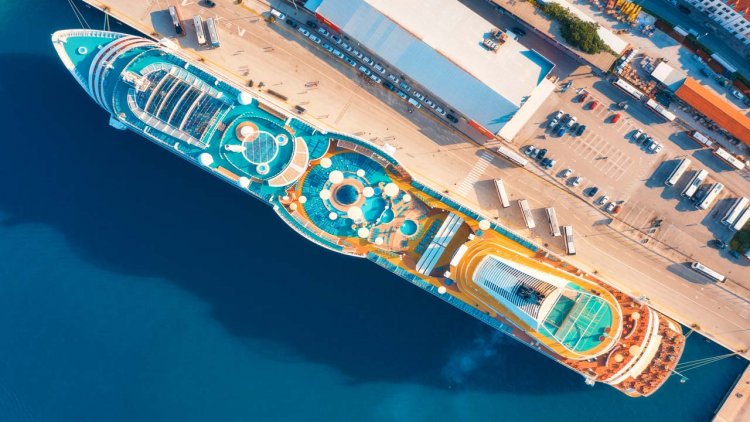
After numerous covid outbreaks on vessels this year, cruise ships and ferries have not been able to operate without severe restrictions. In order to resume operations strict measures must be taken to guarantee the health and safety of crew and passengers. For this purpose, Arkitech selected renowned specialized cleanroom company KCS to develop a fully qualified Maritime CleanCabin® (MCC) applicable for different environments and circumstances on vessels.

The MCC is a high-tech solution to quarantine contaminated passengers onboard and to prevent disease outbreaks at sea. The MCC is a joint product of Arkitech and KCS.

The MCC’s are isolated cabins on the vessel which are kept at Constant Under Pressure (CUP) by regulating the airflow system.  An airlock system separates the MCC from other areas of the vessel. This way, no contaminated air can flow out of the MCC and the air quality in the other areas of the vessel will not be compromised.

To supply the quarantined passengers with food, medication and necessities in a safe way, the MCC is equipped with a medically approved passthrough system. Medical crew can take care of the patients without unnecessary contact. In addition, the whole interior of MCC has been designed to cleanroom standards for hygienic environment and medical cleaning.  Optionally, an MCC can also be prepared for urgent medical treatment.
Research has shown that ventilation is key to prevent a virus transmitting from person to person. The air flow in the MCC’s is thoroughly filtered, monitored and separated. Connection to the Arkitech ARK M20 data analysis system, enables all critical indicators of the air quality to be continuously monitored. The dashboard will inform crew about air quality and critical alarms.

MCC’s are developed as multipurpose solution not only for Covid virus but also to take care of other diseases requiring isolation on board.

What makes the MCC unique, is that the cleanroom technology applied has been proven for a long time and approved by important institutes such as the Centre for Disease Control (CDC) and the Food and Drug Administration (FDA).  This makes MCC a fully qualified concept proven to be safe and fast to implement. All parts of the MCC are designed and produced in the Netherlands.

Patient health and safety are of course of the highest priority, but the MCC is also designed for the wellbeing of the quarantined person.  Therefore, MCC’s are equipped with comfortable furniture and communication systems.  The airlock and passthrough system ensure that people in quarantine can be personally contacted and easily provided with their needs.
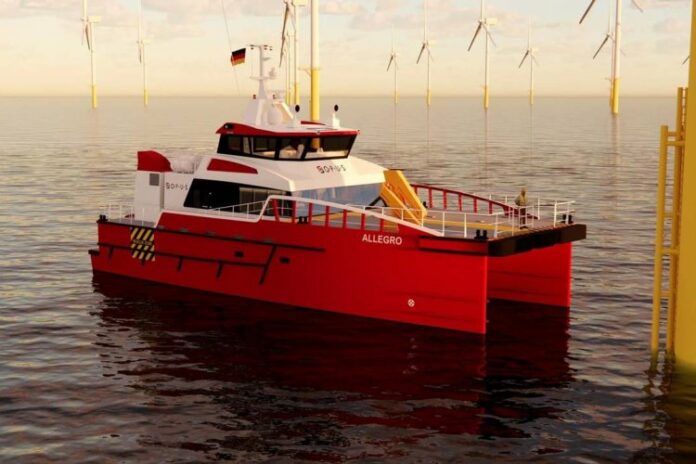
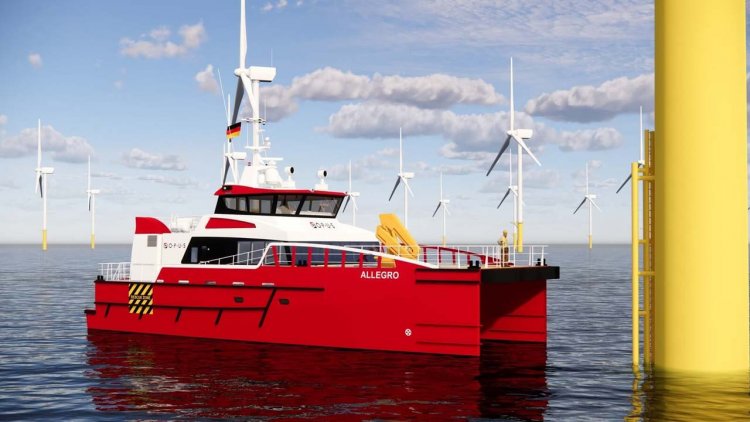
Damen contracted to deliver Germany’s first Fast Crew Supplier 2710

0

On 3rd December in Hamburg, Damen Shipyards Group signed a contract with Opus Marine for the delivery of a Fast Crew Supplier (FCS) 2710, to be named Allegro. The company will operate the vessel in support of its charterers, serving the offshore wind industry in the German section of the North Sea.

Damen will deliver the vessel to Opus Marine in March. The relative speed of delivery comes as a result of the shipbuilder’s practice of building standard vessels in series for stock. At the time of the contract signing, the FCS 2710 was already being constructed at Damen’s yard.

Opus Marine operates a fleet of crew transfer vessels, amongst which is a Damen FCS 2610 named Verdi. This predecessor to the FCS 2710 was a game changer in offshore wind and went on to become an industry benchmark, of which around 50 were built.

The FCS 2710 builds on the success of this design. It draws on the same Twin Axe bow in order to provide safe, comfortable transportation even in rough seas. A key feature is the vessel’s 1 metre increased height above the water. This allows the FCS 2710 to operate in water over 2 metres wave height, significantly increasing uptime. The FCS 2710 also offers additional deck space, tank capacity and accommodation.

When Opus Marine wanted to increase its fleet it turned to Damen based on its previous experience, managing director Bernhard Messer explains:

“We didn’t see any reason to change this winning team. It is our goal to provide the best CTV service to our clients, which we can only do with the best boats. If the going gets tough, Damen has proven itself to be an impressively reliable partner with an outstanding back office performance and technical support throughout. We are looking forward to our new fleet addition and further successful cooperation with Damen.”

Damen sales manager Joschka Boddeling echoed his sentiments, saying:

“We are very happy that this project, which has been in pipeline for some time, has now matured. Working with Opus Marine, who in 2015 pioneered the 24 pax FCS 2610 in Germany, is something that we greatly value. Introducing the improved successor in the German market is something that we wish Bernhard and his team much success with.”

DCSA publishes standards for the Bill of Lading

0

First release of DCSA’s eDocumentation initiative establishes data and process standards for bill of lading preparation and issuance

Digital Container Shipping Association (DCSA), a neutral, non-profit group established to further digitalisation of container shipping technology standards, in conjunction with its nine member carriers, today published data and process standards for the submission of shipping instructions and issuance of the bill of lading (B/L). DCSA B/L standards are aligned with the UN/CEFACT (United Nations Centre for Trade Facilitation and Electronic Business) multimodal transport reference data model to ensure a global industry framework that accelerates digitalisation through a unified industry effort.

This is the first publication of the multi-year DCSA eDocumentation initiative which will deliver standards to enable digitalisation of end-to-end container shipping documentation, starting with the B/L. Through this initiative, DCSA aims to facilitate acceptance and adoption of an electronic bill of lading (eBL) by regulators, banks and insurers and to unify communication between these organisations and customers, carriers and all other stakeholders involved in a transaction.

The DCSA eBL standard publication comprises the following documents: DCSA Standard for the Bill of Lading 1.0, the DCSA Industry Blueprint 3.0, the DCSA Information Model 3.0 and the DCSA Interface Standard for the Bill of Lading. The Standard for the Bill of Lading, Industry Blueprint and Information Modelare immediately available to download for free on the DCSA web site. The Interface Standard will be available for download in January 2021. To facilitate implementation and compliance, API definitions will be published on SwaggerHub, and a reference implementation will be available on GitHub, also in January.

The DCSA Standard for the Bill of Lading can be implemented immediately to streamline and align paper-based B/L data and processes. Subsequent releases of DCSA’s eDocumentation initiative will include data and process standards for: booking request and confirmation, arrival notice and release shipment.

The eBL standard is the first DCSA standard to be eligible for self-certification under a new DCSA Compliance Programme, which will be published in January 2021. Any organisation that implements the eBL standard may demonstrate compliance by completing a self-certification checklist (SCC). In January, the SCC will be available on the DCSA website along with a Self-Certification Handbook that provides further details about the DCSA compliance programme and the procedure for self-certification. Self-certification for other DCSA standards will be introduced in the subsequent months.

Thomas Bagge, CEO of DCSA, remarked:

“Digitising documentation, starting with the bill of lading, is key to the simplification and digitalisation of global trade. The alignment we’ve achieved among the carriers is a critical milestone on the way to full eBL adoption. Paperless trade will benefit all parties involved in a transaction in terms of cost reduction, customer experience, efficiency, growth, innovation and sustainability. We invite all industry stakeholders to collaborate with us on optimising eDocumentation standards for safely and seamlessly delivering goods to their final destination.”

Oswald Kuyler, Managing Director Digital Standards Initiative (DSI) at International Chamber of Commerce, said:

“The COVID pandemic has brought more urgency to the shift towards digitalization of the global trade environment. Achieving a standardized eBL is a foundational element of that transformation. It’s fantastic to see alliances stepping up to the challenge, working with industry stakeholders and delivering something practical that can have a tangible impact. I’m looking forward to working with DCSA to advocate for adoption of digital standards not only for the B/L – but potentially for other use cases as well.”

Sue Probert, Chair at UN/CEFACT, said:

“It is the aim of standards bodies to digitalise and facilitate trade across different carriers, geographies and transportation modes. We were very pleased that DCSA’s standards are fully aligned with the UN/CEFACT MultiModal Reference Data Model to enable eBL transactions that are seamless and transparent across international borders. This type of collaboration is key to supporting global interoperability.”

Equinor joins Europe’s biggest green hydrogen project, the NortH2-project

0

The project aims to produce green hydrogen using renewable electricity from offshore wind off the coast of Netherlands of about 4 gigawatts by 2030, and 10+ gigawatts by 2040, kickstarting the hydrogen economy in Northwest Europe.

Equinor CEO, Anders Opedal, says:

“This is a groundbreaking project that Equinor is looking forward to contribute to. The project can be an important part in our efforts to build a competitive position in hydrogen, creating future value and industrial possibilities. Our aim is to be a net-zero energy company by 2050 and developing a profitable low carbon value chain for hydrogen will be an essential part of our transition to become a broad energy company. Hydrogen will be key to decarbonization and net zero efforts for the energy market, especially in otherwise hard to abate sectors which cannot be served by electricity.”

NortH2 was launched in February 2020, with Shell, Groningen Seaports Gasunie and the province of Groningen. Equinor joins RWE as new partners to the project. The project will complete a feasibility study by 2021, with the aim to start project development activities in the second half of 2021.

The project will have a capacity of 1 GW in 2027, 4 GW by 2030 and 10+ GW by 2040 for electrolysis. This equates to 0.4. million tonnes of green hydrogen production in 2030 and 1 million tonnes green hydrogen production by 2040. This can abate 8 to 10 million tonnes of CO2 emissions. This is equivalent to the yearly emissions from road traffic in Norway. The rapid growth in offshore wind is well suited to developing a green hydrogen value chain.

Pål Eitrheim, executive vice president New Energy Solutions in Equinor, says:

“NortH2 fits well with Equinor’s experience and position as a leading offshore wind operator. Hydrogen will add to the competitiveness of renewables in the years to come, by adding value and an alternative route to market for renewables. The development of viable large-scale clean hydrogen value chains twill help meet the Paris agreement targets.”

Northwest Europe is wellpositioned to develop an integrated hydrogen value chain – from offshore wind development and renewable power generation to production, storage, transport and the sale of green hydrogen.

The North Sea has a great potential for large-scale wind development, there is extensive existing natural gas infrastructure that is suitable for storage and large-scale transport of hydrogen, and there are large industrial clusters in the Netherlands and Germany as well as heavy-duty vehicle OEMs that could economically benefit from a ‘first mover’ advantage.

NortH2 expands the energy transition agenda for Equinor by adding a significant green hydrogen value chain. This complements already existing renewable and low-carbon world-class projects like Dogger Bank (offshore wind), Northern Lights (CCS) and H2H Saltend (Blue hydrogen).

NortH2 sets a vision for 4 GW integrated offshore-wind-to-green-hydrogen value chain by 2030, and for 10+ GW by 2040. Through the parallel development of the required hydrogen infrastructure by repurposing existing natural gas infrastructure, the project could supply major Northwest European clusters.

By doing so the NortH2 project will make an important domestic contribution to meet expected quickly growing hydrogen demand and thereby to meet Dutch as well as EU climate targets for 2030. It also ensures long term decarbonisation in line with the Paris Agreement. The project fits well with the agenda of the Northern Netherlands to become a leading region for green hydrogen, supporting economic development and the creation of high-skilled jobs.

Innovez One to digitise Singapore’s last mile delivery of launch operations

0

Innovez One is embarking on a collaboration to automate and digitise Singapore’s last-mile delivery of launch operations at its Marina South Pier (MCP) and West Coast Pier (WCP). This project is one of the 11 Joint Industry Projects recently awarded by the Maritime Port Authority and announced by Mr. Chee Hong Tat, Senior Minister of State for Transport and Foreign Affairs, at the Smart Port Challenge 2020 Finals.

Innovez One will launch its new Counter Service Digital Platform, a contactless counter services software that will streamline the current time-consuming manual operations at MCP and WCP, increasing efficiencies and generating significant cost savings. The project is being conducted in collaboration with leading maritime companies including GAC Group, Bernhard Schulte, HHH Marine Launch, DM Sea Logistics (part of DM Group Services), and KanLian Ferry. The trial will first be conducted in West Coast Pier (WCP) before being further extended into Marina South Pier (MCP).

Currently, there are over 40 launch operators and only a subset of launch operators operate counter services at MCP and WCP serving the business and consumer community that provide crucial services to calling ships, such as shipping agents, crew change, ship supplies, and chandlery, ship inspections, and bunker surveyors. Hundreds of transactions are managed every day currently requiring human-to-human booking, scheduling, and confirmation and payment processes, as well as the storing and retrieval of items, the majority of which are still manual.

The Counter Service Digital Platform will encompass several effective innovations, negating the need for physical counter services and replacing repetitive processes with the digitalisation of core services including passenger management and loose cargo management. 

The Counter Service Digital Platform will overhaul passenger management with passengers receiving booking and QR codes on email or apps prior to boarding the launch from the ship or arrival at the terminal. Onboarding, the QR code is scanned and registered, and the information is fed directly to the ship agent and launch company. Universal display panels will be deployed at the piers. These will offer immediate arrival and departure time information, the estimated time of arrival of the vessel, and the boarding location, enabling more efficient launch services due to clear, up-to-date information regarding passenger journeys.

The piers will also host storage solutions to securely store loose items or spare parts cargo for pick up either by the shipping agents or boatmen. This will ensure the grounds of the piers are constantly clear, as well as managing the size of cargo that is handled at the piers, ensuring the integrity of the cargo and adherence to standards. 

The Counter Service Digital Platform will provide an open API for data exchange and transactions with any solutions or systems, ensuring interoperability as well as scalability with new digital innovations.

David Yeo, group CEO and founder of Innovez One, said:

“The launch and implementation of the Counter Service Digital Platform is a significant step in using digital solutions to tackle manual, traditional processes. By automating and digitising the operations at MCP and WCP, we will be able to unlock tremendous productivity and efficiency gains, enhancing value and reducing the costs of operating the piers.

“Many ports around the world continue to rely on manual, paper-based processes or Excel spreadsheets and are missing out on the opportunities of digitalisation. As one of the world’s leading maritime hubs, the MPA is demonstrating what can be achieved in embracing innovation that can drive efficiencies, sustainability, and improved commercial success.”

Henrik Althén, Managing Director of GAC Singapore, commented:

“We’re delighted to be collaborating on this exciting project to enhance the pier services at the Marina South and Westcoast Piers. At GAC, we’ve been quick to appreciate the short and long-term benefits of digitalisation. This project is testament to how cutting-edge digital solutions can make an immediate impact on improving productivity, transparency, and drive more efficient, profitable, and better launch services.”

Bernard Lee, Manager of DM Sea Logistics, commented:

“The Marina South Pier and West Coast Pier are some of our busiest areas of operation, handling hundreds of transactions a day, and currently requiring repetitive, manual processes. We’re looking forward to working with Innovez One and other partners to overhaul the physical counter service to create a streamlined launch process which will boost operational resilience and productivity.”

Maersk Drilling secures one-well contract for low-emission rig from OMV

0

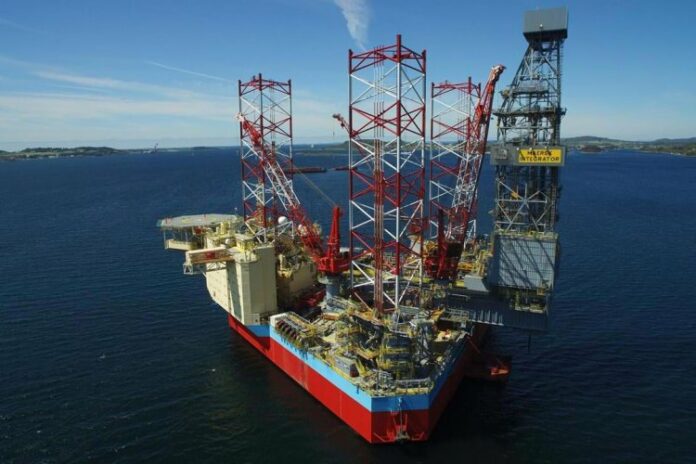
Maersk Drilling has been awarded a one-well contract from OMV (Norge) AS for the low-emission jack-up rig Maersk Integrator. In direct continuation of its previously announced work scope, the rig will drill one exploration well in the Ommadawn prospect in PL 970 offshore Norway. 

The contract is expected to commence in mid-2021, with an estimated duration of 52 days. The firm contract value is approximately USD 14.3m, including mobilisation, but excluding integrated services provided and potential performance bonuses. The contract further includes an option to add approximately 28 days of well testing.

Maersk Integrator is currently undergoing a series of upgrades to combine the use of hybrid power with low levels of NOx emissions, adding data intelligence to further reduce energy consumption and CO2 emissions. The performance bonus schemes included in the contract with OMV are based on rewarding reduced fuel consumption and reduced NOx emissions during the drilling operations.

COO Morten Kelstrup of Maersk Drilling says:

“We’re pleased to add this additional work scope for Maersk Integrator in 2021, and to enter into a new type of collaborative contractual set-up with OMV where we will focus on aligning incentives in the planning and execution of the drilling operation which again is expected to significantly reduce the uncertainty about overall well construction costs for our customer. We believe this kind of commercial model has the potential to increase exploration drilling activity in Norway and across the North Sea.

The contract further shows the commercial value of our low-emission upgrades. By reducing fuel consumption, CO2 emissions and NOx emissions we are not only making contributions towards reaching emission targets, but also create value for our customer under the incentive schemes established in Norway.” 

Maersk Integrator is an ultra-harsh environment CJ70 XLE jack-up rig, designed for year-round operations in the North Sea. It was delivered in 2015 and is currently operating offshore Norway.

Hanseaticsoft integrates Microsoft’s Power BI into its fleet management system

0

Leading maritime software provider, Hanseaticsoft has integrated Microsoft’s Power BI into its fleet management system, Cloud Fleet Manager (CFM), to offer customers enhanced insights into their operational data and drive a data culture across the organisation to improve business decision making.

Power BI is a business analytics service offered by Microsoft which allows data from multiple sources to be pooled and analysed in a central place. It provides interactive visualisation tools and business intelligence capabilities and enables users to create their own reports and dashboards.

By integrating this into CFM, Hanseaticsoft is enabling companies to process any operational data from CFM in Power BI, giving them access to more robust and informative reporting options beyond the existing set of reports currently available.

Now users of CFM can choose from a variety of predefined reports, create their own reports using an assortment of templates or create new ones completely from scratch. All data is visualised in a clearly structured way and users can make use of easy to navigate options for visualisation to create impactful graphs to share with colleagues in minutes.

One of the key benefits is the interface is kept simple, helping users that are non tech-savvy to create and share their own analyses. By generating impactful statistics, KPIs and detailed reports users across the business will be able to make more informed data-driven decisions to improve business operations and processes.

Alexander Buchmann, Managing Director, Hanseaticsoft said:

“Data is the new gold for ship managers. However, data needs to be managed efficiently and analysed in a structured way so that businesses can clearly interpret it to make insight-driven decisions to achieve their goals and objectives. This exciting integration offers new opportunities for analysis and added value for our clients. With the option to also include data from external sources to create interactive reports, the possibilities are unlimited – giving clients many more options to take advantage of the benefits that data analytics has to offer.”

Cloud Fleet Manager is web-based and can be used without any installation. It centralises all information and makes insights available for all employees as well as crews at sea.

Operators can gain a complete 360-degree overview of their fleet and entire operations, plus get rid of data silos and data being replicated in different systems. This facilitates better information exchange between crews on the ship and employees on shore.

The software suite comprises more than 25 applications including; Purchase, Inspections & Audits, Schedule & Agents, Crewing, Charter, Risk Assessment, and Maintenance.

Abu Dhabi Ports announces completion of Delma Port’s second phase of development

0

In support of its ongoing development of Al Dhafra Region, Abu Dhabi Ports has today announced the completion of the second phase of development at Delma Port. Abu Dhabi Ports is leading the developments of Al Dhafra’s premiere multi-purpose port and other key maritime infrastructure in the emirate.

Aimed at extending the port’s capability to benefit both the region and the local community’s recreational, fishing and commercial needs, the project will significantly facilitate the movement of landing craft vessels, passenger ferries, pleasure boats, and fishing boats through the new facility.

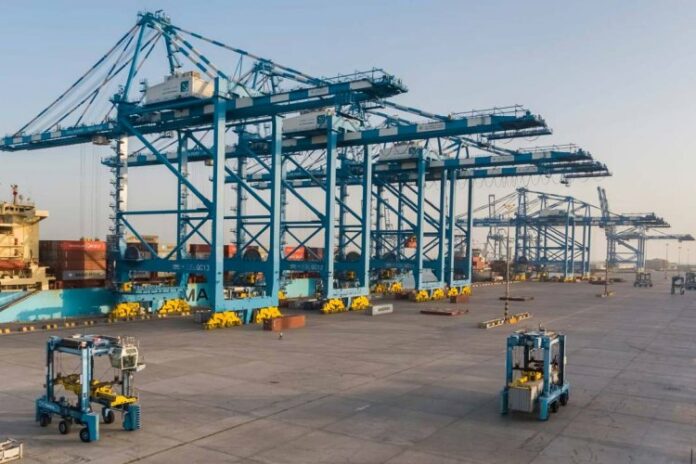
A key focus of the second phase of the development was the construction of a dedicated 315-metre quay wall, which together with several modern onsite facilities, were designed to specifically satisfy the demands of Delma Island’s and Al Dhafra region’s long-standing maritime community. Capable of accommodating up to 60 boats, the expansion project will allow the region’s recreational and commercial vessels to easily transfer and relocate from the old Delma Port to the new port.

Captain Mohamed Juma Al Shamisi, Group CEO, Abu Dhabi Ports, said:

“Projects such as the ongoing development and evolution of the new Delma Port are vital to facilitating the economic growth of Delma Island and Al Dhafra region.

“By ensuring that Delma Port continues to serve the needs of the region’s maritime community and attract interest as an international destination, Abu Dhabi Ports is delivering on our leadership’s vision to establish our emirate as a top global maritime centre, one that is backed by streamlined ultra-modern services, infrastructure, and health, safety and quality standards.”

Saif Al Mazrouei, Head of Ports Cluster – Abu Dhabi Ports, said:

“Thanks for our wise leadership’s guidance, the new Delma Port serves as the focal point of our government’s plans to grow and promote the economic and social development of Al Dhafra region.

“With the conclusion of the second phase of the development at Delma Port, we have not only provided Al Dhafra’s maritime community with access to modern facilities, but have also built it a new home from where it can continue to grow its business and thrive.

“The port will act as a driver for the future recreational and commercial development, and a bridge linking back to the proud traditions and rich history of our people and our nation.”

When phase one of the new port was inaugurated in 2017 as a modern replacement of the old port, it featured a 103-metre-long quay for a ferry terminal that meets the commercial and community requirements of Delma Island, a marina with 160 wet berths and 104 dry berths for fishing and recreational craft, a repair yard, an administration building, a fish market, and the ADNOC marine fuelling station, making it one of the largest multi-purpose ports in Al Dhafra.

The second phase of the development also saw the creation of a new protection breakwater that will shelter the northern half of the harbour which, as part of the project, was dredged to six metres in depth.

Other project highlights included: relocation of Etisalat marine cables surrounding Delma Port; completion of a navigational study; construction of interconnecting roads, pavement and an ISPS (International Ship and Port Facility Security) fence; and, installation of service utilities such as potable water and solar streetlights. In addition, the project included installation of coastal protection for the Delma Ladies Club, at the request of Al Dhafra municipality.

Damen RSD-E Tug 2513 launched at Song Cam Shipyard in Vietnam

0

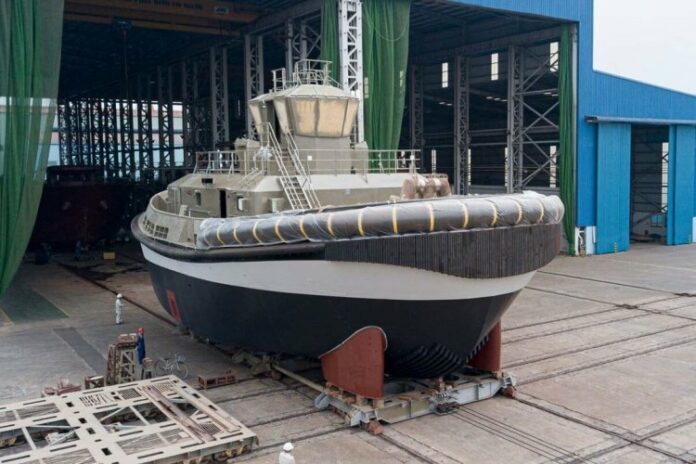
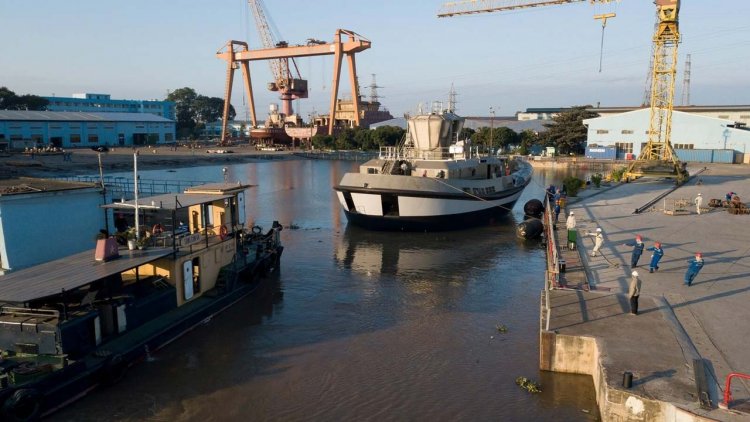
Damen is building the vessel to supports its customer, New Zealand’s Ports of Auckland, in achieving its ambitious sustainability targets.

The RSD-E Tug 2513 takes an already efficient design and optimises it for maximum maritime sustainability. Ports of Auckland has the goal of being a zero emissions organisation by 2040. With this is mind, the organisation approached Damen with the question – was a fully-electric, zero emissions tug a possibility?

Damen, with its own goal to become the world’s most sustainable shipbuilder, was keen to take up the challenge. With Ports of Auckland already operating a Damen ASD Tug 2411, the shipbuilder was able to assess the potential for a fully-electric tug. The idea proved not only to be possible, but economically viable.

Sjoerd de Bruin, Damen sales manager Asia Pacific, said:

“ With 40% of New Zealand’s energy being generated from sustainable sources – including 80% of electricity – Sparky offers the chance to complete the sustainable circle in Ports of Auckland’s tug operation. Since receiving the order for this historic vessel, we have been working towards this moment – the introduction of the first fully-electric tug of this capability to the water. We are looking forward to continuing in our task and completing the vessel in the coming months.”

The next stages of construction will see Damen install the vessel’s innovative hardware. The RSD-E Tug 2513 is scheduled to be delivered to Ports of Auckland end 2021. Following a vote, Ports of Auckland planning to name the vessel Sparky.

The RSD-E Tug 2513 is just one example of Damen’s work towards more maritime sustainability. Recently the shipyards group has delivered a number of fully electric platforms, including its first fully electric Cutter Suction Dredger. Damen has also delivered a number of electric and hybrid ferries to Denmark and Canada.

Recently, Damen signed a contract for the delivery of nine hybrid and fully electric ferries to operate in the area of Rotterdam in the Netherlands. In addition to their fuel efficiency, Damen has designed the ferries to feature sustainable credentials throughout. An example is their interiors, which will use natural and recyclable materials in order to be completely circular.

Damen aims to reach its goal of becoming the most sustainable shipbuilder by ensuring that, not only are its products environmentally clean, but also that the processes by which it makes them are optimally efficient.

Boskalis awarded EUR 75 million worth of infrastructure projects in the Netherlands

0

Boskalis has been awarded two infrastructure projects in the Netherlands with a total contract value of approximately EUR 75 million.

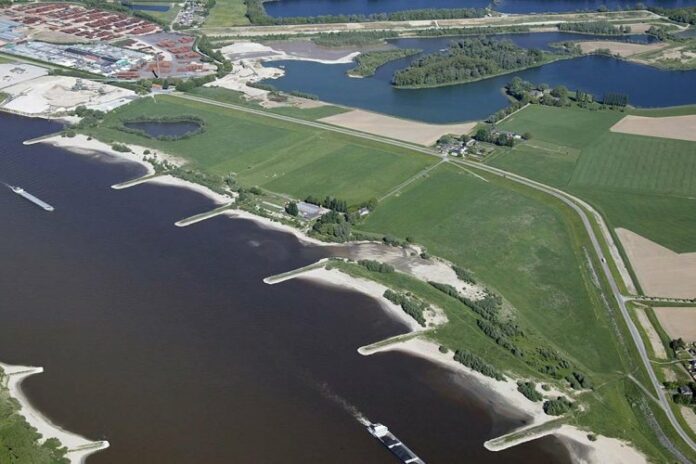
Boskalis will construct a new inland harbor in Spijk in the Netherlands on behalf of Rijkswaterstaat. The harbor is located on the river Waal close to the German border. The harbor is intended for inland vessels and will increase the capacity, safety and accessibility.

For this project approximately three million cubic meters of soil will be moved by means of a small cutter suction dredger and other earthmoving equipment. Work will commence early 2021 with a lead time of approximately 2.5 years. Boskalis expects to reduce its CO2 emissions by more than 50% on this project by using a sustainable biofuel.

Boskalis will furthermore redesign the N241 provincial road in the North of the Netherlands.