-7.8 C
New York
Home Blog Page 707

Wärtsilä launches SmartMove Suite, a unique offering for semi-autonomous sailing

0

This flagship offering for semi-autonomous sailing features the industry’s most advanced sensors and high-accuracy ship control systems, effectively taking the concept of automated dock-to-dock operations to the next level. Fully retrofittable, the SmartMove Suite can soup-up existing vessels with next-generation capabilities to improve safety, efficiency and productivity on the water. The technology enables navigation officers to perform at a higher level.

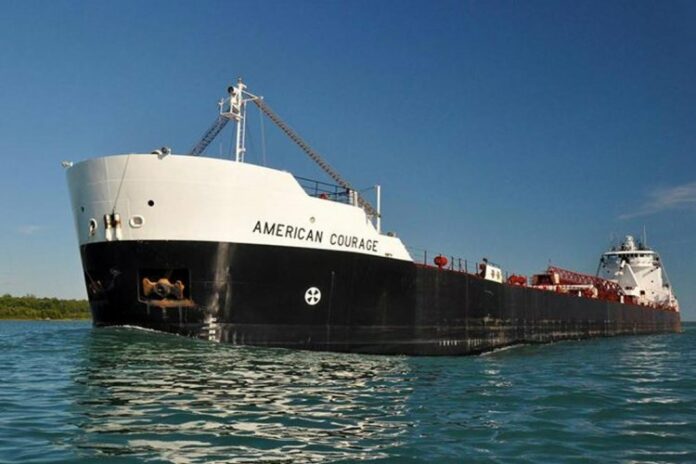
The first order was placed by American Steamship Company (ASC), a subsidiary of Rand-ASC Holdings LLC, and has been installed on the MV American Courage, a 194 metres Great Lakes self-unloading bulk freighter with a cargo carrying capacity of 24,300 gross tonnage. This is the largest ship ever capable of performing automated docking and dock-to-dock sailing operations. The winding, often narrowing Cuyahoga River in Ohio, US, can be heavily congested, making it by far the most challenging of shipping routes for any vessel using automated sailing and docking technology. The Wärtsilä solution has been successfully tested on the American Courage since March 2020.

Pierre Pelletreau VP of Engineering, Rand-ASC Holdings LLC, says:

“American Steamship Company chose to partner with Wärtsilä Voyage based on their ability to bring to bear their diverse subject matter experts into a cohesive team to deliver comprehensive solutions to complex challenges. The complete Voyage Smart technology package addresses the American Courage’s restricted water manoeuvring profile requirements including a position margin of less than two meters and transit under bridges. Wärtsilä adeptly familiarized themselves with our business sensitivities to drive adjustments throughout the project to benefit ASC. One example of this is the versioning of the technology that utilizes the surrounding environment for vessel positioning making it ship-based rather than on shore. The resulting impact was a further reduction of the American Courage’s operating costs.”

John J Marshall, Senior Business Development Manager, Automation & DP; Americas, Wärtsilä Voyage, says:

“Advanced decision support systems, such as Wärtsilä SmartMove, bring value because they can automate the repetitive tasks, such as docking on repeated itineraries, allowing the navigation officers to focus their bandwidth on the parts of the operation. This is not about going captain-free, rather, enhancing the capabilities of onboard crew as they traverse shuttle routes, congested or restricted areas. When vessels must operate twenty-four hours a day, seven days a week, we are pleased to offer an automated dock-to-dock transit solution that ensures every trip is conducted safely.”
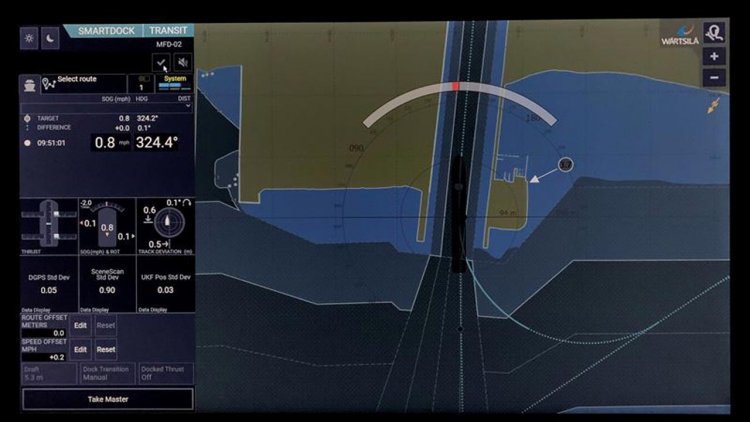
Wärtsilä Voyage provides a standard hardware setup with redundant controllers and displays, along with a sensor suite (comprising gyro, MRU, wind, and GNSS sensors). This is connected to a single digital platform through which five software products are available: SmartDock, SmartTransit, SmartEntry, SmartPredict, and SmartDrive. The core blocks of software (including controllers, sensor processing, Thruster Allocation Logic and track follow) are sourced from Wärtsilä Voyage’s Dynamic Positioning portfolio, which has been in use over many years in some of the world’s harshest environments.

Thomas Pedersen, Director, Automation & Dynamic Positioning, Wärtsilä Voyage, says:

“To understand the challenges and true innovations of these technologies, you have to grasp the complexities of modern vessels with all of the components conducting specific functions independently. We are effectively making each component “smart” so that the ship itself becomes the sum of the parts and is capable of working as efficiently and smartly as possible. Decades of research and maritime data, multiple unrivalled technologies, real-world testing, engineering, and data have gone into this solution, and we’re pleased to be celebrating a new era of smart navigation together with American Steamship Company.”
Great Lakes announces receipt of $60.9 million in awarded work

0

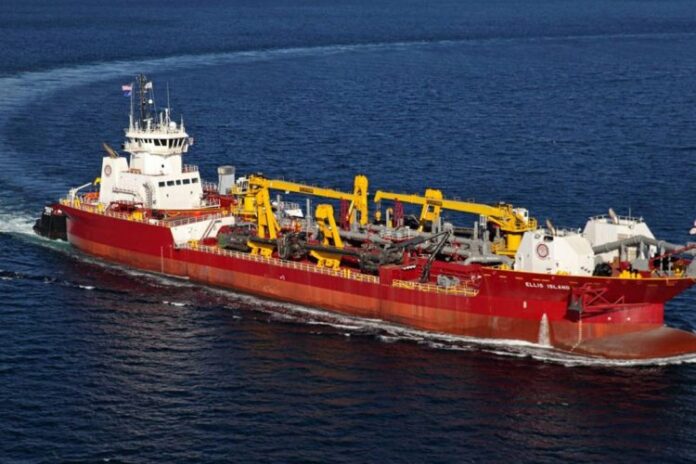
Great Lakes Dredge & Dock Corporation , the largest provider of dredging services in the United States has announced the receipt of several major dredging awards totaling $60.9 million which will be included in the year-end 2020 backlog number.

The awarded work includes:

  • North County Comprehensive Shore Protection Project (Coastal Protection, Florida, $21.2 million)
  • U.S. Naval Station Mayport and Jacksonville Harbor Maintenance Dredging Project (Maintenance, Florida, $21.2 million)
  • U.S. Naval Station Kings Bay Entrance Channel Maintenance Dredging Project (Maintenance, Georgia and Florida, $15.8 million)
  • Brunswick Inner Harbor Maintenance Dredging Subcontract (Maintenance, Georgia, $2.7 million)

The North County Comprehensive Shore Protection Project work entails beach renourishment in Palm Beach County, Florida, for a distance of approximately 2.5 miles. Sand will be dredged from a designated offshore borrow area and placed on Juno beach and Jupiter-Carlin beach to restore the existing coastal system that will provide a habitat for nesting turtles and other animals as well as provide protection from future storms. This project is funded by Palm Beach County. Work is expected to be completed early February 2021.

The U.S. Naval Station Mayport and Jacksonville Harbor Maintenance Dredging Project work consists of maintenance dredging in the U.S. Navy Mayport approach channels and turning basin. This project also covers maintenance dredging of the Jacksonville Harbor federal channel for work performed on Contract A and B. This work and the completion of Contract C, which Great Lakes is currently working on, will allow the port to open at full depth. The client on this projects is the U.S. Army Corps of Engineers, Jacksonville District and is federally funded. Work is expected to commence at the end of the first quarter of 2021 with anticipated completion in the third quarter of 2021.

The U.S. Naval Station Kings Bay Maintenance Dredging Project involves maintenance dredging of the Kings Bay Naval Station entrance channel. Excavated beach compatible material will be pumped for beneficial use onto Fort Clinch Beach and Fernandina Beach. Remaining excavated material will be placed in a designated disposal site. The client on this projects is the U.S. Army Corps of Engineers, Jacksonville District and is federally funded. Work is expected to commence in January of 2021 with anticipated completion in the first quarter of the year.

The Brunswick Inner Harbor Maintenance Dredging Subcontract involves dredging from the Cedar Hammock Range in the Brunswick Entrance Channel. This project supports the maintenance of the channel for ship traffic for the Port of Brunswick in Georgia. Great Lakes is a subcontractor on this project, which is federally funded by the U.S. Army Corps of Engineers Savannah District. Work is expected to be completed in January of 2021.

David Simonelli, Chief Operating Officer, commented:

“Great Lakes is pleased to announce these important coastal protection and maintenance projects. The U.S. Naval Station projects will ensure U.S. Navy surface vessels based in Mayport and submarines from Kings Bay have safe access to the Atlantic Ocean. All of these projects are aligned with our strategy to support the overall improvement and resiliency of our country’s environment, coastlines and infrastructure.”

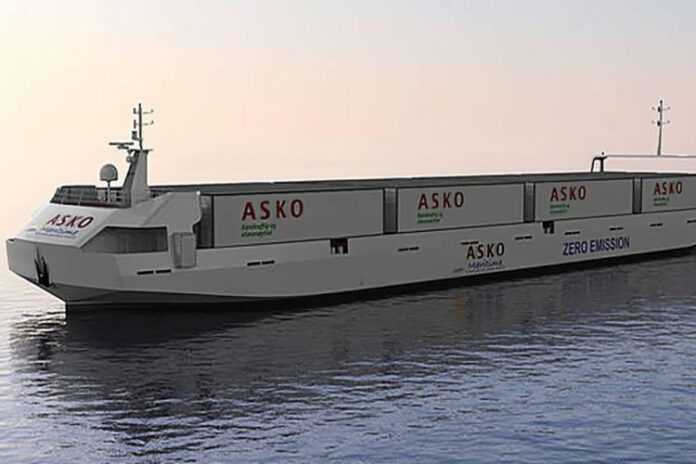
Norway: Two autonomous electric Ro-Ro vessels driven by SCHOTTEL

0

They will be operated by ASKO Maritime AS, Norway’s largest grocery wholesaler, and built at Cochin Shipyard (CSL) in India. Both vessels will have full battery-electric propulsion and are designed for transporting trailers across Oslo Fjord between two of ASKO’s distribution centers.

Kai Just Olsen Director of ASKO Maritime:

“We have a clear ambition to be climate neutral and have set ambitious goals, including being a self-sufficient provider of clean energy and having 100% emission-free transport by 2026. These innovative ships are key to fulfilling that ambition and will form an essential component of a zero-emissions logistics chain linking our facilities. We are very pleased that SCHOTTEL is supporting us in this project.”

The main propulsion system of each vessel consists of one medium-sized SCHOTTEL EcoPeller type SRE 210 (500 kW) driven by an electric motor. This motor will be electrically powered by a battery bank with 1,846 kilowatt-hours capacity.

With its special hydrodynamically optimized design, the SRE generates maximum steering forces, thereby enabling top performance in terms of overall efficiency and course stability. This reduces fuel consumption and ensures lower operating costs and lower emissions.

An electrically powered SCHOTTEL PumpJet type SPJ 57 (200 kW) will be fitted at the bow to act both as thruster and take-home system. The extremely compact SPJ will improve manoeuvrability many times over.

The vessels will be fitted with a bridge forward and initially they will be operated with a crew on board. Once established, the vessels will operate fully autonomously for ASKO with the ability to transport 16 fully loaded standard EU trailers at a time. These will be stowed on the open deck with a loading ramp at the stern.

The operating speed will be 10 knots and it is anticipated that this mode of trailer transport will replace over 2 million road miles per year, in turn saving around 5,000 tonnes of CO2 every year. 

The 67-metre long vessels have been designed by Naval Dynamics in Norway. They will be built under DNV GL Classification and flagged in Norway. The contract includes options for two further vessels.

Both vessels are scheduled to enter operation in January 2022.

Lloyd’s List survey: Regulation is key to shipping’s green push

0

The first shipping decarbonisation survey, a collaboration between Lloyd’s List and Lloyd’s Register, asks owners and non-owners how they see decarbonisation working out, who will drive it, what impact it will have and where they stand today.

Regulatory action is now one of the most important factors for shipping’s decarbonisation prospects, according to the first ever Lloyd’s List shipping decarbonisation survey.

More than a quarter of the owners, operators and managers that responded to the survey identified decarbonisation as the greatest challenge to the shipping industry, followed by the impact of the ongoing coronavirus backdrop.

Conducted between mid-October and mid-December 2020, the survey amassed insights from shipping companies, charterers, investors, government representatives, non-governmental organisations and other stakeholders.

The pivotal role of policymakers and regulators in materialising shipping’s decarbonisation ambitions has been apparent for some while, but the findings of the survey illuminate just how significant it has become.

Respondents across the board saw the “lack of clear, detailed regulations” as the single greatest potential barrier to decarbonisation, while the possible lack of proven viable decarbonisation solutions was also among the biggest impediments.

Fleet owners identified the International Maritime Organization and regional regulators as the two biggest pressure drivers for the decarbonisation of their operations. Investors were the third largest pressure force.

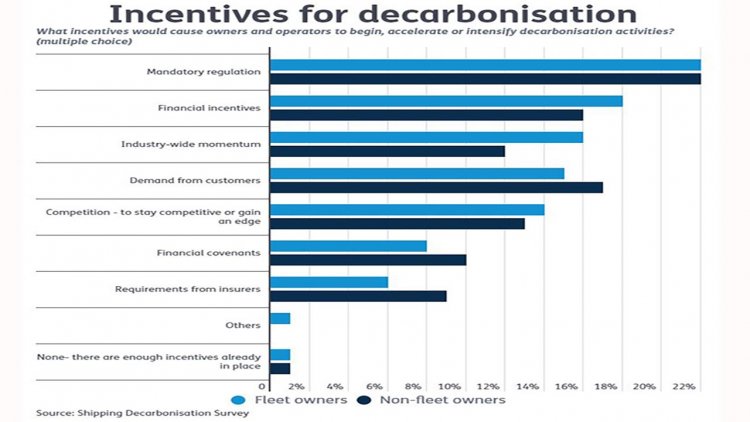
Along the same lines, both fleet owners and non-owners see mandatory regulations as the single biggest motivating factor for future action on decarbonisation, with financial incentives following as a close second.

The position reflects the cornerstone of decarbonisation success, which is that regulatory certainty will help boost investment in the development and adoption of cleaner technologies.

The survey’s results come ahead of a defining year in decarbonisation regulation and climate politics for shipping that could see regional policies outpace progress made on the international level.

In about six months’ time, the European Commission will unveil its plan for adding maritime to the Emissions Trading System, the EU’s carbon trading market. Though subject to political negotiations, it should result in a new market-based measure regional measure for shipping, a prospect widely loathed by the industry that wants global action taken through the IMO.

This year, the IMO is also set to finalise short-term operational and technical efficiency requirements that will also affect the existing fleet, where regulations thus far have focused on newbuildings.

These IMO measures are the early implementation of the its overarching commitments to slash shipping’s total annual greenhouse gas emissions by at least 50% by 2050 compared with 2008, while reducing the fleet’s carbon intensity by at least 40% by 2030 and aim for 70% by 2050.

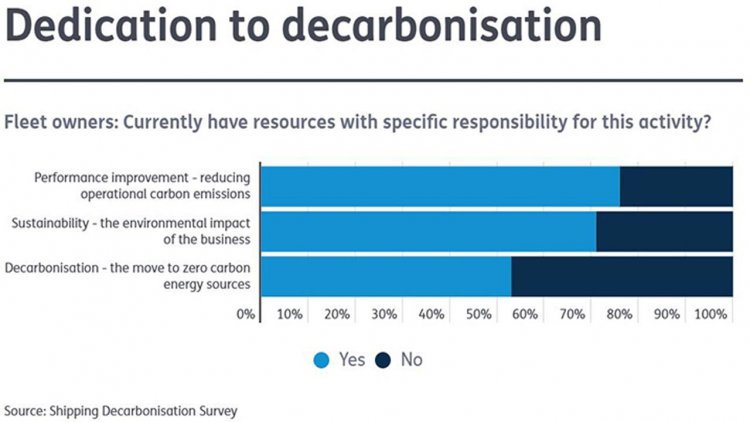
Nascent action and ambition are already affecting business decisions. While 23% of the fleet owner respondents said the industry’s decarbonisation ambitions have had no impact on their fleet investment plan, the remaining 77% said they have had to take relevant action, ranging from changes to their existing fleet to order delays and cancellations.

Owners said they are currently relying mostly on fuel optimisation technologies, coatings and slow steaming to improve their ships’ energy efficiency.

The fleet’s fuel composition will change drastically over the next 10 to 30 years. Some 20% of fleet owners believe their ships will be running on liquefied natural gas and as many anticipate they will use current marine fuels combined with carbon offsetting in 2030.

But those rates dwindle down to 5% for LNG and 7% for the carbon offsetting combination in 2050.

Meanwhile, the share of those owners expecting to be running ships on hydrogen and ammonia grew from 8% and 7% respectively in 2030 to 19% and 20% in 2050.

Source: Lloyd’s List.

Klaveness Combination Carriers ASA takes delivery of the sixth CLEANBU vessel

0

On January 11, Klaveness Combination Carriers ASA (“KCC”) took delivery of the MV Baiacu from New Yangzi Shipyard in China. 

The MV Baiacu is the sixth of in total eight contracted CLEANBU combination carriers.

The CLEANBUs are unique vessels both in terms of design, their unprecedented environmental performance, operational and technical efficiency. These vessels have up to 40% lower CO2 emissions per ton mile transported cargo compared to standard vessels, in line with IMO’s 2030 targets for shipping.

The start of trading of MV Baiacu will be delayed due to COVID-19 travel restrictions and quarantine regulations impacting the mobilization of crew. She is scheduled to load her first cargo of clean petroleum products in mid-February.

With the delivery of the MV Baiacu, Klaveness Combination Carriers will operate a fleet of 15 combination carriers.

Neptune Energy awards $6.5M contracts for Cygnus gas facility

0

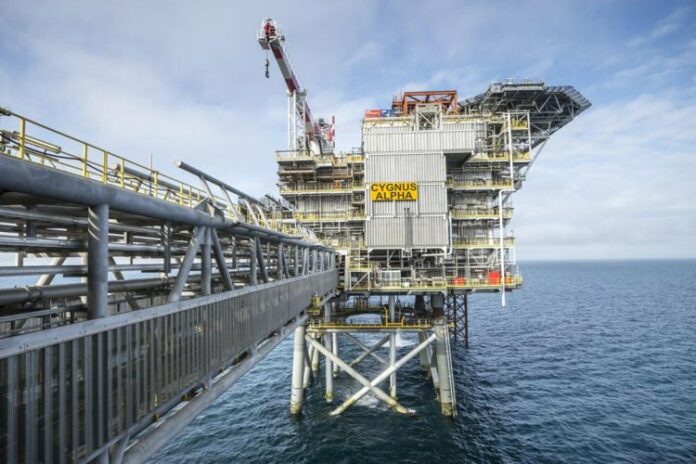
Neptune Energy has announced the award of integrity management and fabric maintenance contracts for its operated gas production platform, Cygnus, to Oceaneering and Stork, to the value of approximately $6.5 million. 

Oceaneering will supply integrity management services covering pressure systems, structural, pipeline, erosion management and offshore inspection services. Oceaneering will work closely with Stork which will deliver fabric maintenance and scaffolding services for Cygnus, located in the UK Southern North Sea.

The contracts have been awarded under a three-year agreement, with two one-year options to extend. 

Neptune Energy’s UK Managing Director, Alexandra Thomas, said:

“2020 was an exceptionally challenging year for our industry, given the impacts of the COVID-19 pandemic and lower commodity prices, and those within the North Sea’s world-class supply chain have been among those hardest hit.

We are pleased to be awarding these contracts to Oceaneering and Stork which demonstrates our commitment to supporting service partners and to maximising efficiency. Combining the scopes of work for our Cygnus production facility within a broader agreement creates additional synergies and reduces complexity.”

Cygnus is a crucial component of the UK North Sea energy infrastructure, capable of producing approximately 6% of UK domestic gas demand.

Oceaneering’s Director of Integrity Management and Digital Solutions (IMDS) – Europe, Crawford Tennant, said:

“Oceaneering is delighted to win this integrity management services contract from Neptune, expanding our existing scope of work. We look forward to working with the Cygnus team to deliver the high-quality integrity services and technologies necessary for Neptune to achieve their asset reliability and efficiency goals.”

Stork’s Regional Director in the UK, Steve Hunt, said:

“We are delighted to have secured this key Industrial Services contract with Neptune Energy and look forward to further growing our relationship and working closely with our valued client and partner. We are committed to supporting Neptune and confident we will continue to deliver the highest quality and standards of work, whilst maximising on efficiencies in support of daily operations.

It has been a challenging year for the industry and our global communities; to be awarded this contract demonstrates our place in the supply chain, as well as a true reflection of Stork’s dedication to being a trusted service partner to Neptune.” 

Pondera and Rebel choose for GE wind turbines in Eemshaven

0

The construction of Strekdammen Windpark is getting closer.

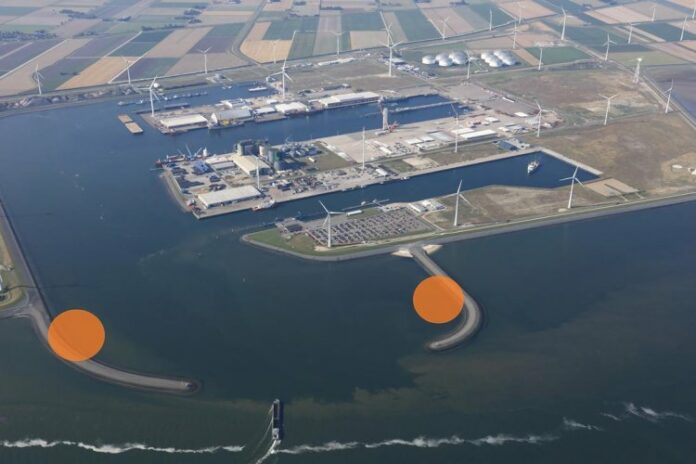
At the end of 2020 Pondera and Rebel completed the financing of the wind farm with ABN AMRO. This means that the contractors VolkerWind (KWS Infra bv Leek / van Hattem en Blankevoort) and Alsema from Zuidlaren, will soon be able to start building the two wind turbines that will mark the entry into Eemshaven in the future.

Pondera and Rebel are planning to build two wind turbines in the mouth of the harbour with a total capacity of 11 MW. GE will supply these turbines which have been specially made for these saline conditions. The turbines are expected to be commissioned by mid-2022. Earlier this year, Pondera and Rebel took over the rights to the wind farm from Yard Energy.

Pondera was able to use the experience we gained in the realisation of the GE Haliade-X, the world’s largest offshore wind turbine, the prototype of which is in the port of Rotterdam. ABN-AMRO is providing the financing for this sustainable energy project.

Sterling PlanB, MJR announce cross-Atlantic sales and service partnership

0

Industrial energy storage experts, Sterling PlanB (SPBES), and technical sales and service company MJR Power & Automation have announced a new partnership agreement, aimed at expanding access to purpose-designed energy storage solutions to UK-based customers in marine markets. Together, they increase access to hybrid and fully electric propulsion and power solutions throughout the sector.

The partnership comes when increasing pressure from the International Maritime Organisation (IMO) to achieve regulations targets means that many marine companies are rapidly adjusting their operations to reduce tier 1, 2, and 3 emissions. The recent push to establish greater, more sustainable offshore sector services in the UK, and growing offshore wind means that many offshore vessel operators are looking to low carbon energy storage solutions.

Under the new partnership, MJR Power & Automation will provide customers in the UK with Sterling PlanB energy storage solutions for offshore and short sea vessels, supporting the drive not only for fuel- and cost-saving operations, but a more sustainable long-term solution to meet emissions reduction targets.

Paul Hughes, President of Sterling PlanB, said:

“We are delighted to have formed this sales and service partnership with Paul and his team at MJR Power & Automation. There is no better partner in the UK to distribute, integrate and service Sterling PlanB energy storage solutions. Their broad multi-market reach coupled with their in-depth experience with delivery of marine power conversion packages, an exceptional reputation for customer service and a long list of satisfied customers makes MJR Power & Automation an ideal partner to develop this most important market.”

Sterling PlanB’s energy storage systems are engineered to the highest standards of performance and safety, and are designed specifically to integrate with any electrical infrastructure, delivering significant operational and efficiency benefits for vessels running on electric or hybrid power. The system is the only lithium energy storage system third-party verified to fully prevent thermal runaway.

Paul Cairns, Managing Director of MJR Power & Automation, said:

“This partnership provides a unique avenue for MJR to grow its business in clean technology with world-class energy storage products and the exemplary service that we are already known for. We are proud to add the Sterling PlanB product line to our portfolio.”

UK-Omani ship repair Joint Venture completes HMS Montrose support period in Oman

0

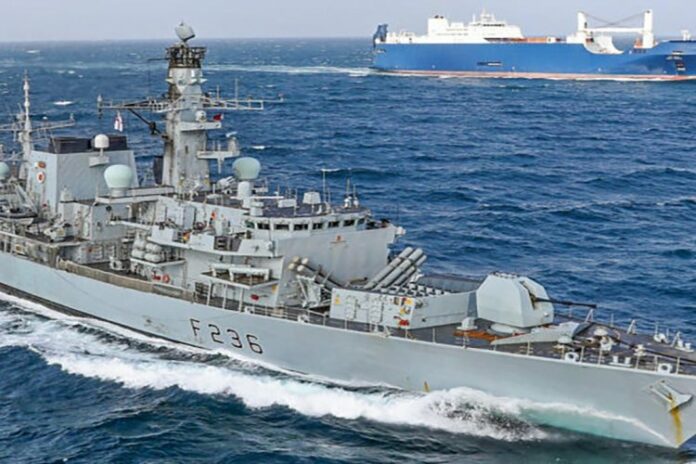
Duqm Naval Dockyard (DND), the Joint Venture between Babcock International and the Oman Drydock Company (ODC), has successfully completed a four week fleet time support programme (FTSP) for the UK Royal Navy frigate HMS Montrose.

The maintenance period enabled the DND team to complete essential repairs and performance improvements, ensuring an on time on cost turnaround of HMS Montrose back to operational duties in the Gulf and Indian Ocean. 

This contract underpins Babcock’s response to the Royal Navy’s commitment to forward-deployed Task Groups. Putting greater emphasis on global partnerships and digitally enabled support solutions, Babcock’s investment with ODC to develop the DND for international navies ensures it is well placed to provide sustainable support to customers. Its regional capability in the Gulf is a key component and the success of the FTSP at Duqm demonstrates Babcock’s global support to customers.

The programme incorporated repair and maintenance activities throughout the ship, with more than 250 critical elements in the scope. Extensive surveys determined a schedule of ship-wide pressure testing and maintenance, including air weapons handling systems, fire systems and ventilation. Activities extended to the hangar, flight deck and bridge, as well as throughout living quarter areas. All had to be undertaken under strict COVID regulations applying at the dockyard.

Alastair Stangroom, Managing Director for Babcock Oman, said:

“DND’s presence in the Middle East positions us well to support critical missions and assets, enabling us to service our customers’ need for fast, effective turnarounds with global reach-back to our extensive network of expertise. Despite the obvious constraints of strict COVID restrictions, the Joint Venture team delivered HMS Montrose back to sea on time, ensuring maximum benefit in terms of cost and quality.”

Strategically located outside the Gulf of Arabia, DND offers customers a competitive, comprehensive facility with a full suite of modern waterside infrastructure. Its 2,800 metres of quayside, complete with new-build workshops and specialist-manufacturing facilities, operate alongside two 480m graving docks capable of supporting Ultra Large Crude Carriers and large Warships, allowing the most complex of programmes to be efficiently delivered.

Established as an Omani company in 2017, DND combines the ship repair skills and dockyard infrastructure of ODC with the naval design, engineering and programming expertise of Babcock, firmly putting our customers’ requirements at the heart of our operations.

Crystal Endeavor on track todebut in Summer 2021

0

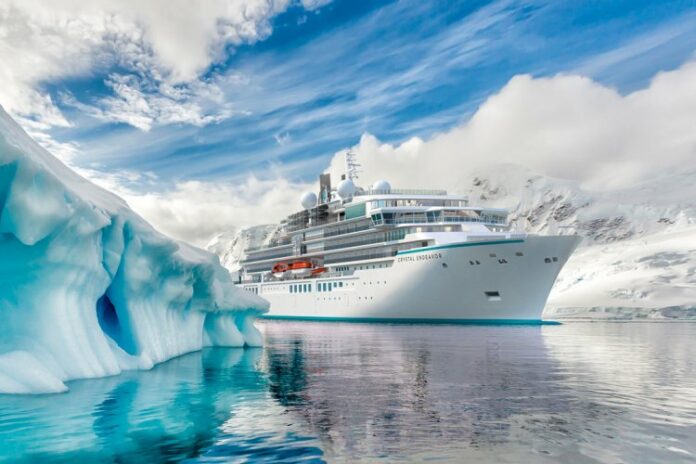
Crystal Endeavor, the German-built, PC6-designated vessel for Crystal Expedition Cruises is on track to debut in Summer 2021. 

Originally set to launch in August of 2020, the ship’s construction was delayed as the global health crisis forced a shutdown of MV WERFTEN where Crystal Endeavor is currently under construction. The shipyard has reopened fully this year and Crystal is pleased with the resumption of work on the vessel.

Jack Anderson, Crystal’s interim president and CEO, said:

“While we are certainly disappointed that Crystal Endeavor’s delivery has been delayed, we are encouraged by the progress and dedication of the professionals at MV WERFTEN and are looking forward to introducing this remarkable ship. As the most spacious and luxurious ship in the expedition market, Crystal Endeavor will offer new ways for luxury travelers to explore the world while also delivering on what Crystal does best – a design that anticipates the needs and comforts of our guests; generous public spaces and elegant suites; immersive and enriching destination experiences; world-class cuisine and, of course, warm and attentive service from the best crew in the world.”

Crystal has cancelled Crystal Endeavor voyages through May 1, 2021 and is currently reviewing the ship’s published summer itineraries. However, some of the exciting upcoming destinations planned for Crystal Endeavor include the Norwegian Fjords and Scottish Isles, France, Spain and Portugal, the Atlantic Isles and Western Africa, Brazil and Argentina, and Antarctica.

Genting Hong Kong (GHK), Crystal’s parent company, recently completed a 193-million-euro loan agreement with the German government for the completion of Crystal Endeavor and to support the operations of the shipyard through March 2021.

In December 2020, GHK announced the termination of the sale and leaseback deal of Crystal Endeavor with the aim to simplify the structure for typical export credit agency (ECA) covering postdelivery financing for the ship. This does not have any impact on the ship’s planned operations.

Crystal Endeavor will navigate some of the world’s most remote areas, where wildlife far out-measures human life and rugged landscapes punctuate the waterline. The ship will offer three dedicated categories of exploration: Remote Expedition, visiting some of the most far-flung destinations and uninhabited locales; Cultural Discovery, distinguished by an emphasis on the region and its people; and Destination Exploration, highlighting the natural wonders and beauty of the destinations.

The 20,000-GRT PC-6 expedition ship will accommodate just 200 guests with elegantly casual, generous public spaces designed to showcase the outside scenery; all-suite, all-verandah, butlerserviced guest rooms; Michelin-inspired dining options with six dining venues including Master Chef Nobu Matsuhisa’s Umi Uma & Sushi Bar; full-service Crystal Life Salon & Spa and a state-of-the-art Fitness Center. Expedition-specific amenities and spaces will enhance guests’ experience, including enrichment areas, designated mud rooms, a helicopter lounge and a seven-person submersible will also be on board, allowing for deep-water explorations up to 980 feet in several areas of the world.