-8.2 C
New York
Home Blog Page 685

Globe Tracker Sense Vessel enhancements benefit crew members

0

Globe Tracker Sense Vessel now includes a bay load plan viewer to manage GT Sense enabled containers at sea and mobile handsets to receive container alarms, acknowledge alarms and notifications by text message.

Globe Tracker’s Sense Vessel solution developed together with maritime IoT, Wi-Fi and cellular services leader Wireless Maritime Services (WMS), and LTE core network software provider Druid, have announced an expanded feature set for easy-to-use vessel mobile services empowering seafarers to provide superior and safer container management at sea.

The GT Sense Vessel solution consists of an onboard private 4G LTE cellular network which can wirelessly communicate with Globe Tracker IoT enabled reefer containers on any size vessel, with the ability to monitor containers locally and transmit information over satellite to land based central control centers. These features enable crew members to respond in real-time to container incidents on vessels.  

Don Miller, Chief Sales and Marketing Officer for Globe Tracker, said:

“The manual monitoring of reefer containers at sea is a complex and often inefficient process, and crew safety is always of paramount importance – especially during rough seas.  Onboard wireless IoT networks are simpler, more efficient, reduce potential damage or loss of cargo loads, and provide additional safety to crew members.”

Globe Tracker Sense Vessel is enhanced with an onboard bay load plan viewer to manage containers from a single console on the bridge. This feature eliminates, or removes, the need for manual inspection. Crew members are also equipped with mobile devices to allow the receipt and management of alarms and notifications from anywhere on the ship – including cargo holds and crew areas. 
Michael Abdul, Vice President of Global Sales for WMS, notes:

“During the global pandemic, seafarers are especially burdened with government COVID-19 restrictions extending their times at sea which impede crew changes and limit access to ports for respite.  Seafarers are the heart of the maritime shipping industry.  They work tirelessly moving ninety percent of global trade so that the world can live, work, and play. The global pandemic has underscored the importance of maritime trade for necessities including perishable food and medicine.” 

Tadhg Kenny, Senior Vice President of Marketing & PR at Druid Software, added:

“When you put a full featured cellular network on a vessel, the system is not only capable for use in container management, but also creates the core IoT infrastructure for a myriad of other smart vessel applications in the future.  We are proud to be part of this best-in-class industrial solution.”

The GT Sense Vessel solution is commercially deployed and operational on fleets for multiple ocean lines, and is fully compliant with recent IoT standards for vessel networks. 
DNV GL awards project certificate to Vattenfall’s Horns Rev 3 offshore wind farm

0

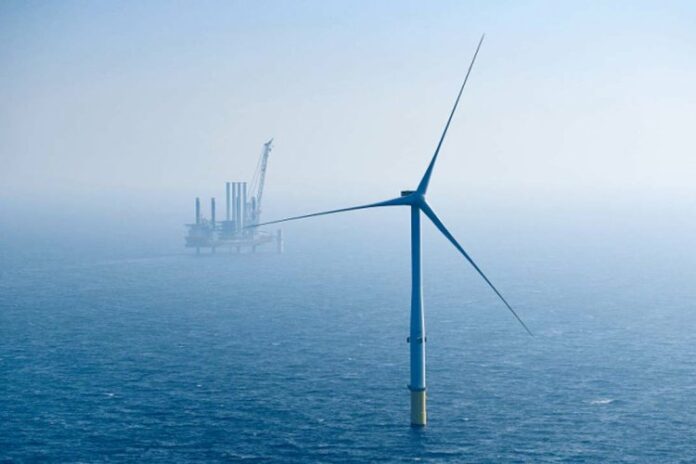
DNV GL, the world’s largest resource of independent energy experts and certification body, has officially issued the project certificate to Vattenfall for its Horns Rev 3 offshore wind farm. The certificate proves a safe and cost-efficient operation of the largest offshore wind farm in Denmark.

The 412 MW Horns Rev 3 offshore wind farm is the third phase of offshore wind development at the Horns Rev site, 20-30 kilometres off the Danish Jutland coast. With its forty-nine 8.3 MW MHI Vestas Offshore Wind V164 turbines, it is capable of powering around 425,000 Danish households and will provide some of the cheapest offshore wind electricity in Europe.

Kim Sandgaard-Mørk, Executive Vice President for Renewables Certification at DNV GL, says:

“As the largest offshore wind farm in Denmark and one of the most cost-efficient generators of offshore wind power in Europe, Horns Rev 3 highlights Vattenfall’s commitment to enable a fossil-free world. DNV GL is proud to have supported them in delivering this remarkable achievement, thanks to a close working relationship with Vattenfall and its suppliers including the wind turbine manufacturer.”

Fabio Pollicino, Director for Project Certification at DNV GL, adds:

“Project certification is a requirement for Danish offshore wind farms and provides Vattenfall and their stakeholders with confidence as during the certification process relevant standards for the development and execution of the project are applied and risks are mitigated.”

Belén Fernández Montes, Certification Engineer at Vattenfall, says:

“With an annual capacity of 1,700 GWh per year, Horns Rev 3 is a significant contribution to our vision for fossil free living within a generation. We are very pleased that we have now been awarded this certificate for Horns Rev 3 confirming that the wind farm is fit to perform for 25 years. We have had a good collaboration with DNV GL, where the evaluation included assessment on the maturity of the turbine design, its manufacturing, installation and commissioning processes as well as assessment of related documentation.”

Project certification is a process of technical evaluation of various components individually and the project as a whole. The independent certification provides reliable proof that a project has taken measures to ensure quality, stable operation and proper risk management, thereby maximizing the chances of a successful project outcome.

The certification of the Horns Rev 3 project was carried out according to the Danish Executive Order No. 73 (BEK 73) and covered the wind turbines including their support structure plus all the cabling connecting the wind turbines to the offshore substation. Inspections were carried out over a three-year period and included surveillance of manufacturing, transportation and installation of the various components and witnessing the commissioning of the complete wind farm.

ONE conducts successful trial use of sustainable biofuel for decarbonization

0

The trial was completed on 7th February 2021, following bunkering at the port of Rotterdam, Netherlands in November 2020 and was performed in collaboration with shipowner Mitsui O.S.K. Lines and leading sustainable biofuel pioneer GoodFuels. 

During this first trial, the sustainable biofuel was blended with conventional fossil fuels enabling the M/V MOL Experience to make its Atlantic crossings between Europe and the USA. The success of the trial proves the viability of sustainable biofuels which will help ONE to meet its carbon reduction targets in 2030 and 2050 respectively.

Biofuel is a fuel that is derived from renewable sources. The advanced biofuel used in the trial is made from waste oils such as used cooking oil. Biofuels are considered to be carbon-neutral because the carbon dioxide that is absorbed by the source of the biomass is equal to the carbon dioxide released when the fuel is burned. It has gained attention around the world as an environmentally-friendly alternative to fossil fuels.

GoodFuels’ sustainable biofuels are virtually free of sulphur oxides and deliver 80-90% “well-toexhaust” C02reduction versus fossil fuel equivalents. They are functionally equivalent to petroleumderived marine fuels, and no modification is required to the engine or the fuel infrastructure.

GoodFuels only works with renewable feedstocks that cannot be used for any higher quality application or recycling and are therefore regarded as truly sustainable.

The biofuel trial marks a positive step forward for ONE’s sustainability initiatives, which includes four areas of priority: Environment; Social; Governance; and Operational Excellence. The use of biofuels will help address our environmental sustainability targets, which aims to reduce carbon dioxide emissions (in gram/teu-km) by 25% from our 2018 baseline by 2030, and by 50% by 2050.

Takeshi Mishima, General Manager of Fleet Management, ONE, said:

“The cooperation and coordination between GoodFuels and ONE was excellent and the successful completion of the trial has confirmed that for ONE, biofuel is one of the solutions to reduce Green House Gases. We at ONE, shall continue to invest in a cleaner, greener future.”

Michihiko Nakano, General Manager of Bunker Business Division, MOL, said:

“MOL Group is committed to protecting the health of our marine / global environmental as its social mission. MOL Group Environmental Vision 2.0 declares that we shall achieve sustainable net zero GHG emissions by the entire MOL Group.

In order to accomplish the vision, we are pursuing possibilities of various alternative marine fuel options. The success of this trial led to the verification of the availability of various leading alternative marine fuels and it is in line with the MOL Group’s stance of continuously monitoring technological development trends. As a major shareholder of ONE, we welcome this success.”

Isabel Welten, Chief Commercial Officer, GoodFuels, said:

“We believe passionately in the requirement for shipping to decarbonize, and sustainable, advanced biofuels have a central and immediate role to play in reducing emissions and our sector’s impact on the world. This partnership with ONE continues to build momentum behind a cleaner shipping sector, and shows what can be achieved when organizations collaborate to accelerate the adoption of alternative fuel solutions.”

Kongsberg wins contract to deliver deck machinery for Novatek ice class LNGC

0

Kongsberg Maritime has announced a significant and strategic new equipment contract with Russian LNG producer Novatek. 

Under the terms of the deal, KM will supply a range of electric frequency converter-driven deck machinery for six Ice Class LNG carriers, with an option for a further four, chartered by Novatek LNGC and destined for operation in the waters of northwest Siberia.

The vessels are to be built by Korean shipyard Daewoo Shipbuilding & Marine Engineering (DSME) and will each be equipped with two combined windlasses and mooring winches capable of handling a 17-tonne anchor with 111mm anchor chain, plus a further seven mooring winches. Designed to operate under extreme ambient temperatures as low as -52°C, the windlasses and mooring winches will also feature a specially-developed modification in the form of an electrically-operated, spring-loaded band brake, as requested by Novatek.

Espen Liset, Kongsberg Maritime SVP Deck Machinery Motion Control, said:

“These Ice Class Arc7 are made to navigate winter/spring ice thickness of up to 1.8m. Our customised deck machinery system is designed for ease of installation and reliable operation in such harsh environments. Selecting our stainless-steel brake drum surfaces allows consistent smooth operation.”

Kongsberg Maritime will also supply control systems and load monitoring for the winches, with further integration to KONGSBERG automation systems available as an option.

Leo Pantazopoulos SVP Sales & Regional Operations, APAC, Kongsberg Maritime, says:

“This contract represents an important endorsement of our advanced technologies as well as signposting our future growth. Working with Novatek will sharpen our competitive edge in the fast-growing, Russian-owned Arctic market, reinforcing our reputation as a reliable supplier with a provably efficient support infrastructure. I would like to thank our teams for working so well collaboratively, and with such a dedicated sense of purpose, to bring this contract agreement to fruition.”

GEODIS charters tonnage to alleviate container capacity shortage on Asia-Europe trade

0

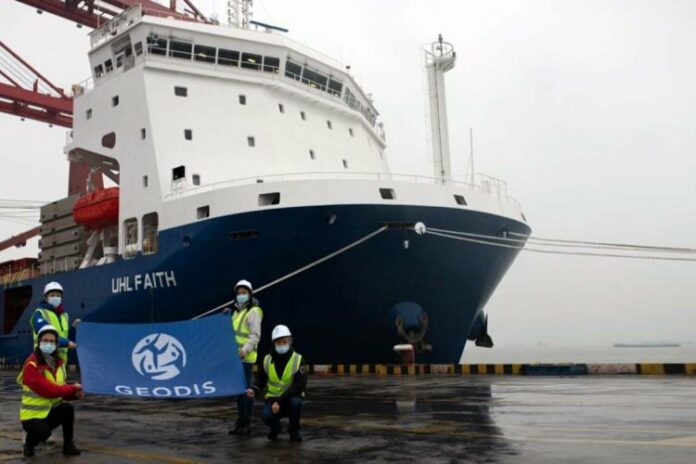
This ship is carrying a total of 435 forty-foot containers for customers who have found it increasingly difficult to secure space with regular carriers at a viable rate. The next vessel sailing is scheduled to leave Shanghai around 10 February.

Depending on demand, GEODIS will plan additional sailings over the coming weeks.

Matthias Hansen is Senior Vice President Global Ocean Freight for GEODIS:

“We understand the current market challenges resulting from unprecedented customer demand and the limitations of ocean carrier capacity and sailings from China and other parts of Asia. We are working hard to find solutions for our customers. Hence, this exclusive vessel charter to supplement fixed long-term agreements we have with core carriers. We strive to deliver certainty to our customers amid the unstable market.”

Onno Boots, GEODIS’ Regional President and CEO for Asia Pacific, comments:

“These market forces have created variable and unforeseen spikes in demand for Asian goods. Our primary aim is to offer multi-modal solutions to our existing customers to enable them to ship on time and in a reasonably economic manner. As an adaptable and innovative service provider, GEODIS is permanently looking for alternatives including rail, ocean and air products that fulfil this aim for shippers on the increasingly volatile Far East West Bound (FEWB) trade lane.”

KVH partners with TechBinder for KVH Watch Maritime IoT Solution

0

KVH Industries has announced that IoT platform provider TechBinder has joined the KVH Watch® Solution Partner program and will offer the KVH Watch service as part of its suite of digital tools and services. 

These tools include Smart Vessel Optimizer, a platform that uses vessel data to optimize fleet performance by benchmarking ship performance, predicting and optimizing asset availability, performing emission reporting, and managing multiple facets of operational efficiency.

Bram van den Boom, managing partner of TechBinder, says:

“Smart Vessel Optimizer’s plug-and-play architecture for data analytics can be easily integrated with KVH Watch connectivity and we expect our customers will greatly benefit from our partnership with KVH. Today, customers increasingly want a real-time visual of their vessels’ key performance indicators, so they need satellite communications as vessels are not within LTE reach all the time.”

Sven Brooks, senior director of IoT business development for KVH, says:

“With solutions such as Smart Vessel Optimizer, TechBinder is devoted to helping maritime companies optimize their operations and we are pleased to be able to provide the connectivity that enables real-time data flow and insights. KVH Watch will enable TechBinder’s customers to engage in remote expert interventions, allowing technical troubleshooting and maintenance work to be carried out at deep sea.”

Vessels and fleets benefit from real-time insights when they are able to use deep sea sailing time to troubleshoot problems, but these insights and interventions are not possible without satellite connectivity. Unlocking already available data sources on a vessel can translate to information that helps maritime companies optimize their operations. By leveraging advanced satellite technology, maritime IoT and service companies can utilize real-time data feeds from vessels and help operators make improvements on every vessel in the fleet.

KVH Watch is an IoT Connectivity as a Service solution that provides Flow, secure 24/7/365 machine-to-cloud satellite connectivity for remote monitoring of onboard equipment plus the ability to perform on-demand Remote Expert Interventions using video, voice, or text via KVH’s global HTS network. KVH Watch is designed for maritime equipment manufacturers, multicard service providers, and shipyards seeking affordable monthly subscription-based connectivity that L-band and cellular services cannot deliver at deep sea.

Low carbon transport at sea: ferries voyage optimization in the Adriatic

0

Energy efficiency or carbon intensity is a possible point of convergence between the International Maritime Organization (IMO) and EU regulations to cut GHG emissions and decarbonize shipping. Short term measures to increase energy efficiency and achieve carbon intensity savings include voyage optimization.

A new study led by the CMCC Foundation, realized in the framework of the Interreg Italy-Croatia GUTTA project and recently published in the Journal of Marine Science and Engineering, explores the potential of carbon intensity reduction through voyage optimization in short sea shipping.

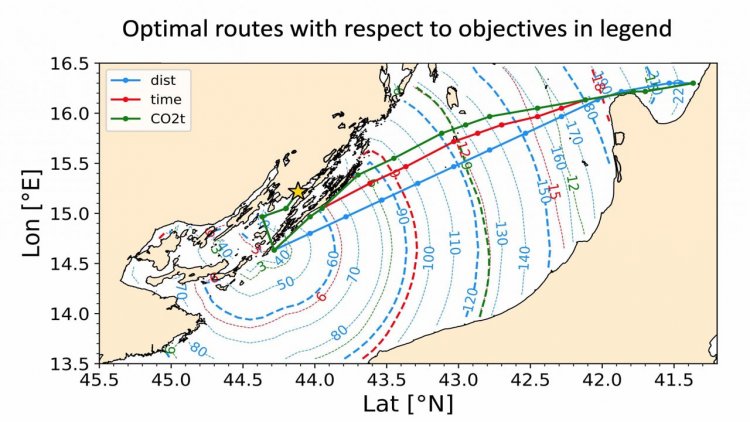
To this purpose, the VISIR (discoVerIng Safe and effIcient Routes) ship routing model was upgraded to a “VISIR-2” version, for computing least-CO2 routes for a ferry in presence of waves and currents.

Gianandrea Mannarini, senior scientist at the CMCC Foundation and Lead author of the study, explains:

“VISIR can compute optimal routes by suggesting a spatial diversion which leads to avoidance of rough sea and related ship speed loss. Besides least-distance and least-time routes, we added in the latest VISIR version a capacity to compute routes of least-CO2 emissions. Moreover, a more accurate vessel model was introduced in VISIR-2 making use of a coupled bridge-engine room simulator hosted by the GUTTA project partner University of Zadar, from which the performance and emissions of a ferry were estimated at various sea conditions.”

The Adriatic Sea, which is routinely crossed by several ferry lanes joining ports in Italy with ports in Croatia, Montenegro, and Albania, was an interesting candidate domain for testing the role of route optimization on short sea shipping. It is relatively small and characterized by not too rough seas. Therefore, if optimization works there, it is scalable to bigger and stormier basins of the world ocean.

On top of that, ferries are quite relevant for emissions, as they account for about 10% of the CO2 emissions in the EEA, despite they represent just 3% of the fleet due to report it (more information here). At International level, there currently is a vivid regulatory activity for curbing ship emissions, and operational measures such a voyage optimization, are considered in the short term.

Therefore, CMCC researchers tried to assess whether path optimization can play a role even for ferries in the Adriatic, what CO2 savings are potentially attainable, and how much ferries’ carbon intensity can be decreased. In order to highlight the role of waves and sea currents in the optimization, CMEMS (Copernicus – Marine Environment Monitoring Service) ocean analysis products related to waves and sea currents were used.

Mannarini comments:

“Our results support the thesis that voyage optimization could be a viable operational measure for short-sea shipping to meet short-term targets for both absolute emission and carbon intensity reduction. For a case study, we found out carbon intensity savings up to 11%, and this is an encouraging outcome towards both IMO and EU curbing targets. We now aim to produce more statistically significant estimations through a web tool we are going to develop in the frame of the Italy-Croatia Interreg project GUTTA.”

Launch of two Incat Crowther 40s for Zhuhai Fast Ferry Company

0

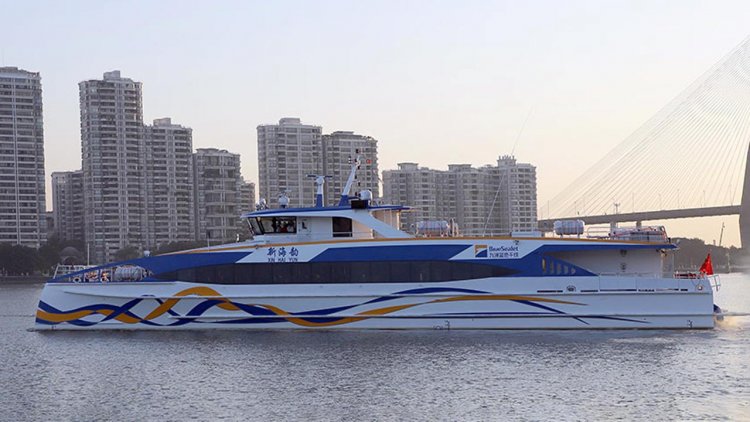
Xin Hai Yun and Xin Hai Jun were built by AFAI Southern Shipyard and delivered in December 2020. They represent the next generation of sleek, fast, low fuel consumption ferries operating in the Pearl River Delta region.

AFAI Southern Shipyard’s winning bid for the project was underpinned by the partnership’s ability to deliver a high speed, low fuel consumption vessel which offers a step-change in passenger experience. 

Xin Hai Yun and Xin Hai Jun each accommodate 199 economy passengers on a single deck with VIP passengers having a dedicated cabin on the upper deck. The main passenger deck features all amenities aft to maximise crew comfort and deliver an open, airy cabin with clean forward visibility.

The Incat Crowther 40 will be powered by twin MTU 12V2000 M72 main engines, driving Rolls Royce Kamewa S71-4 waterjets.

The vessel utilize Incat Crowther’s latest hull form featuring a unique reverse bow design which optimises hull efficiency and seakeeping characteristics delivering reduced operating costs and exceptional passenger comfort. This proven hull form has been rigorously tested in service and continues to support Incat Crowther to deliver leading designs throughout the industry.

Incat Crowther has delivered over 50 ferries currently in operation in People’s Republic of China.

Nexans secures power supply of remote Norwegian Islands

0

Nexans has been awarded a major order by Statnett, Norway’s national Transmission and Systems Operator, to supply and install a new high-voltage subsea power link crossing Hadselfjord in the far north of the country. The project is critical to strengthen the security of supply for a population of around 50,000 people in the Lofoten and Vesterålen island archipelagos.

The Hadselfjord cable project is vital for Statnett as the current cable, installed in 1977, has exceeded its technical design life. Nexans will upgrade the link by installing two 170kV submarine cable systems covering a route of approximately 8.8km at a maximum water depth of 200m.

According to Elisabeth V. Vardheim, Statnett’s Executive Vice President:

“the Hadselfjord project will strengthen the security of supply in the region and facilitate future electrification and developments. The cable contract is the most crucial part of this project, and we are looking forward to work together with Nexans on this. We have in previous projects experienced Nexans as a good supplier”.

The cable route extends across Hadselfjord between Fiskebøl and Melbu in Vesterålen. The EPCI contract comprises engineering, procurement, construction and installation of the cable systems based on Nexans well-proven cross-linked polyethylene (XLPE) subsea cable technology. The three-core cables will have an integrated fiber-optic element for both communication and Distributed Temperature Sensing (DTS). The contract also includes single-core XLPE underground cables for the land-based sections of the link, together with accessories such as cable terminations, cable joints, earthing systems and anti-corrosion systems.

The Hadselfjord cables will be manufactured at Nexans’s specialized subsea cable factory in Halden, Norway and the fiber optic elements will be produced at Nexans’ own plant in Rognan in the north of Norway. The cables have a design lifetime of 40 years and installation is expected to commence in 2022.

Ragnhild Katteland, Executive Vice President, Subsea & Land Systems Business Group, Nexans, said:

“Our company purpose of Electrifying the Future is aligned with a long history of working with Statnett on many different types of projects, including cross-fjord power links. We are therefore delighted that Statnett have put their trust in us once again for Hadselfjord.”

Jumbo: Transport phase for Yunlin Offshore Wind Farm comleted

0

Jumbo mobilised ships from its own Heavy Lift Vessel fleet, together with subcontracted deck carriers and HLVs from third parties, to transport the 40 monopiles, 120 monopile sections and 40 transition pieces (TPs) from yards in the Netherlands and Germany to Taiwan.

Yunlin illustrates Jumbo’s position as a Tier I contractor for a major offshore wind farm construction project. In addition to the actual transport of components from A to B, Jumbo’s role was complete project management of numerous critical aspects of the project. This included the engineering, design and fabrication management of the supporting and sea-fastening elements such as cradles, grillages and load spreader beams, procurement of additional equipment and services, as well as the chartering of third party vessels.

Jumbo secured the Yunlin T&I contract with Yunneng Windpower Co. (a Taiwanese subsidiary of wpd AG) back in June 2019. Looking back over the previous eighteen months, Laurens Govers, Jumbo Manager Commerce Shipping, outlines the impact of Jumbo working as a Tier 1 contractor:

“In providing total project logistics management, we have had very short communication lines with all the project participants. We have worked with an efficient mix between our own tonnage and the support rendered by our competitor-colleagues. At all times, our client has had direct contact with the asset holder. Furthermore, at all times, our decisions have been based on what was best for the project, thereby not focusing on short-term gains, but on building long-term relations. The fact that Jumbo is a family business is a contributing factor to this successful way of working.”

In terms of logistics, the Yunlin offshore wind farm is a substantial project; the transport of components required no less than 21 intercontinental voyages, at times with 10 TPs per voyage.

Boudewijn van der Garden, Jumbo Commercial Manager specialised in Offshore Renewables, says:

“Our eye for detail in the early contractual stages enabled the smooth progress in execution of transport. We highlighted potential bottlenecks in the port logistics in Taiwan well in advance, tackling them in an open and candid fashion to safeguard our client. Moreover, we supported direct berthing at the fabrication yard in Germany; this saved a lot of time. We re-used the saddles and other sea-fastenings; this saved a lot of money.”

The transport of the offshore wind substructures is now completed. In the meantime, Jumbo is ready for the installation of 80 transition pieces. Once again, Jumbo will be working at the Tier I level, contracting additional support services such as monopile cleaning specialists and TP grouting teams.