-7.4 C
New York
Home Blog Page 677

Joint group to develop the world’s first commercial tug to be fully remotely controlled

0

The RECOTUG™ – the world’s first commercial tug to be fully operated from a remote operations centre on shore.

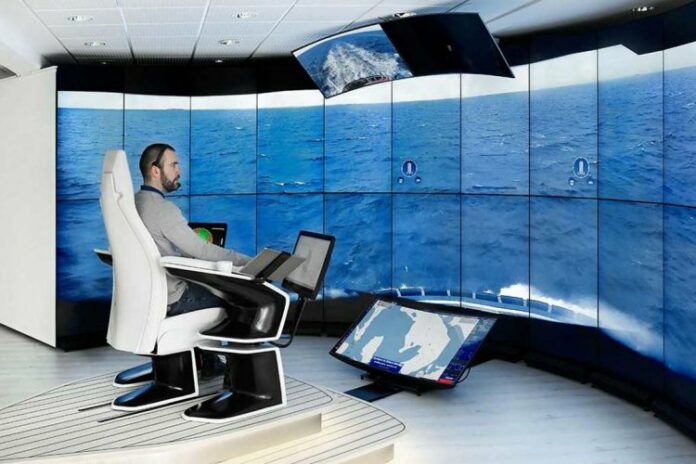
Today, global towage operator Svitzer A/S, Kongsberg Maritime and ABS announced that they have signed an agreement to jointly develop RECOTUG™, the world’s first fully operational, and fully remotely controlled tugboat. 

While Svitzer is bringing the needed operational experience, a newly built tug with crew as well as tug-specific technical solutions, Kongsberg Maritime will provide the remote control systems and the autonomous technology and lead the integration of systems and technology. ABS will bring the guidance and expertise necessary to obtain regulatory approval.

The aim of the RECOTUG™ project is to develop a remotely controlled tug that will be able to perform a full towage operation with all operations controlled from a remote operations centre. The solution and the achieved safety level shall lead to maritime authorities (class and flag) approving the technology, ultimately permitting Svitzer to conduct commercial remote tug operations in the port of Copenhagen. The project is expected to run for the years to come.

Egil Haugsdal, President, Kongsberg Maritime, commented:

“We are delighted to work with Svitzer and ABS on this important collaboration. Kongsberg Maritime is leading the market in maritime autonomy and are involved in several projects that define the remote and autonomous vessel control systems for tomorrow; this venture takes that ground-breaking work a step further by integrating these key technologies into a new context of operation. At Kongsberg, we believe that digitalisation and enhanced automation are vital to ensuring a safe, sustainable and profitable future for the maritime industry, and the step forward represented by this project is of great importance in demonstrating the application.”

The project is a natural continuation of the first Svitzer/Kongsberg Maritime (formerly Rolls-Royce Marine) project announced in 2017 centred around remotely operated navigation of the Svitzer Hermod tug in the Port of Copenhagen. As a result of the project, the partners safely conducted a number of remotely controlled, non-towage specific manoeuvres on water. From the quay side in Copenhagen harbour the vessel master, stationed at a remote operating centre, berthed the vessel alongside the quay, undocked, turned 360°, went for a sail and safely docked again.

The near-shore environment of harbour towage, where Svitzer operates, is well-suited for remote controlling which requires full connectivity and Svitzer is excited to be partnering up with Kongsberg Maritime and ABS.

Ingrid Uppelschoten Snelderwaard, Svitzer’s global COO, commented:

“While we are still several years away from seeing remotely operated tugs with no crew on board in commercial operation, there is no doubt that advanced autonomy is progressing fast across the maritime industry. At Svitzer, we are determined to be at the forefront of the innovation in this space to ensure we are well positioned to meet changing demands. We start with one tug and explore from there how to best leverage technology, improve safety and efficiency and meet our customer’s demand for reliable & cost-efficient services, also in the future. Technology is changing our lives across the board and at Svitzer we want to influence and drive how technology will transform towage over time. Safety comes first, and this entire project is first and foremost relying on the implied safety case.”

Christopher Wiernicki, ABS Chairman, President and CEO, said:

“As a data-centric organization, ABS is a leader in the maritime application of digital technologies. As safety moves away from the things you can see and touch, to things you cannot see such as software and data, ABS has been spearheading development of next generation safety approaches that draw on our expertise as a technical integrator. As a result of this tradition of constant innovation, we are uniquely well placed to support this project, which is genuinely breaking new ground for the entire industry. Greater industry collaboration is going to be key to meeting the challenges of digitalization and maritime sustainability, so ABS is proud to be part of a team that has such a significant role to play in shaping the direction of both.”

DNV GL secures three-year services contract for Total’s UK assets

0

DNV GL will provide core services such as verification, classification and flag, risk advisory services and major accident hazard awareness training. These will be carried out for assets, including the Shetland Gas Plant, Elgin Franklin and Alwyn, in continuing on Culzean and Gryphon.    

The company has built and maintained a strong relationship, centred on trust, with Total following the Paris-headquartered operator’s acquisition of Maersk Oil’s production assets in 2018 – for which DNV GL was the incumbent safety services provider. 

Hari Vamadevan, regional director, UK & Ireland, DNV GL, said:

“As one of the  largest operators in the UK, this contract award from Total is a key win for DNV GL and is a great start to the year. At a pivotal time for the oil and gas industry, our work with Total will focus on areas of safety, innovation and efficiency. We look forward to aligning with Total as the company continues its substantial investment in the drive to net zero.” 

Jack Downie, head of development and innovation, UK & Ireland, DNV GL, added:

“This contract will see Total use a broad range of DNV GL’s services to enhance its operations, and support its low carbon goals. Throughout our conversations with the Total team, we see forward-looking motivation and the desire to further develop the value we add to its operations, while further strengthening the bond between our organisations.”

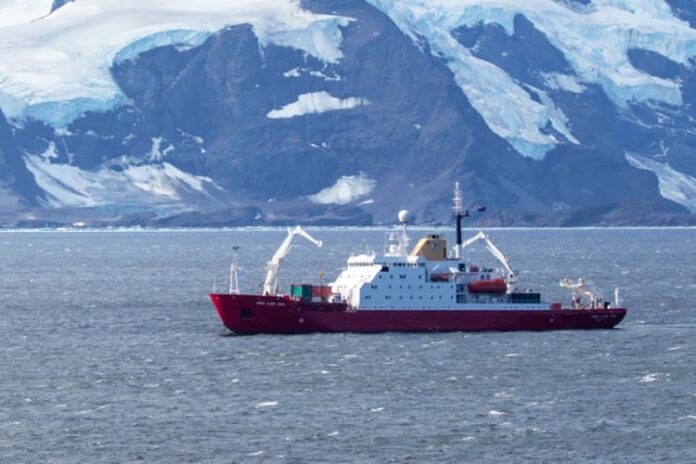
RRS James Clark Ross departs Antarctica for the final time

0

On Friday 19 February 2021 the RRS James Clark Ross made her final call to Rothera Research Station. 

Rothera was the JCR’s final call on the ship’s five-and-a-half-month mission to deliver scientific and operational staff to Antarctica, and to resupply the UK stations in Antarctica for another year. Later this month the JCR will make one final stop to her home port of the Falkland Islands to refuel before making the six-week journey back to the UK. RRS James Clark Ross’ final season has been one like no other, with COVID-19 presenting exceptional operational challenges.

For the past three decades the JCR  has been a floating platform for biological, oceanographic and geophysical research. She contains some of Britain’s most advanced facilities for oceanographic research in both Antarctica and the Arctic.

The RRS James Clark Ross will be replaced with the RRS Sir David Attenborough (SDA). The SDA has just completed two weeks of intensive sea trials around the United Kingdom. 

Neptune Energy announces start-up of Gjøa P1 development

0

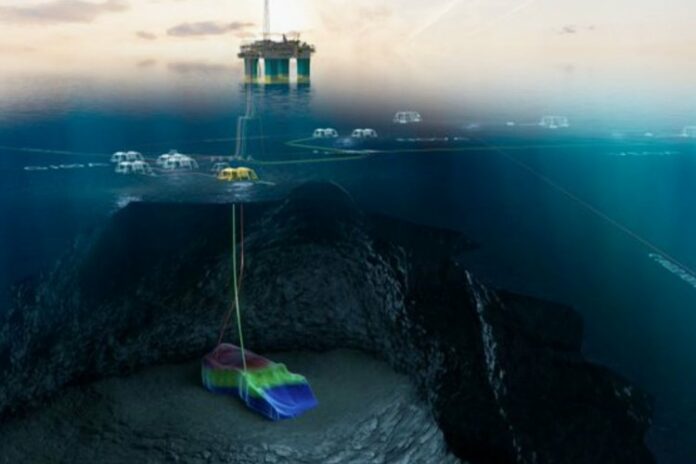
Gjøa P1 has been developed via a new subsea template, tied back to existing infrastructure on the Gjøa field. It is a two well development with one oil and one gas producer. As planned, the gas well came onstream on 22 February, with the oil well planned to start-up later this week.    

The semi-submersible Gjøa production unit is electrified with hydropower from shore and has one of the lowest CO2 footprints per produced barrel of oil equivalent (boe) on the Norwegian Shelf.

Neptune Energy’s Managing Director in Norway, Odin Estensen, said:

“This is an important milestone for Neptune and our Gjøa partners and demonstrates our commitment to invest in Norway. Despite the challenges of the pandemic, we delivered the project on time and on budget. The start-up of Gjøa P1 underlines the Gjøa platform’s position as an important hub, increasing total remaining developed reserves at Gjøa by 30%.”

Good reservoir management has already extended the field life considerably. Gjøa is now set to produce over 100 million boe more than was estimated when production began in 2010. Gjøa P1 will help further maximise use of hydrocarbon resources.

Estensen added:

“The start-up of Gjøa P1, as well as the upcoming production start from the neighbouring Duva field, strengthens Neptune’s role in the northern part of the North Sea, an important growth area for the business.”

Neptune Energy’s Projects and Engineering Director in Norway, Erik Oppedal, said:

“The P1 development enables us to recover significant quantities of oil and gas from deeper lying reservoirs, as well as to utilise spare production capacity. This will help lower production costs per barrel, adding significant value to the Gjøa Licence Partners and to Norwegian society.”

Licence partners: Neptune Energy (30% and operator), Petoro AS (30%), Wintershall Dea Norge AS (28%), OKEA (12%).

Worley helps Allseas to decommission two offshore gas platforms

0

As offshore installations in mature oil and gas fields reach the end of their useful lives, safely decommissioning aging assets is becoming an increasingly important focus for energy producers.

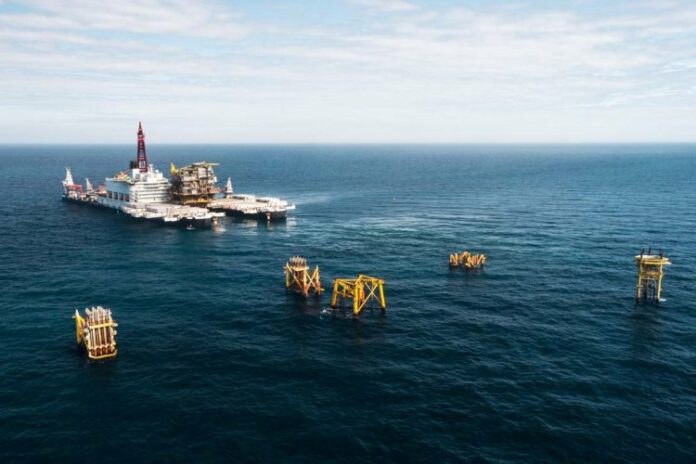
Worley is supporting Allseas with a range of decommissioning engineering, procurement and construction services for Allseas’ DP3 and DP4 project in the eastern Irish Sea. This includes engineering preparations to safely remove two of Spirit Energy’s 11,000-tonne platforms, DP3 and DP4, at Morecambe Bay.

Worley has been supporting Allseas, a world-renowned offshore contractor, since early 2020. This includes engineering preparations to safely remove two of Spirit Energy’s 11,000-tonne platforms, DP3 and DP4, at Morecambe Bay. 

The decommissioned platforms will be lifted and taken back to shore for recycling by Allseas’ Pioneering Spirit – the world’s largest construction vessel.

The DP3 and DP4 installations have been in operation since 1985, helping to heat hundreds of thousands of homes with natural gas extracted from the South Morecambe field.

Worley’s Aberdeen office is leading the project, with support from wholly owned subsidiary, Scopus Engineering. Worley is providing management and assurance services, while Scopus Engineering is providing lean engineering and site construction at Morecambe Bay.

Worley’s offshore work on DP4 is now complete with work on DP3 set to commence in early 2021.

Shaun Poll, Senior Vice President for Energy Offshore in the UK for Worley, commented:

“We are thrilled to be providing our decommissioning services to Allseas. Decommissioning offshore installations is a complex process, but our specialized engineering resources and project management expertise has helped to make this project a success.”

Parkwind selects DEME Offshore for foundation EPCI contract at Arcadis Ost I

0

DEME Offshore has been awarded a substantial Engineering, Procurement, Construction and Installation (EPCI) contract for the foundations at Parkwind’s Arcadis Ost I offshore wind farm. The next-generation XXL monopiles will be the largest ever installed in Europe with a weight of around 2,000 tonnes each.

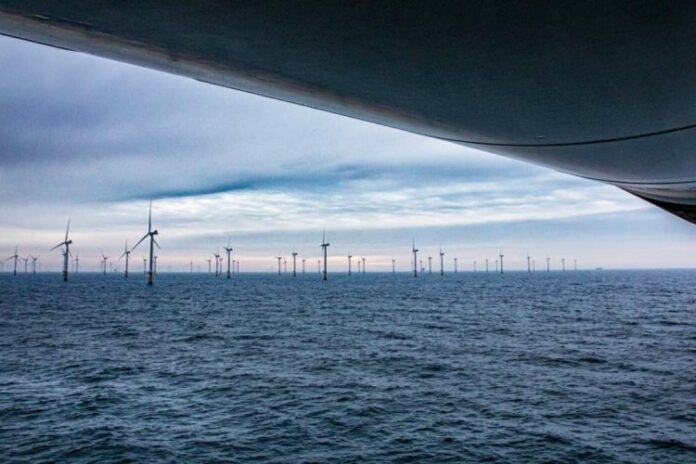
The Arcadis Ost I wind farm is developed by the Belgian offshore wind specialist Parkwind and has a capacity of 257 MW. The wind farm will be located in the Baltic Sea, northeast of the island of Rügen in the coastal waters of Mecklenburg-Vorpommern, Germany.

Manufactured by Steelwind in Germany, the 28 XXL monopile foundations will be about 100 m long and weigh around 2000 tonnes each. One of the 28 foundations will support the offshore substation. The monopiles for the wind turbines will not be equipped with common transition pieces but will have a direct connection with the turbine tower.

DEME Offshore will deploy the DP3 offshore installation vessel ‘Orion’ for this project. ‘Orion’ is a front runner in the industry – effectively a mega monopile installation machine – and will be equipped with a tailor-made, motion compensated gripper system able to handle enormous foundations of up to 2,500 tonnes.

Bas Nekeman, Business Unit Director DEME Offshore:

“Being awarded such a pioneering project highlights how Parkwind has confidence in the game-changing DP3 offshore installation vessel ‘Orion’. DEME Offshore is delighted that it will be the first company to install these XXL monopiles, as the offshore wind industry takes the next step forward. With ‘Orion’ we will be strongly positioned to offer solutions for the installation of larger foundations and turbines, and large-scale wind farm projects such as Arcadis Ost I, delivering energy at lowers costs.”

Clement Helbig de Balzac, Arcadis Ost I Project Manager:

“The signing of the foundation EPCI contract with DEME Offshore is another important step towards the realisation of Arcadis Ost I. The project is pushing the limits of what has been done to date in offshore wind in terms of foundation technology. Therefore, it was key for the project’s success to select a strong and highly experienced EPCI contractor such as DEME Offshore, deploying state of the art installation vessels and technology”. 

Production of the monopile foundations will start in 2021, while the installation campaign is planned to start before the summer 2022. Arcadis Ost I is scheduled to be fully commissioned in 2023.

A ‘substantial’ contract refers to a contract with a value of EUR 150-300 million.

Research lab to advance how humans interact and live with autonomous systems

0

A new International Research Laboratory (IRL) will focus on humans-autonomous agents teaming: an area of research at the interface of artificial intelligence, computer science, engineering, technology, human factors and psychology.

The French Australian Laboratory for Humans-Autonomous Agents Teaming, shortened to CROSSING, is a collaboration between the French National Centre for Scientific Research (CNRS), the University of Adelaide, Flinders University, the University of South Australia, French technological university IMT Atlantique, and Naval Group, the only industrial partner.

An IRL is a flagship international collaboration mechanism used by CNRS, France’s leading scientific research centre. The new IRL is called CROSSING because it represents the crossover of ideas that is at the heart of this important collaboration.

Professor Jean-Philippe Diguet, Director of the lab, says:

“The CROSSING Lab will bring together leading French and Australian scientists from artificial intelligence, machine learning, computer science, engineering, psychology and human factors. They will work together to tackle important challenges in finding new ways for systems and humans to work together. The outcomes could provide significant advances in the way operators use control systems on ships, maintenance platforms in industry or services to assist within the home, and the way these systems are developed to assist and improve human performance to make work safer and more efficient.”

The CROSSING Lab will join a network of more than 70 IRLs, but will become one of only five international research laboratories with industry partners in the world. It will join the ranks of other labs in global innovation hubs, including Singapore, China, Japan and the United States of America. 

Professor Anna Ma-Wyatt, from the University of Adelaide’s School of Psychology, who is Co-Director of the new lab, says:

“At the CROSSING lab we will develop new ways for humans to work with robots and autonomous systems. Human operators will cooperate with high-level automata, robots or adaptive information systems able to produce knowledge and to explore the physical or informational environment on their own.”

Each partner brings complementary expertise to the research partnership. Industrial partner, Naval Group, will share its world-class expertise from areas including embedded intelligence, optimised architectures, unmanned vehicles, industry of the future and human performance measurement.

Professor David Lloyd, Vice-Chancellor and President, the University of South Australia:

“We are proud to be contributing our world-leading expertise in key areas that connect human factors with the physical aspects of maritime vehicles in novel ways.”

“Our interdisciplinary research includes psychophysiology and behaviour, metrics-based ergonomic design, virtual reality and augmented reality.”

Mr Pierre Eric Pommellet, CEO of Naval Group:

“Naval Group is proud to be the industry partner for the new International Research Lab. We are honoured by the trust of our Australian and French partners, and the opportunity to make this a cornerstone of international scientific breakthrough. As one of only five labs with an industrial partner opened by CNRS, this world leading research laboratory, based in Adelaide, supports our commitment to ongoing global innovation. Supported by our subsidiary Naval Group Pacific, this partnership will help Australia realise and fulfil its innovation roadmap across a broad spectrum of sectors.”

Ms Anne Beauval, Vice-President, IMT Atlantique:

“IMT Atlantique has especially set cooperation axes with Naval Group Research (and more generally Naval Group) about submarine communication and detection, ocean monitoring as well as digital transformation at different levels of practice (industrial management, command & control). These cooperations are already supported through chairs and collaborative projects and will contribute to consolidating and enriching the CROSSING Lab”.

CWind launches the world’s first hybrid surface effect ship

0

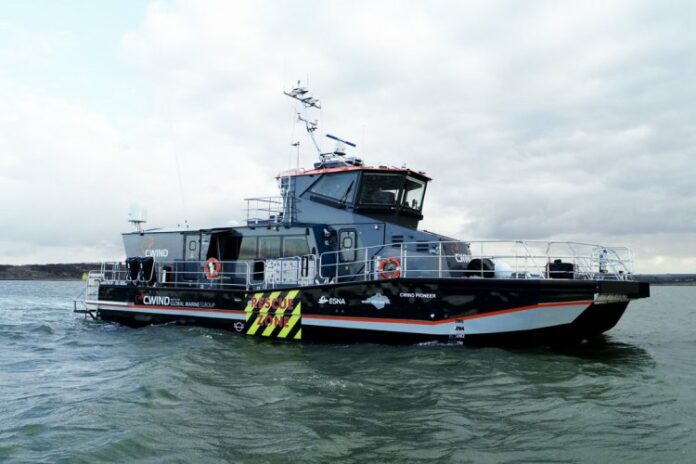
CWind, CTVs and GWO-accredited training courses to the offshore wind industry, and part of the Global Marine Group, delivers the world’s first hybrid powered Surface Effect Ship (SES), the CWind Pioneer.

Named the CWind Pioneer to demonstrate its position at the forefront of crew transfer vessel innovation, the vessel was developed in response to an industry-wide push to develop and deploy innovative technologies that reduce CO2 emissions, while cost-effectively servicing windfarms located further offshore. The CWind Pioneer achieves this through a hybrid diesel and battery electric power system which enables the vessel to operate purely on battery power while in harbour or at standby in the windfarm, resulting in a decrease in fuel burn and CO2.

With surface effect hull form and heave compensation technology, the CWind Pioneer can operate at speeds exceeding 43.5kts, and can transit and transfer safely in sea states in excess of 1.8m Hs, while minimising motion and acceleration through its air cushion motion control system, resulting in a smoother, more comfortable CTV experience for technicians and crew. The overall design and build, with 24 passenger capacity, pays particular attention to technician and crew health, safety and comfort, delivering the workforce in the best possible work-ready condition, resulting in increased operation days offshore for our client’s O&M and construction activities. 

At a speed of 43.5kts, the Pioneer is over 20% more fuel efficient than conventional CTVs running at 24kts on a mile for mile basis. For a typical windfarm situated 30nmi from port, this translates to a reduction of over 110 tonnes of CO2 per vessel, per year, by using the hybrid SES.

This figure excludes the savings of the hybrid system, which will allow the vessel to be zero emission ship infield while technicians are carrying out their work on the turbines. Specific figures will be shared once these savings are proven, but initial desk top studies suggest a 30%-50% saving over conventional vessels.

The high transit speed of the vessel also means windfarms previously serviceable only by an expensive SOV, can now be reached by the SES CTV within 60 minutes, giving wind farm owners and operators more low cost, low carbon options when determining their transfer strategy.

Nathanael Allison, Managing Director, CWind said:

“The launch of the CWind Pioneer marks a significant milestone for the industry and helps pave the way towards achieving net zero targets. The vessel utilises revolutionary technology to meet the needs of the market and our customers who want a greener, safer, and more efficient Crew Transfer Vessel to support their commercial and green objectives. With the CWind Pioneer we have delivered just that – a new generation of CTVs.”

The CWind Pioneer will be used at the Borssele 1 and 2 offshore wind farms through a long-term charter contract agreement with Ørsted. Using the CWind Pioneer enables Ørsted to not only deliver and service their windfarms efficiently through reduced transit times, but also supports their ambition of a world that runs entirely on green energy.

The Hybrid SES crew transfer vessel was developed in partnership with ESNA, a ship design company based in Kristiansand, Norway. ESNA specialises in low emissions technologies and surface effect ship development, to deliver commercially competitive vessels with significant carbon reductions by design.

Trygve H. Espeland, Naval architect and co-founder of ESNA, said:

“We are delighted to see the launch of the CWind Pioneer. She is not only a step-change for the offshore wind industry, but also for the SES design, as she is the first SES with 100% electric air cushion systems, which were both fun and challenging to achieve.

“As a SES, she is reducing emissions by offering low resistance at high speed, and the air cushion motion damping is allowing offshore operations in same wave heights as larger vessels. By choosing a SES you can, therefore, reduce emissions by simply building a smaller vessel for the same job.”

The Hybrid SES propulsion engine delivers sprint speed and extreme bollard push, from its 1,600 kW installed diesel engines, which can be battery boosted up to 1,800 kW.

The vessel was built by Wight Shipyard Co., a leading UK aluminium and high-speed craft vessel builder.

Contractors selected to construct the quays in the Amalia Harbour

0

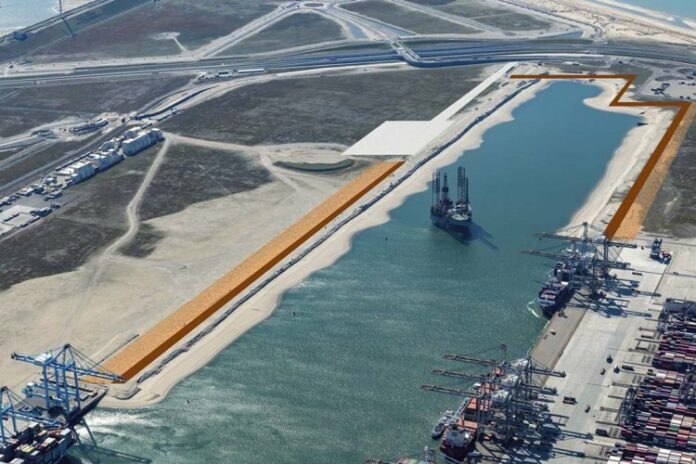
The Port of Rotterdam Authority has, after completing a European tendering procedure, awarded the construction of some 2.4 kilometres of quays and earth-retaining walls in the Princess Amalia Harbour to the HOCHTIEF, Ballast Nedam and Van Oord contractor consortium.

The decision marks the start of the further development of the harbour located on Maasvlakte II, which will increase annual throughput capacity in the port of Rotterdam by four million standard containers (TEU).

Boudewijn Siemons, chief operating officer of the Port of Rotterdam Authority, explains:

“Particularly because of e-commerce, container volumes are increasing sharply. That will continue for the time being. To further strengthen our leading position as Europe’s largest container port, we are now responding to this development by investing in the further expansion of the Princess Amalia Harbour. This is an investment that will boost the competitive position of our customers and of Rotterdam.” 

The potential additional container traffic of 4 million TEUs is equivalent to an increase in capacity of about 28 percent over the 2020 annual total.

Container terminals APM Terminals and RWG are already active in the Princess Amalia Harbour, with 1,500 and 1,700 metres of quay respectively. The construction of new deep-sea and inland shipping quays will allow these companies to develop the other sites around this harbour in time. Both terminal operators have already signed the relevant options. The project also includes the construction of a 160-metre waiting area for general use by inland shipping vessels.

The new building work will be on either side of the harbour, which is approximately 2.5 kilometres long. This total will include 1,825 metres of deep-sea quay, 160 metres of inland shipping quay and 360 metres of soil-retaining walls. Barring 725 metres, this means that the entire harbour basin, which went into use in 2015, will be enclosed. The completion of the first 500 metres of quay wall is expected in late 2022. The final part of the project will be completed no more than eighteen months later.

In addition to the construction of the quays, which will have a retaining height of 29 metres, the work also involves dredging the quays to a depth of more than 20 metres below sea level. In addition, a rear crane track will be built on piles over a distance of approximately 1.8 kilometres for the rear legs of the container cranes that will be used here.

The quays will be state-of-the-art. For example, they will be fitted with a wide range of sensors to monitor forces and any deformation. In addition, ECOncrete blocks will be used at two locations to act as artificial reefs and encourage biodiversity below the water.

Siemons:

“We are looking forward to working with HOCHTIEF, Ballast Nedam and Van Oord on the basis of the values we share with them in terms of safety and sustainability.” 

Dirk Osthus, HOCHTIEF Managing Director:

“We are proud to take on this challenging project as a building consortium. Our work will be a demonstration of the Rotterdam mentality: practical and effective.”

Ronald de Geus, managing director of Ballast Nedam Infra Projects, adds:

“By looking at the project from the perspective of a range of disciplines and working with partners in the chain, a variety of solutions were elaborated to come up with the most sustainable and efficient working method. For example, we will be reducing disruption in the local area by bringing in most of the construction materials by water. That allows us to ensure that the operations of the container terminals can continue interrupted during the course of the project.”

Mark van der Hoeven, Netherlands director with Van Oord, says:

“We are paying particular attention to reducing emissions during the operation. By deploying equipment powered by Hydrotreated Vegetable Oil (HVO)*, as well as electric construction equipment, we are fully in line with the Port Authority’s ambitions to significantly reduce harmful emissions.”

*HVO fuel leads to a reduction in carbon emissions of 89 percent by comparison with diesel and it also produces lower emissions of particulate matter, nitrogen and sulphur.

VIDEO: BC Ferries’ fifth battery hybrid-electric vessel launches

0

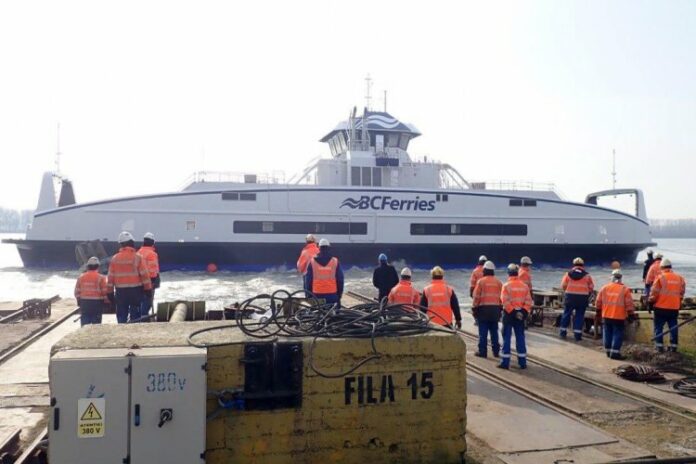
Another of BC Ferries’ Island Class ferries has launched, entering the water last Thursday at Damen Shipyards Galati in Romania. 

The yet-to-be named ship is the fifth in a series of six Island Class vessels joining the BC Ferries fleet. When in operation, it will be one of two Island Class vessels assigned to the Nanaimo Harbour – Gabriola Island route.

Work will continue on the new ship until scheduled sea trials in June. Following successful sea trials, the vessel will be delivered to Point Hope Maritime in Victoria in late 2021 for final preparations. Two-ship service is scheduled to begin on the Nanaimo Harbour – Gabriola Island route by early 2022, replacing the Quinsam.

Replacing one larger ship with two smaller vessels on the route will provide customers with increased capacity per hour and more frequent service. Customers will also notice reduced vehicle line-ups and congestion on local roads, and improved safety. It also eliminates the need to consume more greenspace to increase the size of terminal holding compounds by moving more traffic through the same amount of space.

The Island Class is a hybrid diesel-electric ferry with a number of key features that support BC Ferries’ Clean Futures Plan and the company’s goal to be efficient and environmentally responsible throughout its system. Once electric charging technology can be installed at BC Ferries’ terminals, these new ships will be configured to operate as all battery-electric ferries, using clean renewable hydroelectric energy. Island Class ferries have the capacity to carry at least 47 vehicles and up to 400 passengers and crew, and allow for fleet redeployments and retirements of existing diesel-fuelled vessels.

The first two Island Class vessels were deployed on the Powell River – Texada Island route and the Port McNeill – Alert Bay – Sointula Island route in mid-2020. The third and fourth new ships will provide two-ship service on the Campbell River – Quadra Island route in 2022. The sixth Island Class ferry is expected to launch in the spring.

BC Ferries issued a Request for Expressions of Interest (RFEOI) for the construction of the four latest vessels to leading shipyards in Canada and around the world in July 2018. Canadian shipyards were invited to participate in the competitive bidding process. BC Ferries received responses from 18 international shipyards and short-listed nine shipyards to proceed to the Request for Proposal (RFP) stage. No Canadian companies submitted a bid.