-11.5 C
New York
Home Blog Page 674

Container giant MSC to open new depot in North Sea Port

0

The world player in container transport aims at inland shipping and rail. Inland carrying trade and rail are key activities of North Sea Port.

Mediterranean Shipping Company (MSC) is one of the world’s largest ocean carriers of containers. Land-based logistics services complement the group’s activities. They include container depots and the provision of loading crates to the shipping company’s customers. The company is continuing to expand their network. Within North Sea Port, MSC already runs depots at Stukwerkers in Ghent and Kloosterboer and Verbrugge in Flushing. It will now add another support point at Vlaeynatie in the Autrichehaven in Terneuzen. This is to provide an excellent base for serving industry and agriculture.

Besides the fertilizer terminal for Plantacote and its Zeeland Sugar Terminal, bulk handler Vlaeynatie operates the 30,000m² container terminal 3MCT in Terneuzen. It connects to road, water and rail. MSC is committed to the use of alternative transport modes in its pursuit of sustainability. At 3MCT, every day barges load and unload containers from or to all major container terminals in Antwerp and Rotterdam. Trains connect the terminal with Antwerp as the central hub in MSC’s European network, and Zeebrugge. If required, Vlaeynatie’s transport subsidiary Swagemakers is ready to provide pre- or post-road transport.

For North Sea Port CEO Daan Schalck, MSC’s decision is good news twice-over:

“An additional depot will expand our container handling, which continued to grow last year. When a top player like MSC makes such a move, it is not without reason and it does not go unnoticed. It once again shows North Sea Port’s significant role as a link between deep sea container ports and the hinterland.”

And it brings out another quality of North Sea Port: the port is a hub with the right mode for each type of transport allowing companies to avoid road congestion by putting cargo on the inland waterways or on the railways. At 58%, inland waterway transport is North Sea Port’s clear front runner.

Daan Schalck says:

“We are also working to increase the proportion of rail transport. The new MSC depot at Vlaeynatie supports us on both fronts.”

Using deep-sea fiber optic cables to detect earthquakes

0

Seismologists at Caltech working with optics experts at Google have developed a method to use existing underwater telecommunication cables to detect earthquakes. 

A vast network of more than a million kilometers of fiber optic cable lies at the bottom of Earth’s oceans. In the 1980s, telecommunication companies and governments began laying these cables, each of which can span thousands of kilometers. Today, the global network is considered the backbone of international telecommunications.

Scientists have long sought a way to use those submerged cables to monitor seismicity. After all, more than 70 percent of the globe is covered by water, and it is extremely difficult and expensive to install, monitor, and run underwater seismometers to keep track of the earth’s movements beneath the seas. What would be ideal, researchers say, is to monitor seismicity by making use of the infrastructure already in place along the ocean floor.

Previous efforts to use optical fibers to study seismicity have relied on the addition of sophisticated scientific instruments and/or the use of so-called “dark fibers,” fiber optic cables that are not actively being used.

Now Zhongwen Zhan, assistant professor of geophysics at Caltech, and his colleagues have come up with a way to analyze the light traveling through “lit” fibers—in other words, existing and functioning submarine cables—to detect earthquakes and ocean waves without the need for any additional equipment. They describe the new method in the February 26 issue of the journal Science.

Zhan says:

“This new technique can really convert the majority of submarine cables into geophysical sensors that are thousands of kilometers long to detect earthquakes and possibly tsunamis in the future. We believe this is the first solution for monitoring seismicity on the ocean floor that could feasibly be implemented around the world. It could complement the existing network of ground-based seismometers and tsunami-monitoring buoys to make the detection of submarine earthquakes and tsunamis much faster in many cases.”

The cable networks work through the use of lasers that send pulses of information through glass fibers bundled within the cables to deliver data at rates faster than 200,000 kilometers per second to receivers at the other end. To make optimal use of the cables—that is, to transfer as much information as possible across them—one of the things operators monitor is the polarization of the light that travels within the fibers. Like other light that passes through a polarizing filter, laser light is polarized—meaning, its electric field oscillates in just one direction rather than any which way. Controlling the direction of the electric field can allow multiple signals to travel through the same fiber simultaneously. At the receiving end, devices check the state of polarization of each signal to see how it has changed along the path of the cable to make sure that the signals are not getting mixed.
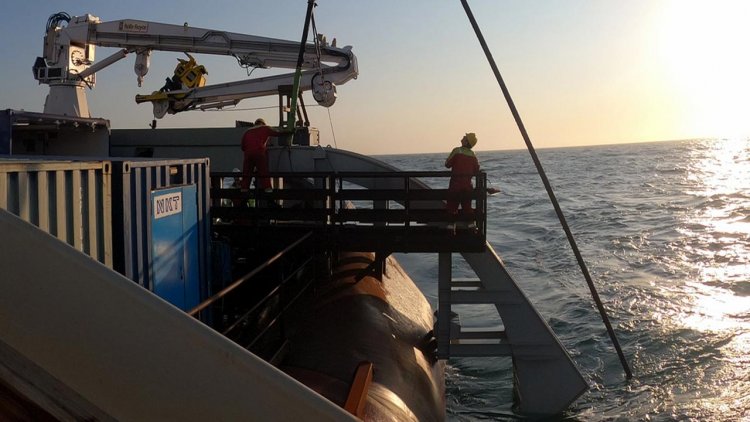
Photo: NKT

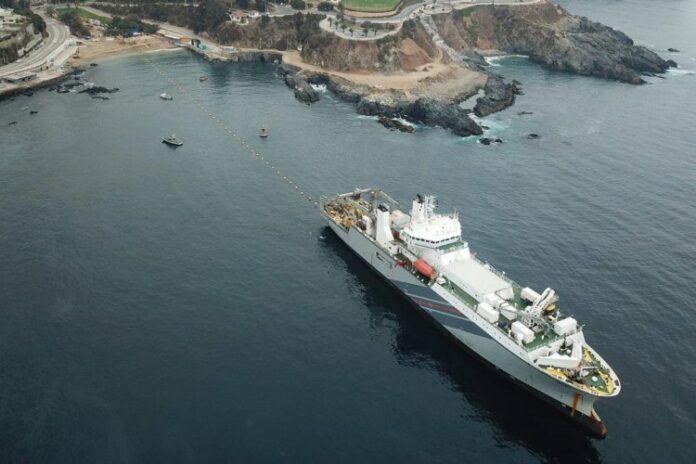
In their work, the researchers focused on the Curie Cable, a submarine fiber optic cable that stretches more than 10,000 kilometers along the eastern edge of the Pacific Ocean from Los Angeles to Valparaiso, Chile. (Although Zhan says the technique could be used on many of the hundreds of submarine cables that criss-cross the globe.)

On land, all sorts of disturbances, such as changes in temperature and even lightning strikes, can change the polarization of light traveling through fiber optic cables. Because the temperature in the deep ocean remains nearly constant and because there are so few disturbances there, the change in polarization from one end of the Curie Cable to the other remains quite stable over time, Zhan and his colleagues found.

However, during earthquakes and when storms produce large ocean waves, the polarization changes suddenly and dramatically, allowing the researchers to easily identify such events in the data.

Currently, when earthquakes occur miles offshore, it can take minutes for the seismic waves to reach land-based seismometers and even longer for any tsunami waves to be verified. Using the new technique, the entire length of a submarine cable acts as a single sensor in a hard-to-monitor location. Polarization can be measured as often as 20 times per second. That means that if an earthquake strikes close to a particular area, a warning could be delivered to the potentially affected areas within a matter of seconds.

During the nine months of testing reported in the new study (between December 2019 and September 2020), the researchers detected about 20 moderate-to-large earthquakes along the Curie Cable, including the magnitude-7.7 earthquake that took place off of Jamaica on January 28, 2020.

Zhan says:

“Although no tsunamis were detected during the study, the researchers were able to detect changes in polarization produced by ocean swells that originated in the Southern Ocean. They believe the changes in polarization observed during those events were caused by pressure changes along the seafloor as powerful waves traveled past the cable. “This means we can detect ocean waves, so it is plausible that one day we will be able to detect tsunami waves.”

Zhan and his colleagues at Caltech are now developing a machine learning algorithm that would be able to determine whether detected changes in polarization are produced by earthquakes or ocean waves rather than some other change to the system, such as a ship or crab moving the cable. They expect that the entire detection and notification process could be automated to provide critical information in addition to the data already collected by the global network of land-based seismometers and the buoys in the Deep-ocean Assessment and Reporting of Tsunamis (DART) system, operated by the National Oceanic and Atmospheric Administration’s National Data Buoy Center.

Port of Corpus Christi and Port of Rotterdam sign MoU

0

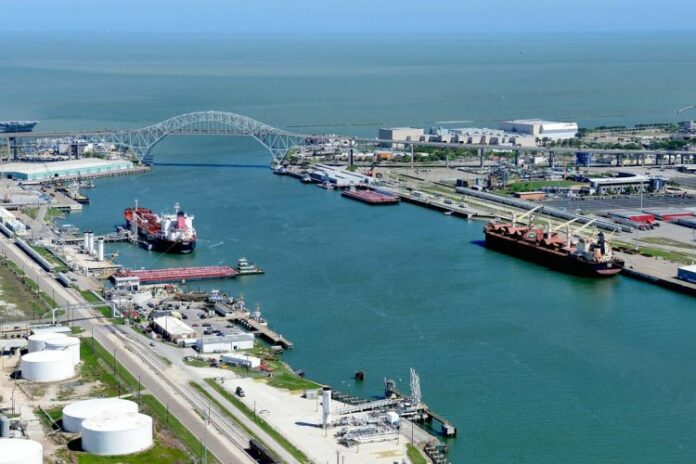
The Port of Corpus Christi, the United States’ largest energy export gateway, and the Port of Rotterdam, Europe’s leading industrial deepsea port, have entered into a Memorandum of Understanding (MOU) that will allow the two global entities to collaboratively improve their global maritime operations.

The two ports have outlined a number of shared objectives, which include co-developing trade and commercial opportunities, fostering an exchange of information, and advancing the development and deployment of innovative technologies specifically related to navigational safety and environmental protection.

Sean Strawbridge, Chief Executive Officer for the Port of Corpus Christi, said:

‘We are honored to partner with an exemplary port authority that shares our resiliency and commitment to growth by design. The Port of Rotterdam is recognized globally for its high-quality infrastructure, connectivity, and economic development. This alliance and the discourse it will generate will enhance the headway we have made toward safe and sustainable industrial facilitation of navigable commerce, and we are excited about the benefits this will bring to our Port customers and the communities we serve.’

Since Congress lifted the ban on U.S. crude oil exports to global markets in December 2015, the Port of Corpus Christi has become the nation’s largest crude oil export gateway, as well as the largest in total revenue tonnage. In 2020, the Port of Corpus Christi set an annual tonnage record for the fourth consecutive year, moving 159.7 million tons (144.9 million tonnes), driven primarily by increases in crude oil, LNG and agricultural exports. While the Port continues to reinforce its prowess in the global energy market, its leadership remains committed to Environmental, Social and Governance policies.

René van der Plas, Director of Port Rotterdam International, said:

‘The Port of Corpus Christi is a leading global energy hub. We share the ambition to be a global leader in applying pioneering innovations and in offering logistical efficiencies and we face the same sustainability challenges. It’s great to start this partnership to explore opportunities that will bring value to our shared customer base.’

Like the Port of Corpus Christi, Port Rotterdam has taken proactive steps to reduce its carbon footprint and bring technology to bear to bolster environmental protection. These efforts include deployment of carbon capture and storage technologies, using hybrid, electric- or hydrogen-powered vehicles for port business and patrols, and discounts on port dues for sea-going vessels who exceed statutory environmental requirements.

The Port of Rotterdam in 2020 moved 436.8 million tonnes of cargo through its 42km waterway in the Netherlands. Approximately 30,000 ocean-going vessels and 100,000 inland vessels call on Port of Rotterdam per annum. Providing direct and indirect employment to some 385,000 people and representing 6.2% of the Netherlands’ GNP, the port of Rotterdam is an important pillar for both the Rotterdam region and the Dutch economy as a whole.

Wallenius Wilhelmsen returns three more vessels from cold lay-up

0

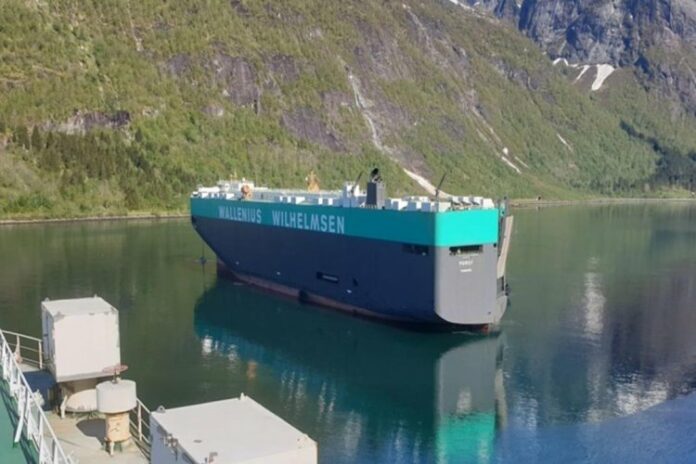
To keep pace with changing market conditions, Wallenius Wilhelmsen is now returning another three vessels to the sea to replace short-term time charter capacity.

In response to growing demand together with rising rates and lack of capacity in the time charter market, the company is bringing another three vessels out of cold lay-up to re-join its almost 130-strong fleet

Joining the nine vessels already in the process of being reactivated, these three vessels are expected to be back in service in June and July.

Craig Jasienski, CEO of Wallenius Wilhelmsen, says:

“As part of our operations, we have the ability to adjust the fleet to our needs and changing market conditions.”

With some industries showing signs of recovery, there is potential for the remaining four vessels in lay-up to be reactivated later in the year, returning the fleet back to full strength.

Jasienski adds:

“While it remains challenging to predict the potential market impact from virus intensity in parts of the world, the overall industry supply-demand balance is expected to improve in the mid-term due to overall global fleet reduction, low order book and a rebound in volumes during 2021.” 

NOAA begins transition exclusively to electronic navigation charts

0

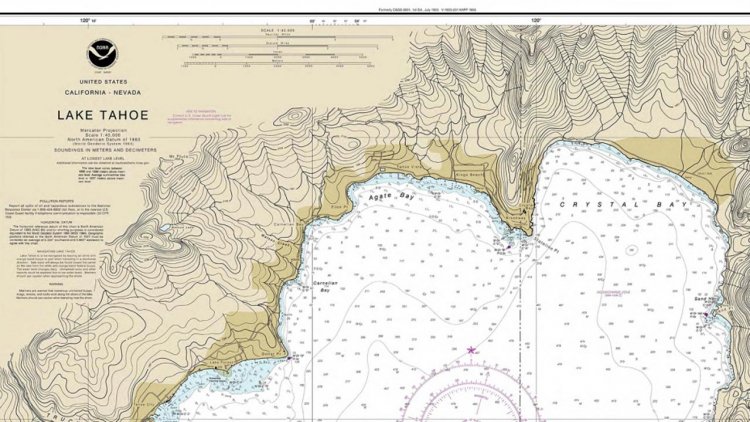
NOAA will begin to implement its sunset plan for paper nautical charts this month, starting with the current paper chart 18665 of Lake Tahoe. After August, NOAA’s electronic navigational chart will be the only NOAA nautical chart of the area.

This is the first traditional paper chart to be fully supplanted by an electronic chart as part of NOAA’s Office of Coast Survey Raster Sunset Plan, which includes a new process to notify mariners of the transition of individual paper charts to electronic charts. These charts are easier to update and maintain, keeping mariners safer with up-to-date information on marine hazards.

As part of the sunset plan, released in 2019, mariners will be officially notified of this chart’s cancellation in the U.S. Coast Guard Local Notice to Mariners. A note in the lower left corner of the chart will state that it is the last paper edition and it will be canceled six months later on August 26. 

NOAA will continue to announce the cancellation of additional paper charts as the sunset plan progresses, initially based on volume of sales or downloads, and in regions with improved NOAA electronic navigational chart coverage. Cancellation of all traditional paper and associated raster chart products will be completed by January 2025.

NOAA announced the start of a five-year process to end traditional paper nautical chart production in late 2019 via a Federal Register Notice. While NOAA is sunsetting its traditional nautical chart products, it is undertaking a major effort to improve the data consistency and provide larger scale coverage within its electronic navigational chart product suite. 

Over the next four years, NOAA will work to ease the transition to electronic products by providing access to paper chart products based on electronic data. The online NOAA Custom Chart tool enables users to create their own paper and PDF charts from the latest NOAA ENC data. 

MPA awards LNG bunker supplier licence to Total Marine Fuels Private Limited

0

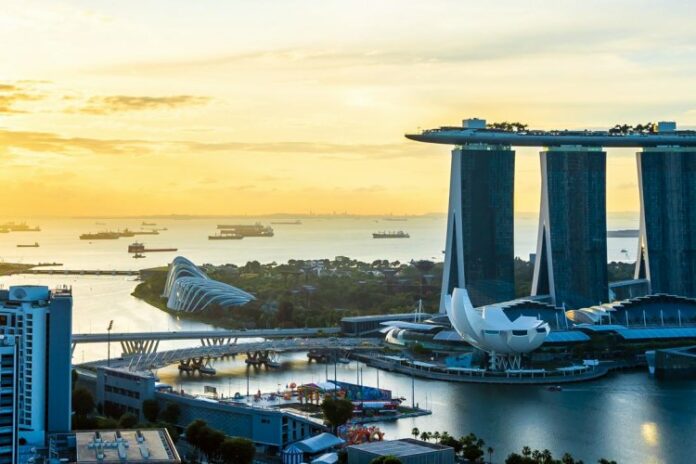
Total Marine Fuels Private Limited is a global LNG supplier and an experienced operator providing end-to-end LNG bunkering solutions that will complement the existing two licensees – FueLNG Pte Ltd and Pavilion Energy Singapore Pte Ltd – to drive demand and grow LNG bunkering volumes in Singapore.

In planning ahead to meet the region’s growing demand for LNG as a marine fuel, MPA issued a Request for Proposal on 28 October 2020 for parties seeking to supply LNG bunker in the Port of Singapore. LNG is a clean marine fuel that reduces the emission of nitrogen oxides and greenhouse gases, while generating minimal sulphur and particulate emissions. Singapore currently has an LNG bunker supply capacity of up to one million tonnes per annum.

Mr Jérôme Leprince-Ringuet, Vice-President, Marine Fuels, Total, said:

“We are honoured to be awarded by MPA the licence to supply LNG as a marine fuel in Singapore. This achievement underscores Total’s goal to be a leading LNG bunker supplier globally, and is in line with our climate ambition to get to Net Zero by 2050, together with society. LNG is the best, immediately available solution to reduce our shipping customers’ carbon footprint and it paves the way towards carbon-neutral bioLNG and synthetic methane. We will continue to ramp up our investments to deliver competitive, reliable and end-to-end LNG bunkering solutions for customers in Singapore and beyond.”

Ms Quah Ley Hoon, Chief Executive of MPA, said:

“As the world’s top bunkering hub, the Port of Singapore is well-positioned to expand its offering of marine fuel solutions. LNG serves as a viable and clean transitional marine fuel to reduce carbon emissions from ships. We welcome Total Marine Fuels Private Limited’s entry into Singapore’s LNG bunker market to bolster the country’s ambition in becoming Asia’s leading LNG bunkering hub. We will continue to work with interested parties to grow the bunkering ecosystem in the Port of Singapore and drive the transition to a more sustainable future.”

Equinor completes farm down of Dogger Bank A and B

0

As part of this transaction Eni has also completed the agreement to purchase a 10% interest in the Dogger Bank A and Dogger Bank B assets from project partner SSE on the same terms.

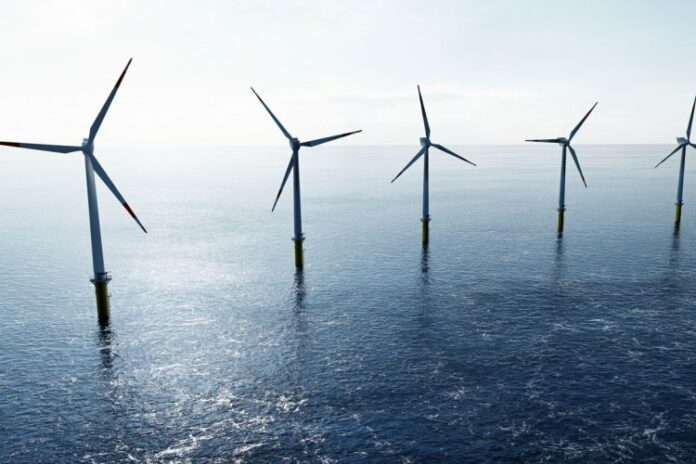
Following this transaction, the new overall shareholding in Dogger Bank A and Dogger Bank B is SSE Renewables (40%), Equinor (40%) and Eni (20%).

Eni entered the Dogger Bank A and B assets effective from financial close of project financing which was reached on 25 November 2020. The total consideration received at closing is GBP 206.4 million.

The farm down to Eni is Equinor’s third offshore wind transaction in less than two years. The three transactions combined (divestments of non-operated interests in Arkona, Empire Wind /Beacon Wind and Dogger Bank A and B projects) generated an accounting gain of approximately USD 1.5 billion.

Equinor divested around 2.5 GW capacity in the different project’s stages for the cash consideration just under USD 2 billion. This demonstrates the company’s track record in consistently capturing value from world class assets.

The A and B phases of the Dogger Bank Wind Farm reached financial close at competitive terms underlining the attractiveness of the UK offshore wind assets and the confidence in the joint venture.

The third phase of the wind farm, Dogger Bank C (1,200 MW), is being developed under a different timeline. There is no change to the ownership of this phase, in which Equinor and SSE each have a 50% stake.

Port of Antwerp will launch a new shipping guidance system

0

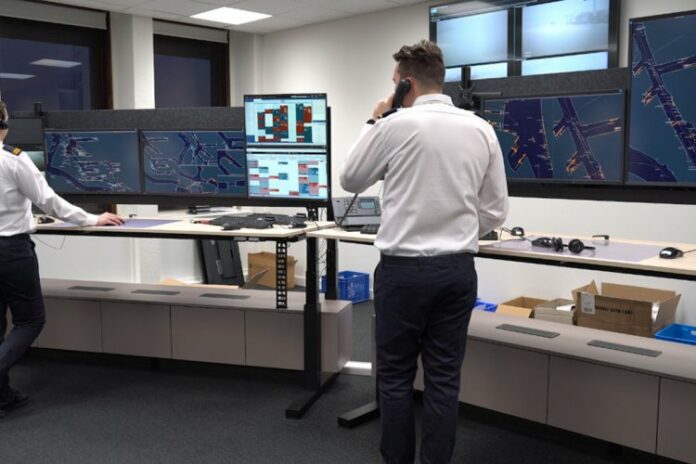
On Monday March 1st, Port of Antwerp will be launching a new shipping guidance system. The new service, called Vessel Traffic Services (VTS), is responsible for safe and smooth vessel traffic at the port.

Traffic on the Scheldt and at the Antwerp docks is becoming increasingly busy and Port of Antwerp is aiming to deal with this effectively. The new service will ensure more efficient guidance of shipping traffic. In addition, VTS also guarantees an increase in safety and environmental protection at the port.

VTS provides information and advice on both ship navigation and weather conditions, calamities and other potential risks. The new VTS operators and traffic controllers are responsible for the safe and efficient organisation of shipping traffic behind the locks. The analysis and communication of this information allows for a smoother throughput of seagoing vessels and inland navigation craft.

The port will be monitored through three sectors. The Right Bank is divided into 2 sectors, Polder and City, while the Left Bank becomes the Waasland sector. These sectors each have their own VHF channel for communicating with traffic participants. With the start-up of the new vessel traffic control system, vessel traffic will be monitored by a VTS operator.

The start-up of the service will take place in several phases. On March 1, VTS will begin with the Waasland sector at the docks on the Left Bank. The service is operational from Monday to Friday between 8am and 4pm. As of 3 April, the service will operate 24/7. In the autumn, the phased roll-out on the Right Bank will begin in the Polder sector and the City sector.

Bladt Industries Invests in Future Offshore Wind

0

The Danish industrial group Bladt Industries now invests in an expansion of the production facilities at Lindø port of Odense, Denmark.

Over time, Bladt Industries has been part of the supply to almost one third of the world’s offshore wind turbine foundations:

CEO at Bladt Industries, Anders Søe-Jensen, says:

‘Soon, most wind farms will be dominated by 15 megawatt turbines with a rotor diameter of 240 meters. These turbines require an enormous foundation fixed to the seabed, and now, we are moving one step closer to meeting the future demand, while, at the same time, consolidating our position as one of the leading suppliers of offshore wind foundations and substations.’

Since 2013, Bladt Industries has had production facilities at Lindø port of Odense. Bladt Industries now plans to initiate a new production, where the enormous XXL Monopile Foundations will be manufactured. Bladt Industries expects to be ready to deliver these in 2022. The investment and the size of the production site will be adapted to fit the market demand for monopiles that will reach a length of 100 meters and a diameter of 15 meters. With the length of a football field, these monopiles will weigh over 3,000 tons each:

Anders Søe-Jensen says:

“Each monopile is a gigantic steel construction, and we will be among the first suppliers who are able to produce steel constructions of this size. From the production site in Denmark, we can ship the structures international, and we will thus enter into partnerships with our customers in a continuously growing market and thereby consolidate our global market position within substations, fixed foundations and the floating offshore wind foundations of the future.”

The global offshore wind market is expected to grow significantly over the next years. In the EU, 12 GW wind power is currently installed, and the plan is to increase the wind power capacity from the current 12 GW to 60 GW before 2030 and to 300 GW by 2050.

In the US, President Joe Biden is also positive news for the Danish wind power industry. As one of his first actions, the newly elected president issued a decree that aims to double the American offshore wind energy capacity by 2030.

In Denmark, Copenhagen Infrastructure Partners, CIP, welcomes Bladt Industries’ investment:

“We know that the global market for offshore wind energy will grow in the next few years. We also know that the Danish wind power industry must invest massively to keep its leading position which is particularly significant in offshore wind power. Therefore, it is positive that Bladt Industries now takes the next step towards scaling their production capacity in Odense. This will resonate well with the global wind power industry where we need to position ourselves as a pioneering country within wind energy, Partner at Copenhagen Infrastructure, Michael Hannibal remarks.” 

At Bladt Industries, the first agreements have already been signed with machine suppliers, while the planning of the new productions facilities at Lindø port of Odense has begun. This means that the production of the first XXL monopiles can start already next year and it will eventually create new jobs.

Two new-generation submarines for the Italian Navy

0

Today, Fincantieri, one of the world’s leading shipbuilding groups and reference operator in the naval shipbuilding industry, and OCCAR (Organisation Conjointe de Cooperation en matiere d’Armement, the international organization for joint armament cooperation) will sign the contract for the construction of 2 new-generation submarines.

Such contract, in which Fincantieri will act as prime contractor, envisages an option for 2 additional units and is part of the new U212NFS (Near Future Submarine) acquisition program of the Italian Navy.

The total contract value for the first two vessels, including relevant logistics support, amounts to 1.35 billion euros.

The project is an evolution of the U212A program carried out in cooperation with the German thyssenkrupp Marine Systems, which resulted in the production of 4 submarines for Italy – “Todaro”, “Scirè”, “Venuti” and “Romei”, delivered by Fincantieri between 2006 and 2017 – and 6 for Germany. According to highly reliable analyses, the technological content of these air-independent propulsion submarines determined the shift in the balance between nuclear and conventional vessels in the postwar period.

With the first two deliveries scheduled for 2027 and 2029, the U212NFS program stems from the need to secure adequate underwater spatial surveillance and control capacity, considering the future complex scenarios of underwater operations and that the operational lifetime of the 4 “Sauro” class submarines, currently in service, is drawing near. It also aims at upholding and further developing Fincantieri’s acquired strategic and innovative industrial know-how, as well as consolidating the technological lead attained by the company and its supply chain, enhancing the presence of technologically-advanced component parts developed by Italian industries on board.

Fincantieri CEO, Giuseppe Bono, commented:

“We are proud that the recognition of our skills by the Italian Navy and the German partner has brought about a change in the relations, thus securing – on the one hand – our role as design authority, on the other as prime contractor. We are going to take a real technological leap forward compared to the submarines of the previous class, starting with the design and the combat system developed along with Leonardo, which we are in charge of integrating on-board. This will allow Italy to continue being a main actor among the limited group of Countries that can build such advanced units”.