-9.8 C
New York
Home Blog Page 651

Shipping industry is set for a growth year but 2021 has multiple risks to navigate

0

After the seismic shocks of 2020 with impacts felt across society and business, Voyager Worldwide used the first quarter of 2021 to ask practitioners in the maritime industry for their views on the trends that would shape the coming 12 months and beyond.

The primary conclusion is that those who took the survey see 2021 as a year of growth. This is perhaps not surprising given the pullbacks in consumer demand caused by the pandemic. But it should be remembered that while knowledge workers have been stuck at home, the shipping industry has had a busy 2020 and the impact of additional demand is already being seen in long queues outside ports as vessels wait to unload.

Some 80% of those questioned were confident that the shipping industry is expected to grow during 2021, with 17% expecting it to stay the same.

However, the rebound in activity as vaccine rollouts continue and economic confidence returns does not mean that everything will be smooth sailing. A combination of factors around vessel operations, human factors and safety mean that 63% of those responding believe that 2021 will be more operationally challenging than 2020.

A quarter predict a much more challenging environment and a clear majority (63%) identified profitability as their biggest challenge, while 20% said it would be reliability and 17% answered safety.
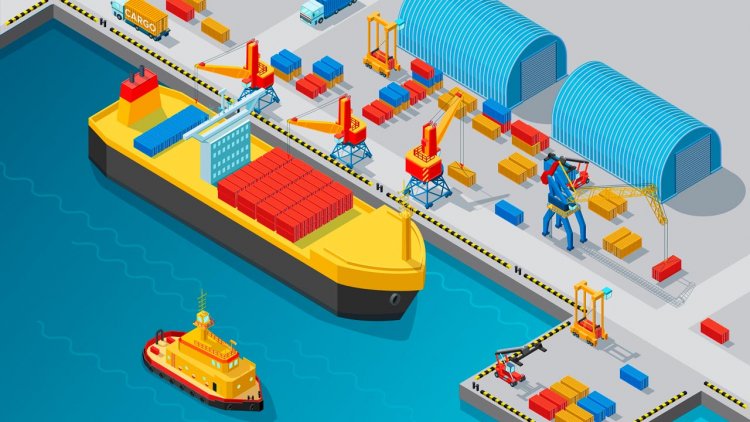
The reasons for the concern over profitability are likely linked to the cost of vessel operations in an environment where pressure on logistics, regional shortages and backlogs create bottlenecks and drive scarcity of supply. Some 72% of the industry is expecting the cost of services and consumables they buy to rise this year, just under 60% see a moderate rise and just over 10% a substantial increase.

As the timetable for the next stage of efficiency measures aimed at decarbonising the industry becomes clearer, vessel operators are confronting the changes that will be required. As knowledge grows around the new energy sources that will be required to tackle the reduction in carbon emissions, 90% of the industry said that they think sustainable fuel choices will be important to their customers in 2021.
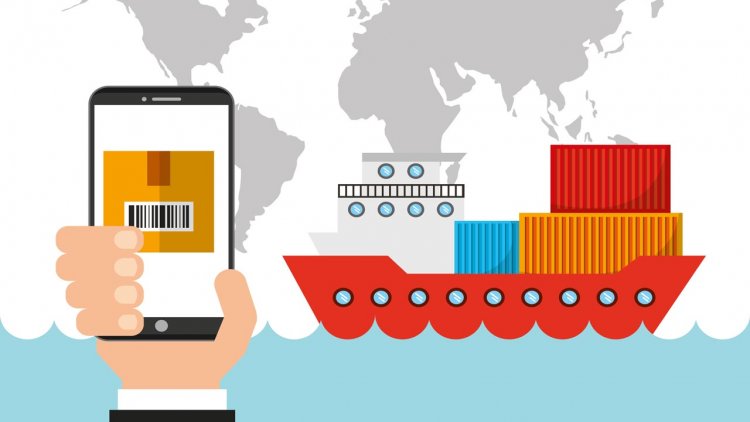
From the results it is clear that the digital transformation of the shipping industry is the big trend for vessel owners and operators. When asked about the issues that are keeping them awake at night, 13% of respondents cited technology dependency.

That didn’t stop an overwhelming 97% of respondents saying they expect technology to provide some level of improvement in operational efficiency this year.

Asked how they expect technology to impact their da-to-day job in 2021, more than half expect it to somewhat improve efficiency while 36% predict it will likely do so.

As a result, some 77% of respondents anticipate having to make investments in 2021 into up-skilling their workforce in order to capitalise on the opportunity of digital transformation. A quarter expect the investment to be significant and more than a half predict some increased investment.

Clearly there are plenty of risks to choose from, but a majority (one third) are still concerned at the impact of COVID-19 on the industry and closely related to this came the issue of crew welfare (20%).

Risks come in many shapes and sizes and for shipping the physical is as present as the digital. Just over 10% of our respondents said piracy threats were enough to keep them awake at night, while just 7% said they were concerned about cyber attacks.

Renewed political tensions in major shipping locations and a resurgence of piracy look likely to remain in the headlines in 2021 but just under half of those surveyed reckoned that physical risks to their fleet in 2021 from piracy or stowaways would be the same as in 2020, though a third believe the risk will be somewhat greater than 2020.

The risk focus of 2021 will also be on cyber security, not least from a regulatory point of view. The entry into force of amendments to the ISM Code requiring demonstration of policy, procedures and awareness around cyber risk will doubtless focus minds onboard ship.

Cyber will have a higher priority in 2021 according to the survey, with 44% of respondents reporting some increase in attention and 37% set to make the topic a much higher priority than in 2020.

Marlink partners with Apizee to deliver satellite-optimised real-time video services

0

Marlink, the leading provider of smart network solutions, has joined forces with Apizee, a CPaaS (Communication Platform as a Service) provider of real-time video interaction features, to enhance video communications for customers requiring collaborative working, safety, diagnostics, and maintenance in remote locations.

Video has already been the application of choice for businesses in mining, energy and offshore as well as NGOs working in development and emergency relief. The COVID-19 pandemic has propelled this demand as travel has become increasingly restricted.

Apizee offers online chat and secure web-based high-definition collaboration services, enabling real-time sharing of data, audio, and video assistance on mobile devices.

Marlink’s intelligent hybrid network infrastructure provides connectivity with the lowest possible latency and the broadest global coverage, offering optimal service continuity to the users of satellite-based video assistance solutions. Using Marlink’s mobile satellite solutions to reach a remote vessel, production plant or operating site enables the utilisation of digital collaborative applications and cloud-based services that were previously impractical to use in areas with limited or non-existent terrestrial and cellular coverage.

Alexandre de Luca, President, Enterprise, Marlink, said:

“Marlink’s satellite solutions are critical in enabling diverse end users to maintain their digital communications during the pandemic, whether for chain of command, safety and security, remote operations and maintenance. Enhancing our customers’ access to video reflects the new reality that remote working is here to stay for many more businesses and organisations, whether they have remote employees or teams connecting from home.”

Michel L’Hostis, General Director, Apizee, said:

“Real-time video can give organisations and businesses better connections to their people and faster updates on the performance and status of their remote assets because experts can collaborate and guide remote technicians to conduct diagnostics and repairs. Customers operating in areas where terrestrial networks are limited or non-existent will be able to enjoy high-quality, satellite-based video feeds from the most remote locations using tablets, smartphones and laptops.”

NOAA launches two coastal models for mariner safety on West Coast, Gulf of Mexico

0

The models provide continuous quality-controlled data on water levels, currents, water temperature and salinity out to 72 hours.

Forecasts from both models are used by commercial and recreational mariners, fisherman, emergency managers, search and rescue responders, and National Weather Service marine weather forecasters.

Nicole LeBoeuf, acting director of NOAA’s National Ocean Service, said:

“The West Coast model will help the Coast Guard with search and rescue and has implications for other stakeholder groups, such as navigation, shipping, and fisheries. The Gulf model improves the safety of marine navigation in an area vital to the safe movement of energy resources and other shipping.”  

These two new models join a network that now totals 15 such models in coastal waters around the United States. The models — located in critical ports, harbors, estuaries, Great Lakes, and coastal waters — are part of a larger national backbone of real-time data, tidal predictions, tide and lakes datums, and operational modeling that enables users to make the best decisions for their needs.

NOAA’s Satellite and Information Service supports a key role in developing the West Coast Operational Forecast System, providing near-real-time satellite observations, including  temperature, sea-surface height and coastal currents.

Steve Volz, director of NOAA’s Satellite and Information Service, said:

“The West Coast operational system is the latest example of NOAA’s commitment to bringing its expertise and data resources together to improve the way Americans live, work and do business.”

The Northern Gulf of Mexico model combines three models into one and extends the model to include coverage up the Mississippi River to Baton Rouge, Lake Pontchartrain and Bartaria Bay in Louisiana, and along the Corpus Christi waterways of Texas, as well as south to the Mexico border. The seaports covered by this model are some of the busiest in the nation in terms of tonnage, energy, value and other measures.

Van Oord wins contract for Sofia Offshore Wind Farm

0

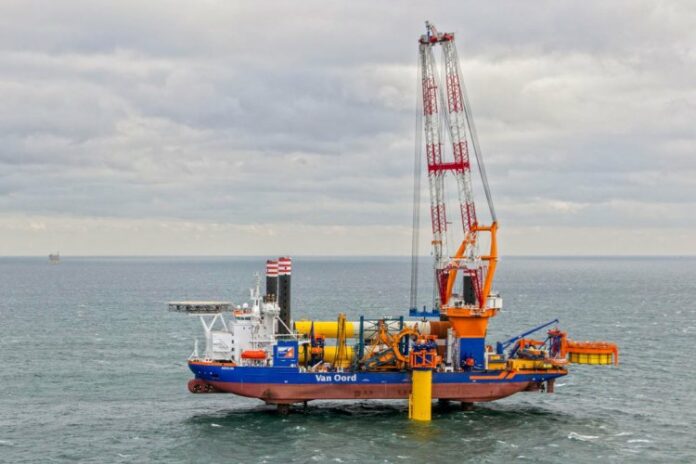
Following the announcement that RWE has reached a financial investment decision for Sofia Offshore Wind Farm, Van Oord is pleased to confirm that it has been contracted for the engineering, procurement, construction and installation (EPCI) of the monopile foundations and array cables for this project. The 1.4 GW Sofia Offshore Wind Farm is one of the world’s largest offshore wind projects.  

Sofia is sited on Dogger Bank in the central North Sea, 195 kilometres from the North East coast of the UK. Through its UK branch MPI Offshore, Van Oord will create a logistics hub to deliver the comprehensive scope of work. Offshore installation vessel Aeolus will be deployed to install the 100 extended monopile foundations without transition pieces. The 350 kilometres of array cables will be installed by cable-laying vessel Nexus. Van Oord will sub-contract the fabrication of the foundations and array cables. 

Sven Utermöhlen, Chief Operating Officer Wind Offshore Global of RWE Renewables said:  

“RWE and Van Oord know each other well having worked together on four UK projects prior to the signing of this most recent EPCI contract for foundations and array cables. At 1.4GW, Sofia is our largest and most ambitious offshore wind development to date. We look forward to leveraging our vast experience and learnings as we progress into the construction of this flagship project, and to realising its potential in terms of contributing to the UK’s net zero energy ambitions.”

The project will be executed by Van Oord Offshore Wind UK from their MPI Offshore office in Stokesley Teesside. With the onshore converter station located near the village of Lackenby in Teesside and the recent announcement by the UK government of Freeport status for the Tees Valley, the area is expected to receive a boost. This will deliver opportunities for the local supply chain and create new jobs.   

Arnoud Kuis, Managing Director Van Oord Offshore Wind, said:

“Our project team is busy preparing for this great offshore wind project. Now that the contract is signed, the design phase will be started and the project team will commence its activities from our Stokesley office. The recent announcement of Freeport status for the Tees Valley will further stimulate the regional development of the offshore wind sector in this area. In the coming period, we will be actively marketing our supply chain opportunities and vacancies with a focus on sourcing well-trained staff.” 

ONE to expand China to Southeast East Asia services

0

Ocean Network Express (ONE) is pleased to unveil 2 new operating services, the China Thailand Philippines (CTP) and the China Indonesia Malaysia 2 (CIM2) further enhancing their Intra Asia network.

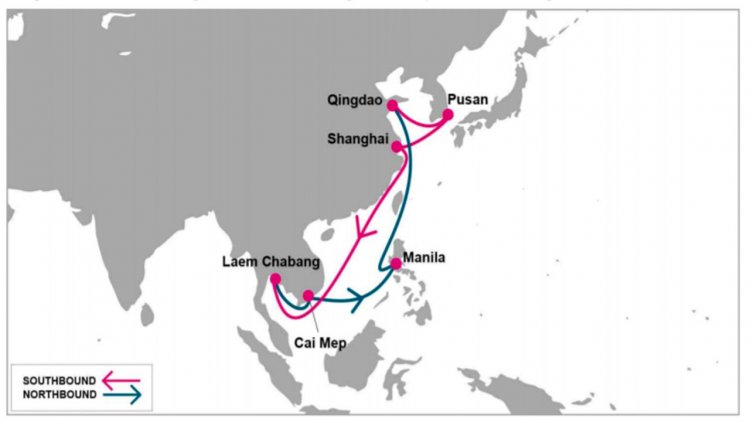
The new CTP service an exciting transformation of the Thailand – Vietnam – Philippines (TPV) service is jointly operated by ONE and Regional Container Lines (RCL). Now extended to include China and Korea port calls and served by 4 x 2700 TEU vessels, the revamped service will provide one of the most competitive transit times in the market, with only 6 days transit time from Shanghai to Laem Chabang. The CTP service starts from MOL SEABREEZE 0162N/S departing Laem Chabang on 5th April 2021.

The CTP rotation is as follows:
Qingdao – Pusan – Shanghai – Laem Chabang – Cai Mep – Manila – Qingdao 

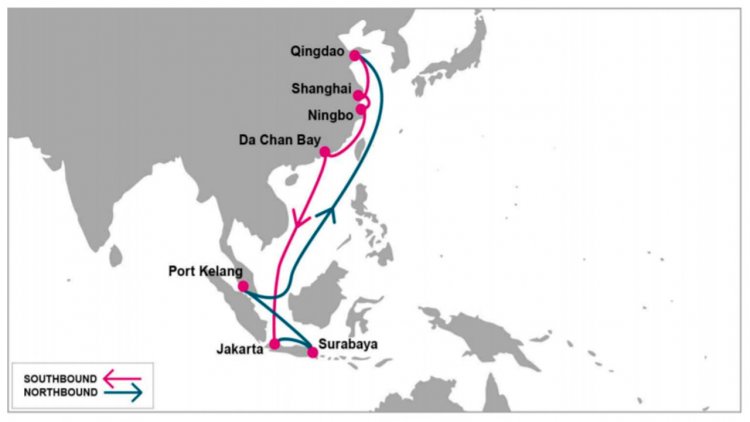
The CIM2 service will launch on the 19th April. Operated in artnership together with OOCL and Goldstar Lines, ONE’s new service will provide 4 x 2800/4250 TEU vessels to complement the existing CIM service and connect different regions in China to Indonesia and Malaysia. The CIM2 service starts with OOCL’s MV Savanna V403S/N departing form Qingdao.

The CIM2 service rotation is as follows:
Qingdao – Shanghai – Ningbo – Da Chan Bay – Jakarta – Surabaya – Port Kelang – Qingdao

Pioneering Spirit is equipped with a second unique lift system

0

Allseas equips Pioneering Spirit with a second unique lift system capable of removing and installing complete offshore jackets weighing up to 20,000 t in one go. After several months of installation works, the sheer size of the “Jacket lift system” (JLS) is becoming apparent.

Recent activities have focused on the “hang-off and upend system” (HOUS), the function of which is to raise and tilt the 170-m lifting beams. The HOUS comprises integrated upend systems, each with a pair of 50-m skid tracks fitted with “push-pull” mechanisms. Hydraulic cylinders drive the push-pull devices along the tracks, moving the beams up, while transom-mounted hang-off frame (HoF) assemblies function as hinges around which the beams rotate.

While the technology is ground-breaking, the way the system works is rather simple. After cuts are made to a jacket’s foundation piles at seabed level, hoisting blocks suspended from the lifting beams raise the jacket at the main legs. The jacket is subsequently aligned with the beams, reclined, and skidded further inboard before transit.

The Jacket lift system will further enhance Pioneering Spirit’s unrivalled versatility and capability, and provide the offshore energy market with a total solution for heavy lift work.

Vineyard Wind selects DEME Offshore US for wind turbine installation

0

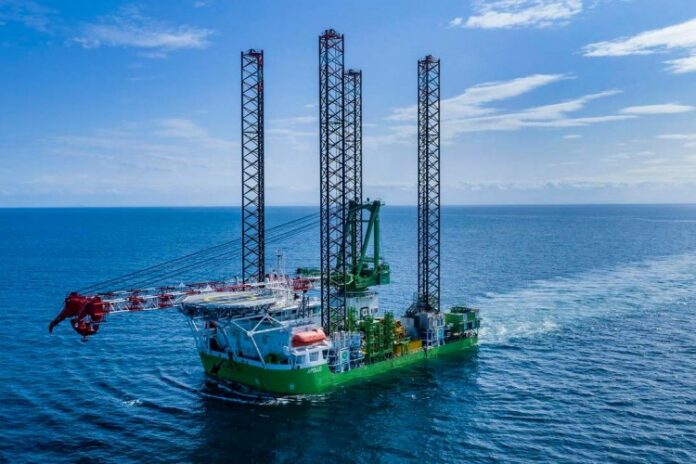
Vineyard Wind, a joint venture between Avangrid Renewables, a subsidiary of AVANGRID, Inc., and Copenhagen Infrastructure Partners (CIP), have announced that DEME Offshore US LLC will serve as its contractor for the offshore transport and installation of the wind turbine generators for its Vineyard Wind 1 project, the first large scale offshore wind installation in the United States.

DEME Offshore US LLC is teaming up with FOSS Maritime Company LLC, a US maritime service contractor that provides union jobs for its employees.  FOSS will provide the Jones Act compliant feeder vessels, a concept by which the wind turbines will be transported from the port of New Bedford to the specialized DEME Offshore US LLC installation jack-up vessel. The DEME Offshore US LLC office in Massachusetts will be the base of operations for activities for the Vineyard Wind project. 

Vineyard Wind CEO, Lars T. Pedersen, said:

“We’re very excited to make this announcement today not only because it’s an important step in the development of our first project but also because of the impact it will have on the US workforce. The offshore wind industry has tremendous potential to create good paying jobs and investment opportunities while also reducing carbon pollution.  By working with companies like DEME Offshore US LLC and FOSS Maritime, we can ensure that US labor is gaining from the experience of well-established operators, so that the industry can take proper root and grow a fully American workforce.”

Jan Klaassen, Director DEME Offshore US LLC, said:

“DEME Offshore US LLC is proud to work together with Vineyard Wind on the start of a new era in the US offshore wind market. The partnership of DEME Offshore US and FOSS Maritime brings our expertise about offshore wind and US related activities together, which is the cornerstone of a successful solution. Our method is Jones Act compliant, driven by high-tech engineering, patented solutions and special adaptions to both companies’ vessels for this project. The deployment of the US feeder concept by the DEME Offshore US/FOSS Maritime Team will create a great opportunity for US mariners to get familiar with the offshore wind industry.” 

Will Roberts, President of Foss Maritime, said:

“Beginning in 1889 we have provided our fleet of highly capable tugs, deck cargo barges, marine engineering staff, experienced project managers and highly trained mariners to work on complex marine projects in harsh environments. We appreciate the opportunity to work closely with DEME Offshore US LLC in support of the Vineyard Wind project.”

Gerard Dhooge, of the Seafarers International Union, and President of the Boston & New England Maritime Trades Council, AFL-CIO, said:

“This announcement is great news for our region, and in particular for the hard-working men and women in the maritime trades. We have a once in a generation opportunity to create a new industry that will help middle class families and those trying to make it to the middle class.  With partners like Vineyard Wind, DEME Offshore US and FOSS Maritime partnering with organized labor, we can and will create a more prosperous future for people in the New Bedford region and throughout Massachusetts.”

Located 15 miles off the coast of Martha’s Vineyard, Vineyard Wind 1 is slated to become the first large-scale offshore wind farm in the United States.  With a generating capacity of 800 megawatts (MW), the project will provide significant benefits to the Commonwealth of Massachusetts by providing clean electricity to power more than 400,000 homes, creating thousands of good paying jobs, and reducing electricity rates by $1.4 billion over the first 20 years of operation.  The project is also expected to reduce carbon dioxide emissions by 1.68 million metric tons annually, the equivalent of taking 325,000 cars off the road each year.  

Vineyard Wind is expected to reach financial close in the second half of 2021 and begin delivering clean energy to Massachusetts in 2023.

Italian terminal orders Konecranes Gottwald Mobile Harbor Crane

0

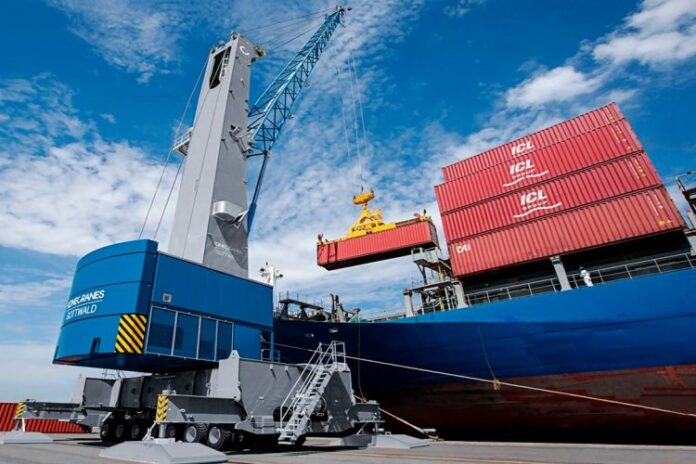
The port terminal operator SERMI in Pozzallo (Sicily) has ordered an eco-efficient Konecranes Gottwald Model 6 Mobile Harbor Crane to improve its overall capacity in container, general cargo and bulk handling.

The order, booked in Q1 2021, highlights Konecranes’ commitment to the growth and transformation of customers and industries so they run more efficiently, sustainably and safely.

SERMI has decided to enlarge its fleet of mobile harbor cranes at its facility in the Port of Pozzallo, a major Mediterranean harbor handling containers shipped worldwide. SERMI ordered a Konecranes Gottwald Model 6 crane, which will increase the handling performance and reduce the operator’s overall carbon footprint thanks to the crane’s diesel-electric drive, raising the terminal to a new level of efficiency. It will be delivered in May 2021.

Vincenzo Venniro, owner and CEO of SERMI, said:

“For many years, we’ve provided the best industry services for our clients, who include some major local shipping lines. Our new Konecranes Gottwald mobile harbor crane will help us to continue meeting increasing customer demand for the traffic of containers worldwide at the highest level of quality, and in a more sustainable way.”

Gino Gherri, Regional Sales Manager for Konecranes Port Solutions, says:

“The advanced electric drive at the heart of our cranes and the high performance that results perfectly fit the productivity and sustainability needs of SERMI. This agreement builds on years of good cooperation and we look forward to continuing on this path into the future.”

Royal IHC receives approval in principle for hydrogen-fuelled TSHD

0

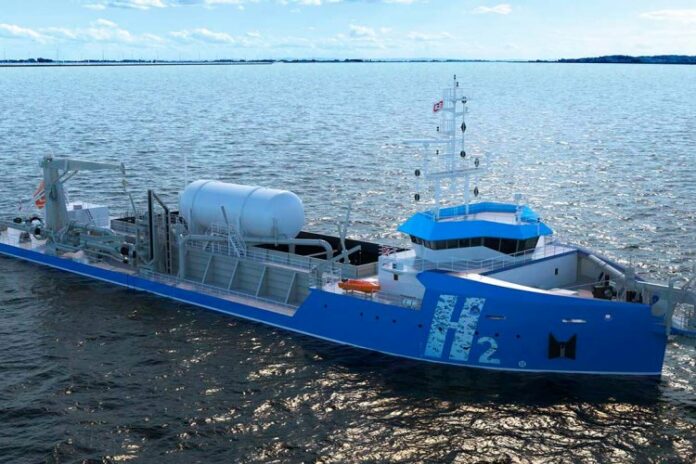
Royal IHC has recently received an ‘approval in principle’ (AiP) from classification society Bureau Veritas for the design of a hydrogen-fuelled trailing suction hopper dredger (TSHD).

In an innovation partnership with the Dutch Rijkswaterstaat, Royal IHC is exploring a new type of vessel referred to as the ‘LEAF’ (low energy adaptive fuel) hopper. 

The AiP from Bureau Veritas means that the proposed design of the vessel, encompassing its features and specifications, has been deemed acceptable in this early stage and that the hydrogen system has been safely integrated. The exploration phase began at the beginning of 2019 with the aim of developing a vessel that can be operational in 2024. 

Rijkswaterstaat has the ambition to become CO2 neutral by 2030, and needed to come up with cost-effective solutions for its coastal protection projects that could significantly reduce CO2 from 2024. 

With this in mind, Royal IHC has been developing a hydrogen-powered TSHD that is designed to be used to maintain the Dutch coastline. The LEAF hopper will contribute to the reduction of greenhouse gas emissions as well as harmful exhaust gas emissions in close proximity to the coast and coastal cities. When operating on hydrogen the vessel emits only water vapour. 

A minimal amount of CO2, SOx, NOx and particulate matter is released only during the construction of the vessel and in producing green hydrogen. In addition, many design features on the LEAF hopper contribute to low energy consumption, including an electric drive train and energy recovery systems.

Major $29 million to modernize the MV Joseph-Savard ferry

0

Recently, a major $29 million contract for the mid-life modernization of the MV Joseph-Savard, a Société des traversiers du Québec (STQ) vessel assigned to the Isle-aux-Coudres – Saint-Joseph-de-la-Rive ferry service, was awarded to Ocean Group shipbuilding and repair sector.

This important project to bring a ship built in 1985 up to current standards will include several phases and has been underway since March 2021. The work includes the replacement of the bow thruster’s diesel engine with a battery- powered electric motor and the replacement of the main engines,  to comply with the new IMO Tier III emission standards. This change of engines will allow a considerable reduction of the ship’s polluting emissions.

The three power generators will be replaced and several systems will beupgraded. These include fire detection, engine room alarm monitoring control (AMS), wastewater treatment unit, heating and ventilation, to name a few.

In addition, major work will be performed to improve the common areas. The passenger lounge will undergo a facelift and enlarged to be more in line with the new customer experience standards that the STQ wishes to offer its passengers throughout its network.

Another important modification will be made on the passenger deck, where new pedestrian ramps will be installed in order to adapt the ship to the infrastructures of the Quebec-Lévis crossing. Once Ocean Group completes this work, the MV Joseph-Savard will officially replace the MV Radisson, which is the relief ship for the Québec-Lévis crossing. This vessel has reached the end of its useful life and can no longer navigate in the ice. Gaining more flexibility and improving the versatility of vessels is one of the strategies adopted by the STQ to make its succession plan more robust.

This contract will allow for a natural partnership with Techsol Marine, which will be responsible for many of the modernization works.

The work began in dry dock at the Isle-aux-Coudres shipyard in March 2021. Thereafter, the vessel will transit to the Québec workshops for work to be done afloat and completed around January 2022. Engineering work was carried out at Concept Naval in preparation for the ship’s dry dock entry.