-3.8 C
New York
Home Blog Page 620

Iberdrola and 50Hertz sign construction agreement for Baltic Eagle offshore substation

0

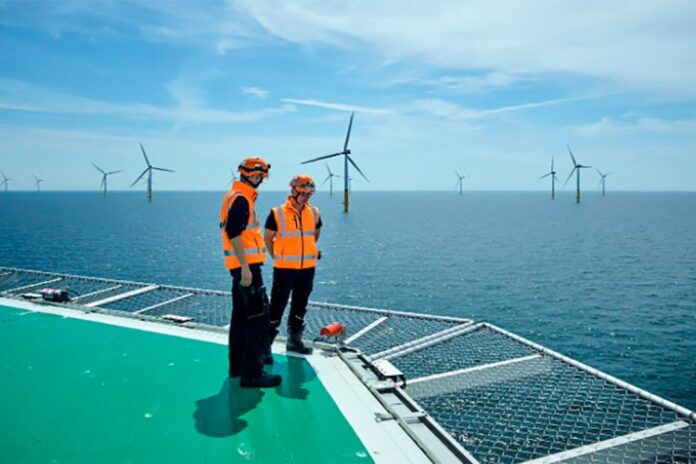
Iberdrola and 50Hertz, the transmission system operator responsible for connecting the Offshore Windfarm to the grid, have signed an agreement to cooperate with regard to the construction, installation and commissioning of the offshore substation (OSS) for Baltic Eagle wind farm being developed in German waters of the Baltic Sea. The jointly used offshore substation will house the technical equipment collecting the electricity produced by the wind turbines and will connect to the onshore transmission grid in Lubmin. 

Iberdrola has further awarded contracts to the joint venture Lemants-Fabricom, responsible for the manufacturing of all structural elements of the substation, and to marine contractor Heerema, who will transport and install the substation on the Baltic Eagle site. Siemens Gas and Power is responsible for the delivery of all main electrical equipment for Iberdrola`s low-voltage part of the OSS.

The substation is made up of a foundation and a topside housing the transformers as well as electrical equipment. The four-legged steel jacket foundation weighs approximately 2,900 tonnes and will be fastened with two hammered piles at each leg. The topside consists of a closed multi-storey module of 5 decks with a total estimated net weight of around 4,250 tonnes. 

Fabrication is already progressing at different locations in Europe and platform manufacturing has already started at Belgian yards. Sail out to the site is planned for 2022, while completion of the off-shore installation and commissioning is expected to take place in 2023.

When the Baltic Eagle wind farm is connected to the grid, the wind turbines will deliver electricity via the inter-array cables to the offshore substation where it is then transformed from 66 kV to 220 kV and transmitted via two high voltage subsea cables across the 90 km distance to the landing point at Lubmin.

The substation is one of the key elements of the windfarm, tasked with collecting and exporting the entire electricity produced by 50 wind turbines – estimated to account for ca. 1.9 TWh per year. With this energy production it will be possible to sustainably meet the demand of 460,000 homes and to avoid the emission of 800,000 tonnes of CO2 into the atmosphere each year.

The Baltic Eagle offshore wind farm is located northeast of the Rügen island off the Mecklenburg-Western Pomeranian coast in the Baltic Sea in a water depth of 40-45 meters. Iberdrola was awarded 476 MW of capacity during the transitional auction held in 2018. 

The wind farm will comprise 50 wind turbines of 9.525 MW capacity to be installed on monopile foundations and will cover an area of 40 km2. Commissioning is expected in 2024. 

A European project fostering industrialization and job creation

Iberdrola and 50Hertz once again confirm their commitment to the “Energiewende” and to sustainable growth in the European Union with the creation of important jobs across the whole value chain while helping to reindustrialize and modernize shipyard facilities.

The combined capacity of 826 MW from Wikinger and Baltic Eagle offshore windfarms underline that investments in renewable energy help to establish sustainable industry with significant growth potential, coupled with the creation of high-quality jobs for German and European companies.
Fratelli Neri holds naming ceremony for three Damen RSD Tugs 2513

0

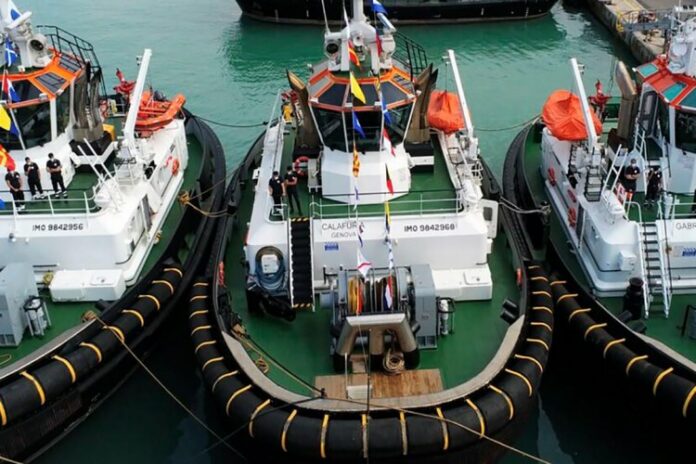
On 15th May, Fratelli Neri held a naming ceremony for three Damen RSD Tugs 2513 in Livorno, Italy. 

Two of the vessels, named Romito and Calafuria were built at Damen Shipyards Galati and were delivered to Fratelli Neri at the end of 2019. Both of these tugs offer 70 tonnes bollard pull in the configuration tractor tug.

The latest addition to the company’s fleet has been named Gabriella Neri, for the wife of Chairman Piero Neri. Damen built the vessel at Damen Song Cam Shipyard and delivered her in Livorno in January this year. This is the most powerful of the three, with 80 tonnes bollard pull.

All three of the tugs are equipped with FiFi1 and feature escort, oil recovery, salvage notation and are fully compliant with Italian Flag regulations.

The design of the RSD Tug 2513 combines characteristics of both tractor and ASD tugs to create a vessel which always sails and operates bow first. For this reason the tug is equally effective at both bow and stern towage operations.

As one of Damen’s Next Generation Tugs Series, the RSD tug 2513 has a focus on offering increased safety, sustainability, reliability and efficiency.

Fratelli Neri managing director Corrado Neri said:

“We are delighted to have taken delivery of Romito, Calafuria and Gabriella Neri from Damen Shipyards. The new tugs’ versatility, high power and low emissions make them an ideal addition to our existing fleet, allowing us to continue to provide the highest standard of service to our customers with safety excellence.”

Damen area manager Antonio Marte said:

“We are honored to once again deliver Damen vessels to Fratelli Neri. These three tugs confirm the long term vision and innovative will of the Neri family. Romito and Calafuria were in fact among the first Damen tugs to feature IMO Tier III readiness for reduction of NOX emissions, the revolutionary Twin Fin concept to provide maximum directional stability and higher towing forces, the resilient mount superstructure to minimise noise and vibration for optimal crew comfort and the Damen Safety Glass to enhance highest safety in operations. Additionally, the Gabriella Neri has the Damen Triton remote monitoring system. With Triton it’s possible to monitor the performance of the vessel in real time from the office, facilitating operational optimisation. I am sure that these three vessels will serve Livorno port extremely well and I look forward to continuing supporting Fratelli Neri going forwards.”

Fratelli Neri, like Damen, is a family company with a long history. Founded by Costante Neri in the 19th century, the company today operates a fleet of over 40 vessels.

American Hellenic Hull Insurance Company joins the Ship Recycling Transparency Initiative

0

The SRTI is a data platform through which shipowners disclose their ship recycling policies, practices and progress, enabling insurance providers, lenders, cargo owners, and other stakeholders to use the data to inform their decision-making and reward good practice through the market.

Ilias Tsakiris, American Hellenic Hull Insurance Company’s Chief Executive Officer, commented:

“American Hellenic Hull is a pioneer in sustainable marine insurance practices and is the first dedicated marine underwriter to sign the United Nations agenda. By becoming a signatory to the Ship Recycling Transparency Initiative family, AHHIC aspires to contribute to the development of a sustainable blue growth strategy for the marine insurance industry. The SRTI plays a pivotal role in the blue economy and we believe the marine insurance industry can make an important contribution by embracing and raising awareness of sustainable ship recycling practices, as part of a stronger overall focus on environmental, social and governance issues.”

Andrew Stephens, Executive Director of the SRTI, said:

“Ship recycling carries with it significant environmental, social, and governance risks, standing out as a material ESG issue for financial stakeholders. Insurers, lenders, and investors have significant leverage to demand transparency on end-of-life policies and practices through the SRTI and drive improvements in the industry. We welcome the American Hellenic Hull Insurance Company to the SRTI community, where they join a growing cohort of financial stakeholders committed to enabling responsible ship recycling through transparency and accountability.”

American Hellenic Hull Insurance Company becomes the 29th signatory to the Ship Recycling Transparency Initiative, joining leading shipowners and other important stakeholders in disclosing its ship recycling policies through the online platform.


Norside Wind chooses SMST’s long term W2W solution

0

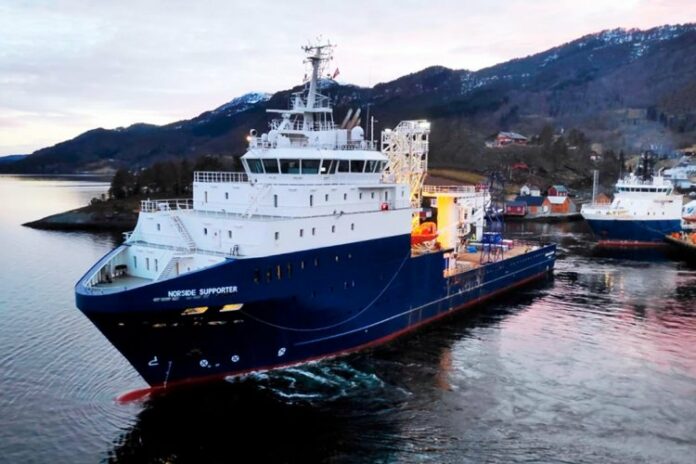
By the end of 2021 the crew of the freshly converted Norside Supporter, a W2W vessel owned by Norside Wind AS, will profit long term from the reliable walk-to-work equipment from SMST. 

Norside Wind AS has recently rewarded SMST a contract for the delivery of a motion compensated gangway combined with an Access & Cargo Tower. A milestone for SMST marking its 10th delivery for this combination of mission equipment to several major ship owners and contractors.

Hans Martin Gravdal, CEO at Norside Wind AS, explains:

“For the conversion of Norside Supporter we were looking for a W2W solution with a “high performance” gangway. The combination of technical solution, delivery time as well as SMST’s track record were the criteria for choosing SMST.”

The gangway, the SMST Telescopic Access Bridge L-Series (TAB-L), with Access & Cargo Tower will guarantee safe transfer of crew and cargo on the current job for Total E&P Danmark A/S as well as for future jobs in offshore wind farms.

The delivery of the modular mission equipment to Norside Wind marks another milestone for SMST. 

Jelle Dijk, Sales Manager at SMST, says:

“The TAB-L with automation packages is longer than the previous delivered gangways and incorporates an updated tower with an electrical height adjustment system.”

Other additions to the equipment that broaden the possibilities of the system are the crane functionality of the gangway and the height adjustment system of 12 meters that operates on both sides of the vessel. 

Jelle Dijk:

“These features offer the opportunity to work in all current and future offshore wind parks. We are very pleased that Norside Wind opted for SMST as their partner for their walk-to-work operations and are looking forward to this new cooperation.”

Sterling PlanB and NYK Trading Corporation ink Japanese ESS distribution agreement

0

NYK Trading Corporation and Sterling PlanB are entering into an exclusive agreement for the sales and distribution of Energy Storage Systems in Japan, bringing new standards of ESS performance and safety to the market.

Energy storage expert, Sterling PlanB has signed an agreement with NYK Trading Corporation, the trading company of the NYK Group, to distribute Sterling PlanB’s energy storage systems in Japan. Sterling PlanB has pioneered the development of energy storage systems (ESS) for use in the maritime industry, and consistently raised performance and safety standards for battery technology.

This move reflects the growing awareness that energy storage technology will be an essential component of the evolution of zero-carbon shipping, both in Japan and globally. Whether in combination with zero-carbon fuels, wind assisted propulsion, or other optimisation solutions, ESS can play a role in peak shaving, managing a hotel load, or supplying emergency power, both increasing performance and safety, and reducing fuel consumption.

This agreement will see Sterling PlanB benefit from the scale and resources of NYK Trading Corporation as an important commercial partner. NYK Trading Corporation is already an established supplier of marine fuel and lubricants oil, and mechanical instrumentation business globally, and strong links with Japanese shipowners, shipyards and technology integrators. This marks the move towards a low-carbon future, in line with NYK Trading Corporation’s investment in developing its solar energy business and other clean technology avenues.

NYK Trading Corporation aims to bring ESS propulsion to small vessels such as tugboats, short distance ferries and merchant vessels in the domestic Japanese maritime market. By using its business network as an established trading house in Japan, the company will establish a strong sales foundation for ESS and fuel cell suppliers and the battery propulsion market as a whole, as the maritime ESS market in Japan remains relatively immature.

Brent Perry, CEO of Sterling PlanB said:

“With many major commercial shipping lines and shipyards based in Japan, we are honored and proud to be joining forces with NYK Trading Corporation to bring our ESS solutions to this market. With their scale and expertise, we look forward to working together to ensure that ESS and battery power is a major part of Japan’s clean shipping future.”

Keiji Tsuchiya, Representative Director, CEO from NYK Trading said: “Sterling PlanB has demonstrated that they are an innovative company that has made safety its top priority. We recognize the urgent need for shipping to reduce its carbon emissions, and as such, look forward to providing our customers with a world leading ESS solution.”

New Incat Crowther 24 motor yacht design Project Elysium

0

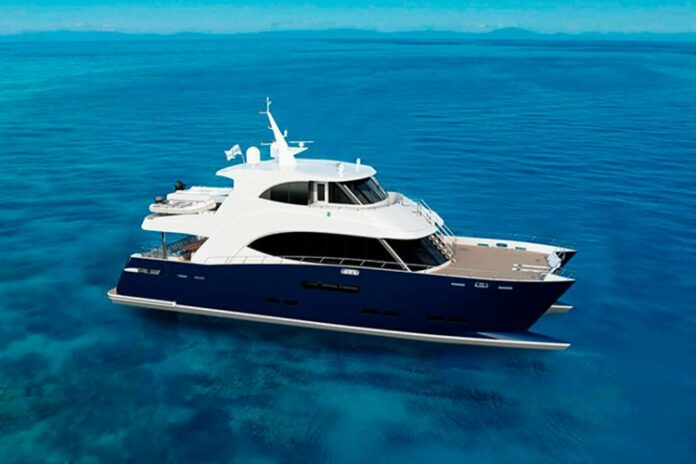
Incat Crowther, in collaboration with the client, has implemented many innovative design solutions to meet a multi-faceted project brief. Benefits of the custom design allow maximum use of spaces for the required purposes and greater efficiency at customer-specified transit speeds.

Incat Crowther supported the client through preliminary design and yard selection phases and will perform production naval architecture, exterior and interior design.

The Incat Crowther 24 offers a full-beam saloon with 360 degrees panoramic view and generous outdoor living spaces. Accommodation includes one master cabin on the main deck, four cabins in the hulls and a captain’s cabin on the wheelhouse deck.

Key features of this vessel include a multifunctional lifting swimming platform that allows easy access to the water and serves as an excellent fishing platform. There is an unmatched main deck open living area and a capable upper deck with room for two sizable tenders.

On the upper deck, a spacious wheelhouse offers a lounge that can accommodate up to five people and three helm chairs. Aft of this is the captain’s quarters plus a day head. Access to the foredeck is provided via a Portuguese bridge layout. Designed for a tropical climate, Elysium has a dedicated multi-zone air conditioning system throughout the vessel.

The proven hull design allows Elysium to operate at an efficient cruising speed of 21 knots while assuring low fuel consumption and great comfort on board. The 2x1150hp Scania DI-16 main engines deliver a top speed of 29 knots. Designed with a practical and functional approach, the vessel offers great manoeuvrability thanks to its layout and the adoption of TwinDisc Express Positioning that administers the gearboxes and main engines with bow thrusters for station-keeping, ease of docking and slow speed manoeuvres. The aluminium hulls will be coupled with a composite superstructure.

Underway, the vessel pitching motions are reduced by twin Humphree active interceptors on the stern whilst at rest a twin anchoring system combines with the widely spaced twin hulls to provide a stable platform that does not require gyro or roll stabilizers.

NYK obtains DNV certification for online cargo-handling training

0

Cargo-handling simulator training for LNG carriers and oil tankers conducted by NYK SHIPMANAGEMENT PTE LTD in an online environment has been certified by DNV, a ship classification association based in Norway. This is the first time in Asia that DNV certification has been obtained for online cargo-handling simulator training for oil tankers.

The DNV certification confirms that the training content follows the guidelines provided in the IMO model courses and that the training is conducted effectively.

The training is provided for seafarers boarding LNG carriers and oil tankers for the first time. It follows the IMO model courses and comprises content unique to NYK Group, including NYK’s safety culture, operational standards, current business conditions, and history. Use of the cargo handling simulator is also included. Before this training was made available, participants would need to travel to the NYKSM training center in Singapore for simulator training. However, a cloud-based cargo-handling simulator now makes training in an online environment possible. All content, including cloud-based cargo-handling simulator training and lectures, can now be provided online in compliance with the IMO model courses. This has made it possible for NYK Group seafarers aboard LNG carriers and oil tankers to complete training without having to travel to Singapore.

NYKSM introduced online ship handling training in September 2020, and afterward added online cargo-handling training for LPG carriers and car carriers. The company is currently working to utilize all resources to introduce online and e-learning options to all types of training. The NYK Group will continue its efforts to train seafarers even during the COVID-19 pandemic to ensure the continuing necessary transport of food, supplies, and energy resources.

Ørsted breaks ground on first renewable hydrogen project

0

Dan Jørgensen, the Danish minister for Climate, Energy & Utilities, led the groundbreaking ceremony of the H2RES project, marking the onsite construction start of Ørsted’s first renewable hydrogen project.

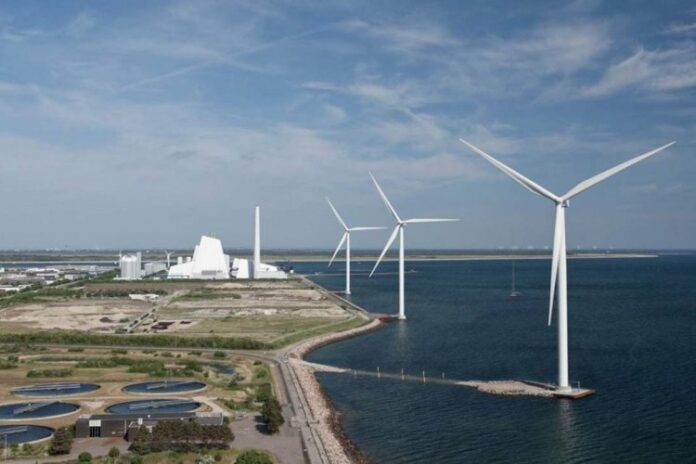
H2RES will have a capacity of 2 MW and will be situated on Ørsted’s premises on Avedøre Holme in Copenhagen. The project will investigate how to best combine an efficient electrolyser with the fluctuating power supply from offshore wind, using Ørsted’s two 3.6 MW offshore wind turbines at Avedøre Holme.

The facility will produce up to around 1,000 kg of renewable hydrogen a day, which will be used to fuel zero-emission road transport in the Greater Copenhagen area and on Zealand. The project is expected to produce its first hydrogen in late 2021.

In less than three years, Ørsted has, with partners, established nine renewable hydrogen projects in Denmark, Germany, the Netherlands, and the United Kingdom so far, spanning from demonstration projects like H2RES to industrial-scale visions like the potentially 1,300 MW ‘Green Fuels for Denmark’ project.

Anders Nordstrøm, Vice President and Head of Ørsted’s hydrogen and PtX activities, says:

“H2RES will be a small, but very important first step in realising Ørsted’s large ambitions for renewable hydrogen, which has fast proven itself as a centrepiece in the green transformation of the European economy to net-zero emissions by 2050. At Ørsted, we believe that renewable hydrogen can become an industrial stronghold of several European economies, including Denmark, while also contributing significantly to bringing down emissions from the hard-to-abate sectors in transport and industry.”

The Energy Technology Development and Demonstration Program (EUDP) under the Danish Energy Agency has previously awarded DKK 34.6 million to the development of the H2RES project to Ørsted, Everfuel Europe A/S, NEL Hydrogen A/S, Green Hydrogen Systems A/S, DSV Panalpina A/S, Hydrogen Denmark, and Energinet Elsystemansvar A/S.

Innovative container vessel receives AiP from Bureau Veritas

0

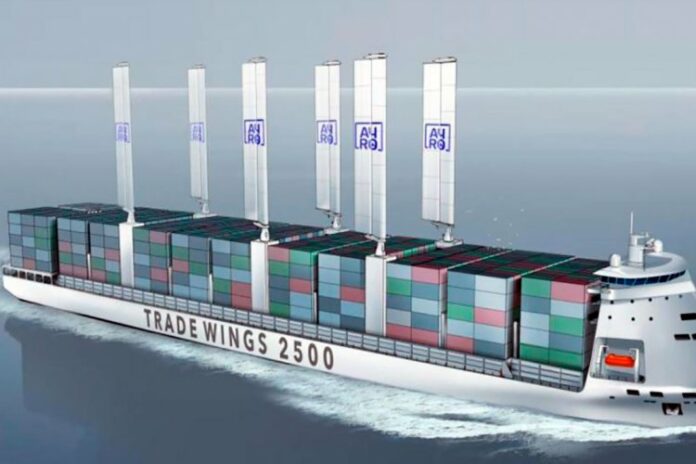
Bureau Veritas has awarded “Trade Wings 2,500”, an innovative 2,500 TEU Container Vessel from VPLP Design (France), Alwena Shipping (France), SDARI (China) and AYRO (France) an Approval in Principle. 

It fosters the combination of a wind-assisted propulsion with six Oceanwings® with an LNG-electric propulsion with pods. The wingsails are installed on a vertical sliding mechanism to retract them partially while the vessel is in port, thus minimizing the impact on cargo operations.  The LNG storage tank is based on GTT’ Mark III containment system and the LNG power plant is designed with pure gas 4-strokes gensets only. This architecture is a flexible platform offering possible upgrade to decarbonated fuels in the future such as Ammonia or Hydrogen.

Suitable to short sea shipping operations or feedering in Europe, Central America, Caribbean Islands and China, the Trade Wings 2,500 can also operate on transatlantic trades. The design minimizes time in port operations, as maneuverability is increased with the Pods, and the hatch coverless design further speeds up cargo operations.

ALEX GREGG-SMITH, Senior Vice-President, Bureau Veritas North Asia:

“Wind-assisted propulsion is a high-potential solution that can contribute to the long-term decarbonization of the marine industry. We have just released new wind propulsion system rules – and this innovative design, approved in principle by BV, including a sliding mechanism, demonstrates the feasibility of wind-assisted propulsion on board container ships with deck space limitations. Benefitting from a coverless hatch and LNG electric pod propulsion, the design provides both operational flexibility, improved efficiency and reduced carbon emissions, complying with, or exceeding, regulatory requirements. Bureau Veritas continues to address the challenges of the energy transition by providing solutions to the safety, risk and performance requirements for innovation in future fuels and propulsion systems.”

On a typical transatlantic route of 4,000 Nm, the Trade Wings 2,500 will save on average 35% CO2-equivalent emissions compared to a conventional design, with a 2-stroke engine, single shaft and without wingsails, at the same speed. Out of these 35% savings, the Oceanwings®  accounts to 57%, the optimized LNG thermal propulsion delivering the remaining 43% savings.

This co-work to design the Trade Wings 2,500 sets the pathway for what could be the low emissions container vessels of the near future.

After reviewing the key drawings, on the 12th of May 2021, Bureau Veritas Marine & Offshore granted an Approval in Principle to the Trade Wings 2500 ‘ basic design.

Research: Water companies are main cause of microplastic pollution in UK’s rivers

0

New research by experts from the University of Manchester has found that the poor management of untreated wastewater and raw sewage by water companies is the main source of microplastic pollution in the UK’s rivers.

Three years ago, the researchers from the University’s Department of Geography were the first to demonstrate high levels of microplastic contamination on the UK’s river beds.

Now, new research published in the journal Nature Sustainability has found that water companies themselves are the cause of this contamination, as they are releasing wastewater during periods of dry weather into river flows that are too sluggish to disperse microplastics downstream.

The quality of river bed habitats underpins the entire river ecosystem because many creatures live, feed and reproduce in this environment—when they are contaminated with microplastics, ecosystem exposure is maximized because the particles are stored on the bed for weeks or months before they are flushed away by flooding. The river bed is the worst place for extended periods of microplastic contamination because it increases opportunities for ingestion by aquatic creatures, and for them to move through the food chain. Microplastics are also vectors for other contaminants present in wastewater.

The researchers say that conventional treatment removes the great bulk of the microplastic load in wastewater—therefore, river beds that are heavily contaminated with microplastics provide a clear indication of poor wastewater management.

The discharge of raw sewage to rivers is already controversial and has generated widespread condemnation. An inquiry into Water Quality in Rivers is currently underway by the UK Parliament’s Environmental Audit Committee. However, the researchers are calling for more to be done to tackle the problem.

Professor Jamie Woodward, who led the research, said:

“Water companies must stop releasing untreated sewage and wastewater into rivers during periods of dry weather, as this causes river beds to be heavily contaminated with microplastics and maximizes habitat damage. Rivers are also the main supplier of microplastics to the oceans—to tackle the global marine microplastic problem, we need to limit their input to rivers.”

“We are asking the water companies to be guided by the science, and to shoulder their responsibilities. We are also calling for stronger regulation from the Environment Agency to police water company discharges.”