-6.4 C
New York
Home Blog Page 584

DNV to study safety implications of offshore green hydrogen production facility

0

DNV will lead the process safety study to identify the main environmental, safety and operational risks for the world’s first offshore hydrogen production facilities.

Lhyfe, a producer and supplier of green and renewable hydrogen for transport and industry, and Centrale Nantes, is a French School of engineering and research centre, and manages SEM-REV offshore test site.

Lhyfe and Centrale Nantes’ ambitious goal is to make offshore renewable hydrogen a reality, by demonstrating the reliability of an offshore electrolyser. It represents a world-first at a time when initiatives for offshore green hydrogen production are emerging across Europe.

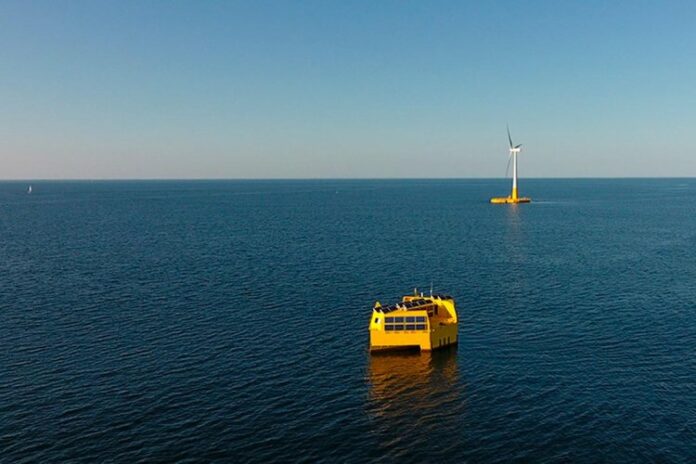
Located off the coast of Le Croisic, France, the green hydrogen-generating system is intended to be powered by electricity from a floating wind turbine, with a target start-up date in 2022.

As part of the design of the new facility, DNV’s experts will undertake workshops and technical sessions to identify and analyse the main environmental, safety and operational risks associated with the project.

Santiago Blanco, Executive Vice-President and Regional Director Southern Europe, MEA and LATAM, Energy Systems at DNV says:

“This is potentially a watershed project, one we are excited to be supporting during the FEED stage. Proving the safety of such activities, particularly with new technologies, to gain acceptance and move them closer to adoption, is vital for the industry and stakeholders.”

“Working with Lhyfe and Centrale Nantes to further their ambitions is something we are pleased to announce, as we believe green hydrogen at-scale is the ultimate destination for the future of energy storage.”

Risks which will be investigated by DNV include the floating barge, fuel cells and hydrogen production. A regulations and standards review will also be included as part of the study.

The offshore electrolyser will be installed on GEPS Techno’s floating platform and connected to the various sources of Marine Renewable Energy (MRE) available on the offshore test site, including the Floatgen floating wind turbine. This unique production process only emits oxygen, no CO2 during the operation. Centrale Nantes is also making its research facilities available and providing support for the various regulatory, experimental and logistical phases to ensure a successful outcome.

Hydrogen is a unique energy carrier with no carbon emissions that can be used for long-term storage and heating applications. By using electricity generated from renewable sources such as wind, the resulting energy carrier is carbon-free ‘green’ hydrogen. The economically viable use of green hydrogen becomes feasible due to the increasing penetration of wind and solar power in the years to come.

Damen Shipyards Den Helder completes modernisation of HNLSM Snellius

0

Damen Shipyards Den Helder has returned the HNLMS Snellius to the Royal Netherlands Navy (RNLN) following her midlife upgrade. The hydrographic survey vessel required a complex and diverse scope of work taking almost a year to complete. 

The Defensie Materieel Organisation (DMO, the Defense Materiel Organisation of the Dutch Ministry of Defence) and the Directie Materële Instandhouding (DMI – the Directorate for Materiel Conservation) were responsible for this major maintenance work on the ship. They commissioned the yard in Den Helder to carry out both the mid-life update and the necessary multi-annual maintenance simultaneously. Part of the project was carried out in the covered dock of Damen Shiprepair in Harlingen.

The assignment was carried out in close collaboration with numerous partners from the Dutch maritime industry, such as Nevesbu, Wartsila, Braspenning, Eekels, RH Marine, Bakker Sliedrecht and Kongsberg. Many of the platforms and Sewaco systems were replaced or overhauled during the project. A number of works were also carried out to prepare the fifteen-year-old vessel for the second half of her lifecycle.

The assignment was carried out in close collaboration with numerous partners from the Dutch maritime industry, such as Nevesbu, Wartsila, Braspenning, Eekels, RH Marine, Bakker Sliedrecht and Kongsberg. Many of the platforms and Sewaco systems were replaced or overhauled during the project. A number of works were also carried out to prepare the fifteen-year-old vessel for the second half of her lifecycle.

HNLMS Luymes (A803) and HNLMS Snellius (A802), which came into use in 2003 and early 2004, marked the beginning of a new chapter for the Dutch Hydrographic Service. The two hydrographic survey vessels, which are equipped with the most modern technology in hydrography, have the important task of mapping the seabed. They do this in particular in the North Sea and parts of the Caribbean. The ships were built by Damen Schelde Naval Shipbuilding (DSNS) with, as usual, a strong participation from the Dutch maritime industry. More than 80% of the purchase value was awarded to Dutch maritime suppliers, including various small and medium-sized companies.

The delivery of HNLMS Snellius, HNLMS Pelikaan, HNLMS Luymes brings to a successful conclusion a series a large-scale mid-life upgrade projects.

Neptune Energy’s wells digitised with gaming tech to enhance production

0

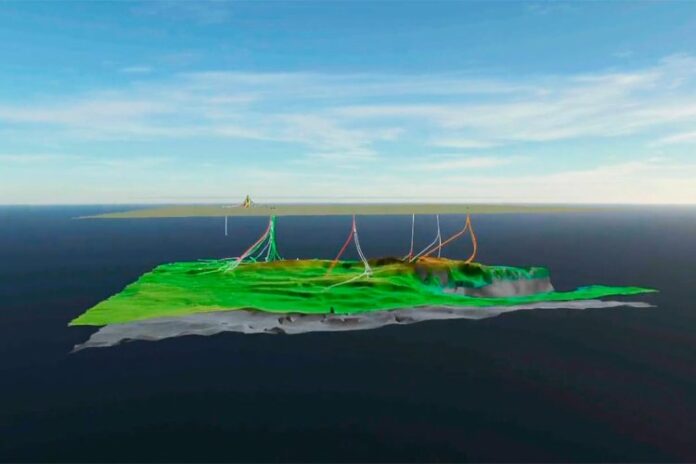
Neptune Energy today announced the digitalisation of its portfolio of subsea wells in Norway, using an innovative data visualisation platform based on 3D gaming technology to enhance drilling and production efficiency, and reduce time and costs.

The developer’s GeologiQ cloud-based software combined raw E&P data in 3D and 2D environments and used 3D gaming technology to enable Neptune’s drilling and wells teams to visualise both historical and live data to improve well design and incorporate learnings in future operations.

Neptune Energy’s Director of Drilling & Wells for Norway, Thor Andre Løvoll, said:

“By digitalising all subsea wells within our Norwegian portfolio we have greatly improved our ability  to plan interventions, monitor drilling and production operations in real-time and gain better understanding of the wells’ history.

“Investing in innovations such as these improves efficiency by enhancing communication, interaction and decision-making across our business.”

This latest digital innovation for Neptune’s assets follows the creation of digital twins of several of its operated platforms in the Norwegian, UK and Dutch sectors of the North Sea, enabling offshore site inspections and maintenance planning to be carried out from onshore.

Neptune has also implemented Virtual Reality technology, originally developed to train astronauts travelling to the International Space Station, on the Neptune-operated Gjøa platform.

Neptune Energy’s Chief Information Officer, Kaveh Pourteymour, added:

“The goal of our digitalisation strategy at Neptune is simple: it’s how, through technology and digitisation, we can support production efficiency and growth. By applying technologies smartly, we can maximise efficiencies and reduce waste in every area of our business.”

15,000-dwt asphalt carrier to be equipped with SCHOTTEL EcoPellers

0

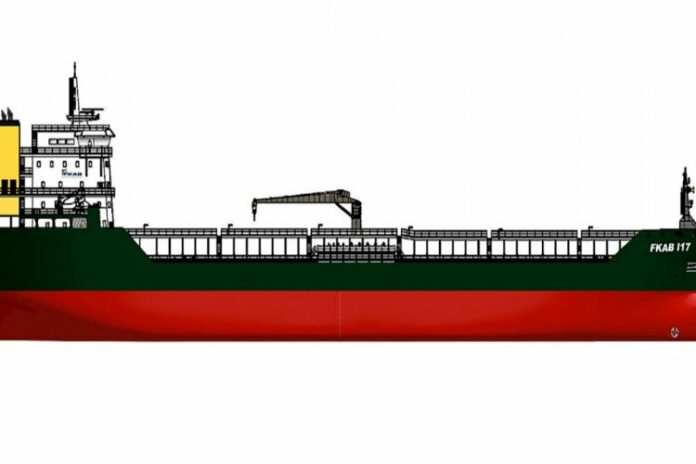
The 15,000-dwt asphalt carrier will be driven by two highly efficient SCHOTTEL EcoPellers and one TransverseThruster. Designed by Swedish FKAB Marine, the vessel will be deployed in West Africa for asphalt transportation services.

The main propulsion of the carrier consists of two electrically driven SCHOTTEL EcoPellers type SRE 560 (2,050 kW each), featuring fixed pitch propellers with a diameter of 3.1 metres. With this configuration, the 145.8-metre-long and 26.2-metre-wide vessel will achieve a maximum speed of 13.55 knots at design draft. Beyond this, one SCHOTTEL TransverseThruster type STT 2 (600 kW) will ensure maximum manoeuvrability.

Thanks to the particularly effective combination of powerful propeller thrust and course-stabilizing fin, the SCHOTTEL EcoPeller fulfils all the requirements of a modern high-performance propulsion unit. The hydrodynamically optimized design allows the SRE to produce maximum steering forces and enables top values in terms of overall efficiency and course stability. This reduces fuel consumption and ensures both lower operating costs and emissions.

Model tests carried out at the maritime consulting company SSPA Sweden confirm the outstanding performance of the EcoPeller: when compared to a conventional rudder propeller with nozzle, it demonstrated a remarkable 17% increase in propulsion efficiency at an operational ship speed of 12.5 knots throughout testing.

To achieve the maximum ship speed of 13.55 knots at design draft, the SRE requires 11 % less propulsion power than a conventional rudder propeller with nozzle.

World first as WindFloat Atlantic windfarm is classed by ABS

0

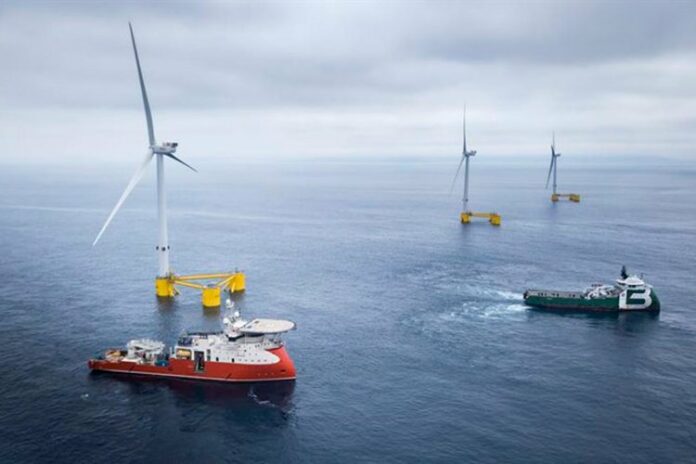
The three ABS-classed, SEMI Submersible Type units designed by Principle Power housing MHI Vestas turbines make a total of 25 MWs of floating offshore wind power. 

WindFloat Atlantic, of which Ocean Winds is the majority shareholder, is continental Europe’s first larger scale floating wind farm, 20 kilometers off the coast of Viana do Castello, Portugal.

Matt Tremblay, ABS Senior Vice President, Global Offshore, said:

“It’s a historic first and, we believe, the first of many more to come. ABS has made a significant contribution both to this project and the development of offshore floating wind in Portugal.  It underscores the potential of Class and industry working together for the safe adoption of new technologies. ABS has supported innovation in offshore energy since 1958. This landmark project underlines how we continue to support promising offshore technology more than 60 years later.”

Jose Pinheiro, Ocean Winds Southern Europe BU Country Manager, said:

“The WindFloat Atlantic project is again showing its technology reliability. Having achieved formal ABS classification for the three floating platforms is therefore an important milestone for the project shareholders and also for the offshore floating wind industry.”

The landmark is the latest step in a journey that began with the earliest days of floating wind in Portugal when ABS supported development of the 2MW WindFloat 1 that was installed in 2012.

The WindFloat Atlantic project is developed by the Windplus consortium, which is jointly owned by Ocean Winds (50:50 JV owned and created by EDP Renewables and ENGIE), Repsol, and Principle Power Inc. 

Thanks to their floating foundations, floating offshore wind farms are not subject to the same depth restrictions as fixed structures and can be at any depth.  With the development of larger turbines above 10 MWs and research focused on shallow water moorings, the floating technology may even be an alternative to traditional bottom- founded technologies in intermediate water depths in the future.

Crowley will build and operate the first fully electric U.S. tugboat

0

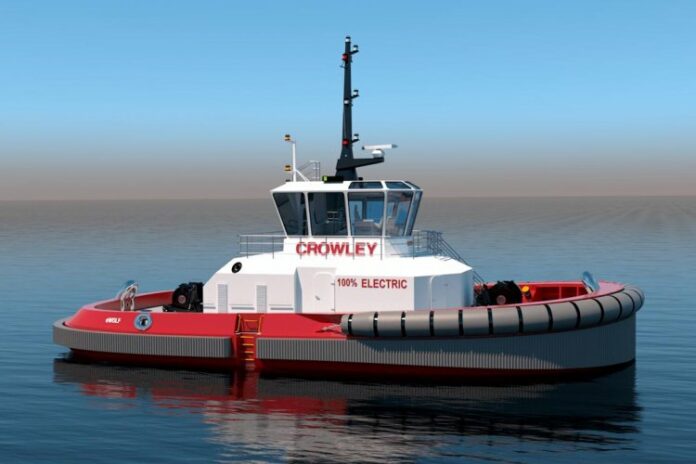
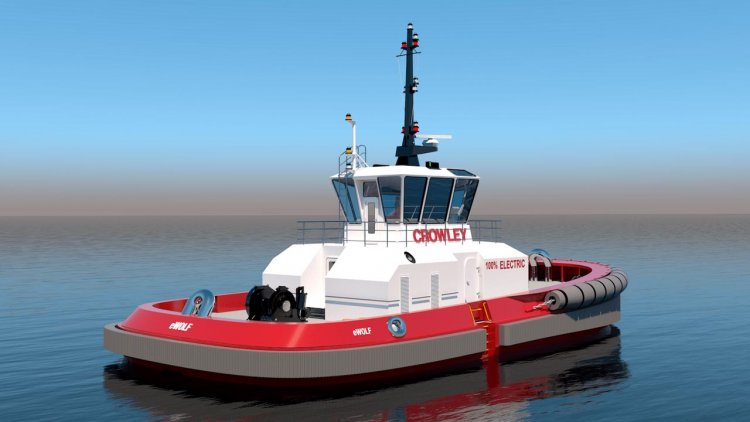
Crowley Maritime Corporation will lead the next generation of industry sustainability by building and operating eWolf, the first all-electric powered harbor tugboat that can complete a job without expending a drop of fuel.

Tom Crowley, company Chairman and CEO, said:

“With this groundbreaking tug design, our team continues to embrace our role as leaders in the maritime industry while providing our customers with innovative and sustainable solutions done right.”

The 82-foot vessel with 70 tons of bollard pull advances Crowley and the maritime industry’s efforts toward sustainability and decarbonization. Over the first 10 years of its use, the operation of the new eTug will reduce 178 tons of nitrogen oxide (NOx), 2.5 tons of diesel particulate matter, and 3,100 metric tons of carbon dioxide (CO2) versus a conventional tug. The electric tug will replace one that consumes more than 30,000 gallons of diesel per year. 

The eTug will be built by Master Boat Builders in Coden, Ala., utilizing the design and on-site construction management by Crowley Engineering Services and its recently integrated Jensen Maritime naval architecture and marine engineering group. The eTug’s battery system will be charged at a specially designed, shoreside station developed with Cochran Marine.

Chairman Michael Zucchet of the Port of San Diego Board of Port Commissioners, said:

“Crowley’s first-of-its-kind electric tugboat is a game changer. It checks all the boxes by providing environmental, economic, and operational benefits for our communities and maritime industry. We are proud to work with Crowley and couldn’t be more pleased the eWolf will operate exclusively on San Diego Bay.”

The eWolf will feature a design that allows the vessel to operate fully electric with full performance capabilities – and zero carbon emissions. The eTug will feature a fully integrated electrical package provided by ABB. With 360-degree visibility, the eTug will also feature ABB’s artificial intelligence technology (AI) to increase safety and efficiency for mariners and provide sustainable performance with the reliability that customers demand.

Garrett Rice, president of Master Boat Builders, said:

“This vessel will set a standard in the U.S. maritime industry for sustainability and performance, and its zero-emissions capability and autonomous technology will benefit the environment and the safety of mariners and vessels.”

The eTug will be a result of a partnership among Crowley, the San Diego County Air Pollution Control District, the California Air Resources Board, the Port of San Diego, the U.S. Environmental Protection Agency and the U.S. Maritime Administration, which all provided financial support and other resources.

Mathematical model predicts the movement of microplastics in the ocean

0

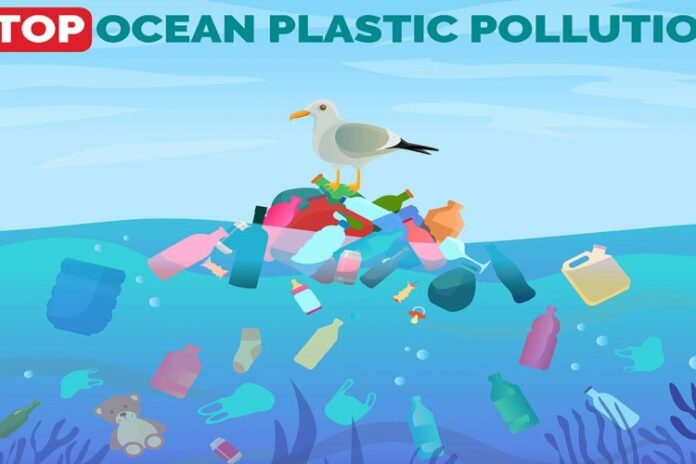
Research led by Newcastle University’s Dr. Hannah Kreczak is the first to identify the processes that underpin the trajectories of microplastics below the ocean surface. 

Publishing their findings in the journal Limnology and Oceanography the authors analyzed how biofouling—the accumulation of algae on the surface of microplastics, impacts the vertical movement of buoyant particles.

The researchers found that particle properties are the biggest factor in determining the period and characteristics of the repetitive vertical movement below the surface, while the algal population dynamics determine the maximum depth reached.

Their findings also show that the smallest particles are extremely sensitive to algal cell attachment and growth, suggesting they are always submerged at depths surrounding the base of the euphotic zone, the layer closer to the surface that receives enough light to support photosynthesis, or could become trapped in large algal colonies.

In general, the results suggest that a higher concentration of biofouled microplastic is expected to be found subsurface, close to the euphotic zone depth rather than at the ocean’s surface.

Microplastics (fragments with a diameter smaller than 5mm) make up 90% of the plastic debris found at the ocean surface and the amount of plastic entering our ocean is significantly larger than the estimates of floating plastic on the surface of the ocean. However, it is not exactly known what happens to these particles once they enter the ocean, and 99% of microplastics within our ocean are considered missing.

This new model has the potential to understand the distribution of fouled plastics in the ocean and therefore the ecological impact, particularly in areas of high concentration.

Dr. Kreczak, EPSRC Doctoral Prize Fellow at Newcastle University’s School of Mathematics, Statistics and Physics, said:

“Mathematical modeling has been extremely beneficial in identifying hot-spots for marine plastic pollution on the ocean surface. I hope this research can be a constructive step in understanding the impact plastic pollution has below the surface and aid in the effort towards a more sustainable ocean.”

Co-Author Dr. Andrew Baggaley, Lecturer in Applied Mathematics at the School of Mathematics, Statistics and Physics, added:

“This is an exciting first step in our project to develop a comprehensive modeling framework to understand the transport of microplastic particles and their distribution in the oceans.”

Future research by the team will focus on the fluid motion in the ocean mixed layer, to allow for even more complete assessment of microplastic vertical distributions in the ocean.

Wärtsilä launches test programme towards carbon-free solutions with hydrogen and ammonia

0

Full-scale engine tests have been recently carried out in Wärtsilä’s engine laboratory in Vaasa, Finland, to assess the optimum engine parameters for running on these fuels. The test results are very encouraging, with one test engine performing very well when running on a fuel with 70% ammonia content at a typical marine load range. Tests were also completed successfully on another engine in pure hydrogen operation. 

Testing will continue throughout the coming years with the aim of defining the most feasible internal combustion engine-based solutions for power plant and marine applications, thereby enabling the transition to a decarbonised future with green fuels. 

For the energy market, Wärtsilä expects to have an engine and plant concept for pure hydrogen operation ready by 2025. For the marine market, the company expects to have an engine running on an ammonia blend already this year. Wärtsilä anticipates having an engine concept with pure ammonia fuel in 2023. In the energy sector, it is anticipated that green hydrogen will deliver 7 percent of the global energy demand by 2050.

Wärtsilä is also developing ammonia storage and supply systems as part of the EU’s ShipFC project. The company has already gained significant experience with ammonia from designing cargo handling systems for liquid petroleum gas carrier vessels, many of which are used to transport ammonia. In addition, Wärtsilä will begin testing ammonia in a marine four-stroke combustion engine together with customers Knutsen OAS, Repsol Norway and Equinor at the Sustainable Energy Catapult Centre in Stord, Norway, as part of the Demo2000 project.

Wärtsilä’s fuel agnostic approach enables the company to support the energy and marine sectors on how to shape sustainable, and efficient, future fuel strategies in several cost-optimal steps. For example, hydrogen can be used as a fuel in its existing state or as a raw material for producing a wide range of future fuels, including ammonia and synthetic methane, each of which has different benefits for industrial and mobility applications. Wärtsilä’s gas engines are highly flexible and are capable of rapidly ramping up or down in power. When wind and solar power vary with weather conditions, Wärtsilä engines can support the power system by ramping up power to meet the required load, reaching full capacity in under two minutes

The company’s engines can currently run on natural gas, biogas, synthetic methane or hydrogen blends of up to 25% hydrogen. Another important part of the way forward is that Wärtsilä engines will be capable of transitioning to future fuels, including pure hydrogen and ammonia, future-proofing customer assets.

Håkan Agnevall, CEO of Wärtsilä said:

“For electricity generation, the amount of renewables globally is growing rapidly, which is vital for being able to comply with the Paris Agreement. To achieve the transition to 100% renewable energy by the middle of the century, a significant amount of flexible balancing power is needed as a complement to ensure stable energy supply, when the sun is not shining or the wind is not blowing. There will be different balancing power technologies, but combustion engines and battery storage will be part of the core solutions. By developing engines that can run on green hydrogen, we are enabling that grid balancing can be done via a 100% renewable process, thereby enabling the energy systems of tomorrow.”

Mikael Wideskog, Director of Sustainable Fuels and Decarbonisation at Wärtsilä Marine Power, commented:

“Wärtsilä is united in its aim of limiting climate change to below 2 degrees, and the development of engines capable of running on future fuels is crucial to that. The International Maritime Organization (IMO) has set a target to reduce total greenhouse gas emissions from shipping by 50 percent by 2050, compared to 2008 levels. In addition, a target has been set to reduce the carbon intensity of shipping by 40 percent by 2030, thus emphasising the need for the rapid introduction of existing and new smart technologies. Our successful engine testing will help us to consider a variety of future fuels and determine the optimum use case for each sustainable fuel.”

ABL supports ONGC’s 36 drilling rigs moved pre-monsoon

0

AqualisBraemar LOC (ABL), the energy and marine consultants assisted with ONGC’s rig moves. The moves were conducted using ABL’s specialist team of mariners supported by their structural and geotechnical engineers, worked in close cooperation with ONGC’s in-house rig move cell.

Despite the severe constraints caused by the Covid-19 lockdown in India and Cyclone Tauktae, ONGC has safely and successfully moved all 36 offshore jack-up rigs to new drilling locations, which was a new record for the three months leading up to the adverse weather conditions associated with the Indian monsoon season.

Rodger Dickson, global managing director of offshore marine operations at ABL, says:

“Moving so many rigs to new locations before the onset of the south west monsoon is always an annual challenge, but it was an immense achievement this year considering the travel limitations and constraints caused by the Covid-19 lockdown in India and with the development of Cyclone Tauktae during the last week of the rig moving season.”

Each of the 36 rigs were placed at their respective monsoon locations before the onset of the seasonal adverse weather conditions. Of these, 19 rigs were moved on to or from wellhead platforms and 16 rigs to open locations and 1 to dry dock. The combined total towing distance for all rigs was approximately 3,700 nautical miles and one jack up rig was towed from the west to east coast of India during this campaign.

Under this agreement, AqualisBraemar LOC group provides marine warranty services to ONGC’s fleet of jack-ups and mobile offshore production units in Indian waters.

Petrofac grows EPC provision for ONEgas

0

Petrofac’s Engineering and Production Services (EPS) business continues to expand its UK EPC portfolio with a new three-year contract with ONEgas, an integrated cross-border asset between Shell UK and the Nederlandse Aardolie Maatschappij.   

The agreement comes with two one-year options to extend. The contract builds on Petrofac’s previously awarded Framework Agreement, enabling delivery of Engineering, Procurement and Construction (EPC) services across the Operator’s Southern North Sea portfolio. The framework positions Petrofac to support the Clipper South complex, Leman Alpha assets, Bacton Terminal, and ONEgas Barge campaigns in the Southern North Sea.

Nick Shorten, Chief Operating Officer of Petrofac Engineering and Production Services, said:

“We are very pleased that ONEgas has demonstrated its continued confidence in our teams in Great Yarmouth and Aberdeen, by increasing our service provision.

““Over the last 18 months Petrofac’s UK brownfield projects business has achieved notable growth. Our best-in class engineering teams, scalable delivery model and project control systems are now being deployed in support of more than 30 assets in the UK. We look forward to continuing this trajectory in 2021 as clients continue to focus on asset integrity, facility modifications and development projects.”