-2.6 C
New York
Home Blog Page 552

ExxonMobil announces discovery at Pinktail, offshore Guyana

0

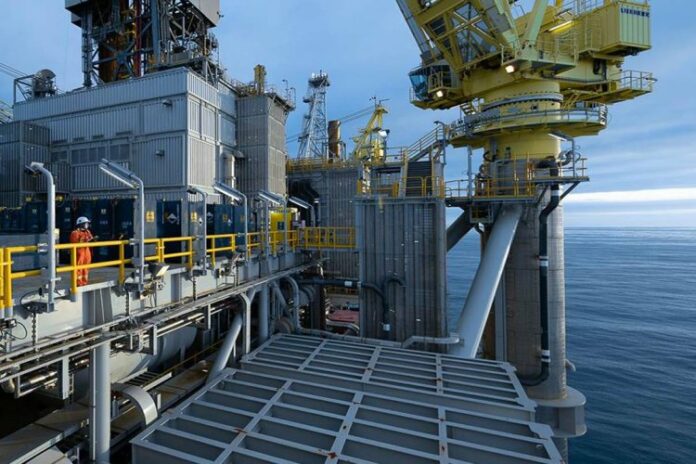
The Pinktail well encountered 220 feet (67 meters) of net pay in high quality hydrocarbon bearing sandstone reservoirs. 

In addition to successful appraisal of the Turbot discovery, the Turbot-2 well encountered 43 feet (13 meters) of net pay in a newly identified, high quality hydrocarbon bearing sandstone reservoir separate from the 75 feet (23 meters) of high quality, oil bearing sandstone reservoir pay encountered in the original Turbot-1 discovery well. This follows the additional pay in deeper reservoirs encountered at the previously announced Whiptail discovery. These results will be incorporated into future developments.

Mike Cousins, senior vice president of exploration and new ventures at ExxonMobil, said:

“These discoveries are part of an extensive well program in the Stabroek Block utilizing six drillships to test play extensions and new concepts, evaluate existing discoveries and complete development wells for the Liza Phase 2 and Payara projects. Our exploration successes continue to increase the discovered resource and will generate value for both the Guyanese people and our shareholders.”  

Separately, the Liza Unity floating production storage and offloading (FPSO) vessel set sail from Singapore to Guyana in early September. The FPSO will be utilized for the Liza Phase 2 development and is expected to begin production in early 2022, with a capacity to produce approximately 220,000 barrels of oil per day. ExxonMobil anticipates at least six projects online by 2027 and sees potential for up to 10 projects to develop its current discovered recoverable resource base. The Liza Destiny FPSO vessel is currently producing approximately 120,000 barrels of oil per day.

The Pinktail discovery is located approximately 21.7 miles (35 kilometers) southeast of the Liza Phase 1 project, which began production in December 2019, and 3.7 miles (6 kilometers) southeast of Yellowtail-1. Pinktail was drilled in 5,938 feet (1,810 meters) of water by the Noble Sam Croft. The Turbot-2 discovery is located approximately 37 miles (60 kilometers) to the southeast of the Liza phase one project, and 2.5 miles (4 kilometers) from the Turbot-1 discovery announced in October 2017. Turbot-2 was drilled in 5,790 feet (1,765 meters) of water by the Noble Sam Croft. 

The Stabroek Block is 6.6 million acres (26,800 square kilometers). ExxonMobil affiliate Esso Exploration and Production Guyana Limited is operator and holds 45 percent interest in the Stabroek Block. Hess Guyana Exploration Ltd. holds 30 percent interest and CNOOC Petroleum Guyana Limited holds 25 percent interest.
Sembcorp to execute front-end engineering design work for Dorado FPSO project

0

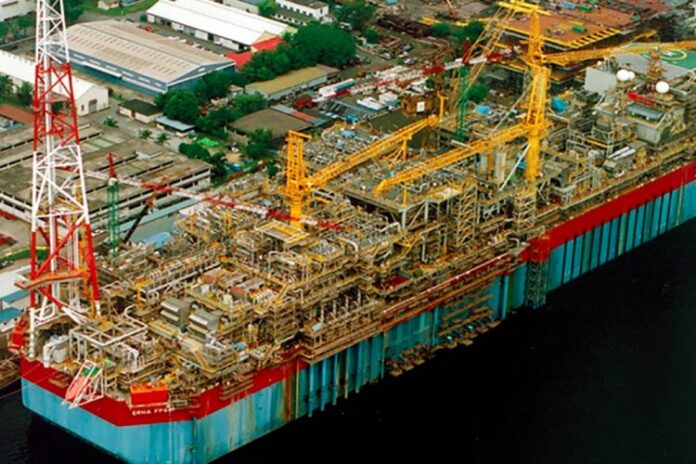
Sembcorp Marine Ltd, through its wholly-owned subsidiary, Sembcorp Marine Rigs & Floaters Pte Ltd, has secured an exclusive contract from Altera Infrastructure GP LLC, to undertake the Front-End Engineering Design (FEED) work for the Floating Production, Storage and Offloading (FPSO) facility for the Dorado project.

Located in the Bedout Sub-basin, offshore Western Australia, Dorado is an integrated oil and gas project which is expected to have an initial oil production of 75,000 to 100,000 barrels per day, with subsequent development of significant gas resources. Operated by Australian energy company, Santos Ltd, Dorado will be one of the lowest emission intensity oil and gas projects in the region, given its very low CO₂ reservoir with approximately 1.5 per cent CO₂ and plans for the reinjection of gas in the initial phase.

Sembcorp Marine Head of Rigs & Floaters Mr William Gu said:

“We are excited to work with Altera Infrastructure and Santos to develop Dorado. The award of the FEED contract affirms Sembcorp Marine’s engineering, procurement and construction (EPC) capabilities, and reinforces our credentials as a leading engineering solutions provider for the offshore, marine and energy industries.”

The FEED work is expected to be completed by the second quarter of 2022. This is the Group’s third EPC project in collaboration with Altera Infrastructure, following the successful delivery of FPSO Pioneiro de Libra and FPSO Petrojarl Cidade de Itajai in 2017 and 2012 respectively.

The FEED contract is not expected to have any material impact on the net tangible assets and earnings per share of the Group for the year ending 31 December 2021.

AD Ports Group and CMA CGM invest in new terminal at Khalifa Port

0

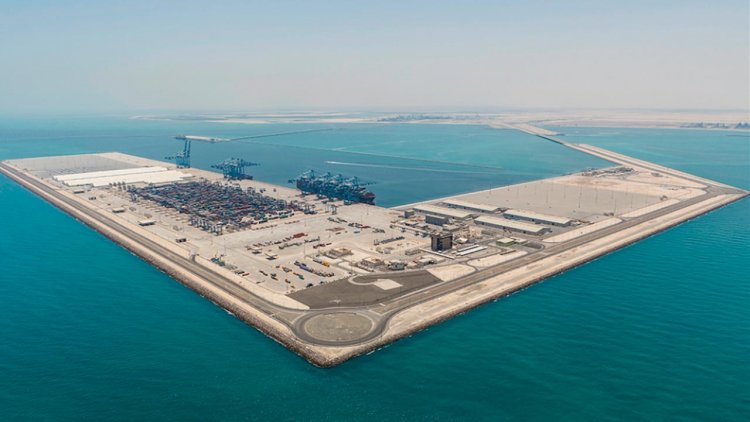
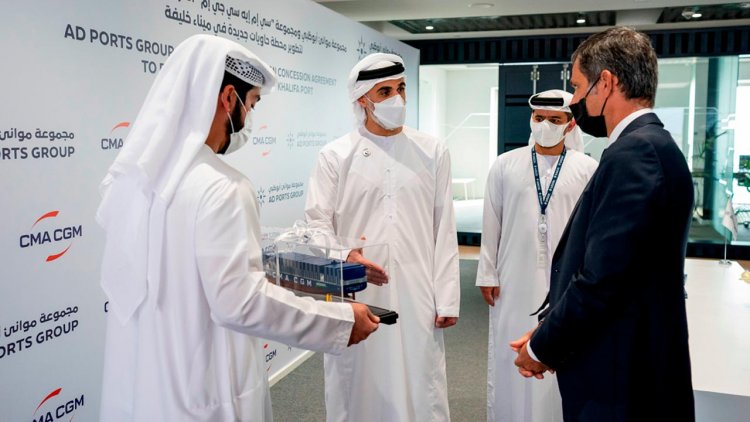
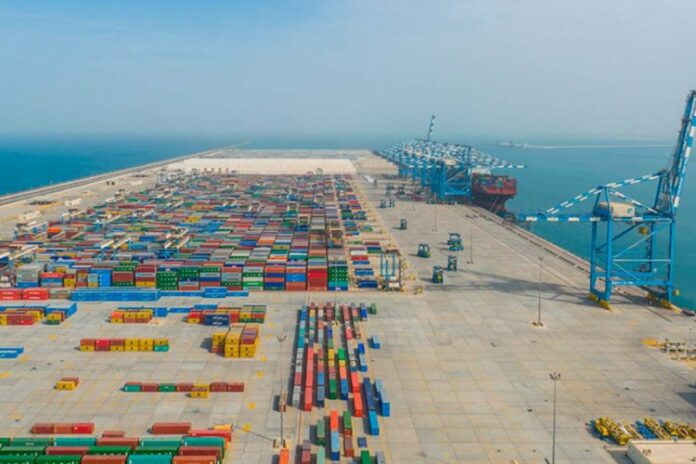
A new terminal will be established in Khalifa Port, the first semi-automated container port in the GCC region, which will be managed by a joint venture owned by CMA CGM’s subsidiary CMA Terminals (with a 70 percent stake) and AD Ports Group (30 percent stake). The partners are expected to commit approximately AED 570 million (USD 154 million) to the project.

With construction starting in 2021, the new terminal is set to be handed over in 2024 with, in phase 1, an initial quay length of 800 metres and an estimated annual capacity of 1.8 million TEUs. AD Ports Group will be responsible for developing a wide range of supporting marine works and infrastructure. This includes up to a total of 1,200 metres of quay wall, a 3,800-metre breakwater, a fully built-out rail platform, and 700,000sqm of terminal yard.

The terminal will provide CMA CGM with a new regional hub and will enable the Group to develop its service offering between Abu Dhabi and South Asia, Western Asia, East Africa, Europe and the Mediterranean as well as the Middle East and the Indian sub-continent.

With this major investment, the CMA CGM Group pushes ahead with its global expansion strategy as a leading terminal operator. The Group currently operates 49 port terminals in 27 countries via its subsidiaries CMA Terminals and Terminal Link.

CMA CGM Group is the third of the world’s top-four shipping entities to join forces with Abu Dhabi’s leading facilitator of trade, logistics and industry. The UAE and Abu Dhabi’s central geographical location, at the center of international trade routes, enables the CMA CGM Group to implement strategic development plans.

H.E. Falah Mohammed Al Ahbabi, Chairman of AD Ports Group, said:

“This landmark agreement with the CMA CGM Group is a prime example of those continued efforts and one that will significantly accelerate trade and the development of industry in the UAE and beyond.”

“As well as driving increased trade volumes through our port and elevating the UAE’s economic development, we expect the facility’s capacity and added trade links with other high-profile port destinations will drive investment into local businesses and our industrial zones, fast-track the development of key sectors including manufacturing and logistics, and raise demand for manpower.”

“This agreement will aid us to realise our long-term ambitions to become a top 10 ports, industrial, and logistics operator by expanding our capacity and growth across the region and beyond. In all, we project that over the next five years the CMA Terminals joint venture will drive the further development of the Khalifa Industrial Zone Abu Dhabi (KIZAD), while simultaneously contributing significantly to the national GDP.””

Captain Mohamed Juma Al Shamisi, Group CEO, AD Ports Group, said:

]“With the addition of another leading worldwide shipping group company, will make Khalifa Port a hub for three of the world’s top four shipping companies. This addition creates opportunities to open trade routes to new markets in Europe, Africa, Western Asia, and South Asia. At home, we expect the presence of the shipping line terminal, which will link directly to Khalifa Port’s upcoming rail terminal and utilise its services, to accelerate trade flows moving in and out of the UAE, while also encouraging CMA CGM Group’s customers to consider establishing a presence in Abu Dhabi.”

Rodolphe Saadé, Chairman and Chief Executive Officer of the CMA CGM Group, said:

“The ambitious project we are launching in Abu Dhabi marks an important milestone in CMA CGM’s development strategy in the region.

This state-of-the-art terminal will contribute to enhancing Khalifa Port’s position as a leading global hub and to boosting the region’s economy, accelerating trade flows in and out of Abu Dhabi.

It will also enable our Group to expand its shipping and logistics network in the region, where we see a lot of growth potential.”

Wärtsilä advances carbon storage in maritime as part of LINCCS consortium

0

The LINCCS project is focused on reducing costs for new carbon storage facilities by 70% and advancing the development of carbon capture technologies in a range of sectors. This week, it was announced that the LINCCS consortium would receive 111m Norwegian kroner to support the funding over the next three years from the Norwegian government’s Green Platform Initiative.

Carbon capture technology can be a significant enabler for decarbonization of the maritime industry. In recognition of this one of the major work-streams of the LINCCS project is to bring to market a maritime CCS solution. Wärtsilä will lead this work-stream with support from the Sustainable Energy Catapult Center and SINTEF Energy. This contribution will join wider, cross-industry CCS developments from project partners including Aker Solutions, Cognite, Aize, AGR, OpenGoSim, Wintershall Dea, Vår Energi, Lundin, Equinor and TotalEnergies.

To support CCS technology development, Wärtsilä Exhaust Treatment will expand its engineering facility in Moss, Norway to develop, test and verify the CCS solutions. This will bring the technology to a maturity level where it can be piloted in full scale on a vessel.

The project will be supported with complimentary knowledge from across the Wärtsilä group. With years of work in both exhaust gas abatement technology and cryogenic gas handling systems, the organisation is well placed to support the full infrastructure chain of carbon capture and storage, from exhaust to final sequestration.

The announcement demonstrates Wärtsilä’s reinforced commitment to innovation for the decarbonisation pathway for shipping. Importantly, it will enable the organisation to prove the viability of CCS on ships while also enabling the industry to implement the technology at scale.

Tamara de Gruyter, President, Marine Systems, Wärtsilä, said:

“The transition towards zero emissions will require us to pioneer a number of different technology solutions in combination, and to do this in close cooperation with key partners. We are humbled and excited to be working with a strong group of companies who all have market-leading competencies to advance CCS as a solution that can enable a low-carbon future.”

“Wärtsilä is committed to being a prime leader in reducing greenhouse gas emissions over the next two decades. With the LINCCS project, we intend to show how our carbon capture solution, in combination with the transport and storage systems, can reduce emissions in both the short and medium term.”

Minesto and SEV extend PPA and plan for scale-up in Vestmannasund

0

In addition, a site extension analysis concludes that the current 200 kW Vestmannasund site has merits for expansion to a 4 MW commercial array.

Dr Martin Edlund, CEO of Minesto, said:

“It is of great importance to Minesto that our collaboration with SEV is extended and expanded. We have a mutual commitment to a continuation of the ongoing operations in Vestmannasund and to bring tidal energy at grand scale to the Faroe Islands’ grid mix. This PPA extension is a strong signal of support from SEV in our mission – we are in the Faroe Islands for the long run.”

The PPA with SEV was first signed in February 2020 and comprises up to 2.2 MW installed capacity of Minesto’s ocean energy technology in the Faroe Islands. The first phase of collaboration between Minesto and SEV, to integrate tidal energy through Minesto’s Deep Green technology in the Faroe Islands, has focused on an EU-funded project where two grid-connected DG100 systems have been installed and operated in the Vestmannasund strait.

As part of the final delivery of that project, a site extension analysis concludes that the Vestmannasund site has merits for a commercially viable smaller array of up to 4 MW.

Martin Edlund said:

“In addition to the proposed larger 10+20 MW site in Hestfjord, where we have completed site measurements and work to optimise array design configuration, the same analysis of the Vestmannasund site shows more favourable conditions for upscaling than previously known. This strengthens our project portfolio with another commercial opportunity for an early – or even first – array build out of Minesto Deep Green systems. Combining that opportunity with the current DG100 site in Vestmannasund is a very compelling path forward to drive down cost of energy for our unique product.”

Hákun Djurhuus, CEO at SEV, said:

“We are pleased to hear about the progress in Vestmannasund over the last year and are looking forward to continuing our collaboration with Minesto to unlock the predictable power of tidal currents.”

OneWeb & Kymeta tests LEO-GEO capable flat panel user terminal

0

OneWeb aims to work with Kymeta on smaller, flat, high-performance user terminals for communications on the move. The Kymeta u8 brings forward another solution to meet the needs of OneWeb’s Maritime, Government, Military, Enterprise, and first responder end-customers.

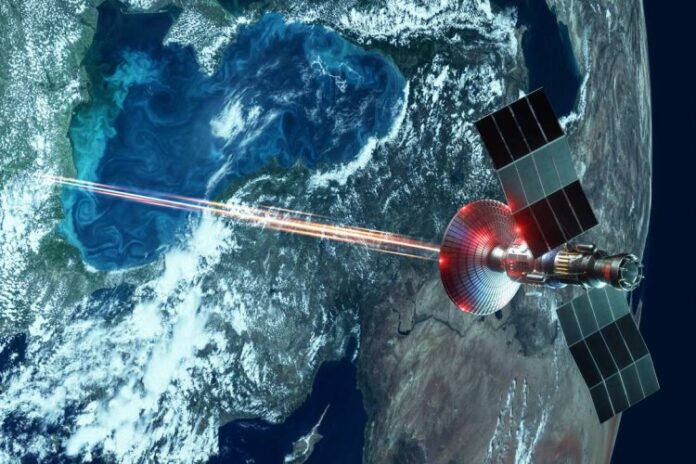
Low Earth Orbit (LEO) satellite communications company, OneWeb, and Kymeta, the communications company making mobile global, today announced the successful testing of the Kymeta u8 based LEO terminal with OneWeb’s LEO satellite constellation.

Kymeta and OneWeb performed a series of LEO satellite acquisition, tracking, and throughput measurements in Toulouse, France. Kymeta plans to leverage these results in the definition of future-proof solutions that are fully integrated and compatible with the rapidly expanding OneWeb system.  

The u8 is the first commercially-available flat panel antenna to interoperate with the OneWeb satellite constellation. OneWeb is working with several new user terminal integrators like Kymeta to explore solutions that meet the needs of Government, Military, Enterprise, Maritime and first responder customers.  The commercially-available Kymeta u8 supports fixed and mobile services enabling choice and redundancy for satellite users, and has demonstrated interoperability with LEO and geostationary (GEO) satellite constellations.

Today, the u8 is the only electronically steered flat panel antenna currently available on the market that is compatible with both LEO and GEO satellite constellations. The device supports fixed and mobile services enabling choice and redundancy for satellite users.

Valery Gineste Senior Director of Technology at OneWeb, commented:

“We are excited about the performance demonstrated in these early pilot test results and pleased to work with Kymeta as a trusted and knowledgeable partner. The u8 will offer another great choice for OneWeb’s end-customers, particularly those with constrained space requirements or who need communications on the move when OneWeb mobility services start to become available from the end of 2022.”

Neville Meijers, Chief Strategy and Marketing Officer at Kymeta, said:

“The collaboration with OneWeb supports Kymeta’s priority mobile markets, and our solution is a natural fit for OneWeb customer needs. Military, government, enterprise, and first responder markets require demanding, mission critical communications, and we can deliver seamless mobile connectivity to those those customers wherever they are in the world.”

The demonstrations in Toulouse showed full-duplex communications between the Kymeta u8 and OneWeb’s satellites. The single aperture antenna achieved downlink and uplink speeds of more than 200 Mbps down and more than 40Mbps up respectively over repeated testing. 

The setup of the antenna and the operations for LEO acquisition and tracking were both rapid and easy. This resulted in the antenna being unboxed, deployed, and with an over the air link-up on OneWeb LEO satellites in times unmatched by existing setups. The u8 also offered very good user experience during beam and satellite handover. The adaptability of the software-driven u8 allows for the improvement of capabilities in a more flexible and ubiquitous way.  

LNG-fuelled vessel approaching 30% of orders

0

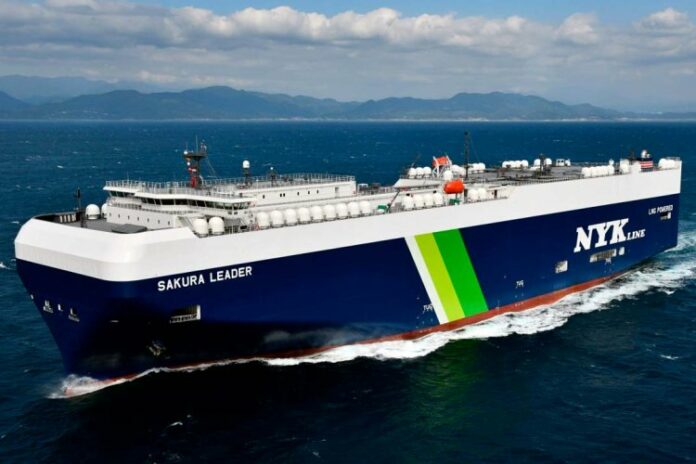
Industry coalition SEA-LNG recognises significant growth in LNG-fuelled vessel orders in 2021. According to the latest report from Clarksons, LNG-fuelled vessel orders are approaching 30% of Gross Tonnage on order, representing a substantial part of shipping’s overall capacity when these vessels are delivered.

2021 has been a banner year for new LNG dual-fuel vessel construction contracts as reported by DNV and others. This trend is expected to continue.  Major deep-sea sectors of the maritime industry are embracing LNG in efforts to reduce both local and global emissions, as LNG-fuelled vessels are one of the only options today that meet the reduced emissions required of environmental finance. It is anticipated that over 90% of the new Pure Car and Truck Carriers (PCTC) that will enter the market in the coming years will be LNG dual fuel. Likewise, containership owners and operators are moving to LNG-fuelled tonnage, with orders for LNG-fuelled liners increasing five-fold since January 2020. Tankers and bulkers are also following suit, with increases of seven-fold and two-fold respectively over the 18-month period.

Owners and operators of deep-sea vessels continue to recognise that LNG is available now, it is proven safe, reduces SOx and particulates to negligible levels, NOx by up to 85%, and GHG emissions by up to 23%. It can also achieve the IMO’s 2030 target of reducing CO2 emissions by 40% compared to 2008 by the use of bio-LNG products as a drop in fuel. This transition to bio-LNG, and eventually synthetic LNG, will enable the industry to meet the IMO 2050 targets. This process utilises established LNG infrastructure without investing in new and costly infrastructure around the globe for unproven fuels.

Peter Keller, Chairman of SEA-LNG said:

“The deep-sea shipping industry understands that while LNG may not be the end game, it is the best starting point to get to net zero. It provides a very clear and achievable plan which starts today.  We know the need is real and waiting is no longer an option.  Recognition for this plan and the pathway forward is continually growing – borne out by the data from both Clarksons and DNV. And the acceleration in uptake of newbuilds fuelled by LNG demonstrates confidence in this pathway through its bio and synthetic cousins.”

Keller concluded:

“The advantage of LNG is that both bio-LNG and synthetic LNG are ‘drop-in’ fuels. There are no compatibility issues, and any ratio combination of bio-LNG, synthetic and ‘conventional’ LNG can therefore be used to fuel a large proportion of the deep-sea merchant fleet. It has the potential to scale incrementally in line with the growing availability of biomass and renewable energy, while delivering significant GHG reductions, starting now.”

Hapag-Lloyd renews and expands Inmarsat Fleet Xpress commitment

0

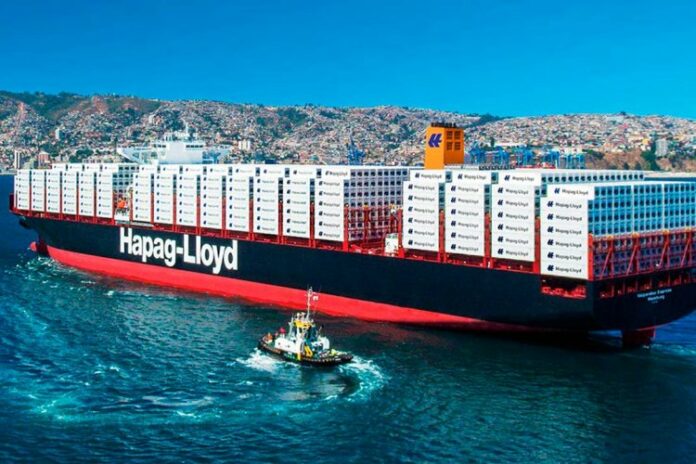
Inmarsat has expanded its agreement to deliver maritime broadband to Hapag-Lloyd, after the global transport group renewed its Fleet Xpress contract for a further five years and committed 33 more ships to the market’s leading very small aperture terminal (VSAT) service.

Under the extended agreement, which now covers 77 ships, the Fleet Xpress hybrid of Ka-band and continuous L-band back-up service replaces Ku-band systems onboard ships merged into the Hapag-Lloyd fleet following the earlier acquisition of United Arab Shipping Company (UASC) in May 2017. Scheduled Fleet Xpress installations enable seamless service migration based on the end of the outgoing supplier’s contract.

Florian Liebetrau, Director IT – Marine & Maritime Operations, Hapag-Lloyd, said:

“The further standardisation of our vessel communication systems is central to our Maritime IT strategy. The outstanding reliability and robustness of Inmarsat’s Fleet Xpress as a product played a key role in our decision to expand our commitment. Hapag-Lloyd has a mature strategy for its vessel connectivity and management which demands systems-wide predictability, reliability, and integration to sustain our global vision for container transport.”

Hapag Lloyd was one of the first major global shipping companies to commit to Inmarsat’s Fleet Xpress following service launch in 2016, transitioning all of its in-house managed ships to Inmarsat’s maritime broadband service for vessel operations and crew connectivity. The five-year contract envisaged expanding data traffic and scalability to handle fleet growth.

Ronald Spithout, President, Inmarsat Maritime, said:

“We are delighted to renew and expand the work we do with one of shipping’s most advanced owners for IT, ship-shore connectivity and digitalisation. Standardisation and integration are pivotal enablers for corporates. This agreement and its expansion to 33 additional ships clearly demonstrate Hapag-Lloyd’s objectives are being met by the reliability, performance, and service support provided by Inmarsat’s Fleet Xpress.”

The new agreement includes the flexibility for Fleet Xpress-connected ships that are managed out of house and linked to Hapag-Lloyd operations to be brought under the same contract terms without renegotiation.

Offering an insight into the major developments in shipping’s digital journey in recent years, Spithout said:

“The average committed information rates of data acceptable to deep-sea container lines today are roughly double the maximum information rates they expected in 2016. On average, a container ship’s monthly data traffic in 2021 is around three and a half times the level experienced five years ago. Inmarsat is meeting this rapid growth in demand for connectivity at sea.”

Vår Energi, Equinor and Horisont Energi cooperate for production of carbon neutral ammonia

0

Bjørn Thore Ribesen, VP Field Development and Projects in Vår Energi, says:

“The project could become an important step in achieving our ambitious climate goals and transition in more carbon neutral direction. Furthermore, as resources owner, we are committed to effective resource management and value creation in the region.”

Vår Energi is the operator of the Goliat and Alke licenses in the Barents Sea. Goliat is mainly an oil field, but also holds natural gas currently being reinjected into the reservoir. Total recoverable resources in Alke and Goliat amount to about 25 billion standard cubic meters of gas.

Ribesen says:

“Vår Energi has explored various alternatives for producing gas resources from these licenses. The potential for an ammonia plant has been included in our studies over the past year. This agreement strengthens our ambitions for a gas evacuation solution in the region.”

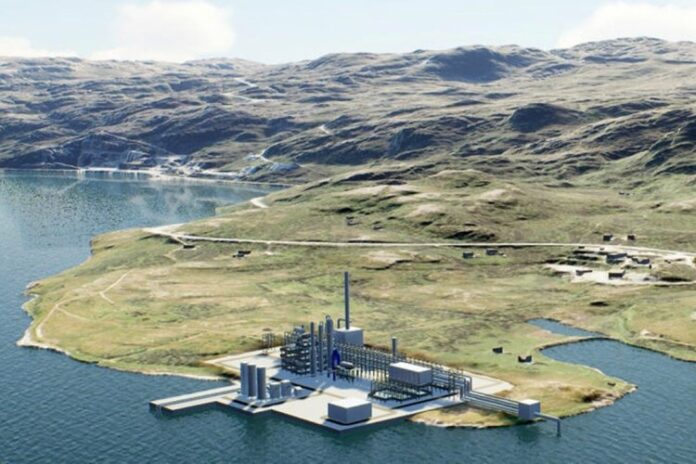
The cooperation agreement builds on Horisont Energi’s concept The Barents Blue Project. The project may entail Alke and Goliat gas resources being brought onshore in Hammerfest via pipeline. There, natural gas will be converted into carbon neutral blue ammonia by capturing and depositing CO2 in reservoirs under the seabed in the Barents Sea.

Ribesen points out:

“In addition to possessing valuable gas resources, Vår Energi also has solid experience and expertise related to the Barents Sea subsurface. This will be essential for developing good solutions for CO2 storage in the future.”

Through the cooperation agreement the partnership aims to mature a technical and commercial solution. This will form the basis for further studies and a potential investment decision.

Ammonia is used on a large industrial scale in areas such as chemical industry and production of artificial fertilizers. Carbon neutral ammonia could potentially become a key energy carrier within maritime transportation in the future.

HAL’s cruise ships to be back in service by late spring 2022

0

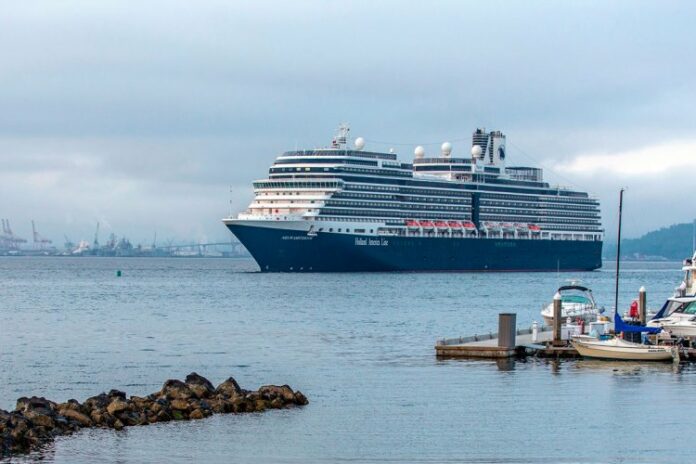
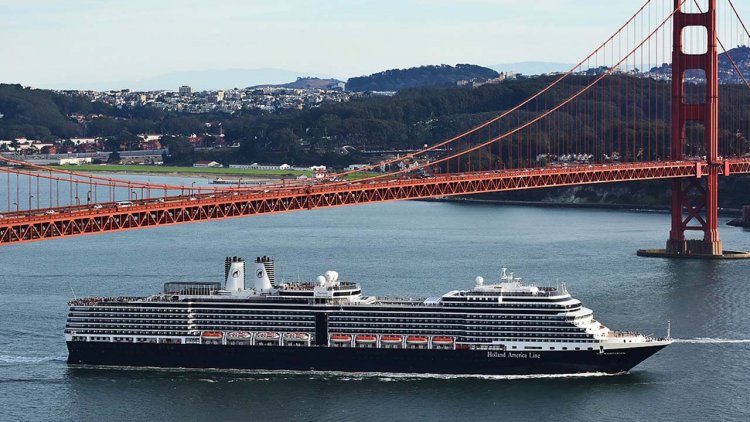
By late spring 2022, Holland America Line will have a complete fleet back to cruising with the restart of operations for Noordam, Oosterdam and Westerdam. Noordam will restart with a March 14, 2022, cruise in Japan; Oosterdam will begin cruising May 1 in the Mediterranean, and Westerdam will return to service May 8 in Alaska.

The ships will join Eurodam, Koningsdam, Nieuw Amsterdam, Nieuw Statendam, Rotterdam and Zuiderdam, which have returned to service or are slated to restart cruising by December 2021. Volendam and Zaandam will return in May 2022.

Gus Antorcha, president of Holland America Line, said:

“We’ve been working intensely to get all of our ships back into service, and to have final restart dates that will complete the fleet is rewarding for everyone who has put their all into making this happen. Our progressive rollout plan allows us to be back in full service over the next several months, and we look forward to welcoming guests on all 11 ships cruising in different regions around the world.”

Holland America Line is working with Japanese authorities to begin cruising for Noordam next spring in Japan with four sailings scheduled. When Noordam sets sail in March, the ship plans to offer three 14-day cruises that deeply explore Japan. 

 
Guests eager to visit the Med next year can embark Oosterdam beginning with the May 1 departure. The ship will sail the season in the region, cruising between Civitavecchia (Rome) and Venice, Italy; and Barcelona, Spain, and Venice; or roundtrip from Venice on seven- and 12-day itineraries. Oosterdam will explore ports in Italy, Greece, Turkey, Montenegro, Croatia, Albania, France, Malta and Israel.
 
When Westerdam returns on May 8, the ship will embark on a season of seven-day Alaska cruises roundtrip from Seattle, Washington. Come September, the ship will cross the Pacific Ocean and begin a season in the Far East offering a variety of 14-day itineraries from Singapore; Hong Kong, China; and Yokohama (Tokyo).

With these restart dates for Noordam, Oosterdam and Westerdam, cruises in Asia, Australia and New Zealand, and South America and Antarctica from January 2022 through the return-to-service departures will be cancelled.

Guests on Westerdam’s cancelled transatlantic crossing departing April 18, 2022, will be moved to a comparable crossing on Nieuw Statendam departing April 17.

Guests on Noordam’s affected Asia departures in 2022 will be moved to the same itinerary in 2023 aboard Westerdam; guests on Oosterdam’s cancelled Australia and New Zealand voyages will be moved to the same itinerary in 2023 aboard Noordam; and guests on Westerdam’s cancelled South America and Antarctica Voyages will be moved to the same itinerary aboard Oosterdam in 2023. Guests also may choose to receive a 100% refund of monies paid to Holland America Line.