1.8 C
New York
Home Blog Page 486

Northland Power and RWE partner to develop offshore wind cluster

0

Northland Power Inc. and RWE Renewables GmbH strengthen their position in the German offshore wind market through an agreement to co-develop a cluster of offshore wind projects in the German North Sea with a total gross capacity of 1.3 gigawatts (GW). 

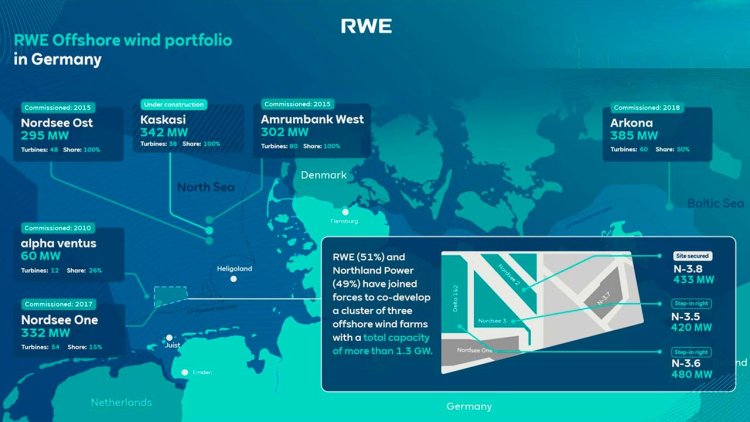
The partners signed an agreement to establish a joint venture company through which they plan to jointly develop, construct and operate the cluster of three offshore wind projects. The cluster will include the 433 MW N-3.8 (Nordsee 2) site, the 420 MW N-3.5 (Nordsee 3) site and the 480 MW N-3.6 (Delta Nordsee) site.

In addition to its position in the N-3.8 (Nordsee 2) and N-3.5 (Nordsee 3) sites, Northland will also gain access to the N-3.6 (Delta Nordsee) site, which RWE has step-in rights for 100% of the lease, while at the same time, RWE will increase its position in the N-3.8 (Nordsee 2) and N-3.5 (Nordsee 3) sites. The size and scale from the formation of the cluster is expected to allow the partnership to unlock synergies. Specifically, the realization of synergies in development and construction costs as well as operating costs are expected to result in enhanced returns for the projects. Northland will also benefit from enhanced offtake opportunities through the formation of the partnership and the cluster to secure offtake agreements for the projects, once complete. The cluster will be in close proximity to the existing 332 MW Nordsee One wind facility in which Northland and RWE are partners already.
Mike Crawley, President and Chief Executive Officer of Northland, said:

“The formation of the cluster aligns with our offshore wind ambitions and strategy of growing our position as a global leader in offshore wind. We are proud to enhance our partnership with RWE to form the cluster to further strengthen our position in the North Sea. This cluster will provide us with significant size and scale and allows us to support the decarbonization efforts in Germany.”

Sven Utermöhlen, CEO Wind Offshore, RWE Renewables:

“Germany has set itself ambitious climate targets, thereby establishing a significant growth potential for renewable energies. Offshore wind power plays a central role in this and is indispensable for supporting the decarbonization of industry in particular. RWE is making its contribution to this and is significantly stepping up the pace here. This includes the collaborative delivery of the 1.3 GW offshore cluster with Northland Power, through which we can achieve considerable synergies to deploy at our new wind farms, while at the same time actively supporting the energy transition in our home market Germany.”

Northland and RWE hold step-in rights for N-3.8 (Nordsee 2) and N-3.5 (Nordsee 3), while RWE holds step-in rights for the N-3.6 (Delta Nordsee) lease. In early November, the partners exercised their step-in rights for N-3.8 (Nordsee 2), allowing them to match the awarded bid in the auction and retain the lease. The auction for the remaining leases, will be held in 2023. For both sites the joint venture holds step-in rights.

Northland will hold a 49 percent interest in the new joint venture with RWE holding 51 percent. The projects will be developed and managed on a joint basis by both parties and are expected to achieve commercial operations between 2026 and 2028.
Sembcorp Marine completes first floating production unit newbuild

0

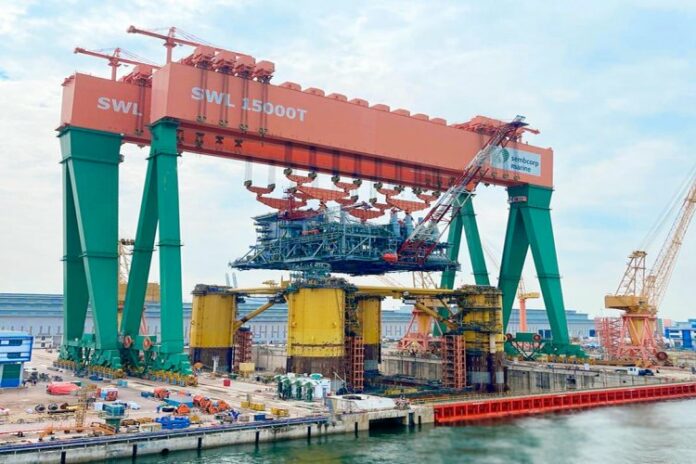
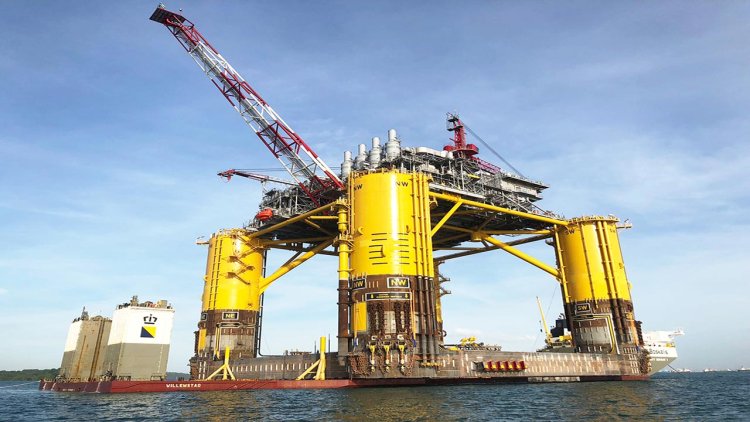
Sembcorp Marine Ltd has successfully completed the Vito Regional Production Facility (Vito RPF) for Shell Offshore.

With the Vito RPF, the Group’s first floating production unit, Sembcorp Marine marks another major milestone in its newbuilding track record.

In 2019, the Group built and delivered a new-generation LNG/MGO dual-fuel semi-submersible crane vessel, the world’s biggest and strongest that can lift 20,000 tonnes.

The integration of Vito’s topside structure with its hull was executed safely and efficiently by a pair of state-of-the-art goliath cranes with 30,000-tonne combined lifting capacity and 100-metre hook height in Tuas Boulevard Yard. The yard’s ability to perform this type of mega-block lifting enabled the Vito topsides and living quarters to be fabricated and assembled at ground level to minimise work-at-height risks, before integration with the four-column FPU hull in a single lift.

The Vito FPU was successfully delivered to Shell on 27 December 2021 and the platform departed Tuas Boulevard Yard for Singapore’s anchorage to prepare for loadout and its sailaway to the Gulf of Mexico in the United States 

Mr Wong Weng Sun, Sembcorp Marine President & CEO, said:

“The successful construction and delivery of Vito FPU is a key milestone in our newbuilding track record and a testament to Sembcorp Marine’s proven expertise and differentiated capabilities in the construction of turnkey projects for the offshore, marine and energy industries.

We would like to thank Shell for their strong teamwork and steadfast support in overcoming the challenges and constraints brought on by COVID-19. We look forward to continuing this partnership with Shell for the Whale Host Facility (WHF).” 

Sembcorp Marine is currently undertaking the construction of a second FPU project for Shell, involving the fabrication and integration of the FPU topsides, living quarters and hull, for the Whale development located in the United States Gulf of Mexico.


LNG-fuelled Salamanca cruise ferry enters Bureau Veritas classification

0

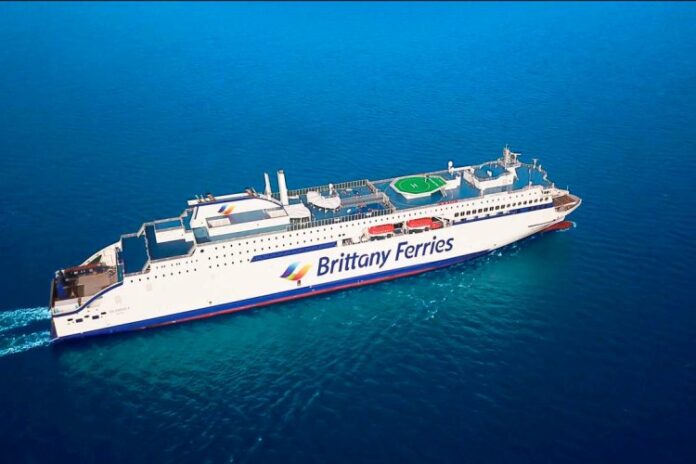
Powered by natural gas, the 1,015-passenger ferry will be operated by Brittany Ferries on its route between Portsmouth, in the UK, and Bilbao and Santander, in Northern Spain. 

The ‘Salamanca’ is the second ‘E-Flexer’ to enter service with Brittany Ferries as part of its commitment to introduce cleaner and more efficient ships to its fleet in the next five years. After its sister ship, Galicia, joined the fleet in December 2020, Salamanca will enter service in March 2022 and will be the first to be fuelled by LNG.

With a length of 214.5 metres, Salamanca has been designed with efficiency and the environment in mind. The vessel is equipped with twin Wärtsilä 12V46DF (dual-fueled) engines, each generating 13,740 kW. Using LNG as a fuel will significantly improve air quality, by virtually eliminating NOx and particulate matter and reducing CO2 emissions. Furthermore, particular attention has been given to its fuel-efficient design, with its long, slender hull and bow, and fine lines delivering excellent seakeeping in all weathers. 

The ferry will be supplied with LNG in the ports of Bilbao and Santander, enabling round trips between Spain and Portsmouth.

Brittany Ferries plans to deploy three more LNG-fuelled vessels in the coming years: Santoña will join the fleet in 2023 on the Portsmouth-Santander-Bilbao route, and two hybrid LNG-electric ships will enter service between France and the United Kingdom in time for the 2025 season. 
    
Arnaud Le Poulichet, Technical Director at Brittany Ferries, said:

“Renewing our fleet stands as one of the pillars of Brittany Ferries’ recovery from the COVID-19 pandemic. It goes hand-in-hand with sustainability, and will see the introduction of a range of cleaner vessels that will enable us to reduce our environmental footprint and deliver on our sustainability targets. Since we embarked on LNG ship projects back in 2012, BV has been by our side, listening and working with us to find technical solutions for the operation of our LNG ferries, as well as for LNG bunkering. Spanning over 40 years, our successful partnership with BV is based on mutual trust, and we look forward to our continued work together.”

Bruno Dabouis, Vice President Southern Europe, North Africa and North America at Bureau Veritas Marine & Offshore, commented:

“BV has been involved in LNG propulsion and bunkering from the very start and has supported the expansion of LNG fuelled vessel capacity, addressing the design and operational requirements to help ensure safety and reliability. We are proud to partner with Brittany Ferries as an environmental frontrunner, and we are looking forward to supporting Salamanca’s operational life on the route across the Bay of Biscay from the United Kingdom to Spain, Brittany Ferries longest route.” 

Neptune Energy’s new digital twins support Dutch New Energy projects

0

Neptune Energy has announced the development of new “digital twins” of two platforms in the Dutch North Sea, which will accelerate work schedules, and reduce costs and environmental impacts by enabling engineers to work onshore. They will also support planning of Neptune’s major Carbon Capture and Storage project in the L10 area.

Leading UK-based 3D technology specialist, Eserv, is creating digitised versions of the L10-A complex’s drilling and production platforms where the large-scale offshore CCS project is planned. 

It follows the development of five digital twins of Neptune-operated platforms in the UK, Norway and elsewhere in the Dutch sector. This will enable engineers and integrity specialists to carry out an estimated 4,100 hours of work from onshore locations, improving efficiency and cutting carbon emissions associated with offshore travel.

Neptune Energy’s Chief Information Officer, Kaveh Pourteymour, said:

“These two new additions will allow us to maximise those benefits while also expanding the use of ‘digital twins’ beyond our traditional E&P activities. We believe their implementation can help accelerate our drive to repurpose existing facilities to deliver large-scale CCS facilities.” 

Progressing with the CCS project in the L10 area would see it become one of the largest CCS facilities in the Dutch North Sea, with the depleted gas fields around the L10-A, L10-B and L10-E areas capable of storing more than 50% of the CO2 volumes being targeted by the Dutch industrial sector.

Lex de Groot, Managing Director of Neptune Energy in the Netherlands, said:

“As the largest offshore gas producer in the Dutch sector of the North Sea, we are well-positioned to help the Netherlands achieve its climate goals by repurposing existing assets for CO2 storage or green hydrogen production. Embedding modern technologies in this way ensures we can plan work, inspect plant equipment and monitor changes in the physical structure, or identify potential issues early and accurately, increasing our chance of success and enabling us to deliver against much shorter timescales.”

Developing digital twins of assets in the UK, Norway and the Netherlands has enabled Neptune engineers to carry out survey, inspection and verification work from onshore. A digital twin of the Cygnus platform in the UK also supported the development of detailed flight plans for drone-based surveys as part of a ground-breaking methane emissions study.

KCC and South32 conclude sustainability linked contract of affreightment

0

KCC Chartering AS, a subsidiary of Klaveness Combination Carriers ASA (“KCC”), and South32 Marketing Pte Ltd, a subsidiary of South32 Limited (“South32”), have signed a six-year contract of affreightment (“COA”) for shipments of caustic soda to South32’s Worsley Alumina refinery located in Western Australia. 

The COA establishes a framework for how KCC and South32 will work together to deliver further reductions in carbon emissions associated with South32’s caustic soda ocean freight to Australia. 

The agreed sustainability framework includes detailed CO2 emission reporting and the establishing of trajectories for annual CO2 reductions targets, and arrangements for how to co-operate to reach the set targets. It further includes an ambition to jointly establish a pathway towards future zero emission freight.  

Klaveness/KCC have serviced Worsley Alumina with four generations of combination carriers on a continued basis for more than 30 years. 

KCC’s CEO Engebret Dahm commented:

“this contract marks another important milestone in the longstanding relationship between South32 and KCC. In this next era of our relationship, together we will address the main challenge of our generation – climate change. We have jointly set ambitions to considerably reduce shipping carbon emissions through building on KCC’s low carbon caustic soda shipping solution, which already today provides South32 with a 30-40% lower carbon footprint than competing tanker vessels.”

South32 Chief Human Resources and Commercial Officer, Brendan Harris, said:

“We are pleased to continue our relationship with KCC and our joint efforts to reduce greenhouse gas emissions in the maritime supply chain. It’s partnerships like these that contribute to the decarbonisation of our value chain and promote the responsible production of commodities needed in a low-carbon world. At South32, we are committed to achieving net zero operational carbon emissions by 2050 and have set a medium-term target to halve these emissions by 2035.”

ExxonMobil makes two discoveries offshore Guyana

0

The Fangtooth-1 well encountered approximately 164 feet (50 meters) of high-quality oil-bearing sandstone reservoirs. The well was drilled in 6,030 feet (1,838 meters) of water and is located approximately 11 miles (18 kilometers) northwest of the Liza field.

The Lau Lau-1 well encountered approximately 315 feet (96 meters) of high-quality hydrocarbon-bearing sandstone reservoirs. The well was drilled in 4,793 feet (1,461 meters) of water and is located approximately 42 miles (68 kilometers) southeast of the Liza field.

These discoveries will add to the previously announced recoverable resource estimate for the block, of 10 billion oil-equivalent barrels. 

Mike Cousins, senior vice president of exploration and new ventures at ExxonMobil, said:

“Initial results from the Fangtooth and Lau Lau wells are a positive sign for Guyana and continue to demonstrate the potential for the country’s growing oil and gas sector, ExxonMobil and our co-venturers in the Stabroek block.”

“The Fangtooth discovery is a successful result of our strategy to test deeper prospectivity, and the Lau Lau discovery adds to the large inventory of development opportunities in the southeast part of the Stabroek block. Both discoveries increase our understanding of the resource, our continued confidence in the block’s exploration potential, and our view that the many discoveries to date could result in up to 10 development projects.” 

Fangtooth was drilled by the Stena DrillMAX, and Lau Lau was drilled by the Noble Don Taylor, which are two of six drillships supporting exploration and development drilling across three blocks operated by ExxonMobil offshore Guyana.

Separately, progress continues on infrastructure for future field development. The Liza Unity floating production storage and offloading (FPSO) vessel is undergoing hookup and commissioning after arriving in Guyanese waters in October 2021. The Unity is on track to start production in the first quarter of 2022 and has a target of 220,000 barrels of oil per day at peak production.

The hull for the Prosperity FPSO vessel, the third project on the Stabroek block at the Payara field is complete and topside construction activities are ongoing in Singapore for planned production start-up in 2024. The Field Development Plan and Environmental Impact Assessment for the fourth potential project, Yellowtail, have been submitted for government and regulatory review.

These new projects continue to drive investment in Guyana’s growing economy. More than 3,200 Guyanese are now employed in supporting project activities, and ExxonMobil and its key contractors have spent more than $540 million with more than 800 local companies since 2015.

The Stabroek block is 6.6 million acres (26,800 square kilometers). ExxonMobil affiliate Esso Exploration and Production Guyana Limited is operator and holds 45% interest. Hess Guyana Exploration Ltd. holds 30% interest and CNOOC Petroleum Guyana Limited holds 25% interest.

Scientists build new atlas of ocean’s oxygen-starved waters

0

Life is teeming nearly everywhere in the oceans, except in certain pockets where oxygen naturally plummets and waters become unlivable for most aerobic organisms. These desolate pools are “oxygen-deficient zones,” or ODZs. And though they make up less than 1 percent of the ocean’s total volume, they are a significant source of nitrous oxide, a potent greenhouse gas. Their boundaries can also limit the extent of fisheries and marine ecosystems.

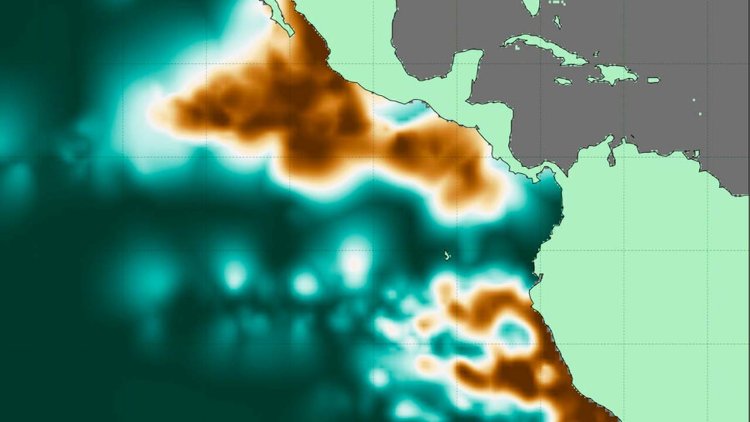
Now MIT scientists have generated the most detailed, three-dimensional “atlas” of the largest ODZs in the world. The new atlas provides high-resolution maps of the two major, oxygen-starved bodies of water in the tropical Pacific. These maps reveal the volume, extent, and varying depths of each ODZ, along with fine-scale features, such as ribbons of oxygenated water that intrude into otherwise depleted zones.

The team used a new method to process over 40 years’ worth of ocean data, comprising nearly 15 million measurements taken by many research cruises and autonomous robots deployed across the tropical Pacific. The researchers compiled then analyzed this vast and fine-grained data to generate maps of oxygen-deficient zones at various depths, similar to the many slices of a three-dimensional scan.

From these maps, the researchers estimated the total volume of the two major ODZs in the tropical Pacific, more precisely than previous efforts. The first zone, which stretches out from the coast of South America, measures about 600,000 cubic kilometers—roughly the volume of water that would fill 240 billion Olympic-sized pools. The second zone, off the coast of Central America, is roughly three times larger.

The atlas serves as a reference for where ODZs lie today. The team hopes scientists can add to this atlas with continued measurements, to better track changes in these zones and predict how they may shift as the climate warms.

Jarek Kwiecinski ’21, who developed the atlas along with Andrew Babbin, the Cecil and Ida Green Career Development Professor in MIT’s Department of Earth, Atmospheric and Planetary Sciences, says:

“It’s broadly expected that the oceans will lose oxygen as the climate gets warmer. But the situation is more complicated in the tropics where there are large oxygen-deficient zones. It’s important to create a detailed map of these zones so we have a point of comparison for future change.”

The team’s study appears in the journal Global Biogeochemical Cycles.

Oxygen-deficient zones are large, persistent regions of the ocean that occur naturally, as a consequence of marine microbes gobbling up sinking phytoplankton along with all the available oxygen in the surroundings. These zones happen to lie in regions that miss passing ocean currents, which would normally replenish regions with oxygenated water. As a result, ODZs are locations of relatively permanent, oxygen-depleted waters, and can exist at mid-ocean depths of between roughly 35 to 1,000 meters below the surface. For some perspective, the oceans on average run about 4,000 meters deep.

Over the last 40 years, research cruises have explored these regions by dropping bottles down to various depths and hauling up seawater that scientists then measure for oxygen.

Babbin says:

“But there are a lot of artifacts that come from a bottle measurement when you’re trying to measure truly zero oxygen. All the plastic that we deploy at depth is full of oxygen that can leach out into the sample. When all is said and done, that artificial oxygen inflates the ocean’s true value.”

Rather than rely on measurements from bottle samples, the team looked at data from sensors attached to the outside of the bottles or integrated with robotic platforms that can change their buoyancy to measure water at different depths. These sensors measure a variety of signals, including changes in electrical currents or the intensity of light emitted by a photosensitive dye to estimate the amount of oxygen dissolved in water. In contrast to seawater samples that represent a single discrete depth, the sensors record signals continuously as they descend through the water column.

Scientists have attempted to use these sensor data to estimate the true value of oxygen concentrations in ODZs, but have found it incredibly tricky to convert these signals accurately, particularly at concentrations approaching zero.

Kwiecinski says:

“We took a very different approach, using measurements not to look at their true value, but rather how that value changes within the water column. That way we can identify anoxic waters, regardless of what a specific sensor says.”

The team reasoned that, if sensors showed a constant, unchanging value of oxygen in a continuous, vertical section of the ocean, regardless of the true value, then it would likely be a sign that oxygen had bottomed out, and that the section was part of an oxygen-deficient zone.

The researchers brought together nearly 15 million sensor measurements collected over 40 years by various research cruises and robotic floats, and mapped the regions where oxygen did not change with depth.

The team mapped the boundaries, volume, and shape of two major ODZs in the tropical Pacific, one in the Northern Hemisphere, and the other in the Southern Hemisphere. They were also able to see fine details within each zone. For instance, oxygen-depleted waters are “thicker,” or more concentrated towards the middle, and appear to thin out toward the edges of each zone.

Kwiecinski says:

“This gives you a sketch of what could be happening. There’s a lot more one can do with this data compilation to understand how the ocean’s oxygen supply is controlled.”

CMA CGM chooses Wärtsilä LNG technologies for 12 boxships

0

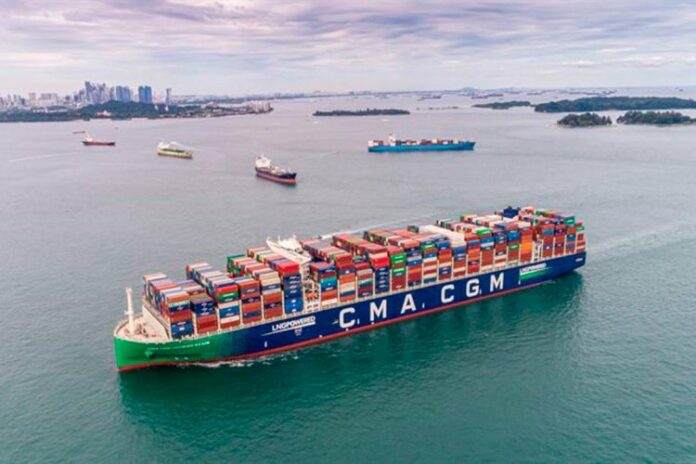
The technology group Wärtsilä has again been selected to supply a broad scope of solutions for new LNG-fuelled container ships ordered by CMA CGM, a global leader of shipping and logistics based in France.

This latest series comprises 12 container vessels to be built in China. Six 13,000 TEU container vessels are being built at the Hudong-Zhonghua Shipbuilding (Group) CO. Ltd, with the other six 15,000 TEU container vessels under construction at the Jiangnan Shipyard (Group) Co., Ltd. The valuable orders were placed in Q3 and Q4 2021.

The Wärtsilä equipment is scheduled for delivery to the yards commencing in 2022, and the first of the 12 vessels is expected to be launched in Q3 2023. Wärtsilä was earlier contracted to supply a similar scope for nine 23K TEU CMA CGM vessels which have been delivered and five 15K TEU whereof 2 vessels are delivered, and 3 vessels are under construction now.

By contracting these ships to operate with LNG fuel rather than conventional marine diesel fuels, CMA CGM is emphasising its support for efforts to decarbonise maritime operations. LNG eliminates almost all air pollutants such as sulphur oxides (Sox: -99%) and nitrogen oxide (NOx: -92%) and particulates (PM10: -91%) and achieves a first step toward decarbonisation. The dual-fuel gas engines on the vessels are already compatible with renewable energies such as biomethane, synthetic methane and e-methane.

Xavier Leclercq, Vice-President of CMA SHIPS, said:

“At CMA CGM we are committed to promoting sustainability in all our operations. We are happy to work with Wärtsilä as they have a similar decarbonisation target and a very broad scope of solutions to offer. The choice of dual fuel gas vessels powered by LNG for our new ships is part of our commitment to build a zero-carbon future.”

Håkan Agnevall, President and CEO, Wärtsilä Corporation, commented:

“This large repeat order for a broad scope of Wärtsilä solutions from a valued customer marks the value of quality, reliability and sharp customer focus. It also highlights our wide range of competences across marine technologies. Both CMA CGM and Wärtsilä have a common strategy in applying LNG solutions to prepare the way towards carbon free shipping.”

The selected Wärtsilä solutions are all designed to deliver high efficiency and environmental sustainability. They include for each vessel five Wärtsilä 34DF dual-fuel auxiliary engines, 60 engines in total, delivered from the joint venture in China, Wärtsilä’s Nacos Platinum integrated control system, propulsion control system,  STC-13 series Sewage Treatment Plants and Fuel Gas Supply System fitted with Wärtsilä’s Operational Performance Improvement and Monitoring (Operim) system. This utilises the latest digital technology to provide data in real-time to allow the system to operate at optimal efficiency at all times, and in all weather and sea conditions.  

New oil discovery close to North Sea Fram field

0

Preliminary calculations of the expected size indicate between 3.3 and 5.2 million standard cubic metres of recoverable oil equivalent, or around 21–33 million barrels of recoverable oil equivalent.

Geir Sørtveit, senior vice president for exploration & production west operations, says:

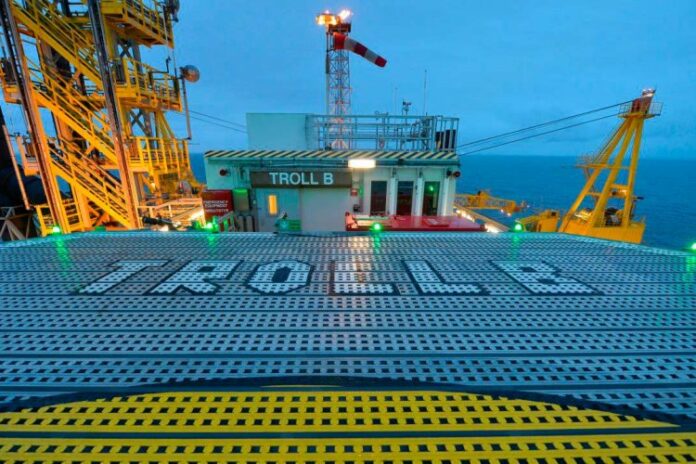
“Our exploration activity is central for our ambitions at the Norwegian continental shelf. We are pleased to see that our success in the Troll- and Fram area continues. We also regard this discovery to be commercially viable and will consider tying it to the Troll B or Troll C platform. Such discoveries close to existing infrastructure are characterised by high profitability, a short payback period and low CO2 emissions.”

After more than 50 years of exploration drilling, there is still much to learn about the NCS underground. Exploration wells provide important data for geologists and geophysicists, continuously developing insight and understanding which in turn form the basis for new exploration opportunities. In parallel new digital tools are introduced.

Several discoveries in the Troll and Fram area during the past few years demonstrate that even mature areas can be revitalised based on new information and modern exploration technology. Toppand is the fifth discovery in the area, and proven resources might exceed 300 million barrels of oil equivalent.

These wells are the second and third exploration well in production licence 630. The licence was awarded in the 2011 Award in Predefined Areas (APA).

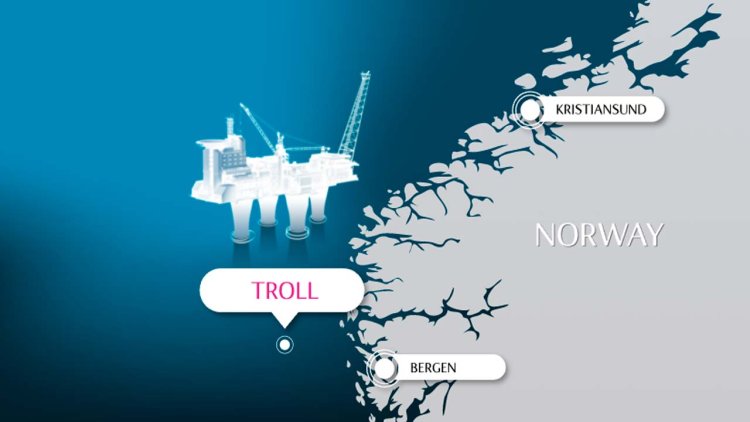
The wells were drilled around 8 kilometres west of the Fram field and 140 kilometres northwest of Bergen.

Well 35/10-7 S encountered an oil column of around 75 metres in the lower part of the Ness formation and in the Etive formation. There were also traces of hydrocarbons in the shale and coal dominated upper part of the Brent Group. A total of around 68 metres of effective sandstone reservoir of good to very good reservoir quality was encountered in the Ness and Etive formations combined.

The Oseberg formation was around 48 metres thick and filled with water. It mainly consisted of sandstone of moderate reservoir quality. The oil/water contact was not proven in the well, but by aid of pressure data it is estimated to be located at around 3303 metres. Sandstone of moderate to poor reservoir quality was encountered in the Cook formation, but the reservoir was filled with water.

Exploration well 35/10-7 A encountered a 60-metre oil-filled sandstone-dominated interval in the lower part of the Ness formation and in the Etive formation. A total of around 67 metres of effective sandstone reservoir of good to moderate quality were encountered in the Ness and Etive formations combined.

The Oseberg formation was around 48 metres thick and mainly consisted of oil-filled sandstone of moderate reservoir quality. An oil/water contact was proven at around 3290 metres, accounting for a 30 m oil column.

Well 35/10-7 S was drilled to a vertical depth of 3509 metres below sea level and a measured depth of 3563 metres below sea level and was completed in the Dunlin Group of early Jurassic rock. Well 30/10-7 A was drilled to a vertical depth of 3370 metres below sea level and a measured depth of 3574 metres below sea level and was completed in the upper part of the Dunlin Group.

Water depth in the area is 354 metres. The wells have been permanently plugged and abandoned. The wells were drilled by the West Hercules drilling rig, which has moved to drill exploration well 6407/9-13 in production licence 1060 in the Norwegian Sea.

Ownership interests in Toppand is 50% Equinor and 50% Wellesley.

UK port investment roars past pre-pandemic levels

0

The figures are being published alongside BPA analysis of new trade data that shows how continued depressed demand for fuel is masking a strong recovery across multiple cargo segments.

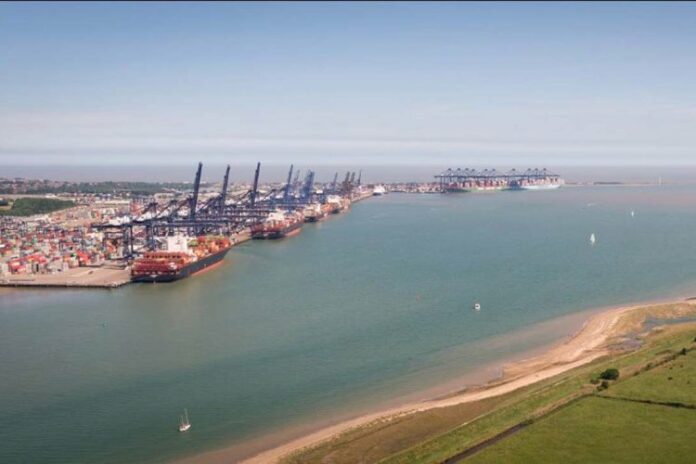
Investment in port infrastructure in 2021 stood at over £1bn, swelled by several big projects such as the £300m fourth berth at DP World’s London Gateway, which will raise capacity at the container port by a third. Significant investment in modernising port machinery, pilot vessels and buildings adds at least another £75m to the total, although this is almost certainly an underestimate as the value or existence much of this investment is not routinely published.

Other notable port infrastructure investments announced this year include:

  • £25m development of the Port of Lowestoft’s Eastern Energy Facility
  • a £50m expansion at the Port of Cromarty Firth
  • Teesport’s new £9.2m bulks terminal
  • the start of a new £60m programme of works to redevelop areas within Pembroke Port
  • £40m of investment in the Port of Leith by Forth Ports

Port investment is spread widely, with container ports, offshore energy, and cruise all seeing hundreds of millions of pounds of private capital pouring in, underlining strong confidence in the sector and its potential for growth. The last industry study in found that port employees at 55% more productive than those in the wider economy and that the ports industry employs over 100,000 people across the UK.