-3.4 C
New York
Home Blog Page 473

Stena Line sets sail to Finland for the first time

0

The vessel Urd left Nynäshamn/Stockholm Norvik Port after an inauguration ceremony with a small group of guests from business and politics. Starting with three departures per week, the link Nynäshamn-Hanko will soon switch to a daily schedule, when the ferry Stena Gothica joins its sister vessel in the beginning of May.

Johan Edelman, Trade Director Baltic Sea North Stena Line, says:

”By Urd’s departure to Finland, we close a gap in the transport network. This new service is primarily an outcome of customer dialogue and market demand. But to bring it to life you also need to be somewhat entrepreneurial, and it requires hard work, a dedicated team and strong commitment to make a new route a success. So far the response has been very positive which shows that we made the right decision.”

The new route marks the next step in Stena Line’s ambition to further expand and strengthen its position in the Baltic Sea. The new service will accommodate the increasing demand of the freight customers for seamless transports in the Baltic Sea and beyond. By extending the network to Finland, Stena Line further improves and expands the most comprehensive, efficient, and integrated ferry network in Northern Europe.

Johan Edelman says:

“It is a straight forward, transport focussed setup, dedicated to establish a floating bridge between Central Sweden and Southern Finland. Reliable ships and flexible, solution-seeking staff are the pillars of Nynäshamn-Hanko. We will carry with us the memory of the inauguration when we are back at our desks to work on further developing the link and fulfilling our aims for growth.”

The first ship on February 1 towards Finnish Hanko sails overnight for a crossing time of 12 hours. Nynäshamn-Hanko is the first ever route from Stena Line connecting Sweden with mainland Finland. 

Fredrik Lindstål, Chair of the Board at Ports of Stockholm, says:

“The commitment of Stena Line in introducing another route from Stockholm Norvik Port emphasises how important the newly built port is for the sustainable supply of goods to Sweden’s largest consumer area. The port has strong intermodal connections to the rest of Sweden both by road and by rail and the location is closer to the fairway than any other ports on the Swedish east coast. It is a success that we together can grow with yet another new route, this time between Sweden and Finland.”

The vessels Urd and Stena Gothica offer a capacity of 1,600 lanemeters and give space to 186 passengers each. The dedicated cargo focus caters for all needs of Stena Line´s freight customers, be it traditional accompanied and unaccompanied units, containers, special cargo or intermodal units arriving by rail.


Opinion: Super-sized offshore wind installations could suffer bottlenecks from 2024

0

Offshore wind turbines are growing in size as technology advances and demand for renewable energy soars but installing them could be a headache for operators as demand will outpace the supply of capable vessels by 2024, Rystad Energy research shows. 

Operators will have to invest in new vessels or upgrade existing ones to install the super-sized turbines that are expected to become the norm by the end of the decade, or the pace of offshore wind installations could slow down.

Wind turbines globally, excluding China, have experienced a growth spurt in recent years, rising from an average of 3 megawatts (MW) in 2010 to 6.5 MW today, with the largest in operation clocking in at 10 MW. Turbines larger than 8 MW accounted for just 3% of global installations between 2010 and 2021, but that percentage is forecast to surge to 53% by 2030.

As the energy transition accelerates, demand for offshore wind turbine installation vessels worldwide, excluding China, will rocket from 11 vessel years in 2021 to almost 79 vessel years by 2030. The need for installation vessels for turbines larger than 9 MW, which was nonexistent in 2019, will grow significantly by the end of the decade and reach 62 vessel years in 2030.

Martin Lysne, Rystad Energy rigs and vessels analyst, says:

“When turbines were smaller, installation could be handled by the first-generation fleet of offshore wind vessels or converted jackups from the oil and gas industry. However, as operators continue to favor larger turbines, a new generation of purpose-built vessels is required to meet demand.”

Unable to install new and larger turbines, the first-generation installation fleet has now transitioned into maintenance and repair services for installed turbines, while operators have upgraded other vessels’ cranes in order to remain competitive in the installations market.

In Europe, Asia (excluding China) and the emerging US market, turbine sizes are ramping up towards 2025 and beyond. Europe’s first commercial 10 MW turbine was installed in December 2021 at Scotland’s Seagreen offshore wind farm by Cadeler’s Wind Osprey. A total of 114 turbines are lined up for the 1.1 GW North Sea project. At the Vineyard Wind development in the US, 13 MW turbines will be installed by DEME’s Sea Installer after its crane upgrade. Jan De Nul’s newbuild Voltaire will debut at the Dogger Bank wind farm in the UK, installing 13 MW turbines.

Cadeler is contracted to install 14 MW turbines at the Sofia wind farm in the UK, and 14 MW turbines will also be installed at the Hai Long development in Taiwan. In addition, 15 MW turbines will be installed at the EnBW He Dreiht project in Germany, while many US developments, such as Coastal Virginia and Empire Wind, are also looking to install 15 MW turbines. Despite installing one 10 MW turbine at the Xinghua Bay wind farm last year, China is expected to lag behind Europe in average turbine size up to 2030. Although China will install some larger turbines in the coming years, most installations are expected to measure between 6 MW and 8 MW.
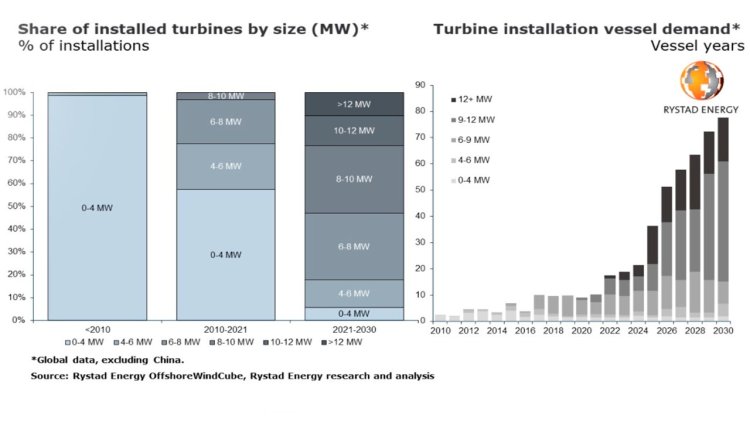
Larger turbine installations require stronger cranes on installation vessels to lift heavier materials higher, and only a handful of purpose-built vessels available worldwide can install 10 MW+ turbines. As a result, many vessels have moved from Europe to China, where lower crane capacity vessels are still in high demand. Jan De Nul’s Taillevent was sold to China last year, and DEME’s Apollo has also recently been renamed and reflagged to work in the Chinese market. Excluding China, demand for 12 MW+ capable installations vessels is set to increase rapidly, taking a larger share of overall demand.

Out of the current fleet of purpose-built vessels, only a handful of units can install 10 MW+ turbines, and none are currently able to install 14 MW+ turbines. This will change towards 2025 as newbuilds start to be delivered and existing vessels get crane upgrades. Fred Olsen Windcarrier, DEME and Cadeler are all planning crane upgrades, with Bold Tern, Brave Tern, Sea Installer, Wind Osprey and Wind Orca all upgrading to 1,600-tonne cranes between 2022 and 2024, with options for other vessels to be upgraded. In addition to the purpose-built vessels, some semisubmersible heavy lift vessels are being proposed for turbine installation, such as Heerema Marine Contractors’ Thialf and Sleipnir.

Generally considered too large and inefficient for installing the smaller turbines of the past, these vessels have instead landed work in the offshore wind industry installing substations and heavy foundations. However, as the size of turbines increases, these units will fit right into the large cranes of heavy lift vessels such as Thialf and Sleipnir. The Thialf will install 27 turbines – each measuring 9.5 MW – at the Arcadis Ost wind farm in the Baltic Sea in 2023, becoming the first floating vessel to install commercial wind turbines of this size. Heerema has said both the Thialf and Sleipnir are already capable of installing 15 MW+ turbines and, with some adjustments, these vessels could even install 20 MW turbines.

Vessels built early this decade are already becoming outdated as turbines grow, making owners reluctant to commit to expensive newbuilds that could be obsolete before they are profitable. The cost to manufacture an installation vessel capable of installing 14 MW+ turbines ranges from $300 million to $500 million, but owners are opting for even bigger cranes in the hope of staying competitive for longer.

A 1,500-tonne crane capacity with 150 meters lifting height is generally considered the requirement to install 14 MW+ turbines. Considering current pending orders, excluding vessels assumed to be operating solely in China, all 11 vessels are installing cranes of more than 2,000 tonnes, with some even opting for 3,000 tonnes. Owners have one eye on the future, with some already stating they will be ready for 20 MW turbines by the end of the decade.

Green ammonia production facility planned in Norway’s municipality of Sauda

0

Hy2gen, an international company specialized in designing, building and operating facilities to produce green hydrogen and green hydrogen-based derivatives, plans to produce green ammonia as a fuel for the maritime sector, in the municipality of Sauda, on the southwestern coast of Norway.

The green ammonia production facility, named Iverson eFuels AS, will be owned by Hy2gen, Trafigura and Copenhagen Infrastructure Partners (CIP), a Danish fund management company focused on renewable energy infrastructure. The consortium plans to invest significant capital in the production, storage and shipping facility which will bring jobs to the local community.

Together with Norconsult, a pre-study was completed in 2021 and the project owners have now started the Front-End Engineering Design (FEED) phase, resulting in a full plan for the construction of the facility by 2023. Following a final investment decision, the commencement of construction is scheduled in the first quarter of 2024, and the facility will be fully operational at the beginning of 2027.

The Iverson project will have an initial electrolyzer capacity of 240 megawatts to produce 600 metric tons of green ammonia per day, with the aim to significantly scale up production in the future. The green ammonia will supply the shipping industry with a zero-carbon alternative marine fuel to traditional fossil fuels.

Gunnar A Gauthun, Hy2gen´s Hub Coordinator in Sauda, said:

“We will produce green ammonia through electrolysis technology, using clean electricity to provide green ammonia for vessels, and thereby contributing to minimize emissions for maritime transportation.”

Rasmus Bach Nielsen, Trafigura’s Global Head of Fuel Decarbonisation, stated:

“Availability of zero emission alternative fuels such as green ammonia is an important pre-requisite to decarbonising the global shipping industry.  We also urgently need global policy-makers to cost neutralise the use of zero carbon fuels through carbon pricing measures to drive demand and enable to radically reduce emissions.”

Cyril Dufau-Sansot, CEO of the Hy2gen Group, affirmed:

“When we started looking for a location for our green ammonia plant in Norway, Sauda emerged as the epitome. The accessibility to abundant green energy from hydropower, a good harbour for exports, an attractive production site, a long regional industry history, and above all, the positive reception of the local authorities and businesses, encouraged us to choose Sauda as the future home of Iverson eFuels AS in Norway.”

When fully operational, the facility is expected to employ about 50 people and create a further 100 indirect jobs. The project team have already started the hiring process and will work together with local authorities to attract qualified personnel.

Asbjørn Birkeland, Mayor of Sauda, declared:

“We believe that this project is extremely interesting. In addition to jobs creation, significant investments will flow in over many years, by virtue of Iverson eFuels AS, Sauda would be put on the map of the energy transition. We wish Iverson eFuels AS all the best in the next steps and look forward to the inauguration of the production plant.” 

Ammonia gas becomes liquefied at minus 33 degrees for storage and transportation. The highest safety regulations shall govern Iverson eFuels’ production, storage and delivery process in Sauda.

The project is supported by Agenda Vest and the UllaFørre fund.

Ballard to supply two marine fuel cells to the liquid hydrogen-powered ferry

0

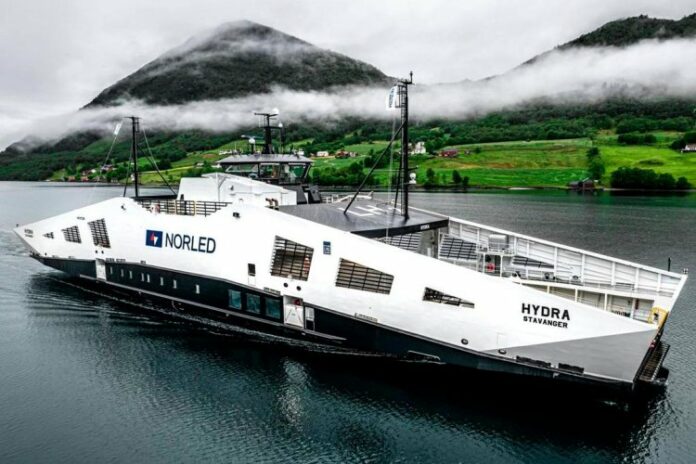
Ballard Power Systems has delivered two, 200 kilowatt (kW) FCwaveTM modules to Norled A/S, one of Norway’s largest ferry and express boat operators. 

MF Hydra will be the first hydrogen-powered ship to be approved by the Norwegian Maritime Directorate, the Norwegian Directorate for Civil Protection and Emergency Planning (DSB) and DNV. The vessel has a capacity of up to 300 passengers and 80 cars and will sail on the triangular route between Hjelmeland-Skipavik-Nesvik in Norway.   

Erlend Hovland, Chief Technology Officer at Norled A/S says:

“This is a pioneering project. It represents a significant turning point for both Norled A/S and the rest of the maritime sector. We believe that hydrogen will play a significant role in the future of zero-emission ships. The delivery of the fuel cell modules from Ballard enables us to continue our work to deliver and operate the world’s first ferry to be fueled by liquid hydrogen.”

The FCwaveTM modules for Norled A/S have been designed, manufactured, and tested at Ballard’s Marine Center of Excellence in Hobro, Denmark. The two FCwaveTM marine fuel cell modules have been approved by DNV, one of the world’s leading classification and certification bodies. The approval of the two modules confirms that the design of FCwaveTM conforms to recognized marine industry quality and safety standards and regulations, as well as international conventions.

Søren Østergaard Hansen, General Manager, Marine and Stationary, Ballard Power Systems Europe A/S adds:

“The handover of the FCwaveTM modules to Norled A/S marks an important milestone for Ballard and demonstrates that hydrogen fuel cells are out of the starting blocks and on the way to lead in zero-emission technologies for the marine industry. Through the experience gained in projects with Norled A/S and other marine partners, we have taken a big step towards the goal of receiving the official Type Approval from DNV, which will certify that the FCwaveTM has met the functional, design, documentation and safety requirements necessary for global marine commercialization.”  

The Norwegian government has introduced its action plan for green shipping with an ambitious goal to reduce emissions from domestic shipping and fishing vessels by 50 percent by 2030. This also included the introduction of requirements for zero-emission cruise ships and ferries in its World Heritage Fjords no later than 2026. This will make the fjords the world’s first zero-emission zone at sea. 

Ocean Infinity expands robotic fleet with 6 additional AUVs

0

Kongsberg Maritime is pleased to announce that Ocean Infinity signed an order for 6 HUGIN Autonomous Underwater Vehicles (AUVs) rated to 3000 metres depth. 

The new vehicles will be mobilised for global operations, enabled by Ocean Infinity’s remote operations infrastructure. The vehicles will integrate as part of the Armada fleet of uncrewed and optionally crewed vessels and will augment the company’s existing AUVs rated to 6000 metres depth.

Dan Hook, CTO of Ocean Infinity, said:

“Lessening the environmental impact of operations at sea is core to our business, and with an expanded fleet of robotics, we’ll have greater capacity to offer sustainable offshore data acquisition services. Using these AUVs as part of our robotic fleet, we’ll be supporting the growing renewables sector with remote data and inspection services.”

Richard Mills, Vice President Marine Robotics Sales with Kongsberg Maritime, said:

“This latest order from Ocean Infinity takes their fleet of HUGIN AUVs to more than 20, making them uniquely placed to deliver data acquisition services at an unmatched scale.” 

“They also include the introduction of some new capabilities enabling operators to interface more easily with 3rd party software and also control adaptive behaviours in response to data collected in-mission.”

Josh Broussard, Director of Sub-Surface Technology at Ocean Infinity, said:

“These new AUVs include special software interfaces, which will allow us to integrate our remote operations technology, mission planning and dive management software, along with a backseat driver allowing the vehicle to react to payload sensor output.  Combined, these technologies will enable greater autonomy, resulting in smart and efficient data gathering.”

Opus Marine names Damen FCS 2710 in Cuxhaven

0

The vessel will begin immediate operations, transporting technicians to wind farms offshore. The crews will enjoy the highest possible comfort onboard a vessel of the latest generation. The vessel was built by Damen Shipyards Group in Antalya.

The Fast Crew Supplier (FCS) 2710 is the first of its kind to fly the German flag. Opus Marine will place the vessel within its existing fleet, consisting of six vessels for the offshore wind industry in the North and Baltic seas. Opus Marine place the order for the vessel in December last year. As a result of Damen’s philosophy of building standard vessels in series, its vessels can be delivered very quickly. The FCS 2710 was already under construction when the order came.

Opus Marine became part of the Zeitfracht Group in mid-2018. The company offers highly specialised transport services for the offshore industry with a wide range of maritime transport services.

Among the company’s fleet Verdi – a Damen FCS 2610. This predecessor of the FCS 2710, of which about 50 ships were built, were a game changer in the offshore wind sector and became a reference in the industry. The FCS 2710 builds on the success of this. It features the same Twin-Axe bow, which ensures safe and comfortable transport even in rough seas. A key feature is that the ship is one metre higher above the water than the predecessor vessel. This means that the FCS 2710 can be used in weather conditions with a wave height of over two metres, significantly increasing the operational window. The FCS 2710 also offers additional deck space, more tank capacity and additional accommodation.

The Damen Shipyards Group was the first address for Opus Marine when it wanted to expand its fleet. This was based on previous experience, says Bernhard Messer, Managing Director of Opus Marine:

“We saw no reason to change this winning team. The goal is to provide our customers with the best crew transfer service – using only the best ships. When the going gets tough, Damen has proven itself to be an impressively reliable partner, characterized by excellent back office services and consistently high-quality technical support.”

Climate change has likely begun to suffocate the world’s fisheries

0

By 2080, around 70% of the world’s oceans could be suffocating from a lack of oxygen as a result of climate change, potentially impacting marine ecosystems worldwide, according to a new study. The new models find mid-ocean depths that support many fisheries worldwide are already losing oxygen at unnatural rates and passed a critical threshold of oxygen loss in 2021.

Oceans carry dissolved oxygen as a gas, and just like land animals, aquatic animals need that oxygen to breathe. But as the oceans warm due to climate change, their water can hold less oxygen. Scientists have been tracking the oceans’ steady decline in oxygen for years, but the new study provides new, pressing reasons to be concerned sooner rather than later.

The new study is the first to use climate models to predict how and when deoxygenation, which is the reduction of dissolved oxygen content in water, will occur throughout the world’s oceans outside its natural variability.

It finds that significant, potentially irreversible deoxygenation of the ocean’s middle depths that support much of the world’s fished species began occurring in 2021, likely affecting fisheries worldwide. The new models predict that deoxygenation is expected to begin affecting all zones of the ocean by 2080.

The results were published in the AGU journal Geophysical Research Letters, which publishes high-impact, short-format reports with immediate implications spanning all Earth and space sciences.

The ocean’s middle depths (from about 200 to 1,000 meters deep), called mesopelagic zones, will be the first zones to lose significant amounts of oxygen due to climate change, the new study finds. Globally, the mesopelagic zone is home to many of the world’s commercially fished species, making the new finding a potential harbinger of economic hardship, seafood shortages and environmental disruption.

Rising temperatures lead to warmer waters that can hold less dissolved oxygen, which creates less circulation between the ocean’s layers. The middle layer of the ocean is particularly vulnerable to deoxygenation because it is not enriched with oxygen by the atmosphere and photosynthesis like the top layer, and the most decomposition of algae—a process that consumes oxygen—occurs in this layer.

Yuntao Zhou, an oceanographer at Shanghai Jiao Tong University and lead study author, says:

“This zone is actually very important to us because a lot of commercial fish live in this zone. Deoxygenation affects other marine resources as well, but fisheries [are] maybe most related to our daily life.”

The new findings are deeply concerning and adds to the urgency to engage meaningfully in mitigating climate change, says Matthew Long, an oceanographer at NCAR who was not involved in the study.

He said:

“Humanity is currently changing the metabolic state of the largest ecosystem on the planet, with really unknown consequences for marine ecosystems. That may manifest in significant impacts on the ocean’s ability to sustain important fisheries.”

The researchers identified the beginning of the deoxygenation process in three ocean depth zones—shallow, middle and deep—by modeling when the loss of oxygen from the water exceeds natural fluctuations in oxygen levels. The study predicted when deoxygenation would occur in global ocean basins using data from two climate model simulations: one representing a high emissions scenario and the other representing a low emissions scenario.

In both simulations, the mesopelagic zone lost oxygen at the fastest rate and across the largest area of the global oceans, although the process begins about 20 years later in the low emissions scenario. This indicates that lowering carbon dioxide and other greenhouse gas emissions could help delay the degradation of global marine environments.

The researchers also found that oceans closer to the poles, like the west and north Pacific and the southern oceans, are particularly vulnerable to deoxygenation. They’re not yet sure why, although accelerated warming could be the culprit. Areas in the tropics known for having low levels of dissolved oxygen, called oxygen minimum zones, also seem to be spreading, according to Zhou.

She says:

“The oxygen minimum zones actually are spreading into high latitude areas, both to the north and the south. That’s something we need to pay more attention to.” 

Even if global warming were to reverse, allowing concentrations of dissolved oxygen to increase, “whether dissolved oxygen would return to pre-industrial levels remains unknown.”

Jan De Nul orders USV for marine and offshore construction

0

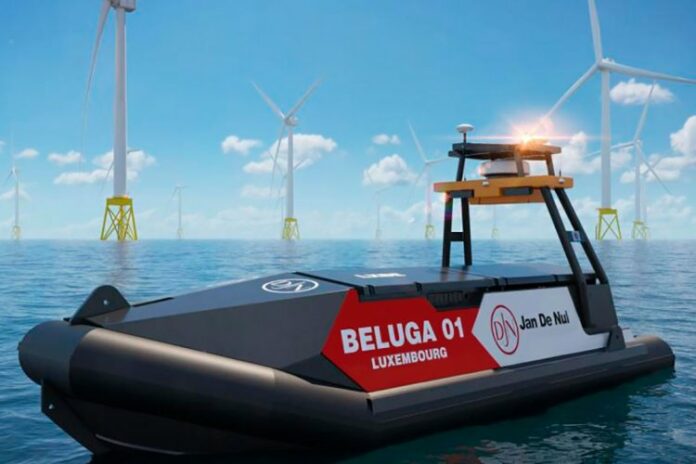
Named Beluga 01, this vessel will sail under the Luxembourg flag and be deployed for worldwide hydrographical and environmental surveys on marine and offshore construction projects. 

Jan De Nul is herewith the first dredging contractor to deploy an unmanned survey vehicle in marine and offshore conditions.

The Beluga 01 is based on the innovative Maritime Robotics’ Mariner class USV, which for years has proven its mobility and seaworthiness for data acquisition under rough conditions. Maritime Robotics’ system convinced Jan De Nul of its well-engineered high-quality design, based on 10 years of experience. It is a user-friendly, cost-effective and low-risk platform for data acquisition at sea as an alternative or adjunct to larger manned vessels. 

By choosing unmanned surveys and by opting for the Mariner class USV, Jan De Nul fully commits to improved safety and operational control during its survey activities, reduced carbon emissions, and more efficient data acquisition. 

Mike Lycke, Survey Manager Offshore Projects at Jan De Nul Group:

“For several years, we have been studying different autonomous systems. Our primary focus has always been to build up our expertise on autonomy for maritime survey operations. The global circumstances in 2020 and a maturing USV market enabled us to take it to the next step and order a turnkey vessel for our marine and offshore projects. We found the perfect partner in Maritime Robotics, a leading provider of innovative unmanned solutions for maritime operations and data acquisition.” 

Eirik Hovstein, COO of Maritime Robotics:

“We are very proud to have been selected as supplier for Jan De Nul Group. We stand for in-house developed systems, with sustainability and autonomy in mind, in close collaboration with civilian, governmental and military partners. We look forward to collaborating with Jan De Nul on the further development of the Beluga 01. Together, we will explore the future of unmanned solutions to ensure safer, greener and more cost-effective data acquisitions at sea.”

The Beluga 01 is equipped with a fully redundant hybrid propulsion system. The prime source of propulsion is a diesel engine that is mechanically coupled to the water jet. Alternatively, the vessel can be operated in full electrical mode. The additional electrical Torqeedo propulsion, installed parallel to the main propulsion, can manoeuvre the vessel in sensitive marine areas.  

There is also a range extender module to top up the batteries which will operate longer than 12 hours. This system has lower emissions than the main engine, which could also be used as an alternator for the batteries. 

Furthermore, the electrical propulsion acts as redundancy for the main engine in case of a failure, or vice versa.

Jan De Nul is committed to cutting carbon emissions. Zero-emission propulsion on future vessels is part of the Group’s strategy. When designing vessels for instance, Jan De Nul takes into account the environmental impact and tackles environmental challenges by focusing on reducing the footprint of its activities, particularly on water and air quality and on the climate. 

The Beluga 01 is capable of operating in up to sea state five, although this usually precludes gathering any useful survey data. The vessel can survive in up to sea state seven. The Beluga 01 only needs 80 cm of water to operate in.

Norside Wind again opts for SMST’s gangway solution

0

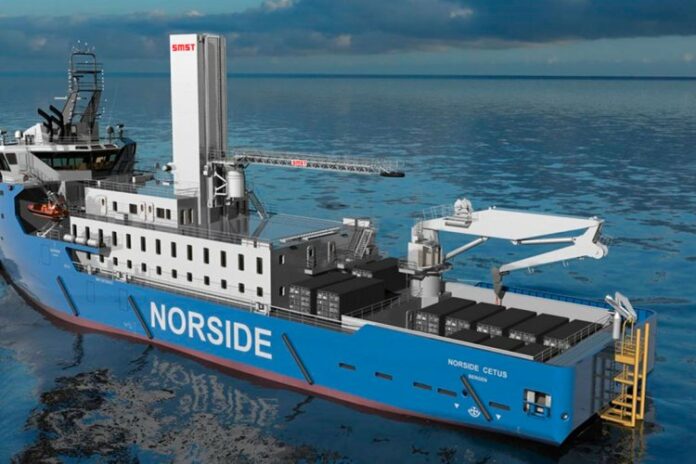
The contract is a continuation of their cooperation that was sealed last year with the first contract for supplying a similar set of walk-to-work equipment, for the freshly converted Norside Supporter.  

Recently, Norside has taken ownership of the Farland, vessel of Ulstein’s PX121 design. The former PSV will be converted into a walk-to-work vessel for the offshore wind industry and will operate under the name ‘Norside Cetus’. 

Hans Martin Gravdal, CEO at Norside Wind AS, says:

“After a successful delivery of the gangway package for the Norside Supporter, we returned to SMST for a second set of their equipment. We believe that their walk-to-work solution complements the PX121 design and increases the performance level of the vessel’s operations. And above all, guarantees safe transfer of crew and cargo.”

The delivery of the gangway, the SMST Telescopic Access Bridge L-Series (TAB-L), with Access & Cargo Tower is planned for Q3-2022. The equipment incorporates important features that ensure deployability in all current and future offshore wind parks. 

Besides using the gangway for walk-to-work operations, it has also a crane functionality for transferring cargo up to 3t. Jelle Dijk, Sales Manager at SMST, says:

“The TAB-L with automation packages and electrical height adjustment system that operates on both sides of the vessel is definitely futureproof. We are very pleased with the trust of Norside and we are confident that with our equipment we can offer them high performance and many safe transfers.” 

Watch: Bulk carrier Julietta D abandoned after colliding with chemical tanker

0

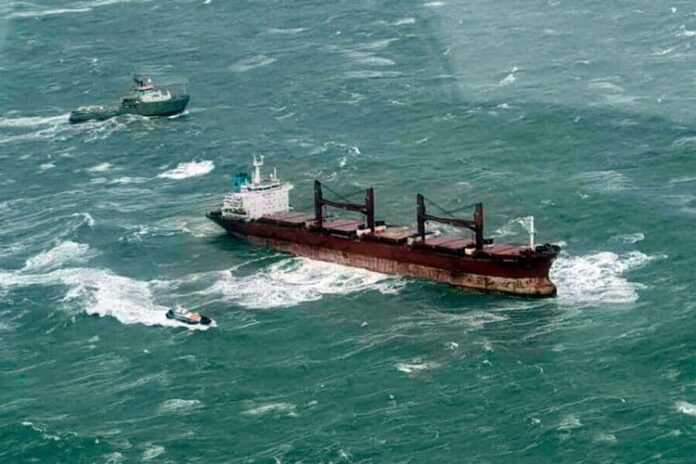
Julietta D, a Maltese-flagged bulk cargo ship, collided with Pechora Star, a Maltese chemical tanker in the anchor bay at IJmuiden, the entryway to the North Sea Canal leading to Amsterdam. By Tuesday morning, the Dutch Coast Guard reported that a pair of Belgian tugs had joined the effort to tow the damaged Juletta D to Rotterdam.

The collision occurred after Julietta D’s anchor failed as storm Corrie whipped up the North Sea. Pechora Star was reported stable and not taking on water, but Julietta D started sinking, causing the rush to rescue the crew.

By 13:30, rescue helicopters – two from the Netherlands and one from Belgium – airlifted all Julietta D crewmembers off the ship.

Julietta D, which had already unloaded its cargo, was then reported rudderless and adrift in Hollandse Kust Zuid wind farm, about 24 km off the Dutch coast, the coastguard reported. It then struck the foundation of a wind turbine yet to be built as the tugs were en route to the ship. 

Source: The Brusselsn Times